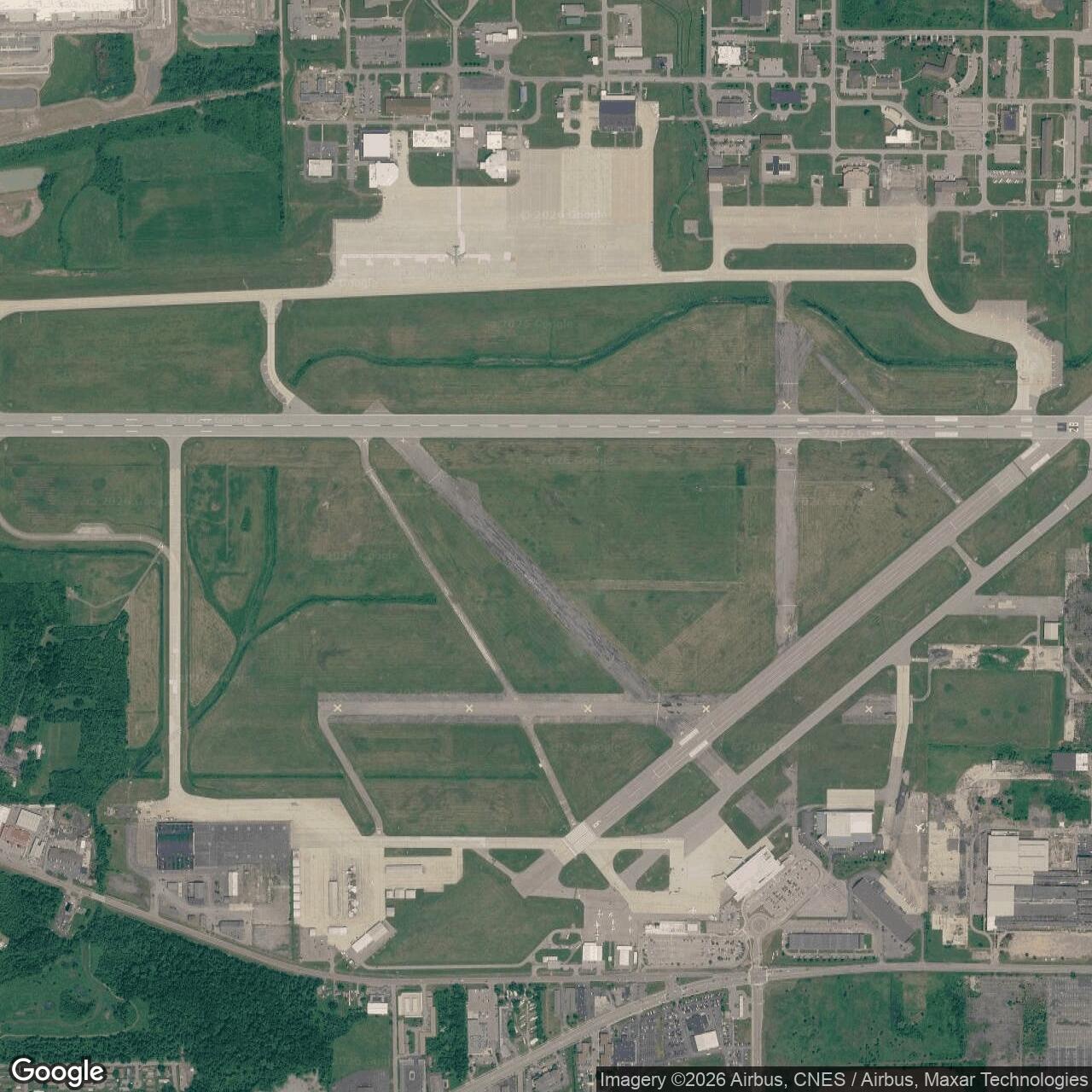
Niagara Falls Air Force Base / Niagara Falls Air Reserve Station, New York
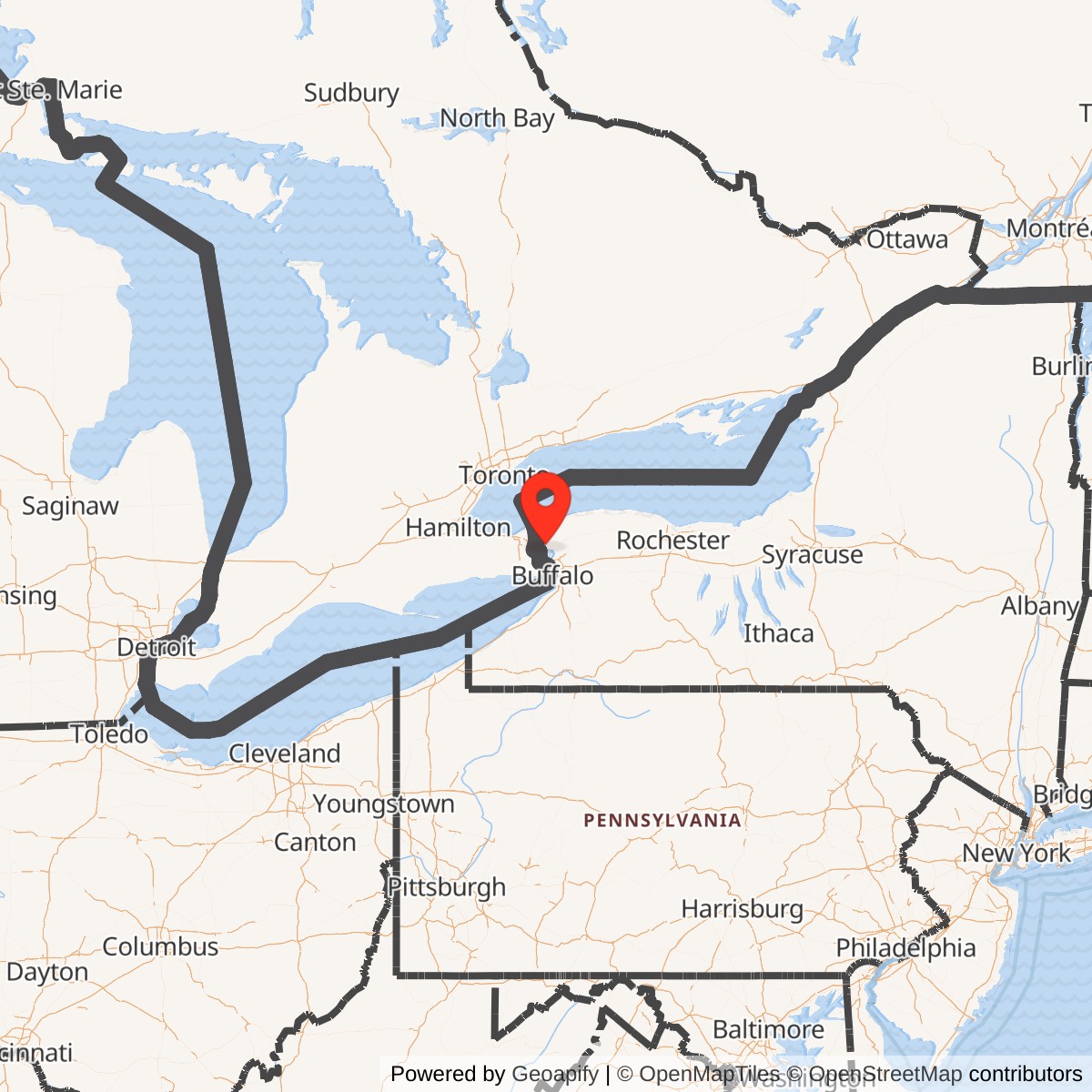
Longitude: -78.9462
Official Base Website: Niagara Falls Air Reserve Station
Current Role: Active KC-135R aerial-refueling and nuclear-support tanker base; MQ-9 Attack Wing mission; aeromedical evacuation, aerial port, logistics, maintenance, Army and MEPS tenants; joint civil-military airport
Niagara Falls is one of the rare American air installations whose military story never settled into a single mission. It began as a municipal airport, became a World War II gateway for Bell-built fighters, hosted postwar Navy and Marine reservists, guarded the northeastern industrial corridor with Air Defense Command interceptors, launched tactical fighters whose crews later fought in Vietnam, carried troops and cargo in C-119s and C-130s, operated KC-135 tankers, and now supports both aerial refueling and remotely piloted attack operations. The active installation is Niagara Falls Air Reserve Station, but the name Niagara Falls Air Force Base correctly identifies its principal active-duty Cold War phase.
The military station and Niagara Falls International Airport share a physical airfield but are not the same administrative property. The Niagara Frontier Transportation Authority operates the public airport and the shared runways. The Air Force controls the adjoining federal cantonment, ramps, hangars, support buildings, and secured operational areas. The airport's current 1,067-acre figure describes the combined civil-airport footprint, not a verified military-only parcel.
The complete site chronology begins in 1928, when Niagara Falls Municipal Airport opened with four crushed-stone runways. During World War II, the Army Air Forces managed military use of the airport and supported Bell Aircraft's adjoining fighter-production and modification complex. After the war, the field supported Naval and Marine Air Reserve activity as Naval Air Station Niagara Falls, Air Force Reserve reconnaissance organizations, and the newly organized New York Air National Guard. Active Air Defense Command units arrived during the Korean War buildup, and the installation was commonly identified as Niagara Falls Air Force Base by the mid-1950s.
Active-duty Air Defense Command host operations ended in 1970. The 914th assumed the host role during the transition to Niagara Falls Air Reserve Station in 1971, preserving the federal Air Force installation instead of closing it. Today the 914th Air Refueling Wing is the Air Force Reserve Command host and operates eight KC-135R Stratotankers. The New York Air National Guard's 107th Attack Wing is the other major flying organization, operating the MQ-9 Reaper mission through the 136th Attack Squadron. The station also supports aeromedical evacuation, aerial port, maintenance, security, civil engineering, communications, logistics, medical, Army Reserve and Army National Guard tenants, and the Buffalo Military Entrance Processing Station.
Municipal Airport Origins
Niagara Falls Municipal Airport opened in 1928 to serve a rapidly industrializing border region connected to Buffalo, the Niagara River, southern Ontario, hydroelectric power, chemical manufacturing, and national transportation networks. Its original four crushed-stone runways reflected the flexible, all-direction layouts common before paved runways and instrument approaches became standard.
The site's location made it attractive for military aviation. It stood well inland from the Atlantic coast, near heavy industry and electrical power, yet within fighter range of the Great Lakes, the Canadian border, and major northeastern cities. The surrounding flat terrain allowed expansion. Rail and highway networks connected the field to Buffalo and to industrial plants across western New York.
Bell Aircraft transformed the surrounding landscape during World War II. Its large Wheatfield plant beside the airport produced more than 10,000 P-39 Airacobras and P-63 Kingcobras and employed tens of thousands of workers at its wartime peak. The plant was an industrial contractor facility rather than a separate flying base, but it and the airport functioned as one production-delivery system. Newly built fighters could be tested, modified, accepted, and dispatched through the airfield without long-distance ground shipment.
World War II Army Air Forces Role
The Army Air Forces assumed wartime responsibility for military operations at Niagara Falls Municipal Airport. The 3522d Army Air Force Base Unit managed the field and coordinated its use with Bell Aircraft. Air Technical Service Command operated a modification and processing mission associated with aircraft leaving the Bell plant. The airport received paved runways, taxiways, aprons, hangars, lighting, and support facilities needed to handle large numbers of military aircraft.
Niagara Falls was not primarily a combat-training base during World War II. Its strategic contribution was industrial and logistical. Bell fighters emerged from the adjacent factory, underwent inspection or modification, and entered the national delivery system. P-39s served in the United States, Soviet Union, Pacific, Mediterranean, and other theaters. P-63s were supplied in large numbers to the Soviet Union through Lend-Lease. The field therefore connected western New York workers and Army technicians to combat aviation across several Allied theaters.
The Bell relationship also linked Niagara Falls to experimental aviation. After the war, Bell's nearby facilities supported the rocket-powered X-1 program, although the historic supersonic flight itself occurred at Muroc Army Air Field in California. This industrial connection should not be confused with an assertion that Niagara Falls Air Force Base was the X-1 flight-test base. It supplied corporate engineering and production expertise within a much larger research network.
Postwar Navy, Marine, Air Force Reserve, and Air National Guard Use
The immediate postwar period was administratively complex. Sources use the name Naval Air Station Niagara Falls for Navy and Marine Reserve activity at the shared airport. Marine Fighting Squadron 441 was later based there as a reserve fighter organization, and Navy reserve attack units also used the station. The naval phase belongs to the same physical site but represents a separate service identity
Air Force Reserve activity began before the independent Air Force formally existed. The 90th Reconnaissance Wing was activated in the reserve at Niagara Falls on December 26, 1946. The 26th Reconnaissance Group and 4th Reconnaissance Squadron followed. These organizations helped build the postwar reserve structure, although the reconnaissance mission ended in June 1949.
The New York Air National Guard established the most enduring local unit lineage. The wartime 339th Fighter Group was redesignated the 107th Fighter Group and allotted to the National Guard. The group organized at Niagara Falls Municipal Airport and received federal recognition on December 8, 1948. Its 136th Fighter Squadron initially flew F-47 Thunderbolts. The Guard mission combined federal readiness with state support and local reserve service, a dual role that remains central to Niagara Falls.
Korean War and Active Air Defense Command
The Korean War accelerated the development of Niagara Falls as a fighter-defense installation. The 136th Fighter-Interceptor Squadron entered federal service on March 2, 1951. Although assigned through commands headquartered elsewhere, it continued standing alert at Niagara Falls. The squadron's mission was continental defense rather than deployment to Korea, but many Guard personnel served overseas and returned with operational experience.
On December 1, 1952, the regular Air Force activated the 47th Fighter-Interceptor Squadron at Niagara Falls to take over the personnel, aircraft, and alert commitment of the federalized 136th as the Guard returned to state control. The active-duty mission gave the airfield a permanent interceptor force. The 76th Air Base Squadron had already provided host support, and the 518th Air Defense Group became the principal active organization on February 16, 1953.
The 518th oversaw the transition from piston fighters to jets. The 47th initially flew F-47s, then received F-86 Sabres, including radar-equipped F-86D interceptors. In August 1955, Air Defense Command's Project Arrow replaced the 518th with the 15th Fighter Group (Air Defense), reviving a distinguished World War II organization. The 15th and 47th defended western and northern New York and adjoining approaches over Ontario. The name Niagara Falls Air Force Base came into regular use during this active-duty era, although the runway system remained a joint-use municipal airport.
The interceptors evolved with the threat. F-86D and data-link-equipped F-86L Sabres gave way to F-102 Delta Daggers. Ground controllers directed the fighters using radar reports and, later, the Semi-Automatic Ground Environment. Niagara Falls aircraft could be scrambled against unidentified tracks approaching the Great Lakes-industrial region or the northeastern United States.
SAGE, Lockport, and the Wider Air-Defense System
Niagara Falls Air Force Base was the flying component of a much larger defense network. Lockport Air Force Station near Shawnee supplied regional radar surveillance through the 763d Radar Squadron. Its radar picture fed the SAGE system and complemented other stations across the Northeast. Fort Niagara had housed Lockport's temporary predecessor radar during the early Cold War, making it an earlier node in the same warning chain.
The SAGE Direction Center and Combat Center at Hancock Field near Syracuse processed radar tracks and coordinated interceptor and missile responses. Data-link-equipped aircraft at Niagara Falls could receive steering information derived from this network. The system shifted air defense from local visual or voice control toward computerized regional command and control.
An adjacent but separately secured Niagara Falls Air Force Missile Site operated CIM-10 BOMARC surface-to-air missiles under the 35th Air Defense Missile Squadron. Construction began around 1959, the squadron activated in 1960, and the BOMARC B weapons became operational in 1961. Hancock Field's SAGE center provided launch-control coordination. The missile complex closed on December 31, 1969.
Air Defense Command discontinued the 15th Fighter Group and 47th Fighter-Interceptor Squadron at Niagara Falls on July 1, 1960. This did not end flying or air defense. The New York Air National Guard carried forward fighter missions with F-86Hs and F-100C Super Sabres, while active host organizations continued to support the base and BOMARC mission. The 4621st Air Base Group later provided active-duty support until its inactivation on March 31, 1970.
Tactical Fighters, Berlin, and Vietnam
The 107th and 136th shifted from interceptor work to tactical fighter training in the late 1950s. The mission now included air-to-ground rocketry, strafing, tactical bombing, and high-altitude interception. F-100 Super Sabres represented the unit's principal 1960s combat aircraft.
The 136th was mobilized during the Berlin Crisis in October 1961. The squadron prepared for possible deployment to Bitburg Air Base, West Germany, but remained at Niagara Falls as tensions eased and returned to state control in August 1962. Even without overseas movement, the mobilization demonstrated how rapidly a Guard unit could be absorbed into federal contingency planning.
The Vietnam War brought the station's most direct combat connection. Mobilized during the Pueblo crisis, approximately 400 members of the 107th and its 136th Tactical Fighter Squadron deployed with F-100Cs to Tuy Hoa Air Base in South Vietnam in 1968. The Niagara airmen served with the 31st Tactical Fighter Wing, flying combat missions until 1969. The deployment transformed a locally rooted Guard organization into an overseas combat force and brought Vietnam experience back to the station.
Air Force Reserve Airlift and the 1971 Transition
The Air Force Reserve established a second lasting lineage at Niagara Falls on February 11, 1963, when the 914th Troop Carrier Group organized with C-119 Flying Boxcars. Its mission included tactical airlift, troop and cargo transport, airdrop, and reserve training. The group operated beside the Guard fighters, creating the dual Reserve-Guard structure that still defines the station.
When active-duty Air Defense Command support ended, the 914th assumed host responsibility. In 1971 the installation became Niagara Falls Air Reserve Station, and the 914th converted from C-119s to C-130A Hercules transports. This was an administrative transition rather than a base closure. Military flying continued without interruption, and the federal station retained access to the shared municipal runways.
The 107th returned to interceptor duty in 1971 with F-101 Voodoos, later flying F-4 Phantoms and F-16 air-defense fighters. The 914th developed a long C-130 lineage, receiving C-130E aircraft in 1986 and advanced C-130H models in the early 1990s. Together, the Guard and Reserve components gave Niagara both fighter defense and tactical mobility.
On July 13, 1985, tragedy struck the Western New York Air Show at the airport. Two Navy Blue Angels A-4F Skyhawks collided during a maneuver. Lieutenant Commander Michael Gershon was killed; the other pilot ejected and survived. The accident was a visiting demonstration-team event rather than a mishap involving an assigned Niagara unit, but it remains part of the airfield's operational memory.
Desert Shield, Desert Storm, and Post-Cold War Operations
The 914th's reserve airlifters entered major contingency operations during the Persian Gulf crisis. More than 300 personnel deployed to the United Arab Emirates for approximately seven months beginning in 1990. The wing supported theater airlift during Operations Desert Shield and Desert Storm, including tactical supply and aeromedical missions. Other Niagara personnel deployed or filled positions left vacant by active units moving overseas.
The 107th did not deploy its interceptor squadron as a complete unit for the Gulf War because it retained a continental air-defense commitment. Guard firefighters, medical personnel, and other specialists nevertheless supported the mobilization. This distinction illustrates the station's dual obligations: overseas contingency support and protection of North American airspace.
After the Cold War, the 107th converted from fighters to KC-135R aerial refueling in 1994. Its tanker crews supported Air Expeditionary Force rotations and operations including Uphold Democracy, Deny Flight, Decisive Endeavor, Noble Eagle, Enduring Freedom, and Iraqi Freedom. The KC-135 also moved passengers and cargo, extending the reach of U.S. and allied aircraft.
The 914th continued C-130 airlift for operations in Southwest Asia, the Balkans, and other contingencies. Its Hercules aircraft also supported humanitarian relief, aeromedical movement, disaster response, and recurring training. Reserve service meant that Niagara's military population combined full-time personnel, civilian employees, contractors, Air Reserve Technicians, Active Guard and Reserve members, and traditional part-time Airmen.
BRAC, Associate Airlift, and MQ-9 Conversion
The 2005 Base Realignment and Closure process reshaped Niagara Falls without closing the air station. The Army Reserve center was selected for closure and replacement within a consolidated Armed Forces Reserve Center. The Air National Guard's tanker mission also changed. Beginning in 2008, the 107th became an associate airlift wing and shared the C-130 mission with the 914th. Reserve and Guard crews, maintainers, and support personnel operated a common aircraft fleet.
The 107th deployed airlift personnel and capabilities in support of operations in Iraq and Afghanistan. It also performed state missions. After Hurricane Sandy in 2012, unit members assisted New York communities with road clearance, traffic control, feeding, and support for displaced residents.
Budget and force-structure decisions produced another transition. The 107th began converting from C-130 airlift to the remotely piloted MQ-9 Reaper mission in 2014, flew its final C-130 mission in December 2015, and was redesignated the 107th Attack Wing on March 15, 2017. Its 136th Attack Squadron operates the MQ-9 mission, supported by operations, command-and-control, air-support, maintenance, communications, security, logistics, civil engineering, and medical elements. MQ-9 operations involve launch, recovery, mission control, intelligence, surveillance, reconnaissance, and strike capabilities that may be distributed across multiple locations. The presence of the 107th at Niagara therefore does not mean every operational sortie physically begins at KIAG.
KC-135 Air Refueling Mission
The 914th simultaneously converted from airlift to aerial refueling. On June 3, 2017, it became the 914th Air Refueling Wing and replaced its C-130s with eight KC-135R Stratotankers. The 328th Air Refueling Squadron operates the aircraft. The wing is assigned to Air Force Reserve Command under Fourth Air Force and is operationally aligned with Air Mobility Command for its mobility mission.
The KC-135 provides fuel to U.S. and allied aircraft in flight, extending range, time on station, and combat reach. It can also transport cargo and passengers. The wing's supporting organizations include operations, maintenance, and mission-support groups; the 914th Aeromedical Evacuation Squadron; the 914th Aeromedical Staging Squadron; the 30th Aerial Port Squadron; maintenance squadrons; and civil engineering, communications, logistics-readiness, force-support, security-forces, medical, and contracting functions.
The wing completed an Initial Nuclear Operational Readiness Inspection in November 2023 and became certified for the nuclear-support mission. This does not make Niagara a nuclear-weapons storage base. It means the tanker wing is trained and certified to support the nuclear deterrence enterprise through aerial refueling and associated readiness requirements.
Current training emphasizes contested logistics and dispersed operations. In 2024, Niagara KC-135 crews practiced Emergency War Order and Agile Combat Employment concepts at former Castle Air Force Base in California and participated in Nordic Response with NATO allies in the High North. In August 2025, nearly 80 Airmen and five KC-135s returned from a four-month overseas deployment supporting global operations. These activities show that Niagara is not simply a reserve weekend field. It is an operational mobility installation tied to current global commitments.
Current Units and Tenants
The 914th Air Refueling Wing is the host organization. Its eight KC-135Rs and supporting units provide air refueling, limited airlift, aeromedical evacuation, aerial-port operations, aircraft maintenance, installation support, and expeditionary readiness. The Air Force's current installation profile identifies Niagara as one of Air Force Reserve Command's reserve host bases and reports more than 1,400 assigned personnel within the 914th workforce categories.
The 107th Attack Wing is the principal Air National Guard tenant. Its major organizations include the 107th Operations Group, 136th Attack Squadron, 107th Mission Support Group, and 107th Medical Group, with additional air-support and command-and-control capabilities. The wing provides MQ-9 surveillance and strike capability for federal missions and maintains readiness for New York state contingencies.
Other current tenants identified by the installation include the Buffalo Military Entrance Processing Station, the Army Reserve's 277th Quartermaster Company, and New York Army National Guard elements including the 2nd Squadron, 101st Cavalry. Tenant rosters can change, and individual Army medical-unit designations cited in older summaries may have reorganized after the Armed Forces Reserve Center opened.
Environmental History and Stewardship
Decades of aircraft maintenance, fuels handling, firefighting, industrial support, vehicle operations, storage tanks, solvents, and munitions-related activity created environmental responsibilities. The Air Force Installation Restoration Program maintains an administrative record for Niagara Falls, documenting investigation and response decisions under federal environmental law. The existence of an active restoration program should not be read as evidence that the entire station is contaminated; it means specific sites and practices have required investigation, monitoring, remediation, or formal closure.
Firefighting foams and fuel systems are among the issues that require particular care at long-used military airfields. Current Air Force environmental management integrates compliance, planning, spill prevention, natural-resource considerations, and mission construction. The 2024 environmental assessment for implementation of the Facilities Operations Capability and Utilization Survey studied four construction projects and expanded herbicide application, showing how present modernization is reviewed alongside environmental obligations.
The former BOMARC area adds a separate Cold War land-use layer. Missile shelters were removed or repurposed, and portions of the former complex became associated with fuel storage and other station uses. It must be treated as a related but distinct historical property when evaluating contamination, demolition, or reuse records.
The station's environmental setting is also shaped by its joint-use relationship. Runways and aircraft operations cross civil and military boundaries. Noise, compatible land use, bird hazards, stormwater, deicing chemicals, fuel systems, emergency response, and development require coordination among the Air Force, Niagara Frontier Transportation Authority, state and local agencies, and surrounding communities.
Built Environment and Present Use
Niagara Falls remains an active military-industrial aviation landscape. The long east-west runway, extended to support military jets and heavy transports, is shared with civilian aviation. The public terminal and civilian businesses occupy the airport side, while secured military aprons, hangars, headquarters, maintenance buildings, fuel facilities, readiness centers, and support complexes occupy the federal and Guard areas.
The current 1,067-acre airport figure is appropriate only as the shared civil-military airport footprint.
Role in the Wider Military Network
Niagara Falls has repeatedly linked local infrastructure to wider defense systems. During World War II it connected Bell's production lines with the Army Air Forces aircraft-delivery network. In the early Cold War it paired interceptors with Lockport's radar coverage and Hancock Field's SAGE direction center. The adjoining BOMARC site added a long-range missile layer, while Fort Niagara and the Buffalo-Niagara Army air-defense system represented earlier radar and Nike missile elements in the regional shield.
The station also connected active, reserve, and Guard forces. Regular Air Force fighter units stood alert beside New York Air National Guard squadrons. Navy and Marine reservists shared the field during the postwar transition. The 914th and 107th later operated side by side and, during the associate C-130 period, shared a common aircraft mission. The current Armed Forces Reserve Center and MEPS continue the multiservice character.
Operationally, the 914th now links Niagara to Air Mobility Command's worldwide tanker system. Its aircraft support fighters, bombers, transports, allies, exercises, deterrence missions, and contingencies beyond the range of any single base. The 107th connects the station to Air Combat Command's remotely piloted intelligence, surveillance, reconnaissance, and strike enterprise. Together they give a northern border station strategic reach far beyond western New York.
Current Status
Niagara Falls Air Reserve Station is active. The 914th Air Refueling Wing is the Air Force Reserve Command host and operates eight KC-135R Stratotankers. The 107th Attack Wing of the New York Air National Guard operates the MQ-9 mission. The station shares KIAG's runways with Niagara Falls International Airport and supports military, civilian, emergency, and community aviation.
Niagara Falls Air Force Base did not close in the ordinary sense in 1971. Active-duty Air Defense Command control ended, the host mission passed to the Air Force Reserve, and the installation was redesignated as an Air Reserve Station. The physical site and federal military mission continued. Its correct status is therefore active, with Niagara Falls Air Force Base treated as a former name and Cold War administrative phase of today's Niagara Falls Air Reserve Station.
Chronology
- 1928 Niagara Falls Municipal Airport opened with four crushed-stone runways.
- 1941 Bell Aircraft's major Niagara-area production plant began wartime operations beside the airport.
- 1942-1945 The Army Air Forces managed military use of the airport through the 3522d Army Air Force Base Unit and supported aircraft modification, acceptance, and delivery associated with Bell production.
- 1946 Naval Air Station Niagara Falls and postwar reserve aviation activity developed at the shared field.
- 1946-12-26 The 90th Reconnaissance Wing activated in the Air Force Reserve at Niagara Falls.
- 1947-10-23 The 26th Reconnaissance Group began its Niagara reserve assignment.
- 1948-12-08 The New York Air National Guard's 107th Fighter Group received federal recognition at Niagara Falls Municipal Airport.
- 1949-06-27 The Air Force Reserve reconnaissance organizations at Niagara Falls were inactivated.
- 1949-07-01 Marine Fighting Squadron 441 was reactivated in the reserve at Naval Air Station Niagara Falls.
- 1951-03-02 The 136th Fighter-Interceptor Squadron entered federal service during the Korean War.
- 1952-12-01 The regular Air Force's 47th Fighter-Interceptor Squadron activated at Niagara Falls and assumed the federal alert mission.
- 1953-02-16 The 518th Air Defense Group activated as the active-duty interceptor and host organization.
- 1955-08-18 The 15th Fighter Group (Air Defense) replaced the 518th under Project Arrow.
- 1955-1960 Niagara Falls Air Force Base operated regular Air Defense Command interceptors including F-86D/L Sabres and F-102 Delta Daggers.
- 1958 The 107th's mission shifted toward tactical fighter operations; SAGE integration expanded regional computerized air defense.
- 1959 Construction proceeded on the adjacent Niagara Falls BOMARC missile complex, and the principal runway was lengthened for modern military aircraft.
- 1960-06-01 The 35th Air Defense Missile Squadron activated for the Niagara Falls BOMARC mission.
- 1960-07-01 The 15th Fighter Group and 47th Fighter-Interceptor Squadron were discontinued at Niagara Falls; Guard fighter and active support missions continued.
- 1961 BOMARC B missiles became operational; the 136th was mobilized during the Berlin Crisis.
- 1961-12-01 A 136th Tactical Fighter Squadron F-100 caught fire on a training flight; the pilot steered it away from populated areas before ejecting near the Niagara Gorge.
- 1963-02-11 The Air Force Reserve organized the 914th Troop Carrier Group at Niagara Falls with C-119 Flying Boxcars.
- 1968-1969 The 107th and 136th deployed F-100s and approximately 400 personnel to Tuy Hoa Air Base, South Vietnam, for combat service.
- 1969-12-31 The Niagara Falls BOMARC missile site closed.
- 1970-03-31 The 4621st Air Base Group inactivated, ending the station's principal active-duty Air Defense Command host phase.
- 1971 The 914th assumed host responsibility, the installation became Niagara Falls Air Reserve Station, the 914th converted to C-130s, and the 107th returned to interceptor operations with F-101s.
- 1982 The 107th began operating F-4 Phantom II fighters.
- 1985-07-13 Two visiting Navy Blue Angels A-4Fs collided during the Western New York Air Show; Lieutenant Commander Michael Gershon was killed.
- 1986 The 914th received C-130E Hercules aircraft.
- 1990-1991 More than 300 members of the 914th deployed to the United Arab Emirates for Desert Shield and Desert Storm airlift operations.
- 1990 The 107th began operating F-16 air-defense fighters.
- 1994 The 107th converted from fighters to KC-135R aerial refueling.
- 2008 The 107th became an associate airlift wing, sharing C-130 operations with the 914th.
- 2012 107th personnel supported New York recovery operations after Hurricane Sandy.
- 2014 The 107th began transitioning from C-130 airlift to the MQ-9 Reaper mission.
- 2015-12 The 107th flew its final C-130 mission.
- 2017-03-15 The 107th was redesignated the 107th Attack Wing.
- 2017-06-03 The 914th became the 914th Air Refueling Wing and transitioned to eight KC-135R Stratotankers.
- 2023-11 The 914th completed its Initial Nuclear Operational Readiness Inspection and became certified for nuclear-support tanker operations.
- 2024 Niagara KC-135 crews participated in Nordic Response and practiced dispersed EWO/ACE operations at former Castle Air Force Base.
- 2025-08-20 Nearly 80 Niagara Airmen and five KC-135s returned from a four-month overseas deployment supporting global operations.
- Present Niagara Falls Air Reserve Station remains an active joint-use Air Force Reserve installation hosting KC-135 aerial refueling, MQ-9 operations, aeromedical, logistics, support, Guard, Reserve, and multiservice tenant missions.