McEntire Air Force Base, South Carolina
Longitude: -80.8015
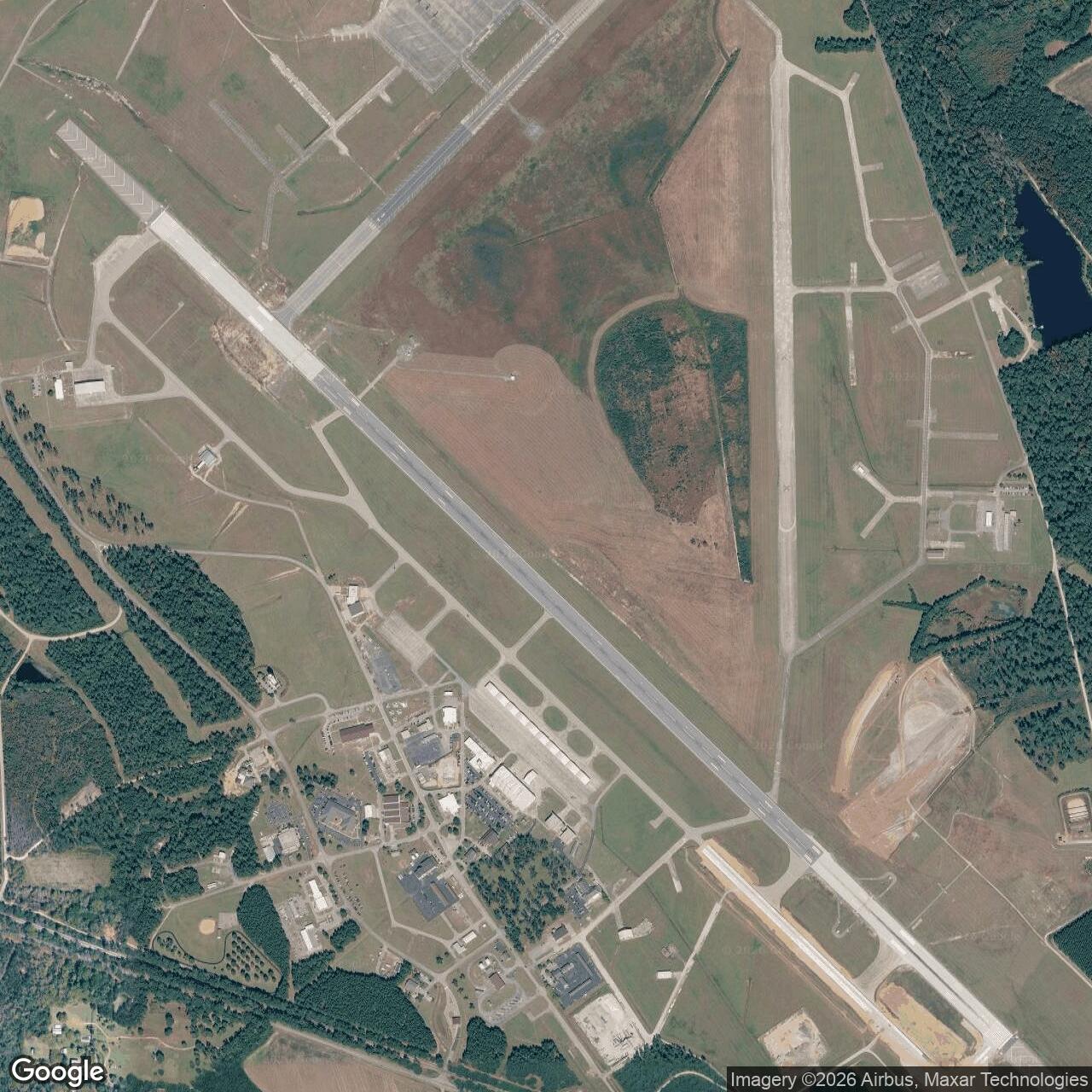
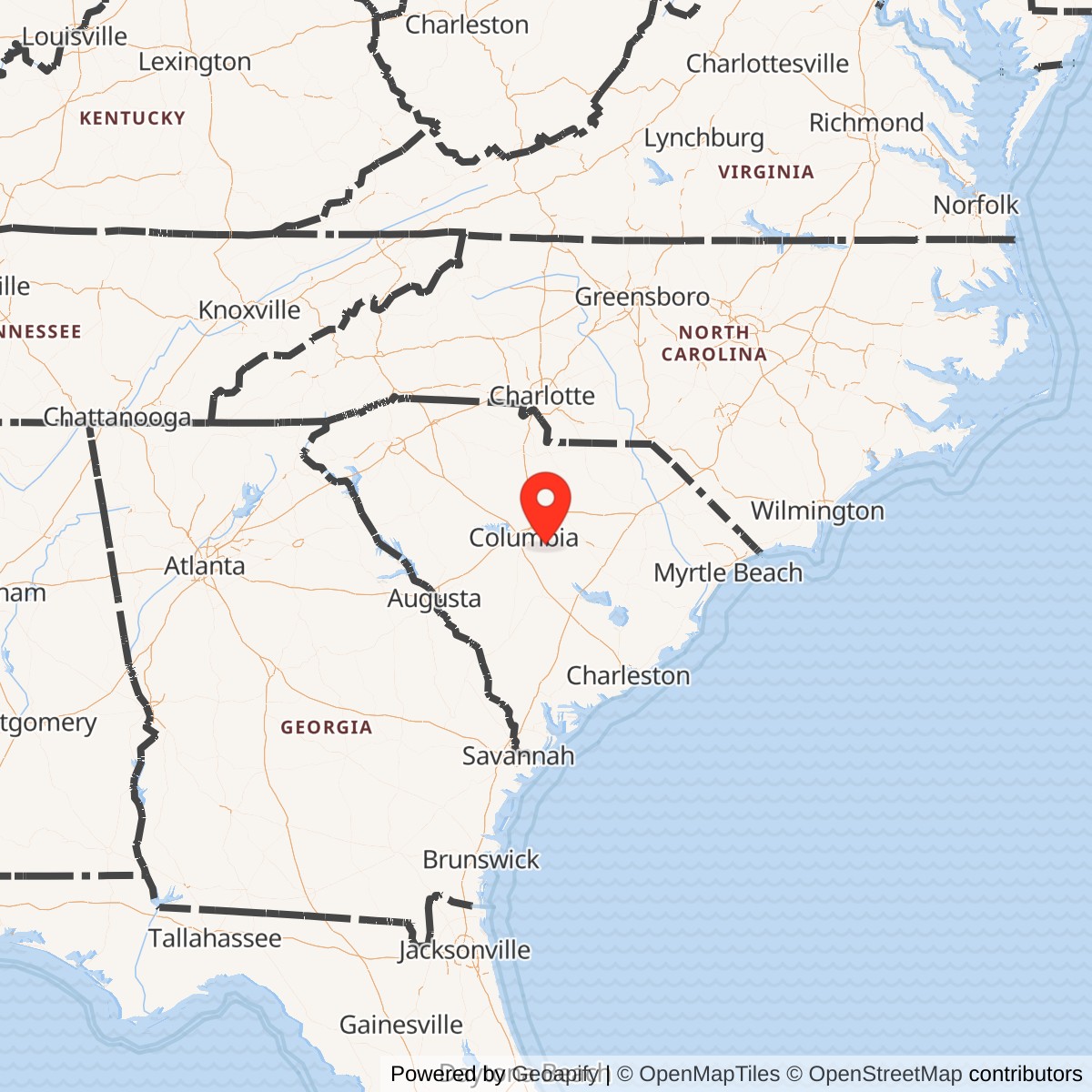
McEntire Joint National Guard Base (JNGB) is a joint military installation in eastern Richland County, South Carolina, approximately 12 miles east of Columbia and 10 miles west of Eastover, spanning about 2,400 acres. It serves as the primary base for the South Carolina Air National Guard (SCANG) and hosts select South Carolina Army National Guard (SCARNG) units, supporting both federal and state missions with over 2,400 personnel, including Soldiers, Airmen, and civilians, and more than 60 military aircraft.
The base is named for the late Brigadier General Barnie B. McEntire, Jr., the first commander of the SCANG and its first general officer. McEntire died in 1961 when he rode his malfunctioning F-104 into the Susquehanna River to avoid crashing in densely populated Harrisburg, Pennsylvania. The base previously was known as Congaree Air Base and was used in World War II as a U.S. Marine Corps training base.
The primary unit of the SCANG is the 169th Fighter Wing. It is comprised of the 169th Operations Group, which include the 157th Fighter Squadron, 245th Air Traffic Control Squadron and the 316th Fighter Squadron (Active Association), the 169th Maintenance Group, the 169th Mission Support Group and the 169th Medical Group. The 245ATCS provides for the base's air traffic control services and possesses the ability to perform this service at other fixed bases and remote sites.
McEntire Joint National Guard Base features a primary runway designated 14/32, measuring 9,012 feet by 150 feet, with a porous European mix (PEM) surface rated at a pavement classification number (PCN) of 34/R/B/W/T, supporting instrument landing system (ILS) approaches and equipped with high-intensity runway lights, approach lighting system with sequenced flashers (ALSF1), precision approach path indicator (PAPI), and runway end identifier lights (REIL) on runway 14.[7] The base also includes a helipad designated 5/23, spanning 2,030 feet by 90 feet on an asphalt surface with a PCN of 50/R/B/W/T and medium-intensity edge lights, designated exclusively for helicopter operations. Runway 18/36, a closed concrete runway measuring 4,500 feet by 150 feet, remains indefinitely unavailable for use.
Construction of Congaree Army Airfield, the precursor to McEntire Joint National Guard Base, began in 1942 as an auxiliary facility to support training operations for the U.S. Army Air Forces near Columbia, South Carolina. The airfield was completed and officially activated on January 31, 1943, under the designation Congaree Army Airfield, with three concrete runways each measuring 4,500 feet in length. Its primary mission during this initial phase was to provide specialized training for dive bombing pilots, assigned to the Third Air Force's III Air Support Command. Units such as the 404th Bombardment Group (Dive), which operated there from July 5 to September 4, 1943, and the 406th Bombardment Group (Dive), active from September 18, 1943, to March 18, 1944, conducted rigorous exercises in precision bombing and tactical maneuvers using aircraft like the A-24 Dauntless and A-36 Apache. These operations emphasized close air support techniques essential for ground troop coordination, though the base remained focused on domestic training without deploying units to combat theaters.
In response to evolving wartime needs, operational control of the airfield shifted on April 30, 1944, when it was transferred from the U.S. Army Air Forces to the U.S. Navy. It was subsequently redesignated and commissioned as Marine Corps Auxiliary Airfield (MCAAF) Congaree on July 10, 1944, falling under the oversight of Marine Corps Air Station Beaufort, with administrative ties to Marine Corps Air Station Cherry Point, North Carolina. The facility then supported U.S. Marine Corps aviation training, hosting Marine Aircraft Group 52 (MAG-52) starting in May 1944, which included four squadrons equipped with F4U Corsair fighter aircraft. Training activities centered on fighter pilot proficiency, including carrier operations simulation, gunnery, and formation flying, to prepare Marine aviators for Pacific Theater deployments. MAG-52 was redesignated as MAG-92 in October 1944 and relocated to Walnut Ridge Army Airfield in Arkansas, but auxiliary operations continued at Congaree until the war's end.
Following the end of World War II, the Congaree Army Air Field was deactivated in late 1945 and transferred to civil control in 1946, reverting largely to its pre-war agricultural use as farmland while awaiting reassignment. The South Carolina Air National Guard (SCANG) was federally recognized on December 9, 1946, with its inaugural muster held that evening at the site, drawing 14 officers and 36 enlisted personnel under the command of Lt. Col. Barnie B. McEntire Jr. The base supported initial Guard operations starting in 1946, with the unit's first field training exercise held from August 31 to September 14, 1947. Initial equipment consisted of P-51 Mustang fighters, reflecting the Guard's emphasis on maintaining post-war pilot proficiency amid limited resources and veteran recruitment challenges.
In the early 1950s, the 157th Fighter Squadron-SCANG's core flying unit-underwent significant modernization to align with emerging Cold War threats. Aircraft transitioned from P-51s to F-86 Sabres by 1953 and F-80 Shooting Stars by 1954, enhancing interception capabilities with jet propulsion and all-weather radar. This period included the unit's federal activation on October 10, 1950, in response to the Korean War, when the entire SCANG was mobilized for 21 months as the 157th Tactical Reconnaissance Squadron, re-equipping with RF-80 jets and deploying personnel to Europe for intelligence missions. Four pilots, including Capt. Eddie R. Elkin, volunteered for combat in Korea, underscoring the Guard's rapid integration into active-duty operations despite its nascent status. The squadron returned to state control on July 9, 1952, resuming training at Congaree with upgraded F-86L interceptors equipped for ground-controlled interception.
Further Cold War expansions in the 1960s saw the adoption of supersonic aircraft, including the F-104 Starfighter in 1960-the first such jet for an Air National Guard unit-and the F-102 Delta Dagger by 1963, bolstering air defense roles amid heightened tensions. These upgrades were led by Brig. Gen. Barnie B. McEntire Jr., SCANG's inaugural commander since 1946 and the first Guard pilot qualified on the Mach 3-capable F-104. Tragically, McEntire perished on May 25, 1961, when his F-104 suffered engine failure near Harrisburg, Pennsylvania; he deliberately crashed into the unpopulated Susquehanna River to avert civilian casualties. In his honor, Governor Ernest F. Hollings renamed the facility McEntire Air National Guard Base on November 10, 1961, recognizing McEntire's foundational leadership and sacrificial service.
In the early 2000s, McEntire Air National Guard Base underwent significant structural changes to enhance its role as a joint facility, culminating in its redesignation as McEntire Joint National Guard Base in 2005. This redesignation, authorized by Congress as part of the National Defense Authorization Act for Fiscal Year 2006, reflected the integrated presence of both South Carolina Air National Guard (SCANG) and South Carolina Army National Guard (SCARNG) units, enabling more efficient shared use of resources and facilities. The transition was driven by the 2005 Base Realignment and Closure (BRAC) Commission's recommendations for expansion, which aimed to consolidate Army aviation operations at the site to support joint training and rapid response capabilities.