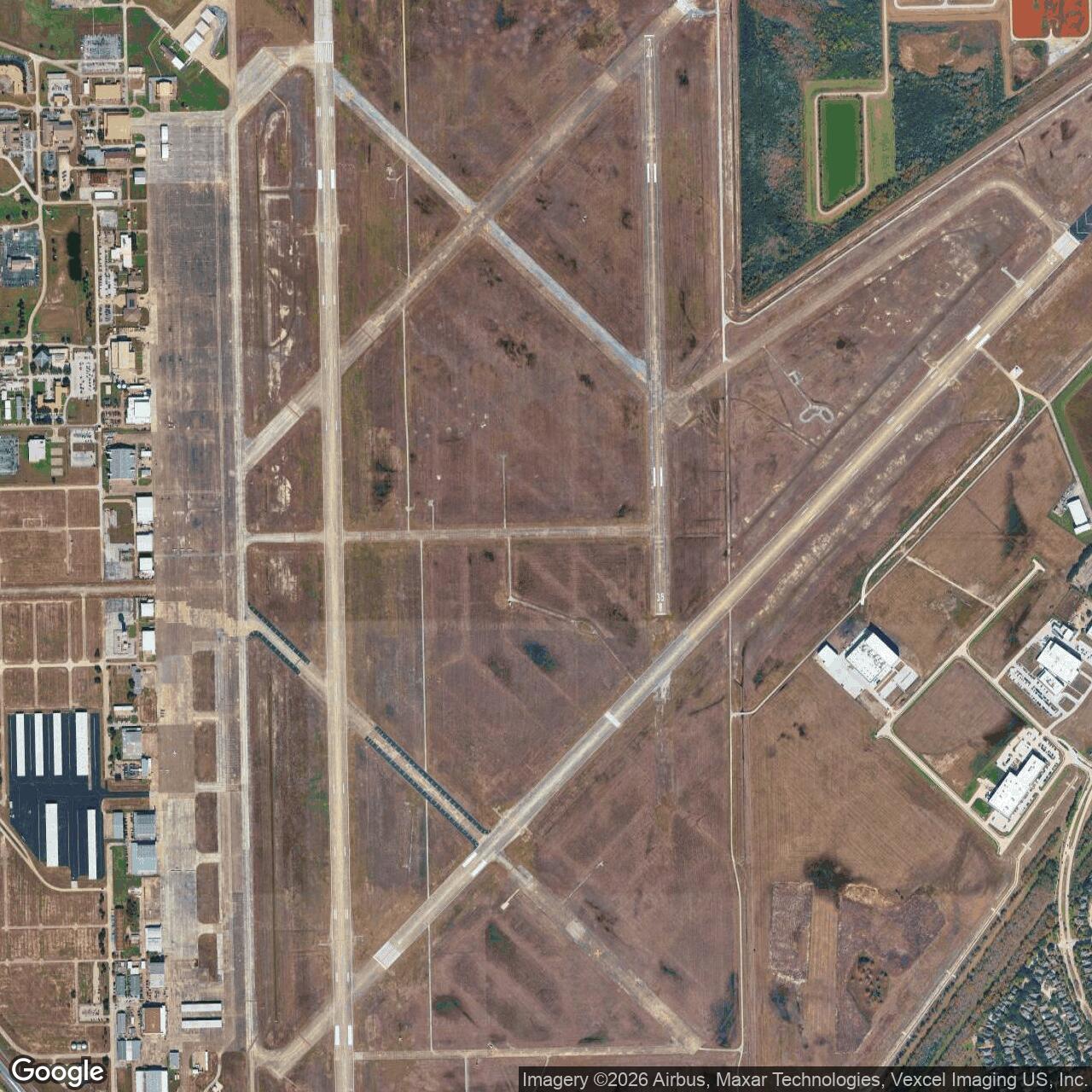
Ellington Air Force Base, Genoa Texas
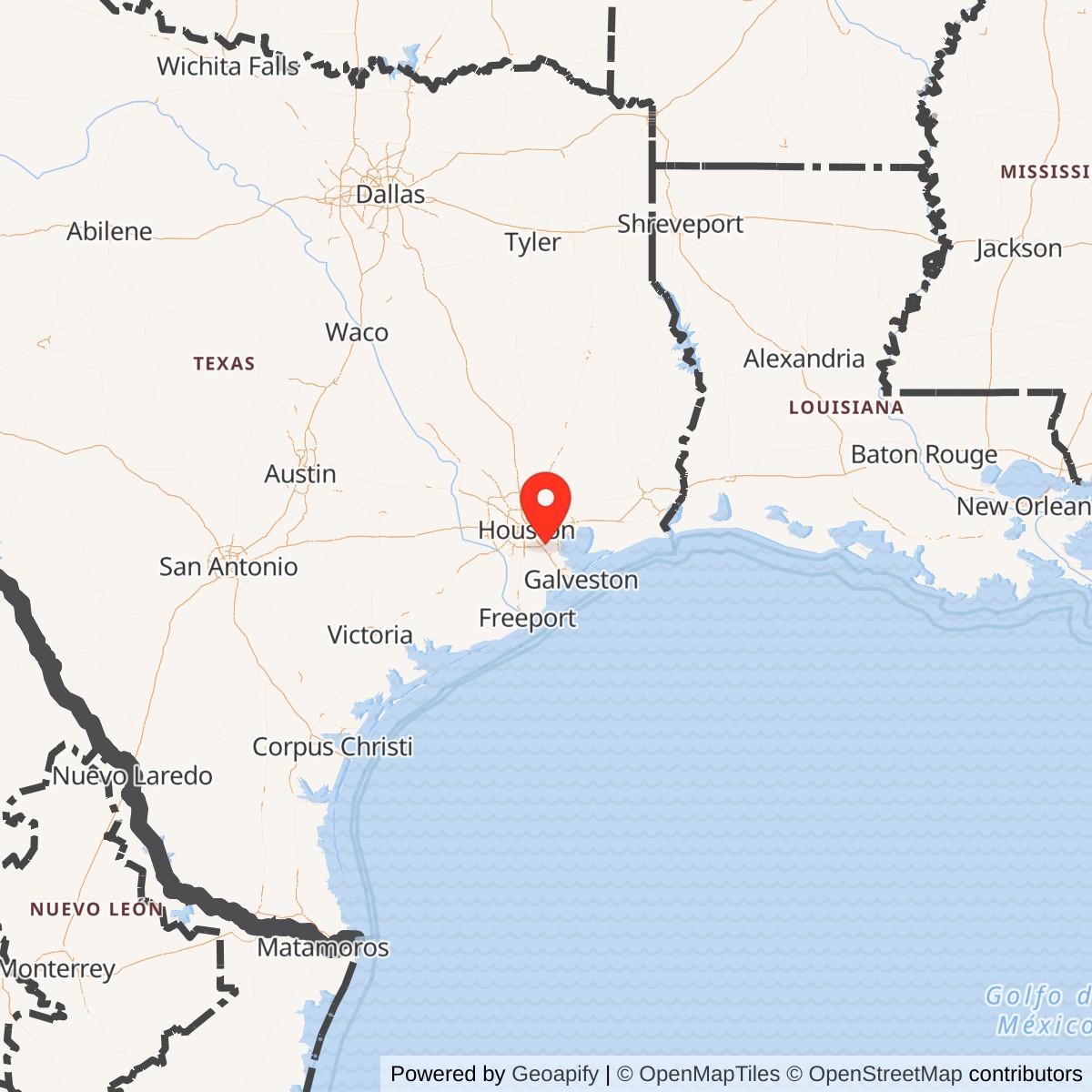
Longitude: -95.1588
Ellington Field History 1917-1920
In August 1914, Europe erupted into a war that soon engulfed the entire continent. By the next year a vast system of trenches stretched across France. Though trench warfare was characterized by a static defensive struggle, the airplane was used during the conflict as an offensive weapon. In 1917, the United States entered the war. The United States needed hundreds of pilots to fulfill its commitment to the Allies. To meet this demand for pilots, the War Department built numerous pilot training bases throughout the ration.In 1917, the U.S. government purchased 1,280 acres of land from Dr. R. W. Knox and the Wright Land Company 25 miles south of Houston near Genoa, Texas. War Department officials selected the Houston area because of the weather conditions necessary for flight training. Soon after construction began, the Secretary of War announced that the new base would be named after Lt. Eric Lamar Ellington, an army aviator who was killed four years earlier at North Island Army Aviation School in California.
The American Construction Company, awarded a contract to build the airfield, began construction in September 1917. At one point during construction of the airfield, civilian workers went on strike. To avoid delays caused by labor problems, U.S. soldiers from nearby Camp Logan were brought in to continue work on the airfield. The labor disputes were settled and the striking workers returned to work. Draft mules were used to pull equipment to clear and smooth the earth to lay concrete foundations. Within two months, most of the buildings on the base were completed. Dozens of wooden buildings served as headquarters, maintenance, and officers' quarters. Enlisted men had to bivouac in tents. Finally, tall prairie grass near the hangers was cleared of obstacles and mowed short for runways.
In November, the 120th Aero Squadron was transferred from Kelly Field to Houston. Only a few U.S. Army Air Service aircraft arrived with the squadron. Most of the Curtiss JN-4 Jennys were shipped in wooden crates by railcar. In December, the first planes from Ellington Field flew over Houston for a benefit for the American Red Cross. A flight of ten JN-4s took off from grass runways and followed the interurban tracks stretching north from Genoa to Houston. Throngs of men, women, and children watched in amazement as the JN-4s flew overhead. The roar of the aircraft was almost drowned out by the wail of sirens and factory whistles as the planes passed over. As the planes circled the city, they dropped paper flyers for the American Red Cross. Next. the formation flew to Camp Logan and then turned south toward Galveston Island. The entire flight took about an hour.
The base was finished by December, but Ellington Field had a chronic shortage of trained personnel. With only 220 men stationed at the airfield, Army officials needed men with a variety of skills, such as painters. draftsmen, cooks, motorcycle drivers, mechanics, and accountants. Personnel problems were so grave that the War Department allowed officials at Ellington to use the "direct enlistment" of men to fill the ranks; this allowed a local man to enlist in the U.S. Army but report directly to Ellington Field.
During the First World War, Ellington Field served as a base for advanced flight training for the United States Army Air Service. In 1917, flight training occurred in two phases: primary and advanced. Primary training took eight weeks and consisted of pilots learning basic flight skills under dual and solo instruction. Flight cadets were then transferred to another base for advanced training. At advanced training bases cadets learned flying techniques that made them proficient pilots. Advanced training took up to six weeks of classroom and flight instruction. Pilot training included practice on bombing and gunnery ranges. In 1918, Ellington Field's gunnery and bombing ranges were at a small peninsula jutting into the Gulf of Mexico just off Sa1 Leon, Texas.
Because of the lack of military pilots in 1917, the U.S. Army Air Service relied on civilian pilots to help train cadets. Civilian pilots often had more flight experience than military aviators. During the war, Ellington Field had seven civilian instructors: W.F. Sullivan, H.B. Crewdson, E.W. Cleveland, G.K. Hood, W.A. Pack, O.W. Hoover, and E.H. Lee. Upon graduation, a flight cadet would be christened a military aviator. After graduation, an aviator was shipped to Europe for more training and assignment to a combat squadron.
For the first months of operation, Ellington Field had no pilot fatalities. Within the year, however, this record changed for the worse. By August 1918, Ellington Field recorded the most pilot fatalities of the 18 U.S. Army Air Service training bases in the United States. By 1918, however, Ellington Field was also known throughout the nation as an airfield of "firsts." Ellington had the first camp newspaper, the first gunnery and bombing ranges, the first "canteen girls," and the first aerial ambulance in American military history.
By January 1919, the future operational status of Ellington Field was unknown. Many local officials speculated that the U.S. government would keep Ellington Field open because of the outstanding combat record established by Ellington-trained pilots in Europe. Locals also pointed to the optimal weather conditions in south Texas area for flight training. In 1920, Ellington Field was deactivated as an active duty airfield, however, and a small caretaker unit was assigned to the facility for administrative reasons. In the future the only flight activity at Ellington Field would be Army pilots flying from Kelly Field practicing touch and go landings. With the return to a peacetime economy, military training facilities such as Ellington Field were deemed unnecessary.
Ellington Field and the U.S. Army National Guard, 1923-1928
Though the U.S. Army National Guard can trace its lineage back to the American Revolution, the modern National Guard is a recent development. The direct ancestry of the modern National Guard was the 19th century state militia. which augmented the regular Army. After the Spanish-American War, the U.S. Army began to reevaluate the role of the militia. The militia's performance in the Spanish-American War was mixed. Because of poor training and lack of equipment, many militia outfits did not fare well in combat.Another problem for the U.S. Army was the militia's uncoordinated nature. The strength level of individual militia units was not uniform. This lack of knowledge hindered the proper deployment of troops. By the turn of the new century, the U.S. military was swept with a wave of reform. Reformers called for the establishment of a well-trained and equipped reserve to augment the regular Army in times of national emergencies. In 1903, Congress passed the Dick Act to replace the state militias with a new National Guard system. The Dick Act required each state or regional groups of states to form National Guard units with prescribed levels of combat-trained troops.
After the passage of the Dick Act, Texas militia units combined to form the U.S. 36th Infantry Division, which the War Department federalized on July 18, 1917. The division actually consisted of men from both Texas and Oklahoma.
After arriving in France in August, the National Guardsmen began to train for combat. While training, the division was attached to the French Fourth Army. The U.S. 36th Division fought with distinction in the vicinity of the Somme River. When the war was over, the division was deactivated and it returned to the United States.
Combat during the First World War had a dramatic effect on the U.S. Army. On the European battlefield, American soldiers were exposed to new military technology. Advancements in weaponry such as chemical warfare, tanks, and aircraft altered the views of some American military planners. The experience also had an impact on the way the military viewed the National Guard system. Though the National Guard was supposed to establish a pool of well-trained divisions, these units often needed additional training before being introduced to combat.
Because of these problems, many military leaders pushed for the reorganization of the National Guard system. In 1920, Congress passed the Reorganization Act to allocate additional funds to the U.S. National Guard for training and equipment. Throughout the early 1920s, the newly reorganized National Guard began adding aviation squadrons to their infantry divisions.
The unofficial lineage of U.S. National Guard aviation can be traced back to New York. In 1908, the New York National Guard had several Signal Corps officers interested in aeronautics who established an aviation squadron. After three years of experimenting with balloons and hand-built aircraft, the squadron received its first aircraft from the Curtiss Aircraft Company.
National Guard aviation units received little or no financial assistance from state or federal coffers. In most cases, individual members provided their own aircraft and funds for maintenance. When the United States entered the First World War, the War Department decided not to activate any of the National Guard air units. All U.S. Army Air Service aviators during the European conflict came from regular Army air squadrons.
The Reorganization Act of 1920 was the genesis of the first officially sponsored National Guard aviation units. When the military reorganized the National Guard, the U.S. Army Air Service pushed for the formation of air units within all National Guard divisions. General William "Billy" Mitchell was the man behind the campaign. The War Department reluctantly agreed with General Mitchell's assessment. In 1923, the U.S. Army authorized National Guard infantry divisions to form observation squadrons. Within nine years all 19 National Guard divisions had aviation units.
In May 1923, the War Department had ordered the small caretaker force at Ellington Field to dismantle all remaining structures and to sell them as surplus. Orders to abandon Ellington Field were abruptly halted, however, when the War Department authorized the Texas National Guard to establish an aviation squadron. General John A. Hulen, commander of the U.S. 36th Division, announced the formation of the 111th Observation Squadron. General Hulen assured the citizens of Houston that the new air squadron was not a daredevil outfit. Hulen believed that the reactivation of Ellington Field as a reserve base would provide Houston an airfield and rekindle public interest in military aviation. With the news of the formation of the Air Squadron. one Houston Chronicle reporter christened the 111th Observation Squadron "Houston's Own," thus beginning a long relationship between Houston and the National Guard.
Major Bernard Law was responsible for the new 111th Observation Squadron locating in Houston. Competition for the site of the squadron's headquarters was fierce. Many cities throughout Texas, including Dallas and San Antonio, vied to be the home base for the fledgling aviation unit. The combination of Major Law's persistence, his aviation experience, and Ellington Field's aeronautical history led to the Texas National Guard selecting Houston.
The 111th Observation Squadron was officially activated on June 29, 1923, in the Houston Light Armory building. The Squadron was organized to provide mapping, photography, and reconnaissance support for the U.S. 36th Infantry Division. Major Law was tapped as commander of the 111th Observation Squadron. He recruited men with both aviation and combat experience from the Houston area to join the squadron. In 1923, the unit had an authorized strength of 130 officers and enlisted personnel. While the 111th Squadron awaited the arrival of aircraft, the Guardsmen drilled in the Houston Municipal Auditorium.
At Ellington Field, the 111th Observation Squadron used several of the remaining structures and hangers from the war for weekend training. The buildings, however, had to be refitted with new electrical, water, and telephone lines. Soon Ellington Field was alive with activity, though the renovation process could not compare to the original base construction. The 111th Observation Squadron received surplus Curtiss JN-6Hs and DH. 4 De Havilands from Kelly Field. The unit was also given surplus uniforms, shoes, and hats from Fort Sam Houston. Once aircraft were stationed at Ellington Major Law hired several mechanics to work full-time at Ellington Field.
In December 1923, the 111th Observation Squadron participated in its first training exercise. Aircraft from Ellington Field joined U.S. Army M3s and SE-5s from Kelly and Brooks Fields for bombing and gunery practice. Gunnery practice took place about five miles off Galveston Island in the Gulf of Mexico.
Aircraft towed giant 12-foot-by-3-foot targets while the JN-6H and DH-4 fighters attacked the moving targets. In January 1924, the 111th Observation Squadron flew its first cross-country flights. During this exercise many of the first-time pilots received enough flight time to qualify for solo and dual ratings.
Though the 111th Observation Squadron had storage and maintenance facilities at Ellington Field, the squadron did not have a true headquarters building. Major Law requested funds from Texas and the U.S. National Guard, but unfortunately monies were not available for new buildings. Law, however, was able convince several local Houston businessmen to donate space in a downtown office building. In 1924, the 111th Observation Squadron headquarters was relocated to the Gas Company Building in downtown Houston.
The new downtown headquarters served a variety of roles for the 111th Observation Squadron: a central meeting point, administrative offices, and training classrooms. The new offices were adorned with mementos from the war and aeronautical memorabilia. An administrative building was also important on foul weather days. When rain showers turned dirt runways at Ellington Field to mud, the squadron needed a place to conduct weekend training.
The use of downtown facilities, however, highlighted the two major inadequacies of Ellington Field: deteriorating facilities and the great distance of the field from Houston. Many of the officers in the 111th Observation Squadron believed that the Squadron and Houston needed a modern airport located near the city. Major Law was a prime mover behind the push to build a new airport. As the president of the Houston chapter of the National Aeronautics Association, Law was convinced that the construction of a municipal airport would benefit Houston's economy. Law also wanted the 111th Observation Squadron to have new training facilities located closer to most members of the squadron.
Though the possibility of a new municipal air field endangered the existence of Ellington Field, rumors circulated throughout the Texas National Guard that the War Department wanted to transfer the aviation schools at Kelly and Brooks Fields to Houston. During the early 1920s, neighborhoods near Brooks and Kelly Fields began to encroach on the military installations. Many in the War Department believed that the safety and efficiency of these training fields were compromised by these demographics shifts. The transfer of U.S. Army aviation schools to Ellington Field, however, remained only a rumor.
In 1925 General Mitchell conducted a "flying tour" of all National Guard Observation Squadrons throughout the United States. On a return trip from the West Coast, General Mitchell came to south Texas for an inspection of Ellington Field. As Mitchell's transport flew near Ellington Field, he was met by a formation of Curtiss JN-6s. Mitchell also watched the 111th Observation Squadron practice aerial gunnery. Once on the ground, Mitchell commented that the 111th Observation Squadron was one of the best units in the nation. Mitchell spoke to enthusiastic crowds at Ellington Field confirming h:s belief that a strong Air Force was vital to national defense. He commented that "the old centers of boundaries have been abolished since the airplane's use..." and also stressed the importance of the development of non-subsidized civil aviation.
The first fatalities for the 111th Observation Squadron occurred when Captain Emil Wagner and Lieutenant. L.T. McLaug 1lin were killed in a freak accident. While putting his Curtiss JN-6 into a steep dive, the left wing of their aircraft collapsed. Pilots flying in other aircraft and spectators on the ground watched in horror as the plane tumbled and then struck the ground. Miraculously both men survived the crash, but both later died in a Houston hospital.
The Squadron lost one of its best pilots when Captain John S. Ansley crashed at Ellington Field during a routine training flight. Captain Ansley was practicing the dangerous maneuver of recovering from a tailspin. Ansley began the maneuver at an insufficient altitude and was unable to recover from the tailspin. Captain Ansley's JN-6 slammed into a pile of stacked lumber and he died later from injuries sustained in the collision.
Throughout 1924, the 111th Observation Squadron participated in various training exercises. The Squadron flew to La Grange, Texas, to participate in a drill with the U.S. 36th Infantry Division. Pilots from the 111th Squadron dropped smoke bombs from treetop level, adding realism to the combat simulation. In July, the Squadron trained with the entire division on Galveston Island. At the Galveston maneuvers. U.S. Army aviators from Kelly and Brooks Fields taught the National Guard pilots new flying techniques. During the summer exercises 14 aircraft flew over 50,000 miles. Training was so intense that the 111th Squadron's Curtiss JN-6s were literally worn out. U.S. Army inspectors from Kelly Field grounded the squadron because the aircraft were deemed unsafe for flying. The aircraft were eventually replaced with newer aircraft from Kelly Field.
In 1924, cattle in Genoa, Texas, were inflicted with an outbreak of foot and mouth disease. Harris County officials feared that the disease would spread so they quarantined the southern portion of the county, and flights out of Ellington Field were temporarily suspended. During the quarantine period, men of the 111th Observation Squadron drilled at the Houston Municipal Auditorium.
By 1926, Houston was in the process of planning a modern municipal airfield so that Houston would remain a center of commerce and trade in south Texas. Rival cities San Antonio and Dallas had already constructed civil airfields.
Even smaller cities such as Waco, Texas, were contemplating building an airport. By 1927 an airport was under construction near the Garden Villa area on Houston's Telephone Road. The completed facility was named the Houston Municipal Airport.
The enticement of new aviation facilities was too much for the Texas National Guard. By 1927 the facilities at Ellington Field were obsolete. Neither the Texas National Guard nor the War Department had the funds to renovate Ellington Field, so the 111th Observation Squadron signed a long-term lease with the Houston Municipal Airport and moved into new facilities in the southwestern corner of the airfield. New buildings included five cottages built for full-time aircraft mechanics and their families and two steel hangers complete with storage and locker rooms.
The Texas National Guard purchased the abandoned remaining usable structures at Ellington Field. The U.S. 36th Division bought buildings that once housed the library, hospital, and bachelors' quarters. Engineers disassembled the wooden buildings and transported them to the new Texas National Guard headquarters in Palacios, Texas. By 1928, Ellington Field was a sea of tall prairie grass, In February, a fire engulfed the entire airfield. Though the Houston Fire Department responded to the blaze, the remaining structures were consumed. All that remained from the fire were concrete foundations and a metal water tower. Throughout the next 12 years, the War Department leased out the vacant land to local ranchers for pasture.
Ellington Field and the Second World War, 1940-1945
On September 1, 1939, World War II began in Europe when German military forces attacked Poland, Soon Europe was enveloped in the most costly war in human history. War had already begun on the Asian continent in 1931 when Japan invaded Manchuria. With Japan's seizure of the Marco Polo Bridge on the Chinese mainland in 1937, Japan and China were fighting a full-scale war. By 1940, expansionistic policies of Germany, Italy, and Japan had plunged most of the globe into war. That same year, the United States, though still a neutral country, began a national defense plan.National defense advocates outlined a plan that included the expansion of the Army, the Navy, and the Marine Corps through a peacetime draft, development of new weapons systems, construction of new military bases, and a Lend-Lease program. Germany's successful use of aircraft to defeat Poland and France highlighted aviation's potential as a military weapon. This recognition led Congress to authorize an unprecedented expansion of the U.S. Army Air Corps (USAAC). Congress authorized the construction of 50,000 aircraft by the end of 1941 and the same number of aircraft annually until the end of the war in Europe. American aircraft manufacturers, however, were unprepared for the task. The USAAC proposed a more realistic program of 18,000 aircraft per year.
Expansion of the USAAC fleet created a great need for trained pilots, navigators, and bombardiers to fly and operate the new aircraft. In Washington. D.C., Representative Albert Thomas (D-Tex) from Houston pushed for the resurrection of Ellington Field. Construction of a new base in the Houston area made sense for several reasons. First, flying conditions in the Houston area were perfect for pilot training. Second, the construction of a base in south Texas was necessary to protect U.S oil refineries in the area. By the 1940s, Texas' oil refineries produced most of the petroleum products in the United States. War Department officials believed that these facilities were vulnerable to enemy attack from the Gulf of Mexico. Finally the site made sense because the U.S. government still owned the old airfield site which was now accessible by highway and rail systems.
In June 1940, the Tellepson Construction Company of Houston, Texas, was awarded the contract for the construction of the new airfield's infrastructure and 160 buildings. During the first phase of construction, Tellepson hired over 200 men to work on the site. Design of the new base was in stark contrast to the facility that was built during the First World War. The new facility was considerably larger than the old base and required concrete runways to accommodate the heavier and larger military aircraft.
Tellepson Construction Company first rebuilt the basic infrastructure of electric, phone, sewer, and water lines. Engineers considered using the old water tower, but the system's fresh water supply would be inadequate. Establishing a telephone communication system at Ellington would require over 140 miles of wire. The government eventually brought in the U S. Army Corps of Engineers to accelerate the construction process. Soon 1,500 men worked day and night to complete the airfield.
From an engineering aspect, the construction of the runways and apron system was a monumental task. Architects designed a plan for an apron and six runways. Construction workers poured over 3,470,332 cubic feet of concrete into an 8-inch-thick slab. In 1940, Ellington Field could boast it had the largest whole piece of cement in the United States. Five control towers directed aircraft from the aprons to runways and monitored incoming aircraft. Two 42,000-square-foot steel hangers were built to store aircraft and handle all maintenance operations. The hangers, however, could not store all the aircraft, so a steel tie-down system was installed within the concrete apron. During the war years, most aircraft were parked in the open air. The construction crews built 11 wooden buildings for headquarters, quartermaster, maintenance, public affairs, and security divisions, 5 mess halls, and 74 barracks for living quarters. The two-story barracks held 67 men. Ellington Field's premier medical facilities (13 buildings) formed the most modern medical complex in south Texas. Army doctors had the latest in diagnostic equipment, an operating room, a 250-bed hospital, and a dental clinic. Several Houston area women's garden clubs-under the coordination of the Texas Garden Clubs Good-Will Committee-planted flowers, shrubs, and trees on the base.
On November 23, 1940, personnel from the 276th Quartermaster Company arrived in Houston to coordinate the opening of the base. Soon officers and enlisted personnel of 65th Base Group arrived to formally take over the field. Eventually the 69th, 70th, 71th, 72th, 74th, 75th, and 76th School Squadrons were transferred to Ellington Field to conduct flight training. In December, Lt. Colonel Walter H. Reid took command of the USAAC Advanced Flying School. Reid was a combat veteran from the First World War and, during the 1920s, a former commander of the 111th Observation Squadron.
In June 1941, AT-6s arrived in Houston from the North American Aviation plant in Grand Prairie, Texas. Due to delays in the construction of the runways, the new training aircraft were diverted to Houston Municipal Airport. The AT-6s were temporarily stored in the 111th Observation Squadron's hanger. Once the runways were ready, U.S. Army pilots ferried the AT-6s on a brief cross-town flight. The AT-6s were augmented by advanced training aircraft, AT-10s and AT-I1s, and eventually over 350 training aircraft were stationed at Ellington Field to provide the USAAC two-phase (primary and advanced) pilot training. Once pilots acquired flying proficiency, they received either a fighter or bomber assignment.
During the Second World War, Ellington Field was the site for advanced flight training for bomber pilots. Initial plans called for the training of 2,800 bomber pilots per year at Ellington Field or about ten percent of the total number of pilots trained throughout the United Sta:es. Beginning at five-week intervals, classes of 274 cadets entered the 10-week course. Cadets moved from the AT-6 to the more complex twin-engine AT-10 01 AT-11. At that level, cadets were taught how to fly the larger multi-engine aircraft. After successful completion of the advanced training course, graduates were transferred to different airfields for more training in actual bombers. Eventually the USAAC Advanced Flying School was transferred to Blackland Field in Waco, Texas.
Ellington Field was also a site for the USAAC Bombardier School, also known as "the Bombardment Academy of the Air." At Ellington Field. officials planned to train 4,480 bombardier cadets per year. Bombardier cadets spent most of their time during the 10-week course in the classroom learning the skills necessary to accurately drop bombs on enemy targets. Hands-on training for the bombardier cadets took place over the Gulf of Mexico, In AT-10s or AT-11s, bombardier students practiced bombing several small islands in Matagorda Bay or small target boats anchored in the bay. The Bombardier School remained at Ellington Field until 1942.
In 1943 Ellington Field became the site for advanced navigator training. The U.S. Army Air Force (USAAF, renamed from the United States Army Air Corps in 1941) transferred the Navigator School from Mather Field in California to Houston. The USAAF Navigator School consisted of a rigorous 18-week course consisting of instruction in celestial navigation and dead reckoning. To complete the course, cadets were required to have 100 hours in navigating both local and long-range flights.
By 1944 the Navigator School used instructors with combat experience to teach classes. Veteran navigators from every theater of operations lectured cadets at Ellington Field. These lectures were invaluable to cadets because the veteran navigators gave their students insights into navigating under combat conditions and life overseas. From 1941 to 1945 the Navigator School graduated 4,000 USAAF navigators that were assigned to every theater of operations during the Second World War.
When Ellington Field was completed, nothing was left from the original airfield. Soon after Ellington reopened, however, several enlisted men made an interesting discovery. The mess bell from the old Ellington Field, affectionately known as "Oscar," was moved to Kelly Field in 1920 when the base was deactivated. Unfortunately, enlisted men at Kelly Field would not return the bell without a monetary incentive. After pooling their money, a small group of enlisted men and officers purchased the mess bell and returned it to Ellington Field.
Col. Reid wanted to link the new airfield with the Ellington Field of the past, so he commissioned an artist to paint a portrait of Lt. Eric Lamar Ellington to hang in the Headquarters Building. Reid chose Mrs. E. Richardson Cherry, a well-known local artist (and his mother-in-law), to paint Lt. Ellington. Mrs. Richardson used an old photograph of the young aviator standing in front of his Wright C Flyer at North Island. The finished painting was hung in the display window of the Sakowitz Brothers department store until Reid had the painting placed in a prominent area of the just-completed Headquarters Building.
In 1942 John Hunter Ellington of Greensboro, North Carolina, was assigned to Ellington Field for advanced flight training. After his arrival in Houston, Cadet Ellington was struck by the fact that the Houston airfield bore his last name. After several friends remarked on the similarity, Ellington stopped by the Public Affairs Office to investigate the history of the field. When the Public Affairs Officer told him that the field was named for a deceased army aviator from North Carolina, Ellington wondered if he was related to the long-dead pilot. Cadet Ellington wrote his cousin Lura Ellington in North Carolina, who replied that John was indeed a distant cousin of Lt. Eric Lamar Ellington.
Ellington Field in the Cold War Era
When the 111th Squadron returned to Houston in 1946 the unit found itself without a home. During the war, Houston Municipal Airport officials had subleased all the 111th Squadron's hangers to Pioneer Airlines. To complicate matters further, Pioneer Airlines had then subleased half the hangar to Chicago and Southern Airlines. The contractual confusion was generated by the Houston Municipal Airport's desperate need for flight operations facilities caused by the rapid expansion of civil aviation during the war and initial post-war period. Airport officials also did not know when the U.S. military would deactivate the Texas National Guard. Ultimately, city leaders expected the 111th Squadron to relocate to a military installation after the war rather than a civilian airport.In August 1946, the USAAF authorized the 111th Squadron to temporarily operate out of Ellington Field. By the next month, War Department officials decided to permanently close all regular USAAF activities at Ellington. A USAAF caretaker unit, however, was assigned to the field for administrative duties. For a short time, the Texas National Guard was Ellington Field's only tenant. Operational! status of the field was altered again when the War Department selected Ellington Field as a site for Reserve flight operations.
Just months after the surrender of Japan, the USAAF believed that the aggregate wartime experience of army pilots should not be allowed to diminish during peacetime. War Department officials wanted to maintain a pool of combat-tested pilots in the event of a national emergency. [Through a Reserve system, pilots would be able to preserve their flying skills with training once a month.
The USAAF decided to utilize airfields near large metropolitan areas to maximum population potential. Reservists from surrounding areas would meet at Ellington Field on selected weekends to fulfill their military commitments. To help funnel Reservists into Houston, the military used a C-47 transport aircraft to shuttle Reservists from as far away as Beaumont and College Station, Texas.
In 1947, Houston officials discussed the possibility of leasing or purchasing Ellington Field from the government. City managers believed the field could be used as a second airport. The USAAF offered Ellington Field to Houston for a dollar a year rent plus all maintenance costs. Houston officials were tempted by the proposition, however, rental fees from the U.S. National Guard and the U.S. Air Force Reserve were not enough to cover the annual maintenance expenditures, and declined.
In 1947. Congress passed the National Security Act, establishing an independent U.S. Air Force (USAF) and creating a Department of Defense, which housed the Army, Navy, and Air Force. The creation of an independent Air Force reflected the vital role military aviation played in the victory over Germany and Japan, and its significance to national security in the post-war world.
In 1946, the wartime-spawned Grand Alliance between the United States, Great Britain, and the Soviet Union unraveled into a Cold War. Ideological and economic differences between the United States and the Soviet Union put these superpowers at odds throughout the globe. By 1948, the United States had broken with a military policy dating back to the 19th century calling for only a small peacetime military. To counter what American officials perceived as Soviet military expansion throughout the world, the United States would build and maintain a large military force.
On July 28, 1948, Stuart Symmington, Secretary of the Air Force, announced that the USAF would reactivate dozens of airfields throughout the nation, including 12 within Texas. Ellington Field was one of the bases selected to be reopened for active duty. The field was renamed Ellington Air Force Base. Air Force officials began to evaluate the costs of reopening the facility. Despite the part-time utilization of the base by National Guard and Reserve units, two years of relative inactivity had taken its toll.
By the late 1940s, military aircraft had grown in size and operational weight. Larger and heavier aircraft required more runway space and additional hanger area for storage and maintenance. Runways needed resealing, repainting. and resurfacing with a new translucent material to improve night landing capabilities. Administrative buildings, barracks, and hangers required extensive renovation. Reactivating Ellington was a daunting and expensive task.
In March 1949, the USAF opened a Radar-Navigator School at Ellington Air Force Base. The 48-week course provided intensive classroom and in-air instruction. Cadets trained in TB-25 and T-29 "flying classrooms" to give them hands-on experience. Navigator cadets were taught dead reckoning and celestial navigation. To assist in the training of navigator students, the Air Force installed a microwave navigation system at Ellington. Microwave navigation made night and foul-weather flying safer.
To help teach celestial navigation, a resident of Houston, Dr. Armand N. Spitz, designed and built a planetarium at Ellington. The observatory, which had a 40-student capacity, stood 50 feet high and was topped by a dome of aluminum. From the auditorium seats, students could observe star formations from any geographical position on the earth and during any season of the year. This unique facility provided radar-navigator cadets with realistic celestial navigation training found nowhere else in the United States.
With the reactivation of Ellington as an active Air Force base, USAF personnel required all available administrative and operational space. Ellington officials requested that the Texas National Guard move its flight operations back to Houston Municipal Airport. Texas Air National Guard officials, however, were in a tough situation because their hangers at the municipal airport were still sublet to Pioneer Airlines. Houston Municipal Airport officials were concerned that the return of a military squadron to a civilian airfield presented safety risks, but federal officials from the Civil Aeronautics Administration explained that National Guard and Air Force Reserve units operated at 52 civilian airports throughout the nation, trying to abate the airport officials' fears. During 1949, city officials, airline executives, and National Guard representatives discussed the impasse. The Texas National Guard, however, remained at Ellington Air Force Base until the squadron was federalized during the Korean War.
In 1951 the Midwestern portion of the United States was inundated by floods. Floodwaters rose to record levels in Kansas and farms and livestock were stranded by the deluge. To assist in disaster relief, the U.S. government authorized the use of USAF and Air National Guard units in the location and rescue of flood victims.
At Ellington Air Force Base, the USAF Reserve's 5th Air Rescue Squadron was ordered to assist local and state authorities in the search and rescue missions. The 5th Air Rescue Squadron flew in SA-16 Amphibious aircraft to Kansas to help with the search and rescue operation. Once the victims were located, SA-16 crews dropped food and supplies to isolated farm families. In serious cases, amphibious planes dropped life rafts and small powered boats to help ground units rescue victims.
During a training mission in Arizona in November 1954, the crew of a T-29 from Ellington was killed in a fiery crash after clipping power lines near the Tucson Municipal Airport. The T-29 had just refueled at the airport and took off for a return flight to Ellington Air Force Base. Within minutes, the pilot radioed the control tower with an emergency message. The pilot told Tucson air traffic controllers that the T-29 had mechanical problems, and he needed immediate instructions for an emergency landing. As the plane descended on final approach, it plunged into a perimeter fence just yards from the end of the runway.
Houston did not escape the unidentified flying object (UFO) hysteria of the 1950s. One night in 1955, residents living near Ellington were startled by what they believed was a UFO. A loud, bright unidentified flying object made a low pass over neighborhoods near the base. Curious residents overwhelmed the telephone switchboards at both Ellington and the Houston Police Department. The UFO, however, turned out to be two gear-down T-29s flying abreast making a landing approach after a late-night training mission.
The 111th Fighter Squadron and the Korean War, 1950-1952
On June 24, 1950, North Korean T-34 tanks rumbled across the 38th Parallel into South Korea. North Korean Army units quickly defeated the ill-equipped and trained Republic of Korea Army troops. In Washington, D.C., President Harry S. Truman decided to defend South Korea from communist aggression. Truman ordered USAF units stationed in Japan to f:y close air support missions for the retreating Republic of Korea forces.Unfortunately USAF air support was not enough to halt the North Korean Army. Truman then ordered U.S. ground forces to the defense of South Korea. The U.S. 24th Infantry Division was airlifted into South Korea. Unable to stop the better-equipped North Korean forces, another entire division was airlifted to Korea to check the advance. Despite the commitment of two American infantry divisions, North Korean forces drove U.S. and South Korean ground units to the outskirts of the city of Pusan. This southeastern potion of the Korean peninsula became known as the Pusan perimeter.
In September 1950, United Nations forces under the leadership of the American General Douglas MacArthur launched a 1wo-pronged counteroffensive. U.S. forces landed to the rear of the North Korean army troops at the seaport town of Inchon and United Nations forces initiated a simultaneous breakout of the Pusan Perimeter. Soon American-led United Nations forces began a drive north to expel the North Korean Army and recapture South Korean territory.
While United Nations units fought to recover South Korea, the recently redesignated 111th Fighter Squadron participated in training exercises at Brooks Air Force Base in San Antonio. The 111th Squadron flew their F-51 Mustangs during a two-week summer camp as rumors circulated that the Squadron would be federalized. By October the 111th Fighter Squadron was mobilized to active duty. Once activated, the Squadron was moved to Langley Air Force Base in Virginia for additional training. In March 1951, the 111th Squadron received its first jet aircraft, the F-84E. During an 8-month period, members of the Squadron received jet, maintenance, and weapons instruction at various USAF installations throughout the eastern United States.
In July 1951, the men of the 111th Fighter Squadron boarded a troop train bound for California and then flew from Travis Air Force Base to Tokyo, Japan. The 111th Fighter Squadron took one final plane flight to Fukuoka Airfield, Japan, where the Ace in the Hole Squadron replaced fellow Texans from the 27th Fighter Bomber Wing out of Austin, Texas.
Throughout the summer of 1951, the 111th Fighter Squadron flew from Japan to Korea to conduct close air support missions for the advancing U.S. 8th Army. On occasion, the 111th Squadron flew long-range escort missions for USAF B-29s flying strategic bombing strikes deep within North Korea. During combat, the pilots of the 111th Fighter Squadron fought North Korean Mig-15's high above an area of Korea known as "Mig Alley." In October the Squadron became the first U.S. Air National Guard unit to shoot down a North Korean Mig 15.
On September 20, 1951, the 111th Fighter Squadron moved to Tague, South Korea. The airfield in South Korea was designated K-2, and the 111th Squadron joined another U.S. Air National Guard unit from Arkansas to form the 136th Fighter-Bomber Wing. Flying conditions in South Korea were far different from those in Japan. The 111th Squadron flew more missions out of K-2, and men in the squadron had little time for relaxation. F-84 fighters took off from steel matte runways to conduct close air support and interdiction missions. By October, the 111th Fighter Squadron had flown over 5,000 missions while bombing enemy artillery positions, railroads. and supply depots. Despite the daily danger, the Guardsmen from Texas and Arkansas set a safety record for 130 days of accident-free flight operations.
In May the USAF rotated the 111th Fighter Squadron back to the United States. When the 111th Fighter Squadron arrived back in the United States, facility space at both Ellington Air Force Base and Houston Municipal Airport was unavailable. The 111th Fighter Squadron was forced to temporarily relocate to a small airfield at La Porte, Texas. By July, the 111th Squadron returned to its original home at the Houston Municipal Airport.
Ellington Air Force Base, 1957-1962
In 1957, the T-29 fleet at the Radar-Navigator School encountered mechanical problems. Air Force inspectors grounded the entire T-29 fleet until the problems were solved. Eventually the maintenance department discovered faulty valve springs in the engines of several T-29s. After the spring values were replaced in all the T-29s, the USAF permitted the training aircraft back into service.In 1957, the U.S. Navy opened a Naval Air Reserve Center at Ellington Air Force Base. Naval aviators flew Grumman $-2 amphibious aircraft on anti-submarine missions over the Gulf of Mexico. The U.S. Navy's anti-submarine capability, combined with the Texas Air National Guard's interceptor ready alert ability, established a formidable defense network for the western half of the Gulf Coast. By 1958, however, the U.S. Naval Reserve Center at Ellington Air Force Base was forced to close due to budgetary considerations.
In January 1958, the USAF replaced the 446th Troop Carrier Wing's C-45s with new C-119s. The new transports had greater range and airlift capability than the smaller C-45s. One of the more bizarre incidents involving this Air Force Reserve unit took place during a long-range training mission. A lone C-119 took off from Ellington Air Force Base bound for Miami, Florida. During the flight over the Gulf of Mexico, the pilot lost the use of all navigational instruments and radio equipment. The plane continued to follow its flight plan, but when the C-119 began its descent into Miami, the city was nowhere in view. Frantically the pilot began to circle the area to find Miami. Finally, as daylight faded, the crew spotted an airfield. Low on fuel, the pilot flew toward the airfield.
When the C-119 landed and rolled to a stop, it was immediately surrounded by trucks and jeeps. Soldiers jumped out of the vehicles and pointed their weapons at the C-119, shouting in Spanish. The C-119 had not landed in south Florida, but on the island of Cuba! After a brief but intense standoff with the Cuban Army, the C-119 crew was taken to a barracks at the airport where they were served a meal and spent the night. Early the next morning the C-119 was refueled and the Reservists flew north to Miami to complete their mission a day late.
In 1958 a special visitor arrived at Ellington Air Force Base. Since the opening of Ellington Air Force Base 40 years earlier, Air Force officials had never received a visit from a member of Lt. Eric Lamar Ellington's immediate family. Mrs. Ellington-Hocutt, the sister of Eric Lamar Ellington, while in Houston for a meeting of the Southern Baptist Convention, decided to use the opportunity to see the federal facility named after her brother.
Upon arriving at the main gate, Mrs. Ellington-Hocutt was awestruck at the base's size. Colonel Howard Bronsen, commander of Ellington, took Mrs. Ellington-Hocutt on a complete tour of the base. After her tour of the building complex, Col. Bronsen took Mrs. Ellington-Hocutt onto the tarmac where all flight operations were conducted. Looking at a row of C-119 "Flying Boxcars," Col. Bronson told Mrs. Ellington-Hocutt that her brother's entire Wright C Flyer could easily fit under the C-119's wingspan.
At the end of the tour, Col. Bronson showed Mrs. Ellington-Hocutt the portrait of her younger brother in the Headquarters Building. The juxtaposition of the aged sister against the portrait of her younger brother was a startling contrast. Mrs, Ellington-Hocutt, however, was unimpressed with the portrait. She complained that it "was not a very good likeness," and even offered to send another picture for a new painting. When Mrs. Ellington-Hocutt left, she stopped by the Ellington Air Force Base sign and snatched a clump of grass and dirt as a remembrance of her long overdue visit.
In 1959, the city of Houston began to consider the possibility of the construction of a second civil airport. By the late 1950s, Houston had outgrown the operational capacity of Houston Municipal Airport. The air space around south Houston could not handle all the air traffic from both Ellington and Houston Municipal Airport. Local real estate developers took a cue from the city's concern and purchased a large tract of land north of Houston. Real estate entrepreneurs offered to sell the land to the city for $1,990,000. Houston officials, however. turned down the land deal. It would be more than a decade before Houston would build another commercial airport.
In 1959 Ellington Air Force Base expanded in a different way. The Civil Air Patrol moved its national headquarters from Bolling Air Force Base in Washington, D.C. to Houston. As a civilian auxiliary to the USAF, the Civil Air Patrol promoted aviation to young Americans and helped to search for lost civilian or military aircraft. Besides serving as Civil Air Patrol Headquarters, Ellington Air Force Base functioned as the location for summer courses for Reserve Officer Training Corps (ROTC) cadets. Throughout the late 1950s, colleges and universities from 22 states sent ROTC cadet officers to Ellington Air Force Base for the completion of their cadet officer training requirements.
In 1959, Ellington Air Force Base was transferred from the Air Training Command to the Continental Air Command (CONAC). Over 10,000 Radar-Navigator students went through training classes during the 10 years that Ellington Air Force Base had served as the main Radar-Navigator School in the United States. Under CONAC, Ellington Air Force Base shifted from an active duty base to an Air Force Reserve facility. With the transition to a Reserve status, the number of personal dropped from 5,000 to around 200. A USAF housekeeping unit remained at the base for administrative purposes, but all regular Air Force flying squadrons were transferred to other bases. From 1959 on, Air National Guard and USAF Reserve units conducted all flight operations at Ellington Air Force Base.
After Ellington's transfer to CONAC, Air Force Reserve activities played a larger role. In 1959, the 446th Troop Carrier Wing hosted an "air rodeo." This event was held to determine which USAF Reserve cargo squadron was the most accurate in the nation. Competition took place in the skies above Ellington and on the blacktop tarmac below. Forty aircrews from 14 air cargo wings represented 12 states in the unusual contest. During the event. aircrews dropped 260-pound bundles from C-119s flying high above the base and attempted to hit designated targets on the ground. Ellington's own 446th Troop Carrier Wing won the first annual competition.
In 1961, the USAF Reserve's 446th Troop Carrier Wing participated in a winter training mission in Canada. During one of the flights, a C-119 crashed into the Canadian hinterland. The cause of the accident was a faulty brake mechanism that overheated, resulting in a fire and an explosion in the landing gear well. As the C-119 spun out of control, several crew members parachuted to safety, but most of the crew was trapped inside the burning plane. Those crew members who parachuted from the plane were widely dispersed over the rugged Canadian terrain. Search and rescue teams spotted most of the downed crew, but several members of the C-119 crew spent several cold days in the Canadian winter before rescue.
In October 1961, Ellington Air Force Base hos:ed an open house and air show. The theme of the open house was the past, present and future of aviation in south Texas. This theme tied perfectly into the recent announcement of the relocation of the National Aeronautics and Space Administration's (NASA) Space Task Group (STG) from Langley, Virginia to Houston. Aircraft on display ranged from Wright C Flyers, that flew when Lt. Eric L. Ellington was stationed at Texas City five decades before, to F-102 fighters. Flight demonstrations by both the USAF Thunderbirds and the United States Navy Blue Angels were the highlights of the air show. Ironically, the most popular exhibit on the ground was not an aircraft, but an unmanned rocket. More spectators examined a Thor missile at the open house than any other static display, foreshadowing Houston's shift from aeronautics to astronautics.
Ellington Air Force Base and NASA, 1961-1963
In 1958 Congress passed the National Aeronautics and Space Act which established the civilian space agency, NASA. Many officials in the new agency wanted NASA to focus on the development of unmanned launched vehicles for the delivery of military payloads and satellites. However, there was a faction within NASA that believed in the development of a manned space program. By 1960, NASA was committed to the idea of manned spaceflights. The next year, President John F. Kennedy publicly linked a manned trip to the moon with Cold War politics. Now a national priority, the race to the Moon was on.In 1961, NASA established the STG to plan and conduct the manned space program. STG officials envisioned an entire complex devoted to the training of astronauts. Existing facilities at Langley Air Force 3ase, however, were unsuitable for a "space base." In June, NASA conducted a nationwide survey of potential sites for the location of the new astronaut training complex. NASA officials arrived in south Texas to survey the entire Houston area, including a tour of the flight operation facilities at Ellington Air Force Base. On an operational level, the city of Houston met all of NASA's basic infrastructure requirements. It was a metropolitan area with deep-water ports, an Air Force base, and quality universities.
Besides economic infrastructure, the city of Houston had the most important requirement of all-political connections. U.S. Representative Albert Thomas (D-Tex) lobbied Congress ta select Houston for the site of the new "Space Base." Vice President Lyndon Baines Johnson. a strong supporter of the civilian space program, backed the selection of Houston. With the political clout of Representative Houston and Vice President Johnson, Houston was assured of the STG's preference.
In September 1961, the STG announced its decision to move from Langley, Virginia, to Houston, Texas, and renamed itself the Manned Spacecraft Center (MSC). Advance teams from Langley left for Houston to begin the immense job of relocation of personnel and the construction of the new facility. Houston city officials rolled out the red carpet for the employees and families of the Manned Spacecraft Center. The Gulfgate Shopping Center provided MSC advance teams with free office space. The Houston Chamber of Commerce provided information on housing, schools, and recreational facilities for families relocating to south Texas.
While the MSC site was under construction, unoccupied buildings and barracks at Ellington Air Force Base were used by the growing number of people moving from Virginia for administrative offices. Some of the buildings, however, were in a state of disrepair and had to be renovated. Insect infestation, dry rot, and lack of air conditioning were some of the maintenance problems MSC staff had to cope with while refurbishing the older structures.
From the onset of the MSC's relocation to the Houston area, NASA officials had always envisioned Ellington Air Force Base in a key role for the space program. Ellington's flight facilities were essential for astronaut flight training. In 1962, MSC established an independent Aircraft Operations Division to conduct all astronaut flight training. Walter Williams, MSC Deputy Director, selected Joseph Algranti to oversee the new Aircraft Operations Division.
As Chief of Aircraft Operations Division, Algranti had a complex, daunting task: to manage all astronaut flight training operations, aircraft maintenance, and safety and quality assurance criteria. Throughout t1e first years of MSC, Algranti's team provided astronauts with T-38s for flight training missions. Mercury, Gemini, and Apollo astronauts logged thousands of hours in T-38s to maintain their flying skills. As the home for all astronaut flight training, Ellington Air Force Base played a vital role in the success of the U.S. space program.
By 1967, Ellington Air Force Base was the site of the Apollo lunar landing training program and yet continued its role as the site for USAF Reserve and Texas Air National Guard flight operations. In 1971, Ellington Air Force Base was officially deactivated. All Air Force Reserve air squadrons were transferred to other USAF facilities. Texas Air National Guard flight operations, however, continue to this day. From 1976 to 1984, a USAF caretaker unit oversaw the maintenance of the base. In 1984 the city of Houston purchased Ellington Air Force Base to use as a third civil airport. Renamed Ellington Field, the airfield still serves today as a crossroad for all aspects of aviation in south Texas.
Lt. Eric Lamar Ellington Biography
John Ellington, the first Ellington to arrive in British North America, landed in the thriving colony of Virginia in 1712 to help conduct a land survey of Prince George's County Virginia (the first reference to the name Ellington in English history was found in William the Conqueror's Domesday Book). John Ellington's son, Jesse, moved from Virginia to North Carolina, where his great-grandson John F. Ellington later served as the mayor of Clayton, North Carolina, and as a congressman in the state legislature.John Ellington's great-great-grandson Jesse Thompson Ellington fought as a 1st Lieutenant in the Confederate Army during the Civil War. Like his father, Jesse was interested in law and politics: later in life, he also became a member of the North Carolina State Legislature, and he served as the sheriff of Johnston County, North Carolina, for 20 years.
After the Civil War ended, Jesse's second marriage, to Sallie Williams from Virginia-produced three children, one of them a boy who later became a pioneer in military aviation. On May 15, 1889 in Clayton, North Carolina, Sallie Ellington gave birth to a son, Eric Lamar Ellington. As a young boy, Eric attended a Baptist church and graduated from Smithfield grade school. Born during the Age of Imperialism, Eric L. Ellington had a keen interest in military and naval history. During the Spanish-American War, Eric and his brothers, Douglas and Kenneth, followed United States involvement in the war by reading local newspapers. His family remembered, "When the Spanish-American War broke out, he was a lad of nine years, but followed the progress of the American campaigns with a degree of patriotism and intelligence that amazed us." Naval battles that took place in exotic places such as Havana Harbor and Manila Bay particularly intrigued Eric who, along with his brothers, designed scale model ships and fought imaginary naval engagements on the bedroom floors.
At the age of 16, Eric Lamar Ellington was appointed to the U.S. Naval Academy. On July 8, 1905, Ellington arrived at Annapolis, Maryland, to matriculate into the prestigious naval officer school, where Naval Academy officials allowed him to enroll despite his diminutive stature (Eric stood only 5 feet 3 inches tall and weighed only 100 pounds).
During a routine physical in the spring of 1906, Naval Academy physicians disqualified Ellington because of "arrested development" and "poor physique," but he received a reprieve when U.S. Naval Academy officials waived his medical disqualification because of his young age. Ellingto1 gained weight over the next three years, but always remained slight in stature. The only photographic images of Eric Lamar Ellington at the Naval Academy are found in the yearbook the Lucky Bag. The 1908 Lucky Bag portrait of Eric L. Ellington is quite revealing. The photograph shows a young man with a defiant scowl. Despite the stern look, Ellington did not escape the barbs of the editors as they joked that he was "the only living beanstalk" at the Naval Academy. Cadet Ellington excelled in the classroom, and his academic persistence paid off when he passed all his courses with high marks. On June 5, 1909 Eric Lamar Ellington graduated seventh in a class of 230 students.
In July 1909. Eric L. Ellington was assigned for midshipman training duty aboard the U.S.S. California, an armored cruiser built in 1904 at the Union Iron Works in San Francisco as a part of the United States' attempt to construct a modern steel navy. The U.S.S. California had 18 guns and displaced over 13,680 tons. After the ship was commissioned, it was assigned to the Second Division out of Puget Sound, Washington.
During the U.S.S. California's first tour of duty, the vessel visited various ports along the West Coast of the United States for public relations purposes. The ship also participated in fleet exercises off the Samoan Islands and the West Coast of South America. During the next year, the U.S.S. California operated along the Western United States. In December 1911, the armored cruiser was reassigned to the Hawaiian Islands.
While aboard the U.S.S. California, Midshipman Eric L. Ellington learned the various skills necessary to become a junior naval officer: deck watch, ship navigation, signal operations, and administrative duties. In Ellington's first fitness report, he received performance ratings ranging from good to excellent. Captain H.T. Mayo of the California wrote that, though Ellington was an intelligent young man, he lacked the self-confidence necessary to become a good officer. After his first rating period, however, Ellington began to gain poise and develop leadership skills; the next fitness report records his personal transformation. Ellington's ratings shifted from mainly good to excellent marks. Mayo now remarked that Ellington was a "zealous. gracious, and promising" young officer. In Ellington's final fitness report aboard the California, Captain Mayo recommended him for promotion to ensign.
In 1911, Ellington decided to transfer from the U.S. Navy to the U.S. Army. Some contemporary newspaper accounts claimed that Ellington suffered from chronic seasickness, which would easily explain his desire for a transfer. Though this is plausible, his official fitness reports from the U.S.S California always indicated "excellent" health, and never mentioned motion sickness. One local researcher, Rosie Ferrell, argued that Ellington's interest in aeronautical science compelled him to switch to the U.S. Army.
On November 11, 1911, Ellington was honorably discharged from the Navy and simultaneously accepted a commission into the U.S. Army. After his transfer, Ellington was assigned to the United States 3rd Cavalry at Fort Sam Houston. While at Fort Sam Houston he requested reassignment to the fledgling aeronautical service. Ellington reported to the U.S. Army aviation school at College Park, Maryland, for flight training. He was also stationed at the Palm Beach, Florida, aviation school. Eventually Ellington was assigned to the 1st Aero Squadron at Texas City, Texas, and at San Diego, California.