Randolph Air Force Base - Joint Base San Antonio, Texas
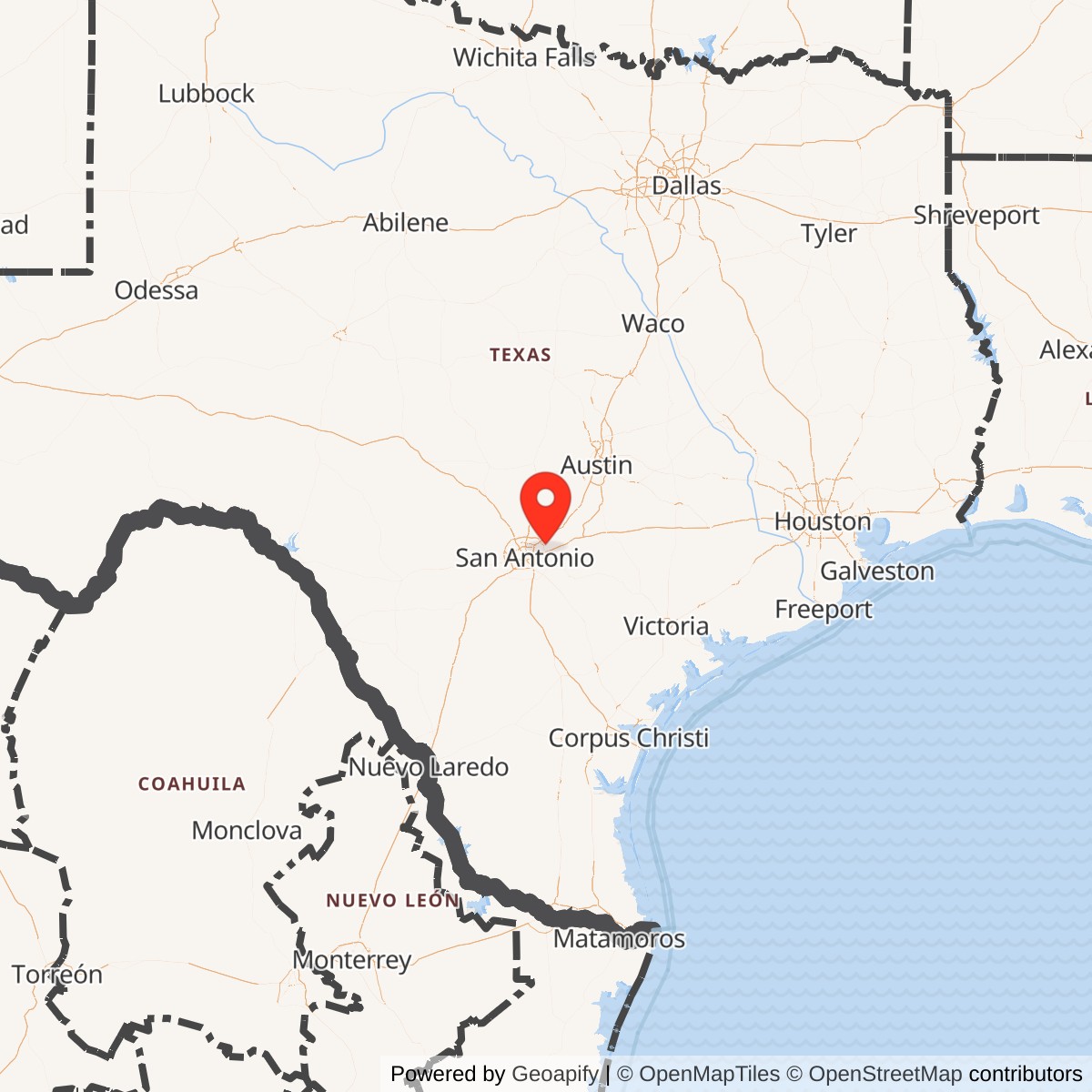
Longitude: -98.27167
Origin of current name: Named in honor of Army Capt William Millican Randolph (1893-1928). Captain Randolph received his wings in 1918, was assigned to the Air Service in 1919, and achieved a permanent captaincy in 1920. He died on 17 Feb 1928 when his AT-4 crashed on takeoff at Gorman, TX.
Date current name was assigned to base: 13 Jan 1948
Previous Names: Aviation Field, San Antonio, 18 Aug 1928; Randolph Field, 27 Sep 1928
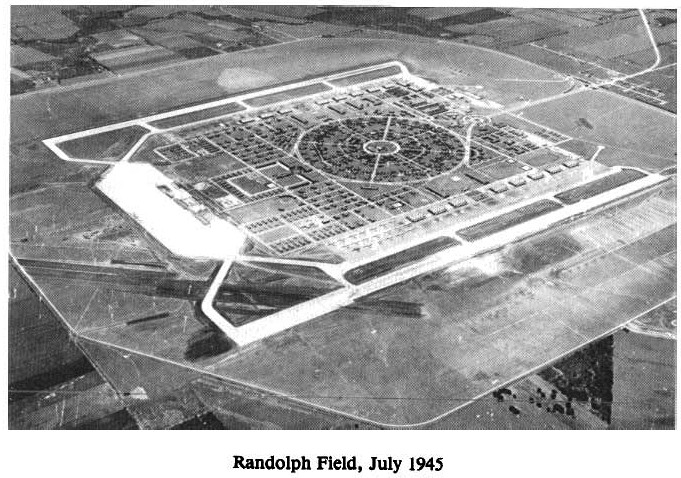
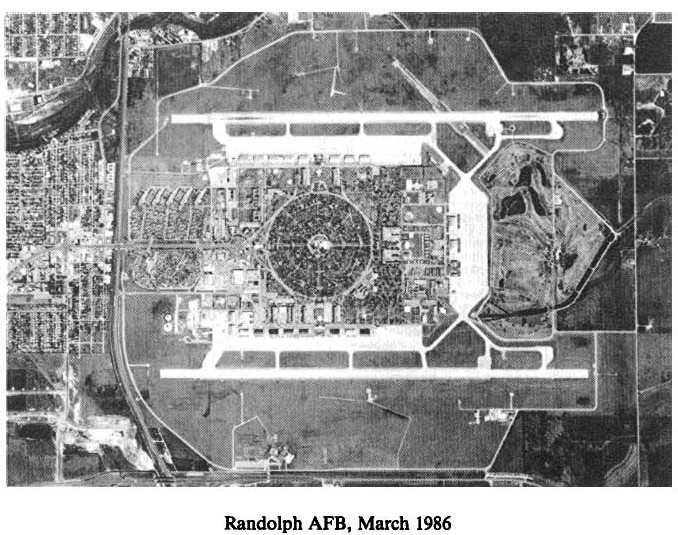
Changes in Capability: Primary and basic pilot training facilities completed for first class Nov 1931; two 5,500-by 150-foot runways completed mid-1944, extended with taxiways and parking upgraded for B-29 operations Apr-Dec 1945; primary pilot training discontinued Mar 1948-Dec 1950; basic pilot training continued until Jul 1951; 612-unit Wherry housing project completed Jul 1952; B-29 pilot training from Forbes AFB, KS, absorbed May 1953; also B-29 crew training conducted 1950-1956; facilities modified for C-119 and T-33 pilot training 1954-1956; T-33/B-57 instructor and transition training commenced Sep 1954-Oct 1955; helicopter pilot training transferred from Edward Gary AFB, TX, mid-1956; KC-97 crew training Jul 1956-Jul 1958; HQ Flying Training Air Force established 1 Jul 1957; HQ ATC arrived from Scott AFB IL, Aug 1957; School of Aviation Medicine transferred to Brooks AFB, TX, 1959; extensive runway rehabilitation project completed Feb 1959; T-38 operations (first in USAF) began 17 Mar 1961; USAF Military Personnel Center arrived from Washington, DC, and became Randolph's largest tenant organization, in spring 1963; all Personnel Center operational functions and data processing in place in fall 1964; HQ USAF Recruiting Service arrived from Wright-Patterson AFB, OH, 1 Jul 1965; runway extension completed Sep 1965; undergraduate pilot training program reestablished May 1967-Jun 1971; major dormitory construction and rehabilitation project completed 1970-1971; pilot instructor training T-37 (Mar 1971), T-38 (Jun 1971); 293 acres acquired for clear zone Mar 1978; underground aircraft support system completed 31 Mar 1978; instrument flight simulator installed Nov-Dec 1978; 600-man dormitory construction begun 1981.
Major Changes in Status: None
Official Base Website: www.jbsa.mil
Randolph Air Force Base, Texas, known for many years as the "West Point of the Air," was dedicated June 20, 1930, as a flying training base and has continued this mission ever since.
The idea for Randolph began soon after the establishment of the Air Corps Act in 1926, which changed the name of the Army Air Service to the Army Air Corps, created two new brigadier general positions, and provided a five year expansion program for the understrength Air Corps. One of the new general officer positions was given to Frank P. Lahm who was placed in charge of all flying training.
General Lahm established the Air Corps Training Center and set up its headquarters at Duncan Field, adjacent to Kelly Field, Texas. General Lahm soon learned that the facilities at Kelly and Brooks fields were not sufficient for proper training. The buildings, erected during World War I with a life expectancy of about five years, had no suitable areas for ground training and the living quarters were inadequate. San Antonio's rapid growth was also beginning to interfere with flying training operations.
The Air Corps soon decided an additional training field was needed and a site north of San Antonio was chosen for the new field.
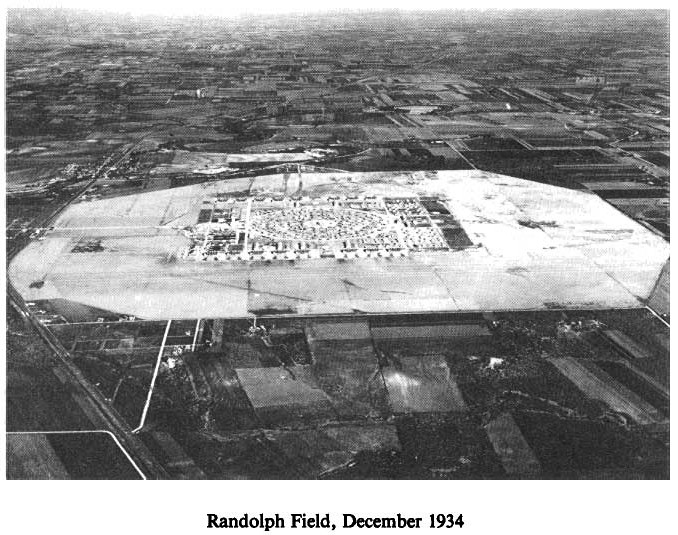
In 1926 and 1927, First Lt. Harold Clark designed Randolph while assigned as the dispatch officer in the Kelly Field motor pool, although the War Department did not receive the land in 1928. Clark, who trained as an architect prior to entering the Army, sketched his ideas of a perfect "Air City," on the back of old dispatch sheets.
After learning that a new field was to be built, Clark took his drawings to General Lahm, who was so impressed with Clark's designs he appointed him to be the architect in charge of the Randolph Field project. It was, at the time, the largest construction project undertaken by the U. S. Army Corps of Engineers since the building of the Panama Canal.
Lieutenant Clark, who retired from the Air Force as a brigadier general in 1951 and resided in San Antonio until his death in 1973.
Once the site for the field was selected, a committee decided to name the base after William Millican Randolph, a native of Austin, Texas, who, during 11 years of flying, earned a remarkable record and contributed immeasurably to the progress of aviation. On February 17, 1928, while returning to his duties at Kelly Field, his AT-4 crashed on takeoff from Gorman Field, Texas.
Ironically, Captain Randolph was serving on the committee to select a name for the new field at the time of his death. Captain Randolph is buried in section Q161 at Fort Sam Houston National Cemetery, San Antonio, Texas.
Randolph Field was dedicated on June 20, 1930, with an estimated 15,000 people in attendance. They witnessed a flyby of 233 planes, possibly the largest flying assembly of military aircraft in the world.
Early in 1931, the School of Aviation Medicine from Brooks Field and the first cadets from the Air Corps Flying School at Duncan Field, now a part of Kelly Air Force Base, began relocating to Randolph.
Basic flying training continued until March 1943, when the Central Instructors School took over. For the next two years, training instructors for the Air Corps' primary, basic and advanced flying training was the primary mission. More than 12,000 instructor pilots graduated from this course.
In April 1945, the Central Instructors School was replaced by the Army Air Force Pilot School, which specialized in transition training for B-29 bomber pilots. In December 1945 until March 1948, primary and basic pilot training was conducted at Randolph. Primary pilot training was deleted from the program in March 1948, and in August 1948, the 3510th Pilot Training Wing (Basic) became the host unit at Randolph.
The Air Force became a separate service September 18, 1947, and on January 13, 1948, Randolph Field, and the Air Force's other major installations, was renamed Randolph Air Force Base.
Since its beginning in 1931, Randolph has been a flying training base. Pilots trained in the basic and primary phases of flying, returned for instructor pilot training or went through combat crew training but, the first pilots to actually pin on their wings at Randolph were 21 foreign students who received their wings January 15, 1964. To date, only two classes, both experimental, pinned on their wings after completing flying training at Randolph.
From August 1 to September 30, 1957, Air Training Command moved its headquarters from Scott Air Force Base, Illinois, to Randolph. In the early 1960s the T-33 and T-38 arrived to bring jet training aircraft to the base. The Air Force Instrument Pilot Instructor School arrived at Randolph in September 1961, followed in close order by the Air Force Military Personnel Center in November 1963 and the Air Force Recruiting Service in July 1965. On May 1, 1972, the 3510th Flying Training Wing was inactivated and replaced by the 12th Flying Training Wing.
Joint training programs with Navy, Marine Corps and Coast Guard student navigators and instructors joining their Air Force counterparts began in October 1993.
In August 2001, the National Park Service designated Randolph a National Historic Landmark.
Despite changes to aircraft models over the years, the heart and soul of Randolph's mission remains the same -- flying training.