
Atlas F Site 550-11 Missile Silo, Glasco Kansas
Longitude: -97.6808550479171
Site Type: Atlas F vertical silo launch facility
Missile Type: SM-65F Atlas
Missile Assigned to this Silo: GD mfg no. 17F; GD serial no. 60-5540; AF tail no. 540; assigned to 550th SMS Site 11; delivered 1961-10-11; not launched; salvaged as scrap.
Number of Launchers/Missiles: 1
Parent Base: Schilling AFB
Missile Wing: 310th Strategic Aerospace Wing
Missile Squadron: 550th Strategic Missile Squadron
Corps of Engineers Site ID: 9
Current Site Use: Former Atlas F launch complex in rural Cloud County; current owner/use not verified from public sources; no verified public access found.
Site Ownership: Former USAF; treat as private property.
Accessible: No verified public access; private property/former military-industrial site; do not trespass.
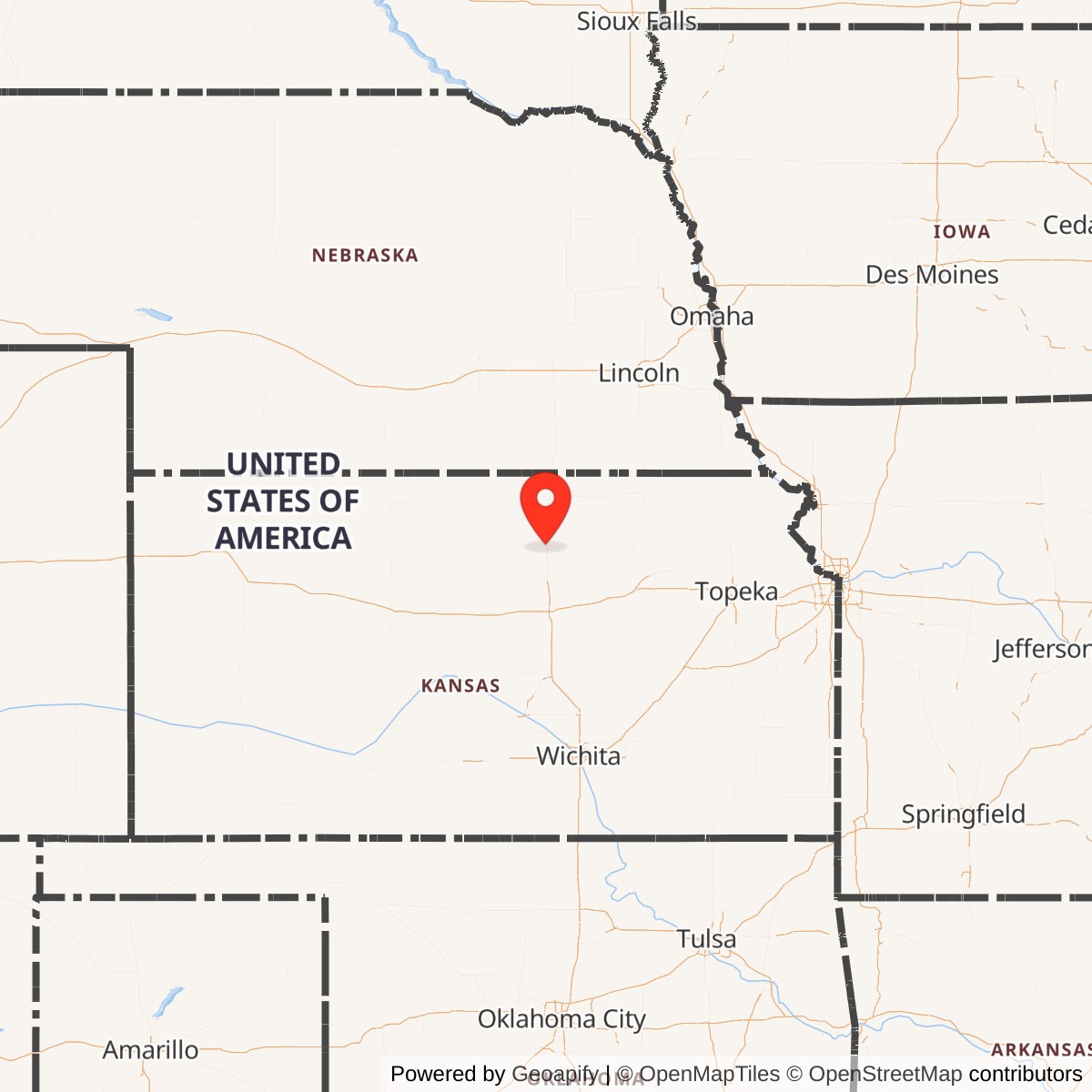

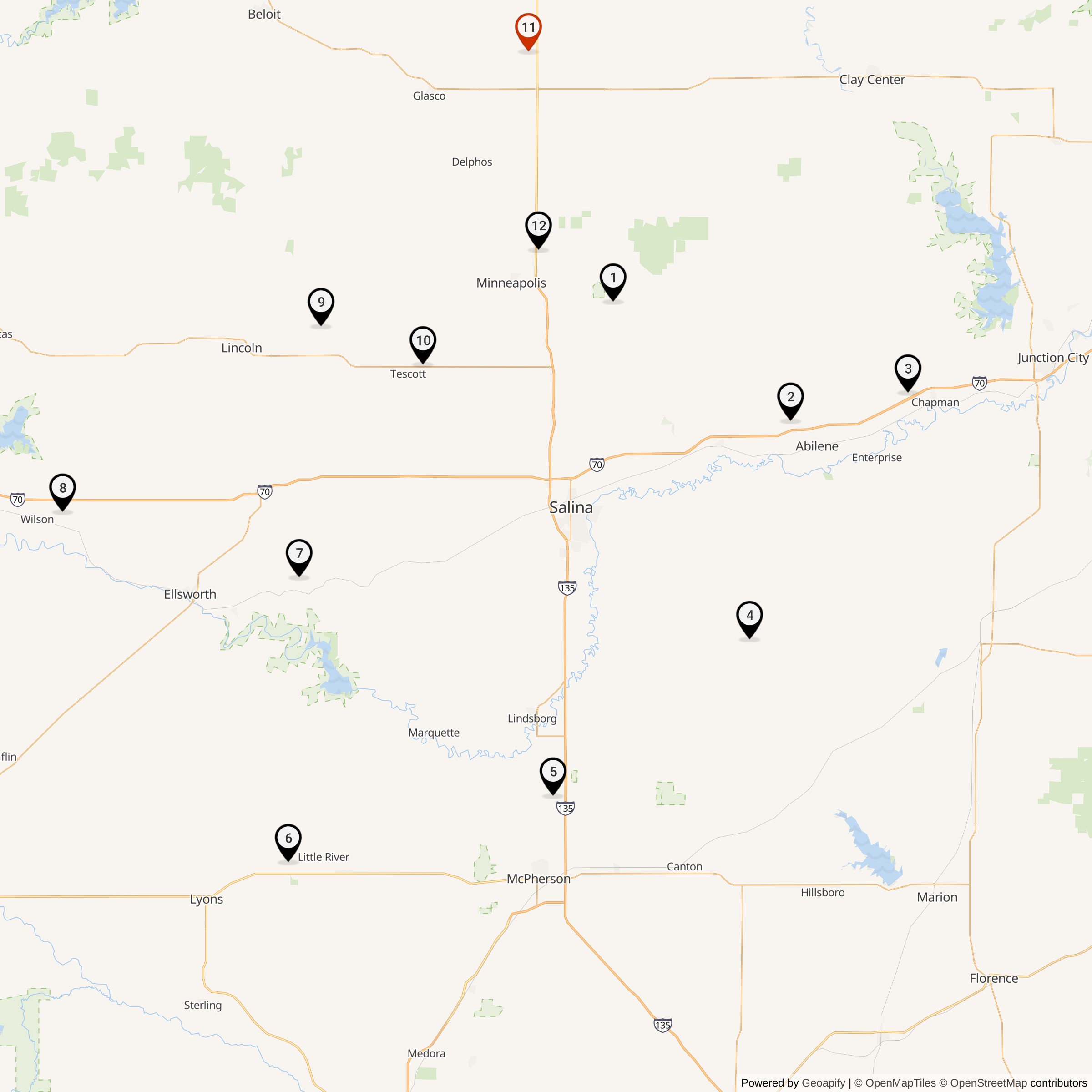
Atlas F Site 550-11 is one of those Cold War places that can look almost invisible from the road and still carry the weight of the nuclear age. Near Glasco in Cloud County, Kansas, the site was built to hide a fueled, pressurized SM-65F Atlas intercontinental ballistic missile below the Kansas prairie and to give a small Strategic Air Command crew the ability to bring it to the surface on short notice. The fields around the former launch complex are quiet now, but for a brief period in the early 1960s this site was one of twelve Atlas F missile bases ringed around Schilling Air Force Base at Salina, Kansas.
The site's operational designation was Atlas F Site 550-11. It belonged to the 550th Strategic Missile Squadron, assigned to the 310th Bombardment Wing, later the 310th Strategic Aerospace Wing, at Schilling AFB. The missile system was the SM-65F Atlas, also known later as HGM-16F. Unlike a Minuteman launch facility, an Atlas F launch complex was not paired with a separate remote Minuteman-style Launch Control Center; the launch-control and support spaces were part of the individual Atlas F complex itself.
EPA and USACE environmental records identify the corresponding former Schilling Atlas facility as S-11 at Concordia, Cloud County, Kansas; that reflects the environmental-record locality rather than a different missile site. The site is inactive and decommissioned. Squadron records show the 550th SMS was discontinued on 1965-06-25 after the Atlas phaseout.
Location, Landscape, and Site Description
Site 550-11 was placed in rural north-central Kansas, in the agricultural landscape south of Concordia and in the Glasco/Aurora area of Cloud County. Its coordinates, 39.412207, -97.680855, mark the former launch-complex footprint rather than a public access point. The siting pattern was typical of the Schilling Atlas F field: twelve single-missile complexes were dispersed around the parent base so that no one strike against Schilling AFB at Salina could disable the entire squadron.The complex was a hardened Atlas F vertical-silo launch facility. Public diagrams and Atlas F descriptions show the basic arrangement: an underground missile silo containing the missile on a massive elevator, an adjoining underground launch-control center and support spaces, surface access roads, utility areas, security fencing, and construction/support pads. The Atlas F design differed from the earlier Atlas D and Atlas E arrangements because the missile was stored vertically underground rather than horizontally in an aboveground or semi-hardened "coffin" shelter. At Site 550-11, the surviving site footprint is visible in public imagery and historic site photography. It should therefore be treated as private property and a potentially hazardous former missile/industrial site.
Strategic and Cold War Context
Atlas F Site 550-11 existed because the United States was trying to make its first generation of intercontinental ballistic missiles survivable enough to matter in a nuclear crisis. Atlas was the first operational U.S. Air Force ICBM, but early Atlas launchers were exposed, slow, or only partly protected. The Atlas F was the final operational Atlas missile variant and was intended to improve survivability by storing each missile vertically in a hardened underground silo while dispersing the launch sites across a broad missile field.The Schilling field was one of six operational Atlas F fields. The National Park Service summarizes Atlas F as a silo-lift missile, with 72 Atlas F missiles placed in the field nationally, including twelve based from Schilling AFB in Kansas. In practice, that meant Site 550-11 was one point in a ring of single-missile complexes that together formed the 550th Strategic Missile Squadron's nuclear deterrent. The site's strategic value came not from any local target or local defense mission, but from its ability to survive long enough to receive and execute national command authority orders during a crisis.
The Atlas F still carried the limitations of the first missile generation. It used liquid propellants rather than solid fuel. RP-1 kerosene could be kept aboard while on alert, but liquid oxygen had to be loaded during the launch countdown. The missile could not be fired from underground; the elevator had to raise it to ground level before launch. That made the Atlas F much more protected than earlier Atlas configurations while stored, but still briefly exposed during the final launch sequence. This was one of the reasons the Atlas was soon replaced by solid-fueled Minuteman and by Titan II systems that could remain ready in ways Atlas could not.
Construction and Activation
The 550th Strategic Missile Squadron was organized at Schilling AFB on 1961-04-01, the first Series F Atlas operational sites at Schilling and Lincoln were accepted by SAC in June 1962, and the 550th SMS was declared operational in September 1962.Construction of an Atlas F complex was a major civil-engineering job. Each site required excavation for a deep launch silo, installation of the elevator and silo doors, construction of underground crew and equipment spaces, installation of propellant, power, ventilation, communications, and security systems, and integration of the missile-support equipment that made a single remote complex operational. The remoteness of Site 550-11 was not incidental. Dispersal across farms and rural roads was a design feature: every site had to function as an independent hardened launch complex while still remaining connected to Schilling AFB command, maintenance, logistics, security, and communications systems.
Missile System and Technical Role
The missile assigned to Site 550-11 was Atlas 17F. It was General Dynamics manufacturing number 17F, General Dynamics missile serial number 60-5540, and Air Force tail number 540.Atlas F was a liquid-fueled, inertially guided ICBM. Public missile-history sources describe the Atlas F as a vertical-silo missile with an adjoining control center, hardened against blast overpressure, and held in a silo-lift configuration. While on alert, the missile could carry RP-1 fuel, but liquid oxygen was loaded only during the launch sequence. At launch, the crew would complete emergency-war-order procedures, load liquid oxygen, raise the missile to ground level on the elevator, and then initiate the launch sequence. The National Park Service describes the Atlas F as approximately 82 feet tall and capable of launch in about ten minutes in the silo-lift configuration, while the National Museum of the U.S. Air Force states that the Atlas ICBM could deliver a nuclear warhead more than 6,300 miles from its launch site.
Public museum data identify the Atlas E/F reentry vehicle as the Mark 4, built by AVCO and used on Atlas E/F and Titan I missiles. The Smithsonian National Air and Space Museum states that the Mark 4 carried the W-38 nuclear warhead with a yield of about 3.75 megatons. This capability description is included here only from public museum and official-history sources.
Operational History
Site 550-11's active operational life was short. The 550th Strategic Missile Squadron was organized at Schilling AFB on 1961-04-01 and became one of the first Atlas F squadrons to move from construction and acceptance into operational missile duty. The unit history records SAC turnover on 1962-09-07 and operational status on 1962-09-09. Site 550-11 was one of the twelve dispersed launch complexes that made up that operational squadron.The Atlas F launch complex was crewed differently from later Minuteman launch facilities. A Minuteman missile silo was normally unmanned and controlled remotely from a separate launch control center. An Atlas F complex, by contrast, included its own launch-control and support spaces, and missile combat crews pulled duty at individual sites. The Association of Air Force Missileers describes Atlas F combat crews as including two officers and three enlisted personnel, with crew responsibilities tied to command, missile facilities, ballistic-missile analysis, electrical power production, and technical systems. A crew tour involved briefing, travel, site turnover, and continuous duty at the remote complex.
During normal operations, Site 550-11 would have depended on recurring maintenance, security, communications checks, power production support, propellant-related readiness, and inspections. The site's Atlas 17F was not a training display or a test article; it was an operational ICBM assigned to a live SAC squadron.
Deactivation and Disposal
Atlas F Site 550-11 left active missile service during the rapid retirement of the first-generation Atlas and Titan I systems. The USAF unit-history summary for the 550th SMS shows the unit phaseout sequence: the first 550th SMS ICBM came off alert on 1965-02-01, the last came off alert on 1965-03-05, the last ICBM was shipped on 1965-03-11, and Headquarters SAC inactivated the last remaining Atlas ICBM squadrons, including the 550th at Schilling, on 1965-06-25. These dates show why a site history must separate missile off-alert, missile shipment, site decommissioning, and squadron inactivation. They did not all happen on the same day.For Site 550-11's assigned missile, Atlas 17F was not launched and was salvaged as scrap. Atlas F phaseout generally involved removing the missile, salvaging or removing Air Force equipment, ending launch readiness, and transferring or disposing of the former launch complex. Because Atlas F was retired before the later strategic arms-control demolition regimes that affected Minuteman and Peacekeeper facilities, the post-service history of Atlas F sites is usually a combination of military disposal, private reuse, environmental review, and local land-use change rather than START-style silo implosion.
Environmental records identify the former launch complex as SCHILLING AFB ATLAS S-11 / B07KS0269 in Cloud County, Kansas. The 2015 USACE Formerly Used Defense Sites inventory lists two sites for S-11: Site 02 in the CON/HTRW category and Site 03 in the HTRW category. EPA's Superfund search results list SCHILLING (EX) AIR FORCE ATLAS FAC S-11, EPA ID KSN000703105, at Concordia, Cloud County, Kansas, as Not NPL, with status fields unavailable for construction complete, sitewide ready for anticipated use, human exposure, and groundwater migration. This record confirms that the former missile facility remained part of federal environmental tracking even after active missile operations ended.
Current Status and Site Use
Atlas F Site 550-11 is inactive and decommissioned. The best current public-source description is that it is a former Atlas F launch complex in rural Cloud County, Kansas, with no verified public access. Its exact ownership and current use were not independently verified. Public imagery and site-photography sources show the former launch-complex footprint, but they do not establish that the site is open for visits, tours, or casual access. It should be treated as private property and as a former industrial/military facility with potential physical hazards.
Chronology
- 1960 Construction began at Atlas F Site 550-11, exact month and day not identified in the public site page.
- 1961-04-01 The 550th Strategic Missile Squadron was organized at Schilling AFB, Kansas.
- 1961-10-11 Atlas 17F / serial 60-5540 / Air Force tail 540 was delivered.
- 1962 Site 550-11 was turned over to the Air Force, exact month and day not identified in the public site page.
- 1962-06 The first Series F Atlas operational sites at the 550th SMS, Schilling AFB, Kansas, and the 551st SMS, Lincoln AFB, Nebraska, were accepted by Strategic Air Command.
- 1962-09-07 The 550th SMS recorded turnover to SAC.
- 1962-09-09 The 550th SMS was recorded as operational.
- 1962-10 During the Cuban Missile Crisis, operational 550th SMS sites, including the Schilling Atlas F field, were placed at a high level of alert.
- 1965-02-01 The first 550th SMS ICBM was removed from alert, according to the USAF unit-history summary.
- 1965-03-05 The last 550th SMS ICBM was removed from alert, according to the USAF unit-history summary.
- 1965-03-11 The last 550th SMS ICBM was shipped, according to the USAF unit-history summary.
- 1965-06-25 Headquarters SAC inactivated the last remaining Atlas ICBM squadrons, including the 550th Strategic Missile Squadron at Schilling AFB.
- 2015-09-30 The USACE Kansas FUDS inventory listed SCHILLING AFB ATLAS S-11 / B07KS0269 in Cloud County with CON/HTRW and HTRW categories.

Read about the Atlas at Schilling AFB
All Atlas Missile Silo Locations