
Atlas F Site 550-6 Missile Silo, Mitchell Kansas
Longitude: -98.068133
Site Type: Atlas F vertical silo launch facility
Missile Type: SM-65F Atlas
Missile Assigned to this Silo: GD mfg no. 20F; GD serial no. 60-5543; AF tail no. 543; accepted 1961-10-09; delivered 1961-10-23; not launched; salvaged as scrap.
Number of Launchers/Missiles: 1
Parent Base: Schilling AFB
Missile Wing: 310th Strategic Aerospace Wing
Missile Squadron: 550th Strategic Missile Squadron
Corps of Engineers Site ID: 5
Current Site Use: Former Atlas F silo complex in rural Rice County near Little River/Mitchell; private rural former missile property with FUDS/EPA/KDHE environmental record.
Site Ownership: Private ownership likely after disposal; exact current owner not verified; former DOD site listed in FUDS/EPA/KDHE records.
Accessible: No public access confirmed; private former missile/FUDS site. Do not enter without permission.


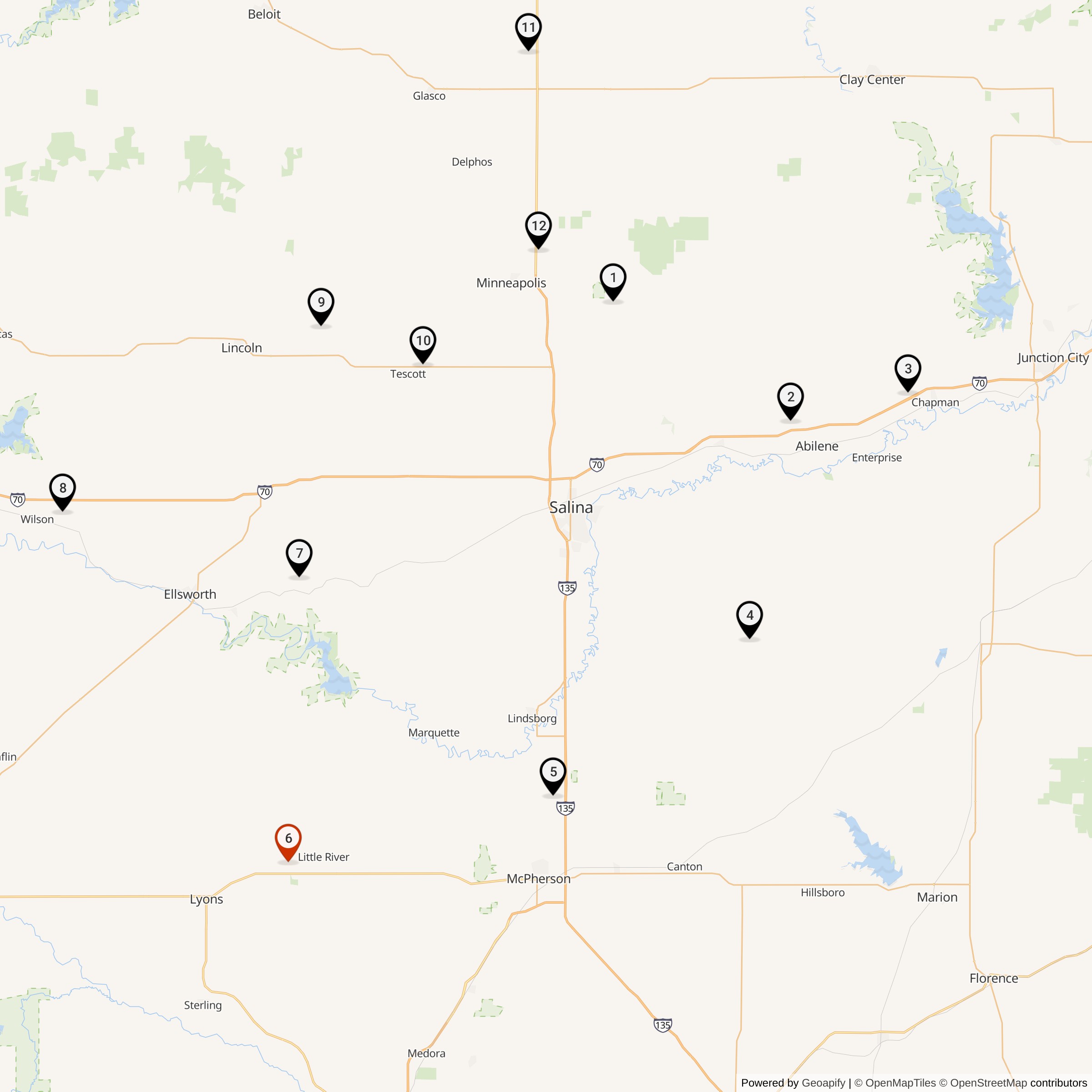
On the Rice County prairie west of Little River, the old Atlas F complex is easy to miss from the road and hard to forget once you understand what it was. Atlas F Site 550-6 was one of twelve dispersed missile silos tied to Schilling Air Force Base near Salina, Kansas. Its job was blunt: keep one nuclear-armed SM-65F Atlas intercontinental ballistic missile ready in an underground launch complex, far enough from the parent base to complicate an enemy strike, but close enough to remain part of a single Strategic Air Command missile squadron.
Atlas F Site 550-6 was an Atlas F vertical silo launch facility of the 550th Strategic Missile Squadron, assigned to Schilling Air Force Base and the 310th Strategic Aerospace Wing.
The site was one of the twelve Atlas F launch complexes of the 550th Strategic Missile Squadron. Construction began in 1960, and turnover to the Air Force occurred in 1962. The 550th Strategic Missile Squadron was declared operational in September 1962. The 550th SMS was inactivated on 1965-06-25. The site is no longer active, is decommissioned, and is best treated today as private rural property with a documented FUDS/EPA/KDHE environmental record.
Location, Landscape, and Site Description
Atlas F Site 550-6 sits in Rice County, Kansas. The local landscape is open central Kansas farm and ranch country. The site lies west of Little River, south of Ellsworth County, and southwest of the village label used by several missile-site sources as "Mitchell." This is the kind of terrain the Atlas F deployment pattern sought: broad, rural, lightly built-up land where individual launch complexes could be dispersed around Schilling AFB rather than clustered on the base itself.The site was not a later Minuteman-style unmanned Launch Facility controlled from a separate Missile Alert Facility. Atlas F complexes were self-contained launch sites. Each included the vertical missile silo, launch-control and crew areas, power and environmental systems, communications equipment, propellant-related systems, access routes, security fencing, and surface support features. They were manned twenty-four hours a day during the squadron's active period. The crew and support personnel served at the launch complex itself rather than operating the missile from a distant LCC.
Satellite images show the former launch complex as a surviving rural footprint. These images show the road grid, surface pads, disturbed ground, and the site footprint in open country. They do not establish public access. The site should be treated as private property and as a former military facility with potential physical and environmental hazards.
Strategic and Cold War Context
Site 550-6 existed because the first generation of American ICBM deployment was built around speed, dispersal, and survivability. The Atlas program began as a crash effort to field a missile that could reach Soviet targets from the continental United States. By the time Atlas F entered service, the Air Force had moved from early aboveground or semi-hardened Atlas configurations to a more survivable silo-lift design.The National Park Service summarizes Atlas F as the most advanced Atlas missile type deployed and notes that the missile was held in a blast-proof silo-lift configuration and could be launched in approximately ten minutes.
Atlas F was still a liquid-fueled first-generation missile. It used RP-1 kerosene fuel and liquid oxygen oxidizer, and that shaped daily operations. The missile could not simply sit fully loaded with liquid oxygen for long periods the way later solid-fueled Minuteman missiles could sit ready in the field. The RP-1 fuel was kept aboard the missile during alert, while liquid oxygen was loaded before launch; gaseous nitrogen helped maintain internal pressure, and the crew could top off liquid oxygen during a short hold after the missile had been raised and locked. Those technical realities made Atlas F faster than Atlas D and Atlas E, but they also made it more labor-intensive and hazardous than later solid-fueled ICBMs.
Construction and Activation
The 550th Strategic Missile Squadron was organized at Schilling AFB in 1961 as an Atlas F squadron. USAF Unit Histories states that the first Series F Atlas operational sites at the 550th SMS, Schilling AFB, and the 551st SMS, Lincoln AFB, were accepted by Strategic Air Command in June 1962. The same unit-history summary states that Headquarters SAC declared the 550th SMS operational in September 1962.
Missile System and Technical Role
The missile system at Site 550-6 was the SM-65F Atlas, the final operational Atlas ICBM variant. The Atlas F was stored vertically in an underground silo. In a launch sequence, the heavy silo doors opened, the missile was raised to the surface by the elevator-lift system, liquid oxygen was loaded, and the missile was launched from the raised position. This vertical silo-lift arrangement was the key difference between Atlas F and the earlier Atlas D and Atlas E fielded configurations.Public sources identify the Atlas E/F reentry vehicle and warhead family as the Mark 4 reentry vehicle with the W-38 thermonuclear warhead. The Smithsonian National Air and Space Museum's Mark 4 collection record describes the Mark 4 as used on U.S. Air Force Titan I and Atlas E/F intercontinental ballistic missiles deployed in the early 1960s and states that it carried a W-38 nuclear warhead with a yield of about 3.75 megatons.
The assigned missile for Site 550-6 was Atlas 20F. It was General Dynamics manufacturing number 20F, General Dynamics missile serial number 60-5543, Air Force tail number 543, accepted on 1961-10-09, delivered on 1961-10-23, assigned to the 550th Strategic Missile Squadron at Site 6, and assigned to an operational ICBM mission at Schilling AFB.
Unlike some Atlas missiles that later flew as space-launch boosters, Atlas 20F was not launched after its ICBM career, instead it was salvaged as scrap.
Operational History
Atlas F Site 550-6 served as one of twelve launch complexes in the Schilling AFB Atlas F missile field. The 550th SMS was part of the 310th Strategic Aerospace Wing and provided a dispersed ICBM alert force in central Kansas. The site was manned, maintained, secured, and operated as a self-contained launch complex, not as an unattended silo in the later Minuteman sense.The site's daily purpose was to keep Atlas 20F and its launch system ready for an emergency war order. That required a launch crew, security personnel, maintenance support, communications systems, power systems, propellant-handling capability, and constant attention to a large liquid-fueled missile stored in a hardened underground structure. The crew did not live in the comfortable sense of a conventional base; the Atlas F complex was a working machine built around alert duty, confinement, checklists, maintenance, and the tension of handling a nuclear-capable missile system.
Site 550-6's most important operational context was the Cuban Missile Crisis. The SAC Missile Chronology states that in October 1962, as a result of the crisis, the Series F Atlas squadrons at Schilling, Lincoln, Altus, and Dyess were for the first time required to place all twelve missiles on alert. This did not mean that Atlas F missiles sat continuously raised above their silos or continuously loaded with liquid oxygen. For Atlas F, being placed in an operational launch-ready alert posture meant that crews, missile equipment, communications, and propellant procedures were brought to a higher readiness state; missiles not already alert for other reasons were prepared for alert; and training use was subordinated to the requirement to generate the operational force. The missile normally remained stored vertically in the silo, with RP-1 aboard and liquid oxygen loaded only as part of the launch sequence or a short prelaunch/hold period.
The active life of the site was short. By late 1964, Secretary of Defense Robert McNamara had directed the phaseout of remaining first-generation ICBMs, including Atlas E, Atlas F, and Titan I, by the end of June 1965. Solid-fueled Minuteman missiles had overtaken Atlas in response time, maintainability, survivability, and long-term strategic value. Site 550-6 was therefore part of a first-generation missile system that reached operational status during the most dangerous year of the Cold War and then disappeared from active service less than three years later.
Deactivation and Disposal
Site 550-6 left active missile service during the rapid phaseout of first-generation Atlas ICBMs. SAC chronology records that on 1964-11-19 Secretary of Defense McNamara announced that all remaining first-generation ICBMs - Series E and F Atlas and Titan I - would be phased out by the end of June 1965. SAC chronology also records that the final remaining Atlas ICBM squadrons, including the 550th SMS at Schilling AFB, were inactivated on 1965-06-25.After Schilling AFB closed, responsibility for the Atlas sites passed to F.E. Warren AFB in July 1967 and the sites were disposed of in March 1971.
The site later entered environmental records. The U.S. Army Corps of Engineers 2015 Kansas FUDS inventory lists SCHILLING AFB ATLAS S-06 at Little River, Rice County, property number B07KS0264, with one HTRW project entry. The EPA CERCLA record identifies the site as SCHILLING (EX) AIR FORCE ATLAS FAC S-6, EPA ID KSN000703284, approximately four miles west of Little River, not on the National Priorities List, and NFRAP, meaning the site did not qualify for the NPL based on information available to EPA. KDHE's Bureau of Environmental Remediation ISL search page lists SCHILLING ATLAS MISSILE S-06 under site number C508003055. The 2023 DERP Table 7 lists SCHILLING AFB ATLAS S-06 / KS79799F030800 with one IRP project and a projected IRP completion year of 2057.
Current Status and Site Use
Atlas F Site 550-6 is inactive and decommissioned. It is not an active military installation, not a public museum, and not a publicly accessible historic site. The best current description from the reviewed sources is a former Atlas F launch complex on private rural property in Rice County, Kansas.The physical condition of the underground spaces could not be verified from official current-condition records. Satellite images show a surviving site footprint with roads, surface pads, disturbed ground, and the outline of a former Atlas F complex. Like other Atlas F sites, it may retain filled, sealed, flooded, deteriorated, or reused underground and surface features.
Public access should be treated as unavailable. Former missile complexes can contain open shafts, confined spaces, unstable structures, contaminated water or soil, and other hazards. The coordinates identify the former launch complex area, not a public destination.
Chronology
- 1960 Construction began at Site 550-6.
- 1961-04-01 The 550th Strategic Missile Squadron was organized at Schilling AFB as an Atlas F squadron.
- 1961-10-09 Atlas 20F, the assigned missile for Site 550-6, was accepted.
- 1961-10-23 Atlas 20F was delivered.
- 1962 Site 550-6 was turned over to the Air Force.
- 1962-06 The first Series F Atlas operational sites at the 550th SMS, Schilling AFB, and the 551st SMS, Lincoln AFB, were accepted by Strategic Air Command.
- 1962-09 Headquarters SAC declared the 550th Strategic Missile Squadron operational.
- 1962-10 During the Cuban Missile Crisis, the Series F Atlas squadrons at Schilling, Lincoln, Altus, and Dyess were required for the first time to place all twelve missiles on alert.
- 1964-11-19 Secretary of Defense Robert McNamara announced that remaining first-generation ICBMs, including Series E and F Atlas and Titan I, would be phased out by the end of June 1965.
- 1965-06-25 Headquarters SAC inactivated the last remaining Atlas ICBM squadrons, including the 550th Strategic Missile Squadron at Schilling AFB.
- 1967-07 Responsibility for the Schilling Atlas sites passed to F.E. Warren AFB after Schilling AFB closed, according to The Military Standard.
- 1971-03 The Schilling Atlas sites were disposed of, according to The Military Standard.
- 2015-09-30 The USACE Kansas FUDS inventory listed Schilling AFB Atlas S-06 at Little River, Rice County, Kansas, property number B07KS0264, with one HTRW project entry.
- 2023 DERP Table 7 listed Schilling AFB Atlas S-06 / KS79799F030800 with one IRP project and a projected IRP completion year of 2057.

Read about the Atlas at Schilling AFB
All Atlas Missile Silo Locations