
Atlas F Site 550-7 Missile Silo, Kanopolis Kansas
Longitude: -98.051586
Site Type: Atlas F vertical silo launch facility
Missile Type: SM-65F Atlas
Missile Assigned to this Silo: GD mfg no. 18F; GD serial no. 60-5541; AF tail no. 541; accepted 1961-09-23); delivered 1961-10-18; assigned to 550th SMS Site 7; not launched; salvaged as scrap.
Number of Launchers/Missiles: 1
Parent Base: Schilling AFB
Missile Wing: 310th Strategic Aerospace Wing
Missile Squadron: 550th Strategic Missile Squadron
Corps of Engineers Site ID: 6
Approximate Base Size: 20 acres (public vacation-rental listing/VRBO; county parcel record not independently verified).
Current Site Use: Former Atlas F silo complex in Ellsworth County near Kanopolis/Brookville.
Site Ownership: Private ownership; exact current owner not independently verified; former DOD site listed in FUDS/EPA/DERP records.
Accessible: Private property; access only through owner/rental operator or other permission. Do not enter without permission.


At Atlas F Site 550-7, the most vivid surviving clue is not a hotel listing or a polished reuse story. It is a silent Propellant Load Exercise film: a short record of a launch complex being tested as a complete Cold War machine. That is the stronger story for this Kansas site. A liquid-fueled Atlas F missile once stood vertically underground here, held in readiness by crews who had to make pumps, doors, elevators, communications, power systems, propellant equipment, and a pressure-stabilized missile work as one coordinated system. Site 550-7 was built to be ready for a nuclear launch order; its surviving history is about alert discipline, mechanical complexity, rapid obsolescence, and the long environmental afterlife of a decommissioned first-generation ICBM facility.
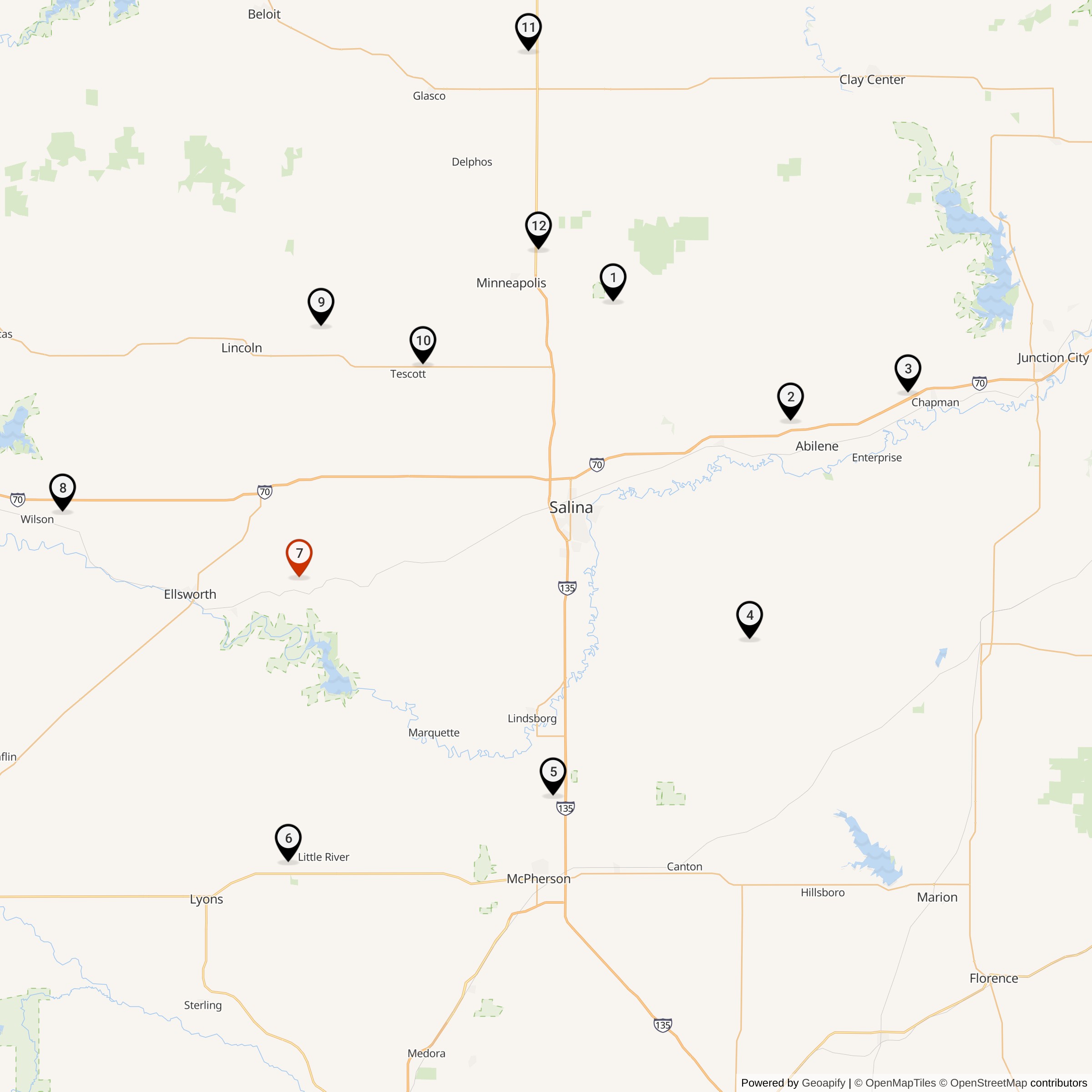
Atlas F Site 550-7 was an SM-65F Atlas vertical silo launch facility of the 550th Strategic Missile Squadron, assigned to Schilling Air Force Base near Salina, Kansas, and the 310th Strategic Aerospace Wing. The site was one of twelve Atlas F launch complexes dispersed around Schilling AFB.
Location, Landscape, and Site Description
Atlas F Site 550-7 is in Ellsworth County, Kansas. EPA describes the environmental site as about seven miles northeast of Ellsworth. The site also lies in the broader rural landscape west and southwest of Salina, not on the former Schilling AFB cantonment itself. These different geographic labels reflect how Atlas sites are often described: missile-history sources tend to use the nearest small-town site label, while environmental and property records may use a different nearby place name or county reference.The surrounding terrain is open Kansas prairie, pasture, and agricultural land rather than dense urban or base property. That was central to the Atlas F deployment pattern. The sites were not clustered on Schilling AFB. They were dispersed in a ring around the parent base so an enemy attack could not destroy the whole squadron with a single strike. Each complex had its own access road, fenced and controlled area, underground launch and control structures, power and mechanical systems, communications, and propellant-handling infrastructure.
The physical Atlas F layout was different from later Minuteman launch facilities. Site 550-7 was not an unmanned Launch Facility watched from a distant Missile Alert Facility. It was a self-contained, manned Atlas F launch complex. The missile was stored vertically in a deep underground silo. A launch-control center and crew areas were integrated into the facility. Support spaces, diesel power, environmental controls, communications systems, propellant systems, and the massive elevator/launcher mechanism all served one missile. The sites were manned around the clock during the squadron's active years.
Satellite images show the complex in open ground, with a distinct site footprint, access drive, surface pads, and surrounding rural land. Any current physical condition should be treated cautiously unless verified through current owner, public property, environmental, or imagery sources. The site should still be understood as a former military-industrial complex with underground confined spaces and potential environmental hazards.
Strategic and Cold War Context
Atlas F Site 550-7 existed because the United States needed an operational ICBM force before newer solid-fueled missiles were fully fielded. Atlas was the Air Force's first operational intercontinental ballistic missile. It was developed quickly, deployed quickly, and then retired quickly as Titan and Minuteman systems overtook it. The National Park Service summarizes Atlas F as the most advanced deployed Atlas type, held in a blast-proof silo-lift configuration and capable of launch in about ten minutes.An isolated Kansas property was tied to Strategic Air Command, the 310th Strategic Aerospace Wing, and the 550th Strategic Missile Squadron's alert force. The strategic logic was simple but severe: disperse missiles far enough apart that a first strike would have to target many individual sites, harden those sites enough to improve survivability, and keep them connected to the command-and-control system that could launch them if ordered.
Atlas F's design represented progress and limitation at the same time. It was more survivable than the earlier Atlas D and Atlas E configurations because it placed the missile upright in a hardened underground silo. But it was still a first-generation, liquid-fueled ICBM. Atlas F used RP-1 kerosene fuel and liquid oxygen oxidizer. The RP-1 could remain aboard the missile during alert, but liquid oxygen had to be loaded as part of the launch sequence. The missile also required internal pressurization because the Atlas airframe was extremely thin and depended on pressure to keep its structure stable. In practice, Site 550-7 was as much a maintenance and propellant-management system as it was a silo.
Construction and Activation
Its construction began in 1960 and was completed in 1962. This pattern matches the broader Schilling Atlas F field: the sites were built in the early 1960s as part of a twelve-site 1 x 12 squadron deployment.The squadron-level timeline is better documented. USAF Unit Histories states that the 550th Strategic Missile Squadron was organized on 1961-04-01 and stationed at Schilling AFB, Kansas. It lists the squadron's weapon system as SM-65F Atlas for 1961-1965. The same unit-history summary states that the first Series F Atlas ICBM operational sites at the 550th SMS, Schilling AFB, and the 551st SMS, Lincoln AFB, were accepted by Strategic Air Command in June 1962. It also states that the 550th SMS was turned over to SAC on 1962-09-07 and operational on 1962-09-09.
Missile System and Technical Role
The missile system at Site 550-7 was the SM-65F Atlas, also known later in some contexts as HGM-16F. Atlas F was the final operational Atlas ICBM variant. The missile sat vertically underground in a silo-lift launcher. In a launch sequence, large overhead doors opened, the missile was raised to the surface, liquid oxygen was loaded, and the missile was launched from the elevated position. The system was quicker and better protected than earlier Atlas configurations, but it still demanded extensive crew, maintenance, power, and propellant support.The missile assigned to Site 550-7 was Atlas 18F. It was General Dynamics manufacturing number 18F, General Dynamics missile serial number 60-5541, Air Force tail number 541, assigned to the 550th Strategic Missile Squadron at Site 7, destined for Schilling Air Force Base, and assigned to an operational ICBM mission. The missile acceptance date was 1961-09-23 and delivery date was 1961-10-18.
Atlas 18F did not receive a later space-launch career. Unlike some retired Atlas ICBMs that later carried satellites or test payloads from Vandenberg, instead it was salvaged as scrap.
Public historical sources identify the Atlas E/F warhead and reentry vehicle family as the Mark 4 reentry vehicle with the W-38 thermonuclear warhead. The Smithsonian National Air and Space Museum describes the Mark 4 as an RV used on U.S. Air Force Titan I and Atlas E/F ICBMs in the early 1960s and states that it carried a W-38 nuclear warhead with a yield of about 3.75 megatons.
Operational History
Atlas F Site 550-7 served during the short, intense operational life of the 550th Strategic Missile Squadron. The squadron was part of Strategic Air Command's first-generation ICBM force and operated twelve dispersed Atlas F launch complexes around Schilling AFB. Each site held one missile. The field's design deliberately placed nuclear-alert duty in small rural communities and isolated properties rather than in a single compact base.At Site 550-7, daily alert duty centered on Atlas 18F and its silo-lift launch complex. Crews had to monitor the missile, maintain readiness, preserve the thin-skinned pressure-stabilized airframe, support propellant and gas systems, maintain communications, secure the site, and keep the complex ready for a launch order that everyone hoped would never come. The underground control spaces and launch systems were built for checklists, redundancy, and pressure, not comfort. A functioning Atlas F site was a twenty-four-hour industrial and military watch station.
The Cuban Missile Crisis gave the Schilling field its most important operational moment. The 550th SMS history states that during the crisis all operational 550th sites were at a high level of alert and ready to launch if necessary. The SAC chronology records that in October 1962, as a result of the Cuban Missile Crisis, Series F Atlas squadrons at Schilling, Lincoln, Altus, and Dyess were required for the first time to place all twelve missiles on alert. For an Atlas F site, that did not mean the missile sat continuously raised above the silo or continuously loaded with liquid oxygen. It meant that the site, crew, missile, launch equipment, communications, fuel and oxidizer support, and procedural readiness were brought to the alert posture required to execute the Atlas F launch sequence if ordered. RP-1 fuel remained aboard the missile; liquid oxygen would be loaded before launch; the missile would be raised and locked; and a short hold could allow LOX top-off before the final "missile away" command. The crisis exposed both the power and the burden of the Atlas F system: it could be brought to ready status, but doing so required a manned, mechanically complex, liquid-oxygen launch operation.
Deactivation and Disposal
The Atlas F force was overtaken quickly by newer solid-fueled Minuteman missiles and by Titan systems. The same qualities that made Atlas F technically impressive in 1961 and 1962, liquid oxygen operations, pressure-stabilized airframe, silo-lift launch, intensive crew and maintenance demands, made it expensive and cumbersome compared with solid-fueled missiles that could remain ready in the field for much longer periods with simpler launch sequences.USAF Unit Histories records the Schilling Atlas phaseout sequence at the squadron level: the first ICBM came off alert on 1965-02-01, the last ICBM came off alert on 1965-03-05, and the last ICBM was shipped on 1965-03-11.
The individual assigned missile, Atlas 18F, was not launched later, instead it was salvaged as scrap.
The Schilling sites were under Schilling AFB until July 1967, then passed under F.E. Warren AFB after Schilling closed, and were disposed of in March 1971. That provides the broad administrative-disposal context for the former 550th SMS sites.
Environmental records preserve a later federal trace of the site. The USACE 2015 Kansas Formerly Used Defense Sites inventory lists SCHILLING AFB ATLAS S-07 in Ellsworth County, Kansas, with property number B07KS0265 and two project entries: one CON/HTRW and one HTRW. EPA's CERCLA record identifies the site as SCHILLING (EX) AIR FORCE ATLAS FAC S-7, EPA ID KSSFN0703283, not on the National Priorities List, with a federal-facility flag and a non-NPL status of "Fed Fac Site Inspection Review Ongoing." DERP Table 7 lists SCHILLING AFB ATLAS S-07 / KS79799F030900 with two IRP projects and a projected IRP completion year of 2031. These records show that the decommissioned missile site remained part of the federal environmental-restoration record long after the missile itself was gone.
Current Status and Site Use
Atlas F Site 550-7 is no longer active, no longer a Strategic Air Command launch complex, and no longer a military missile site. It is a decommissioned former Atlas F complex in Ellsworth County, Kansas.The current ownership and current site use were not independently verifiedn. The site should be treated as private property unless a public agency or current owner states otherwise. Public access is not documented as open. A former missile complex can include confined spaces, open or covered shafts, deteriorated structures, electrical and mechanical hazards, contaminated soil or groundwater, and other risks. No one should enter the site without permission.
Chronology
- 1960 Construction began at Site 550-7.
- 1961-04-01 The 550th Strategic Missile Squadron was organized at Schilling AFB, Kansas.
- 1961-09-23 Atlas 18F, the assigned missile for Site 550-7, was accepted.
- 1961-10-18 Atlas 18F was delivered.
- 1962-06 The first Series F Atlas ICBM operational sites at the 550th SMS, Schilling AFB, and the 551st SMS, Lincoln AFB, were accepted by Strategic Air Command.
- 1962-09-07 The 550th Strategic Missile Squadron was turned over to SAC according to USAF Unit Histories.
- 1962-09-09 The 550th Strategic Missile Squadron was operational according to USAF Unit Histories.
- 1962-10 During the Cuban Missile Crisis, the Series F Atlas squadrons at Schilling, Lincoln, Altus, and Dyess were required for the first time to place all twelve missiles on alert.
- 1964-11-19 Secretary of Defense Robert McNamara announced that remaining first-generation ICBMs, including Series E and F Atlas and Titan I, would be phased out by the end of June 1965.
- 1965-02-01 The first 550th SMS ICBM came off alert according to USAF Unit Histories.
- 1965-03-05 The last 550th SMS ICBM came off alert according to USAF Unit Histories.
- 1965-03-11 The last 550th SMS ICBM was shipped according to USAF Unit Histories.
- 1965-06-25 Headquarters SAC inactivated the last remaining Atlas ICBM squadrons, including the 550th Strategic Missile Squadron at Schilling AFB.
- 1967-07 Responsibility for the former Schilling Atlas sites passed to F.E. Warren AFB after Schilling AFB closed.
- 1971-03 The Schilling Atlas sites were disposed of.
- 2015-09-30 The USACE Kansas FUDS inventory listed Schilling AFB Atlas S-07 in Ellsworth County, Kansas, property number B07KS0265, with CON/HTRW and HTRW project entries.
- 2023 DERP Table 7 listed Schilling AFB Atlas S-07 / KS79799F030900 with two IRP projects and a projected IRP completion year of 2031.

Read about the Atlas at Schilling AFB
All Atlas Missile Silo Locations