Atlas F Site 550-8 Missile Silo, Wilson Kansas
Longitude: -98.434497
Site Type: Atlas F vertical silo launch facility
Missile Type: SM-65F Atlas
Missile Assigned to this Silo: GD mfg no. 25F; GD serial no. 60-5548; AF tail no. 548; accepted 1961-11-25; delivered 1962-01-31; assigned to 550th SMS Site 8; later launched successfully from Vandenberg AFB SLC-3W on 1979-06-27 carrying Star 37S-ISS / NOAA-A weather satellite payload (NOAA-6).
Number of Launchers/Missiles: 1
Parent Base: Schilling AFB
Missile Wing: 310th Strategic Aerospace Wing
Missile Squadron: 550th Strategic Missile Squadron
Corps of Engineers Site ID: 7
Approximate Base Size: 24 acres (Atlas Ad Astra website; county parcel record not independently verified).
Current Site Use: Former Atlas F silo complex near Wilson; private reuse as Atlas Ad Astra Missile Silo Adventure Resort and educational/space-habitat center with guided tours, camping/RV/vanlife stays, and overnight lodging in the former launch-control-center space; FUDS/EPA/DERP response-complete environmental record.
Site Ownership: Private ownership / Atlas Ad Astra operator; former DOD site listed in FUDS/EPA/DERP records.
Accessible: Public access only through Atlas Ad Astra tours, lodging, camping, or other owner/operator permission. Do not enter without permission.


Two miles east of Wilson, Kansas, a Cold War launch complex now invites the public to do something the original missile crews could never have imagined: walk into the underground spaces of an Atlas F nuclear-missile site as a history tour, campground, and overnight adventure destination. Atlas F Site 550-8 is not interesting merely because it once held a missile. It is interesting because the site's whole arc is visible in one place, emergency Cold War construction, round-the-clock Strategic Air Command alert, rapid obsolescence, environmental cleanup, and modern reuse as a public-facing missile-silo experience.
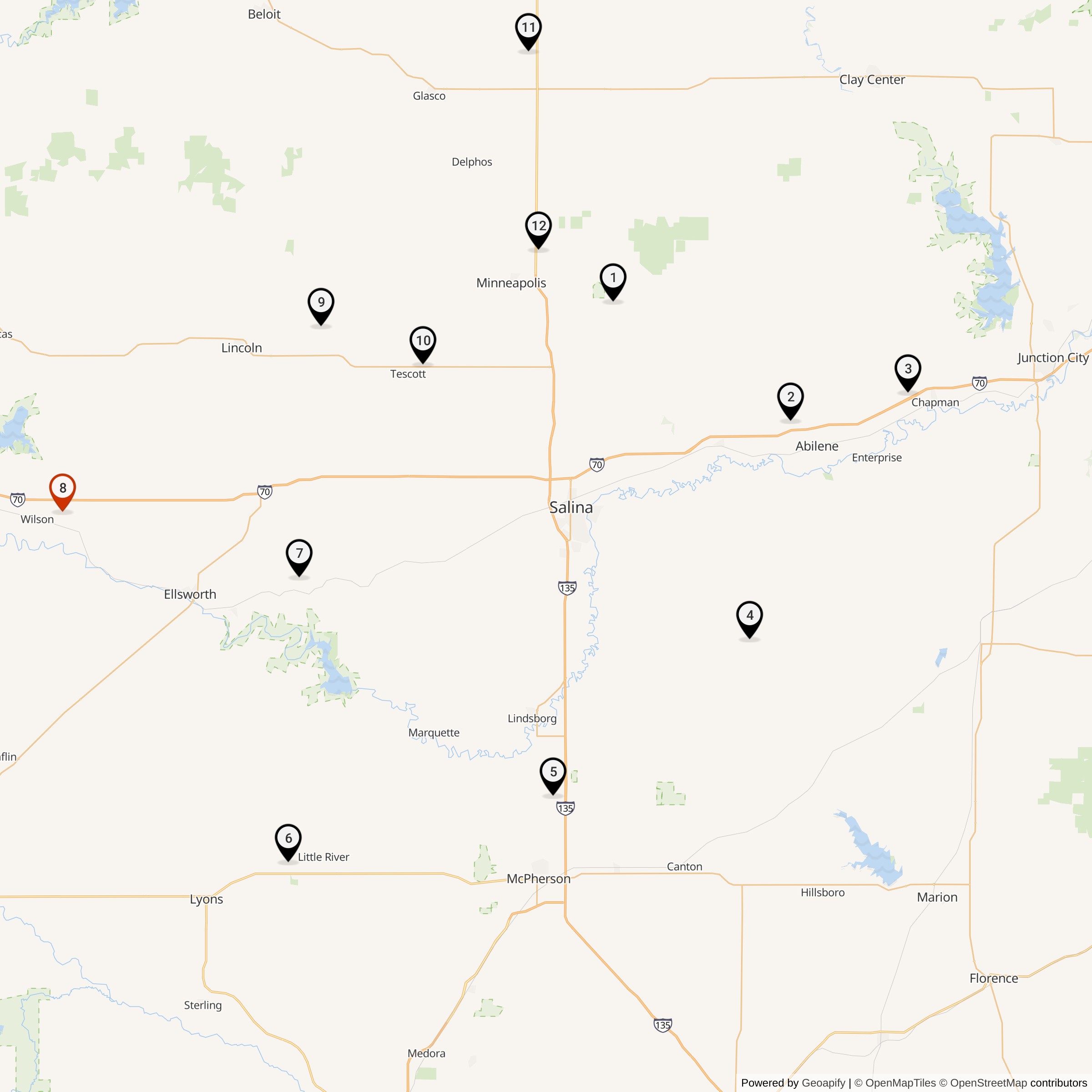
Atlas F Site 550-8 was an SM-65F Atlas vertical silo launch facility of the 550th Strategic Missile Squadron, assigned to Schilling Air Force Base near Salina, Kansas, and the 310th Strategic Aerospace Wing. It was one of twelve Atlas F launch complexes dispersed around Schilling AFB. Its military site code is 550-8.
The 550th Strategic Missile Squadron as a whole discontinued on 1965-06-25. The site is no longer active as a missile installation. It is a decommissioned and reused Atlas F complex on private property near Wilson, Kansas. The current public-facing reuse is Atlas Ad Astra, described by its operator as a missile-silo adventure resort and educational center for space habitat studies. The property offers guided tours, camping and vehicle/RV stays, and overnight lodging in the former launch-control-center space. Public access is only through the current operator's tours, bookings, or permission.
Location, Landscape, and Site Description
Atlas F Site 550-8 is in Ellsworth County, Kansas, near Wilson. Atlas Ad Astra states that the present property is four miles off I-70, two miles from Wilson, and twelve miles from Wilson Lake. The location places the former missile complex in the Smoky Hills country of central Kansas, in open rural terrain rather than on the grounds of Schilling AFB itself.Atlas F missiles at Schilling were not clustered on the base. They were dispersed across central Kansas so that each launch complex would have to be found and targeted separately. Site 550-8 stood as one point in a ring of twelve independent Atlas F silos around Salina and Schilling AFB. The open ground gave the Air Force space to build a hardened underground launch facility, construct access and support areas, manage propellant and power systems, and isolate the site from civilian development while still keeping it within the squadron's support network.
The Atlas F physical plant was larger and more complex than the word "silo" suggests. The missile was stored vertically underground in a deep silo-lift launcher. Above it were massive launch doors. Nearby underground spaces housed the launch-control center, crew areas, mechanical systems, and support equipment needed to maintain one liquid-fueled intercontinental ballistic missile on alert. The site had surface access roads, hardstands, communications and utility features, support-building pads, and security fencing. The current operator describes the surviving underground structure as including a former launch-control-center space and a 176-foot-deep silo. The same public site describes the property as a 24-acre tract with views of the surrounding countryside and wind farm.
Unlike a later Minuteman Launch Facility, Site 550-8 was not an unmanned silo watched from a distant Missile Alert Facility. It was a manned, self-contained Atlas F launch complex. The sites were manned twenty-four hours a day, seven days a week, during the active squadron period. That meant the site's daily life involved missile crews, security personnel, maintenance teams, communications support, power systems, fuel and oxidizer procedures, and the constant problem of keeping a liquid-fueled Atlas in a safe but launch-ready condition.
Strategic and Cold War Context
Atlas F Site 550-8 existed because the United States needed operational intercontinental ballistic missiles before the later solid-fueled Minuteman force could take over the main deterrent role. The Atlas was the Air Force's first operational ICBM. The National Park Service describes Atlas as the first operational U.S. Air Force ICBM, developed in several versions and ultimately deployed in Atlas D, E, and F configurations. The same NPS summary identifies Atlas F as the most advanced deployed Atlas type, held in a blast-proof silo-lift configuration and capable of launch in approximately ten minutes.The Schilling sites were part of that first-generation deterrent. In theory, a site like 550-8 gave Strategic Air Command a nuclear missile that could be launched across intercontinental range from the middle of the United States. In practice, it also exposed all the difficulty of early missile operations. Atlas F was hardened compared with earlier Atlas variants, but it was still a liquid-fueled system. It used RP-1 kerosene fuel and liquid oxygen oxidizer. The RP-1 could remain aboard the missile during alert, but liquid oxygen was loaded during the launch sequence. The Atlas airframe was also pressure stabilized, meaning that internal pressure was essential to maintain structural integrity. NPS compares an unpressurized Atlas to a deflated balloon.
This is why the site's isolated rural setting and hardened structure were only part of the story. Site 550-8 also represented the operational labor behind early ICBM deterrence. The missile had to be guarded, tested, powered, pressurized, communicated with, fueled when required, raised from the silo, and either launched or safely returned to a nonlaunch condition. That mission was demanding enough that Atlas became both a breakthrough and a transitional system. By the middle of the 1960s, the Air Force was already retiring Atlas in favor of more survivable and easier-to-maintain systems.
Construction and Activation
The current Atlas Ad Astra website says the property was built in 1959 and active until 1965, but the site-specific missile-history source gives 1960 for construction start.The larger Schilling Atlas F construction effort is better documented. Schilling was initially planned for nine silos, then increased to twelve individual sites near Bennington, Abilene, Chapman, Carlton, McPherson, Mitchell, Kanopolis, Wilson, Beverly, Tescott, Glasco, and Minneapolis. It identifies Utah-Manhattan-Sundt as the joint venture that won the nine-silo contract at $17.2 million and later received a $6.2 million contract for three additional lift-launcher silos. The same account notes that design changes doubled final costs, high water tables increased pumping costs at some excavations, and construction was marred by five fatalities and numerous injuries across the Schilling project.
The 550th Strategic Missile Squadron was organized at Schilling AFB on 1961-04-01 under the 310th Bombardment Wing, later the 310th Strategic Aerospace Wing. USAF Unit Histories lists the 550th's weapon system as SM-65F Atlas from 1961 to 1965 and states that the first Series F Atlas ICBM operational sites at the 550th SMS, Schilling AFB, and the 551st SMS, Lincoln AFB, were accepted by Strategic Air Command in June 1962. The same unit-history source states that the 550th was turned over to SAC on 1962-09-07 and declared operational on 1962-09-09.
Missile System and Technical Role
Site 550-8 housed the SM-65F Atlas, the final operational Atlas ICBM variant. The Atlas F missile was stored vertically in an underground silo-lift launcher. During a launch sequence, the overhead doors opened, the missile was elevated, liquid oxygen was loaded, and the missile launched from the raised position. This arrangement improved protection over earlier Atlas D and E shelter types, but it did not make the weapon simple. The site had to support a liquid-fueled missile, high-pressure systems, electrical power, environmental control, communications, guidance, propellant handling, emergency procedures, and a trained launch crew.The assigned missile for Site 550-8 was Atlas 25F. It was General Dynamics manufacturing number 25F, General Dynamics missile serial number 60-5548, and Air Force tail number 548. Its acceptance date was 1961-11-25 and a delivery date of 1962-01-31.
Atlas 25F had a later career after its Schilling alert service. The missile was launched successfully from Vandenberg AFB Space Launch Complex 3W on 1979-06-27, carrying a Star 37S-ISS / NOAA-A weather satellite payload.
Public-source descriptions of the Atlas F reentry system generally identify Atlas E/F missiles with the Mark 4 reentry vehicle and the W-38 nuclear warhead. The Smithsonian National Air and Space Museum describes the Mark 4 reentry vehicle as used on Titan I and Atlas E/F ICBMs deployed in the early 1960s and states that it carried a W-38 nuclear warhead with a yield of about 3.75 megatons.
Operational History
The active operational history of Site 550-8 was short, but intense. The 550th Strategic Missile Squadron was one of the first Atlas F squadrons to stand up. USAF Unit Histories records that the squadron was organized on 1961-04-01, turned over to SAC on 1962-09-07, and operational on 1962-09-09. From that point until early 1965, Site 550-8 was one of twelve missile complexes that gave Schilling AFB an Atlas F ICBM force.The site's daily operations were defined by the realities of liquid-fueled alert duty. The missile and site had to be kept in a condition that could support launch if ordered, while avoiding the hazards of propellant handling, pressurization failures, equipment faults, and crew error. Atlas F was more protected than earlier Atlas D and E deployments, but readiness still depended on people and equipment at the individual complex. The missile was not continuously raised from the silo and was not continuously loaded with liquid oxygen. In normal alert condition, the Atlas F remained protected in the silo with RP-1 fuel aboard, pressure and support systems maintained, and the launch crew and site systems ready to carry out the sequence of opening the doors, raising the missile, loading liquid oxygen, completing checks, and launching if a valid order arrived.
During the Cuban Missile Crisis in October 1962, the Schilling Atlas F force entered one of the most important alert periods of its service life. The SAC Missile Chronology states that, as a result of the crisis, the Series F Atlas squadrons at Schilling, Lincoln, Altus, and Dyess were required for the first time to place all twelve missiles on alert. For Site 550-8, this meant participation in a squadron-level alert posture in which the site was expected to be launch-ready in the Atlas F sense described above. It did not mean the missile was continuously standing above the silo or continuously filled with liquid oxygen. It meant the site, crew, communications, missile, launch machinery, and support systems had to be maintained at a heightened readiness level so the full launch sequence could be executed if ordered.
The 550th's operational period ended almost as quickly as it had begun. Secretary of Defense Robert McNamara announced in 1964 that the remaining first-generation ICBMs, including Atlas E/F and Titan I, would be phased out by the end of June 1965. USAF Unit Histories states that the first 550th SMS ICBM came off alert on 1965-02-01, the last came off alert on 1965-03-05, and the last ICBM was shipped on 1965-03-11. Headquarters SAC inactivated the 550th Strategic Missile Squadron on 1965-06-25.
Deactivation and Disposal
Site 550-8 left active missile service during the general phaseout of the first-generation Atlas and Titan I systems. The sequence matters because several different events are often compressed into the single word "decommissioned." The first 550th SMS ICBM came off alert on 1965-02-01. The last 550th SMS ICBM came off alert on 1965-03-05. The last ICBM was shipped on 1965-03-11. The squadron was discontinued on 1965-06-25.When Schilling AFB closed, responsibility for the former Schilling Atlas sites passed to F.E. Warren AFB, Wyoming, in July 1967, and that the sites were disposed of in March 1971. That means Site 550-8 likely remained part of a post-operational Air Force disposal portfolio for several years after missile operations ended. Disposal did not mean the underground complex disappeared. Like many Atlas F sites, the hardened structures survived in private hands, though military equipment, launch systems, and operational support hardware were removed, scrapped, sealed, or otherwise rendered unusable over time.
Site 550-8 also appears in later environmental records. EPA identifies it as "SCHILLING (EX) AIR FORCE ATLAS FAC S- 8," EPA ID KSN000703291, not on the National Priorities List, with a Non-NPL status of NFRAP, meaning the site did not qualify for the NPL based on existing information. The 2015 USACE Kansas FUDS inventory lists "SCHILLING AFB ATLAS S-08" in Ellsworth County, Wilson, property number B07KS0266, with HTRW and CON/HTRW project entries. DERP Table 9, listing active installations, BRAC locations, and FUDS properties that achieved final response complete before FY23, includes "SCHILLING AFB ATLAS S-08 / KS79799F031000" with two IRP projects. ProPublica's DERP-based "Bombs in Your Backyard" table lists Schilling AFB Atlas S-08 in Wilson, Ellsworth County, as Response Complete.
Current Status and Site Use
Atlas F Site 550-8 is a decommissioned and reused missile complex near Wilson, Kansas. The site is not active as a military installation and has no operational missile role. It is private property with a public-facing reuse as Atlas Ad Astra, a missile-silo adventure resort and educational center. Access is controlled by the current operator; visitors should use only official tours, bookings, or permission and should not trespass.Atlas Ad Astra describes the current site as an educational center for space habitat studies and an adventure resort. It advertises one-hour guided tours of the former Atlas F missile base, current tent camping, vehicle/vanlife camping, RV parking, and overnight stays in the former launch-control-center space. The website also describes future plans for more developed underground lodging and education-oriented reuse. It specifically warns visitors that the property is a historic missile base under active restoration and that risks include uneven terrain, open holes, protruding infrastructure, construction debris, stairs, tunnels, confined spaces, and other inherent hazards.
Chronology
- 1960 Construction began at Site 550-8.
- 1961-04-01 The 550th Strategic Missile Squadron was organized at Schilling AFB, Kansas.
- 1961-11-25 Atlas 25F, the assigned missile for Site 550-8, was accepted.
- 1962-01-31 Atlas 25F was delivered.
- 1962-06 The first Series F Atlas ICBM operational sites at the 550th SMS, Schilling AFB, and the 551st SMS, Lincoln AFB, were accepted by Strategic Air Command.
- 1962-09-07 The 550th Strategic Missile Squadron was turned over to SAC according to USAF Unit Histories.
- 1962-09-09 The 550th Strategic Missile Squadron was operational according to USAF Unit Histories.
- 1962-10 During the Cuban Missile Crisis, the Series F Atlas squadrons at Schilling, Lincoln, Altus, and Dyess were required for the first time to place all twelve missiles on alert.
- 1964-11-19 Secretary of Defense Robert McNamara announced that remaining first-generation ICBMs, including Series E and F Atlas and Titan I, would be phased out by the end of June 1965.
- 1965-02-01 The first 550th SMS ICBM came off alert according to USAF Unit Histories.
- 1965-03-05 The last 550th SMS ICBM came off alert according to USAF Unit Histories.
- 1965-03-11 The last 550th SMS ICBM was shipped according to USAF Unit Histories.
- 1965-06-25 Headquarters SAC inactivated the last remaining Atlas ICBM squadrons, including the 550th Strategic Missile Squadron at Schilling AFB.
- 1967-07 Responsibility for the former Schilling Atlas sites passed to F.E. Warren AFB after Schilling AFB closed.
- 1971-03 The Schilling Atlas sites were disposed of.
- 1979-06-27 Atlas 25F, formerly assigned to Site 550-8, launched successfully from Vandenberg AFB SLC-3W carrying the Star 37S-ISS / NOAA-A weather satellite payload, later NOAA-6.
- 2015-09-30 The USACE Kansas FUDS inventory listed Schilling AFB Atlas S-08 in Wilson, Ellsworth County, property number B07KS0266, with HTRW and CON/HTRW project entries.
- 2024-04-23 A 310th Space Wing history video was recorded at Wilson, Kansas, with the wing historian visiting the former Atlas F silo.
- 2024-05-02 DVIDS posted the 310th Space Wing "History Shorts: Atlas F Missiles and Strategic Deterrence" video.

Read about the Atlas at Schilling AFB
All Atlas Missile Silo Locations