
Atlas F Site 551-7 Missile Silo, Firth Nebraska
Longitude: -96.6392055565563
Site Type: Atlas F vertical silo launch facility
Missile Type: SM-65F Atlas
Missile Assigned to this Silo: GD mfg 22F; GD serial 60-5545; AF tail 545
Number of Launchers/Missiles: 1
Parent Base: Lincoln AFB
Missile Wing: 98th Strategic Aerospace Wing
Missile Squadron: 551st Strategic Missile Squadron
Current Site Use: Former Atlas F launch complex on private rural property southwest of Firth; visible surface remnants documented; FUDS TCE groundwater remediation record.
Site Ownership: Former USAF/DOD; Lincoln AFB Online Museum lists private ownership; FUDS response involves private landowners.
Accessible: No public access / private property
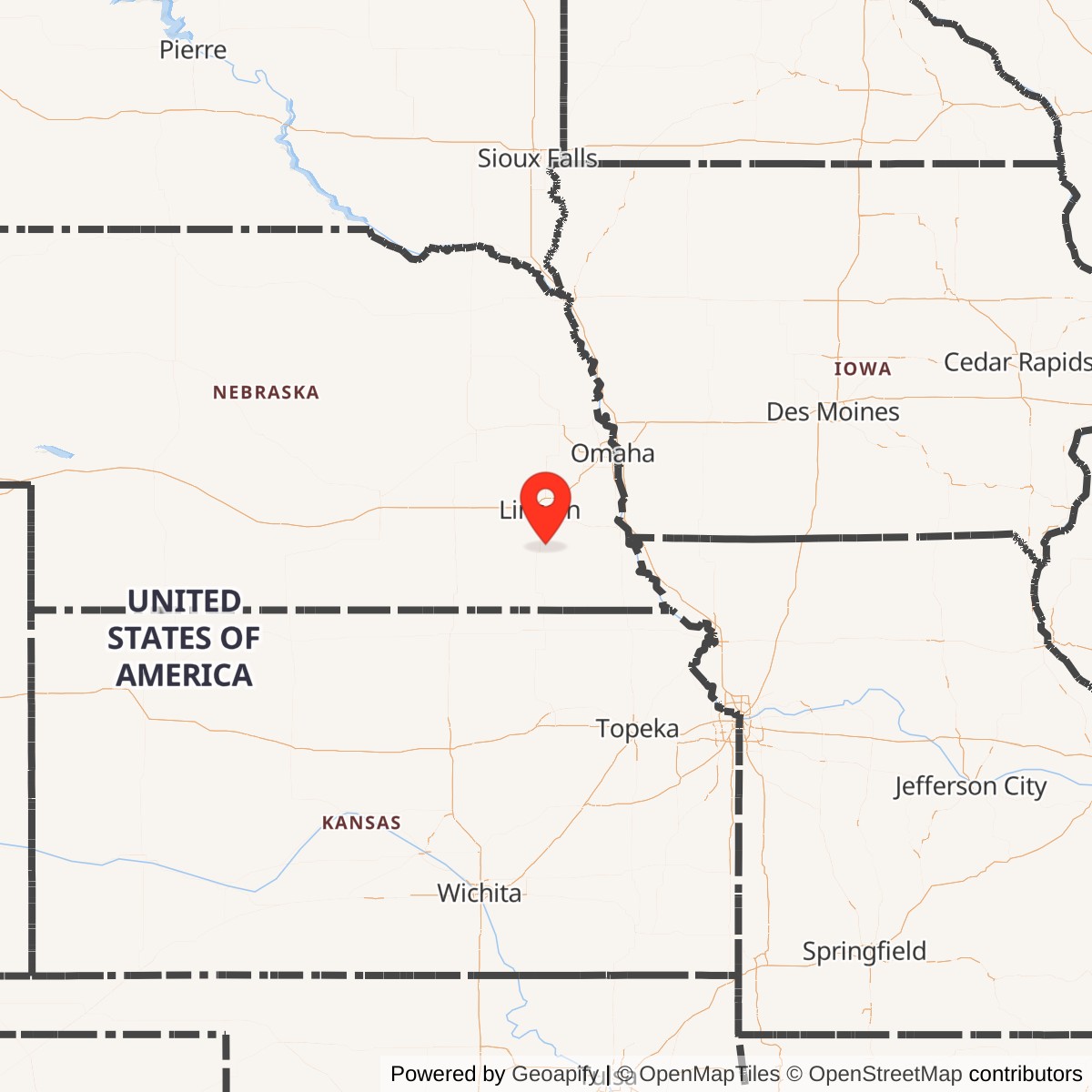
Atlas F Site 551-7 is the kind of Cold War place that can disappear in plain sight: a fenced rural property southwest of Firth, Nebraska, where a first-generation nuclear missile once sat in a deep hardened silo, where later photographs show concrete pads, vents, utility remnants, and small buildings still marking the ground, and where the longest-lived legacy is not the missile itself but the trichloroethene contamination that kept the former launch complex in the federal cleanup record decades after Atlas left Nebraska. The site's missile was never reborn as a space launcher. It did not get a second act over Vandenberg. Its story stayed in the soil, groundwater, and local landscape where Strategic Air Command briefly made the farm country south of Lincoln part of the nation's nuclear-alert system.
Atlas F Site 551-7 was one of the twelve SM-65F Atlas intercontinental ballistic missile launch complexes operated by the 551st Strategic Missile Squadron at Lincoln Air Force Base, Nebraska. The site is near Firth and Cortland in Gage County. It appears in sources as Atlas F Site 551-7, 551st Strategic Missile Squadron Site 7, Air Force Operational Site Number 7, Corps of Engineers Construction Site Number 4, LINCOLN AFB AF FAC S-7 in FUDS / DERP records, and LINCOLN (EX) ATLAS "F" FAC S-7 in EPA Superfund records.
The parent base was Lincoln AFB. The operational missile unit was the 551st Strategic Missile Squadron, associated with the 98th Strategic Aerospace Wing during the final Atlas F period. Atlas F launch complexes did not use a Minuteman-style remote Launch Control Center. Each Atlas F site was a self-contained, manned launch complex with an underground launch-control area connected to the missile silo, so the parent LCC field is not applicable for this site.
The missile assigned to Site 551-7 was General Dynamics manufacturing number 22F, General Dynamics serial number 60-5545, and Air Force tail number 545. The missile was accepted on 1961-10-12 and delivered on 1961-10-24 for the Lincoln AFB / 551st Strategic Missile Squadron operational ICBM mission. Unlike some former Atlas F missiles that later flew as space or test boosters, missile 22F was not later launched.
Site 551-7 is no longer an active missile installation. Squadron and Air Force records show the Lincoln Atlas F force leaving active service during the 1965 phaseout of first-generation ICBMs. The former launch complex is now private property and a FUDS environmental site associated with documented TCE soil and groundwater contamination. It is not open to the public.
Location, Landscape, and Site Description
Site 551-7 lies in the agricultural landscape south of Lincoln, Nebraska.The location is best described carefully because the public sources use different nearby-town labels. USACE describes the FUDS property as approximately three miles southwest of Firth, Nebraska. EPA lists the site street/location as three miles southwest of the city of Firth.
USACE FUDS records place LINCOLN AFB AF FAC S-7 in Gage County, and the USACE fact sheet describes the former Site 7 as being in Gage County. EPA's Superfund site-information page, however, lists the same EPA ID, NEN000703243, with the Firth address and Lancaster County. Because the coordinate falls at the county-line edge and the USACE FUDS record is the more site-specific cleanup source, this history treats the former launch complex as a Gage County.
The site was one point in the ring of Atlas F launch complexes around Lincoln AFB. Like the other eleven 551st SMS sites, it was deliberately separated from the parent base and from the other launch sites. Its farm-country setting was part of the weapons system. The Air Force wanted the sites dispersed so that no single attack against Lincoln AFB could destroy the entire squadron, and so that each missile complex would present a separate targeting problem.
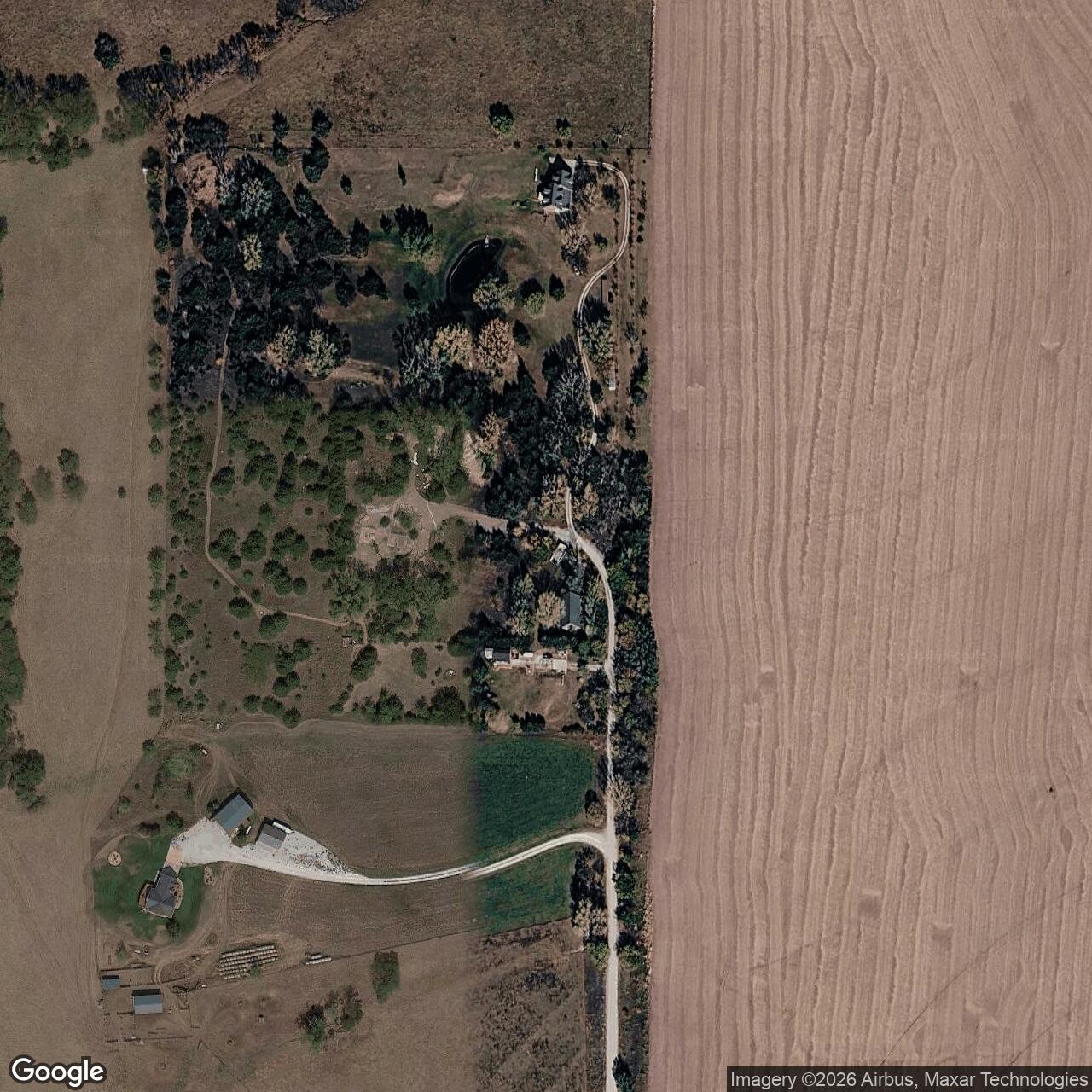
The visible remains documented in public images show the post-military surface of an Atlas F launch complex. Satellite images show a rectangular former military property embedded in farmland, with a surviving access road entering from the east and a concentration of concrete features and disturbed ground near the center. Lincoln Air Force Base Online Museum photographs from December 2012 show concrete pads, vents or utility features, small buildings or sheds, and other surface remnants on private property. The images are useful historical documentation, but they should not be read as an invitation to enter the site. Former Atlas F complexes can contain confined spaces, unsafe underground structures, contaminated groundwater, unstable concrete, hazardous debris, and private-property restrictions.
Strategic and Cold War Context
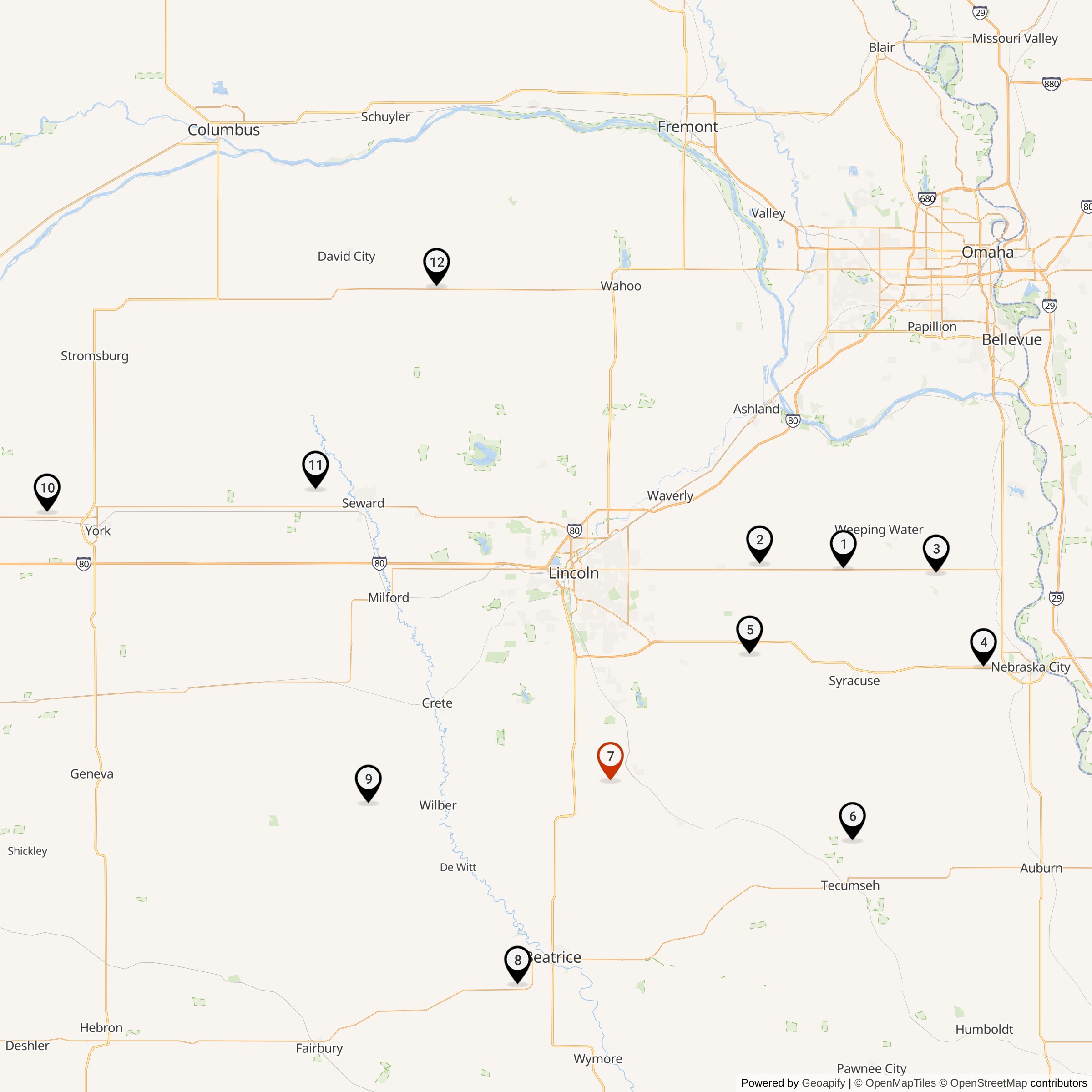
Site 551-7 existed because Strategic Air Command needed a dispersed, hardened, intercontinental missile force before second-generation solid-fueled missiles could fully assume the nuclear-alert mission. Atlas was the first operational American ICBM family. Atlas D and Atlas E provided earlier operational capability, but Atlas F was the final and most hardened operational Atlas variant. It stored the missile vertically in an underground silo, protected it below grade, and raised it to the surface for launch.The Lincoln missile field was part of the rapid expansion of the early-1960s ICBM force. The 551st Strategic Missile Squadron at Lincoln AFB was one of the Atlas F units that put the final operational Atlas model into the field. The squadron's twelve sites were not clustered on base. They were distributed around towns including Elmwood, Eagle, Avoca or Nehawka, Nebraska City, Palmyra, Tecumseh, Firth or Cortland, Beatrice, Wilber, York, Seward, and Brainard. That distribution turned ordinary rural roads, farms, and county boundaries into part of a national deterrent system.
Atlas F was a powerful but demanding weapon. It used RP-1 kerosene fuel and liquid oxygen oxidizer. The missile could be stored vertically in the silo with RP-1 aboard, but liquid oxygen had to be loaded as part of the launch sequence. The missile was then raised on an elevator and launched from above the silo rather than fired from inside it. This made Atlas F far more cumbersome than later Minuteman missiles, but it represented an important step away from vulnerable surface pads and toward hardened, dispersed missile alert.
When a Lincoln Atlas F site was placed in an operational launch-ready alert posture, that did not mean the missile was continuously raised above the silo or continuously loaded with liquid oxygen. It meant the assigned missile, trained launch crew, command-and-control links, authentication procedures, communications, environmental-control systems, electrical and hydraulic systems, security force, fuel and oxidizer handling equipment, and maintenance posture were ready so the site could proceed through the Atlas F launch sequence as quickly as the system allowed after receipt of a valid launch order.
The Cuban Missile Crisis showed why that posture mattered. Lincoln AFB Online Museum history states that by October 1962 most of Lincoln's Atlas F missiles were operational and that members of the 551st pulled long two-day shifts because the number of crews trained on the system was limited. Site 551-7 should be understood within that crisis environment: not as a symbolic Cold War landmark, but as one of the specific, staffed, guarded launch complexes that turned a national nuclear emergency into sustained shift work at dispersed rural sites.
Construction and Activation
The broader 551st SMS record gives the construction context. The 551st Strategic Missile Squadron was organized at Lincoln AFB on 1961-04-01 and later operated twelve Atlas F launch complexes in eastern Nebraska. USAF unit-history material states that the original Lincoln planning called for nine Atlas F silos and that three more were later added, bringing the total to twelve. The same summary places construction of the Lincoln sites in the 1959-to-1962 period and identifies the surrounding towns where the silos were built.Lincoln AFB Online Museum history states that construction finally ended in June 1962 and that Atlas F missiles were shipped from their construction plants and placed in the ground. It also notes that the 551st began in a small building on the west edge of the base before moving to Building 310, the Missile Assembly and Maintenance Shop. Building 310 supported missile maintenance, crew training, administrative work, and the briefing of crews before they departed for their assigned sites.
The Nebraska History article "Rural Communities and Nuclear Missile Base Construction in Nebraska" helps explain the scale of this work. It emphasizes that the Atlas construction program had a large regional impact and that thousands of workers and contractors were involved in building the missile bases under Cold War schedule pressure. The Atlas F silo itself was an enormous underground structure. Although only small parts of a former site are visible at ground level today, the operational complex extended deep underground and included the launch silo, launch-control spaces, support systems, utilities, access features, and the aboveground infrastructure needed to keep a liquid-fueled ICBM in alert status.
Site 551-7's assigned missile was General Dynamics manufacturing number 22F, General Dynamics serial number 60-5545, and Air Force tail number 545. The missile acceptance date was 1961-10-12 and the delivery date was 1961-10-24. Those dates fall before the site's reported 1962 turnover, which reflects the fact that missile manufacture, acceptance, delivery, site construction, Air Force acceptance, crew training, and operational readiness were separate processes.
As with the other Lincoln Atlas F complexes, delivery of the missile did not by itself make the site operational. The site had to be structurally complete, its equipment installed and checked out, crews trained, communications integrated, and the broader squadron ready to support alert operations. The result was a short but intense operational life: the site went from construction to alert service to decommissioning in only a few years.
Missile System and Technical Role
The missile system at Site 551-7 was the SM-65F Atlas, commonly called Atlas F. Atlas F was a first-generation American ICBM built by Convair / General Dynamics. It was liquid-fueled, pressure-stabilized, and operationally complex. Its stainless-steel "balloon tank" structure required internal pressure to maintain rigidity, one reason Atlas operations demanded careful technical procedures even when the missile was not being launched.The Atlas F launch method was distinctive. The missile was stored vertically inside a hardened underground silo. In a launch sequence, liquid oxygen was loaded, the silo door opened, the missile was elevated to the surface, and the missile launched from the raised position. The silo protected the missile when not being launched, but Atlas F was not a true hot-launch-from-silo weapon like later Minuteman. That difference is central to understanding the site's operation and the limits of its readiness.
Site 551-7 was a self-contained launch complex rather than an unmanned Minuteman-style Launch Facility. Atlas F launch crews served at the site itself, using the underground control spaces tied to the launch silo. Maintenance teams, security personnel, communications technicians, propellant specialists, and other support personnel were essential to keeping the site on alert. In practical terms, a single Atlas F missile required a small guarded industrial plant around it.
Public-source technical descriptions identify the Atlas E/F reentry system as the Avco Mark 4 reentry vehicle carrying the W-38 thermonuclear warhead. The Smithsonian National Air and Space Museum describes the Mark 4 as an unflown reentry vehicle used on U.S. Air Force Titan I and Atlas E/F ICBMs, and states that it carried a W-38 warhead with a yield of about 3.75 megatons.
The assigned missile's later record is simple but historically useful. Missile 22F did not become a satellite launcher or a later test booster. Some Atlas F missiles outlived the ICBM mission as space boosters; Site 551-7's missile did not.
Operational History
Site 551-7's operational history was short, but it sat inside one of the most urgent moments of the early missile age. The 551st Strategic Missile Squadron was part of Strategic Air Command's attempt to field hardened, dispersed ICBMs quickly. From Lincoln AFB, the squadron operated twelve Atlas F launch complexes spread around eastern Nebraska. Each site had its own crew and support requirements, but the field depended on the parent base for maintenance, logistics, training, administration, weapons-system support, and command structure.The site's daily operational life would have been defined by readiness, maintenance, and caution. Atlas F was not a simple sealed missile in a tube. It required continuous attention to power, pressurization, environmental control, hydraulics, communications, security, and propellant-related systems. The missile's liquid oxygen launch requirement meant that the launch sequence involved hazardous cryogenic oxidizer handling. Crew members had to know the system well enough to act quickly under alert conditions while still respecting the technical hazards of a first-generation liquid-fueled ICBM.
Lincoln AFB Online Museum history states that the missile crews worked long shifts during the Cuban Missile Crisis because there were not yet enough trained crews for the system. For Site 551-7, this means that its most historically significant operational period was likely not a dramatic launch or accident, but the sustained routine of alert duty in October 1962: crews on extended shifts, security at a remote rural site, communications checked, missile equipment maintained, and the site ready to begin the Atlas F launch sequence if the national command authority issued a valid order.
The broader Air Force and SAC phaseout moved quickly. By 1964 and 1965, second-generation solid-fueled missiles, especially Minuteman, were making the first-generation Atlas force obsolete. Minuteman could remain on alert with solid propellant, be remotely monitored, and launch more rapidly from hardened silos. Atlas F remained a vital transitional system, but it was expensive and labor-intensive for the readiness it provided.
USAF unit-history material states that the first ICBM in the 551st came off alert on 1965-03-10, the last ICBM came off alert on 1965-04-12, the last ICBM was shipped on 1965-04-20, and the 551st Strategic Missile Squadron was inactivated in June 1965. Site 551-7 therefore represents a compressed operational life: built under emergency Cold War urgency, placed in service during the missile-alert buildup, stressed by the Cuban Missile Crisis, and removed from the active force after only a few years.
Deactivation and Disposal
Site 551-7 left active missile service during the 1965 retirement of the Atlas F force. The 551st SMS unit-history summary places the first 551st ICBM off alert on 1965-03-10, the last ICBM off alert on 1965-04-12, the last ICBM shipped on 1965-04-20, and the squadron inactivation in June 1965.The assigned missile, 22F / AF tail 545, did not have a documented later launch career. The missile was not launched and was salvaged as scrap. That record distinguishes Site 551-7 from some other Atlas F locations whose former missiles later served as satellite boosters or test vehicles. For Site 551-7, the physical launch complex and the assigned missile both ended their missile-era usefulness without a later successful flight.
The Atlas F phaseout was not driven by post-Cold War arms-control treaties. It happened because first-generation liquid-fueled ICBMs were quickly superseded by more survivable, faster-reacting, solid-fueled systems. Atlas F had helped bridge the gap between early, vulnerable launch pads and later hardened solid-fuel missile fields, but by 1965 it was a temporary solution whose time had passed.
The later disposal of the Site 551-7 property placed it in the former-defense-site cleanup universe rather than in a preserved historic-site pathway. The surviving surface remains visible in photographs and satellite imagery appear to be on private property, and the environmental record is tied to FUDS / DERP response rather than public interpretation.
Current Status and Site Use
Site 551-7 is now a former Atlas F launch complex on private property with ongoing or unresolved environmental-response significance. Lincoln Air Force Base Online Museum identifies the site today as private ownership. USACE identifies it as a FUDS property and documents TCE contamination in soil and groundwater. EPA identifies LINCOLN (EX) ATLAS "F" FAC S-7 as EPA ID NEN000703243, not on the National Priorities List, with a non-NPL status of Referred to Removal - NFRAP and an NFFA notation. That EPA status should not be confused with the separate Department of Defense / USACE environmental-response record, which continued to track Site 7 as a FUDS property.The site's surface remains are visible in public photographs, especially the Lincoln AFB Online Museum images from 2012 and the satellite images. These show a former military property with surviving concrete pads, utility features, small structures, trees, and access roads. Some of the visible features may reflect post-military reuse or modification, and they should not be treated as a complete inventory of the original Atlas F complex.
The former launch complex is not a public historic site. It is private property, and USACE's environmental record indicates that landowner access was a major factor in remediation activities. The site should not be entered without lawful permission. Former Atlas F properties can present physical and environmental hazards including confined spaces, vertical drops, contaminated groundwater, unstable structures, oxygen-deficient underground spaces, debris, and residual industrial contamination.
Chronology
- 1961-04-01 The 551st Strategic Missile Squadron was organized at Lincoln AFB.
- 1961-10-12 Missile 22F / AF tail 545 was accepted.
- 1961-10-24 Missile 22F / AF tail 545 was delivered for the Lincoln AFB / 551st SMS operational ICBM mission.
- 1962 Lincoln AFB Online Museum history states that construction of the Lincoln Atlas F silos was completed in June and that most Lincoln Atlas F missiles were operational by the Cuban Missile Crisis.
- 1962-10 During the Cuban Missile Crisis, operational Lincoln Atlas F sites were held in a heightened launch-ready alert posture; for Atlas F, this did not mean continuous aboveground or liquid-oxygen-loaded status.
- 1965-03-10 USAF unit-history material states that the first 551st SMS ICBM was removed from alert.
- 1965-04-12 USAF unit-history material states that the last 551st SMS ICBM was removed from alert.
- 1965-04-20 USAF unit-history material states that the last 551st SMS ICBM was shipped out.
- 1965-06-25 The 551st Strategic Missile Squadron was inactivated according to USAF unit-history material.
- 2001 GAO records listed LINCOLN AFB AF FAC S-7 / B07NE0096 as a FUDS property in Gage County with eligible hazards and one eligible cleanup project.
- 2011-07 USACE states that a performance-based contract was awarded for remedial design, pilot study, performance monitoring, proposed plan, and decision-document work.
- 2012-03-09 USACE states that right of entry had been refused by all landowners except the silo-area parcel property landowner, limiting groundwater remediation outside the silo parcel.
- 2012-12-28 Lincoln Air Force Base Online Museum photographs documented visible surface remains at the privately owned Site 7 property.
- 2015-04-07 USACE published its public FUDS fact sheet for Former Lincoln Air Force Base, Atlas "F" Missile Site 7, near Firth, Nebraska.
- 2015 The USACE FUDS Inventory for Nebraska listed LINCOLN AFB AF FAC S-7 / B07NE0096 in Gage County with HTRW site numbers 11 and 12.
- 2024 DOD/DENIX Table 6 listed LINCOLN AFB AF FAC S-7 / NE79799F047100 with NPL status "Not Listed" and an IRP final response-complete target of FY 2043.
Read about the Atlas at Lincoln AFB
All Atlas Missile Silo Locations