
Atlas F Site 556-6 Missile Silo, Au Sable Forks New York
Longitude: -73.64261645966246
Site Type: Atlas F vertical silo launch facility
Missile Type: SM-65F Atlas
Missile Assigned to this Silo: GD mfg 100F; GD serial 62-12136; AF tail 136; accepted 1962-07-19; delivered 1962-07-21; assigned to 556th SMS Site 6; launched 1969-09-16 from Vandenberg AFB Gantry A-3 with ABRES RMP-B12 reentry-vehicle test payload; successful.
Number of Launchers/Missiles: 1
Parent Base: Plattsburgh AFB
Missile Wing: 380th Strategic Aerospace Wing
Missile Squadron: 556th Strategic Missile Squadron
Corps of Engineers Site ID: 5
Current Site Use: Former Atlas F silo at 641 Dry Bridge Road, Black Brook; privately owned and unmaintained former missile property with entrance road/asphalt and silo entrance area visible; 2020 USACE/NYDEC UST investigation found no UST and concluded suspected tank was previously removed.
Site Ownership: Private ownership documented in 2020 USACE/NYDEC closure report
Accessible: No public access / private property
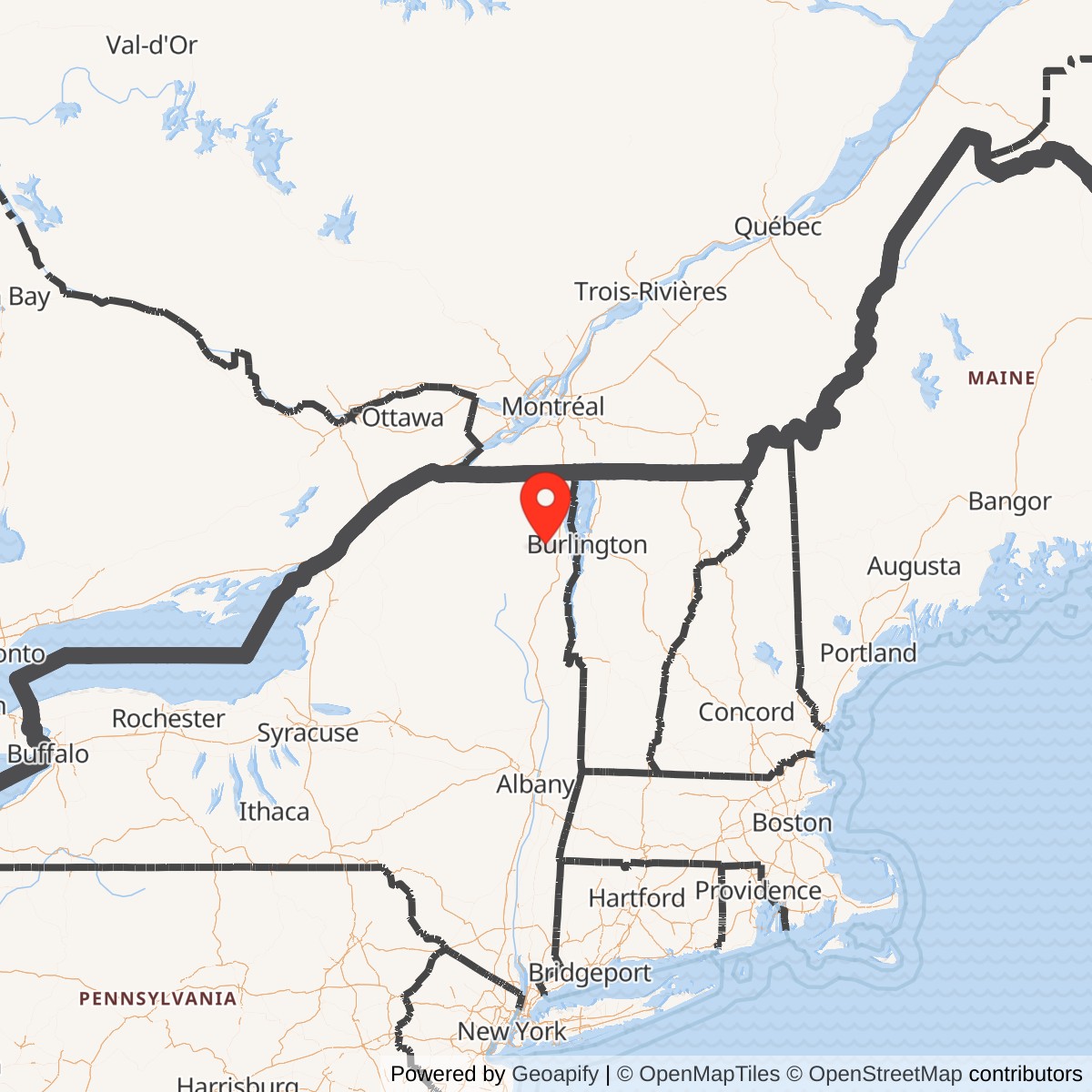
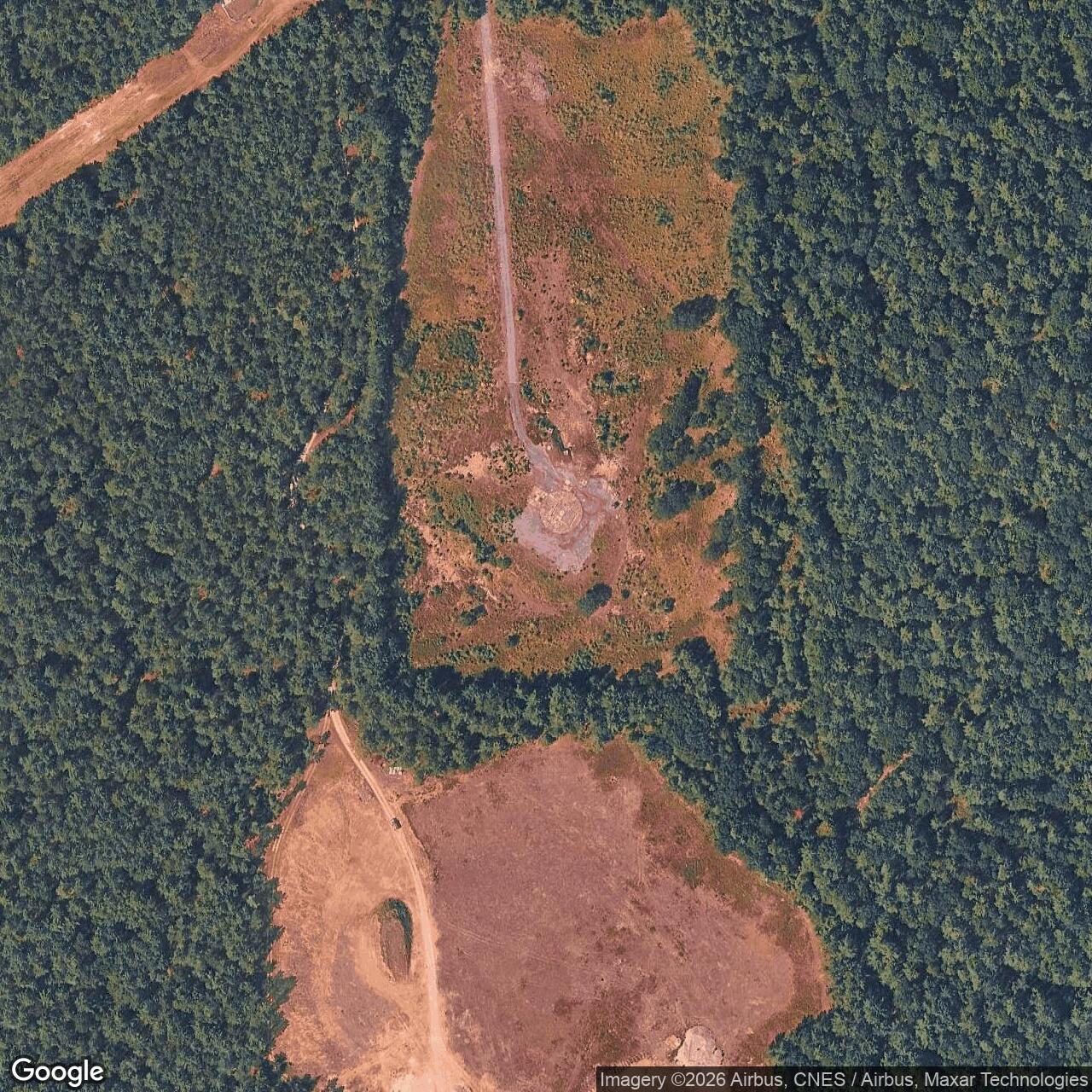
A narrow road into the woods near Au Sable Forks once led to one of the strangest places in the Adirondacks: a nuclear launch complex hidden under a clearing in the mountains. At Atlas F Site 556-6, an intercontinental missile stood vertically underground, sealed behind massive silo doors, connected to its own buried control and support spaces, and ready, after fueling and checkout, to rise into the open air. The site lasted only a few years as an active weapon, but its concrete, steel, environmental record, and later missile career make it one of the more vivid remnants of Plattsburgh's brief ICBM era.
Atlas F Site 556-6 was a single-missile SM-65F Atlas intercontinental ballistic missile launch facility operated by the 556th Strategic Missile Squadron, 380th Strategic Aerospace Wing, Strategic Air Command, with support from Plattsburgh Air Force Base, New York. The site is best identified today as the former Atlas S-6 property at 641 Dry Bridge Road, Black Brook, near Au Sable Forks, Clinton County, New York. The launch complex is inactive and decommissioned.
Because Atlas F launch complexes were self-contained vertical-silo facilities, Site 556-6 did not have a Minuteman-style remote parent Launch Control Center. Its launch-control and support functions were part of the individual Atlas F complex itself. The site is currently private property, and a 2020 U.S. Army Corps of Engineers / New York State Department of Environmental Conservation closure report described it as privately owned and unmaintained, with grasses, wildflowers, weeds, asphalt around the entrance road and silo entrance, and visible former missile-site features.
Location, Landscape, and Site Description
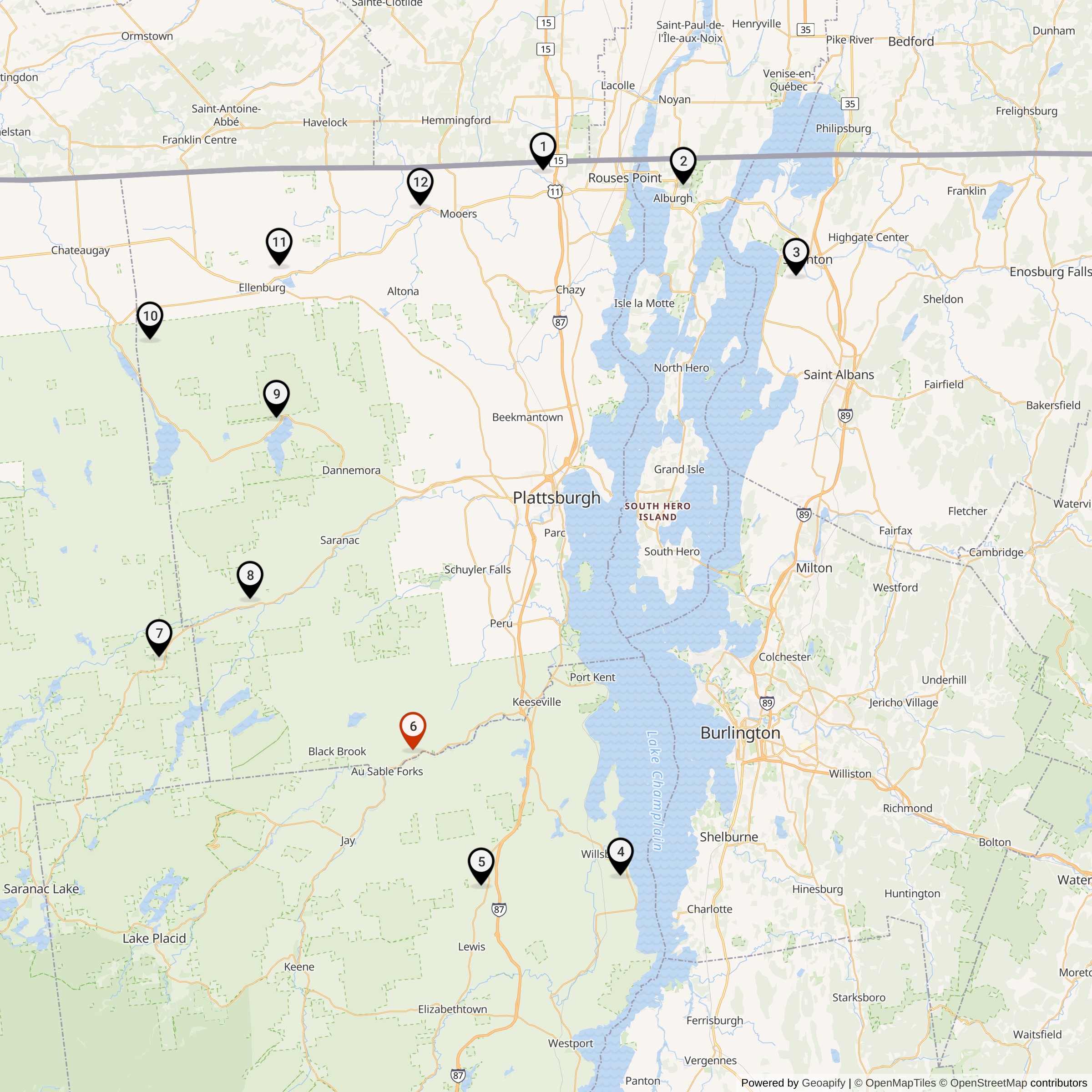
Site 556-6 lies in the Adirondack foothills northeast of Au Sable Forks, in the town of Black Brook, Clinton County, New York. Its coordinates place it off Dry Bridge Road near Buck Hill Road in a wooded and rural landscape rather than on the Plattsburgh base itself. Plattsburgh Air Force Base was east-northeast of the site, on the western side of Lake Champlain. The Plattsburgh Atlas field was deliberately dispersed around the North Country so that no single attack on the parent base could destroy the entire missile force.The site was one of twelve Atlas F complexes built in a ring around Plattsburgh Air Force Base: eight in Clinton County, two in Essex County, and two in northern Vermont. A 2020 environmental site report identifies the property as Atlas S-6, FUDS Property C02NY0211, located at 641 Dry Bridge Road, Black Brook, New York. That report places the former silo property on Dry Bridge Road near Buck Hill Road and identifies the investigation area around the former missile-site surface features. The same report's appended site-layout material refers to the access road, silo doors, chain-link security fence, tower, monitoring wells, soil-sampling locations, an underground diesel fuel oil tank area, and the Atlas missile silo.
As an Atlas F site, 556-6 was not simply a missile stored in a hole. The complex included the deep vertical silo, the launch-support structures needed to raise the missile to the surface, power and environmental systems, propellant and oxidizer support equipment, communications links, and a hardened underground control area. The 2020 closure report's description of asphalt around the entrance road and silo entrance indicates that key surface circulation and launch-area paving remained visible decades after decommissioning.
Strategic and Cold War Context
Site 556-6 existed because the early Cold War missile race demanded an ICBM force that could be placed on alert quickly, dispersed over broad territory, and made harder to destroy than a small number of exposed launch pads. The Atlas F represented the final operational Atlas ICBM configuration. It moved the Atlas into a vertical underground silo-launcher complex, a major survivability improvement over earlier aboveground or semi-hardened arrangements. The missile still had to be raised from the silo before launch, but storing it vertically underground reduced its exposure before the final launch sequence.The Plattsburgh Atlas deployment was unusual because it placed first-generation ICBMs in the northeastern United States, east of the Mississippi River, in a region better known for mountains, farms, paper towns, and the Lake Champlain corridor than for nuclear launch sites. A 2024 Adirondack Life account describes how, in 1959, a property owner in the Au Sable Forks area drew attention to Air Force test drilling east of town. The Air Force initially treated such surveying as routine, while the Pentagon denied knowledge of a specific missile installation. The secrecy did not last. The same account notes that the region eventually received a dozen rural missile installations around Plattsburgh, including the Au Sable Forks site.
The site also reflected the briefness of the first-generation ICBM era. The Atlas F could deliver a thermonuclear warhead across intercontinental range, but it used RP-1 kerosene fuel and liquid oxygen. The RP-1 fuel could remain aboard the missile, but liquid oxygen was cryogenic and had to be loaded before launch. This made Atlas F more responsive than earlier Atlas systems in some respects, yet still slower and more operationally demanding than the solid-fueled Minuteman missiles that were entering service at the same time.
Construction and Activation
Construction of the Plattsburgh Atlas F field began in the early 1960s, and the 556th Strategic Missile Squadron was organized at Plattsburgh to operate the new sites. The HAER history of Plattsburgh Air Force Base states that construction began on twelve Atlas F ICBM sites under Plattsburgh AFB control during the early 1960s, all within a fifty-mile radius of the base. It also notes that a portion of a flightline hangar at Plattsburgh was used as a missile assembly area and that installation of all twelve Atlas F missiles took several additional months because of sub-zero weather and water seepage.Atlas missile 100F, General Dynamics serial 62-12136 and Air Force tail number 136, was accepted on 1962-07-19 and delivered on 1962-07-21. Those dates show that the Au Sable Forks complex had received its missile months before Headquarters SAC declared the 556th Strategic Missile Squadron operational.
Official SAC chronology context places the squadron's major milestones in sequence. Headquarters SAC activated the 556th Strategic Missile Squadron at Plattsburgh AFB on 1961-10-01, identifying it as the last Series F Atlas squadron. Headquarters SAC later declared the 556th Strategic Missile Squadron operational on 1962-12-20, completing the deployment of the Atlas ICBM force. For Site 556-6, the most conservative operational interpretation is that the individual complex was part of the field being armed and brought to readiness in 1962, with the squadron-level operational declaration coming on 1962-12-20.
Missile System and Technical Role
Site 556-6 housed an SM-65F Atlas missile in a vertical silo-launcher complex. The Atlas F was a liquid-fueled first-generation ICBM built by General Dynamics / Convair. In public-source descriptions of the Plattsburgh Atlas F system, the missile used RP-1 fuel and liquid oxygen, carried a General Electric Mark IV reentry vehicle with a W-38 thermonuclear warhead, and had a range of roughly 6,000 miles. The W-38 yield was approximately 3.8 megatons of TNT.The assigned missile for Site 556-6 is unusually well documented. The missile was General Dynamics manufacturing number 100F, General Dynamics missile serial number 62-12136, and Air Force missile tail number 136. It was accepted on 1962-07-19, delivered on 1962-07-21, assigned to the 556th Strategic Missile Squadron at Site 6, and later used after its operational ICBM career for an ABRES reentry-vehicle test. Its later launch occurred on 1969-09-16 from Vandenberg AFB, Gantry A-3, with an ABRES RMP-B12 payload, and the listed outcome was successful.
Atlas F alert operations required a careful distinction. An operational launch-ready alert posture did not mean that the missile sat aboveground, continuously raised, or continuously loaded with liquid oxygen. In normal alert configuration, the missile remained vertical inside the silo. RP-1 fuel was kept aboard, while liquid oxygen was loaded only during the launch sequence. A launch order would require the crew and equipment to complete checkout, load liquid oxygen, open the heavy silo doors, raise the missile, lock it into launch position, and proceed through final launch steps. If there was a launch hold after the missile was raised, the crew could top off liquid oxygen for a limited time, but Atlas F's cryogenic oxidizer and exposed raised position made prolonged aboveground alert impractical.
Operational History
The 556th Strategic Missile Squadron operated the twelve Atlas F sites around Plattsburgh Air Force Base. Site 556-6, near Au Sable Forks, was one of those individual launch complexes. The sites were geographically separate from the parent base and were manned continuously during the squadron's active period. The Atlas sites as manned 24 hours a day, seven days a week, 365 days a year while the squadron was active. That manning reflected the nature of Atlas F operations: launch crews, maintenance technicians, security personnel, and support teams had to keep a complex liquid-fueled weapon and its hardened facility ready despite remote locations, severe weather, and the technical demands of early ICBM alert duty.The Cuban Missile Crisis occurred while the Plattsburgh Atlas field was still in the process of reaching full operational status. During the crisis, all operational 556th sites were at a high level of alert and ready to launch if necessary. For Site 556-6 specifically, the assigned missile had already been delivered on 1962-07-21, but the official SAC chronology did not declare the 556th Strategic Missile Squadron operational until 1962-12-20. The careful reading is that the Plattsburgh field was under heightened readiness pressure in October 1962, while the squadron-level operational declaration came afterward. Where sources refer to an operational launch-ready alert posture for Atlas F, it should be understood as crewed readiness to fuel, raise, and launch the missile, not as a missile continuously raised above the silo or continuously loaded with liquid oxygen.
Site 556-6 did not remain active long. By late 1964, Defense Secretary Robert McNamara had announced the accelerated phaseout of first-generation ICBMs, including the Atlas and Titan I systems. Plattsburgh's Atlas F missiles were removed from their silos, and usable equipment and missiles were diverted to other Air Force uses, including space-launch and test programs. The 556th Strategic Missile Squadron was officially inactivated on 1965-06-25.
Deactivation and Disposal
The deactivation of Site 556-6 was part of a national decision to retire the first generation of American ICBMs. Atlas F had filled an urgent strategic gap, but by 1964-1965 solid-fueled Minuteman missiles and other newer systems made the liquid-oxygen Atlas force obsolete. HAER documentation for Plattsburgh AFB states that the Department of Defense announced the phaseout of first-generation ICBMs in November 1964; the Atlas F missiles assigned to Plattsburgh were removed from their silos; equipment was salvaged for the Air Force space program; and the sites were divested from Air Force ownership.The 556th Strategic Missile Squadron was inactivated on 1965-06-25.
Unlike later Minuteman and Peacekeeper sites removed under arms-control verification regimes, the Plattsburgh Atlas F silos were not generally imploded under a strategic arms-reduction treaty. The Adirondack Life account notes that the North Country silos remain because they were not treated as ongoing international treaty threats in the same way later launch facilities were. Instead, they moved into a mixed afterlife of private ownership, reuse attempts, environmental investigation, and long-term physical survival. For Site 556-6, the 2020 closure report shows that former missile-site infrastructure and environmental concerns remained relevant more than five decades after the missile left.
Current Status and Site Use
The former Site 556-6 launch complex is decommissioned, inactive, and privately owned. It is not a public historic site. The best available current-status source is the 2020 USACE/DEC closure report, which describes Atlas S-6 at 641 Dry Bridge Road, Black Brook, New York, as privately owned and unmaintained, covered by grasses, wildflowers, and weeds, with asphalt comprising the entrance road and surrounding the missile silo entrance.The site remains a former missile property rather than an active military installation. Public access should be treated as closed unless the owner grants permission.
Chronology
- 1959 Air Force test drilling near Au Sable Forks reportedly drew local attention to the future missile-site area.
- 1960 Construction began on Site 556-6, exact month and day not identified in the site-specific source.
- 1961-10-01 Headquarters SAC activated the 556th Strategic Missile Squadron at Plattsburgh AFB as the last Series F Atlas squadron.
- 1962-07-19 Atlas missile 100F, General Dynamics serial 62-12136 and Air Force tail number 136, was accepted.
- 1962-07-21 Atlas missile 100F was delivered for assignment to the 556th Strategic Missile Squadron, Site 6, at Plattsburgh AFB.
- 1962-10 During the Cuban Missile Crisis, operational 556th sites were placed at a high level of alert; Atlas F alert did not mean continuously raised or continuously LOX-loaded.
- 1962-12-20 Headquarters SAC declared the 556th Strategic Missile Squadron operational, completing deployment of the Atlas ICBM force.
- 1963-03 A SAC Series F Atlas launch exercise from Vandenberg included crews from several Atlas F squadrons, including the 556th at Plattsburgh; this was squadron-level, not site-specific.
- 1964-11-19 Secretary of Defense Robert S. McNamara announced that remaining first-generation ICBMs, including Atlas systems, would be phased out by the end of fiscal year 1965.
- 1965-06-25 Headquarters SAC inactivated the 556th Strategic Missile Squadron at Plattsburgh AFB.
- 1969-09-16 The former Site 556-6 missile, Atlas 100F, was successfully launched from Vandenberg AFB, Gantry A-3, on an ABRES RMP-B12 reentry-vehicle test.
- 2020-10-27 A GPR and test-pit investigation was conducted at the former Atlas S-6 property for a suspected underground storage tank area.
- 2020-12 The Site Closure Report for Atlas S-6, FUDS Property C02NY0211, concluded that no UST was found and that the suspected tank had apparently been removed earlier.
Plattsburgh history-office packet on Atlas Missile Deployment
Read about the Atlas at Plattsburgh AFB
All Atlas Missile Silo Locations