Atlas E Site 566-8 Missile Silo, Greeley Colorado
Longitude: -104.861855408
Site Type: Atlas E single-missile coffin launcher complex
Missile Type: SM-65E Atlas
Number of Launchers/Missiles: 1
Parent Base: F.E. Warren AFB
Missile Wing: 389th Strategic Missile Wing
Missile Squadron: 566th Strategic Missile Squadron
Current Site Use: Weld County Missile Site Park; day-use public park and county storage/records use in former launch facility; park access and maintenance handled by City of Greeley as of 2023.
Site Ownership: Weld County; access/maintenance by City of Greeley for adjacent open-space trailhead access.
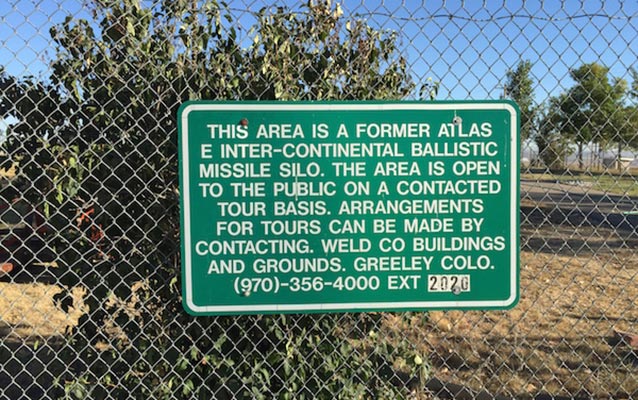
Accessible: Public day-use park; buried facility/interior tours no longer provided; overnight camping not permitted; restricted/fenced areas should not be entered.

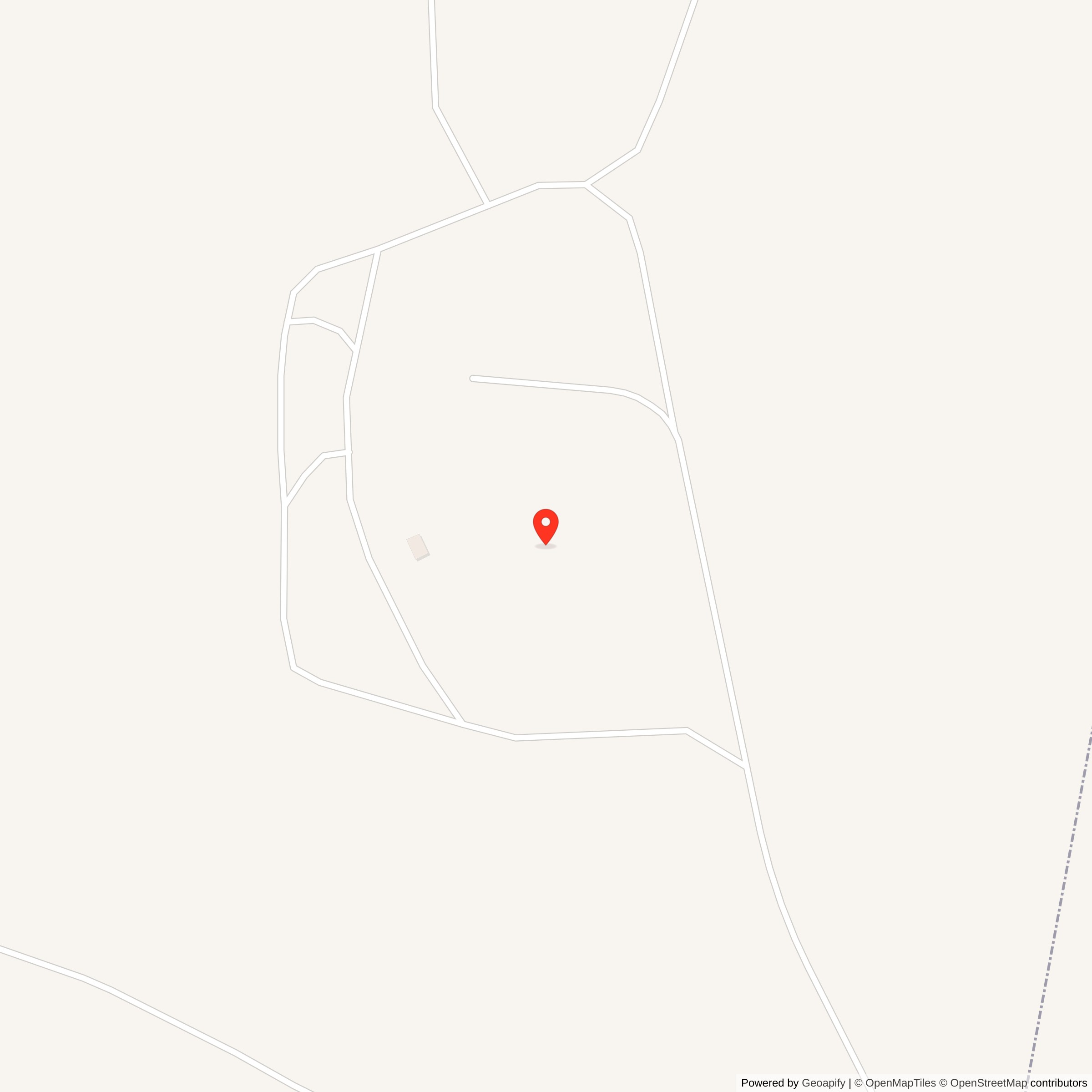
Atlas E Site 566-8 was a single-missile SM-65E Atlas launch complex operated by the 566th Strategic Missile Squadron under the 389th Strategic Missile Wing at F.E. Warren Air Force Base. The site was located west of Greeley, near Windsor and Loveland, in Weld County, Colorado.
The site is best described technically as an Atlas E single-missile coffin-launcher complex rather than a later vertical silo. Operational missile-history sources identify it as 566th Strategic Missile Squadron Site 8, Greeley, Colorado. Colorado environmental records identify the same property as Atlas 12 or Site #12. It was not a Minuteman Launch Facility and no separate parent Launch Control Center is identified for this Atlas E site, so the parent LCC is best recorded as N/A.
Site 566-8 entered the Atlas E era in 1961. Available public sources do not provide a verified exact operational-alert date for this individual site, but official park summaries state that the former Atlas E site was constructed in 1961. The site was decommissioned in 1965. It survives as the preserved former Atlas E launch complex known publicly as Missile Site Park, a Weld County-owned day-use park and county storage/records facility with City of Greeley access and maintenance responsibilities.
Location, Landscape, and Site Description
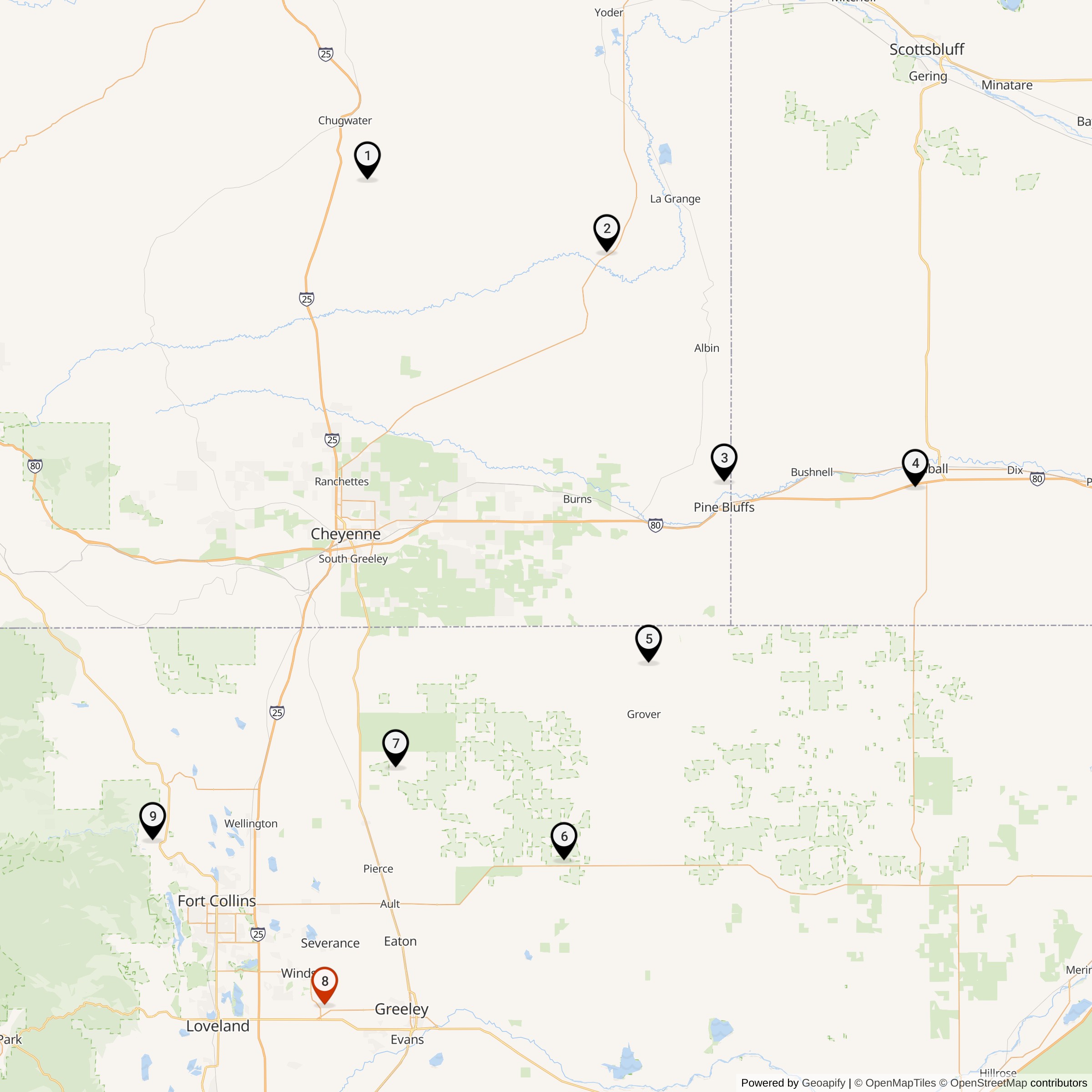
Site 566-8 occupies high ground west of Greeley on the bluffs overlooking the Cache la Poudre River valley, in the rural and semi-rural landscape between Greeley, Windsor, and Loveland. Weld County describes Missile Site Park as located at 10611 Spur 257, Greeley, Colorado, and notes its views over the Poudre River valley, Windsor, and the Rocky Mountains. The National Park Service summarizes the location as west of Greeley and identifies the preserved site as an Atlas-E missile launch facility managed by Weld County.The site was one of the Colorado members of the F.E. Warren Atlas E field. The Warren Atlas E sites were deliberately dispersed across a wide three-state area rather than placed on the base itself. Five were in northern Colorado, one was in Nebraska, and three were in Wyoming. That geography reflected a central feature of early ICBM basing: a missile field was not a single compact base, but a network of separated launch complexes supported by a parent Air Force base, communications links, maintenance teams, security forces, and launch crews.
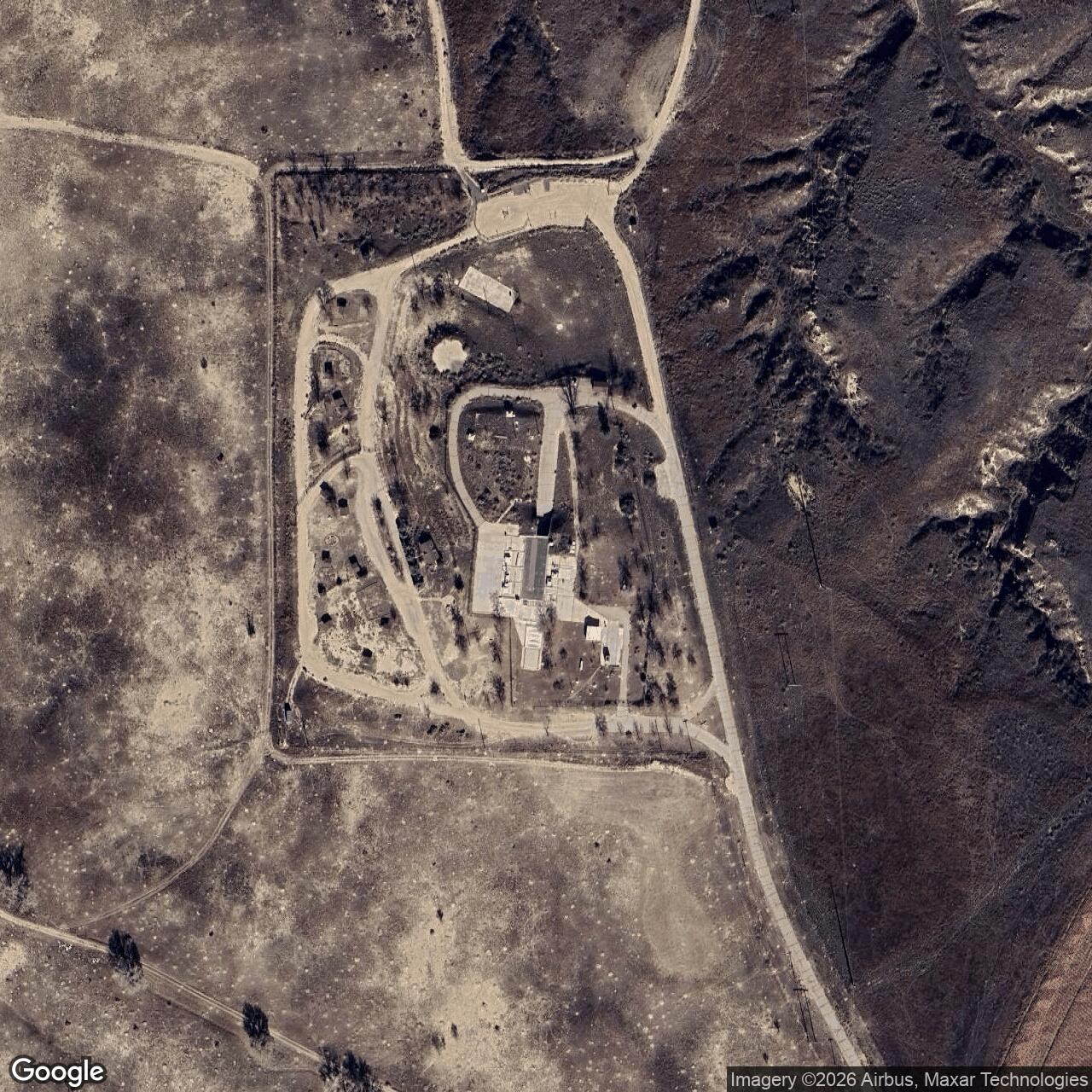
The physical layout of Site 566-8 followed the Atlas E coffin-launcher pattern. The missile was stored horizontally in a below-grade reinforced launch-and-service structure with the protective roof at or near ground level. This was not a fully underground vertical launch silo in the later Atlas F or Minuteman sense. In a launch sequence, the launcher roof would open, the missile would be raised from its horizontal shelter, loaded with liquid oxygen, and launched from the surface. The site also contained a launch operations building, utility and support systems, communications equipment, access roads, security fencing, hardstands or paved areas, and the specialized propellant-handling infrastructure required by a liquid-fueled Atlas missile.
Missile Site Park remains unusually legible compared with many former first-generation ICBM sites. Public photographs show the surviving recessed launcher structure, the blast-door area, paved surfaces, fencing, access roads, and former military murals. A 2023 KUNC report described the bunker as carved into the landscape, fenced, largely inaccessible to the public, and still marked by 1960s-era murals, including Strategic Air Command and missile-themed imagery. Weld County states that tours inside the buried facility are no longer provided, but the park itself remains a public day-use site. The present public landscape is therefore both a recreational open-space setting and a preserved Cold War military structure.
Strategic and Cold War Context
Atlas E Site 566-8 was built during the urgent first generation of American intercontinental ballistic missile deployment. The Atlas program gave the United States Air Force its first operational ICBM force, but it did so with a technology that still carried many transitional features. Atlas was a large liquid-fueled missile with a pressure-stabilized stainless-steel airframe. It required constant pressurization, specialized maintenance, hazardous liquid oxygen and RP-1 fuel handling, and more preparation time than the solid-fueled Minuteman missiles that soon followed.The Atlas E represented an important step beyond the earliest Atlas D deployments. Atlas D sites with radio guidance needed clustered launchers near guidance equipment. Atlas E used inertial guidance, which allowed the Air Force to disperse individual launchers over a wider area. For the F.E. Warren field, this meant that single coffin-launcher complexes could be scattered across Wyoming, Nebraska, and northern Colorado. Dispersal complicated an enemy targeting problem by forcing any attack to account for many separated launch points rather than one concentrated base.
The site also shows the compromise built into early hardened missile infrastructure. The Atlas E coffin launcher gave the missile some protection by placing it below grade, but it did not provide the degree of hardening associated with later vertical silos. The missile still had to be raised and fueled before launch. National Park Service material describes Atlas E launch response time as approximately fifteen minutes and states that the Atlas E was operational from September 1961 through January 1965. Site 566-8 therefore belongs to a brief but consequential period in which Strategic Air Command relied on liquid-fueled, dispersed ICBMs while newer Minuteman and Titan systems were overtaking the first Atlas deployments.
Construction and Activation
Site 566-8 was part of Warren III, the F.E. Warren Atlas E construction program. Public Air Force unit-history material identifies Martin K. Elby Construction Company of Wichita, Kansas, as the low bidder for the Warren III Atlas E work. Because Atlas E used inertial guidance, the nine launch sites did not have to be concentrated. The same source describes the Warren III field as nine Atlas E missiles scattered over a broad area at single coffin launch sites and states that work began on December 7, 1959.The Warren III geography was demanding. The field placed coffin launchers at Chugwater, LaGrange, and Pine Bluffs in Wyoming; one at Kimball, Nebraska; and five in Colorado at Grover, Briggsdale, Nunn, Greeley, and Fort Collins. Construction took place under severe Cold War schedule pressure. Historical accounts describe erratic steel deliveries after the national steel strike, labor complications caused by sites spread across multiple jurisdictions and union locals, work stoppages at some locations, disabling injuries, and continuing difficulties with propellant-loading system skids. These construction problems were not just local annoyances. They helped demonstrate that early ICBM construction required specialized management and contributed to the later creation of the Corps of Engineers Ballistic Missile Construction Office.
Weld County and National Park Service summaries describe the former Atlas E site as constructed in 1961. The 549th Strategic Missile Squadron was activated at F.E. Warren on October 1, 1960, as the Atlas E squadron. On July 1, 1961, that squadron was redesignated the 566th Strategic Missile Squadron, and command responsibilities at Warren shifted to the newly activated 389th Strategic Missile Wing. Site 566-8 was therefore an active-service site of the 566th Strategic Missile Squadron, even though construction planning and early activation occurred in the preceding Warren Atlas E organizational context.
Missile System and Technical Role
Site 566-8 housed the SM-65E Atlas, a liquid-fueled intercontinental ballistic missile. Atlas used RP-1 kerosene fuel and liquid oxygen oxidizer. Its thin stainless-steel pressure-stabilized airframe required internal pressure to maintain structural rigidity. The National Park Service describes the Atlas as the Air Force's first operational ICBM and notes that Atlas missiles had to remain pressurized while on alert because the airframe shell was so thin that pressure kept it in shape.The Atlas E differed from Atlas D by using individual launch complexes and inertial guidance. At Site 566-8, the missile would have been stored horizontally in the below-ground coffin launcher. The launch process required the shelter roof to open, the missile to be raised, liquid oxygen to be loaded, and the missile to be prepared for launch. This made the site an alert facility but not an instant-launch solid-fuel facility. Its technical role was to maintain one nuclear-armed Atlas E missile as part of the F.E. Warren Atlas E deterrent force, supported by launch crews, maintenance crews, security personnel, communications systems, power systems, propellant-handling equipment, and the squadron/base command structure.
Public sources identify the Atlas E/F reentry vehicle and warhead in broad historical terms. The Smithsonian National Air and Space Museum identifies the Mark 4 reentry vehicle as used on U.S. Air Force Atlas E/F and Titan I intercontinental ballistic missiles and states that it carried the W-38 nuclear warhead with an approximate yield of 3.75 megatons. CDPHE notes that the Colorado Atlas E sites were equipped for plutonium-based nuclear warheads, but also states that there is no evidence of radioactive contamination at the sites because warhead maintenance occurred at warhead manufacturing facilities, not at the dispersed missile sites themselves.
Operational History
Atlas E Site 566-8 was operated by the 566th Strategic Missile Squadron as part of the F.E. Warren Atlas E missile field. The squadron maintained nine SM-65E Atlas launch complexes deployed around Cheyenne and into northern Colorado and western Nebraska. The site was one of four Weld County Atlas E properties and one of five Colorado Atlas E properties tied to F.E. Warren's Atlas E mission.Operations at a site such as 566-8 revolved around alert readiness, maintenance, communications reliability, security, and the demanding support requirements of a liquid-fueled missile. Unlike later Minuteman launch facilities that held solid-fueled missiles in vertical silos, an Atlas E coffin site required special attention to missile pressurization, liquid oxygen systems, RP-1 fuel systems, launch-mechanism readiness, power, communications, and safety procedures. Missile crews and site personnel had to keep a large, fragile, hazardous, nuclear-armed weapon ready for rapid use while avoiding the accidents and delays that could come with cryogenic oxidizer handling and complex ground equipment.
The site should not be understood as an isolated local oddity. It was a functioning part of Strategic Air Command's early ICBM alert posture. F.E. Warren supplied the command, logistics, and organizational center; the 566th Strategic Missile Squadron supplied the missile-squadron mission; and the dispersed sites supplied the survivable launch points. Because Atlas E launchers were separated across wide distances, security police, maintenance teams, and specialized technicians moved between remote complexes as needed. Local communities saw the physical evidence of the Cold War in the form of fenced compounds, access roads, construction traffic, military convoys, and a new federal military presence embedded in rural plains terrain.
The active service life of Site 566-8 was short. The Atlas E system became operational only in the early 1960s and was overtaken quickly by newer missile systems. The National Park Service states that Atlas E ICBMs were operational from September 1961 through January 1965. Public site-specific sources identify 566-8 as decommissioned on March 25, 1965, placing its active missile life at roughly four years. That short span was typical of first-generation Atlas sites: expensive and strategically important when built, but rapidly superseded by more capable and maintainable systems.
Unlike many former missile sites that became private industrial or agricultural properties, were heavily salvaged, or disappeared into nonpublic reuse, Site 566-8 became Missile Site Park. Weld County, the National Park Service, and CDPHE all identify the former Atlas E launch complex as a public park or preserved launch facility. KUNC reported in 2023 that the bunker itself remains inaccessible to the public and is used for Weld County records storage, while the surrounding park and adjoining open-space landscape are part of a broader public recreation setting. Weld County's current park page states that in 2023 park access and maintenance became the responsibility of the City of Greeley in exchange for trailhead access to adjacent City of Greeley open space.
Deactivation and Disposal
Site 566-8 left active missile service in 1965 as the Atlas E force was phased out at F.E. Warren.The site's decommissioning occurred before the later arms-control inspection and silo-demolition programs associated with post-Cold War treaty implementation. Atlas E retirement was a force-modernization decision driven by the rapid arrival of newer ICBM systems rather than a START-era demolition event. The practical deactivation process would have involved removing the missile, ending the alert mission, removing or disabling military launch and support equipment, closing out hazardous propellant and support systems, and transferring the property out of active Air Force missile use.
The site took a different post-closure path from many former missile properties. Weld County and National Park Service summaries state that the former Atlas E site was turned over to Weld County and became Missile Site Park. CDPHE identifies Atlas 12 as the Weld County Missile Park and states that it is also used for county storage. KUNC reported that the bunker stores Weld County records and that the county expected to retain the bunker as the surrounding recreation/open-space setting evolved. This makes Site 566-8 one of the more publicly recognizable preserved Atlas E launch complexes, even though the buried facility itself is no longer open for interior tours.
Environmental cleanup became the main federal post-closure issue. EPA identifies the property as Warren F.E. AFB Atlas "E" Missile Site #12, EPA ID CO0009139016, in Weld County, not on the National Priorities List and assigned to federal facility-lead cleanup. CDPHE identifies the Atlas sites as Formerly Used Defense Sites investigated and cleaned up through the U.S. Army Corps of Engineers Omaha District under the federal CERCLA/Superfund process, with CDPHE oversight and EPA Region 8 involvement. For Atlas 12, CDPHE reports that a feasibility study for groundwater cleanup was completed in 2003; in June 2008 the Corps awarded a cleanup contract for additional characterization and pilot testing; work began in fall 2008; the selected remedy was zero-valent iron injection into the TCE plume beneath the site; several rounds of injections took place during 2010-2019; and TCE reductions did not meet expectations because of fractured bedrock. CDPHE states that the site is undergoing reevaluation and re-characterization to determine how to treat remaining TCE.
Current Status and Site Use
Atlas E Site 566-8 is a decommissioned and preserved former Atlas E missile launch complex. It is no longer active as a military installation. Its current public identity is Missile Site Park, located at 10611 Spur 257, Greeley, Colorado. The National Park Service describes it as a preserved Atlas-E missile launch facility managed by Weld County. Weld County describes the park as a day-use site and states that tours inside the buried facility are no longer provided. Overnight camping is not permitted. The RV dump is available during park hours for a fee. The City of Greeley's Natural Areas and Trails page also lists Missile Site Park with seasonal winter closure information.Current site use has more than one layer. The public surface landscape functions as a park and recreation area with views over the Poudre River valley. The former launch structure survives as a fenced, nonpublic Cold War remnant. CDPHE identifies Atlas 12 as Weld County Missile Park and also county storage. KUNC reported that the bunker stores Weld County records. Official Weld County information states that in 2023 the City of Greeley took responsibility for park access and maintenance in exchange for allowing trailhead access to adjacent City of Greeley open space. The best concise ownership/use description is therefore: Weld County-owned preserved missile site and storage facility, with day-use public park access and City of Greeley access/maintenance responsibilities.
Chronology
- 1959-12-07 Work began on Warren III, the F.E. Warren Atlas E coffin-launcher construction program.
- 1960 Construction began at 566th Strategic Missile Squadron Site 8 near Greeley.
- 1960-10-01 The 549th Strategic Missile Squadron was activated at F.E. Warren as the Atlas E squadron.
- 1961 Site 8 was constructed and/or turned over to the Air Force; exact month and day were not verified in available public sources.
- 1961-07-01 The 549th Strategic Missile Squadron was redesignated the 566th Strategic Missile Squadron.
- 1961-07-01 The 389th Strategic Missile Wing assumed F.E. Warren missile command responsibilities after the 706th Strategic Missile Wing stood down.
- 1961 The F.E. Warren Atlas E sites entered the operational Atlas E era; the exact alert date for Site 566-8 was not verified in available public sources.
- 1965 Colorado's Atlas E sites were decommissioned and their missiles removed.
- 2003 CDPHE reports that a feasibility study for Atlas 12 groundwater cleanup was completed.
- 2008-06 CDPHE reports that the U.S. Army Corps of Engineers awarded a cleanup contract for additional Atlas 12 site characterization and cleanup-option pilot testing.
- 2008 CDPHE reports that the additional Atlas 12 work began in fall 2008.
- 2010-2019 CDPHE reports that several rounds of zero-valent iron injections were performed at Atlas 12, but TCE reductions did not meet expectations because of fractured bedrock.
- 2023 Weld County states that park access and maintenance became the responsibility of the City of Greeley in exchange for allowing trailhead access to adjacent City of Greeley open space.
- 2026 EPA lists Warren F.E. AFB Atlas "E" Missile Site #12, EPA ID CO0009139016, as not on the National Priorities List and under federal facility-lead cleanup status.
Read about the Atlas at F.E. Warren AFB
All Atlas Missile Silo Locations