
Atlas F Site 577-12 Missile Silo, Granite Oklahoma
Longitude: -99.4272814311468
Site Type: Atlas F vertical silo launch facility
Missile Type: SM-65F Atlas
Missile Assigned to this Silo: GD mfg 67F; GD serial 61-2553; AF tail 553; accepted 1963-02-21; delivered 1963-03-22; launched 1980-03-03 with NOSS-3.
Number of Launchers/Missiles: 1
Parent Base: Altus AFB
Missile Wing: 11th Bombardment Wing; 11th Strategic Aerospace Wing after 1962-04-01
Missile Squadron: 577th Strategic Missile Squadron
Current Site Use: Former Atlas F silo complex in rural/private-property setting near Granite; visible former launch-complex features documented satellite imagery; no public reuse or authorized public access verified.
Site Ownership: Private/non-federal ownership after surplus disposal likely; exact current owner not verified.
Accessible: No public access / private property.
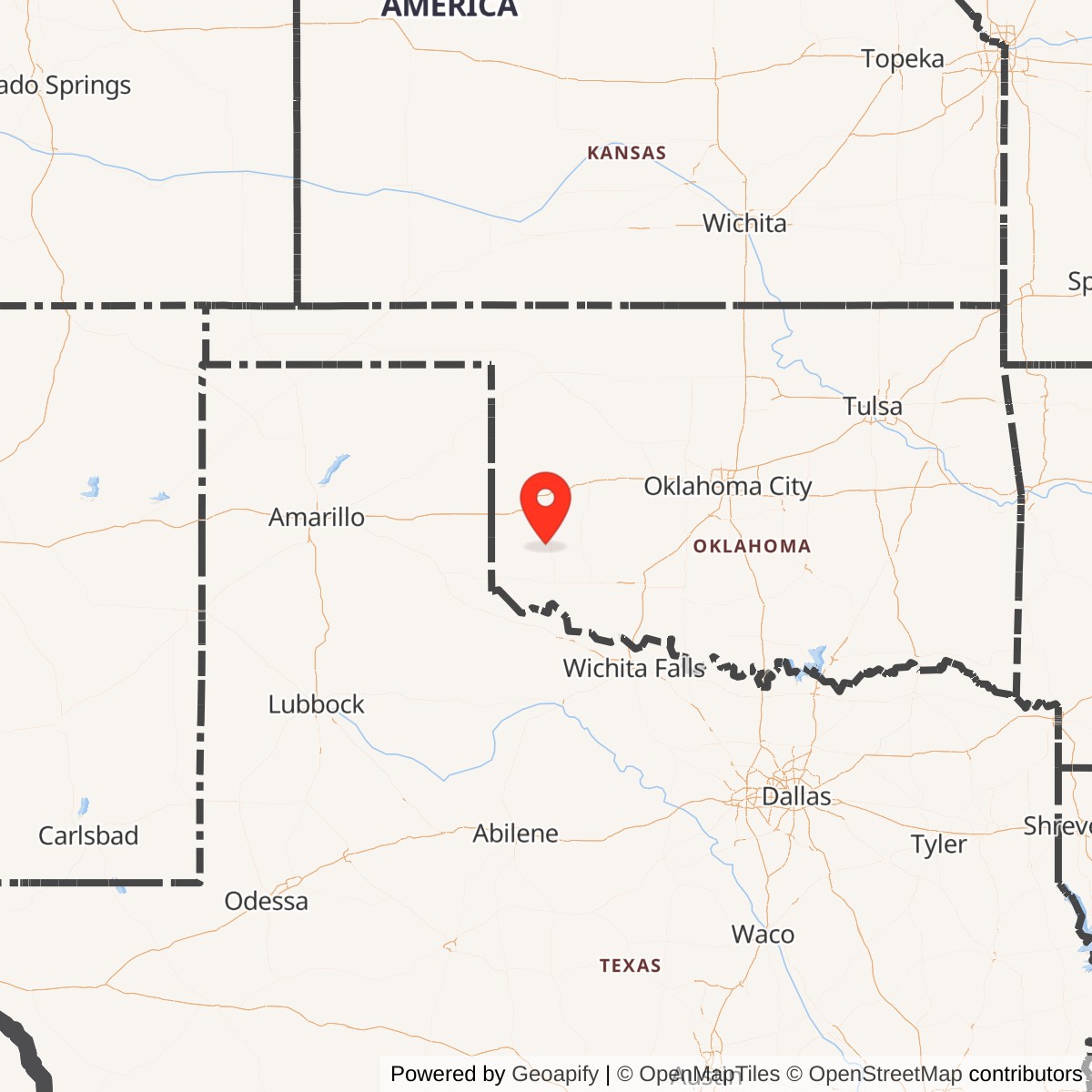
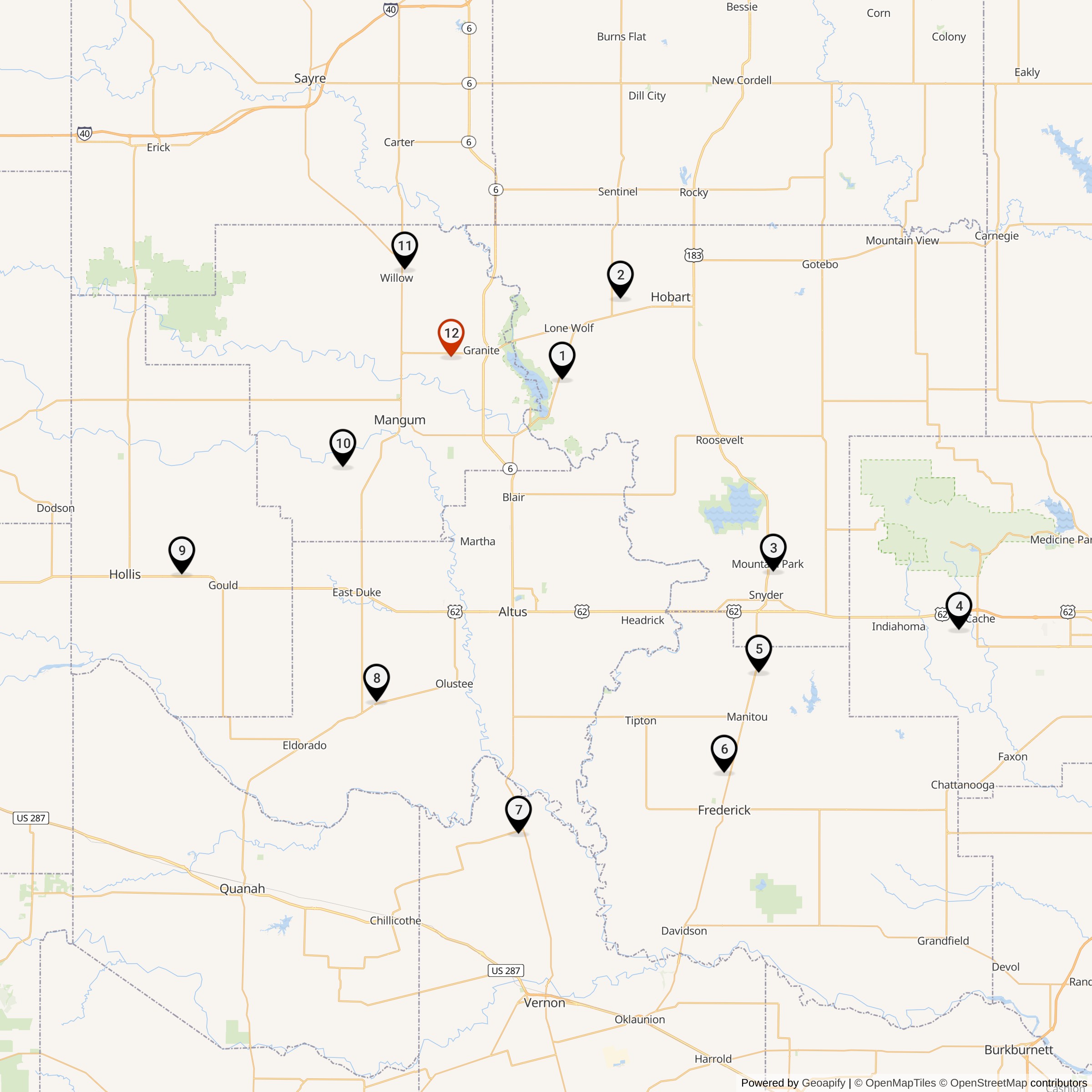
Atlas F Site 577-12 was one of the twelve SM-65F Atlas intercontinental ballistic missile launch complexes assigned to the 577th Strategic Missile Squadron at Altus Air Force Base, Oklahoma. The site was the squadron's Site 12 and was located near Granite in Greer County, Oklahoma.
The site belonged to the 11th Bombardment Wing, which was redesignated the 11th Strategic Aerospace Wing on 1962-04-01, and to the 577th Strategic Missile Squadron, the Atlas F missile unit assigned to Altus AFB. Atlas F launch complexes were self-contained vertical-silo sites with their own launch-control and support structures, rather than Minuteman-style unmanned launch facilities controlled from a separate remote launch control center.
Construction at the site began on 1960-06-30, the site was turned over to the Air Force on 1961-10-18, and the Altus Atlas F missile force became operational in October 1962. The site remained part of the operational 577th Strategic Missile Squadron until the Atlas F weapon system was removed from service in 1965. Site 577-12 was decommissioned on 1965-03-25, the same date on which the 577th Strategic Missile Squadron was inactivated.
Its assigned operational missile was General Dynamics Atlas missile 67F, serial number 61-2553, Air Force tail number 553. The missile was accepted on 1963-02-21 and delivered on 1963-03-22. The missile did not disappear when the Granite launch complex left active ICBM service. It later became an Atlas E/F space-launch vehicle and launched OPS 7245 / NOSS-3 from Vandenberg Space Launch Complex 3 West on 1980-03-03. That later launch did not occur at Site 577-12, but it gives the site's assigned missile a traceable post-ICBM career in the national-security space-launch program.
The former missile property later appeared in public FUDS and DERP-related records as ATLAS MISSILE NO. 12 / K06OK0412. A U.S. General Accounting Office Oklahoma FUDS status table lists ATLAS MISSILE NO. 12 in Greer County with eligibility and hazards marked "Yes," one eligible project, and zero cost to date or cost to complete.
Location, Landscape, and Site Description
Site 577-12 is in rural southwestern Oklahoma near Granite, west-southwest of the town and northwest of Altus Air Force Base. The surrounding landscape is open agricultural and ranch country, with cultivated fields, pasture, county roads, and broad views across the southwestern Oklahoma plains. The site is close enough to be supported by the Altus missile field's maintenance, security, communications, and logistics system, but separated from the parent base and from the other launch complexes in keeping with Strategic Air Command's dispersed ICBM basing doctrine.The site was not a surface launch pad. It was an Atlas F vertical-silo launch complex built around a deep reinforced-concrete underground silo, an elevator launcher, heavy silo doors, an underground launch-control and support area, equipment rooms, power and communications systems, propellant and liquid-oxygen handling systems, environmental-control equipment, security fencing, surface access roads, and aboveground support features. The missile stood vertically in the underground silo while protected. During a launch sequence, the launcher elevator raised the missile to the surface, the silo doors opened, and the missile launched from above ground.
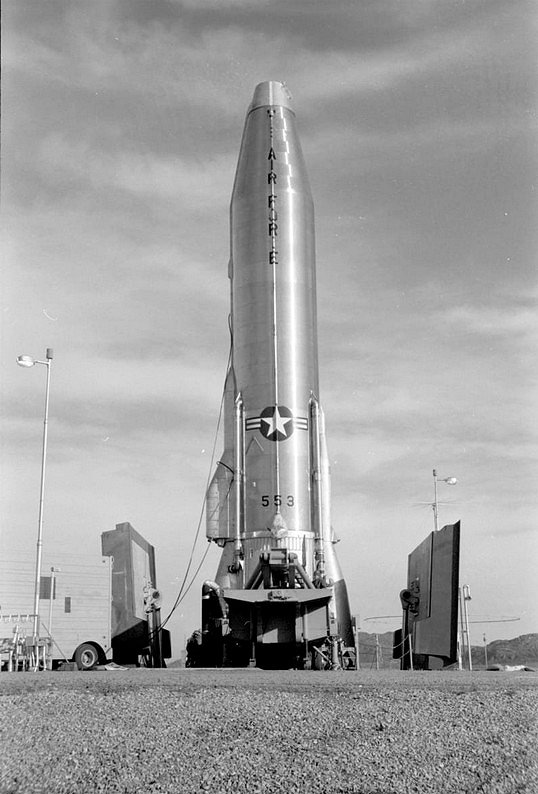
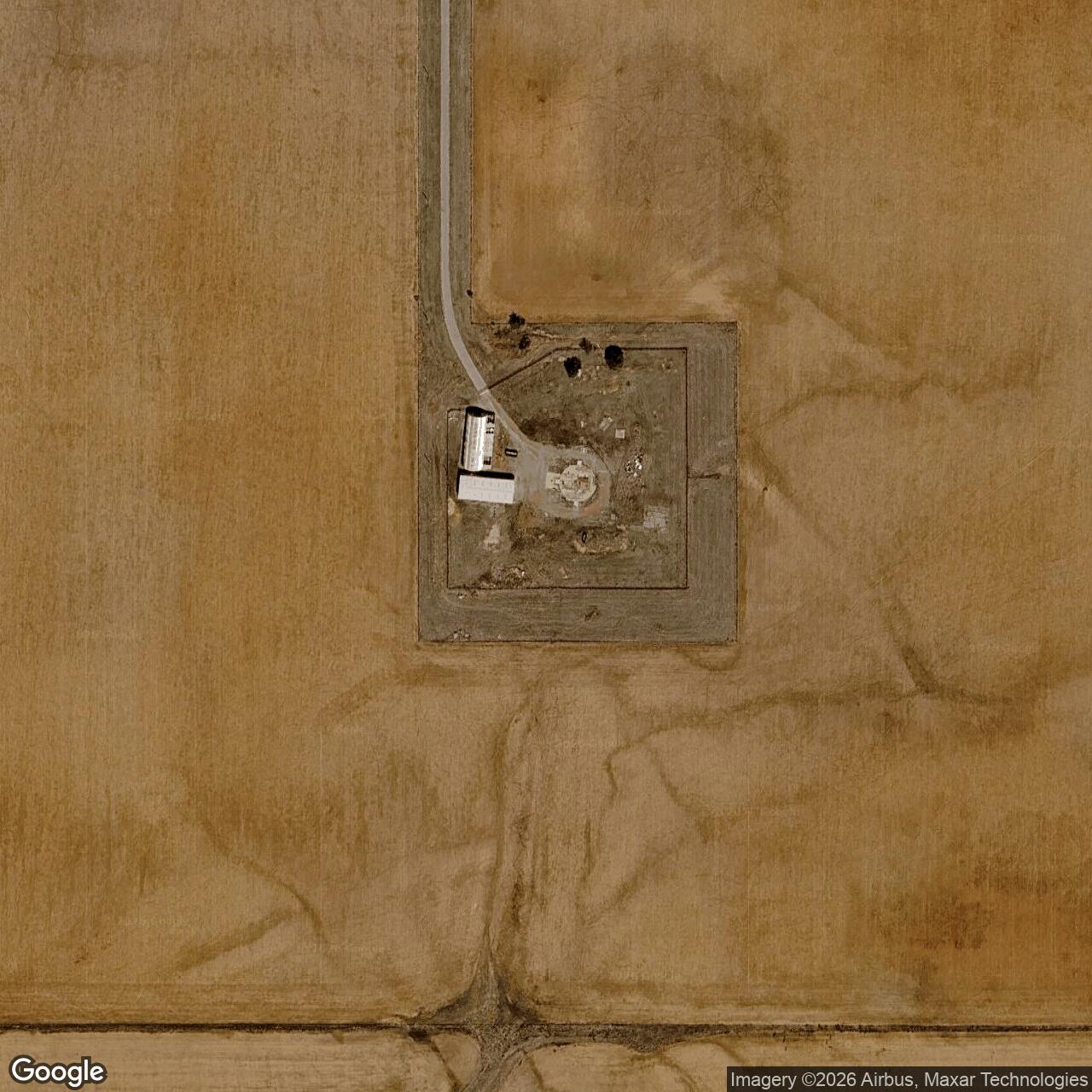
Satellite photographs show the compact former missile compound in an agricultural setting, while the operational photograph shows Atlas 553 raised at a launch complex with "AIR FORCE" lettering visible on the missile. The presence of tail number 553 matches the Site 12 missile assignment, making the image especially useful for connecting the Granite site to its specific operational missile.
Strategic and Cold War Context
Site 577-12 existed because the United States was trying to field a credible land-based nuclear deterrent during the early and dangerous period of the missile age. The Atlas was the first operational intercontinental ballistic missile deployed by the U.S. Air Force. National Park Service and Air Force summaries describe the Atlas as a first-generation system that preceded the more mature Titan and Minuteman forces.The Atlas F was the most protected operational version of the Atlas family. Earlier Atlas D and E systems used exposed, semi-hardened, or horizontal coffin-launcher arrangements. The F model placed one missile vertically inside an underground silo. This made the missile field harder to attack than surface pads or soft shelters, and the one-missile-per-site arrangement reduced the chance that a single strike would destroy a large fraction of the force at once.
The system was still transitional. Atlas F was a liquid-fueled ICBM. Its RP-1 fuel could be stored aboard the missile while on alert, but liquid oxygen had to be loaded during the countdown. The Atlas airframe was also a very thin stainless-steel pressure-stabilized structure, meaning it had to be kept pressurized to maintain its shape. These features made the weapon powerful and technically impressive, but also maintenance-intensive and operationally demanding.
Site 577-12 entered the operational force at an especially tense moment. Official Altus AFB chronology states that the 577th Missile Squadron activated on 1961-06-01 to operate twelve Atlas F missile sites within a forty-mile radius of Altus and that the squadron became operational on 1962-10-10. USAF unit-history material lists SAC turnover and operational status on 1962-10-09. The one-day difference is a source conflict between two public Air Force-derived summaries, but both place the Altus Atlas F force on operational status immediately before the Cuban Missile Crisis. During that crisis, the 577th SMS sites were part of Strategic Air Command's nuclear alert posture.
Construction and Activation
Construction of the Altus Atlas F missile field began as part of the nationwide program to deploy hardened first-generation ICBM launchers at dispersed inland sites. Official Altus AFB chronology states that construction began on the first of the twelve Atlas F missile sites around Altus on 1960-05-01. USAF unit-history material records that the Corps of Engineers, Tulsa District awarded the basic construction contract for the Altus Atlas F field to Morrison-Knudsen and Hardeman and Associates, with a combined bid of just over $20.9 million.The same USAF unit-history material records that the twelve launcher locations were sited around the region and that land acquisition required the Tulsa District's Real Estate Division to file condemnation suits against 477 landowners in six counties to acquire 12,879 acres. That figure applies to the Altus missile-field acquisition program as a whole, not to Site 577-12 alone, so it should not be used as the individual acreage for the Granite site.
Construction at the Granite site began on 1960-06-30. The work required excavation of the deep silo, placement of heavily reinforced concrete, installation of the elevator launcher and silo doors, construction of the underground control and support areas, and installation of liquid-oxygen, RP-1, power, communications, ventilation, security, and environmental-control systems.
The site was turned over to the Air Force on 1961-10-18. Turnover did not mean the launch complex instantly became part of a certified operational force. First-generation ICBM activation required overlapping stages of construction completion, equipment checkout, missile delivery, site acceptance, crew training, communications integration, propellant-system testing, and SAC operational certification. The Altus Atlas F force reached operational status in October 1962, immediately before the Cuban Missile Crisis.
Missile System and Technical Role
Site 577-12 was built for the SM-65F Atlas, the final operational Atlas ICBM variant. Atlas F was stored vertically underground in a silo-lift launcher. In a launch sequence, the missile and launcher were raised to the surface before launch. The silo protected the missile while it was stored, but the missile did not fire from within the closed underground structure in the way later hot-launch or cold-launch silo systems did.The missile was a first-generation liquid-fueled ICBM. It used RP-1 kerosene fuel and liquid oxygen oxidizer. The Atlas pressure-stabilized airframe and liquid-oxygen loading requirement made the system more demanding than later solid-fueled Minuteman missiles. The launch complex therefore had to support not only alert monitoring but also cryogenic oxidizer handling, propellant-system maintenance, pressure maintenance, elevator-launcher operation, power generation or distribution, communications, environmental control, security, and repeated readiness checks.
Public Air Force and Smithsonian sources provide the short capability summary. The Atlas ICBM could deliver a nuclear warhead over intercontinental range. The National Park Service describes Atlas F as an 82-foot missile with a 4.5-megaton warhead in a blast-proof silo-lift configuration and an approximately ten-minute launch response. The National Air and Space Museum identifies the Mark 4 reentry vehicle as used on U.S. Air Force Titan I and Atlas E/F ICBMs in the early 1960s and says it carried a W-38 nuclear warhead with a yield of about 3.75 megatons. The yield difference reflects the way public sources summarize weapon capability, but both identify Atlas F as a high-yield strategic nuclear system.
The Site 577-12 missile assignment is unusually clear. The operational missile was General Dynamics missile 67F, serial number 61-2553, Air Force tail number 553. The missile was accepted on 1963-02-21 and delivered on 1963-03-22. The same missile later launched OPS 7245 / NOSS-3 from Vandenberg SLC-3W on 1980-03-03, demonstrating the post-ICBM conversion of retired Atlas missiles into space-launch vehicles.
Operational History
Site 577-12's active operational life was brief but historically important. The 577th Strategic Missile Squadron was organized at Altus AFB on 1961-06-01 and operated twelve Atlas F launch complexes distributed around southwestern Oklahoma and nearby Texas. The squadron was assigned to the 11th Bombardment Wing and later the 11th Strategic Aerospace Wing. USAF unit-history material identifies SM-65F Atlas as the squadron's missile weapon system from 1961 to 1965.The first Series F Atlas ICBM at the 577th SMS was placed on alert early in August 1962. By October 1962, the squadron reached operational status. The timing mattered. The Cuban Missile Crisis unfolded later that month, and USAF unit-history material states that all twelve missiles were put on alert status as a result of the crisis. Site 577-12 was therefore part of an Atlas F force that entered alert duty during one of the most dangerous periods of the Cold War.
Day-to-day operations at Site 577-12 would have centered on maintaining a liquid-fueled first-generation ICBM in a usable alert condition. That work included launcher-system checks, electrical and communications checks, environmental-control maintenance, propellant-system readiness, security response, and periodic exercises. The site also had to support liquid-oxygen operations, which required trained crews, carefully maintained equipment, and strict safety practices.
The operational photograph of Site 12, shown in photo 1 below, is a rare site-specific image. It shows Atlas tail number 553, the assigned Site 12 missile, raised in launch position. This visual evidence helps explain how an Atlas F site operated: the weapon was protected underground most of the time, but launch preparation required the missile to be raised above ground and exposed to the surface environment while final launch operations proceeded.
Site 577-12's assigned missile had a significant afterlife. After the Atlas F ICBM force was retired, many Atlas missiles were refurbished as space launch vehicles. Missile 67F later launched OPS 7245 / NOSS-3 from Vandenberg SLC-3W on 1980-03-03. The Cape Canaveral Space Force Museum's SLC-3W history confirms that the complex supported Atlas F, Atlas E, and Navy Ocean Surveillance Satellite missions, and independent Atlas launch listings identify the 1980-03-03 launch as Atlas 67F with OPS 7245 / NOSS-3.
Deactivation and Disposal
The Atlas F weapon system had a short service life. By late 1964, the Department of Defense had decided to accelerate the retirement of remaining Atlas D, Atlas E, Atlas F, and Titan I systems. USAF unit-history material records the 577th SMS phaseout sequence: the first 577th SMS ICBM was removed from alert on 1964-12-30, the last was removed from alert on 1965-02-04, and the last was shipped on 1965-02-10.Its assigned missile, Atlas 67F / tail number 553, was not scrapped immediately after missile-field service. It later served as a space launch vehicle and launched OPS 7245 / NOSS-3 from Vandenberg in 1980.
Current Status and Site Use
Site 577-12 is a decommissioned former Atlas F launch complex in Greer County, Oklahoma. It is not an active military installation. No public museum, interpretive program, or authorized visitor program was found for the site.Satellite imagery indicate that visible former launch-complex features remain at or near the coordinate, including the surface footprint of the launch area and associated former Atlas F structures or pads. Public imagery alone should not be used to infer safe access or structural condition. Former Atlas F complexes can contain underground confined spaces, water hazards, deteriorated concrete and steel, old utility systems, environmental residues, and fall hazards.
Public access should be treated as prohibited unless the current owner provides explicit permission. Lawful roadside observation is the only appropriate public-viewing assumption.
Chronology
- 1960-01 Oklahoma congressional officials publicly announced plans for an Atlas F missile facility at Altus.
- 1960-04 The Corps of Engineers, Tulsa District awarded the Altus Atlas F construction contract to Morrison-Knudsen and Hardeman and Associates.
- 1960-05-01 Official Altus AFB chronology states that construction began on the first of twelve Atlas F missile sites around Altus.
- 1960-06-30 Construction began at Site 577-12 near Granite, Oklahoma.
- 1960-11 Ballistic-missile construction-management responsibility was transferred to the Corps of Engineers Ballistic Missile Construction Office.
- 1961-06-01 The 577th Strategic Missile Squadron was organized at Altus AFB to operate the Altus Atlas F missile field.
- 1961-10-18 Site 577-12 was turned over to the Air Force.
- 1962-08 The first Series F Atlas ICBM at the 577th Strategic Missile Squadron was placed on alert early in the month.
- 1962-10-09 USAF unit-history material lists the 577th SMS as turned over to SAC and operational.
- 1962-10-10 Official Altus AFB chronology states that the 577th Missile Squadron became operational.
- 1962-10 During the Cuban Missile Crisis, all twelve 577th SMS missiles were put on alert status.
- 1963-02-21 Atlas missile 67F, assigned to Site 577-12, was accepted.
- 1963-03-22 Atlas missile 67F was delivered.
- 1964-05-14 A propellant-loading explosion destroyed 577th SMS launch complex 577-6 near Frederick; this was a squadron-field event, not a Site 577-12 accident.
- 1964-12-30 The first 577th SMS ICBM was removed from alert.
- 1965-02-04 The last 577th SMS ICBM was removed from alert.
- 1965-02-10 The last 577th SMS ICBM was shipped.
- 1965-03-25 Site 577-12 was decommissioned, and the 577th Strategic Missile Squadron was inactivated.
- 1980-03-03 Atlas 67F, formerly assigned to Site 577-12, launched OPS 7245 / NOSS-3 from Vandenberg SLC-3W.
- 2001 A GAO Oklahoma FUDS status table listed ATLAS MISSILE NO. 12 / K06OK0412 in Greer County as eligible with hazards and one eligible project.
Read about the Atlas at Altus AFB
All Atlas Missile Silo Locations