
Atlas F Site 577-6 Missile Silo, Frederick Oklahoma
Longitude: -99.01459978207942
Site Type: Atlas F vertical silo launch facility
Missile Type: SM-65F Atlas
Missile Assigned to this Silo: GD mfg 61F; GD serial 61-2547; AF tail 547; accepted 1962-04-04; delivered 1962-04-20; destroyed in 1964-05-14 Site 6 accident; not launched.
Number of Launchers/Missiles: 1
Parent Base: Altus AFB
Missile Wing: 11th Bombardment Wing; 11th Strategic Aerospace Wing after 1962-04-01
Missile Squadron: 577th Strategic Missile Squadron
Current Site Use: Former Atlas F silo complex near Frederick; destroyed in a 1964 propellant-loading accident and not rebuilt; rural private-property setting with documented surface remains/accident imagery.
Site Ownership: Private/non-federal ownership after surplus disposal.
Accessible: No public access / private property.
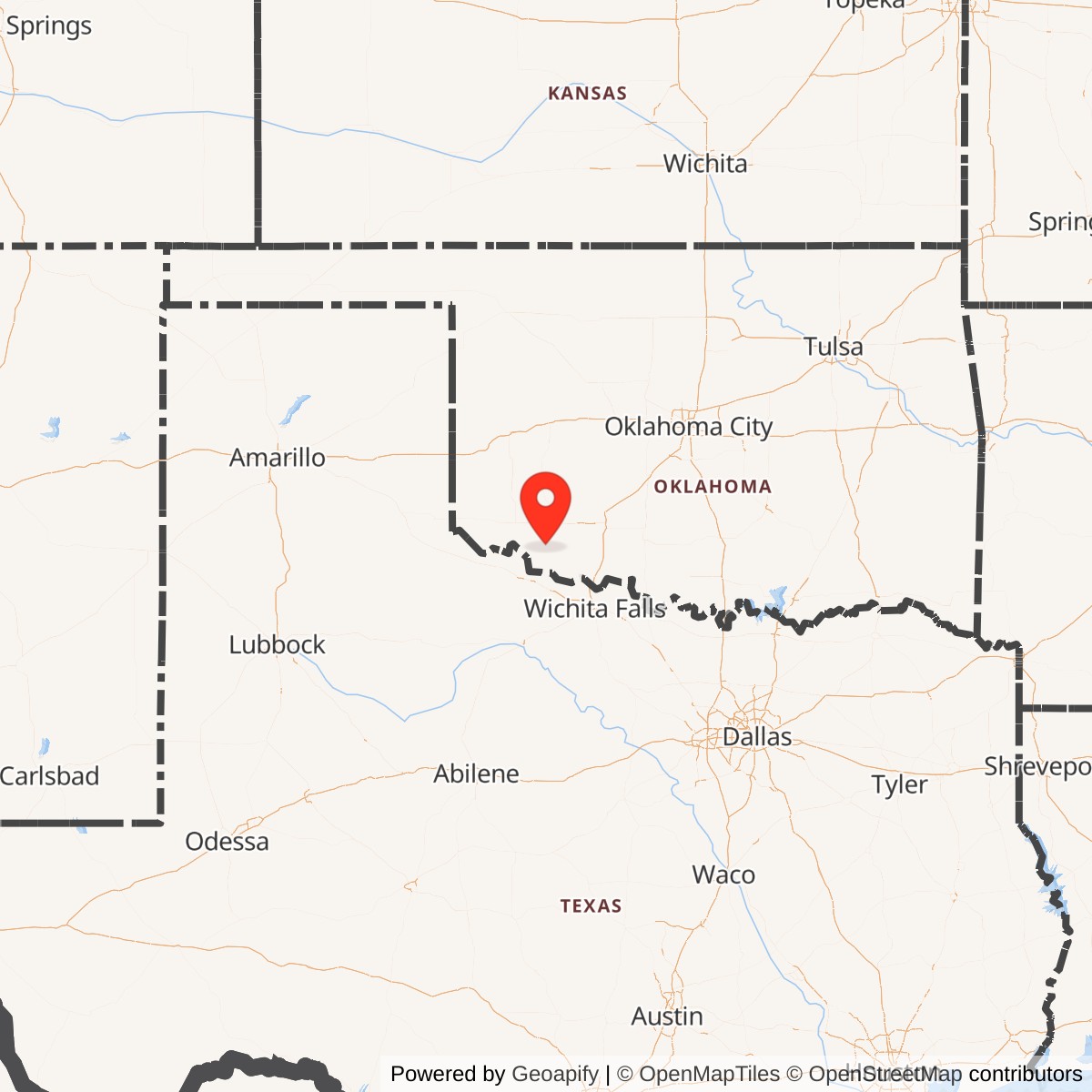
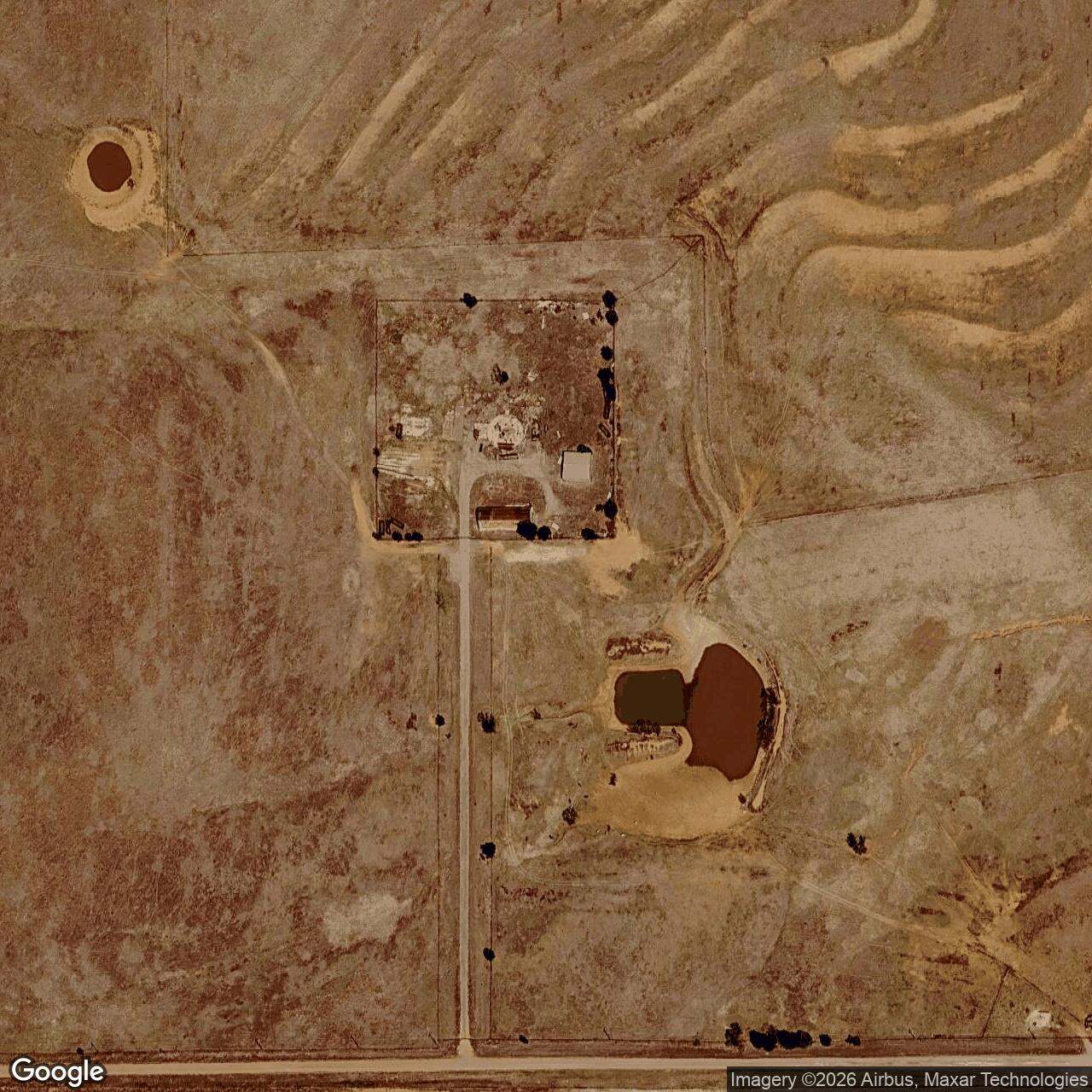
Atlas F Site 577-6 was an SM-65F Atlas intercontinental ballistic missile launch complex assigned to the 577th Strategic Missile Squadron at Altus Air Force Base, Oklahoma. It was one of the twelve Atlas F sites in the Altus missile field and was the squadron's Site 6, located near Frederick in Tillman County, Oklahoma.
The site belonged to the 11th Bombardment Wing, which was redesignated the 11th Strategic Aerospace Wing on 1962-04-01, and to the 577th Strategic Missile Squadron, the Altus Atlas F operating unit. Atlas F sites were not Minuteman-style unmanned launch facilities controlled from a separate remote Launch Control Center. Each Atlas F complex was a self-contained hardened silo-lift facility with its own underground launch-control and support spaces at the complex.
Site 577-6 is inactive and decommissioned as a military installation. It also has a more unusual history than most Atlas F sites because it was destroyed during active service. Construction at the site began on 1960-05-26, the complex was turned over to the Air Force on 1961-09-27, and the 577th Strategic Missile Squadron's Atlas F force became operational in early October 1962. The official Altus AFB chronology gives 1962-10-10 for operational status; USAF unit-history material gives 1962-10-09 for SAC turnover and operational status. The one-day difference should be treated as a source difference rather than resolved by inventing precision.
On 1964-05-14, while the site was still part of the active Altus Atlas F missile force, a propellant-loading exercise ended in a fire and explosion that destroyed launch complex 577-6. The official USAF unit-history summary states that the explosion occurred during a propellant-loading exercise and caused the destruction of launch complex 577-6. The Strategic Air Command Office of the Historian's SAC Missile Chronology gives the same core fact: Atlas F launch complex 577-6 of the 11th Strategic Aerospace Wing at Altus AFB, Oklahoma, was destroyed by an explosion during a propellant-loading exercise. The site was not rebuilt and did not return to operational alert. The 577th Strategic Missile Squadron continued to exist until 1965-03-25, when it was inactivated as part of the accelerated retirement of Atlas F and other first-generation ICBMs.
The missile assigned to Site 577-6 was General Dynamics Atlas 61F, serial number 61-2547, Air Force tail number 547. The missile as accepted on 1962-04-04 and delivered on 1962-04-20. Unlike some retired Atlas missiles that later served as space-launch vehicles or range-test boosters, missile 61F was destroyed in the 1964 Site 577-6 accident.
The former launch complex is now non-federal, private property. No public museum use, authorized visitor program, or official public-access arrangement was found for Site 577-6. Public photographs and accident imagery show recognizable former Atlas F features and damaged surface structures, but no current engineering assessment was found that documents the condition of remaining underground spaces. The site should therefore be treated as a private, decommissioned, accident-damaged former ICBM launch complex with no public access.
Location, Landscape, and Site Description
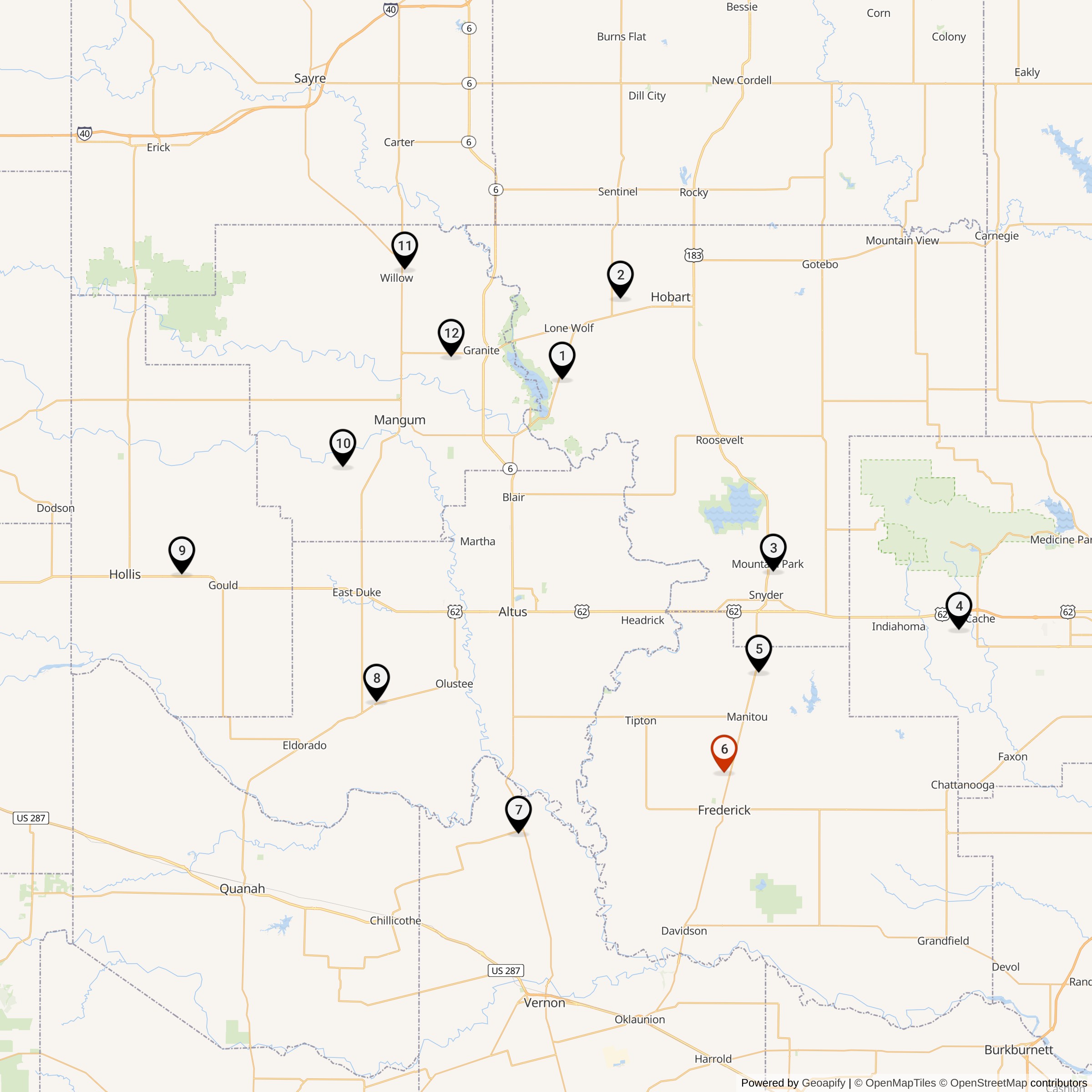
Site 577-6 occupies a rural setting north-northeast of Frederick, Oklahoma, in Tillman County. Frederick lies in southwestern Oklahoma, within the agricultural and open-rangeland landscape that surrounded the Altus Atlas F deployment area. The location placed Site 577-6 within the dispersed missile field operated from Altus Air Force Base, but the site itself was geographically separate from the base and from the other Atlas F launch complexes. That separation was central to the basing plan: the missile sites had to be far enough apart to reduce the chance that one attack could destroy the entire field, while still close enough to Altus for logistics, maintenance, convoy movement, security response, command administration, and technical support.Official Altus AFB history states that the 577th Missile Squadron activated in 1961 to operate twelve Atlas F missile sites within a forty-mile radius of Altus. USAF unit-history material identifies the twelve launcher locations as at or near Lonewolf, Hobart, Snyder, Cache, Mantiou/Manitou, Frederick, Creta, Hollis, Russell, Willow, and Fargo, Texas. The same material states that the Altus program required acquisition of 12,879 acres and condemnation suits against 477 landowners in six counties around Altus. That figure applies to the Altus Atlas F missile field as a whole, not to Site 577-6 specifically. No documented site-specific acreage for 577-6 was found, and acreage should not be estimated from aerial imagery or parcel outlines.
The Frederick site was not simply a fenced launch pad. Atlas F used a vertical silo-lift complex built around a deep reinforced-concrete and steel underground launch structure. A typical Atlas F site included a cylindrical silo, a large elevator-launcher, heavy overhead doors, a below-grade launch-control and equipment area, access tunnels or passages, electrical and power systems, environmental-control systems, propellant and liquid-oxygen handling systems, communications equipment, antennas, security fencing, access roads, and a controlled surface compound. The Association of Air Force Missileers describes Atlas F as a missile housed in a vertical silo with an adjoining control center, hardened to 100 psi overpressure, using an inertial guidance system, kept on alert with RP-1 fuel aboard, loaded with liquid oxygen at the start of the countdown, and raised to ground level by a massive silo elevator before launch.
The site setting and site design together reflected the transition from early, relatively exposed ICBM basing to hardened dispersed missile operations. Site 577-6 was designed to protect the missile from blast effects while it was stored, then raise it to the surface for launch. That engineering approach made the site more survivable than earlier Atlas launch arrangements, but it also gave the site a complicated machinery-and-propellant environment. The same elements that made the complex an advanced first-generation ICBM site; the silo-lift launcher, liquid-oxygen transfer system, fuel and oxidizer handling equipment, environmental-control systems, blast doors, and launch-control spaces, also created the operating hazards that became central to its 1964 destruction.
Publicly available accident photographs show the site after the 1964 explosion, including damaged silo-door structures and damaged surface features. Those photographs are important because they show that the site was not merely removed from alert and sold after the normal 1965 Atlas phaseout. Site 577-6 was physically wrecked while the Atlas F force was still operational.
Strategic and Cold War Context
Site 577-6 existed because the United States was rapidly fielding a land-based nuclear deterrent during the early Cold War. Strategic Air Command entered the missile age while still maintaining a large bomber force, and the first operational ICBMs were deployed under intense pressure to create a credible capability to strike intercontinental targets from the continental United States. The National Park Service describes Atlas as the United States Air Force's first operational ICBM. Atlas D, Atlas E, and Atlas F represented successive operational basing approaches as the Air Force tried to place a liquid-fueled missile on alert in a survivable and usable form.Atlas F was the most hardened operational Atlas configuration. Earlier Atlas D launch sites used more exposed arrangements, while Atlas E sites stored the missile horizontally in semi-hardened coffin launchers. Atlas F stored the missile vertically underground in a silo-lift launcher. The missile still had to be raised before launch, but the underground vertical storage arrangement gave it greater protection than the earlier configurations. The improvement was important because a strategic missile force had to survive long enough to be useful as a deterrent. Dispersal across a missile field and hardening at each individual launch complex were intended to complicate Soviet targeting and reduce the likelihood that the entire force could be destroyed in a first strike.
At the same time, Atlas F remained a first-generation liquid-fueled weapon system. The missile used RP-1 kerosene fuel and liquid oxygen oxidizer. RP-1 could be kept aboard the missile during alert, but liquid oxygen was cryogenic and had to be loaded during the countdown. The missile's thin, pressure-stabilized structure, liquid-propellant systems, silo-lift machinery, launch-control equipment, and real-property installed facility systems all had to work together during alert, exercise, and launch preparations. Atlas F was therefore a strategic bridge between early surface or semi-hardened ICBMs and the more survivable, quicker-reacting solid-fueled Minuteman system.
The Altus field became operational at a dangerous moment. USAF unit-history material states that the first Series F Atlas missile at the 577th SMS was placed on alert early in August 1962 and that all twelve missiles were placed on alert in October 1962 as a result of the Cuban Missile Crisis. Official Altus AFB chronology lists the Altus Atlas F silos as operational on 1962-10-10. Thus Site 577-6 belonged to a missile force that entered operational service immediately before and during the most acute nuclear crisis of the Cold War. That context helps explain why the United States accepted the complexity and risk of first-generation liquid-fueled ICBM operations while better systems were still coming into service.
Construction and Activation
The Altus Atlas F program formed part of the larger national effort to deploy hardened ICBM sites in the central United States. Official Altus AFB chronology states that construction began on the first of twelve Atlas F missile sites around Altus AFB on 1960-05-01. USAF unit-history material records that the Corps of Engineers, Tulsa District awarded the basic construction contract to Morrison-Knudsen and Hardeman and Associates for a combined bid of just over $20.9 million. The same USAF summary records that the twelve launcher locations were at or near Lonewolf, Hobart, Snyder, Cache, Mantiou/Manitou, Frederick, Creta, Hollis, Russell, Willow, and Fargo, Texas.Construction at Site 577-6 began on 1960-05-26. The site was Corps of Engineers Construction Site Number 4 and Air Force Operational Site Number 6. Construction of an Atlas F site was a major civil-engineering project. It required excavation of a deep silo, placement of heavy reinforced concrete, installation of a large steel launch elevator, installation of massive doors and mechanical systems, construction of an adjoining underground control and support area, installation of power and environmental equipment, construction of propellant-handling systems, integration of communications systems, and completion of roads, fencing, and surface-support elements. It also required the site to be integrated with the missile, ground equipment, and Strategic Air Command operating procedures.
The Altus program also illustrates the concurrency problem that affected first-generation missile construction. USAF unit-history material states that, as at other Atlas construction sites, Tulsa District engineers faced constant modifications to ongoing launcher construction because improvements in the missile required changes to the facilities. The Tulsa District used a "Red Ball" system to prioritize Atlas paperwork, but construction management was later centralized under the Corps of Engineers Ballistic Missile Construction Office. The same USAF summary notes coordination problems among the Corps of Engineers, contractors, Site Activation Task Force personnel, and Convair/General Dynamics integrating consultants; higher-than-expected water tables at some sites; underground cavities at one site; three project-related fatalities; two major on-site fires; and difficulty with installation and testing of the propellant-loading system because contaminants hindered its operation.
Site 577-6 was turned over to the Air Force on 1961-09-27. Atlas 61F, the missile associated with the site, was accepted on 1962-04-04 and delivered on 1962-04-20. The 577th missile force moved to alert status in 1962. USAF unit-history material records the first Series F Atlas at the 577th SMS on alert early in August 1962, while the official Altus chronology states that the silos became operational on 1962-10-10. By October 1962, during the Cuban Missile Crisis, the 577th SMS had all twelve Atlas F missiles on alert.
Missile System and Technical Role
Site 577-6 was built for the SM-65F Atlas, later commonly associated with the HGM-16F designation. Atlas was a stage-and-a-half, liquid-fueled ICBM built by Convair/General Dynamics. Atlas F was the vertical-silo version of the operational Atlas family. The missile was stored underground on an elevator-launcher and, during a launch sequence, was loaded with liquid oxygen and raised above the silo before launch.The National Museum of the U.S. Air Force states that Atlas could deliver a nuclear warhead more than 6,300 miles from its launch site and that the Atlas missile was phased out in 1965, after which the system continued to serve as a space booster for USAF and NASA programs. The Association of Air Force Missileers describes Atlas propellants as RP-1, a kerosene-based fuel, and liquid oxygen, a cryogenic oxidizer maintained at extremely low temperature. For Atlas F, RP-1 fuel remained aboard the missile during alert, while liquid oxygen was added at the start of the countdown. Once liquid-oxygen loading was complete, the elevator raised the missile to the surface for launch.
The Atlas F at Site 577-6 carried a nuclear reentry vehicle and warhead when in operational alert service. Public missile-history sources identify Atlas E and Atlas F with the Mk 4 reentry vehicle and W38 thermonuclear warhead. This history relies only on public historical sources for that capability description and does not include any sensitive modern operational details. The site itself was not a test range launch pad; it was an operational Strategic Air Command nuclear-alert site. The test-range life of some Atlas missiles after retirement should not be confused with Site 577-6's active role, which was to support a deployed alert ICBM in the Altus missile field.
Atlas F operating procedures made the site a complex interaction of missile, crew, ground equipment, and permanent facility systems. The missile combat crew worked in the underground control spaces. Maintenance and technical personnel were required for checks, exercises, propellant operations, and repairs. Security personnel protected the surface compound and controlled access. The site also depended on real-property installed equipment such as ventilation, air conditioning, water and power distribution, detection and warning equipment, communications systems, fire-protection systems, and blast-door interlocks. The March 1965 Air Force Aerospace Safety article on Atlas F propellant-loading accidents stressed that these permanent facility systems were just as significant to safety as aerospace ground equipment.
Operational History
The 577th Strategic Missile Squadron was organized at Altus AFB to operate the Atlas F missile field. The squadron was part of the 11th Bombardment Wing when organized and later the 11th Strategic Aerospace Wing. The squadron's operational missile mission was short, but historically important. It was among the first operational Atlas F forces and entered service during the Cuban Missile Crisis. USAF unit-history material states that the first Series F Atlas ICBM was placed on alert at the 577th SMS early in August 1962 and that all twelve missiles were placed on alert in October 1962 as a result of the Cuban Missile Crisis.During ordinary service, a site such as 577-6 would have been kept in alert condition, guarded, maintained, inspected, and periodically exercised. The missile was not a solid-fueled Minuteman that could sit in a sealed launch tube with a relatively simple rapid-launch sequence. Atlas F required a liquid-propellant system, launch-elevator system, cryogenic oxidizer loading, pressure and environmental systems, and precise crew procedures. Alert duty therefore included the ongoing work of keeping a complicated liquid-fueled weapon system ready without unnecessarily exposing personnel, equipment, or the site to risk.
The 577th SMS also operated in a period when Atlas F was already being overtaken by newer systems. The Minuteman I missile, with solid fuel and more rapid launch characteristics, was entering service in parallel with Atlas F operations. The official SAC Missile Chronology records multiple 1964 Minuteman milestones in the same period as the Atlas F accident series, including continued deployment of Minuteman I and later phaseout actions for earlier systems. Site 577-6 therefore operated at the overlap between first-generation liquid-fueled ICBM alert and the emergence of the solid-fueled Minuteman force that soon became the core of U.S. land-based deterrence.
The most important operational event in Site 577-6's history occurred on 1964-05-14, when the launch complex was destroyed during a propellant-loading exercise. The event was not simply a local maintenance mishap. It was part of a wider pattern of Atlas F propellant-loading accidents that reached Congress, the Air Force safety community, and Strategic Air Command's phaseout planning. A congressional hearing was held in 1964 under the title Series of Explosions of Air Force's Atlas F Intercontinental Ballistic Missiles.
The 1964 Propellant-Loading Accident
The destruction of Site 577-6 was part of a broader 1964 Atlas F accident series. The SAC Missile Chronology records that on 1964-02-13, Atlas F launch complex 579-5 of the 6th Strategic Aerospace Wing at Walker AFB, New Mexico, was destroyed by an explosion during a propellant-loading exercise. The same chronology records that on 1964-03-09, Atlas F launch complex 579-2, also of the 6th Strategic Aerospace Wing at Walker AFB, was destroyed by an explosion during a propellant-loading exercise. On 1964-05-14, the chronology records the destruction of Atlas F launch complex 577-6 of the 11th Strategic Aerospace Wing at Altus AFB, Oklahoma, again during a propellant-loading exercise. This official SAC chronology makes clear that 577-6 was not an isolated one-off event. It was one of several Atlas F silo losses tied to propellant-loading exercises in 1964.The USAF unit-history summary for the 577th Strategic Missile Squadron gives the site-level fact directly: on 1964-05-14, during a propellant-loading exercise, an explosion caused the destruction of launch complex 577-6. It also places the accident in the broader history of the Altus missile field. The same summary discusses difficult construction and activation conditions, including the installation and testing of propellant-loading systems, and then identifies the 577-6 explosion as a major event before the squadron's 1965 inactivation.
The most useful official safety source located for explaining why Atlas F propellant-loading exercises were so hazardous is the March 1965 issue of the Air Force safety magazine Aerospace Safety. In an article titled "Prepare / Prevent," E. R. Roth of the Directorate of Aerospace Safety discussed strategic liquid-propellant systems and Atlas F propellant-loading accidents. The article did not identify Site 577-6 by name in the excerpted text, so it should be treated as system-level Air Force safety analysis rather than a site-specific accident report. Its relevance is nevertheless strong because it was published shortly after the 1964 Atlas F accident series and explicitly refers to inspection of several Atlas F sites after such mishaps.
Roth's Aerospace Safety article stated that when a fire and explosion occurred during a propellant-loading exercise, the launch facility usually was completely destroyed, a conclusion confirmed by inspection of several Atlas F sites after mishaps. The article also stated that no injuries or loss of life resulted from the Atlas F accidents, although there were close calls. It noted that in most cases more than an hour elapsed between the first emergency indication and the actual explosion. Those points are important for understanding Site 577-6. They indicate that Atlas F losses were not instantaneous unexplained detonations in the Air Force safety record; they were often extended emergencies in which indications, decisions, equipment performance, personnel preparation, and emergency response all mattered.
The same Air Force safety article identified several categories of problems found across Atlas F propellant-loading mishaps. It pointed to lack of system and personnel preparation; critical malfunctions in missile lift systems and propellant-transfer systems; liquid oxygen leaks; inadequate checkout of launch-platform lift systems and transfer-loading-system leaks; malfunctions in real-property installed equipment; failure of missile enclosure exhaust fans to respond properly to gaseous oxygen alarms; water-fog fire-protection systems that failed to operate when needed; hydrocarbon contamination near critical components; and blast-door interlock problems. It also emphasized the importance of clear command responsibility and effective communications during an emergency.
Those system-level findings help explain why a hardened launch complex could be lost during what, in peacetime, might appear to be a controlled exercise. A propellant-loading exercise involved the same dangerous materials and many of the same systems that would have been used in an actual countdown. Liquid oxygen created cryogenic and oxygen-enrichment hazards. RP-1 and hydraulic or diesel contamination could contribute combustible material. Electrical, ventilation, water, warning, communications, and fire-protection systems all had to function correctly. The launch elevator and blast-door systems introduced large mechanical structures and interlocks into the procedure. If a leak, malfunction, contamination problem, or procedural error occurred, the underground geometry of the site could convert a system failure into a catastrophic facility loss.
Deactivation and Disposal
Site 577-6 left active missile service on 1964-05-14 because the launch complex was destroyed and not rebuilt. That date is the best close date for the individual site. The squadron/system date of 1965-03-25 remains important, but it marks the inactivation of the 577th Strategic Missile Squadron, not the operational end of the destroyed Site 577-6.The SAC Missile Chronology records that on 1964-05-16, two days after the Site 577-6 accident, Secretary of Defense Robert S. McNamara directed that the phaseout program for Series E Atlas and Titan I ICBMs be accelerated. The chronology states that the original schedule called for completion of the phaseout by December 1965 but that under the new program the phaseout was to be completed no later than the end of fiscal year 1965. The same chronology later records that on 1964-11-19, McNamara announced that all remaining first-generation ICBMs, Series D and F Atlas I and Atlas E, would be phased out by the end of June 1965.
The 577th SMS followed that broader retirement pattern. USAF unit-history material records that the squadron was inactivated on 1965-03-25. The SAC Missile Chronology records the inactivation of the 577th Strategic Missile Squadron at Altus on that same date, along with other Atlas F, Atlas E, and Titan I units. The chronology also records that on 1965-04-20 the last Series F Atlas ICBM, and the last Atlas and last liquid-fueled ICBM, left the SAC first-generation liquid-fueled ICBM operating inventory when it was shipped from the 551st Strategic Missile Squadron at Lincoln AFB to storage for future space and development programs. That broader entry places 577-6 in the final months of SAC's first-generation liquid-fueled ICBM era.
Former Atlas sites often entered surplus disposal, private ownership, agricultural reuse, or environmental tracking. For Site 577-6, U.S. Army Corps of Engineers FUDS inventory material lists ATLAS MISSILE NO. 6 / K06OK0406 at Frederick, Tillman County, with HTRW and BD/DR project entries. ProPublica's DERP-derived Bombs in Your Backyard table lists the Frederick site as Response Complete. These sources indicate that the former defense-site cleanup process has at least been tracked in federal environmental records. They do not, by themselves, document the complete physical disposition of the silo, exact property-transfer chain, or current subsurface structural condition.
Current Status and Site Use
Site 577-6 is a decommissioned former Atlas F launch complex on private property near Frederick, Oklahoma. It is not an active military installation, not an active missile site, and not a public museum. The site should be treated as inaccessible private property unless a current owner or authority grants permission. No official visitor program or public interpretation was found.
Chronology
- 1960-01 Public announcements identified Altus AFB as the future hub for twelve Atlas F missile sites in southwestern Oklahoma and nearby Texas.
- 1960-05-01 Official Altus AFB chronology states that construction began on the first of twelve Atlas F missile sites around Altus AFB.
- 1960-05-20 A symbolic groundbreaking ceremony for the Altus-area Atlas missile sites was held at Altus AFB.
- 1960-05-26 Construction began at Atlas F Site 577-6 near Frederick, Oklahoma.
- 1961-06-01 The 577th Missile Squadron activated at Altus AFB to operate twelve Atlas F launch sites.
- 1961-09-27 Site 577-6 was turned over to the Air Force.
- 1962-04-01 The 11th Bombardment Wing was redesignated the 11th Strategic Aerospace Wing.
- 1962-04-04 Atlas missile 61F / serial number 61-2547 / tail number 547 was accepted.
- 1962-04-20 Atlas missile 61F was delivered for the Altus operational ICBM mission.
- 1962-08 USAF unit-history material records the first Series F Atlas ICBM at the 577th SMS placed on alert early in the month.
- 1962-10-09 USAF unit-history material lists SAC turnover and operational status for the 577th SMS missile force.
- 1962-10-10 Official Altus AFB chronology states that the Atlas F missile silos became operational.
- 1962-10 USAF unit-history material states that all twelve 577th SMS missiles were placed on alert as a result of the Cuban Missile Crisis.
- 1964-02-13 SAC Missile Chronology records that Atlas F launch complex 579-5 at Walker AFB was destroyed by an explosion during a propellant-loading exercise.
- 1964-03-09 SAC Missile Chronology records that Atlas F launch complex 579-2 at Walker AFB was destroyed by an explosion during a propellant-loading exercise.
- 1964-05-14 SAC Missile Chronology records that Atlas F launch complex 577-6 at Altus AFB was destroyed by an explosion during a propellant-loading exercise.
- 1964-05-14 USAF unit-history material records that an explosion during a propellant-loading exercise caused the destruction of launch complex 577-6.
- 1964-05-14 Missile 61F / tail number 547 was destroyed with the site and was not later used for a test or space-launch mission.
- 1964-05-16 SAC Missile Chronology records that Secretary of Defense Robert S. McNamara directed acceleration of the Series E Atlas and Titan I phaseout program two days after the 577-6 accident.
- 1964-11-19 SAC Missile Chronology records McNamara's announcement that remaining first-generation ICBMs, including Series D and F Atlas I and Atlas E, would be phased out by the end of June 1965.
- 1964-12-30 USAF unit-history material records the first 577th SMS ICBM removed from alert.
- 1965-02-04 USAF unit-history material records the last 577th SMS ICBM removed from alert.
- 1965-02-10 USAF unit-history material records the last 577th SMS ICBM shipped.
- 1965-03 Air Force Aerospace Safety published E. R. Roth's official safety article on Atlas F propellant-loading accident prevention.
- 1965-03-25 Headquarters SAC inactivated the 577th Strategic Missile Squadron at Altus AFB.
- 1965-04-20 SAC Missile Chronology records that the last Series F Atlas ICBM, and the last Atlas and last liquid-fueled ICBM in SAC's first-generation inventory, left the operating inventory.
- 2001 GAO-derived FUDS records identified ATLAS MISSILE NO. 6, K06OK0406, Tillman County, as a former defense site requiring environmental-program tracking.
- 2015-09-30 The USACE FUDS Oklahoma inventory listed FREDERICK, ATLAS MISSILE NO. 6, K06OK0406, with HTRW and BD/DR entries.
- 2017 ProPublica's DERP-based Bombs in Your Backyard dataset listed ATLAS MISSILE NO. 6 at Frederick, Tillman County, as Response Complete.
Read about the Atlas at Altus AFB
All Atlas Missile Silo Locations