
Atlas F Site 578-1 Missile Silo, Abilene / Phantom Lake Texas
Longitude: -99.6500516461435
Site Type: Atlas F vertical silo launch facility
Missile Type: SM-65F Atlas
Number of Launchers/Missiles: 1
Parent Base: Dyess AFB
Missile Wing: 96th Bombardment Wing; 96th Strategic Aerospace Wing after 1963-02-01
Missile Squadron: 578th Strategic Missile Squadron
Current Site Use: Former Atlas F silo complex in rural/private-property setting near Lake Fort Phantom Hill; visible former launch-complex footprint documented, no verified public reuse found.
Site Ownership: Private/non-federal ownership after surplus disposal likely; exact current owner not verified.
Accessible: No public access / private property.


Atlas F Site 578-1 was an SM-65F Atlas intercontinental ballistic missile launch complex assigned to the 578th Strategic Missile Squadron at Dyess Air Force Base, Texas. The site was one of the twelve dispersed Atlas F vertical-silo launch facilities built for the Dyess missile field and was operated under Strategic Air Command by the 96th Bombardment Wing, later redesignated the 96th Strategic Aerospace Wing. It was not a Minuteman-style launch facility controlled from a separate remote Launch Control Center; as an Atlas F complex, the launch-control and crew-support functions were built into the individual launch complex.
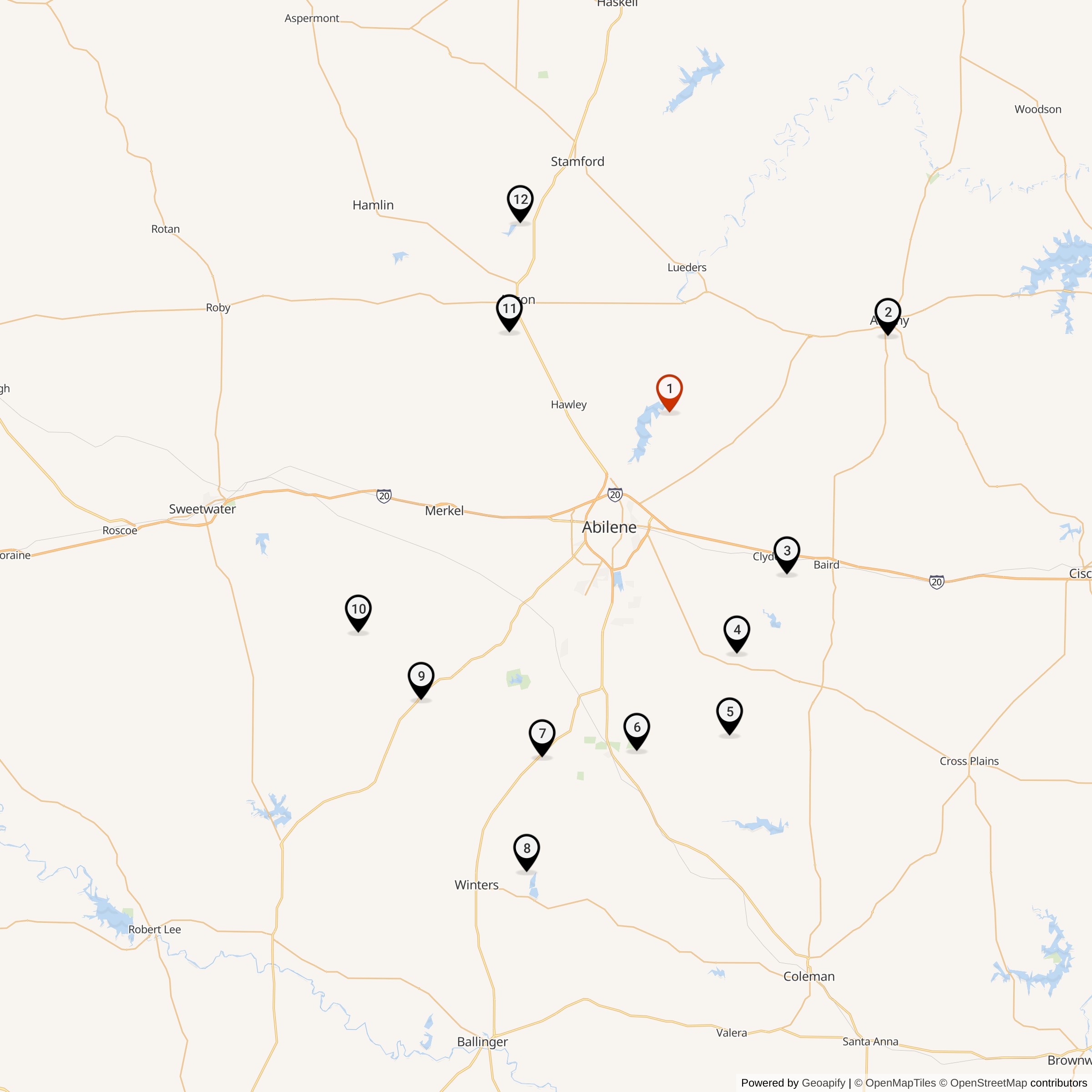
The site was located near Abilene and Lake Fort Phantom Hill in Jones County, Texas. The site was decommissioned with the rest of the 578th Strategic Missile Squadron in 1965. It is no longer an active military installation and is best described today as a decommissioned former Atlas F silo complex on private or non-federal property with no verified public access.
Location, Landscape, and Site Description
Site 578-1 sat in the rural landscape north of Abilene, southeast of Lake Fort Phantom Hill. The surrounding terrain is open West Texas agricultural and ranch land, with the former launch complex set apart from the urban core of Abilene but close enough to Dyess Air Force Base to be part of the base's dispersed Atlas missile ring. The location gave the Dyess missile field a wide geographic footprint: the launch sites were separated from each other and from the parent base so that a single attack would be less likely to disable the entire squadron.The launch complex was an Atlas F "silo-lift" facility. The missile was stored vertically underground in a hardened silo rather than horizontally in a coffin launcher, as on Atlas E sites. The complex included a deep silo, large launch doors, an elevator or launcher mechanism to raise the missile for firing, underground support and control spaces, utilities, propellant-handling systems, access ways, and surface support features.
The site's association with Lake Fort Phantom Hill matters geographically as well as historically. Lake Fort Phantom Hill is a municipal reservoir owned and operated by the City of Abilene and lies in southeastern Jones County. The missile site was not part of the reservoir itself, but the lake is the most useful nearby geographic landmark for identifying Site 578-1 in the northern part of the Abilene missile field.
Strategic and Cold War Context
Site 578-1 existed because the United States wanted a survivable, rapid-response intercontinental ballistic missile force during the early 1960s. Atlas was the Air Force's first operational ICBM. The first Atlas variants were important but vulnerable: some were stored above ground or in less-protected launch configurations. The Atlas F represented the last and most hardened Atlas deployment concept, with missiles placed in individual underground silo-lift complexes.The Atlas F system was still a first-generation liquid-fueled missile. It improved on earlier Atlas basing by placing each missile in a hardened silo, but it did not launch directly from the underground tube. The missile had to be raised to the surface before firing, and liquid oxygen still had to be loaded before launch. The concept was therefore a compromise between survivability and the technological limits of the Atlas missile. It offered better protection than earlier Atlas sites and a faster launch process than Atlas D or E, but it was soon overtaken by solid-fueled Minuteman missiles and by Titan II systems that could remain at a higher state of readiness.
The Dyess missile field also had a regional defensive context. The official Dyess AFB history notes that Army Nike Hercules air-defense sites were placed around Dyess to defend SAC bombers and the Atlas F silos in the area. Site 578-1 was therefore part of a layered Cold War military landscape: nuclear bombers at Dyess, dispersed Atlas F ICBM launch sites around Abilene, and Nike missile defenses intended to protect the larger SAC complex.
Construction and Activation
The Atlas F construction program at Dyess was managed initially through the U.S. Army Corps of Engineers Fort Worth District. The Fort Worth District also had responsibility for nationwide procurement of the Atlas F propellant-loading system before the Corps of Engineers Ballistic Missile Construction Office assumed broader missile-construction oversight in 1960. Six bids for the Dyess Atlas F project were opened at Abilene on May 26, 1960, and the low bid of about $20 million came from a joint venture of H. B. Zachry Company and Brown & Root, Inc. Construction began on June 7, 1960.The Dyess missile-field construction project included twelve lift-launcher sites at locations identified in contemporary and later sources as Abilene or Phantom Lake, Albany, Clyde, Denton Community, Oplin, Lawn, Bradshaw, Winters, Shep, Nolan, Anson, and Corinth. The project was notable because, according to USAF unit-history material and The Military Standard's Dyess summary, it was completed on time and without labor-related work stoppages. The same sources record the cost of construction in human terms: three fatalities and thirty-three disabling injuries occurred during the Dyess construction project.
The 578th Strategic Missile Squadron was activated at Dyess on July 1, 1961. The assigned missile as General Dynamics Missile Serial Number 61-2564, General Dynamics Manufacturing Number 78F, and Air Force Missile Tail Number 564. That missile was accepted on May 31, 1962 and delivered on June 11, 1962. USAF unit-history material lists "Turnover to SAC" on November 4, 1962 and "Operational" on November 15, 1962, so the operational date for the completed Dyess Atlas F alert force is best treated as November 15, 1962 rather than the earlier squadron activation date.
Missile System and Technical Role
Site 578-1 housed the SM-65F Atlas, the final operational Atlas ICBM variant. Atlas was developed by Convair / General Dynamics and used a pressure-stabilized stainless-steel airframe. Because the missile's structure depended on internal pressure, the system required careful handling and constant technical attention. The National Park Service describes Atlas as the Air Force's first operational ICBM and notes that the Atlas F was deployed in a blast-proof silo-lift configuration and could be launched in approximately ten minutes. F. E. Warren Air Force Base's Atlas fact sheet similarly explains that the Atlas missile was stored in a silo for protection and raised to ground level for launch.The Atlas F used RP-1 kerosene and liquid oxygen. RP-1 remained aboard the missile while it was on alert, while liquid oxygen was loaded before the missile was raised and launched. The site therefore needed specialized propellant-handling equipment, fueling procedures, pressurization systems, power, communications, and trained crews. The missile was not a simple "button in a silo" weapon. It was a complex liquid-fueled system that demanded frequent maintenance and a carefully choreographed alert procedure.
Public-source technical descriptions identify the Atlas E/F reentry system as the Mark 4 reentry vehicle carrying the W-38 nuclear warhead. The Smithsonian National Air and Space Museum identifies its Mark 4 reentry vehicle as used on Atlas E/F and Titan I ICBMs and states that it carried a W-38 warhead with a yield of about 3.75 megatons.
Operational History
Site 578-1's active operational life was brief but intense. The 578th Strategic Missile Squadron was organized as a twelve-missile Atlas F squadron at Dyess AFB. The missile sites were dispersed in a ring around Abilene and were supported by Dyess-based missile, maintenance, security, communications, and command personnel. The sites were manned around the clock during the squadron's active period, reflecting the Atlas F complex design in which the launch-control and support elements were integrated with each individual site rather than separated into a Minuteman-style remote launch-control network.The squadron became operational in 1962, a critical year in the Cold War. USAF unit-history material states that the 578th and its twelve missiles were placed on alert during the Cuban Missile Crisis. For Site 578-1, this meant that the complex was part of the national nuclear alert posture at the moment when U.S.-Soviet confrontation over Cuba brought the strategic missile force to one of its most dangerous early tests. The Atlas F system's liquid-fueled complexity remained a limitation, but the Dyess sites gave SAC a hardened ICBM force in central Texas at a time when the United States was still building out the larger Minuteman and Titan II force.
Operational routines at Site 578-1 would have centered on alert watch, missile checkout, propellant-system readiness, security patrols, communications, equipment maintenance, and periodic evaluations. The 578th missile field was also subject to SAC inspection and readiness culture. From May 28 through June 2, 1963, the 578th Strategic Missile Squadron underwent the first Operational Readiness Inspection for an Atlas F missile unit. That inspection was squadron-wide rather than uniquely tied to Site 578-1, but it is important because it shows that the Dyess Atlas F force was early in SAC's process of standardizing and testing Atlas F operational readiness.
Deactivation and Disposal
Atlas F was already nearing obsolescence by the time Site 578-1 became operational. The missile was a major achievement, but its liquid oxygen fueling requirement, pressure-stabilized airframe, and silo-lift launch method made it more complicated and less responsive than later solid-fueled systems. On May 16, 1964, Secretary of Defense Robert S. McNamara directed the accelerated phaseout of Atlas and Titan I ICBMs. Later that year, the first Atlas F missile at Dyess was removed from alert on December 1, 1964.The phaseout process should be understood as a sequence rather than a single event. The 578th squadron's first missile came off alert on December 1, 1964. USAF unit-history material lists the last 578th ICBM off alert on February 3, 1965 and the last ICBM shipped on February 10, 1965. The squadron was deactivated on March 25, 1965. The official Dyess history states that after decommissioning in 1965, the Atlas missiles were removed and the sites were demilitarized.
Unlike later Minuteman and Peacekeeper sites, Site 578-1 was retired before the major strategic-arms treaties that drove many post-Cold War silo eliminations. Its disposal was therefore part of the 1960s retirement of first-generation ICBM infrastructure rather than a START-era demolition program. The missile, launch equipment, and military-sensitive systems were removed or demilitarized before disposal. Public secondary summaries indicate that many Atlas F sites passed into private ownership after demilitarization, with major salvage taking place at some locations while the massive underground structures often remained.
Current Status and Site Use
Site 578-1 is a decommissioned former Atlas F launch complex on private or non-federal land. It is not an active military site, not a staffed museum, and not known to be open for public access. The best available public imagery shows the former launch complex footprint, with the access road and central silo-area remnants still visually distinguishable.
Chronology
- 1960-05-26 Six bids for the Dyess Atlas F construction project were opened at Abilene, Texas.
- 1960-06-07 Construction began on the twelve Atlas F lift-launcher sites around Dyess AFB.
- 1961-07-01 The 578th Strategic Missile Squadron was activated at Dyess AFB.
- 1962-05-31 The missile assigned to Site 1, General Dynamics Missile 78F / serial number 61-2564 / Air Force tail number 564, was accepted.
- 1962-06-11 Missile 78F was delivered to Dyess AFB.
- 1962-11-04 USAF unit-history material lists turnover to Strategic Air Command for the 578th Atlas F force.
- 1962-11-15 USAF unit-history material lists the 578th Atlas F force as operational.
- 1962 The 578th Strategic Missile Squadron's twelve Atlas F missiles were placed on alert during the Cuban Missile Crisis.
- 1963-05-28 to 1963-06-02 The 578th Strategic Missile Squadron underwent the first Operational Readiness Inspection for an Atlas F missile unit.
- 1964-05-16 Secretary of Defense Robert S. McNamara directed the accelerated phaseout of Atlas and Titan I ICBMs.
- 1964-12-01 The first Atlas F missile at Dyess was removed from alert ahead of schedule.
- 1965-02-03 USAF unit-history material lists the last 578th ICBM off alert.
- 1965-02-10 USAF unit-history material lists the last 578th ICBM shipped.
- 1965-03-25 The 578th Strategic Missile Squadron was deactivated and Site 578-1's active Atlas F service was over.
- 1973-08-29 The former Site 1 missile, Atlas 78F, was launched from Vandenberg Air Force Base with an ABRES payload.

Read about the Atlas at Dyess AFB
All Atlas Missile Silo Locations