
Atlas F Site 578-12 Missile Silo, Corinth West / Stamford Texas
Longitude: -99.8914633658666
Site Type: Atlas F vertical silo launch facility
Missile Type: SM-65F Atlas
Number of Launchers/Missiles: 1
Parent Base: Dyess AFB
Missile Wing: 96th Strategic Aerospace Wing
Missile Squadron: 578th Strategic Missile Squadron
Current Site Use: Private former Atlas F missile site; original Quonset hut remains; LCC complete; silo crib structure gone; lake water-rights arrangement noted.
Site Ownership: Private property
Accessible: Private/no general public access; permission required
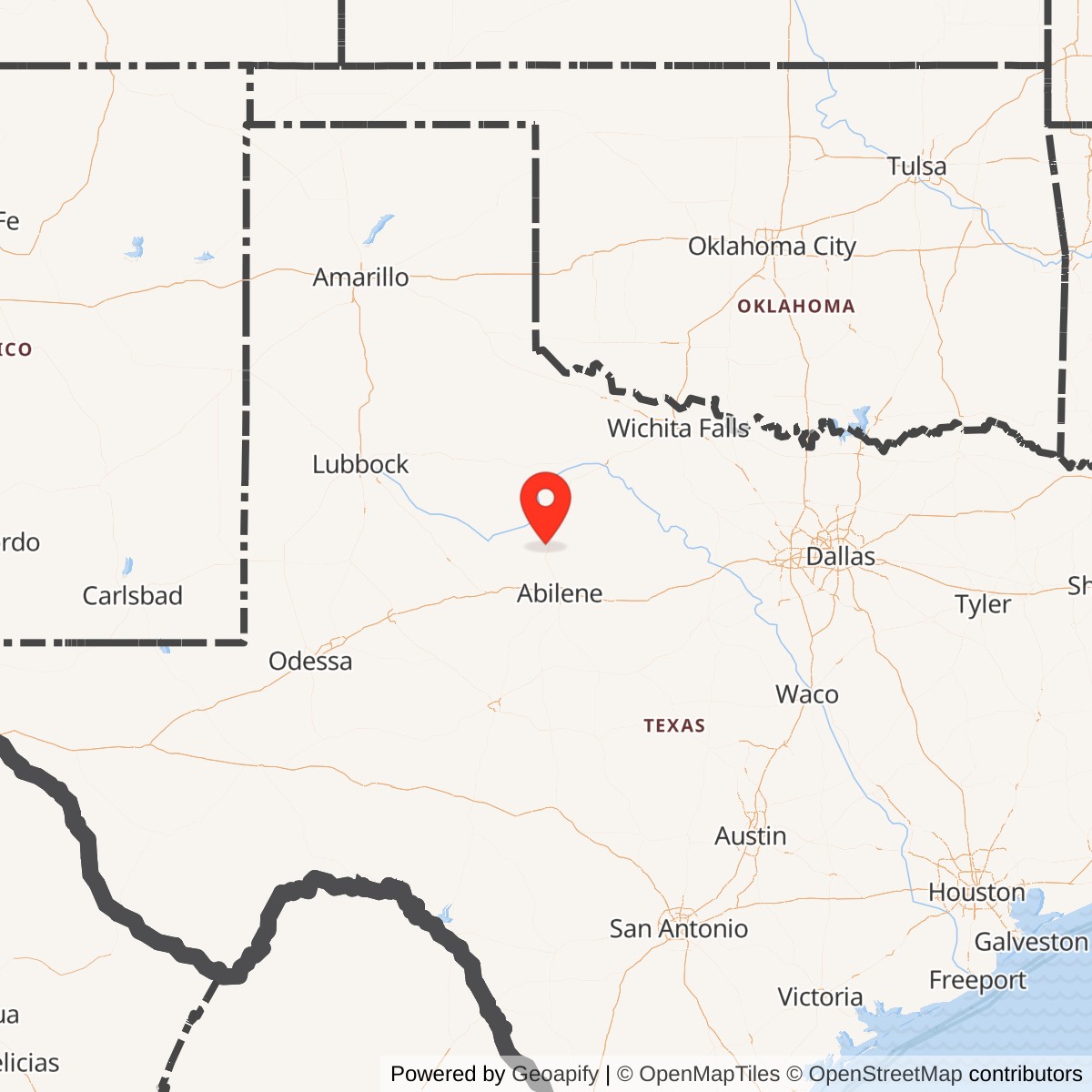
In the farm and ranch country northwest of Abilene, the former Atlas F Site 578-12 looks, from the surface, like one more quiet rural property in Jones County. Its Cold War purpose was anything but quiet. Near the Corinth West / Stamford area of Texas, the site once held an SM-65F Atlas intercontinental ballistic missile in a deep underground silo, with its own buried launch-control center, access tunnel, utility spaces, liquid-oxygen and fuel systems, security features, and the heavy elevator machinery needed to raise the missile to the surface before launch.
Site 578-12 is a good closing chapter for the Dyess Atlas F field because it shows both sides of the Atlas story. It was one of twelve hardened vertical-silo launch complexes assigned to the 578th Strategic Missile Squadron, a unit that reached operational status in November 1962, placed its missiles on alert during the Cuban Missile Crisis period, and then disappeared from the active force less than three years later. The Corinth West site also has unusually useful post-service documentation: its assigned missile was Atlas 94F, serial number 62-12130, Air Force tail number 580, later launched on 1968-01-31 with a re-entry-vehicle test payload; Atlas Missile Museum of Texas records that the site retains its original Quonset hut, has a complete launch-control center, has lost the silo crib structure, and is unusual among Dyess sites because it used nearby lake water rights instead of wells. Beneath a rural surface is the story of a very short-lived but technically ambitious first-generation ICBM complex.
Installation / Site Identity
Atlas F Site 578-12 was a single SM-65F Atlas intercontinental ballistic missile launch complex assigned to the 578th Strategic Missile Squadron at Dyess Air Force Base, Texas. The site code is 578-12. It was one of twelve Atlas F vertical-silo launch facilities operated around Dyess by the 96th Bombardment Wing, later the 96th Strategic Aerospace Wing, through the 578th Strategic Missile Squadron.The site is located in Jones County, Texas, near the historical Corinth / Corinth West area and near Stamford in the broader county geography. The U.S. Army Corps of Engineers Formerly Used Defense Sites inventory lists the environmental property as STAMFORD ATLAS AF FACILITY S-12, which indicates that official environmental records used Stamford as the nearest city or administrative locality even though missile-history sources commonly identify the site as Corinth.
Like the other Dyess Atlas F complexes, Site 578-12 did not have a separate Minuteman-style remote Launch Control Center. The launch complex itself contained its own underground launch-control center and support spaces.
Official 578th Strategic Missile Squadron unit-history material states that the squadron was organized at Dyess Air Force Base on 1961-07-01, that construction of the Dyess missile-field project began on 1960-06-07, that the squadron was turned over to Strategic Air Command on 1962-11-04, and that the squadron became operational on 1962-11-15.
Atlas F Site 578-12 is inactive and decommissioned as a military installation. It is not an active missile facility. The 578th Strategic Missile Squadron was inactivated on 1965-03-25 during the accelerated phaseout of the Atlas E, Atlas F, and Titan I first-generation ICBMs. The former Site 578-12 property is private property. Public access should be treated as private and permission-only rather than open.
Location, Landscape, and Site Description
Site 578-12 lies in rural Jones County, northwest of Abilene and west of the Stamford area. Its coordinates, 32.86004166, -99.89146337, place it in the northern part of the dispersed Dyess missile ring. The setting is agricultural and rural, with open land, county roads, and enough distance from the parent base to give the missile field the separation that Strategic Air Command wanted for survivability. This was not a single missile base with a row of launch pads; it was a ring of individual hardened launch complexes spread across central Texas communities.Official 578th SMS unit-history material lists the twelve lift-launcher locations as Abilene, Albany, Clyde, Denton County, Oplin, Lawn, Bradshaw, Winters, Shep, Nolan, Anson, and Corinth. Site 578-12 was the Corinth location in that system. It was operationally supported from Dyess Air Force Base but physically separate from the base, making it one of the remote rural outposts of Strategic Air Command's early land-based ICBM force.
As built, Site 578-12 followed the Atlas F silo-lift configuration. The missile was stored vertically in a hardened underground silo. It did not launch directly from underground. In a launch sequence, the overhead silo doors opened, the launcher raised the missile to the surface, and the missile fired from the raised platform. That design combined underground protection with a surface launch method. It required a deep circular silo, heavy steel and concrete, a suspended launch crib and elevator platform, silo doors, an access tunnel, underground control and support spaces, propellant and pressurization systems, power and environmental-control equipment, communications systems, security fencing, and aboveground support structures.
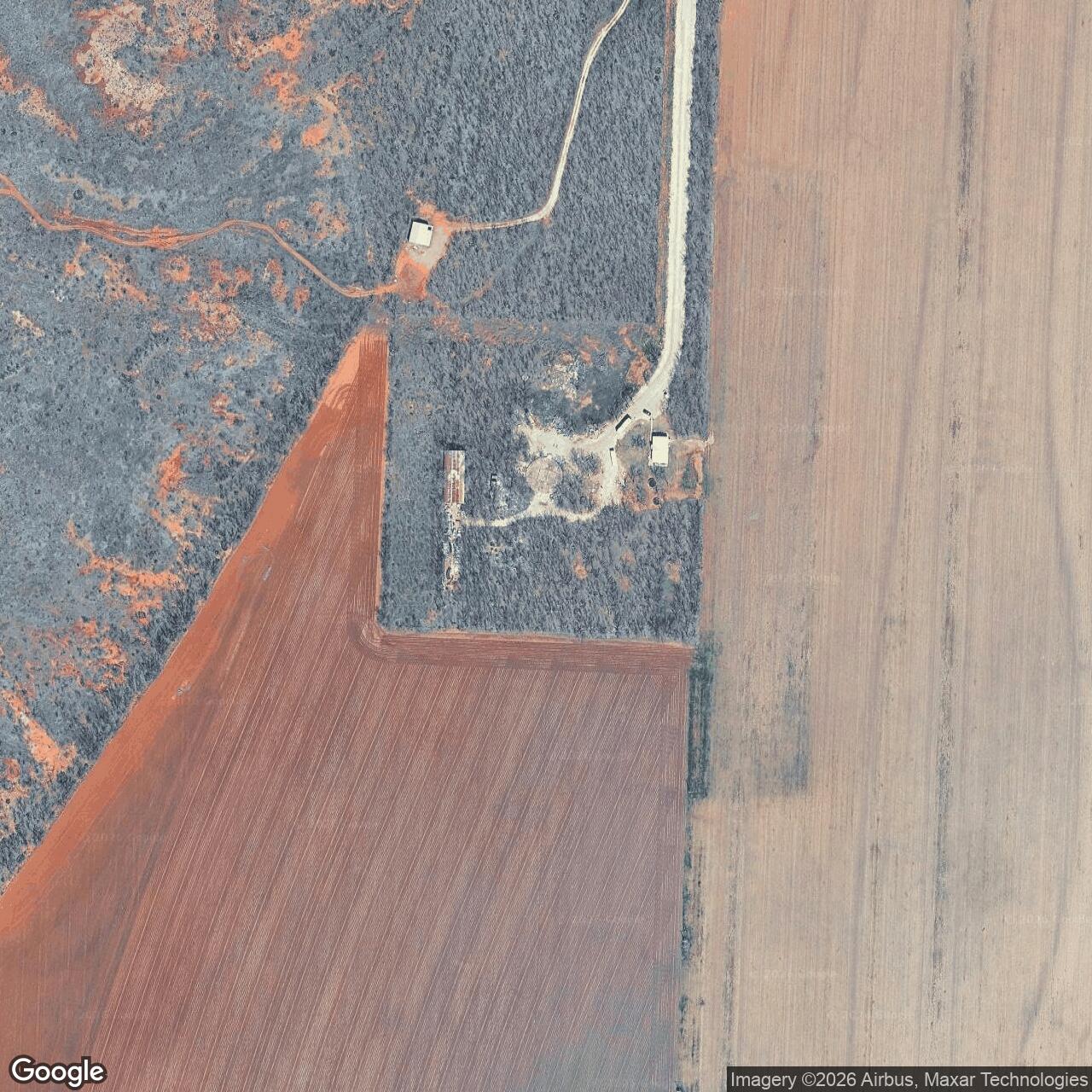
The standard Atlas F complex was more than the silo itself. Above ground, the missile-era site would have included a controlled access road, security fencing, a gate area, support buildings, ventilation and utility features, antenna or communications-related structures, and exterior equipment areas. Underground, the launch complex contained the launch-control center and the equipment needed to monitor, maintain, fuel, pressurize, raise, and launch the missile. Atlas Missile Museum of Texas material for Site 12 states that the former Corinth West site retains an original Quonset hut, has no other original outbuildings, has a complete LCC, and no longer has the silo crib structure. It also records an unusual water arrangement: unlike many other Dyess Atlas F sites that relied on wells, Site 12 had water rights to a nearby lake.
Siloworld's 1995 Corinth photo set documents visible surface and entry features from the former site, including an access road, parking area, entryway, and escape-hatch-related features. Those images help show that Site 578-12 was still visually identifiable decades after decommissioning, though not as an active public site.
Strategic and Cold War Context
Site 578-12 existed because the United States needed a survivable, land-based intercontinental nuclear deterrent at the moment when ICBMs were still new and unproven. The Atlas was the United States Air Force's first operational intercontinental ballistic missile. It emerged from the early Cold War effort to build weapons that could reach targets across continents and became the first practical bridge between nuclear strategy, rocket engineering, hardened basing, and Strategic Air Command alert operations.The National Park Service describes Atlas as the Air Force's first operational ICBM and notes that Atlas E and Atlas F missiles were deployed across the United States after the initial Atlas D deployment. At their peak, 132 Atlas sites were operational from December 1962 through May 1964. That period matches the short operational window of the Dyess Atlas F field. Site 578-12 was therefore part of Atlas at its peak rather than a late historical footnote.
Atlas F was the final and most hardened operational Atlas variant. Earlier Atlas D sites used aboveground gantry or coffin-type launchers. Atlas E used dispersed individual coffin sites with improved blast protection. Atlas F moved the missile into a vertical underground silo. The Atlas F was stored on an elevator-like launch platform; after a launch order sequence began, liquid oxygen was loaded, the missile and launcher were raised to the surface, and the missile launched from above ground. Spaceline's Atlas F summary describes the system as a quick-firing Atlas E derivative stored vertically in underground concrete and steel silos, fueled with RP-1 and liquid oxygen, and able to launch in roughly ten minutes once the sequence was underway.
The system was powerful but transitional. The Atlas airframe used a thin stainless-steel pressure-stabilized structure that required constant pressure to maintain its shape. National Park Service material explains that the Atlas missile had to be pressurized while on alert because the stainless-steel shell was so thin that only pressure kept it structurally sound on the ground. That engineering approach reduced weight but increased maintenance demands. It made Atlas an extraordinary missile and a demanding weapon system.
The public technical record also identifies the Atlas F reentry vehicle and warhead combination. The Smithsonian National Air and Space Museum describes the Mark 4 reentry vehicle as an AVCO-built RV used on Atlas E/F and Titan I missiles in the early 1960s. The same Smithsonian record states that it carried the W-38 nuclear warhead with a yield of about 3.75 megatons. The National Park Service gives a 4.5-megaton figure for Atlas F in its overview. Because public sources vary in rounded yield figures, this history uses the Smithsonian Mark 4 / W-38 description and notes that public-source yields are generally described in the 3.75- to 4.5-megaton range.
Site 578-12 therefore belonged to a brief but critical generation of ICBM sites. It was hardened, dispersed, and technically more capable than earlier Atlas launchers, but it still relied on liquid oxygen, RP-1 fuel, complex pressurization, and labor-intensive readiness procedures. Within only a few years, solid-fueled Minuteman missiles made first-generation liquid-fueled Atlas and Titan I systems obsolete for long-term alert duty.
Construction and Activation
The construction history of Site 578-12 is best understood as part of the larger Dyess Atlas F field. The available public sources do not provide a precise site-specific contract start date or Air Force acceptance date for Site 12, but the official 578th SMS unit history gives unusually good information about the overall construction program.Initial responsibility for constructing the twelve Dyess Atlas F silos fell to the U.S. Army Corps of Engineers Fort Worth District. The Fort Worth District also received responsibility for nationwide procurement of the Atlas F propellant loading system. When the Corps of Engineers Ballistic Missile Construction Office, or CEBMCO, was formed in 1960, the Fort Worth District was relieved of direct silo-construction oversight. That shift reflected the national scale and urgency of the ICBM construction program. Atlas F sites were not ordinary military buildings; they were deep hardened launch complexes with heavy civil engineering, specialized mechanical systems, liquid-oxygen and fuel support, electrical systems, environmental controls, and command-and-control infrastructure.
On 1960-05-26, six bids were opened at Abilene, Texas, for the Dyess Atlas F construction project. The low bid, approximately $20 million, came from a joint venture of H.B. Zachry Company and Brown & Root, Inc. Construction commenced on 1960-06-07. The 578th SMS unit history lists the twelve lift-launcher locations, including Corinth, confirming Site 578-12 as one of the planned and built Dyess facilities.
The Dyess project is notable because official unit-history material says it was completed on time and without work stoppages due to labor unrest. That was not a minor accomplishment. Atlas F construction required excavation and concrete work on a scale far beyond conventional building construction. Each site required a deep silo, a buried launch-control center, a connecting access tunnel, structural steel, reinforced concrete, silo doors, launch-platform machinery, propellant equipment, power and communication systems, drainage and environmental controls, surface support facilities, and road/utility access. Work had to proceed across multiple rural sites while maintaining national schedule pressure during the early ICBM race.
The same official source also records the human cost of the work: three fatalities and thirty-three disabling injuries were associated with the Dyess construction project. Those numbers are important because they prevent the construction story from becoming only a triumph of engineering. Building a ring of hardened nuclear-missile silos around Abilene required dangerous excavation, heavy lifts, confined work, deep concrete construction, machinery installation, and a construction pace driven by Cold War urgency.
Site 578-12 has a site-specific construction-photo page at Atlas Missile Museum of Texas. The images on that page preserve the scale of the construction effort at Corinth West. They show deep excavation, heavy reinforcing steel, large concrete forms, workers inside the excavation, the circular silo structure under construction, and the kind of internal framing and platform work required before the site could become a functioning launch complex. The page is especially valuable because many former missile sites are now documented only by coordinates and present-day aerial imagery; for Site 12, the construction photographs show the property in the moment when rural Jones County land was being transformed into a hardened ICBM facility.
The Historic American Engineering Record documentation for Dyess Atlas F Site S-8 at Winters provides representative engineering detail for the launch complexes built in the same twelve-site Dyess ring. HAER identifies the U.S. Army Corps of Engineers as engineer and builder, with H.B. Zachry and Brown & Root as builders, and describes the launch facility as an Atlas F silo-lift complex. The S-8 documentation should not be read as proof of every Site 12 measurement or condition, but it is useful because Site S-8 was part of the same Dyess Atlas F program and illustrates the standard construction features: a deep launch facility, launch-control center, heavy reinforced concrete, an underground control structure, and the equipment arrangement needed for an Atlas F vertical silo.
The 578th Strategic Missile Squadron was activated in January 1961 and organized at Dyess on 1961-07-01 while construction and site activation continued. Official unit-history material states that the squadron was turned over to Strategic Air Command on 1962-11-04 and became operational on 1962-11-15.
Missile System and Technical Role
Site 578-12 housed the SM-65F Atlas, also known in later nomenclature as HGM-16F Atlas. Atlas F was a liquid-fueled, first-generation intercontinental ballistic missile. It used RP-1 kerosene-type fuel and liquid oxygen oxidizer. RP-1 could be kept aboard the missile while it was on alert, but liquid oxygen had to be loaded before launch. The missile's stainless-steel airframe had to remain pressurized, and its launch sequence required careful coordination of fueling, pressurization, mechanical raising, guidance readiness, communications, and launch-control actions.The Atlas F was not a Minuteman-style solid-fueled missile that sat sealed in a silo ready to fire from underground. It was stored vertically in a protected silo, then raised to the surface for launch. The silo therefore protected the missile before launch but was not itself the launch tube. The launch facility had to function as a mechanical and industrial system: the doors opened, the elevator raised the missile and launcher, liquid oxygen was handled, gaseous systems maintained pressure, and the launch-control crew and support personnel monitored a complex set of status and safety indications.
Site 12's assigned missile was General Dynamics Manufacturing Number 94F, serial number 62-12130, Air Force missile tail number 580. The missile acceptance date was 1962-06-11 and the delivery date as 1962-06-13. It also records a post-service launch on 1968-01-31 with a payload described as "Re-Entry Vehicle Test - RMP-B-5." That later launch was not an operational launch from the Corinth site, but it shows that the physical missile associated with Site 578-12 had an afterlife after the Atlas F alert mission ended.
The Atlas F launch complex was a crewed facility during alert operations, unlike later unmanned Minuteman launch facilities controlled from remote Launch Control Centers. Atlas Missile Museum of Texas material for the 578th SMS describes the Dyess sites as manned twenty-four hours a day, seven days a week, during the squadron's active period. The site contained its own launch-control center and support spaces. Missile combat crews, maintenance technicians, security personnel, communications personnel, and support teams all formed part of the operating system, even though the actual property sat far from the parent base.
The technical role of Site 578-12 was therefore straightforward but demanding: preserve a first-generation thermonuclear ICBM in a high state of readiness, protect it in a hardened silo, keep it connected to Strategic Air Command command-and-control channels, and be able to raise, fuel, and launch the missile if ordered. The site existed for deterrence, not for routine launch activity. Its purpose was to make the missile available as part of the national nuclear alert force.
Operational History
The operational history of Site 578-12 was short, intense, and typical of the Atlas F era. The 578th Strategic Missile Squadron was assigned to Dyess Air Force Base and operated the twelve Atlas F launch complexes around Abilene. The squadron was organized at Dyess on 1961-07-01 under the 96th Bombardment Wing, later the 96th Strategic Aerospace Wing. Its weapon system was the SM-65F Atlas.Official unit-history material states that the squadron became operational on 1962-11-15. That date places the Dyess Atlas F sites at the center of a tense moment in Cold War history. The Cuban Missile Crisis had occurred in October 1962, just before the 578th's formal operational date. The same unit-history material states that the 578th and its twelve missiles were placed on alert status during the Cuban Missile Crisis.
Routine operations at Site 578-12 would have involved continuous readiness monitoring, system checks, maintenance, security control, communications checks, propellant-system readiness, and exercises. The Atlas F was maintenance-intensive. It required attention to the missile's pressure-stabilized structure, RP-1 fuel, liquid-oxygen loading system, gaseous-nitrogen pressurization, environmental controls, the mechanical launcher, silo doors, guidance system, power systems, and safety interlocks. Keeping the site on alert meant maintaining both the missile and the launch complex around it.
Security was also central to daily operations. The site was an isolated nuclear missile complex in rural Texas. Access would have been controlled, and security personnel had to protect the surface compound, underground entry points, communications links, and the weapon system. The remoteness of the site served a strategic purpose, but it also meant that maintenance and emergency response depended on coordination between the local site and Dyess-based support organizations.
Site 578-12 also fit into Dyess Air Force Base's broader Strategic Air Command posture. Dyess was a bomber and missile base during this period, and the Atlas F field expanded the base's Cold War footprint well beyond the main installation. The missile field tied the Abilene region, Jones County, Callahan County, Taylor County, Runnels County, Shackelford County, and Nolan County into the national nuclear-alert network.
Deactivation and Disposal
Site 578-12 left active missile service as part of the rapid retirement of the Atlas and Titan I first-generation ICBM force. Official 578th SMS unit-history material states that on 1964-05-16, Secretary of Defense Robert S. McNamara directed the accelerated phaseout of Atlas and Titan I ICBMs. The first Atlas F missile at Dyess was removed from alert on 1964-12-01 ahead of schedule to avoid costly maintenance expenditures. The last 578th SMS ICBM was removed from alert on 1965-02-03, and the last ICBM was shipped on 1965-02-10. The squadron was inactivated on 1965-03-25.Those dates matter because they separate several different events often collapsed into the single word "decommissioned." The squadron's operational life ended in stages: policy direction for phaseout in May 1964, the first Dyess Atlas F missile removed from alert in December 1964, the last missile removed from alert in February 1965, the last missile shipped out a week later, and the squadron inactivated in March 1965.
The deactivation of Site 578-12 was not a result of later arms-control treaty demolition such as START-era Minuteman or Peacekeeper elimination. Atlas F had already left service by 1965, long before those later verification regimes. Its phaseout reflected technological obsolescence and maintenance cost. Solid-fueled Minuteman missiles were better suited for long-term dispersed alert because they could remain ready without the same liquid-oxygen loading, pressure-maintenance, and mechanical raising demands that defined the Atlas F system.
Public sources do not provide a complete equipment-removal and property-disposal file for Site 578-12. Available sources support the broad sequence: the missile was removed from alert and shipped during the squadron phaseout; the 578th SMS was inactivated; the site was demilitarized; the property eventually passed into private use; the LCC remains complete; the silo crib structure is gone; an original Quonset hut remains; no other original outbuildings are reported; and the former site appears in the USACE Formerly Used Defense Sites inventory.
The U.S. Army Corps of Engineers 2015 Formerly Used Defense Sites inventory lists STAMFORD ATLAS AF FACILITY S-12 in Jones County, Texas, with property number K06TX0117. It lists Site 02 with the category HTRW and Site 03 with the category CON/HTRW. In the FUDS inventory legend, HTRW refers to hazardous, toxic and/or radioactive waste, while CON/HTRW refers to containerized hazardous, toxic and/or radioactive waste. This listing does not by itself describe present conditions at every part of the former launch complex, but it confirms that the former Site 12 property has a recognized FUDS/environmental-program record.
Current Status and Site Use
Atlas F Site 578-12 is inactive, decommissioned, and no longer a military missile site. The former launch complex is private property in Jones County, Texas, near Corinth West / Stamford.The current site is not documented as an open public museum. Atlas Missile Museum of Texas material indicates that significant features remain: an original Quonset hut, a complete launch-control center, and the loss of the silo crib structure. It also notes the unusual water-rights arrangement to a nearby lake. Siloworld's 1995 photo set documents exterior and entry-related features visible at that time. None of those sources establish unrestricted public access. The property should be treated as private, permission-only land.
Former Atlas F sites require caution. Even after demilitarization, they may contain deep shafts, water, unstable surfaces, confined spaces, deteriorated stairs or ladders, electrical or mechanical remnants, debris, environmental hazards, and unguarded openings. The FUDS listing reinforces the need to treat the property as more than a simple rural ruin.
Chronology
- 1960-05-26 Six bids were opened at Abilene, Texas, for the Dyess Atlas F construction project; the low bid of approximately $20 million came from the H.B. Zachry Company and Brown & Root, Inc. joint venture.
- 1960-06-07 Construction commenced on the Dyess Atlas F missile-field project, including the twelve lift-launcher locations that included Corinth.
- 1961-01-25 The 578th Strategic Missile Squadron was activated.
- 1961-07-01 The 578th Strategic Missile Squadron was organized at Dyess Air Force Base, Texas.
- 1962-06-11 Site 12 assigned missile, Atlas 94F / serial 62-12130 / tail 580, as accepted.
- 1962-06-13 Site 12 assigned missile as delivered.
- 1962-11-04 Official unit-history material lists the 578th Strategic Missile Squadron as turned over to Strategic Air Command.
- 1962-11-15 Official unit-history material lists the 578th Strategic Missile Squadron as operational.
- 1962 The 578th SMS and its twelve missiles were placed on alert status during the Cuban Missile Crisis period, according to official unit-history material.
- 1964-05-16 Secretary of Defense Robert S. McNamara directed the accelerated phaseout of Atlas and Titan I ICBMs.
- 1964-12-01 The first Atlas F missile at Dyess was removed from alert ahead of schedule.
- 1965-02-03 The last 578th SMS ICBM was removed from alert.
- 1965-02-10 The last 578th SMS ICBM was shipped.
- 1965-03-25 The 578th Strategic Missile Squadron was inactivated.
- 1968-01-31 Site 12 assigned missile, Atlas 94F / tail number 580, was launched with a re-entry-vehicle test payload identified as RMP-B-5.
- 2015 The U.S. Army Corps of Engineers Texas FUDS inventory listed STAMFORD ATLAS AF FACILITY S-12 / K06TX0117 in Jones County with HTRW and CON/HTRW categories.
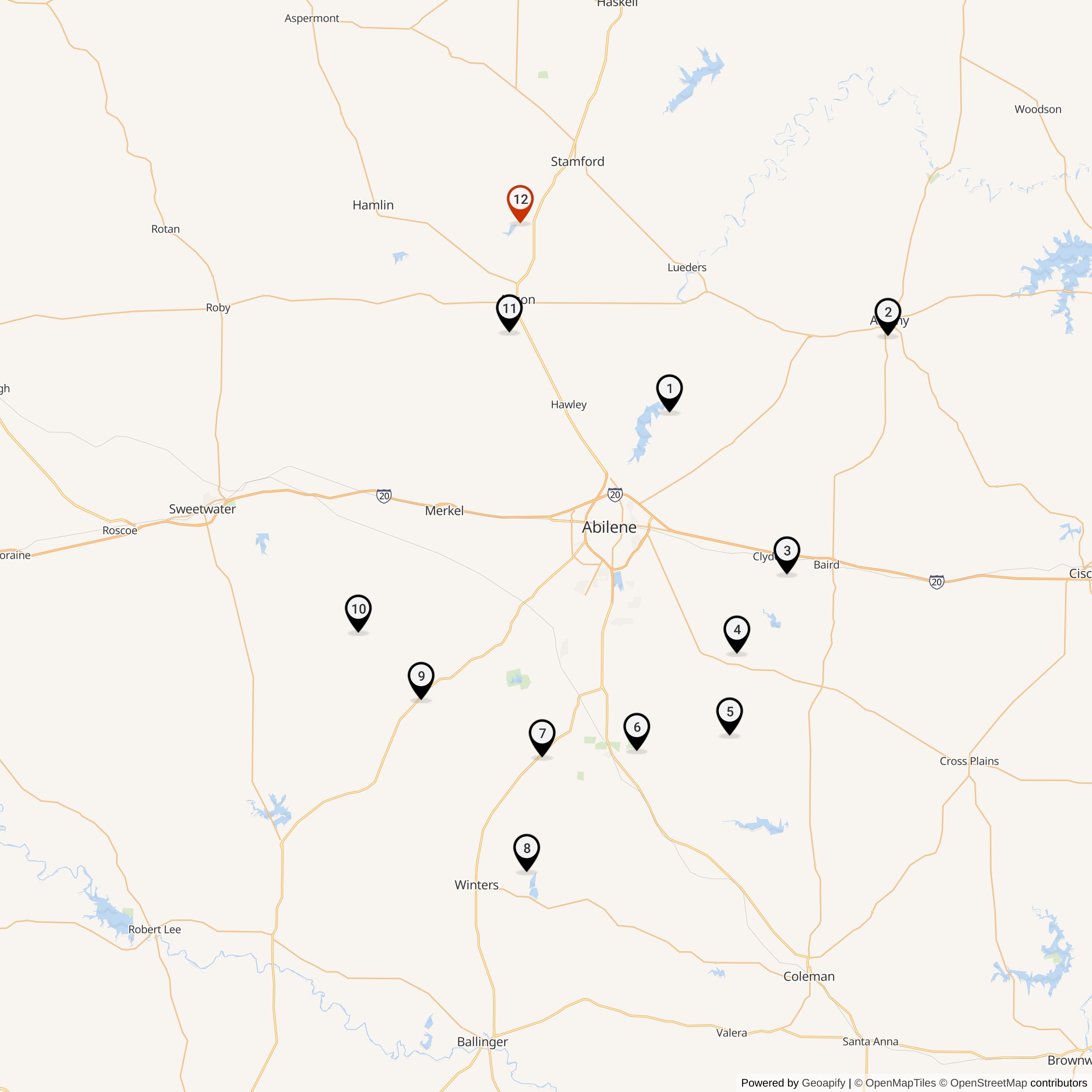
Read about the Atlas at Dyess AFB
All Atlas Missile Silo Locations