Atlas F Site 578-5 Missile Silo, Oplin Texas
Longitude: -99.5530373779052
Site Type: Atlas F vertical silo launch facility
Missile Type: SM-65F Atlas
Number of Launchers/Missiles: 1
Parent Base: Dyess AFB
Missile Wing: 96th Bombardment Wing; 96th Strategic Aerospace Wing after 1963-02-01
Missile Squadron: 578th Strategic Missile Squadron
Current Site Use: Private restored Atlas F silo complex; home of the Atlas Missile Museum of Texas, with appointment-only tours and surviving silo/launch-control features.
Site Ownership: Private/non-federal ownership; Atlas Missile Museum of Texas, Inc. operates historic interpretation at the site.
Accessible: Appointment-only museum tours; private property and access subject to current museum rules and safety restrictions.
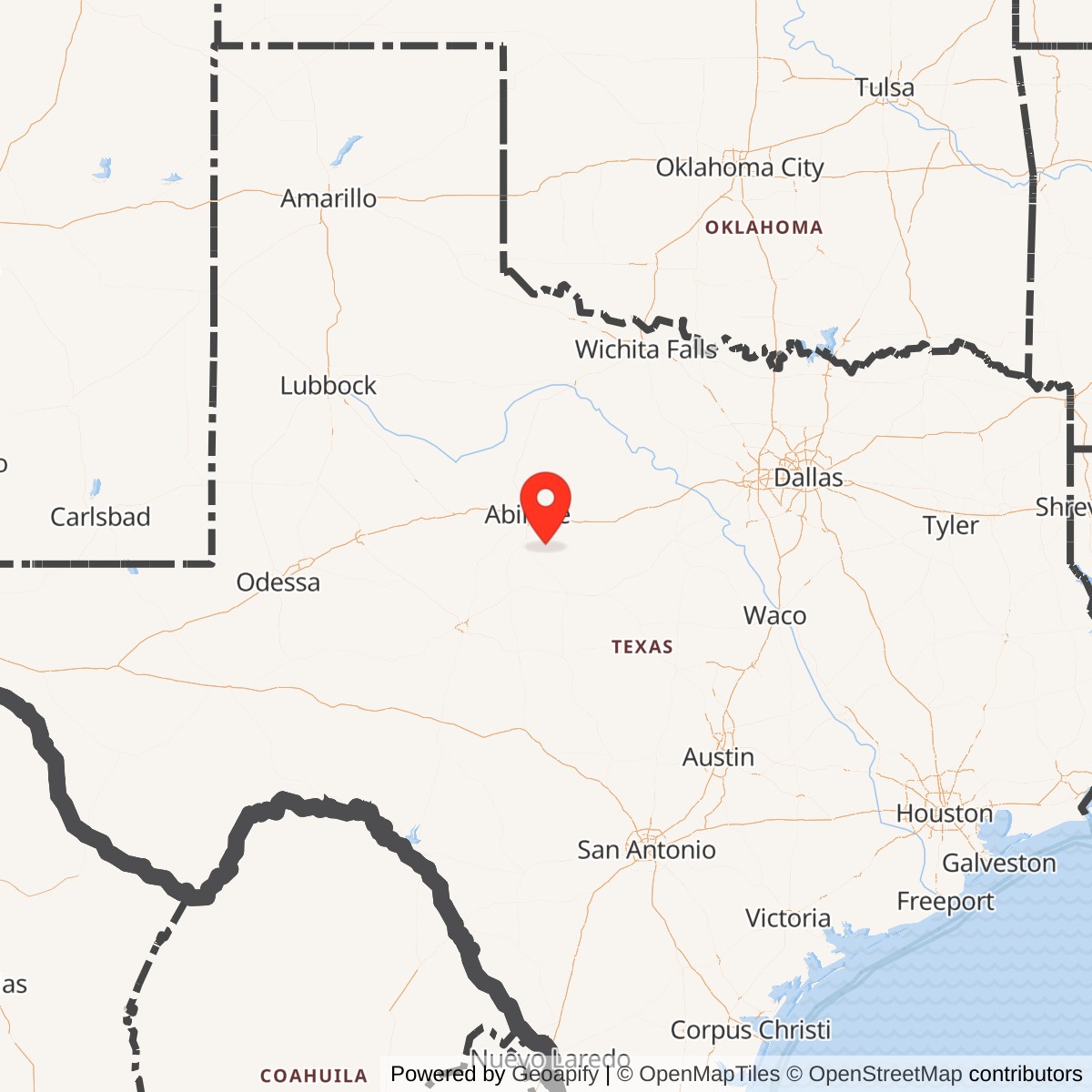
South of Abilene near the small Callahan County community of Oplin, Atlas F Site 578-5 is one of the Dyess missile field's most readable Cold War survivors. It was not only one of the twelve hardened Atlas F launch complexes built around Dyess Air Force Base; it was the site that contemporary Dyess newspaper coverage identified as receiving the first Atlas ICBM placed in a Dyess silo. Its assigned missile, nicknamed "Spirit of Oplin," later had an afterlife far beyond central Texas: public Atlas site records identify it as Atlas 64F, the booster that launched NAVSTAR-1, the first GPS satellite, from Vandenberg in 1978.
That arc gives Site 578-5 an unusually clear story. It began as a deep, blast-hardened nuclear launch complex in the 1960 construction boom around Dyess. It served only briefly as an operational Strategic Air Command missile site. After deactivation, it passed through private hands and eventually became one of the better-known restored Atlas F complexes in Texas, with an intact suspended crib, a renovated launch-control center, a working demonstration console, an operable silo door, and appointment-only museum interpretation through the Atlas Missile Museum of Texas.
Installation / Site Identity
Atlas F Site 578-5 was a single SM-65F Atlas intercontinental ballistic missile launch complex assigned to the 578th Strategic Missile Squadron at Dyess Air Force Base, Texas. The site code is 578-5. It was part of the Dyess Atlas F missile field operated by the 96th Bombardment Wing, later redesignated the 96th Strategic Aerospace Wing, through the 578th Strategic Missile Squadron.The site was located near Oplin in Callahan County, Texas.
Like the other Dyess Atlas F sites, Site 578-5 did not have a separate Minuteman-style remote parent Launch Control Center. The Atlas F launch complex incorporated its own hardened control and support spaces within the individual site.
Construction of the Dyess Atlas F field began in 1960. Site-specific Atlas records list Site 5 as Oplin, Texas, show construction beginning sometime in 1960, and show the site turned over to the Air Force sometime in 1962. The 578th Strategic Missile Squadron was activated on 1961-07-01, turned over to Strategic Air Command on 1962-11-04, and became operational on 1962-11-15.
Atlas F Site 578-5 is inactive and decommissioned. It is no longer an active missile facility. The 578th Strategic Missile Squadron was inactivated on 1965-03-25 during the accelerated retirement of Atlas E, Atlas F, and Titan I first-generation cryogenic ICBMs. The former launch complex is now privately owned and reused for historic interpretation through the Atlas Missile Museum of Texas. Public access is by appointment only and is subject to the museum's current safety and reservation rules.
Location, Landscape, and Site Description
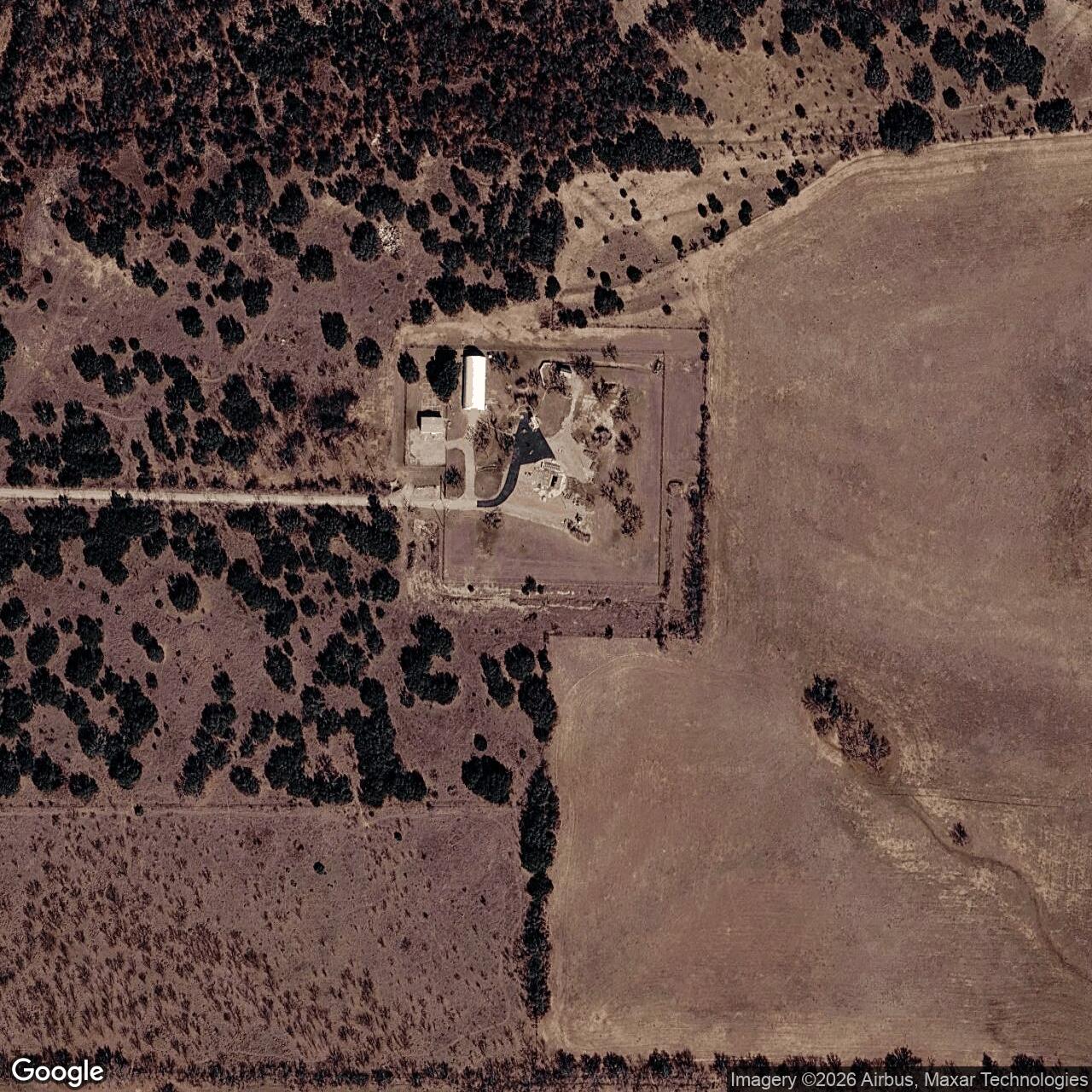
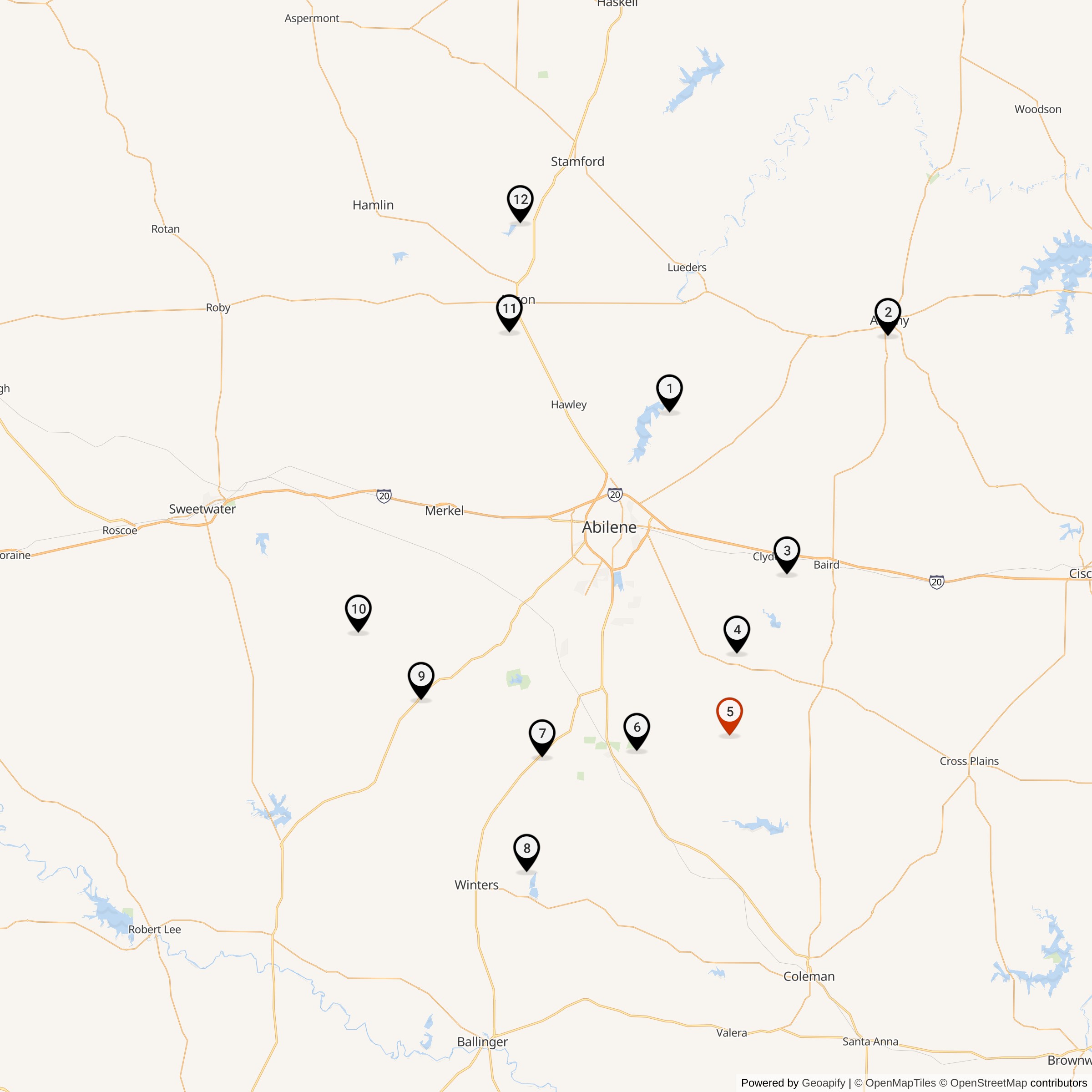
Site 578-5 was built in rural Callahan County, south of Abilene and near Oplin. The setting is the ranching and agricultural landscape typical of much of the Dyess missile field: open land, county roads, scattered homes and ranch improvements, and enough distance from Dyess Air Force Base to disperse the missiles while still keeping them within the base's maintenance, security, and command-support network.The Dyess Atlas F sites were deliberately placed in a ring around the parent base rather than on the base itself. This pattern reduced the chance that a single strike on Dyess AFB could destroy the entire missile force. It also meant that small communities such as Oplin, Lawn, Bradshaw, Winters, Shep, Nolan, Anson, Albany, and Clyde suddenly became neighbors to large, secretive federal construction projects and later to live nuclear alert facilities.
A completed Atlas F complex was far more than a missile tube. The Oplin site included a deep vertical silo, a suspended steel crib, a silo-lift launch platform, launch doors, propellant and gas systems, control and support spaces, power equipment, communications connections, environmental-control equipment, security fencing, road access, and aboveground support buildings. Atlas Missile Museum of Texas material states that one of the original Quonset huts remains at Site 5. The museum's What you will see page describes the surviving complex as having an operable overhead 70-ton silo door, a working launch-control console used for simulated launch demonstrations, a renovated and suspended launch-control center / living area, and an 8-story suspended silo crib inside a 185-foot-deep silo.
The key engineering concept was the Atlas F silo-lift arrangement. The missile was stored vertically underground for protection but was not launched from inside the silo. When preparing to launch, the silo doors opened, the elevator-type launch platform raised the missile to the surface, and the missile fired from above ground. This was a major improvement in protection over earlier Atlas D aboveground and coffin-style sites, but it still reflected the limitations of a first-generation liquid-fueled missile.
Strategic and Cold War Context
Atlas F Site 578-5 existed because the United States needed intercontinental-range nuclear missiles that could be dispersed, hardened, and held on alert inside the continental United States. Atlas was the Air Force's first operational ICBM, and the Atlas F was the most advanced operational member of the Atlas family. The National Park Service describes the Atlas F as the best of the Atlas types deployed, notes that it used a blast-proof silo-lift configuration, and states that seventy-two Atlas F missiles were placed in the field at six Air Force bases, including Dyess.The Atlas F was still a first-generation cryogenic missile. It used RP-1 fuel and liquid oxygen oxidizer, and its thin, pressure-stabilized stainless-steel airframe had to be maintained under pressure to retain its shape. The same design that made Atlas light enough to fly also made it demanding to maintain. Alert crews, maintenance teams, and propellant specialists had to manage a complex combination of missile pressurization, liquid oxygen handling, inertial guidance, launch-platform machinery, communications systems, power systems, and site security.
The Dyess missile field was part of Strategic Air Command's rapid expansion of hardened ICBM capability in the early 1960s. Dyess AFB already had a bomber mission, and the 578th SMS added a dispersed missile mission around the base. The twelve Atlas F launch complexes were not large bases in their own right, but each site was a complete hardened weapon system. Site 578-5 therefore represented both a local Texas construction project and a national strategic investment in nuclear deterrence.
Construction and Activation
The construction history of Site 578-5 is tied to the broader Dyess Atlas F building program. Official unit-history material for the 578th Strategic Missile Squadron states that initial responsibility for constructing the twelve Atlas F silos fell to the Corps of Engineers Fort Worth District. The Fort Worth District also received responsibility for nationwide procurement of the Atlas F propellant-loading system. When the Corps of Engineers Ballistic Missile Construction Office, or CEBMCO, was formed in 1960, the Fort Worth District was relieved of silo-construction oversight. Bids were opened at Abilene on 1960-05-26, and the low bid of about $20 million was submitted by a joint venture of H.B. Zachry Company and Brown & Root, Inc. Construction commenced on 1960-06-07.The same official unit-history summary lists the twelve Dyess lift-launcher locations as Abilene, Albany, Clyde, Denton County, Oplin, Lawn, Bradshaw, Winters, Shep, Nolan, Anson, and Corinth. Oplin corresponds to operational Site 5.
The Corps of Engineers construction organization for Dyess was substantial. The Dyess Area Office was activated on 1960-04-18 under the U.S. Army Engineer District, Fort Worth. It supervised, inspected, and coordinated construction of twelve hardened weapon-system launch-and-control facilities. This required far more than ordinary building oversight. The office handled engineering review, field inspection, safety, materials tracking, as-built documentation, propellant-system technical coordination, acceptance testing, and the preparation of turnover records. Because Atlas F complexes were standardized but still built in varied local geology, the work required constant coordination between engineers, contractors, military inspectors, and specialized equipment suppliers.
Representative HAER documentation for Dyess Atlas F Site S-8, near Winters, preserves the kind of construction process used in the Dyess field. At S-8, open-cut excavation began before the vertical shaft work. Heavy equipment removed overburden until the shaft could be started; a crane, bucket system, hoists, guide tracks, shoring, ring beams, welded wire mesh, and pneumatic concrete were used as excavation deepened. When harder formations of gypsum, limestone, and shale blocked ordinary digging methods, the contractors drilled and shot the material with explosives. The HAER account is site-specific to S-8 rather than Oplin, but it is valuable representative documentation because the twelve Dyess Atlas F sites were built under the same missile-field construction program.
After excavation, the construction sequence moved into reinforced concrete and steel. The floor of the shaft was sealed with reinforced concrete. Reinforcing steel was placed for the silo walls. A slip-form system allowed the cylindrical concrete walls to be poured upward under controlled conditions. The suspended crib, the launch platform, the propellant systems, mechanical and electrical equipment, stairs, ladders, grating, handrails, communications gear, and control equipment all had to be installed and tested. The Atlas F silo cap and doors were massive structural elements; HAER documentation for the representative Dyess S-8 site describes the cap as a 9-foot-thick reinforced-concrete slab and the steel doors as 2.5 feet thick.
A critical construction problem across the Atlas F program was sequencing. Tanks and special equipment for the propellant-loading system could not simply be substituted with commercial hardware. HAER documentation notes that delays in delivery of liquid-oxygen and nitrogen vessels affected the construction sequence at a Dyess Atlas F site, requiring modification of the work order so the site could continue progressing while awaiting specialized components. The propellant-loading system was especially important because Atlas F readiness depended on the site's ability to fuel and service a liquid-fueled missile safely and quickly.
The 578th SMS construction program was remembered as comparatively successful. Official unit-history material states that construction at Dyess was completed on time and that there were no work stoppages due to labor unrest. It also records the human cost of the program: three fatalities and thirty-three disabling injuries associated with the project. Those are Dyess missile-field construction figures, not documented as Site 578-5-specific casualties, but they belong in the history because they show the scale and risk of building deep ICBM complexes under national-priority pressure.
Site 578-5 has an especially important site-specific activation record. The assigned missile was General Dynamics missile serial number 61-2550, manufacturing number 64F, Air Force tail number 550. It lists the missile acceptance date as 1962-04-03 and the missile delivery date as 1962-04-16. The Atlas Missile Museum of Texas Site 5 page reproduces Dyess Peacemaker newspaper material from 1962 headlined "Oplin Silo Now Holds 1st Dyess Atlas ICBM." The article described the Oplin missile as the first Atlas F ICBM lowered into a Dyess silo and referred to the missile as "Spirit of Oplin." This makes Site 578-5 one of the best documented individual Dyess Atlas F sites for early activation.
Missile System and Technical Role
Site 578-5 was built for the Convair SM-65F Atlas, the Atlas F. The Atlas F used inertial guidance, RP-1 fuel, liquid oxygen oxidizer, and the Atlas family's pressure-stabilized stainless-steel structure. The missile was stored underground in a vertical silo on a launch platform. For launch, the platform raised the missile to the surface, where it would be fired from above ground.The Atlas F silo-lift system shaped the entire launch complex. The missile's underground storage offered blast protection, but the site also needed machinery powerful and reliable enough to raise the missile and support equipment to launch position. Representative HAER documentation describes the launch platform as an elevator-type structure designed to prevent flames and exhaust gases from entering the silo during firing and to withstand engine blast, exhaust temperature, and angular misalignment forces. The same documentation describes the platform drive system as using electric motors, gear reducers, cable drums, steel cables, and counterweights.
The suspended crib was the working heart of the silo. It supported the missile, operating ground equipment, platforms, access ways, and servicing systems. The museum's current description of the Oplin site emphasizes that surviving intact cribs are unusual because many were removed during salvage operations. That makes Site 578-5 especially valuable as a physical interpreter of Atlas F operations: the surviving crib lets visitors understand the vertical scale and working arrangement of the original silo.
Public sources describe the Atlas F as about 82 feet tall and capable of delivering a nuclear warhead over intercontinental distance. The National Park Service states that the Atlas F carried a 4.5-megaton warhead and could be launched in approximately ten minutes. The Smithsonian National Air and Space Museum identifies the Mark 4 reentry vehicle as used on Atlas E/F and Titan I ICBMs and states that it carried a W-38 nuclear warhead with a yield of about 3.75 megatons.
The operational site was not a simple unmanned hole in the ground. Atlas F complexes required a missile crew and support personnel within the site, plus recurring visits by maintenance, propellant, security, communications, and inspection teams. In later interviews about the restored Oplin site, former 578th SMS personnel described 24-hour duty and regular readings of equipment inside the silo. The crew's job was to keep the missile and launch complex ready, maintain communications with higher headquarters, perform checkouts, respond to alerts, and safely manage a dangerous liquid-fueled weapon system.
Operational History
The 578th Strategic Missile Squadron was organized at Dyess AFB on 1961-07-01 and operated the twelve Atlas F sites around Abilene. Dyess AFB's official history states that from 1962 to 1965 the base had SM-65 Atlas missile sites around it, that the Dyess sites were operated by the 578th Strategic Missile Squadron, and that after decommissioning in 1965 the missiles were removed and the sites demilitarized.Site 578-5's early operational story is unusually visible because of the "Spirit of Oplin" coverage. The 1962 Dyess Peacemaker article reproduced by the Atlas Missile Museum of Texas described the missile convoy from Dyess to Oplin, the lowering of the missile into the silo, and the site's significance as the first Dyess Atlas ICBM placed in a silo. It also conveyed the public-facing pride surrounding the missile-field activation even though the site's military purpose remained tied to nuclear alert.
The squadron-level chronology indicates that the 578th SMS was turned over to Strategic Air Command on 1962-11-04 and became operational on 1962-11-15. That operational date came just after the public peak of the Cuban Missile Crisis, but the field was already in the activation process during the crisis period. Official unit-history material states that the 578th became operational in 1962 and that its twelve missiles were all placed on alert status during the Cuban Missile Crisis.
Once operational, Site 578-5 participated in the routine but demanding work of Atlas F alert. Crews maintained the missile, control systems, and launch equipment; security personnel guarded a nuclear-capable site in open country; maintenance specialists serviced mechanical, electrical, communications, propellant, and environmental-control systems; and inspection teams checked readiness. Much of this work was repetitive by design. The point of the system was that a missile in a remote Texas silo could remain ready day after day, under positive control, with enough protection and dispersal to survive long enough to be useful in deterrence.
The site's active service was brief. Atlas F was more survivable than earlier Atlas variants, but it was quickly overtaken by the solid-fueled Minuteman and by broader changes in U.S. strategic forces. The National Park Service notes that Atlas sites reached their operational peak from December 1962 through May 1964 and were then phased out in favor of Minuteman and Titan systems. For the 578th SMS, this meant only a short period between full squadron operational status in November 1962 and the beginning of Dyess Atlas F removals from alert in December 1964.
Deactivation and Disposal
Atlas F Site 578-5 left active missile service during the accelerated retirement of the first-generation cryogenic ICBM force. On 1964-05-16, Secretary of Defense Robert S. McNamara directed that the phaseout of Series E Atlas, Series F Atlas, and Titan I ICBMs be accelerated. The SAC Missile Chronology records that the phaseout was expected to save approximately $188 million and to be completed no later than the end of fiscal year 1965.Official 578th SMS unit-history material gives the Dyess phaseout sequence. The first Dyess Atlas F missile was removed from alert on 1964-12-01. The last ICBM was removed from alert on 1965-02-03. The last ICBM was shipped on 1965-02-10. The 578th Strategic Missile Squadron was deactivated on 1965-03-25.
The Atlas E/F and Titan I phaseout was a managed process, not simply abandonment. Deactivation planning documents for the Atlas and Titan I phaseout describe removal and shipment of reentry vehicles, missiles, classified components, mobile equipment, and propellants; shutdown or protection of systems not needed after retirement; transfer of selected items for reuse, storage, donation, salvage, or disposal; and transfer of facilities to base civil-engineer custody pending real estate disposition. Atlas F sites presented special problems because the silos contained cryogenic systems, high-pressure gases, launch-platform equipment, and large amounts of specialized hardware.
The missile airframes were not necessarily destroyed immediately. Site 578-5 is a good example. Its assigned missile, Atlas 64F, serial 61-2550, did not simply disappear after the Oplin site left alert service. Public Atlas records and later space-history sources identify the former Oplin missile as the booster used for NAVSTAR-1 in 1978. That reuse fits the broader post-ICBM history of Atlas boosters, many of which were repurposed for research, development, and space-launch missions after their nuclear-alert role ended.
After decommissioning, Site 578-5 entered the long afterlife typical of Atlas F complexes. The Air Force removed the missile and military equipment, the site was demilitarized, and the property left active missile service. Public accounts indicate that the Oplin site passed through private ownership before being acquired by the current owner in 1997. Unlike many Atlas sites where crib structures or equipment were heavily salvaged, Site 578-5 retains major interpretive features, including the suspended crib and an operable silo door, according to the museum's own current description.
USACE's 2015 Texas FUDS inventory lists the property as OPLIN ATLAS AF FACILITY S-5, property number K06TX0110, in Callahan County, with category CON/HTRW. That record identifies the site as part of the Formerly Used Defense Sites universe and indicates a containerized hazardous, toxic, or radioactive waste category in the 2015 inventory.
Current Status and Site Use
Atlas F Site 578-5 is privately owned and reused as a preserved / restored former Atlas F complex associated with the Atlas Missile Museum of Texas. The site is not an active military installation. It is no longer a missile site in military service.Atlas Missile Museum of Texas states that Site 5 was acquired in 1997 by the current owner, renovated and upgraded, and now provides facilities that can be toured and used to house artifacts and documents relating to the Atlas F system. The museum states that one original Quonset hut remains, while the original water wells were not acquired with the property. Its visitor information states that tours are arranged by appointment and, at the time of writing, were available on a limited Saturday schedule on a space-available basis. The museum also emphasizes safety restrictions, including that visitors must be able to descend and climb 55 metal-grate steps and that tours are limited in size.
Current public descriptions identify the Oplin site as one of the better-preserved Atlas F complexes in Texas. The museum describes an operable overhead silo door, a working launch-control console used for a simulated launch, and the intact suspended crib inside the deep silo. KTXS and Texas Co-op Power accounts describe the launch-control center as renovated for living space and interpretation. These accounts should be read as current-use and preservation descriptions rather than as military operational documentation.
Because the site remains private property and contains underground industrial and military infrastructure, access should be arranged only through the current museum / owner process. Former missile sites can contain physical hazards, confined-space hazards, water, deteriorated structural elements, electrical or mechanical hazards, and environmental concerns. The coordinates identify the historic launch complex, not a general public park.
Chronology
- 1960-04-18 The Corps of Engineers Dyess Area Office was activated under the U.S. Army Engineer District, Fort Worth, to support the Dyess Atlas F construction program.
- 1960-05-26 Six bids were opened at Abilene for the Dyess Atlas F silo construction work; the low bid of about $20 million came from the H.B. Zachry Company and Brown & Root, Inc. joint venture.
- 1960-06-07 Construction commenced on the Dyess Atlas F missile-field project.
- 1961-07-01 The 578th Strategic Missile Squadron was activated at Dyess Air Force Base.
- 1962-04-03 Site 578-5 missile, General Dynamics 64F / serial 61-2550 / tail number 550, was accepted.
- 1962-04-16 Site 578-5 missile was delivered.
- 1962-05-03 The Dyess Peacemaker published "Oplin Silo Now Holds 1st Dyess Atlas ICBM," identifying the Oplin site with the first Atlas ICBM placed in a Dyess silo.
- 1962-11-04 Official unit-history material lists turnover of the 578th Strategic Missile Squadron to Strategic Air Command.
- 1962-11-15 Official unit-history material lists the 578th Strategic Missile Squadron as operational.
- 1964-05-16 Secretary of Defense Robert S. McNamara directed accelerated phaseout of Atlas E, Atlas F, and Titan I ICBMs.
- 1964-12-01 The first Dyess Atlas F missile was removed from alert status ahead of schedule.
- 1965-02-03 The last 578th SMS ICBM was removed from alert.
- 1965-02-10 The last 578th SMS ICBM was shipped.
- 1965-03-25 Atlas F Site 578-5 was decommissioned, and the 578th Strategic Missile Squadron was inactivated.
- 1978-02-22 Atlas 64F, the former Site 578-5 missile, launched NAVSTAR-1 / GPS 1-1 from Vandenberg.
- 1997 Atlas Missile Museum of Texas material states that the current owner acquired Site 5 and later renovated and upgraded it.
- 2024 Public reporting described the Oplin site as the home of the Atlas Missile Museum of Texas and as a restored former Atlas F complex open by appointment.
Read about the Atlas at Dyess AFB
All Atlas Missile Silo Locations