Atlas F Site 578-7 Missile Silo, Bradshaw / Ovalo Texas
Longitude: -99.855161
Site Type: Atlas F vertical silo launch facility
Missile Type: SM-65F Atlas
Number of Launchers/Missiles: 1
Parent Base: Dyess AFB
Missile Wing: 96th Strategic Aerospace Wing
Missile Squadron: 578th Strategic Missile Squadron
Approximate Base Size: 11.47 acres (TCEQ HRS MRE facility tracts; not confirmed full original Air Force acquisition acreage)
Current Site Use: Former Atlas F launch complex reused as Materials Recovery Enterprises Class I industrial solid-waste facility; state Superfund cleanup completed with silo/fill/cap; TCEQ Operation and Maintenance Phase.
Site Ownership: Private / PRP-managed environmental site under TCEQ state Superfund O&M; exact current owner not confirmed.
Accessible: No public access / restricted private or controlled environmental site; do not enter.
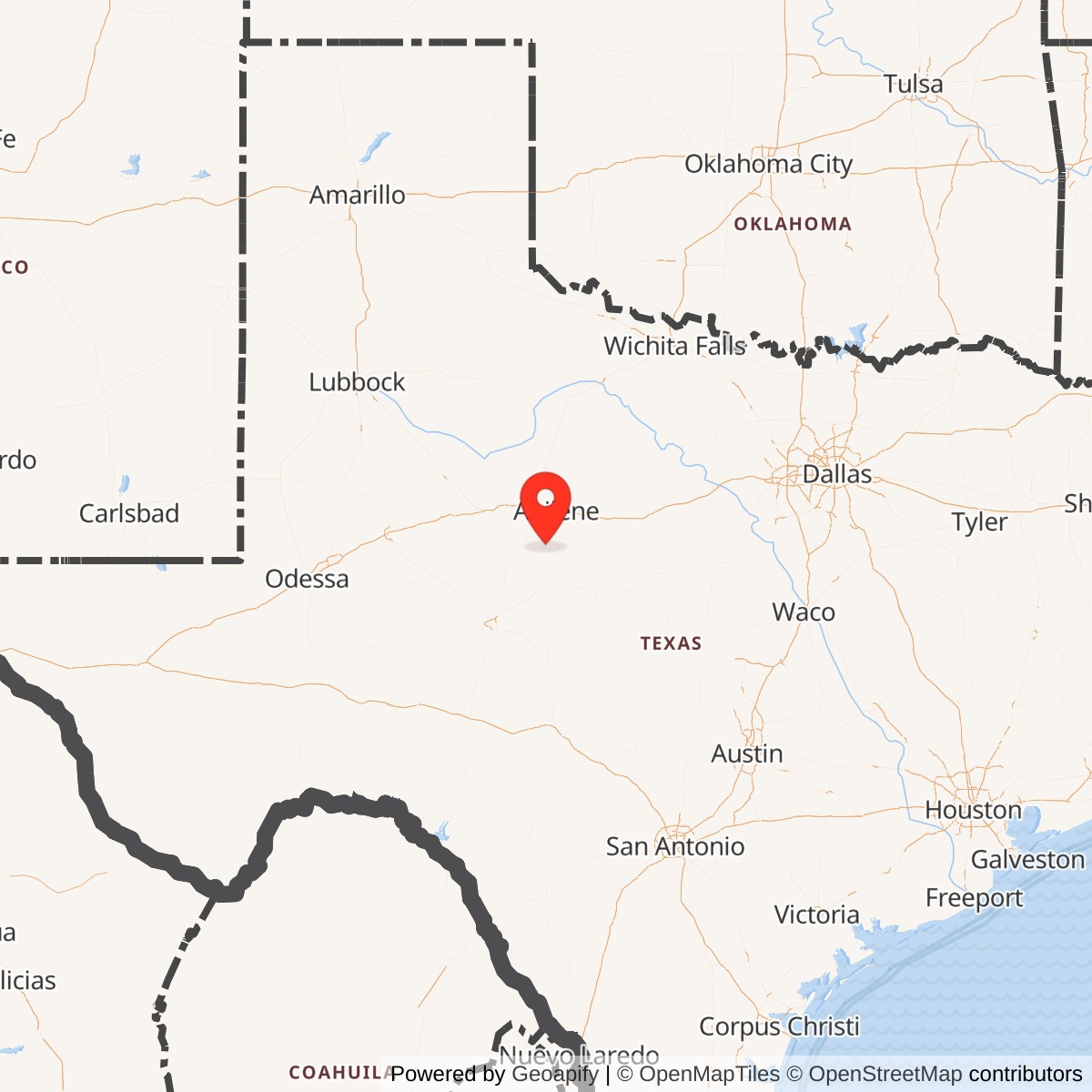
Atlas F Site 578-7 is one of the Dyess missile-field sites where the Cold War story did not end when the Air Force removed the missile. Built northeast of Bradshaw, Texas, as a hardened underground launch complex for an SM-65F Atlas intercontinental ballistic missile, the site later became Materials Recovery Enterprises, a commercial hazardous-waste facility that used the former missile silo as an industrial waste-storage structure. Its history therefore combines two powerful stories: the first generation of American silo-based nuclear deterrence, and the long environmental afterlife of an abandoned military-industrial structure.
Beneath the capped ground near U.S. 83 and FM 604 was once a complete Atlas F silo, a launch-control center, access tunnel, propellant systems, blast doors, and the reinforced-concrete machinery of Strategic Air Command alert duty. After decommissioning, the same underground volume was converted to hold liquid industrial waste from metal-finishing and electroplating processes. The result was one of the most complicated post-service stories in the Dyess Atlas field: a former ICBM launch complex that became a state Superfund site and remains in operation-and-maintenance status after cleanup.
Installation / Site Identity
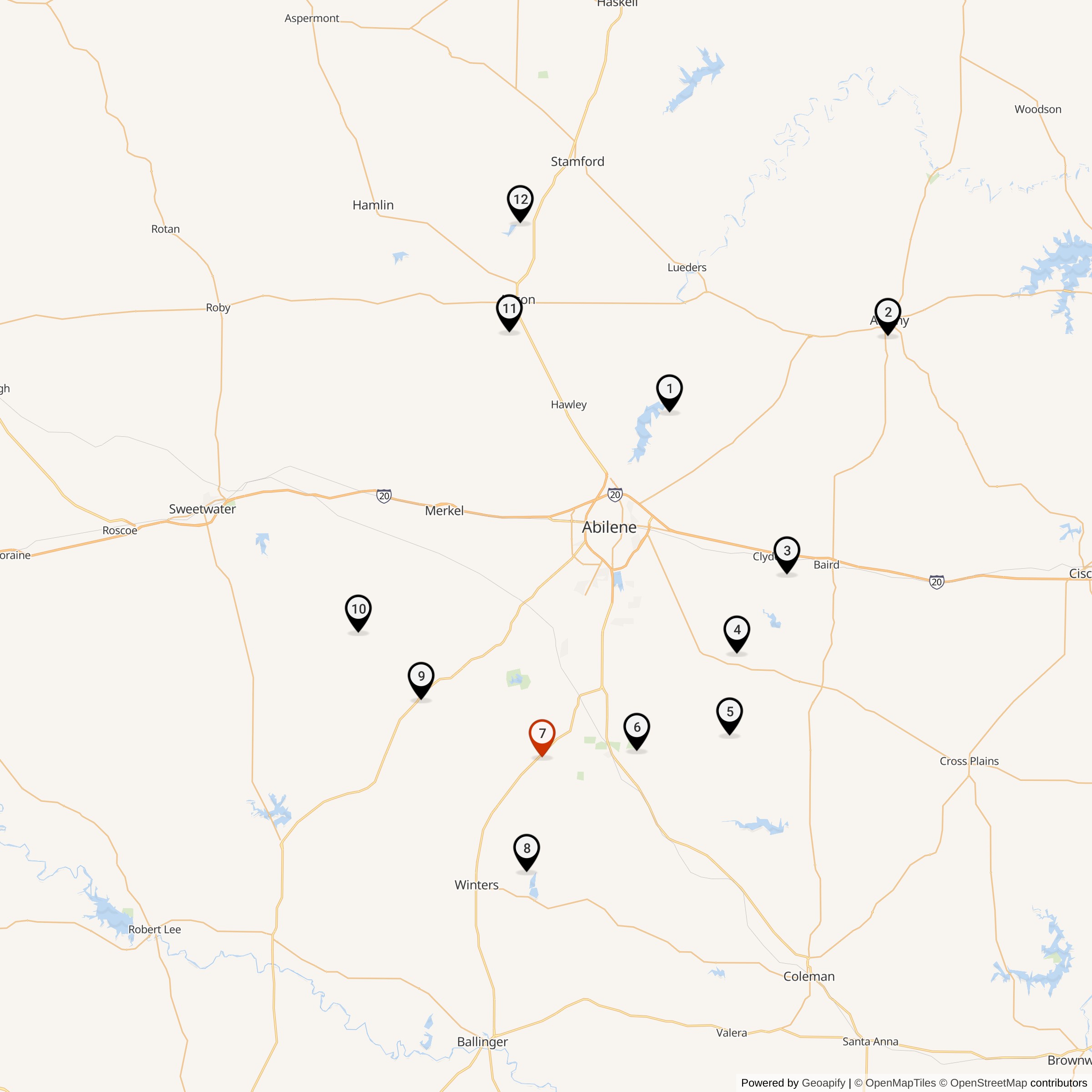
Atlas F Site 578-7 was a single SM-65F Atlas intercontinental ballistic missile launch complex assigned to the 578th Strategic Missile Squadron at Dyess Air Force Base, Texas. The site code is 578-7. It was one of twelve Dyess Atlas F sites operated by the 96th Bombardment Wing, later redesignated the 96th Strategic Aerospace Wing, through the 578th Strategic Missile Squadron.The site is located near Bradshaw in Taylor County, Texas. It is also described in Texas environmental records as the Materials Recovery Enterprises site near Ovalo, approximately four miles southwest of Ovalo and near U.S. Highway 83 and Farm Road 604.
Like the other Dyess Atlas F sites, Site 578-7 did not have a separate Minuteman-style remote Launch Control Center. The Atlas F launch complex incorporated its own hardened launch-control and support facilities within the individual site.
Construction of the Dyess Atlas F missile field began in 1960. Official unit-history material gives 1960-06-07 as the start of construction for the Dyess missile-field project. The 578th Strategic Missile Squadron was organized at Dyess on 1961-07-01, turned over to Strategic Air Command on 1962-11-04, and became operational on 1962-11-15.
Atlas F Site 578-7 is inactive and decommissioned. It is no longer an active missile facility. The 578th Strategic Missile Squadron was inactivated on 1965-03-25 during the accelerated phaseout of Atlas E, Atlas F, and Titan I first-generation ICBMs. The former site later became the Materials Recovery Enterprises industrial-waste site, was addressed through the Texas state Superfund process, and is currently identified by TCEQ as being in the Operation and Maintenance Phase. It is not an open public site and should be treated as restricted private/property and environmental-control land.
Location, Landscape, and Site Description
Site 578-7 was built in rural Taylor County northeast of Bradshaw and southwest of Ovalo, in the agricultural and ranching country south of Abilene and Dyess Air Force Base. The setting placed the site within the broad dispersed ring of Atlas F complexes around Dyess while keeping it far enough from the base and from the other missile sites to reduce the risk that a single attack could destroy multiple launchers. The Dyess field used small towns and rural road networks as geographic anchors: Lake Fort Phantom Hill, Albany, Clyde, Denton Valley, Oplin, Lawn, Bradshaw, Winters, Shep, Nolan, Anson, and Corinth all became part of a strategic missile landscape.As originally built, Site 578-7 would have included the standard Atlas F vertical silo launch arrangement: an underground reinforced-concrete missile silo, heavy overhead silo doors, an elevator-type launch platform, a suspended internal crib and work levels, an underground launch-control center, tunnel access, power and environmental systems, propellant-loading equipment, liquid-oxygen and gaseous-nitrogen systems, communications equipment, security fencing, an access road, and aboveground support features. In operation, the missile was stored vertically inside the silo but could not be launched from within it. Before launch, the silo doors opened and the missile and launch platform rose to the surface.
The post-military site description is unusually well documented because of the Materials Recovery Enterprises environmental record. TCEQ's 1995 Hazard Ranking System documentation states that the MRE facility used a decommissioned Atlas missile silo complex to receive liquid slurries from treatment of metal-finishing and electroplating wastewaters. The document describes five facility tracts totaling approximately 11.47 acres. It identifies six solid-waste-management units: the waste-storage silo, truck unloading platform, initial evaporation pond, second evaporation pond, secured landfill, and drum storage area. It describes the main underground silo as approximately 52 feet in diameter and about 174 feet deep from the ground surface, with reinforced-concrete walls thickening toward the surface. It also states that the Atlas launch-control center had a 40-foot internal diameter and extended from about 10 feet above grade to 40 feet below grade.
Strategic and Cold War Context
Atlas F Site 578-7 existed because the United States needed a dispersed, hardened, land-based nuclear deterrent during the most dangerous years of the Cold War. The Atlas program produced the Air Force's first operational intercontinental ballistic missile. Atlas F represented the final operational Atlas ICBM variant and the most protected version of the Atlas family deployed in the field.The National Park Service describes Atlas as the United States Air Force's first operational ICBM and notes that 132 Atlas sites were operational at the program's peak from December 1962 through May 1964. The same NPS summary describes Atlas F as the best of the deployed Atlas types and states that it used a blast-proof silo-lift configuration. Seventy-two Atlas F missiles were deployed at six bases: Schilling, Lincoln, Altus, Dyess, Walker, and Plattsburgh. Dyess received twelve of those launch complexes.
The Atlas F was powerful but operationally demanding. It used RP-1 fuel and liquid oxygen, and because it was based on the Atlas missile's thin stainless-steel pressure-stabilized structure, it required careful pressurization and maintenance. It was more protected than Atlas D and Atlas E because it sat vertically in a hardened underground silo. But it was still not a later-generation in-silo-launch missile. It had to be raised above ground before firing, making the launch platform, blast doors, and propellant-loading systems central to its operation.
The Dyess missile field became operational during the period when nuclear deterrence, crisis response, and survivable command-and-control dominated Strategic Air Command planning. Official USAF unit-history material states that the 578th and its twelve missiles were placed on alert status during the Cuban Missile Crisis. Site 578-7 was therefore part of the same local missile network that tied rural Taylor County directly to national strategic war planning.
Construction and Activation
The construction history of Site 578-7 begins with the broader Dyess Atlas F construction campaign. Official unit-history material for the 578th Strategic Missile Squadron states that initial responsibility for constructing the twelve Dyess Atlas F silos fell to the U.S. Army Corps of Engineers Fort Worth District. The Fort Worth District also received responsibility for nationwide procurement of the Atlas F propellant-loading system. After the Corps of Engineers Ballistic Missile Construction Office, or CEBMCO, was formed in 1960, the Fort Worth District was relieved of direct silo-construction oversight, but the Dyess effort remained part of the national Corps-managed missile-construction program.The Dyess contract was a major Cold War construction project in central Texas. The 578th SMS unit history states that six bids were opened at Abilene on 1960-05-26 and that the low bid of about $20 million came from a joint venture of H.B. Zachry Company and Brown & Root, Inc. Construction commenced on 1960-06-07. The same unit-history account lists the twelve lift-launcher locations as Abilene, Albany, Clyde, Denton County, Oplin, Lawn, Bradshaw, Winters, Shep, Nolan, Anson, and Corinth. Bradshaw corresponds to Site 578-7.
The project was large, dangerous, and unusually successful for a missile-construction program. The unit history states that Dyess was an exception because the project was completed on time, with no work stoppages due to labor unrest. It also records three fatalities and thirty-three disabling injuries associated with the construction project. Those numbers are important because Atlas F sites were not simply dugouts or concrete pads. Each required a deep vertical excavation, reinforced-concrete construction, major steel installation, precision mechanical systems, large propellant and gas systems, electrical and communications work, blast protection, drainage control, and extensive inspection before the Air Force could accept the complex.
The HAER S-8 account shows the kind of work that Site 578-7 would also have required as a standardized Dyess Atlas F launch complex. At S-8, open-cut excavation was followed by shaft excavation; a taxcavator, cranes, hoists, buckets, shoring, and ring beams were used as the hole deepened. When the excavation encountered hard gypsum, limestone, and shale, the contractor used drill-and-shoot blasting, with hundreds of holes per shot and dynamite to break the material. Shoring used circular I-beam segments, welded wire mesh, pneumatic concrete, and metal or wood support. After excavation, workers placed reinforced concrete, installed reinforcing steel, used slip forms to build silo walls, erected the suspended octagonal steel crib, installed spring-hanger and shock-isolation components, and placed the propellant-loading-system tanks.
The same HAER documentation explains the later installation sequence: the Atlas F silo received a 23,000-gallon liquid-oxygen tank, gaseous-nitrogen tanks, piping, floor grating, stairs, ladders, handrails, electrical gear, mechanical equipment, launch-platform counterweights, drive mechanisms, the silo cap, and massive doors. The silo cap was a nine-foot-thick reinforced-concrete slab, and the steel doors were about 2.5 feet thick. The launch platform itself was an elevator-like structure designed to raise the missile above ground while resisting flame, exhaust, misalignment forces, and engine blast. Final inspection and validation required special teams from the Corps of Engineers, Site Activation Task Force / Air Force elements, and contractors.
Although this engineering detail comes from Dyess S-8, it is directly useful for understanding Site 578-7 because the Dyess Atlas F sites were standardized launch complexes built under the same missile-field program and contract system. For 578-7 specifically, the environmental record later confirms that the underground missile silo and launch-control center remained substantial enough to be converted into an industrial waste facility. That post-service reuse is indirect evidence of the scale and durability of the original construction.
Missile System and Technical Role
Site 578-7 housed the SM-65F Atlas, a first-generation liquid-fueled intercontinental ballistic missile. The Atlas F used RP-1 fuel and liquid oxygen oxidizer. The RP-1 could be stored aboard the missile, but liquid oxygen had to be loaded before launch. The 578th SMS Atlas F system was a silo-launcher complex in which the missile was kept vertical, the overhead doors opened, the missile was raised on its launch platform, and liquid oxygen was loaded before launch.Site 7's assigned missile was General Dynamics missile serial number 61-2557, manufacturing number 71F, and Air Force missile tail number 557. The missile acceptance date was 1962-04-26 and the missile delivery date was 1962-05-08. The missile's later post-ICBM history is also documented, it was launched from Vandenberg AFB Space Launch Complex 3 West in April 1975 with payload STP-72-2 / P72-2 and failed after a LOX / RP-1 explosion in the flame trench damaged the vehicle, leading to sustainer-engine failure and range-safety destruction at T+303 seconds. Site and missile pages differ by one day on the exact launch date; the site page gives 1975-04-13, while the missile-specific page gives 1975-04-12. Published launch tables commonly list the launch as 1975-04-13 UTC.
The National Air and Space Museum describes the Mark 4 reentry vehicle as used on Atlas E/F and Titan I ICBMs in the early 1960s and states that it carried a W-38 nuclear warhead with a yield of about 3.75 megatons. The National Park Service describes Atlas F as taller than earlier Atlas types, using a blast-proof silo-lift configuration, and having an approximately ten-minute launch response time.
The launch complex itself was part of the weapon system. The missile required launch crews, security forces, maintenance teams, propellant and mechanical specialists, communications support, and periodic inspections. Unlike a Minuteman launch facility, which was normally unmanned and controlled from a remote launch control center, an Atlas F complex had its crewed launch-control and support spaces built into the individual site. Site 578-7 therefore contained both the missile-storage/launch structure and the underground crew/control elements needed to operate it.
Operational History
The 578th Strategic Missile Squadron was organized at Dyess AFB on 1961-07-01 and assigned to the 96th Bombardment Wing, later the 96th Strategic Aerospace Wing. Official USAF unit-history material states that the squadron's weapon system was the SM-65F Atlas in 1962, that the squadron was turned over to Strategic Air Command on 1962-11-04, and that it became operational on 1962-11-15.During its short active life, Site 578-7 was one of twelve independent Atlas F launch complexes around Dyess. The squadron's mission was nuclear deterrence: keeping missiles, crews, communications, security, and maintenance systems ready to respond to national command authority. The 578th sites were manned twenty-four hours a day, seven days a week, every day of the year during the squadron's active period. The Atlas F's liquid-oxygen system made alert operations more labor-intensive than later solid-fueled missiles, but the silo-lift arrangement gave the Atlas F better protection and a faster response than the older Atlas D and E configurations.
The Cuban Missile Crisis provides the most important documented operational episode for the squadron. Official unit-history material states that the 578th and its twelve missiles were placed on alert during the crisis. The record does not isolate Site 578-7 from the other Dyess sites during the crisis, so the correct interpretation is squadron-level rather than site-specific: 578-7 was one of the Dyess Atlas F launch complexes that formed the operational force placed on alert.
Routine operations at Site 578-7 would have centered on alert duty, system readiness, inspections, maintenance, propellant and pressure systems, security, communications, and crew proficiency. The launch crew worked inside the site's underground control area. Maintenance and support teams maintained the silo, launch platform, doors, guidance and communications interfaces, environmental systems, power systems, and the missile's support equipment. Security personnel controlled access to the remote site and protected the weapon system. The Atlas F system demanded constant attention because its missile and ground systems were more fragile and maintenance-intensive than the later Minuteman force that soon displaced it.
The active operational period was short. Atlas F entered service late in the first-generation ICBM era, and by 1964 the Department of Defense was already accelerating the phaseout of Atlas and Titan I systems. Solid-fueled Minuteman missiles, with lower maintenance burden and faster response, were becoming the backbone of the land-based deterrent. Site 578-7 therefore represents a highly engineered but transitional phase: it was built as a cutting-edge hardened Atlas launch site, served through the Cuban Missile Crisis and the early 1960s alert posture, and then left strategic service only a few years after becoming operational.
Deactivation and Disposal
Atlas F Site 578-7 left service as part of the rapid retirement of first-generation Atlas and Titan I ICBMs. Official unit-history material states that Secretary of Defense Robert S. McNamara directed the accelerated phaseout of Atlas and Titan I ICBMs on 1964-05-16. At Dyess, the first Atlas F missile was removed from alert on 1964-12-01, the last 578th SMS ICBM was removed from alert on 1965-02-03, and the last 578th SMS ICBM was shipped on 1965-02-10. The 578th Strategic Missile Squadron was inactivated on 1965-03-25.The decommissioning of Site 578-7 predated the later strategic arms-control demolition regimes that shaped many Minuteman and Peacekeeper facilities. Atlas F deactivation was driven primarily by modernization and cost: Minuteman and Titan II provided more capable, more survivable, or more operationally efficient alternatives. After the missile and military equipment were removed, the real property entered the disposal and reuse stream.
TCEQ's Hazard Ranking System documentation gives unusually specific disposal information. It states that the Air Force decommissioned the site and sold the property to James H. Smith on 1968-02-14. Smith reportedly used the property for cattle grazing and storage and stated that he did not store chemicals there. On 1977-12-07, Smith sold the property to Materials Recovery Enterprises, Inc. of Dallas County. In late 1977, the company's representatives submitted a permit application to use the former missile site as a commercial industrial solid-waste-management facility. On 1978-10-03, the Texas Water Commission issued Commercial Class I Permit No. 39038 for an industrial solid-waste-management site in Taylor County.
That reuse fundamentally changed the physical meaning of the former missile complex. The silo became the waste-storage silo. A truck unloading platform was built so drums or bulk wastes could be pumped into the silo. Evaporation ponds were added to reduce the liquid fraction of the waste. A landfill was created for pond-remediation remnants, and a drum-storage area was also identified. MRE began accepting or handling waste by the late 1970s; TCEQ's current site summary states that MRE received waste from 1978 to 1982, while the HRS record states that Phase I became operational in March 1979 and that the Texas Department of Water Resources gave approval to begin accepting industrial waste on 1979-03-28.
Environmental Afterlife and State Superfund Cleanup
The Materials Recovery Enterprises period is the defining post-service chapter of Site 578-7. TCEQ identifies the MRE site as a former Class I industrial solid-waste-management facility in Ovalo, Taylor County, now in the Operation and Maintenance Phase. It states that the company used a former Atlas missile silo to operate the waste-management facility, received waste from 1978 to 1982, and that state inspectors noted permit violations during routine inspections. Texas Water Commission inspectors found the facility abandoned in 1988.The 1995 HRS documentation provides a detailed account of what was stored and managed at the site. It states that MRE used the former Atlas silo to receive liquid slurries from treatment of metal-finishing and electroplating wastewaters. It also states that MRE received and stored wastes not authorized by its permit, resulting in a complex mixture of mineral and organic acids, caustics, metals, chelators such as cyanides and ammonia, chlorinated and aromatic solvents, paint and ink wastes, and pesticide wastes in the silo and pond. This makes Site 578-7's environmental history much more severe and specific than a generic abandoned-silo story.
The regulatory history unfolded over decades. In 1980, state regulators cited excessive waste storage in the silo and ordered correction of problems with the evaporation pond liner. In 1982, the Texas Department of Water Resources requested legal action for violations that included excessive waste elevation in the silo, waste-manifest discrepancies, failure to provide required financial assurance, high hexavalent chromium levels, delays in rehabilitating an evaporation pond after seepage, and failure to submit monthly groundwater monitoring reports. In 1985, an agreed temporary order required closure, but TCEQ's HRS documentation states that the terms were never accomplished and that the facility was abandoned in late 1987.
By 1988, inspectors found serious deterioration and loss of control. The HRS record states that hazardous-waste signs had deteriorated or blown down, the fence had been cut, the record book was missing, the surface-impoundment liner had splits, the leachate-collection system contained several feet of water, the cover to the silo was missing, the silo living quarters had been vandalized, and drums of hazardous waste were found. A later inspection described the facility as totally abandoned and in noncompliance with state and federal regulations.
The Superfund process brought the site under more formal state cleanup management. TCEQ's current site page states that an HRS document was prepared on 1995-08-15; potentially responsible parties were notified in 1997; the site was proposed for listing on the state Superfund registry in 1997; public meetings were held at Jim Ned High School and later at Tuscola; and an agreed administrative order became effective in 1998 for a remedial investigation and feasibility study. The site's remedial planning continued through 1999, 2000, and 2001.
The remedy for the silo became controversial. TCEQ's site chronology states that in November 2001 the proposed cleanup alternatives included pumping and treating water from the evaporation pond, moving sludge and pond material into the silo, placing liner material and loading-dock-sump contents into the silo, and covering the entire silo area with a six-inch layer of reinforced concrete over all openings and air vents. In August 2002, Taylor County Commissioners strongly objected to the proposed response action plan because it did not call for removal of the 1.7 million gallons of contaminated water from the silo. TCEQ later revised and implemented the remedy through state Superfund administrative orders.
The selected cleanup evolved. In 2004, the consultant began setting up and operating a water-treatment plant and sprinkler-evaporation system. Heavy rainfall created more stormwater, and TCEQ modified the approach so that accumulated stormwater and approximately half the silo water would be disposed of in an approved off-site disposal well. The remaining silo water would be solidified using fluidized-bed ash and returned to the silo as solid fill. In May 2005, additional fencing was installed around the open silo door, a larger pump was installed, accumulated stormwater was removed from the irrigation area and evaporation pond, and excavation and confirmation sampling followed. On 2005-08-15, TCEQ approved a change in designation to cleanup complete. In 2006, TCEQ approved a post-construction activities plan for long-term monitoring to ensure the stability of the cap. TCEQ later reported that there had been no subsidence of the concrete-capped waste in the missile silo and that the waste remained stable in inspection reporting.
The Atlas Missile Museum of Texas page for Site 7 summarizes the post-service story in more informal terms: it states that Bradshaw was a toxic waste dump for many years, that pesticides and heavy metals from refining and plating processes were stored there for a fee, that the state eventually closed and remediated the site, and that no salvaging of equipment artifacts was permitted before remediation. The same page states that the silo and launch-control center appeared to have remained unusually complete before environmental cleanup, but that both were filled as part of remediation and no original outbuildings remained.
Current Status and Site Use
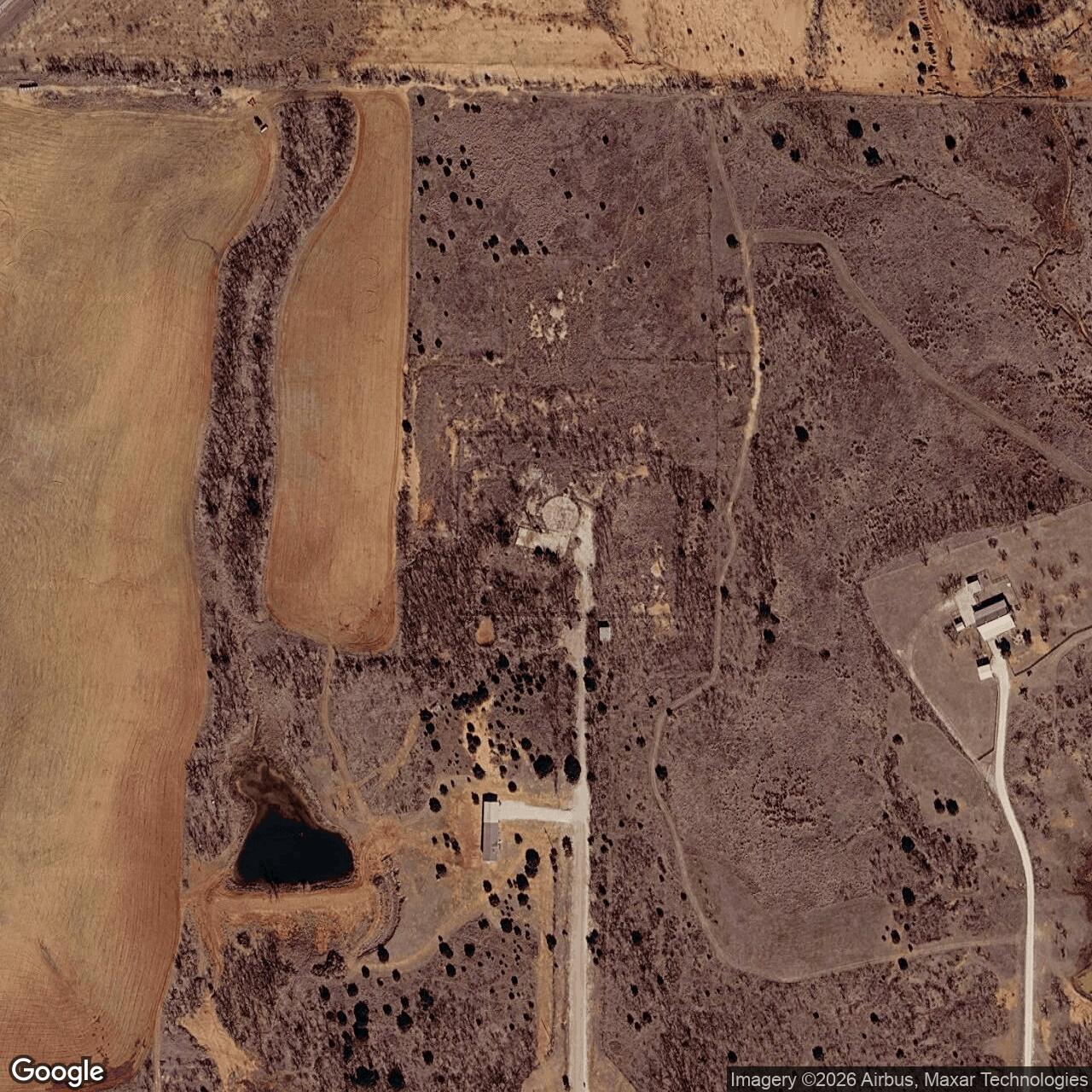
Atlas F Site 578-7 is a decommissioned missile site and a former industrial hazardous-waste facility. TCEQ currently identifies Materials Recovery Enterprises as a former Class I Industrial Solid Waste Management Facility in Ovalo, Taylor County, in the Operation and Maintenance Phase. TCEQ site-specific information lists EPA ID TXD000803502, site status Operation and Maintenance, category Listed, media affected Soil.The site is not a museum, not an open historic site, and not a place for unscheduled visits. Its history includes confined underground structures, hazardous-waste management, state Superfund cleanup, concrete capping, long-term monitoring, and restricted environmental-control concerns. Public-source imagery shows a large cross-shaped capped or graded area at the former silo location and surviving access-road/site patterns.
The current visible remains are shaped by the cleanup more than by Atlas preservation. The Atlas Missile Museum of Texas account states that the silo and LCC were filled as part of cleanup, the overhead silo doors were pushed closed, and no original outbuildings remained. TCEQ records show that the remedy involved water treatment/disposal, transfer or solidification of contaminated material, filling/stabilization of the silo contents, a concrete cap, and long-term monitoring for cap stability and subsidence.
Chronology
- 1954 The U.S. Air Force selected Convair's Atlas missile program as part of the development of intercontinental ballistic missiles with nuclear warheads.
- 1960-05-26 Six bids were opened at Abilene for the Dyess Atlas F silo construction project; the low bid of about $20 million came from the H.B. Zachry Company and Brown & Root, Inc. joint venture.
- 1960-06-07 Official 578th SMS unit-history material states that construction commenced on the Dyess Atlas F missile-field project.
- 1961-07-01 The 578th Strategic Missile Squadron was organized at Dyess Air Force Base.
- 1962-04-26 Acceptance date for Site 578-7's assigned missile, Atlas 71F / serial 61-2557 / tail 557.
- 1962-05-08 Delivery date for Atlas 71F.
- 1962 The 578th SMS became an SM-65F Atlas missile squadron at Dyess.
- 1962-10 During the Cuban Missile Crisis, official unit-history material states that the 578th SMS and its twelve missiles were placed on alert status.
- 1962-11-04 Official unit-history material lists turnover of the 578th Strategic Missile Squadron to Strategic Air Command.
- 1962-11-15 Official unit-history material lists the 578th Strategic Missile Squadron as operational.
- 1964-05-16 Secretary of Defense Robert S. McNamara directed accelerated phaseout of Atlas and Titan I ICBMs.
- 1964-12-01 The first Atlas F missile at Dyess was removed from alert ahead of schedule.
- 1965-02-03 The last 578th SMS ICBM was removed from alert.
- 1965-02-10 The last 578th SMS ICBM was shipped.
- 1965-03-25 Atlas F Site 578-7 was decommissioned as part of 578th SMS inactivation.
- 1968-02-14 TCEQ HRS documentation states that the Air Force sold the decommissioned site property to James H. Smith.
- 1977-12-07 TCEQ HRS documentation states that Smith sold the property to Materials Recovery Enterprises, Inc.
- 1978-10-03 The Texas Water Commission issued Commercial Class I Permit No. 39038 to MRE for an industrial solid-waste-management site in Taylor County.
- 1979-03 TCEQ HRS documentation states that Phase I of the MRE facility became operational.
- 1979-03-28 The Texas Department of Water Resources gave approval for MRE to begin accepting industrial waste.
- 1980-04-16 A TDWR enforcement action report documented that MRE was in violation of its permit due to excessive waste stored in the silo.
- 1980-09-24 TDWR ordered MRE to repair an apparent hole in the evaporation-pond liner.
- 1982-01-29 TDWR requested that the Texas Attorney General institute legal action for violations of state solid-waste law and TDWR rules.
- 1982-05 TCEQ's current site summary states that May 1982 was the last known reported acceptance of waste.
- 1985-08-07 An Agreed Temporary Order required closure of the facility, but TCEQ HRS documentation states the order's terms were not accomplished.
- 1987 TCEQ HRS documentation states that the facility was abandoned in late 1987.
- 1988 Texas Water Commission inspectors found the MRE facility abandoned.
- 1990-04-17 The Texas Water Commission referred the MRE site for federal or state Superfund action.
- 1992-09-02 The Industrial and Hazardous Waste Division referred the site for ranking purposes.
- 1995-08-15 A Hazard Ranking System document was prepared for the Materials Recovery Enterprises site.
- 1997-07 TNRCC notified potentially responsible parties and proposed the site for listing on the state Superfund registry.
- 1997-09-04 A public meeting was held at Jim Ned High School in Tuscola regarding the proposed state Superfund listing.
- 1998-06-11 The agreed administrative order for the remedial investigation / feasibility study became effective.
- 1999-09-02 TNRCC approved the potentially responsible parties' remedial investigation report.
- 2001-04-17 TNRCC approved the remedial action plan and the potentially responsible parties' completion of the RI/FS administrative order.
- 2001-11-08 A public meeting was held at Jim Ned High School Cafetorium to present proposed cleanup alternatives.
- 2002-08-13 Taylor County Commissioners objected to the proposed silo remedy because it did not call for removing 1.7 million gallons of contaminated water from the silo.
- 2003-09-22 A TCEQ administrative order became effective for remedial design / remedial action, and the site was moved to listed status on the state Superfund registry.
- 2004-04 The potentially responsible parties' consultant began setting up and operating the water-treatment plant and sprinkler-evaporation system.
- 2005-05 Additional fencing and pumping measures were implemented, accumulated stormwater was removed, and off-site disposal of silo water began.
- 2005-08-15 TCEQ approved cleanup complete status after review of the remedial-action report and supporting documents.
- 2006-05-18 TCEQ approved the post-construction activities plan, beginning long-term monitoring for cap stability.
- 2009-10-22 TCEQ approved an annual inspection report stating there had been no subsidence of the concrete-capped waste in the missile silo.
- 2010-09 TCEQ approved an annual inspection report stating that waste in the missile silo remained stable.
- 2025-10-14 TCEQ's Materials Recovery Enterprises page identified the site as being in the Operation and Maintenance Phase.
Read about the Atlas at Dyess AFB
All Atlas Missile Silo Locations