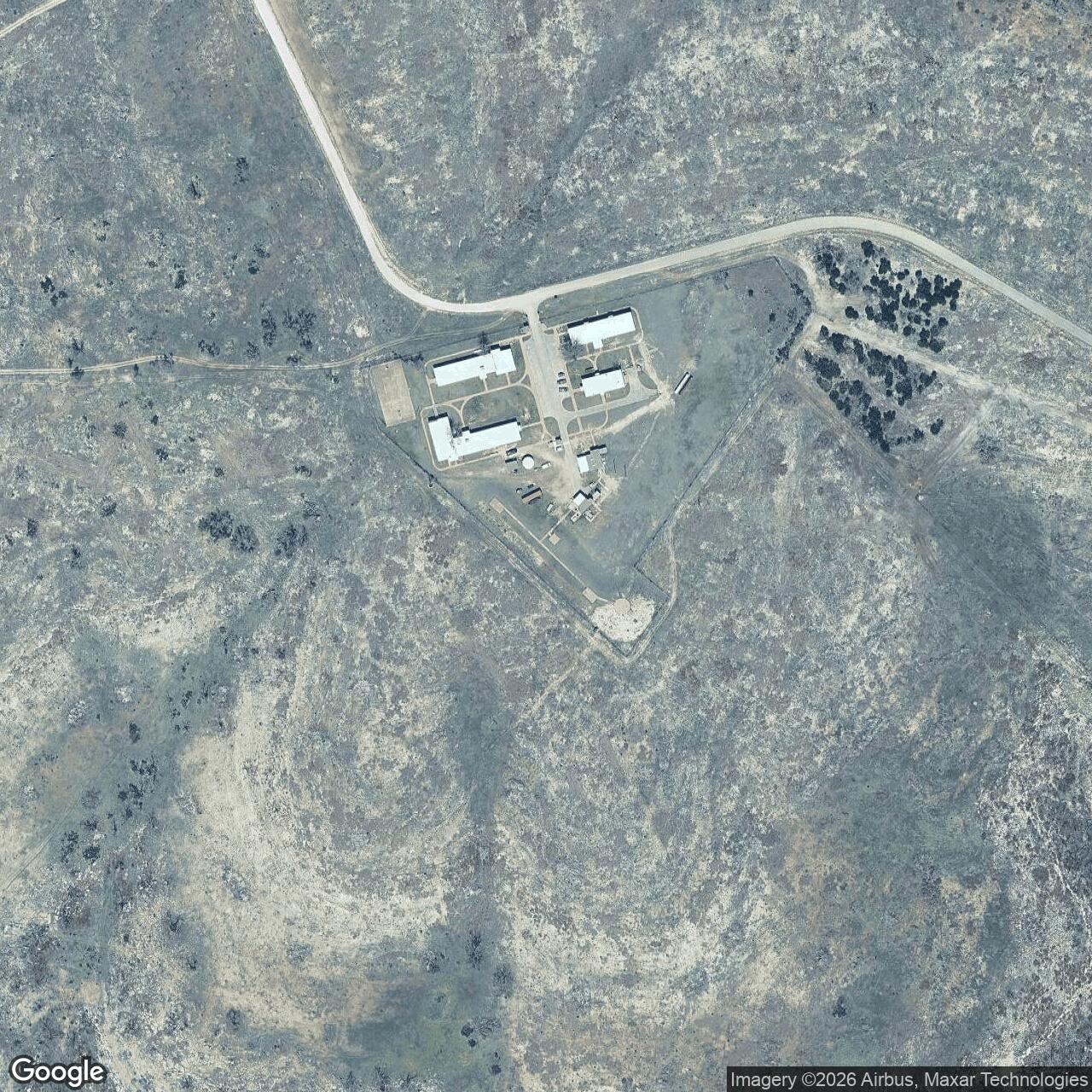
Nike Missile Site DY-50 IFC, Abilene Texas
Longitude: -99.9439321174192
This location was part of the Dyess Defense Area
Site ID: DY-50
This site controlled the missiles at the Launch Area located here.
Site Role: IFC
A typical Nike air defense site consisted of two separate parcels of land. One area was known as the Integrated Fire Control (IFC) Area. This site contained the Nike system's ground-based radar and computer systems designed to detect and track hostile aircraft, and to guide the missiles to their targets.
The second parcel of land was known as the Launcher Area. At the launcher area, Nike missiles were stored horizontally within heavily constructed underground missile magazines. A large, missile elevator brought the Nikes to the surface of the site where they would be pushed across twin steel rails to one of four satellite launchers.
Elaboration on how Nike worked here.
Missile Type: Hercules
The Nike Ajax was the first in the Army's family of guided missiles, and the world's first operational, guided, surface-to-air missile system. Nike Ajax had a burnout speed of Mach 2.3, a range of 25-30 miles, and a ceiling of 65,000 feet.
Designed to carry either nuclear and/or high-explosive warheads, the Nike Hercules missile could attack supersonic aircraft operating at altitudes in excess of 150,000 feet and at a range of more than 87 miles.
Battery Type: single
Current site status: demolished
Nike Missile Site DY-50 was a U.S. Army Nike Hercules air-defense battery in the Dyess Defense Area southwest of Abilene, Texas, near the former Camp Barkeley military reservation. It was not an Air Force Atlas missile silo and it was not physically part of Dyess Air Force Base. It was an Army Air Defense Command surface-to-air missile installation whose purpose was to defend Dyess AFB, its Strategic Air Command bomber force, and the Atlas F missile field around Abilene from Soviet bomber attack.
It operated from October 1960 to June 1966 and was then removed from active Army air-defense service. Federal site summaries later listed both the control site and launch site as Formerly Used Defense Sites. The best documented post-closure field observation found is Scott D. Murdock's June 1997 visit, which described the DY-50 launch property as privately owned and largely intact, with the perimeter fence, launch bays, launch shelters, maintenance building, generator building, sentry dog kennel, sentry boxes, watch towers, warheading building, well house, and portions of the inner secure-area fencing still present.
Location, Terrain, and Military Purpose
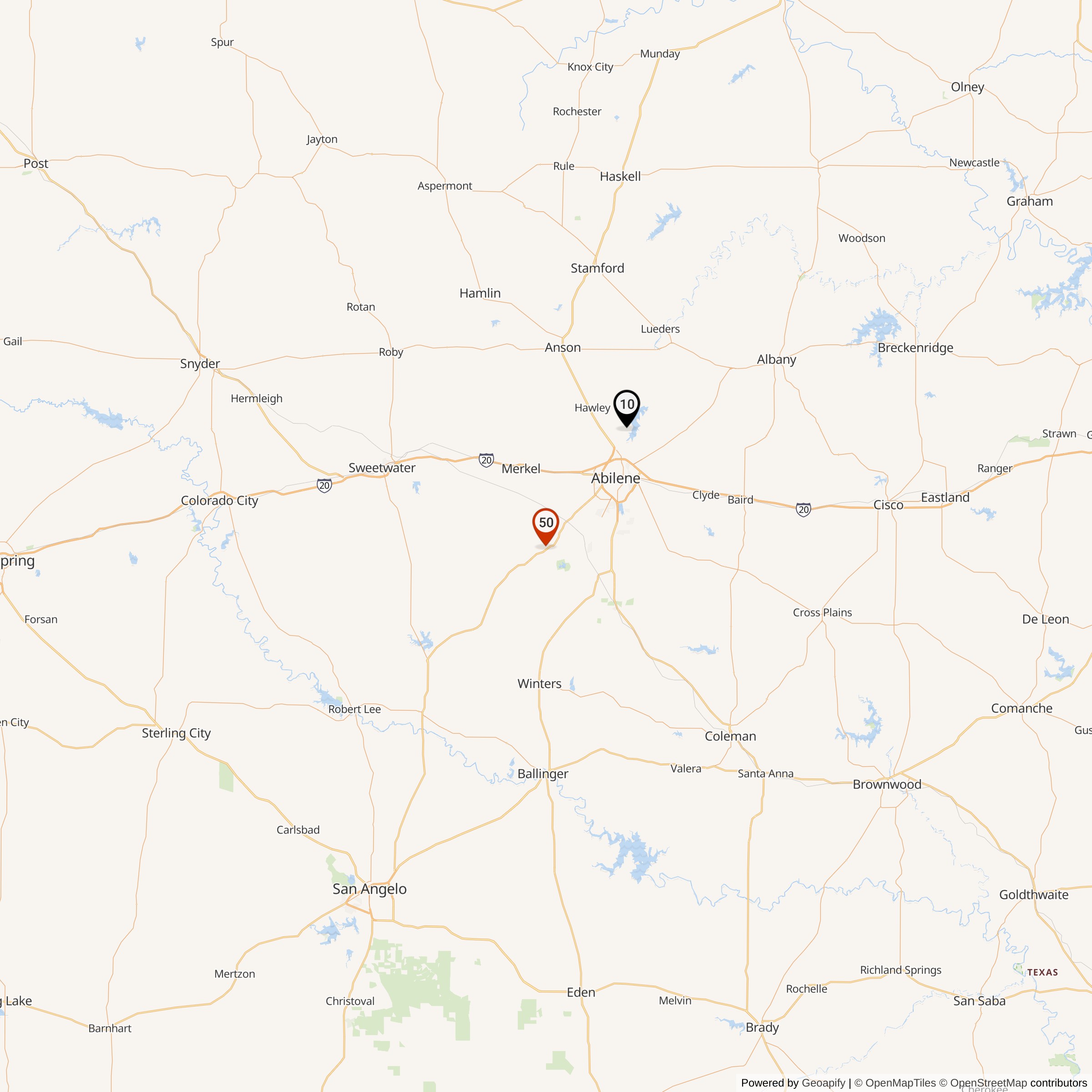
DY-50 sat southwest of Abilene in Taylor County, in the open country associated with former Camp Barkeley. The site occupied the southern side of the Dyess Defense Area. Its companion site, DY-10, was north of Abilene near Fort Phantom Hill. Together, DY-10 and DY-50 formed a two-battery Nike Hercules shield around Dyess Air Force Base and the dispersed Atlas F missile field.This was a Strategic Air Command base-defense Nike site, not a metropolitan Nike ring. Major urban defense areas such as Chicago, New York, Philadelphia, and Los Angeles used many Nike batteries to defend dense industrial and population centers. The Dyess Defense Area used two Hercules batteries because its main defended asset was a high-value nuclear strike installation rather than a major coastal city. The defended target set included SAC bombers, tanker and support infrastructure, nuclear weapons-related facilities, command and alert functions, and the Atlas F ICBM silos operated by the 578th Strategic Missile Squadron around Abilene.
The southwest Abilene / Camp Barkeley landscape was suitable for a Nike Hercules battery because it offered open terrain, clear radar horizons, and enough land for above-ground launch positions, safety buffers, access roads, support buildings, and separation between the radar/control area and the missile launch area. Nike batteries required the Integrated Fire Control area to see the relevant airspace and to maintain command guidance to missiles launched from the launch area. The line-of-sight relationship between the IFC and launch area was especially important because Nike Hercules was a command-guided missile. The radar site tracked the target and missile; the battery-control equipment generated steering commands; and the missile responded to those commands during flight.
The site also reused a landscape with earlier military significance. Camp Barkeley had been a World War II training center southwest of Abilene. The official Dyess AFB history identifies Camp Barkeley as a former World War II infantry division training center and notes that the DY-50 Nike site was located near that former Army post. A Texas Historical Commission marker for the 12th Armored Division at Camp Barkeley stands on FM 3438 near Hartford Street in Abilene, tying the later Cold War missile site area to the larger military history of southwest Abilene.
Strategic Context
DY-50 belonged to the late Nike Hercules phase of the continental air-defense program. It was not an early Nike Ajax site converted to Hercules. Appendix D of the Nike Hercules history lists DY-50 under new SAC base sites, gives its construction period as August 1959 to August 1960, and gives its operational date with Hercules missiles as October 15, 1960. Later federal and site inventories summarize its active service as October 1960 to June 1966.The key reason for DY-50's existence was the vulnerability of Dyess AFB and its surrounding missile field. Dyess had become a Strategic Air Command installation during the 1950s. The 96th Bomb Wing moved to Dyess in September 1957 and operated nuclear-capable bombers and refueling aircraft in the Cold War alert system. The official Dyess history states that the Army broke ground on November 19, 1959, for the headquarters of the 5th Missile Battalion, 517th Artillery, U.S. Army Air Defense Command, and that the Nike Hercules sites were installed to defend SAC bombers and Atlas F missile silos stationed at and around Dyess AFB.
Dyess also became the center of an Atlas F intercontinental ballistic missile field. The official Dyess history states that from 1962 to 1965 Dyess AFB had Atlas missile sites around it operated by the 578th Strategic Missile Squadron, and that after decommissioning in 1965 the Atlas missiles were removed and the sites demilitarized. The Nike batteries therefore protected both aircraft-based and missile-based elements of the American nuclear deterrent during the short period in which the Atlas field was active.
DY-50 and DY-10 were controlled through a BIRDIE system at Sweetwater Air Force Station. BIRDIE, meaning Battery Integration and Radar Display Equipment, was a smaller command-and-control system than the large Missile Master installations used in major defense areas. It allowed the two Dyess batteries to receive air-defense information and coordinate engagements through the Army Air Defense Command Post associated with Sweetwater AFS, about 37 miles west of Dyess. This made DY-50 part of the wider continental air-defense network, while still preserving its local role as a point-defense battery for Dyess and the Atlas field.
Physical Layout and Facilities
Like other Nike batteries, DY-50 was divided into two physically separated areas: the Integrated Fire Control area and the Launch area.The Integrated Fire Control area was the radar and command portion of the battery. It would have contained acquisition radar, target-tracking radar, missile-tracking radar, battery-control vans or equipment buildings, communications, generators, utility systems, administrative and support buildings, security fencing, access roads, and possibly housing or ready facilities depending on local arrangement. The control site was where the battery searched for hostile aircraft, tracked the selected target, tracked the outbound missile, and produced the command guidance needed to steer the missile to the intercept point.
The launch area was the missile-handling and firing portion of the battery. DY-50's missile type is listed as Nike 3AG/12H/12L-H. This code indicates a Nike Hercules battery with three above-ground launch groups, twelve Hercules missiles, and twelve Hercules launchers. Appendix D also notes that the SAC base sites were above-ground installations. This is an important physical distinction. Many earlier Nike Ajax sites used underground magazines and elevators, and some were later modified for Hercules. DY-50, by contrast, was built as an above-ground Hercules site. Its missiles were not stored in deep underground magazine vaults. Instead, the site used surface launch positions protected by earth berms and associated shelters, with support buildings and security infrastructure arranged around the launch area.
A 1997 field visit by Scott D. Murdock provides unusually useful site-specific physical detail for DY-50. The report describes the control site as gated and locked. At the launch site, the visitor spoke with the owner and received a guided tour. The report states that the outer perimeter fence was extant; the launch bays were fairly intact though missing launchers and equipment; the maintenance building, generator building, sentry dog kennel, and sentry boxes were fairly intact; the owner had power to the ready building and maintenance building; two security watch towers still stood; much of the inner secure-area fence and gate remained; the launcher shelters in the berm behind each launch bay were intact; the well house remained, although the adjacent elevated water tank was gone; and the warheading building was intact. Those details make DY-50 one of the better-documented surviving above-ground Nike Hercules launch areas in Texas, at least for the condition visible in 1997.
Operational History
DY-50's construction began in August 1959 as part of the Dyess Nike Hercules buildup. The battalion headquarters groundbreaking occurred at Dyess AFB on November 19, 1959, for the 5th Missile Battalion, 517th Artillery. Appendix D records DY-50's construction period as August 1959 to August 1960 and gives October 15, 1960 as the operational date with Hercules missiles. The Military Standard and To Defend and Deter summarize the site's active service as October 1960 to June 1966.Once operational, DY-50 formed the southwestern battery of the Dyess Defense Area. Its role was to engage hostile aircraft approaching the defended base and missile field from the southwest or otherwise assigned by the BIRDIE command system. The battery's Hercules missiles gave it a greater reach and altitude capability than the earlier Nike Ajax and, critically, a nuclear warhead option for engagements against massed bomber formations. The nuclear role was central to the Nike Hercules concept: a single intercept could destroy or disrupt multiple aircraft in a formation, making the system more effective against the expected Soviet bomber threat of the late 1950s and early 1960s.
The battery worked as a distributed system. The IFC detected and tracked the target. The launch area maintained ready missiles and launchers. The BIRDIE system at Sweetwater AFS helped integrate the two Dyess batteries with the regional air-defense picture. If an attack reached the Dyess area, DY-50's radars and launchers would have formed the local missile layer of defense after long-range warning radars, fighter-interceptors, and the wider national air-defense system.
The units and defended assets around DY-50 show why the site mattered. The official Dyess history identifies SAC's 819th Strategic Aerospace Division, the 96th Bomb Wing, and the 578th Strategic Missile Squadron as present at Dyess while the 5/517th was operational. The 96th Bomb Wing operated B-47 and B-52 nuclear bombers and refueling aircraft; the 578th Strategic Missile Squadron operated the Atlas F missile sites; and the 819th Strategic Aerospace Division reflected the SAC command structure around those bomber and missile missions. DY-50 was therefore tied directly to the American nuclear deterrent rather than simply to local airfield security.
Closure and Post-Military Use
DY-50 was deactivated in June 1966. Its closure was part of the broader contraction of Nike air-defense sites during the 1960s, as the strategic threat shifted from manned bombers toward intercontinental ballistic missiles and submarine-launched ballistic missiles. The Dyess Atlas F field had already been decommissioned in 1965, which removed one of the principal target sets the Dyess Nike batteries had been built to protect. In that context, maintaining a two-site Hercules defense around Dyess became less compelling. List of all Nike Installations in the Dyess Defense AreaList of all Nike Installations in Texas