Nike Missile Site S-43 IFC, Kent / Midway Washington
Longitude: -122.28546935394500
This location was part of the Seattle Defense Area
Site ID: S-43
This site controlled the missiles at the Launch Area located here.
Site Role: IFC
A typical Nike air defense site consisted of two separate parcels of land. One area was known as the Integrated Fire Control (IFC) Area. This site contained the Nike system's ground-based radar and computer systems designed to detect and track hostile aircraft, and to guide the missiles to their targets.
The second parcel of land was known as the Launcher Area. At the launcher area, Nike missiles were stored horizontally within heavily constructed underground missile magazines. A large, missile elevator brought the Nikes to the surface of the site where they would be pushed across twin steel rails to one of four satellite launchers.
Elaboration on how Nike worked here.
Nike Missile Site S-43 was a former U.S. Army Nike Ajax surface-to-air missile battery in the Seattle Defense Area. It was located in the Kent / Midway area of King County, Washington, on the south side of the Seattle-Puget Sound Nike ring. The site is no longer an active missile installation. The federal Nike inventory lists S-43 as active from 1956 to February 1963.
S-43 was an Ajax-only site. It was not converted to Nike Hercules. Its federal missile-type listing is Nike 1B,2C/30A/10L-A, meaning that the site had one B-type magazine, two C-type magazines, an Ajax missile allowance, and ten Ajax launchers. In practical terms, S-43 was one of the larger Ajax-era launch facilities in the Seattle ring, with thirty Nike Ajax missiles and ten launchers, but it did not become one of the nuclear-capable Nike Hercules sites that survived into the 1970s.
The S-43 installation should be understood as a multi-part Nike complex. The launch area was separate from the Integrated Fire Control, or IFC, area. Local sources often discuss S-43 together with S-45 because the Kent / Midway property included a dual firing battery and battalion headquarters functions. The federal inventory, however, does not carry S-45 as a separate Washington site inventory entry; it lists S-43 at Kent / Midway.
S-43 existed because Seattle and Puget Sound were major Cold War target areas. Washington's western urban-industrial corridor contained Boeing facilities, port infrastructure, rail and highway routes, Fort Lewis, McChord Air Force Base, naval installations, the Puget Sound Navy Yard, and other military and industrial assets. During the early Cold War, those assets made the Seattle region a logical target for Soviet long-range bombers. Nike batteries formed the Army's ground-based last line of defense against bombers that evaded early warning, fighter interception, and other layers of air defense.
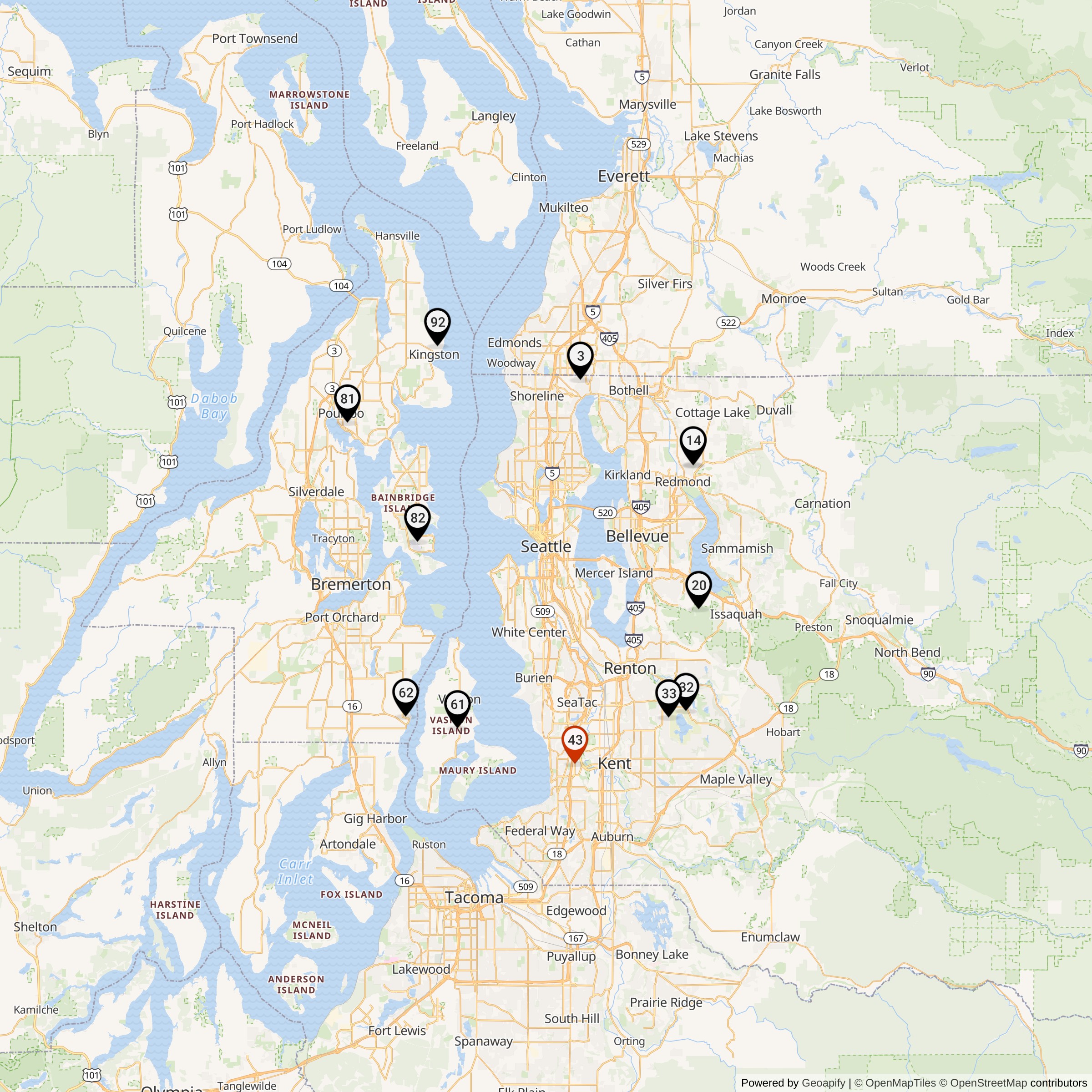
The Seattle Defense Area was one of three Nike defense areas in Washington. Seattle-Puget Sound was the largest urban-industrial target area; the Spokane / Fairchild Defense Area protected Fairchild Air Force Base and nearby military facilities; and the Hanford Defense Area protected the nuclear production complex along the Columbia River. Seattle's Nike sites were not concentrated in downtown Seattle. They formed a ring around the region, with batteries positioned at Kenmore, Redmond, Cougar Mountain / Issaquah, Lake Youngs, Kent / Midway, Vashon Island, Olalla, Poulsbo, Winslow / Bainbridge Island, and Kingston.
The Army began surveying possible Seattle-area Nike locations in the mid-1950s. Where possible, federal land was used, but many Nike sites required acquisition of private or local land. The Seattle District of the U.S. Army Corps of Engineers handled land acquisition, design, and construction supervision for the area. The first Nike Ajax missiles arrived in the Seattle Defense Area in October 1954, and temporary Nike batteries opened while permanent locations were being built. By the later 1950s, Seattle had a ring of permanent batteries supported by fire-control radars, command facilities, and housing or support areas.
S-43 occupied a tactically important southern position. The Kent / Midway ridge overlooked the Green River Valley and the industrial-transportation corridor between Seattle and Tacoma. From that location, the battery helped cover the southern approaches to Seattle and the Puget Sound target area. It complemented nearby Seattle Defense Area batteries at Lake Youngs / Renton, Cougar Mountain / Issaquah, Vashon Island, and the northern and western sites around Puget Sound.
Site Layout and Function
Like other Nike batteries, S-43 was divided into physically separated functional areas.The IFC/control area contained the radars and fire-control equipment. Nike Ajax fire control used acquisition radar to search for targets, target-tracking radar to follow the selected enemy aircraft, missile-tracking radar to follow the outgoing Nike missile, and analog computer equipment to calculate the interception course. The IFC was the command-and-guidance brain of the battery. It detected targets, locked onto them, generated firing data, and guided the missile after launch.
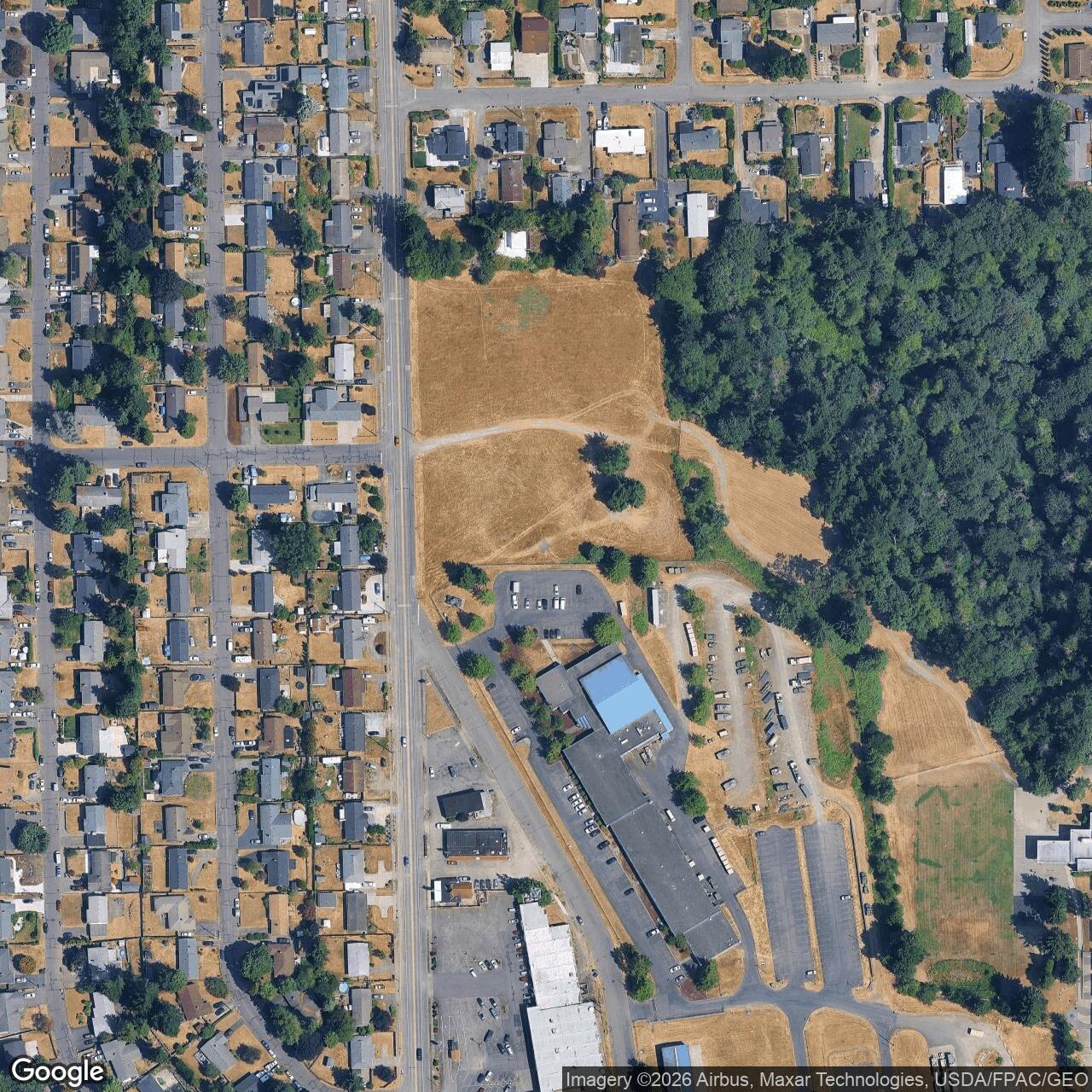
Local sources place the control and headquarters complex on or near Military Road South and 38th Avenue South. HistoryLink states that the control and headquarters site became a Washington National Guard training facility with concrete-block buildings intact. Ed Thelen's notes describe the IFC and battalion-headquarters facility on 38th Avenue South where it splits from 36th Avenue, and record that former ARADCOM buildings at the north end were cleared for a large new National Guard armory while radar berms remained visible at the north end of the property.
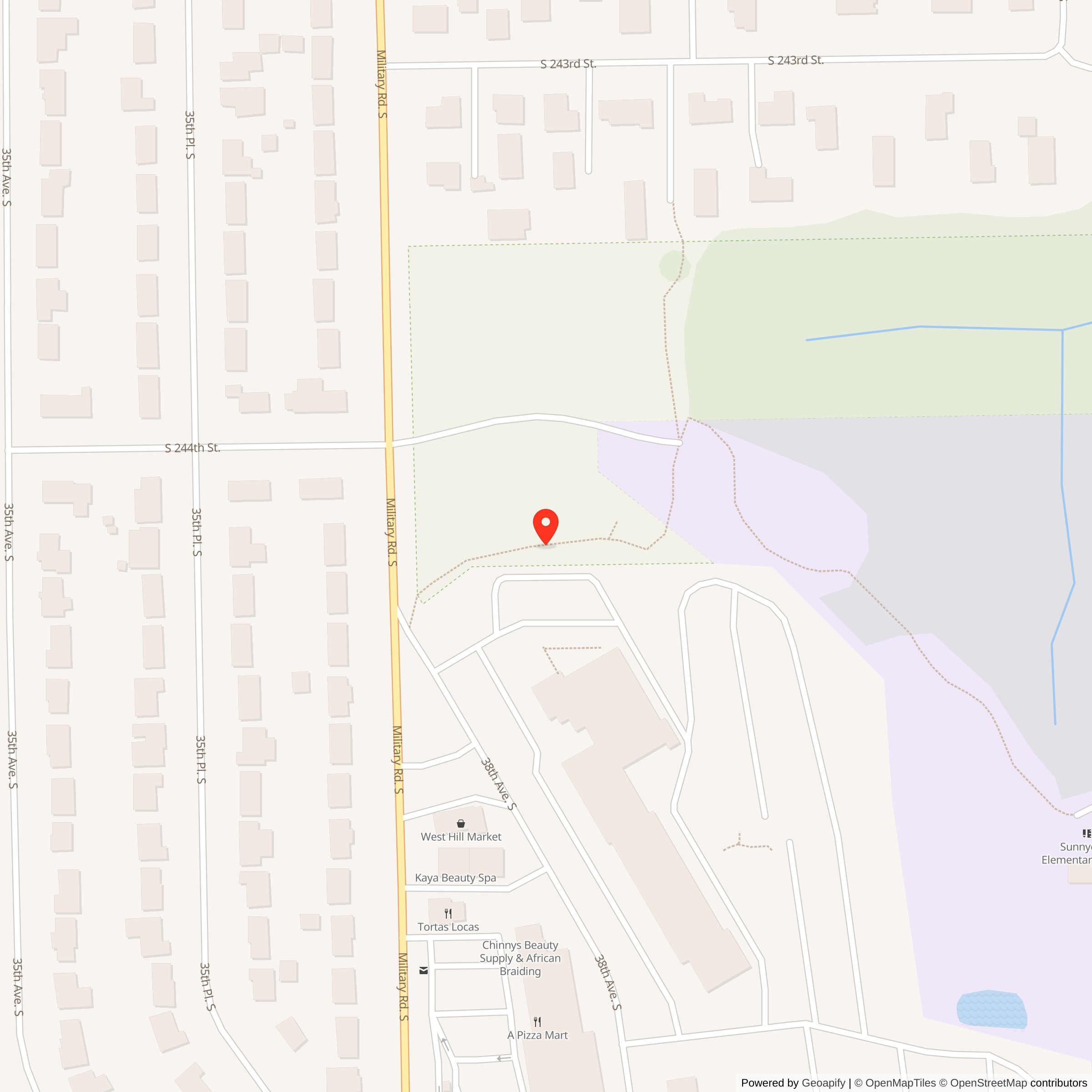
The launch area contained the missile magazines, launchers, missile-assembly and maintenance functions, guard features, ready facilities, and related support structures. Ed Thelen's field notes place Four-Three Lima at the end of South 228th Street, east of Military Road South and north of Kent-Des Moines Road / State Route 516. EPA's Superfund site profile for NIKE S-43 MIDWAY similarly places the site near the end of South 224th Street, east of Military Road South, east of Des Moines.
The federal inventory lists the launch site as partially intact and associated with King County Parks and Kent School District. Later public-history and site-status sources identify the former launch landscape with Grandview Park / Grandview Off-Leash Dog Park and nearby school redevelopment. The physical Nike launch machinery is no longer operational, but the launch magazines were not simply left exposed. Later accounts describe the magazines as buried or covered with soil, with the roof of the former magazine structure contributing to the upper field of the park landscape.
Nike Ajax missiles were stored horizontally in underground magazines. When the battery was ordered to fire, an elevator raised the missile and launcher to the surface. The missile was then elevated and launched under command from the IFC. S-43's 1B,2C/30A/10L-A configuration indicates a three-magazine Ajax battery with ten launchers and a 30-missile allowance. That made it a substantial Ajax installation, but still within the pre-Hercules Nike Ajax design family.
Operational History
S-43 entered service during the permanent buildout of the Seattle Defense Area. The federal inventory gives the active-service range as 1956 to February 1963.The Kent / Midway site belonged to the group of Seattle batteries that initially used Nike Ajax. Ajax was the first operational U.S. Army Nike missile system. It had a solid-fuel booster and a liquid-fuel sustainer, and it carried three conventional high-explosive warheads. It was built to intercept formations of attacking aircraft before those aircraft reached the defended urban-industrial target. Unlike the later Nike Hercules, Nike Ajax was not a nuclear-armed missile.
The battery was manned first by Regular Army units and later by the Washington Army National Guard. HistoryLink says that, on July 1, 1959, Washington Army National Guard personnel took over four Seattle-area sites: Kent, Kenmore, Cougar Mountain, and Olalla. Ed Thelen's Kent / Midway unit notes identify the site grouping with HHB/433d, D/433d, HHB/4/60th, D/4/60th, and Washington Army National Guard HHB and B/3/205th. Those assignments reinforce the interpretation that Kent / Midway was more than a small isolated launch point: it included battery operations and headquarters functions in the southern Seattle ring.
S-43's daily work would have been repetitive, technical, and security-heavy. Crews maintained missiles, launchers, elevators, magazines, generators, communications equipment, radars, plotting equipment, and security systems. IFC crews trained to detect, identify, and track high-speed aircraft, while launcher crews trained to bring missiles from underground storage to firing readiness. The battery had to be ready continuously because the Nike system existed for sudden-warning air defense, not for scheduled wartime mobilization.
The Seattle Nike batteries developed a strong training reputation. The federal Seattle Defense Area history says Army units manning Seattle-area Nike Ajax batteries were considered among the best in the nation, winning the ARADCOM Commander's Trophy in 1956, 1957, and 1958 after high scores at Annual Service Practices at McGregor Range. HistoryLink adds that Regular Army and National Guard missilemen continued to receive high recognition and that all Seattle-area National Guard batteries made the 1963 honor roll. S-43 was part of that regional performance culture, especially after the Washington Army National Guard assumed operation of the Kent site.
S-43 was not selected for Hercules conversion. This is the most important technical point in the site's later operational history. In Washington, only selected Ajax sites were modernized for Nike Hercules. HistoryLink states that Nike Hercules was installed at six Washington locations overall and that in the Seattle area only three Hercules sites survived: Redmond, Vashon Island, and Kingston. The federal Seattle Defense Area history similarly states that Ajax sites were phased out from 1960 to 1963, while S-13 Redmond, S-61 Vashon Island, and S-92 Kingston were upgraded to launch Nike Hercules and survived until 1974. S-43 therefore closed as the Army consolidated the Seattle missile-defense mission into fewer, longer-range Hercules batteries.
Why S-43 Closed
S-43 closed in February 1963 because the Seattle Defense Area no longer required every Ajax-era battery once Nike Hercules became available. Hercules had longer range, higher-altitude performance, solid-fuel handling advantages, and the ability to carry a nuclear warhead. Because one Hercules battery could cover more airspace than a Nike Ajax battery, the Army could reduce the number of sites while maintaining a broader defensive reach.S-43's closure in February 1963 also coincided with a change in Seattle's command-and-control system. When the Seattle Defense Area had many Ajax batteries, a large Missile Master facility at Fort Lawton helped assign targets among fire positions. With the Ajax sites deactivated and only a few Hercules batteries remaining, the Army could use the smaller BIRDIE system for missile-defense coordination.
Closure and Post-Closure Reuse
S-43 is no longer an active military missile installation. Its two main components followed different post-closure paths.The former IFC/control and headquarters area remained in a military or military-related role. The control and headquarters site became a Washington National Guard training facility, and the Washington Military Department currently lists the Kent Readiness Center at 24410 Military Road South, Kent, Washington. Ed Thelen's field notes describe substantial redevelopment of the National Guard armory area but also note that berms at the north end of the former facility may mark former radar positions.
The former launch area became a park and school-related landscape. The federal inventory lists the launch site as partially intact and associated with King County Parks and Kent School District. HistoryLink states that the launch magazine was covered with soil and became part of Grandview Park. Later site-status sources identify the former launch area with Grandview Off-Leash Dog Park, where buried magazine structures underlie part of the park's upper field. Public-history accounts describe the current park as the successor landscape to Nike launch site S-43.
The former launch area has also been affected by school redevelopment. Some later site-status summaries state that dormitory, office, and missile-maintenance buildings survived for many years in school use as Mountain View Academy before demolition in 2019 to make room for River Ridge Elementary.
Chronology
- 1954 The Seattle Defense Area received its first Nike Ajax missiles, and temporary batteries opened while permanent sites were being constructed.
- 1956 The federal Nike inventory records S-43 as beginning active service in 1956.
- 1956 S-43 functioned as a Nike Ajax battery in the Seattle Defense Area, with separate IFC/control and launch areas in the Kent / Midway area.
- 1956-1958 Seattle-based Nike Ajax units earned national recognition, including ARADCOM Commander's Trophy awards based on high Annual Service Practice scores at McGregor Range.
- July 1, 1959 Washington Army National Guard personnel took over several Seattle-area Nike sites, including Kent / S-43.
- 1960 Gun batteries were removed from the Seattle defense net, leaving Nike missiles as the primary ground-based air-defense layer.
- 1960-1963 Nike Ajax sites in the Seattle Defense Area were phased out as selected Hercules batteries took over the reduced missile-defense mission.
- 1963 Seattle-area National Guard Nike batteries received honor-roll recognition for training performance.
- February 1963 S-43 closed as an operational Nike Ajax battery.
- Post-1963 The former IFC/control area continued in military use and evolved into the Washington National Guard Kent Armory / Kent Readiness Center landscape.
- Post-1963 The former launch area was reused by King County Parks, Kent School District, Grandview Park / Grandview Off-Leash Dog Park, and school-related redevelopment.
- 2019 Later site-status summaries report demolition of surviving school-used former Nike support buildings to make room for River Ridge Elementary.
List of all Nike Installations in Washington