
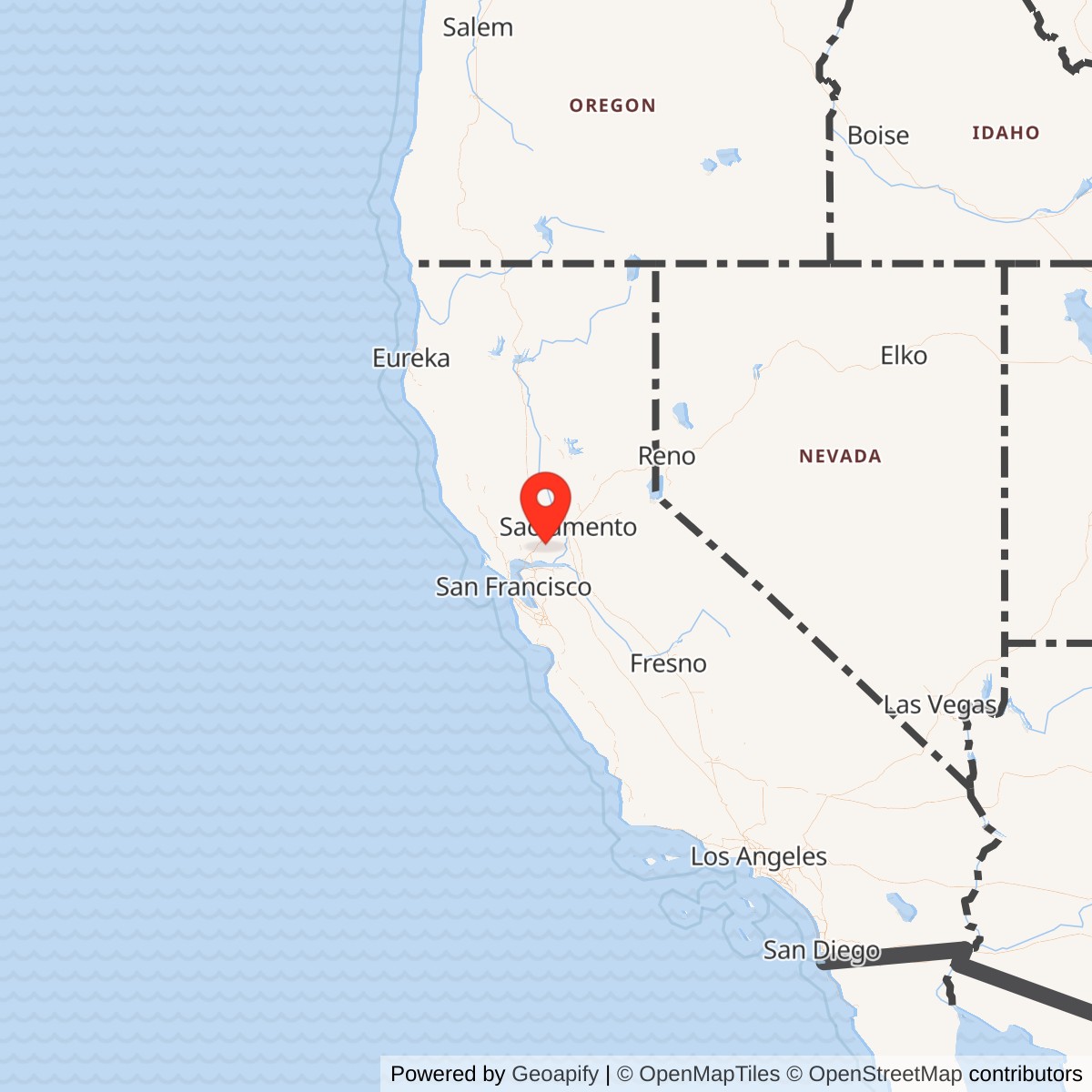
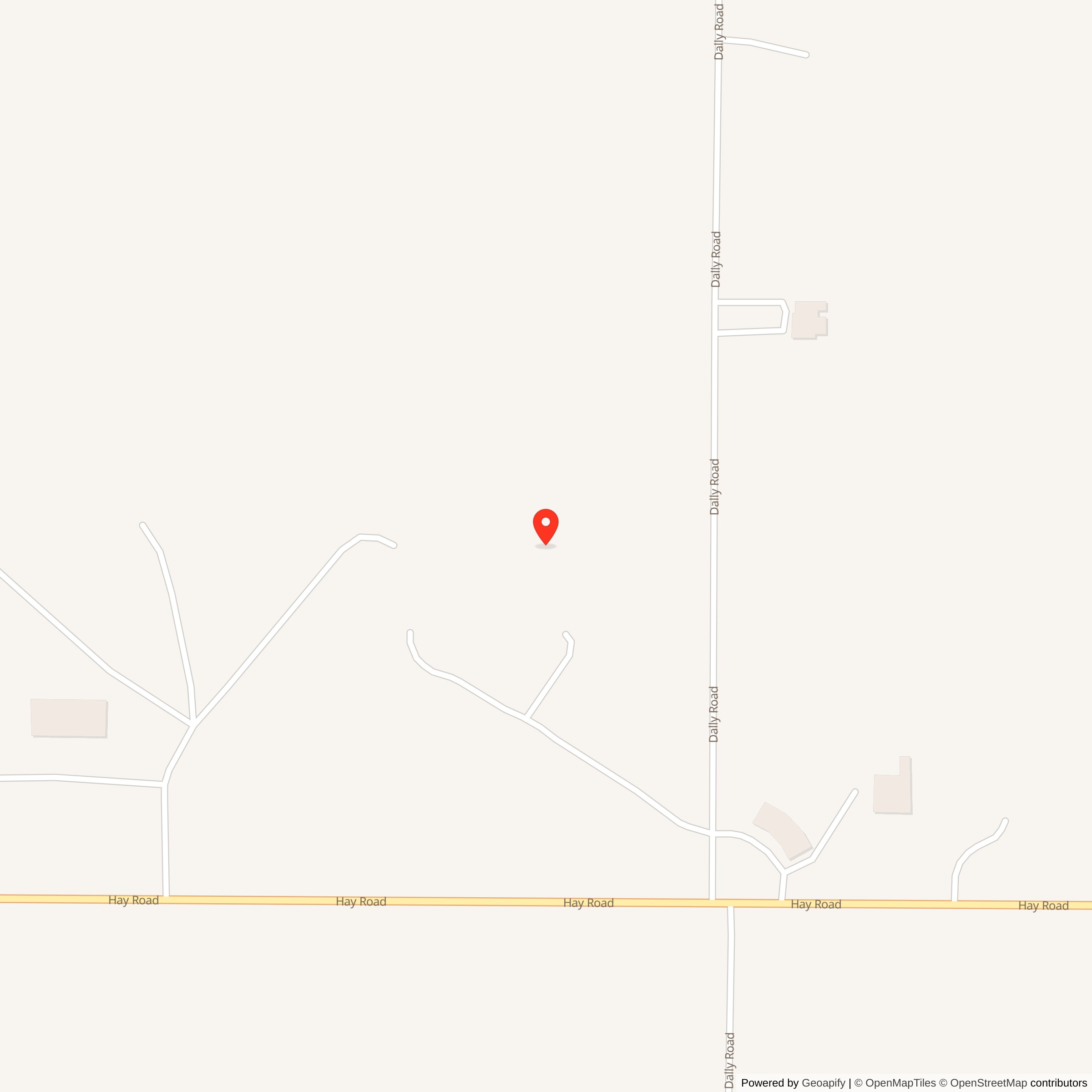
Nike Missile Site T-10 IFC, Elmira California
Longitude: -121.870505011147
This location was part of the Travis AFB Defense Area
Site ID: T-10
Missile / battery configuration: Nike 3B/18H,30A/12L-U
This site controlled the missiles at the Launch Area located here.
Site Role: IFC
A typical Nike air defense site consisted of two separate parcels of land. One area was known as the Integrated Fire Control (IFC) Area. This site contained the Nike system's ground-based radar and computer systems designed to detect and track hostile aircraft, and to guide the missiles to their targets.
The second parcel of land was known as the Launcher Area. At the launcher area, Nike missiles were stored horizontally within heavily constructed underground missile magazines. A large, missile elevator brought the Nikes to the surface of the site where they would be pushed across twin steel rails to one of four satellite launchers.
Elaboration on how Nike worked here.
Missile Type: Ajax/Hercules
The Nike Ajax was the first in the Army's family of guided missiles, and the world's first operational, guided, surface-to-air missile system. Nike Ajax had a burnout speed of Mach 2.3, a range of 25-30 miles, and a ceiling of 65,000 feet.
Designed to carry either nuclear and/or high-explosive warheads, the Nike Hercules missile could attack supersonic aircraft operating at altitudes in excess of 150,000 feet and at a range of more than 87 miles.
For most Nike batteries, the strategic target remained broadly consistent throughout the site's life. T-10 was different. It opened while Travis Air Force Base still hosted Strategic Air Command B-52 bombers, continued as the base grew into the Air Force's principal West Coast military airlift hub, and remained on alert after every other Nike battery assigned to the Travis Defense Area had closed. Its mission therefore bridged two eras of the base: nuclear deterrence built around long-range bombers and global mobility built around heavy transports. By the time the Elmira battery shut down in March 1974, it was the last active Nike firing site in the Travis ring.
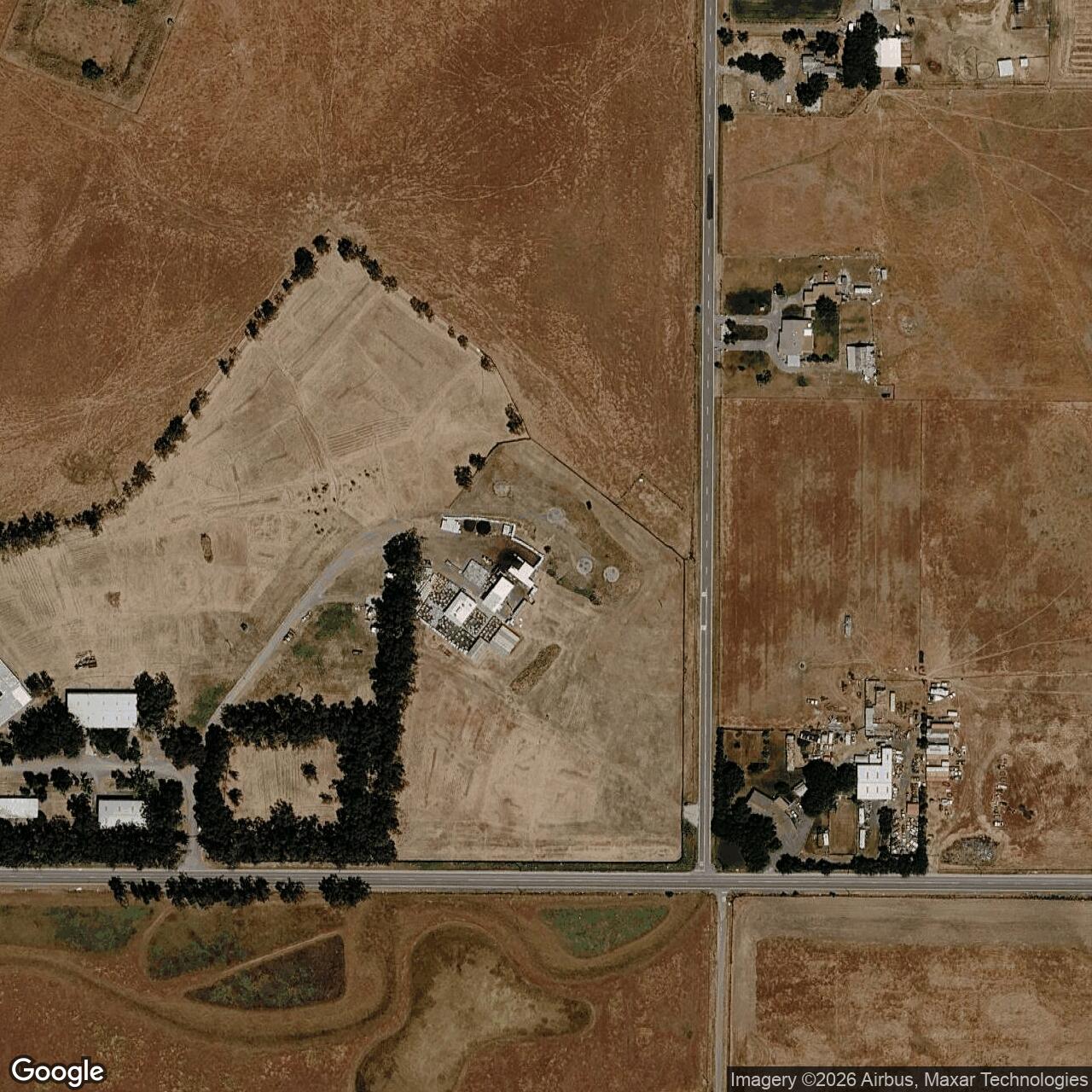
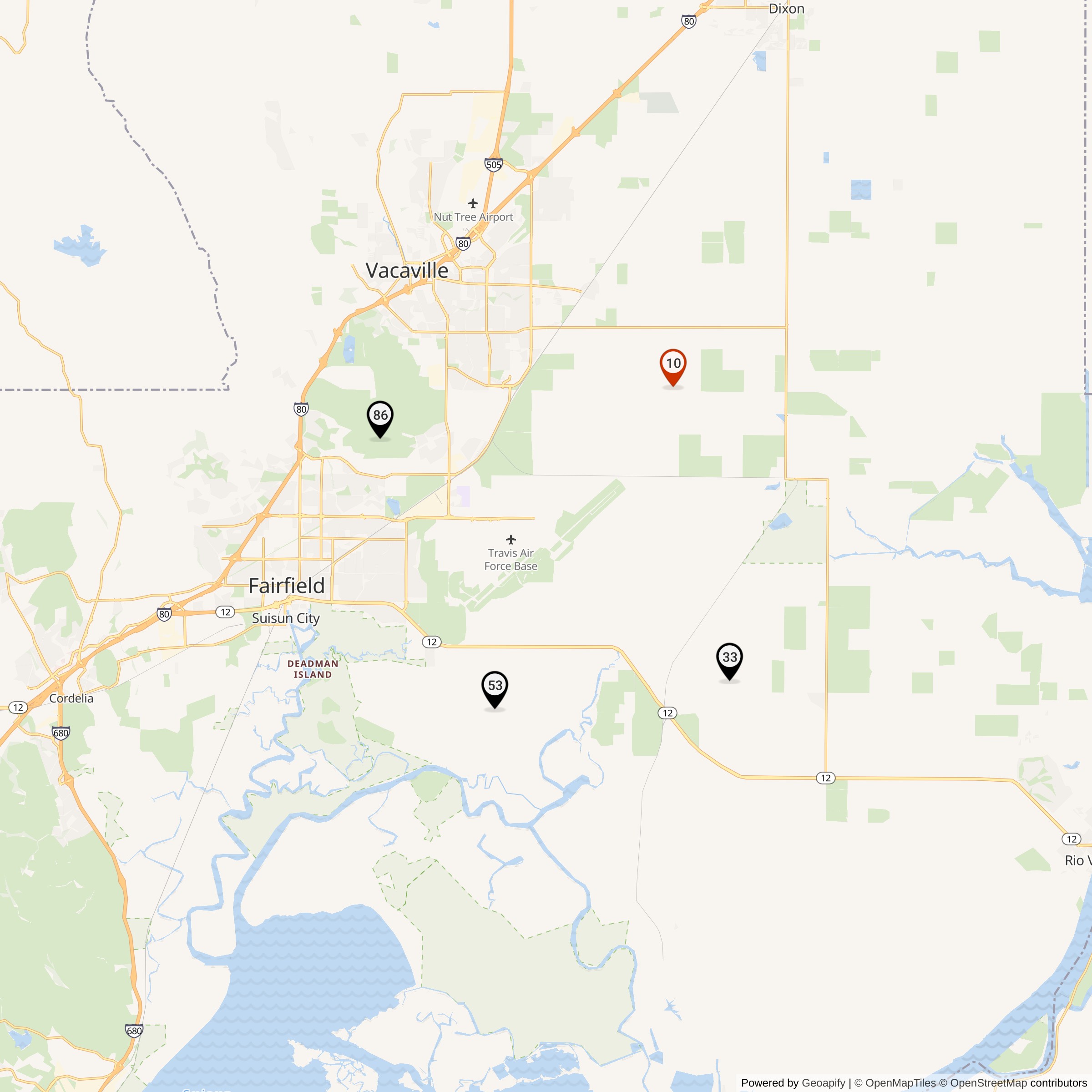
T-10 was one of four Regular Army Nike batteries positioned around Travis. The others were T-33 near Dixon and Lambie, T-53 in the Potrero Hills, and T-86 at Cement Hills near Fairfield. T-10 and T-86 were upgraded for Nike Hercules, while T-33 and T-53 remained Ajax batteries and closed early. The Army placed the T-10 components in open agricultural country northwest of the air base, near Elmira. The launcher area lay near the junction of Hay and Lewis roads. The integrated fire control area, usually abbreviated IFC, stood about a mile and a half to the east along Hay Road. This separation gave the tracking radars a clear view of missiles after launch and kept the radar and command equipment away from the hazards and electrical interference of the launcher plant.
Why Travis Needed a Nike Defense
The Cold War value of Travis was larger than its runways. Strategic Air Command assumed control of the base in 1949, and Travis became home to B-29, B-36, and later B-52 bomber operations. Military Air Transport Service resumed command on 1 July 1958, the year T-10 entered service, but the 5th Bombardment Wing remained at Travis as a tenant until July 1968. Tanker support also continued. The base therefore combined a strategic bomber and refueling presence with an expanding intercontinental airlift mission during much of T-10's life.That concentration of aircraft, fuel, maintenance facilities, crews, and command infrastructure made Travis a high-value target for Soviet bomber attack. The four Nike sites formed a local defensive ring intended to engage hostile aircraft before they could reach the base. The battery network did not operate in isolation. It depended on regional early warning, identification, communications, and Army air-defense command channels. Within that system, T-10 became especially important after its Hercules conversion because Hercules offered greater range, altitude, and destructive power than Ajax.
Travis continued to change under T-10's protection. The first C-133 Cargomaster reached the base in October 1958. By the late 1960s, the bomber wing had departed and Travis was increasingly identified with strategic airlift. The first C-5 Galaxy arrived on 24 October 1970. The defended asset had evolved, but it remained critical. T-10's final years protected an airfield whose transports connected the continental United States with forces across the Pacific.
Construction, Activation, and Hercules Conversion
The Army inventory records T-10 as active from 1958. Unit histories identify Battery A, 436th Antiaircraft Artillery Missile Battalion as the first firing battery, followed in September 1958 by Battery A, 1st Missile Battalion, 61st Artillery. Headquarters and Headquarters Battery of the 1st Battalion, 61st Artillery was also based in the Travis area. The exact day on which the original Ajax battery first assumed an operational alert has not been found, so 1958 is the most precise defensible opening date.T-10's transition to Hercules began almost immediately. The Army's Hercules upgrade schedule records construction from June 1958 through January 1959 and lists the battery as operational with Hercules on 12 June 1959. This date is more precise than the broad 1958 opening date because it comes from a conversion schedule rather than a general site inventory. The sequence indicates that T-10 entered service during the transition from the first-generation Ajax system to Hercules rather than spending many years as an Ajax-only site.
Converting an Ajax battery required more than changing the missile. Hercules was larger and heavier, and it used different launch and handling equipment. Elevators, launcher rails, electrical systems, test equipment, and missile storage arrangements had to be modified. The fire-control plant also gained the radar and computing equipment needed for Hercules engagements. The converted battery retained the recognizable two-part Nike layout, but its physical plant and tactical reach were substantially enhanced.
Site Layout And Configuration
T-10's recorded configuration is "Nike 3B/18H,30A/12L-U." The compact inventory code can be read as follows:3B: Three B-type underground missile magazines at the launcher area. Each magazine was a reinforced below-grade storage and handling space connected to the surface by an elevator.
18H,30A: The recorded missile accommodation or planning capacity, 18 Hercules or 30 Ajax missiles. These numbers describe the alternative capacities associated with the configuration, not evidence that both complete loads were stored simultaneously.
12L-U: Twelve universal launcher rails. The universal conversion allowed the launcher plant to support the larger Hercules missile while retaining compatibility with the established Nike site arrangement.
The launcher component contained the magazines, elevators, launcher sections, missile assembly and test facilities, fueling or servicing areas associated with the earlier Ajax system, power and hydraulic equipment, and the security perimeter. Missiles were stored horizontally below grade. During an alert sequence, an elevator raised a missile to the surface, crews moved it onto a launcher rail, and the launcher elevated it for firing. The magazines were not launch silos. The missile left from an exposed surface rail after being raised from protected storage.
The IFC component was the battery's eyes and brain. It included acquisition and tracking radars, the computer and plotting equipment, operations buildings, generators, maintenance spaces, and personnel support facilities. Hercules operations used target-tracking, missile-tracking, and target-ranging radars, supported by acquisition radar and electronic computation. The IFC calculated an intercept, sent steering commands to the missile in flight, and issued the burst command when the computed engagement conditions were met.
An expert field survey describes T-10 as the primary fire-control facility for the two Hercules batteries in the Travis Defense Area and identifies it as a Secondary Master Fire Unit equipped with High Power Acquisition Radar, or HIPAR. HIPAR gave the Hercules defense improved long-range target detection in an electronic-countermeasures environment. Surviving radar berms and the HIPAR building were still identifiable during the 2002 visit. This additional equipment helps explain why T-10 outlasted T-86 and later supported the remaining San Francisco area batteries through a consolidated command arrangement.
Units, Crews, and Daily Operations
Battery A, 436th Antiaircraft Artillery Missile Battalion served at T-10 during its initial activation. Battery A, 1st Missile Battalion, 61st Artillery took over in September 1958 and remained the firing unit through the site's closure in March 1974. Army nomenclature changed during the period, and later records use Air Defense Artillery designations for the same 1st Battalion, 61st lineage. Headquarters and Headquarters Battery, 1st Battalion, 61st Artillery operated from the Travis area until the 1971 consolidation.A Nike battery required continuous teamwork across two separated compounds. At the IFC, radar operators acquired, identified, and tracked targets; missile trackers followed the outbound weapon; computer personnel maintained the engagement solution; and technicians kept radar, communications, and power systems ready. At the launcher area, missile crewmen inspected rounds, performed tests, operated elevators and launchers, and maintained hydraulic and electrical equipment. Guards controlled access to the exclusion area. Administrative, supply, mess, motor, and maintenance personnel kept the unit functioning between alerts and evaluations.
Veteran recollections associated with T-10 describe around-the-clock duty, hot-battery periods, tactical proficiency inspections, nuclear surety procedures, and the physical work of maintaining radar berms and launcher equipment. One former IFC section chief recalled responsibility for the target-tracking, missile-tracking, target-ranging, acquisition, and computer systems. Launcher veterans remembered weapons handling, warhead movement, missile movement, and the drawn-out work of closing the site in 1974. These accounts are personal recollections rather than formal unit records, but together they illuminate the routine labor behind the battery's readiness statistics.
Hercules could carry either a conventional or nuclear warhead. Public sources do not provide a complete T-10 warhead inventory by date. Veteran accounts do, however, refer to nuclear surety and exclusion-area procedures at the site. Those procedures included strict access control, two-person safeguards, formal inspections, and rehearsed emergency actions. The important historical point is that T-10 belonged to a weapons system designed for nuclear as well as conventional air defense, so crew proficiency and custody standards were central to daily operations.
Final Years and Closure
By 1974, the nationwide Nike network was approaching the end of its continental air-defense mission. Improvements in intercontinental ballistic missiles had changed the strategic threat, while manned-bomber defense competed for shrinking resources. T-10 ceased firing-site operations in March 1974. Veterans recalled removing warheads and missiles, securing equipment, and preparing the launcher compound for turnover.Two dates appear in authoritative records and describe different milestones. The Army site inventory gives March 1974 as T-10's closure date. The official Travis heritage pamphlet states that the 1st Battalion, 61st Air Defense Artillery was inactivated on 30 August 1974. The March date is therefore used for the end of the battery's operational site history, while the August date marks the later administrative inactivation of its parent battalion.
After closure, the government removed missiles and military equipment and disposed of the two compounds as private property. The former launcher and the former barracks or control-area parcels subsequently entered rural residential and agricultural use. Disposal did not erase the site's industrial legacy. Underground tanks, piping, hydraulic systems, transformers, missile magazines, and contaminated soil required later attention.
The 1995 Closure Action
In 1995, a contractor working for the U.S. Army Corps of Engineers carried out a documented removal and restoration project at the former T-10 launcher and barracks properties. The final report is useful because it records physical work at both parcels rather than relying on distant observation. The project removed six underground storage tanks, one above-ground tank, extensive piping, and five transformers. Crews also drained and flushed the launcher hydraulic system.The missile magazines had accumulated a large volume of water. The contractor reported pumping approximately 1.2 million gallons from the vaults. Following sampling and regulatory review, water meeting the approved conditions was discharged to an on-site irrigation pond. Workers entered the confined magazine space, recovered fluids, and addressed equipment associated with the former military plant.
Excavation exposed petroleum-stained soil and damaged tanks or piping. The contractor removed roughly 360 cubic yards in twenty truckloads, plus an additional truckload of affected soil, for disposal. Excavations were backfilled and compacted, disturbed pavement and fencing were restored, and a grassy area was hydroseeded. The report's appendix includes photographs of the soil stockpile, stained excavation, damaged tanks, groundwater sampling, confined-space work in a missile vault, and the restored ground surface.
This 1995 work should be described precisely. It documents a specific containerized hazardous-material, tank, piping, transformer, water-management, and soil-removal project. It does not by itself establish that every environmental issue on either former parcel was investigated or resolved. No comprehensive current environmental determination was found.
Current Status and Surviving Features
The T-10 components remain on separate private parcels in the rural Hay Road and Lewis Road area northwest of Travis Air Force Base. Public real-estate records describe both former military properties as farm or residential acreage. The launcher parcel was developed with a residence in the mid-1990s, and the former control or barracks parcel has also been marketed and transferred as rural residential or agricultural property. Because these are private properties, surviving features should be viewed only from public rights of way unless the owner grants permission.The 1995 closure report confirms that the below-grade launcher vaults, hydraulic equipment, fencing, paved areas, and associated buildings were sufficiently intact for cleanup work. The 2002 field survey described the launcher assembly building and protected launcher compound, while at the IFC it identified the HIPAR building, radar berms, and nearby housing. Later public property information confirms continued private reuse but does not provide a professional archaeological survey of the surviving Cold War fabric.
T-10 is therefore best characterized as partially intact and privately reused, with important below-grade and above-ground features reported to survive. The launcher magazines and the specialized HIPAR-related features give the site particular interpretive value. Its paired compounds preserve the basic logic of a Nike battery: sensors and command at one location, missiles and launch equipment at another, joined by communications and a shared mission.
Chronology
- 1 May 1949 Strategic Air Command assumed control of Travis Air Force Base, beginning the bomber era that made the installation a major air-defense objective.
- 1958 Nike battery T-10 entered service near Elmira as one of four Regular Army sites in the Travis Defense Area.
- June 1958 Construction began to convert T-10 for Nike Hercules operation.
- 1 July 1958 Military Air Transport Service resumed command of Travis while Strategic Air Command bomber and tanker units remained as tenants.
- September 1958 Battery A, 1st Missile Battalion, 61st Artillery replaced Battery A, 436th Antiaircraft Artillery Missile Battalion at T-10.
- October 1958 The first C-133 Cargomaster arrived at Travis, marking the growth of the strategic airlift mission protected by T-10.
- January 1959 The recorded Hercules conversion construction period at T-10 ended.
- January 1959 Ajax-only sites T-33 and T-53 closed, leaving T-10 and T-86 as the two Hercules-capable Travis batteries.
- 12 June 1959 T-10 was recorded as operational with Nike Hercules.
- 25 March 1960 A national program reduction stopped work on the incomplete BOMARC site intended for the Travis area.
- July 1968 The 5th Bombardment Wing departed Travis, while T-10 continued to protect the base's expanding mobility mission.
- 24 October 1970 The first C-5 Galaxy arrived at Travis.
- 1 June 1971 The Travis battalion headquarters departed the base during consolidation with the San Francisco defense organization.
- 1971 T-86 closed, leaving T-10 as the last active Nike firing site in the original Travis Defense Area.
- March 1974 T-10 ceased operational firing-site service and its soldiers began final equipment removal and closure work.
- 30 August 1974 The 1st Battalion, 61st Air Defense Artillery was formally inactivated, an administrative milestone separate from the site's March closure.
- 14 August 1995 The contractor dated its final Corps of Engineers report on tank, piping, transformer, water, and soil removal at the former T-10 properties.
- 2002 A field survey documented surviving launcher, HIPAR, radar-berm, and support features at the two private parcels.
List of all Nike Installations in the Travis AFB Defense Area
List of all Nike Installations in California
Sources & References