Nike Missile Site T-33 IFC, Suisun City / Dixon / Lambie California
Longitude: -121.847051799409
This location was part of the Travis AFB Defense Area
Site ID: T-33
Missile / battery configuration: Nike AG/12A/12L-A
This site controlled the missiles at the Launch Area located here.
Site Role: IFC
A typical Nike air defense site consisted of two separate parcels of land. One area was known as the Integrated Fire Control (IFC) Area. This site contained the Nike system's ground-based radar and computer systems designed to detect and track hostile aircraft, and to guide the missiles to their targets.
The second parcel of land was known as the Launcher Area. At the launcher area, Nike missiles were stored horizontally within heavily constructed underground missile magazines. A large, missile elevator brought the Nikes to the surface of the site where they would be pushed across twin steel rails to one of four satellite launchers.
Elaboration on how Nike worked here.
Missile Type: Ajax
The Nike Ajax was the first in the Army's family of guided missiles, and the world's first operational, guided, surface-to-air missile system. Nike Ajax had a burnout speed of Mach 2.3, a range of 25-30 miles, and a ceiling of 65,000 feet.
Designed to carry either nuclear and/or high-explosive warheads, the Nike Hercules missile could attack supersonic aircraft operating at altitudes in excess of 150,000 feet and at a range of more than 87 miles.
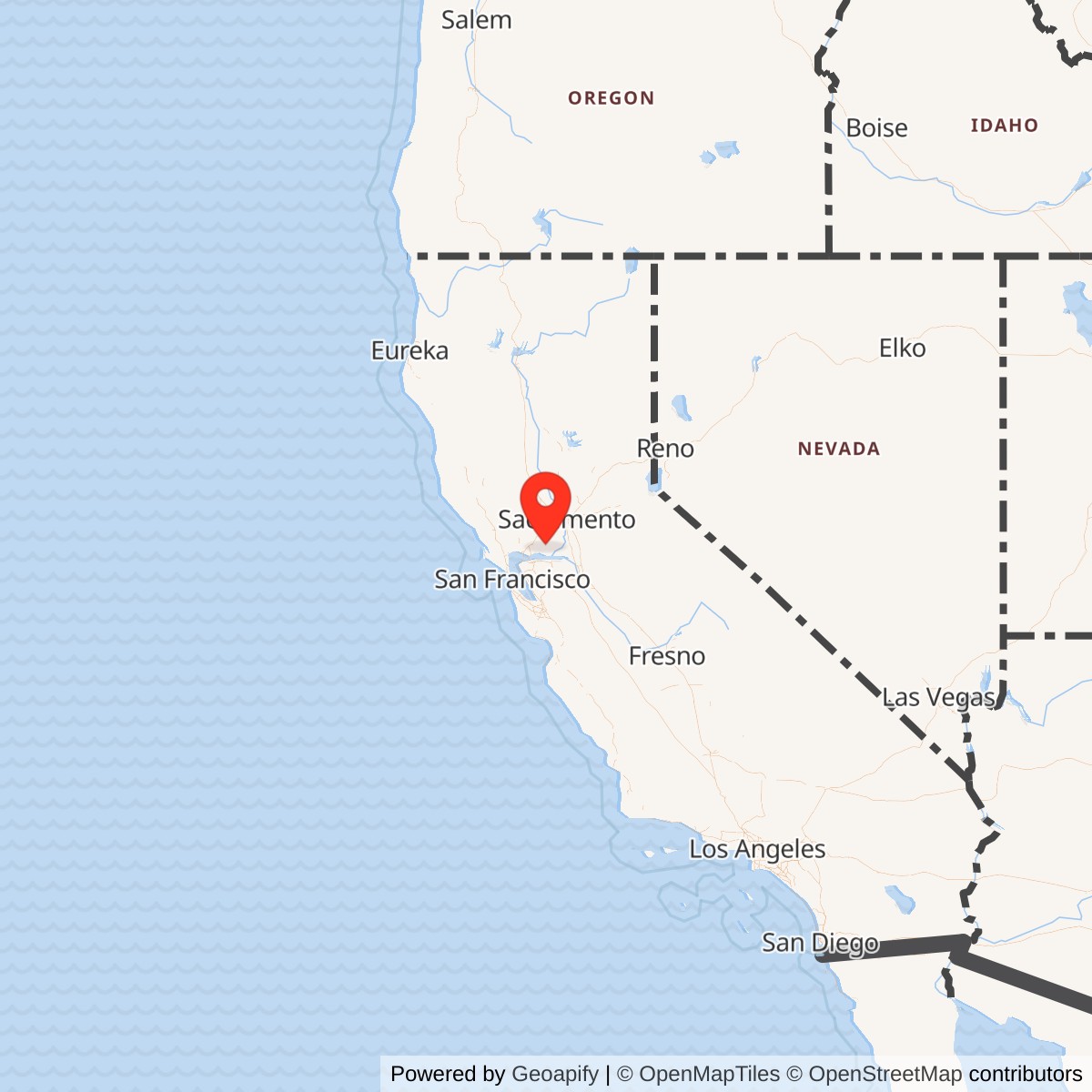
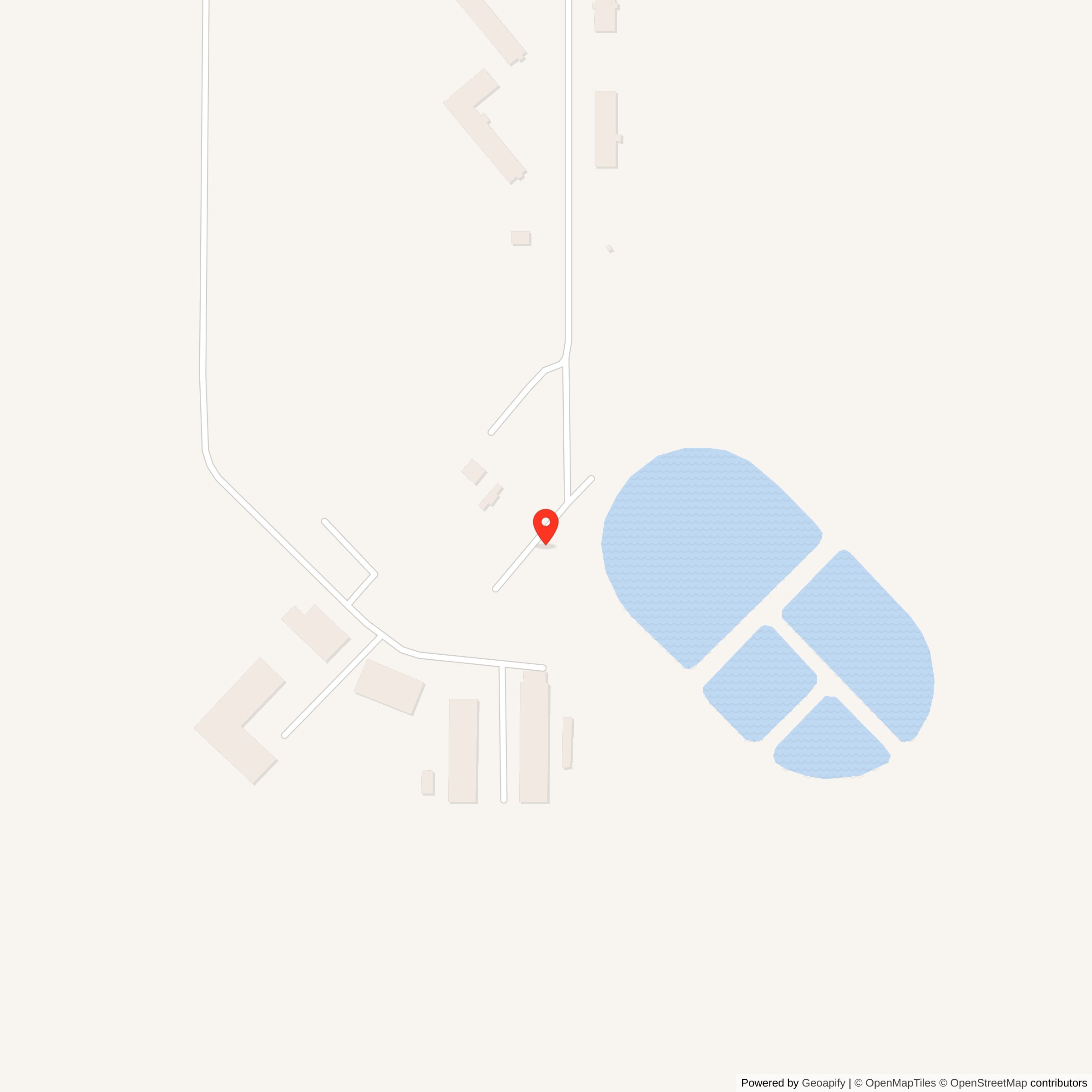
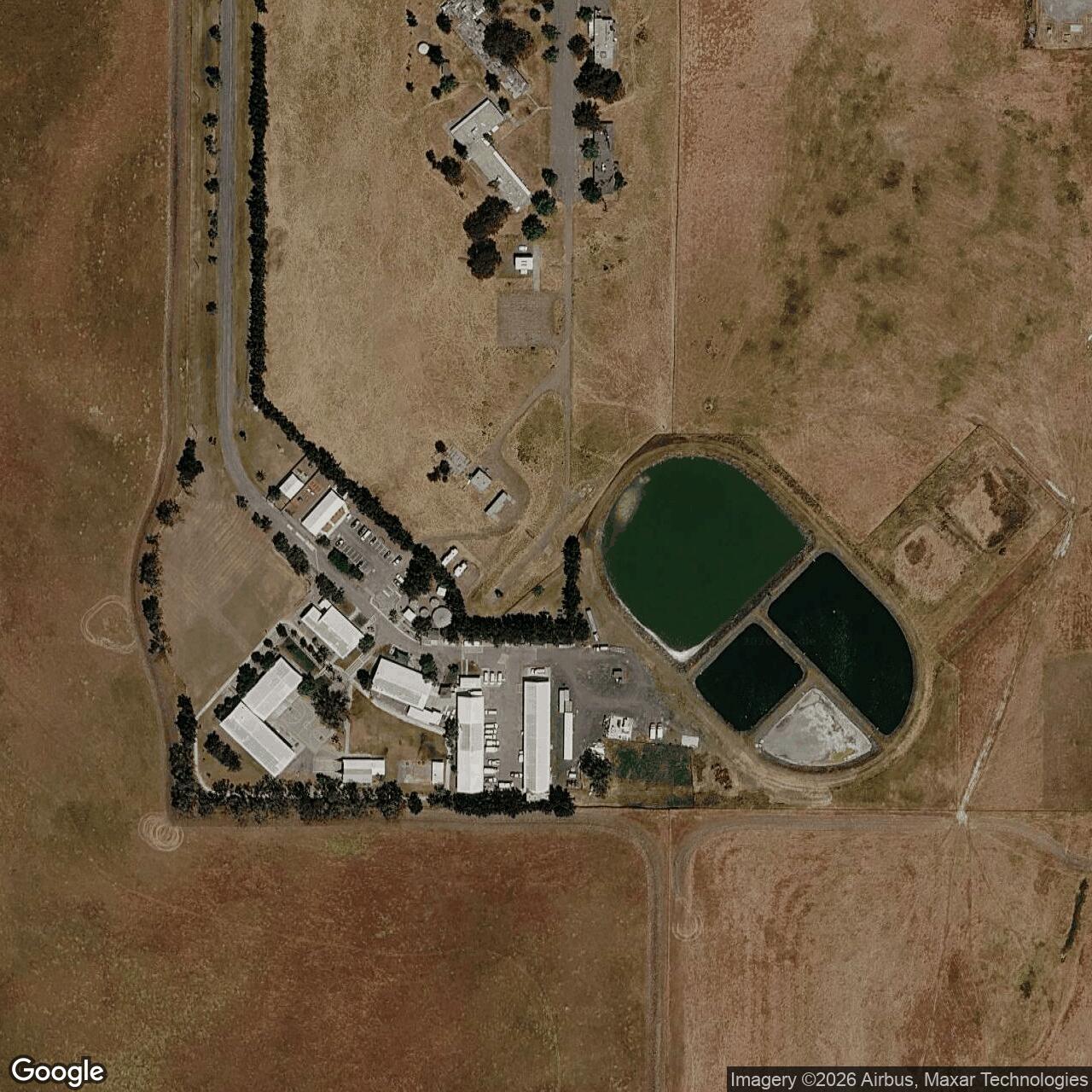
T-33 was the battery that put the Travis Air Force Base Nike defense into operation. It was also the battery most clearly built not to last. The Army opened the Dixon/Lambie position in 1957 as the defense area's first operational Nike Ajax site, using a temporary above-ground launcher arrangement rather than the underground magazines that became the familiar image of a permanent Nike battery. Twelve launchers stood on rails anchored by limited concrete work. Less than two years later, T-33 closed. Its radar and command compound survived through adaptation, while the sparse launcher plant almost disappeared into agricultural land.
That contrast gives T-33 unusual historical value. It documents the speed with which the Army could establish a guided-missile defense around a strategic air base, the transitional architecture used before or instead of permanent construction, and the equally rapid concentration of the Travis defense on longer-ranged Nike Hercules batteries. It also shows two very different afterlives. The former Integrated Fire Control compound became Delta Conservation Camp #8, now operated jointly by the California Department of Corrections and Rehabilitation and CAL FIRE. The former launcher area was returned to private agricultural use and was already described as obliterated in the national Nike inventory.
Why Travis Needed T-33
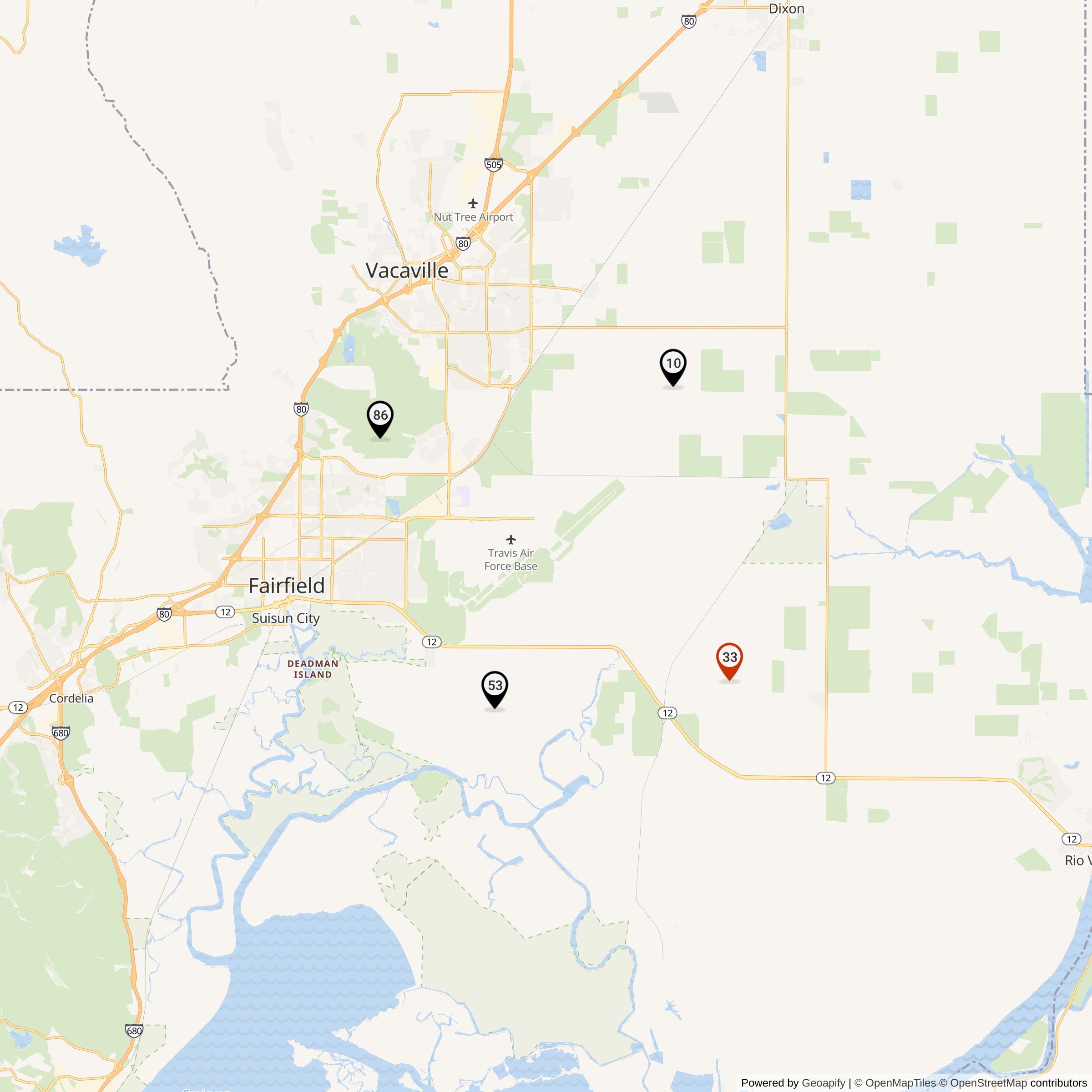
Strategic Air Command assumed control of Travis in 1949. The base hosted B-29, B-36, and later B-52 bomber operations, together with the crews, fuel, weapons support, maintenance capacity, and communications that made a strategic air base an attractive wartime target. The Army therefore established four Regular Army Nike sites around Travis: T-10 near Elmira, T-33 near Dixon and Lambie, T-53 in the Potrero Hills, and T-86 at Fairfield and Cement Hills. Headquarters facilities were located at the air base.Nike was a last-line defense against hostile bombers that survived warning, interception, and other defensive measures. A battery did not protect one runway threshold or one building. It contributed an engagement zone around the defended area, linked to regional warning and identification channels and supported by adjacent batteries covering other approaches. T-33 occupied the rural Lambie Road district southeast of Travis, between Suisun City and Dixon. Its position helped cover the eastern and southeastern approaches to the base.
The defended mission changed during T-33's brief life. Military Air Transport Service resumed command of Travis on 1 July 1958, while Strategic Air Command's 5th Bombardment Wing remained as a tenant. The first C-133 Cargomaster arrived that October. T-33 therefore stood alert during an overlap between the base's strategic-bomber role and its growing heavy-airlift mission. The site closed before Travis became primarily identified with global military mobility, but it guarded the infrastructure on which that later mission was built.
Location and Two-Component Layout
Like other Nike batteries, T-33 was divided into a fire-control component and a launcher component. The Integrated Fire Control area, or IFC, stood near the intersection of Lambie and Goose Haven roads, roughly four miles east-southeast of Travis. The launcher position was about a mile north-northwest, near Lambie Road and Rithell Lane. The historic Army inventory called the locality Dixon/Lambie. The former IFC's current official mailing locality is Suisun City, so both place associations appear in modern sources.Separating the components was essential to the system. Acquisition and tracking radars at the IFC required clear fields of view and enough distance to track a missile after launch. The launcher crew needed a secure area for missiles, rails, testing, power, maintenance, and firing operations. Communications carried targeting and guidance information between the two compounds. T-33's geography still expresses this functional split even though most launch-area fabric has disappeared.
The supplied geographic inventory confirms the two components and their relationship to the road network. Exact coordinates are intentionally omitted from this public history. The IFC is now an active state facility, and the former launcher is private agricultural property. Neither location should be entered without authorization.
An Above-Ground Ajax Battery
The inventory code "AG/12A/12L-A" distinguishes T-33 from a standard underground Nike battery. The elements decode as follows:AG: Above ground. Specialist field research describes the launcher plant as a temporary installation with only enough concrete to anchor the rails and launchers. No underground missile magazines are documented.
12A: Twelve Nike Ajax missiles in the recorded battery configuration.
12L-A: Twelve Ajax launchers. The suffix identifies an Ajax-only launcher arrangement rather than a universal launcher conversion for Hercules.
This configuration should not be interpreted as twelve missile silos. Nike missiles fired from exposed rails. At permanent sites, missiles were normally stored horizontally in reinforced underground magazines, raised by elevator, and moved to surface launchers. T-33 omitted that below-grade plant. Its twelve-rail temporary layout traded hardened storage and substantial permanent construction for speed and economy. The source set does not include original engineering drawings or a construction contract, so the exact arrangement of ready missiles, service spaces, revetments, and support equipment cannot be reconstructed with confidence.
The choice of a temporary installation was consistent with a wider early-Nike practice. Army histories describe above-ground launchers at locations where the Corps of Engineers used existing property or fielded an initial capability before permanent magazines were available. At T-33, the temporary solution became the final solution. The battery was never rebuilt as a permanent underground site and was never converted for Hercules.
How the Ajax System Worked
Nike Ajax was a radar-directed, command-guided antiaircraft missile. At the IFC, a low-power acquisition radar searched for targets. Identification equipment helped operators distinguish friendly aircraft. Once a target was assigned, the target-tracking radar followed it precisely. A separate missile-tracking radar followed the outbound Ajax through a transponder in the missile. The battery computer compared the two tracks, calculated an intercept, and transmitted steering commands. At the computed point, the system commanded the missile's conventional high-explosive warheads to detonate.This was a coordinated human and electronic process, not a fire-and-forget weapon. Radar operators had to acquire and maintain tracks. Computer and plotting personnel monitored the engagement solution. Communications crews connected the battery with the wider defense. Technicians kept radar, power, hydraulic, and electronic equipment calibrated and ready. At the launcher area, missile crewmen inspected missiles, operated the rails, performed electrical checks, and maintained the equipment needed to bring a round to firing condition.
Ajax used a solid-propellant booster and a liquid-fueled sustainer. That technology imposed handling and maintenance demands that later solid-fueled Hercules operations reduced. The reviewed records do not describe T-33's specific fueling schedule or the precise location of its missile assembly and service functions, so no site-specific procedure is inferred here.
Ajax carried conventional high explosive and was not nuclear capable. T-33 therefore should not be described as a nuclear missile site. Nuclear capability entered the Travis defense with Hercules at T-10 and T-86, although public records still require caution about the exact warhead inventory at any particular battery and date.
Units, Command, and Daily Readiness
Specialist unit research identifies Battery D, 436th Antiaircraft Artillery Missile Battalion as T-33's original firing unit. In September 1958, Battery D, 1st Missile Battalion, 61st Artillery took over and operated the battery through its January 1959 closure.The firing battery had to keep two separated compounds functioning as one weapon. IFC personnel maintained continuous radar, computer, communications, and generator readiness. Launcher personnel tested missiles and launchers, guarded the restricted compound, and practiced the rapid sequence needed to place weapons in firing condition. Administrative, mess, motor, supply, and maintenance soldiers supported both technical sections. Formal alerts and evaluations tested whether the entire chain could detect, track, identify, calculate, launch, guide, and detonate under time pressure.
T-33's short service did not make its readiness requirement temporary in the everyday sense. While the battery was assigned to the defense, it had to be capable of responding whenever the alert network required it. The sparse launcher construction likely made weather protection, equipment care, and security especially important, but no T-33 duty logs or inspection reports were found to show how its crews managed those conditions. The absence of such records is a research gap rather than evidence of poor or exceptional performance.
Closure and the Shift to Hercules
T-33 closed in January 1959 after roughly two years or less of operational service. T-53, the other Ajax-only site in the Travis ring, closed in the same month. T-10 and T-86 remained and were modified to accept Nike Hercules. T-10's documented conversion construction ran from June 1958 through January 1959, and the battery was recorded as operational with Hercules on 12 June 1959.Hercules had greater range, altitude, payload, and target capability than Ajax. The official Army technical history notes that its greater coverage allowed some Ajax batteries to be deactivated as Hercules entered the force. The timing at Travis strongly indicates a deliberate concentration of the local defense on the two Hercules-capable positions. T-33's temporary construction would also have required a more substantial rebuild than an already permanent launcher plant.
That explanation remains an evidence-based inference. The reviewed source set does not contain T-33's deactivation order, a site selection board report, or a memorandum explicitly stating why this battery rather than another was closed. The secure conclusion is narrower: T-33 and T-53 retired in January 1959, only T-10 and T-86 received Hercules modifications, and the longer-ranged system then carried the Travis mission.
Post-Military Reuse of the IFC
The IFC's substantial buildings and utilities made it more adaptable than the temporary launcher area. The Department of Defense inventory recorded the control compound as intact and associated it with the California Department of Health Services. A late-1988 field visit likewise found much of the compound standing, although the radar platforms were gone, and noted state and youth-correctional use in the area. These observations represent snapshots during a period when institutional uses and agency associations were changing.The clearest current record is the official history of Delta Conservation Camp #8. The California Department of Corrections and Rehabilitation states that the camp opened in June 1988. It occupies the former T-33 IFC location and is jointly operated by CDCR and CAL FIRE. The Nike radar and command mission has disappeared, but reuse of the compound preserved the site's institutional layout and many buildings better than abandonment or agricultural clearing would have done.
A 2002 specialist survey described the IFC as partially intact and in excellent condition for a reused Nike compound, while emphasizing extensive modifications for the conservation camp. That survey found the former radar platforms removed.
Delta Conservation Camp #8 Today
Delta Conservation Camp remains an active public-service facility. CDCR and CAL FIRE train and deploy incarcerated fire crews from the camp. Its primary response area includes the Sonoma, Lake, Napa Unit and Solano County, and crews can be sent to emergencies elsewhere in California. Between emergency assignments, crews perform vegetation management and other conservation and community-service projects. Official program descriptions also identify work at the Yountville Veterans Home, a digital decal sign shop, and educational and rehabilitative opportunities.As listed on the official camp page in 2026, Lieutenant S. Turner serves as camp commander, with Sergeants S. Kett and W. Marcantelli as assistant camp commanders.
The camp's mission is one of the more consequential examples of Nike-site reuse in the Travis area. A compound once organized to guide antiaircraft missiles now supports wildfire response, fuel reduction, storm work, and public-land stewardship. The continuity lies in organized readiness and emergency response, not in equipment or command lineage. CDCR reporting from January 2023, for example, documented Delta crews supporting storm-damage work, illustrating the present public-service role of the former IFC property.
The Launcher Area after Closure
The launcher component had far less permanent fabric to reuse. A 1988 field observation found no site buildings and identified only old embankments amid farm and equipment use. The 2002 survey described the launch area as completely gone in agricultural use, with only a couple of berms remaining. The national Nike inventory consequently classified it as obliterated and privately owned.Those descriptions fit the original above-ground design. T-33 lacked the deep magazines and elevators that often preserve the footprint of a permanent Nike launcher even after surface structures are removed. Once rails, equipment, fencing, and light support construction were taken away, cultivation and grading could absorb most of the installation. Low earthworks may preserve some spatial evidence, but they have not been verified by a current professional field survey.
The launch area is best characterized as obliterated through agricultural and private reuse, based on the inventory and 1988 and 2002 field reports. That wording does not assert that every fragment is gone. Foundations, utilities, buried debris, or altered berms may survive below or at ground level. Determining that would require landowner permission, archival plans, and an archaeological or engineering survey.
List of all Nike Installations in the Travis AFB Defense Area
List of all Nike Installations in California
Chronology
- 1 May 1949 Strategic Air Command assumed control of Travis Air Force Base, beginning the bomber era that made the installation a major air-defense objective.
- 1957 T-33 entered service near Dixon and Lambie as the first operational Nike Ajax battery in the Travis Defense Area.
- 1957 Battery D, 436th Antiaircraft Artillery Missile Battalion operated the new T-33 position.
- 1 July 1958 Military Air Transport Service resumed command of Travis while Strategic Air Command's 5th Bombardment Wing remained as a tenant.
- September 1958 Battery D, 1st Missile Battalion, 61st Artillery replaced Battery D, 436th Antiaircraft Artillery Missile Battalion at T-33.
- October 1958 The first C-133 Cargomaster arrived at Travis, expanding the heavy-airlift mission protected by the local Nike defense.
- January 1959 T-33 and T-53 closed, leaving T-10 and T-86 as the Hercules-capable batteries in the Travis ring.
- January 1959 The documented Hercules conversion construction period at T-10 ended as the defense shifted away from its temporary Ajax positions.
- 12 June 1959 T-10 was recorded as operational with Nike Hercules, confirming the new two-site architecture of the Travis defense.
- June 1988 Delta Conservation Camp #8 opened at the former T-33 Integrated Fire Control compound.
- 22 December 1988 A specialist field visit found the IFC largely standing but without radar platforms and found the launcher area stripped of buildings.
- March 2002 A follow-up field survey described the reused IFC as partially intact and the agricultural launcher area as completely gone apart from limited berms.
- January 2023 CDCR documented Delta crews supporting storm-damage response, illustrating the current public-service mission of the former IFC property.
- 2026 The official CDCR facility page listed Delta Conservation Camp as active under joint CDCR and CAL FIRE operation.
Sources & References
- PDF Mark A. Berhow and Mark L. Morgan, To Defend and Deter: The Legacy of the United States Cold War Missile Program The Department of Defense history identifies the four Travis batteries, Regular Army manning, Hercules conversions, headquarters location, and T-33's configuration, dates, and recorded disposition.
- WEB Mark L. Morgan, 2002 Nike Site Field Trip Report The specialist field survey supplies T-33's first-operational status, temporary twelve-launcher layout, unit succession, component locations, and observed post-military condition.
- WEB Mark L. Morgan, Travis Air Force Base Nike Sites Field Notes The 1988 field notes record the IFC's state institutional reuse and removed radar platforms, plus the absence of launcher buildings and survival of limited embankments.
- WEB California Department of Corrections and Rehabilitation, Delta Conservation Camp #8 The official page documents the camp's June 1988 opening, joint operation with CAL FIRE, current missions and programs, and current leadership.
- PDF 60th Air Mobility Wing History Office, Travis Air Force Base Heritage Pamphlet The official base history supplies the bomber-to-airlift transition, the 1958 command change, and the C-133 arrival during T-33's service.
- WEB U.S. Army Aviation and Missile Command History Office, Nike Ajax The official technical history explains Ajax acquisition and tracking radars, computer-controlled command guidance, propulsion, and conventional warhead system.
- WEB U.S. Army Aviation and Missile Command History Office, Nike Hercules The official technical history explains the greater coverage that enabled Hercules deployment to replace or reduce some Ajax battery positions.
- WEB The Military Standard, California Nike Missile Site Inventory The inventory key decodes AG as above ground, A as Ajax, and L as launcher, supporting the interpretation of T-33's AG/12A/12L-A configuration.
- WEB National Park Service, Nike Missile Site SF-88 The National Park Service overview explains Nike's last-line bomber-defense mission and the separation of radar-control and launcher components.