
Nike Missile Site T-53 IFC, Fairfield / Suisun City / Potrero Hills California
Longitude: -121.949413389248
This location was part of the Travis AFB Defense Area
Site ID: T-53
Missile / battery configuration: Nike 1B,2C/30A/12L-A
This site controlled the missiles at the Launch Area located here.
Site Role: IFC
A typical Nike air defense site consisted of two separate parcels of land. One area was known as the Integrated Fire Control (IFC) Area. This site contained the Nike system's ground-based radar and computer systems designed to detect and track hostile aircraft, and to guide the missiles to their targets.
The second parcel of land was known as the Launcher Area. At the launcher area, Nike missiles were stored horizontally within heavily constructed underground missile magazines. A large, missile elevator brought the Nikes to the surface of the site where they would be pushed across twin steel rails to one of four satellite launchers.
Elaboration on how Nike worked here.
Missile Type: Ajax
The Nike Ajax was the first in the Army's family of guided missiles, and the world's first operational, guided, surface-to-air missile system. Nike Ajax had a burnout speed of Mach 2.3, a range of 25-30 miles, and a ceiling of 65,000 feet.
Designed to carry either nuclear and/or high-explosive warheads, the Nike Hercules missile could attack supersonic aircraft operating at altitudes in excess of 150,000 feet and at a range of more than 87 miles.
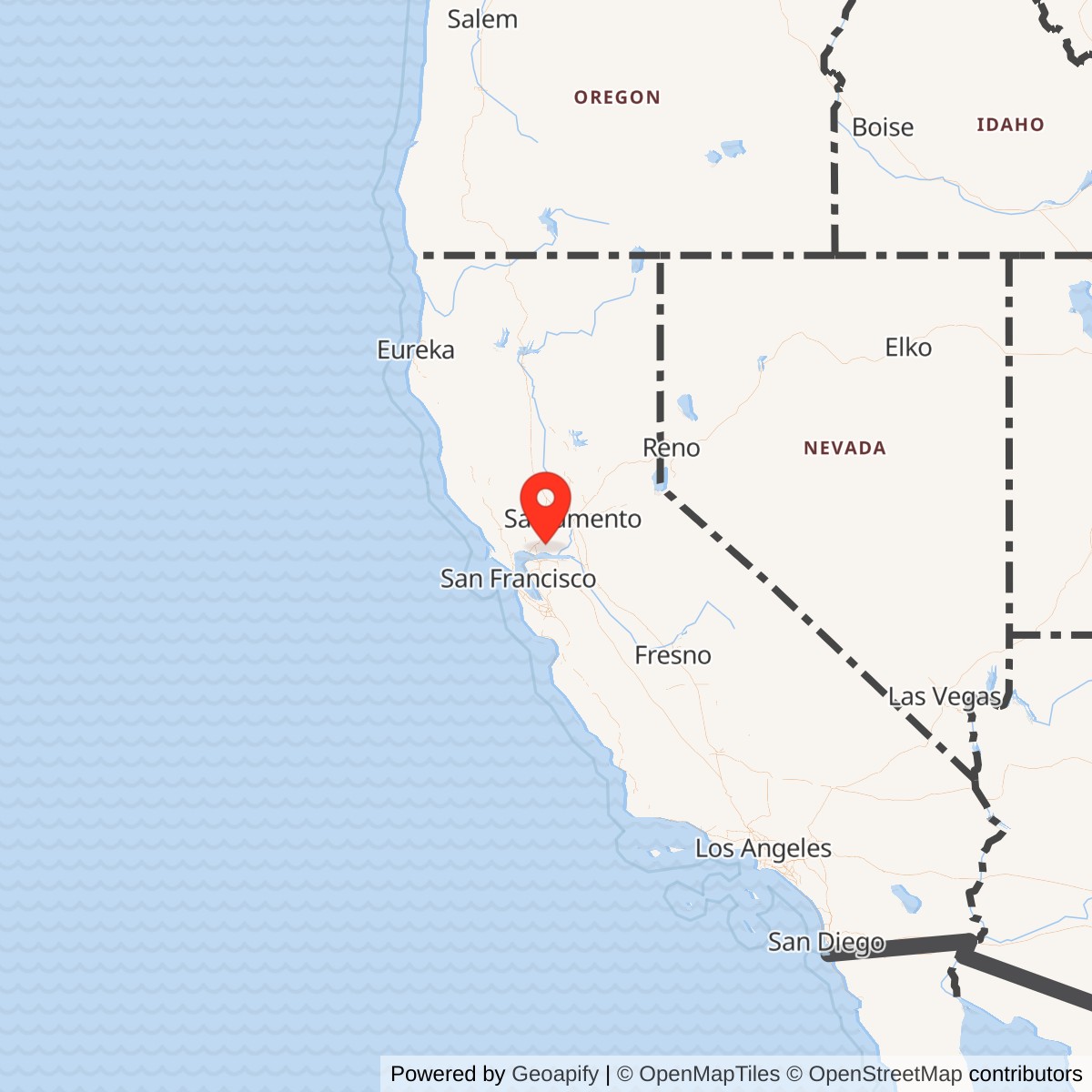
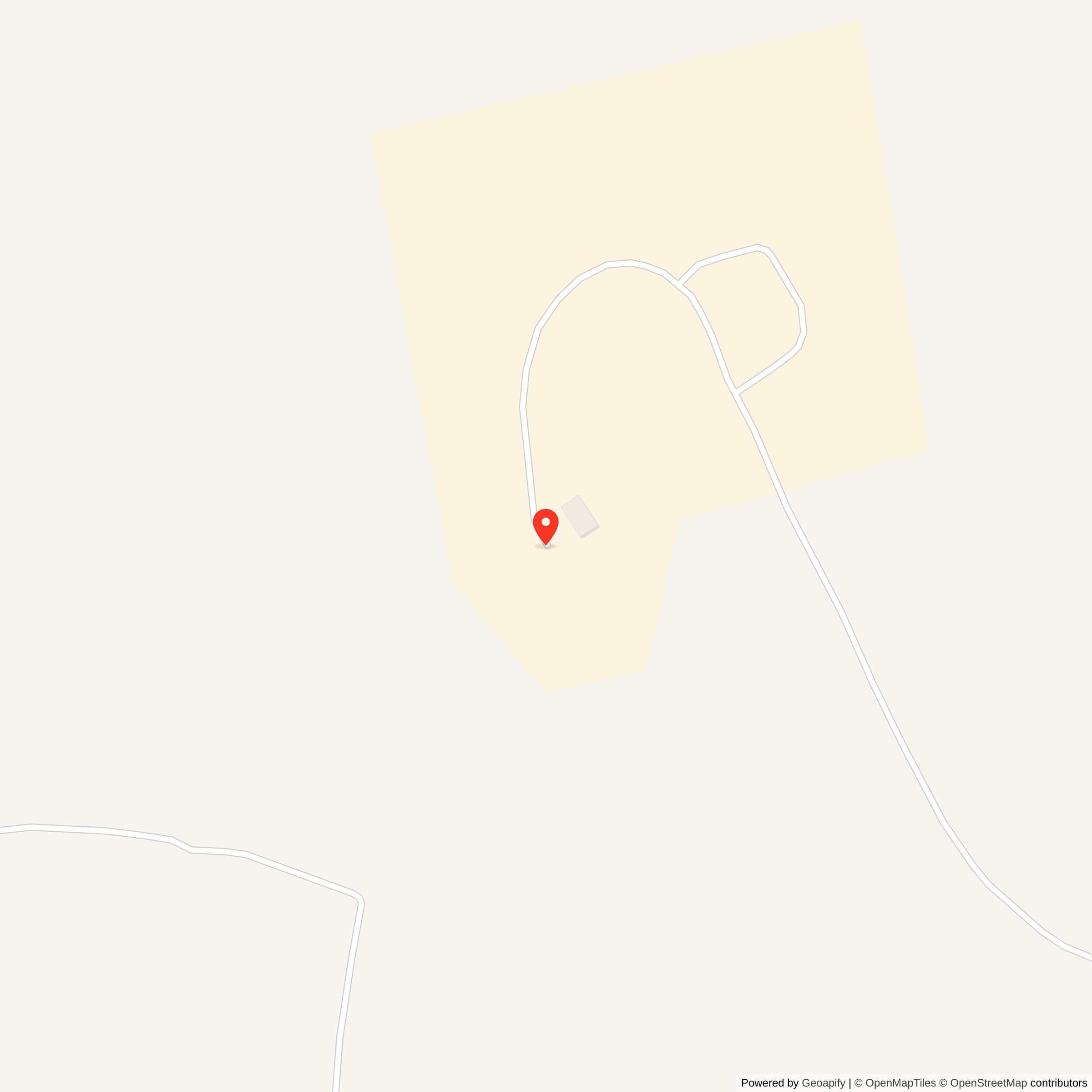
T-53 had the shortest documented service life in the Travis Air Force Base Nike ring and one of its longest physical afterlives. The Army operated the Potrero Hills battery during 1958 and into January 1959. Yet its permanent underground launcher plant survived, entered Air Force custody as the Potrero Hills Storage Annex, supported an energetic-device industry for decades, and remains listed in current federal real-property material. The nearby hilltop fire-control compound also left recognizable traces in specialist field surveys. A missile position that was obsolete almost as soon as it opened thus became a durable industrial and military landscape.
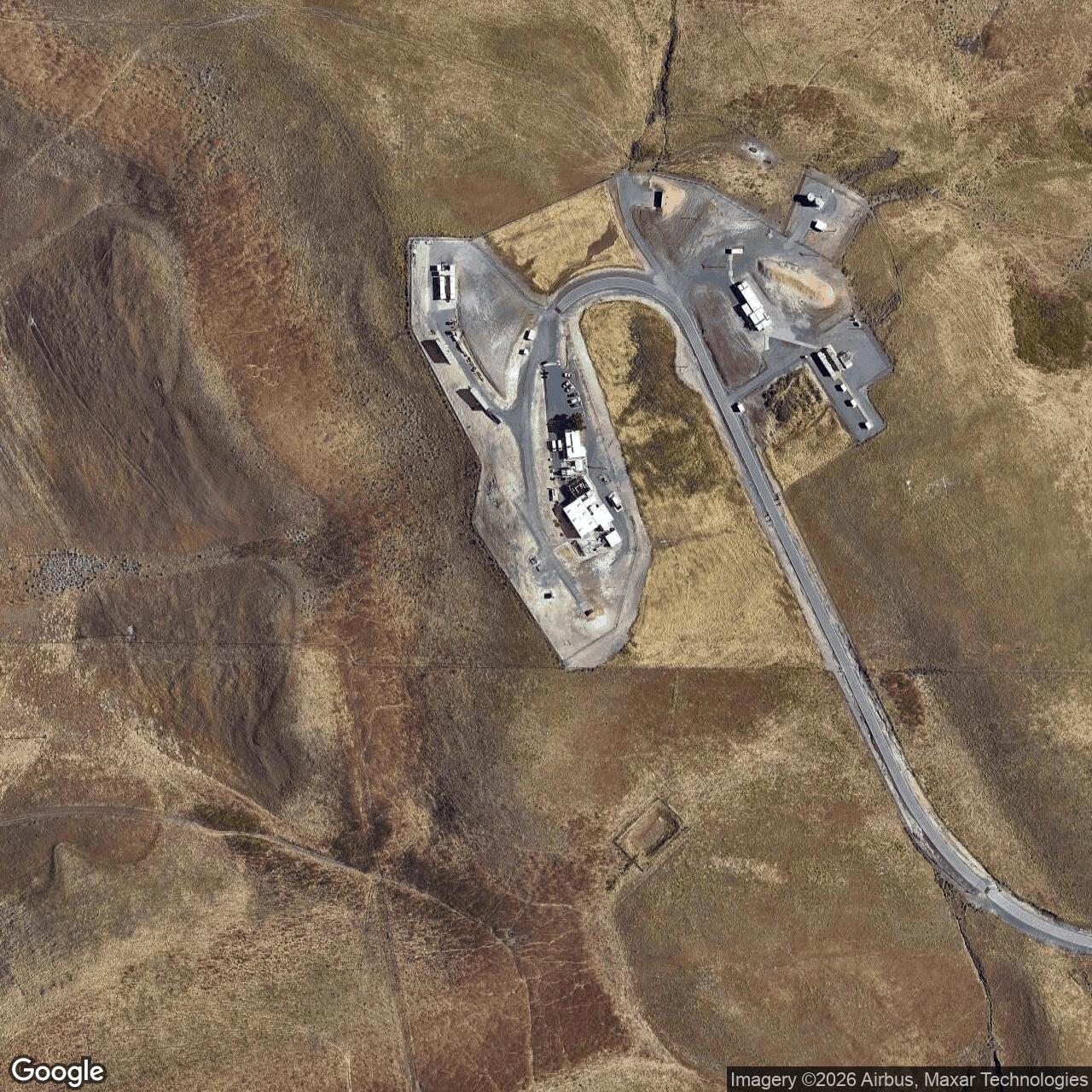
The location was distinctive within the four-site Travis defense. T-53 was the only battery whose Integrated Fire Control, or IFC, and launcher components occupied the same general Potrero Hills complex. The IFC stood above and west of the launcher, giving its radars the open horizon and line of sight needed to control missiles fired from the lower compound. Its launcher had three underground magazines, thirty Ajax missiles in the recorded allowance, and twelve launchers. This was a permanent Ajax installation, unlike T-33's temporary above-ground position, but it was never converted for Nike Hercules.
T-53's later history is also unusually easy to misunderstand. The industrial firms that followed the Army made aircraft escape-system devices, airbag initiators, and other propellant-actuated products. Explosions and injuries reported there in the 1990s were industrial accidents many years after Nike operations ended. Environmental investigations likewise addressed a mixture of former military support features and later manufacturing and testing. Those events belong in the history of the place, but they are not evidence of a Nike missile accident or accidental launch.
Why Travis needed T-53
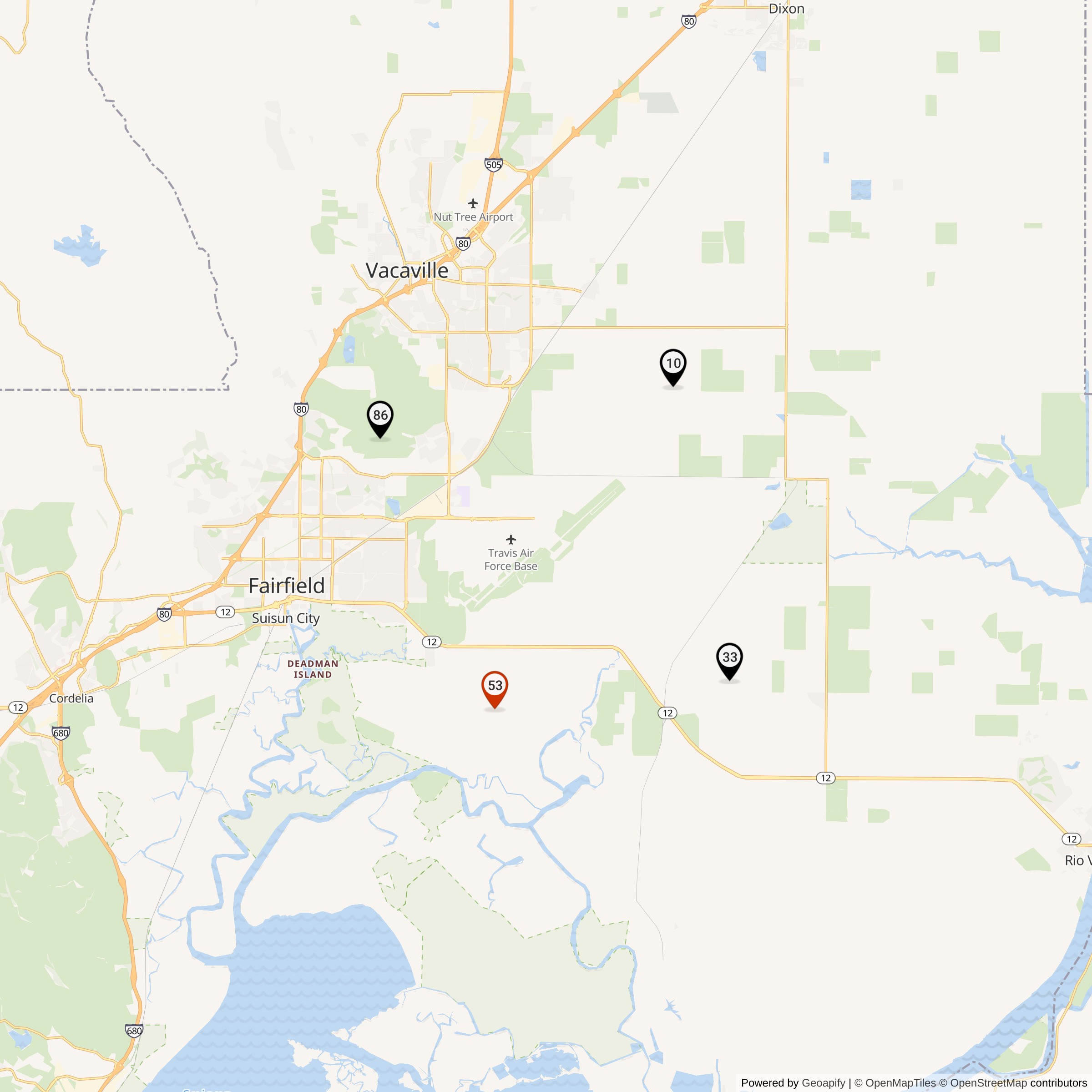
Strategic Air Command assumed control of Travis in 1949. During the 1950s, the base supported B-29, B-36, and B-52 bomber operations as well as the crews, fuel, maintenance, communications, and other infrastructure required for a strategic air mission. That concentration of military capability made Travis an important potential target. The Army placed four Regular Army Nike batteries around it: T-10 near Elmira, T-33 near Dixon and Lambie, T-53 in the Potrero Hills, and T-86 at Fairfield and Cement Hills. The defense headquarters was at Travis.Nike was the last local layer of defense against hostile bombers that penetrated warning and interception systems. The individual batteries were parts of an overlapping ring, not isolated protectors of a single runway or building. Their acquisition and tracking radars, command posts, launcher crews, and communications links provided engagement coverage across different approaches to the defended area. T-53's position south-southwest of the air base covered a sector beyond the lowlands around Suisun Bay while using the Potrero Hills for radar elevation and separation from the launch plant.
The base mission was changing while T-53 stood alert. Military Air Transport Service resumed command of Travis on 1 July 1958, while Strategic Air Command's 5th Bombardment Wing remained as a tenant. The first C-133 Cargomaster arrived in October. T-53 therefore guarded Travis during a brief overlap between its strategic-bomber role and its expanding heavy-airlift mission. The battery closed before global mobility became the base's dominant public identity, but the personnel and facilities it protected supported both missions during 1958.
Location and compact two-component layout
T-53 occupied the Potrero Hills south-southwest of Travis, near Fairfield and Suisun City. Contemporary and later records also associate the property with Explosive Technology Road, a name derived from its industrial reuse. The supplied geographic inventory identifies separate IFC and launcher components. Exact coordinates are intentionally omitted from this public history because the launcher property remains in the federal inventory and the control-area property relationship and present operator have not been conclusively established.The two components were closer together than at the other Travis batteries. A 2002 specialist field report called T-53 the only Travis site with both sections in the same general area. The IFC occupied the crest of a hill west of the launcher. Its elevation gave the acquisition and tracking radars a broad view and allowed the missile-tracking radar to acquire a missile shortly after launch. The lower launcher compound provided more room for magazines, elevators, launch rails, maintenance, security, and surface circulation.
Closeness did not eliminate the functional separation. At the IFC, operators acquired and identified targets, tracked the selected aircraft and outbound missile, calculated an intercept, and transmitted steering commands. At the launcher, crews stored, tested, fueled, raised, and prepared Ajax missiles. Communications joined the two compounds into one weapon system. The hilltop and lower plant therefore should be read together even though their ownership and preservation histories later diverged.
The reviewed source set does not include the original tract maps, construction drawings, easements, or a boundary survey. It is consequently unsafe to equate every later industrial building or every part of the surrounding acreage with the former Army battery. Official restoration documents distinguish a roughly 25-acre Air Force annex from a much larger adjacent industrial property. The launch plant is the component most clearly associated with the annex. The precise relationship between former IFC parcels, industrial parcels, and current ownership requires deed and survey research.
A permanent Ajax Launcher Plant
The official inventory records T-53 as "Nike 1B,2C/30A/12L-A." Its elements decode as follows:1B,2C: One B-type and two C-type underground missile magazines. The letter distinctions refer to magazine designs within the Nike construction program, not to different missile models.
30A: Thirty Nike Ajax missiles in the recorded battery allowance.
12L-A: Twelve Ajax launchers. The suffix identifies an Ajax-only launcher arrangement rather than a later universal installation adapted to Hercules.
These were not vertical missile silos. Ajax missiles were stored horizontally in reinforced underground magazines. Elevators raised them to the surface, where crews moved them along rails or paved handling areas to exposed launchers. Each magazine group required electrical and hydraulic equipment, blast-resistant access, drainage, ventilation, and nearby support space. A 1988 field visit reported operating elevators, an important snapshot of the plant's survival three decades after the Army left. A 2002 visit found one magazine elevator still covered by a building and the other two inoperative.
T-53's permanent construction makes its early closure notable. The Army invested in three magazines and a full twelve-launcher surface plant, then used the battery for no more than about a year. Unlike the above-ground T-33, T-53 was physically substantial enough to be reused. Its elevators and protected below-grade space offered industrial value after the missiles were gone, helping explain why the launcher component survived when temporary or agricultural sites disappeared.
The configuration was Ajax only. T-53 never received Nike Hercules and had no Nike nuclear capability. Ajax carried conventional high explosive. The presence of underground magazines, an explosive-manufacturing business, or later Air Force storage does not make the site a former nuclear missile installation. The reviewed records also do not establish that nuclear weapons were ever stored at the post-Nike annex.
How the Ajax system worked
Nike Ajax was a radar-directed, command-guided antiaircraft missile. At the IFC, an acquisition radar searched for targets and identification equipment helped operators distinguish friendly aircraft. After assignment, the target-tracking radar followed the aircraft precisely. A separate missile-tracking radar followed the outbound Ajax through its onboard transponder. The battery computer compared the two tracks, calculated an intercept, and sent steering commands by radio. At the calculated point, the system commanded the missile's conventional fragmentation warheads to detonate.This process depended on trained crews and a continuous chain of functioning equipment. Radar operators had to establish and hold tracks. Computer, plotting, and communications personnel monitored the engagement. Generator and electronics specialists kept the control system stable and calibrated. Launcher soldiers inspected missiles, handled liquid fuel and other hazardous materials, operated elevators and rails, and maintained the missiles in a ready condition. Guards, mechanics, supply staff, cooks, and administrators sustained the two compounds.
Ajax used a solid-propellant booster and a liquid-fueled sustainer. Liquid fuel increased the maintenance and handling burden, particularly compared with the all-solid Hercules. The official technical history explains the general system, but no T-53 duty log, maintenance journal, inspection score, or fueling plan was located. General Ajax procedures should not be converted into a claim about the exact daily sequence or an individual structure at Potrero Hills without site drawings or unit records.
Units, command, and daily readiness
Specialist unit research identifies Battery B, 436th Antiaircraft Artillery Missile Battalion as T-53's first firing unit in 1958. In September, Battery B, 1st Missile Battalion, 61st Artillery relieved it and operated the position until the January 1959 closure. This succession parallels the Army's wider 1958 reorganization and redesignation of Nike units. The reviewed sources do not establish T-53's exact operational opening day, the handover day in September, or a verified roster of battery commanders.Short service did not mean relaxed readiness. While assigned to the defense, T-53 had to function as an operational weapon at any hour required by the alert network. IFC and launcher crews practiced the sequence from acquisition and identification through tracking, calculation, missile preparation, simulated launch, guidance, and detonation. Security personnel controlled a restricted installation containing missiles, fuel, explosives, and sensitive electronics. Evaluations tested the whole battery, because a failure at either component or in the communications path could break an engagement.
No T-53-specific Nike-era accidental launch, missile explosion, fatality, organized protest, or emergency was found in the focused review. This is a statement about the reviewed evidence, not proof that no reportable event ever occurred. Later industrial accidents at the property are documented and are treated separately below. They should not be folded backward into the battery's 1958 to 1959 operating record.
Closure and the Hercules shift
T-53 closed in January 1959, along with T-33. T-10 and T-86 remained and were converted for Nike Hercules. Hercules offered greater range, altitude, payload, and coverage than Ajax. Official Army history explains that this broader reach allowed fewer Hercules batteries to cover missions that had required a denser Ajax deployment. At Travis, two Hercules-capable sites replaced the four-position Ajax-era ring.The timing strongly supports a planned concentration on T-10 and T-86. T-53's closure was not the result of physical inadequacy in the ordinary sense, since its substantial underground plant survived. More likely, its geometry and the coverage available from the two selected Hercules locations made an expensive conversion unnecessary. That is an evidence-based inference, not a documented reason quoted from a T-53 deactivation order. No site-selection report, closure memorandum, or conversion-cost comparison was found.
The official inventory gives January 1959 as the end of missile service. Later Air Force documents sometimes describe the former battery as decommissioned in 1964. Those dates refer to different stages. January 1959 is the operational close date for the Nike battery. The 1964 date corresponds to the end of residual Army custody and transfer of the launcher property to the Air Force, not four additional years of missile alert.
Transfer to the Air Force
The former launch property transferred from the Army to the Air Force on 31 July 1964. It became the Potrero Hills Storage Annex, facility number 9380 and installation code TQYP, under Travis Air Force Base jurisdiction, control, and accountability. Official restoration minutes state that Travis used the annex for small-arms and medical storage. The available records do not define the exact duration of that use or identify every building and magazine involved.The transfer preserved the launcher plant inside a continuing federal property framework. It also created the administrative history that persists today. The Department of Defense Fiscal Year 2025 Base Structure Report lists Potrero Hills Storage Annex Site 1 in Suisun as an active Air Force site. A 2026 Air Force Civil Engineer Center land-management notice likewise lists Travis: Potrero Hills Storage Annex under Air Mobility Command. These records establish current real-property status, not a staffed installation, an uninterrupted storage mission, or public access.
The IFC's post-Army title is less clear. Specialist field reports describe the radar compound at the top of the hill and place both battery sections within the broader industrial setting. Official environmental records, however, distinguish the 25-acre Air Force annex from the surrounding approximately 500-acre property. Without current parcel records and a professional survey, the former IFC is best described as partly surviving within the former private industrial complex, with its current operator and access status unverified.
Explosives Technology, OEA, and Goodrich
Industrial reuse began quickly. A 1965 federal housing-market report said Explosives Technology was completing a new Potrero Hills plant, initially expected to employ about fifty workers and later more than one hundred. Official Air Force restoration minutes state that the annex itself was leased to Explosive Technology in 1967. The apparent sequence is that the firm first developed its own surrounding property, then leased the adjacent federal annex. The records are compatible once the two property interests are distinguished.Explosive Technology manufactured energetic devices used in aircraft escape and separation systems. The enterprise later operated as OEA Aerospace and also produced airbag initiators. Official records describe activities including design, assembly, manufacture, and testing of explosive or propellant-actuated components. Underground Nike magazines and a remote, already secured industrial landscape were adaptable to work that required separation, controlled storage, and blast protection.
A specialist tour on 22 December 1988 found the former launcher remarkably intact. The two former Army administrative buildings were part of the main industrial complex, control-area buildings remained on the hill, and the launcher elevators reportedly operated. That observation is dated evidence, not a current condition survey. It nevertheless shows how industrial reuse retained key Nike fabric that might otherwise have been demolished or filled.
By 2000, OEA Aerospace's Fairfield operation employed about 250 people and generated roughly $35 million in annual sales. On 30 November 2000, Autoliv announced an agreement to sell substantially all of OEA Aerospace's assets to BFGoodrich. A March 2002 field visit saw a Goodrich Aerospace sign at the gate. The visitor found intact entrance-area buildings, remnants of buildings and pads at the hilltop IFC, one magazine with a structure above its elevator, and two other elevators inoperative.
Goodrich ended its Air Force lease in January 2005. Official environmental material nevertheless continued to treat the annex and surrounding former industrial property as a connected investigation area. Corporate succession, leasehold rights, federal ownership, and surrounding private acreage should not be collapsed into a single chain of ownership. The secure conclusion is that the Air Force retained the annex while successive private firms used the federal lease and adjacent land for energetic-device production.
Post-Nike industrial accidents
The later manufacturing mission carried hazards unrelated to Nike alert operations. A December 1995 blast reportedly injured a worker's eye. On 15 February 1996, an explosion at the OEA plant injured three workers. Contemporary reporting said one employee suffered severe hand injuries, including the loss of fingers, while two others had minor injuries. The cause was still under investigation when the report was published.A separate Occupational Safety and Health Administration accident inspection opened on 17 June 1996 for OEA Aerospace at the Explosive Technology Road address. The associated record describes a 13 June device detonation that injured an employee's hand during final assembly, along with a later drill and glove injury. These records document industrial occupational accidents at the post-Nike plant. They do not document an Ajax missile accident, an accidental Nike firing, or a Nike warhead event.
A July 1977 plant explosion is indexed in newspaper archives, but the accessible record was too incomplete to support casualty, cause, or facility details. fully.
Environmental Investigation and Cleanup
Environmental records require the same separation between military and industrial causes. A 1998 Air Force proposed plan described the roughly 25-acre annex as part of the former Nike Ajax battery and said the military had used it in the late 1950s to store, maintain, and operate missiles. The plan identified 1.3 parts per million of polychlorinated biphenyls near a former generator building as the only contamination associated with military activities in that investigation. It attributed metals in surface soil to later industrial production and testing.Two underground petroleum storage tanks were removed from the annex in 1991. In 2000, official restoration minutes recorded that the California Regional Water Quality Control Board had reviewed the data and agreed that no further action was required for those two tank sites. A 2006 community-involvement plan described those petroleum-only sites as closed in March 2000.
The remaining environmental work was more complex because the Air Force annex and surrounding industrial property had intertwined use histories and different ownership. The Water Board issued a Site Cleanup Requirements Order on 22 September 1999. The 2006 plan said three remaining sites would be addressed in a record of decision after that order was rescinded. It also noted that Goodrich had relinquished the lease in January 2005.
Air Force restoration meeting records still carried the Potrero Hills Annex feasibility study, proposed plan, and record of decision on the schedule in 2022. In January 2023, the Water Board representative agreed that the Potrero Hills item could be removed from the master meeting and document schedule. The reviewed minutes do not explain that removal as final cleanup, do not provide a final record of decision, and do not declare the entire property closed. It should be reported only as removal of a tracking item. A definitive current cleanup status remains a research gap.
Current condition and access
The launcher component is best characterized as partly intact within the Air Force's Potrero Hills Storage Annex. Three underground magazine footprints were documented historically, and field observers found elevators and surface features in 1988 and 2002. Those observations are now decades old. Current federal inventories confirm that the annex remains active Air Force real property, but they do not inventory individual Nike structures or establish their present mechanical condition.The former IFC is also best described as partly intact based on the 2002 report, which found building remnants and pads on the hill west of the launcher. No current professional architectural survey was located, and the present owner or operator could not be verified from the reviewed sources. Public mapping and the supplied geographic file can establish the general relationship of the two components, but not safe or lawful access.
Neither component should be treated as an abandoned public attraction. The launcher is associated with an active Air Force annex, and the surrounding land has a history of private industrial use and environmental regulation. Entry requires explicit authorization from the responsible owner or agency. Residual industrial hazards, underground structures, restricted operations, and uncertain parcel boundaries make casual exploration inappropriate.
List of all Nike Installations in the Travis AFB Defense Area
List of all Nike Installations in California
Chronology
- 1 May 1949 Strategic Air Command assumed control of Travis Air Force Base, beginning the bomber era that made the installation an important air-defense objective.
- 1958 T-53 entered service in the Potrero Hills as a permanent Nike Ajax battery in the Travis Defense Area.
- 1958 Battery B, 436th Antiaircraft Artillery Missile Battalion initially operated T-53.
- 1 July 1958 Military Air Transport Service resumed command of Travis while Strategic Air Command's 5th Bombardment Wing remained as a tenant.
- September 1958 Battery B, 1st Missile Battalion, 61st Artillery replaced Battery B, 436th Antiaircraft Artillery Missile Battalion at T-53.
- October 1958 The first C-133 Cargomaster arrived at Travis, expanding the heavy-airlift mission protected during T-53's final months.
- January 1959 T-53 and T-33 closed, leaving the Hercules-capable T-10 and T-86 positions in the Travis ring.
- 12 June 1959 T-10 was recorded operational with Nike Hercules, confirming the defense area's shift to longer-ranged batteries.
- 31 July 1964 The former T-53 launch property transferred from the Army to the Air Force and became the Potrero Hills Storage Annex under Travis jurisdiction.
- Mid-1965 A federal market report described Explosives Technology as completing a new plant in the Potrero Hills, initially planned for about fifty workers.
- 1967 The Air Force leased the Potrero Hills Storage Annex to Explosive Technology for energetic-device work.
- 22 December 1988 A specialist tour found the industrial complex active, control-area buildings present, and the former launcher elevators operating.
- 1991 Two underground petroleum storage tanks were removed from the annex for environmental investigation.
- December 1995 A post-Nike industrial blast at OEA reportedly injured a worker's eye.
- 15 February 1996 An explosion at the OEA plant injured three workers, including one who suffered severe hand injuries.
- 13 June 1996 A separate device detonation during final assembly injured an OEA employee's hand and led to an OSHA accident inspection.
- July 1998 The Air Force issued a proposed environmental plan distinguishing limited former military contamination from metals associated with later industrial production and testing.
- 22 September 1999 The Water Board issued a Site Cleanup Requirements Order covering the annex and surrounding industrial investigation area.
- March 2000 The two petroleum-only storage-tank sites were recorded as closed with no further action required.
- 30 November 2000 Autoliv announced an agreement to sell substantially all OEA Aerospace assets, including the Fairfield operation, to BFGoodrich.
- March 2002 A specialist field visit found intact entrance buildings, hilltop IFC remnants, one covered magazine elevator, and two inoperative elevators.
- January 2005 Goodrich relinquished its lease of the Air Force annex.
- 2022 Air Force restoration schedules still listed a feasibility study, proposed plan, and record of decision for the Potrero Hills Annex.
- January 2023 The Water Board representative agreed to remove the Potrero Hills item from the master restoration meeting and document schedule, without the reviewed minutes declaring final cleanup.
- Fiscal Year 2025 The Department of Defense Base Structure Report listed Potrero Hills Storage Annex Site 1 in Suisun as an active Air Force site.
- 2026 An Air Force Civil Engineer Center land-management notice listed Travis: Potrero Hills Storage Annex under Air Mobility Command.
Sources & References
- PDF Mark A. Berhow and Mark L. Morgan, To Defend and Deter: The Legacy of the United States Cold War Missile Program The Department of Defense history identifies the Travis defense, Regular Army sites, Hercules conversions, and T-53's configuration, dates, and recorded post-service condition.
- WEB Mark L. Morgan, 2002 Nike Site Field Trip Report The specialist field survey supplies the compact two-component layout, unit succession, magazine configuration, industrial succession, and observed condition in March 2002.
- WEB Mark L. Morgan, Travis Air Force Base Nike Sites Field Notes The 1988 field notes document the Explosives Technology tour, surviving control buildings, industrial reuse, and then-operating launcher elevators.
- PDF 60th Air Mobility Wing History Office, Travis Air Force Base Heritage Pamphlet The official base history supplies the strategic-bomber context, 1958 command change, and arrival of the C-133 during T-53's service.
- WEB U.S. Army Aviation and Missile Command History Office, Nike Ajax The official technical history explains Ajax radar acquisition and tracking, computer command guidance, propulsion, and conventional warhead system.
- WEB National Park Service, Nike Missile Site SF-88 The National Park Service overview explains Nike's last-line bomber-defense mission and the functional separation of fire-control and launcher components.
- PDF U.S. Department of Housing and Urban Development, Analysis of the Eastern Solano County, California Housing Market as of July 1, 1965 The federal market report documents construction, initial employment, and projected growth of the Explosives Technology plant in the Potrero Hills.
- WEB Travis Air Force Base, Environmental Restoration Advisory Board Meeting Minutes, 19 October 2000 The official minutes describe the annex transfer, Air Force storage, 1967 lease, and later energetic-device and airbag-initiator manufacturing.
- WEB Air Force Bases, Nike Facilities at Travis Air Force Base The specialist installation reference records the 31 July 1964 transfer, Potrero Hills Storage Annex designation, facility number, and Air Force accountability.
- WEB Travis Air Force Base, Proposed Plan for the Potrero Hills Annex, July 1998 The official plan distinguishes the annex's former Nike use and limited military-associated PCB finding from metals linked to later industrial production and testing.
- WEB Travis Air Force Base, Environmental Restoration Advisory Board Meeting Minutes, 20 July 2000 The official minutes record the 1991 removal of two underground storage tanks and the Water Board's no-further-action position for those sites.
- WEB Travis Air Force Base, Community Involvement Plan, 2006 The official plan records the 25-acre annex, surrounding industrial property, Goodrich lease termination, Water Board order, and status of environmental sites.
- PDF Travis Air Force Base, Restoration Program Manager Meeting Minutes, April 2022 The official minutes show the Potrero Hills feasibility study, proposed plan, and record of decision continuing on the restoration schedule in 2022.
- PDF Travis Air Force Base, Restoration Program Manager Meeting Minutes, January 2023 The official minutes document agreement to remove the Potrero Hills item from the master schedule without stating that a final record of decision or full closeout had occurred.
- WEB U.S. Department of Defense, Fiscal Year 2025 Base Structure Report The official real-property report lists Potrero Hills Storage Annex Site 1 in Suisun as an active Air Force site.
- PDF Air Force Civil Engineer Center, Request for Statements of Interest for Land Management Support, 2026 The current federal notice lists Travis: Potrero Hills Storage Annex under Air Mobility Command, corroborating continued Air Force real-property status.
- WEB Autoliv, Autoliv Sells OEA Aerospace, 30 November 2000 The company release documents the planned BFGoodrich acquisition, Fairfield workforce and sales, and OEA Aerospace propellant-actuated product line.
- WEB San Francisco Chronicle, Three Hurt in Blast at Fairfield Aerospace Plant, 16 February 1996 The contemporary report documents the February 1996 OEA explosion and distinguishes its post-Nike industrial setting and injuries.
- WEB Occupational Safety and Health Administration, OEA Aerospace Inspection 125766402 The federal inspection record documents the June 1996 accident inspection and associated industrial device-detonation injury.