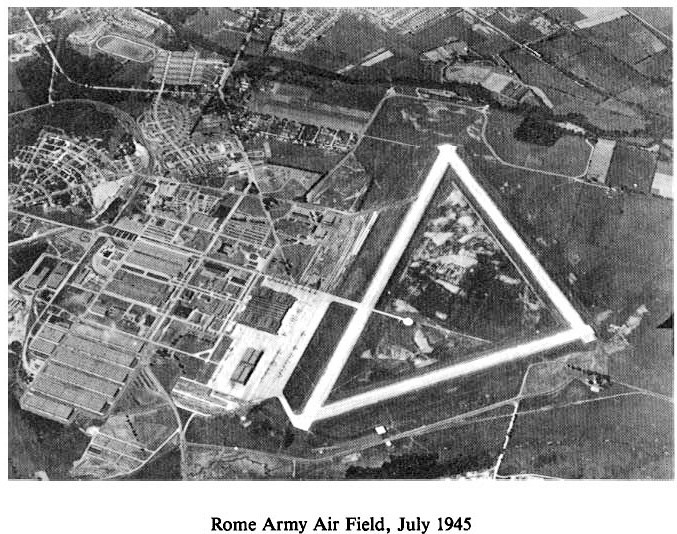
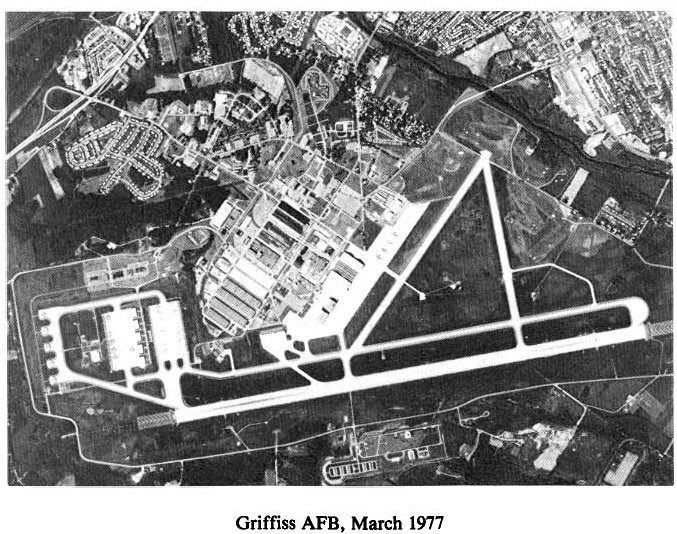
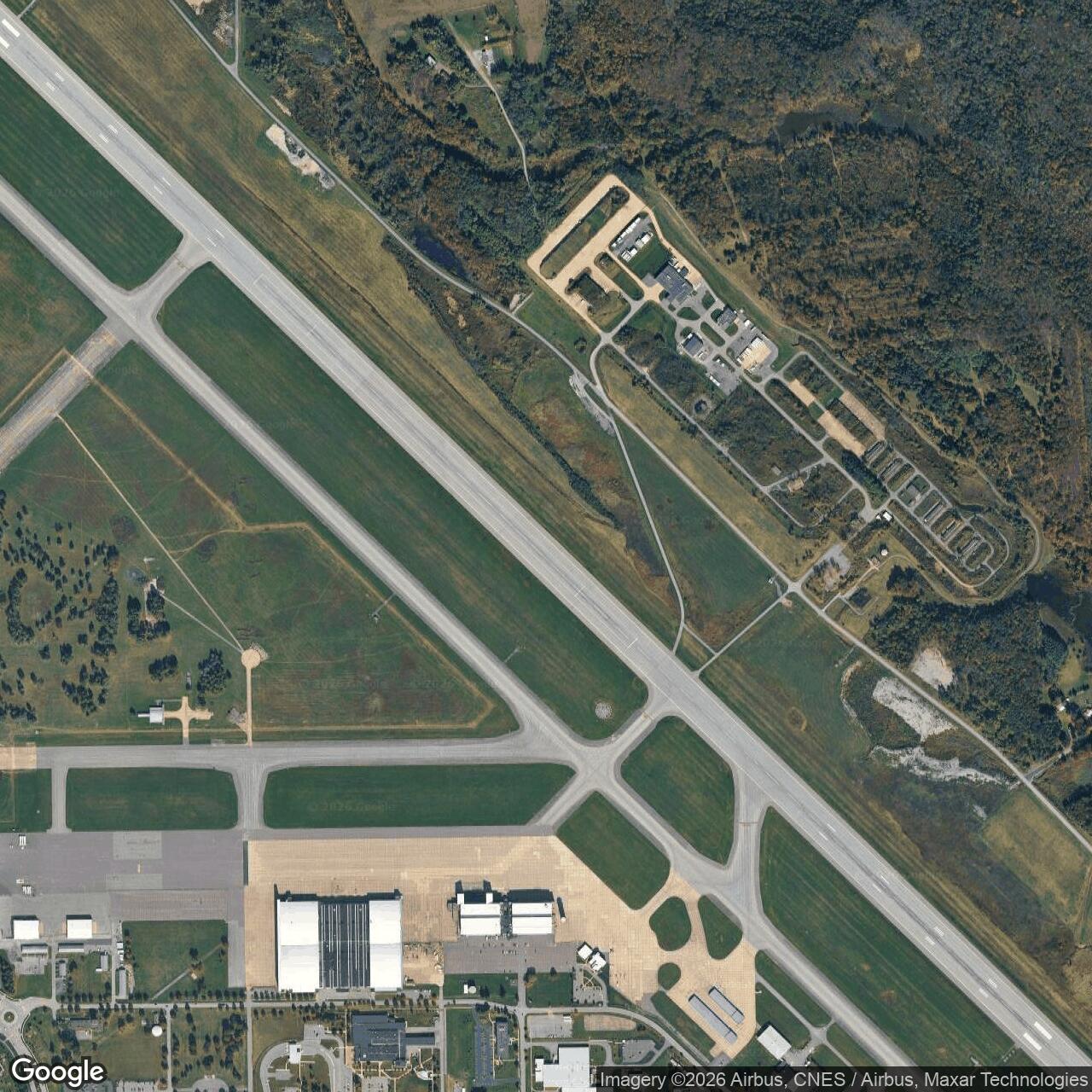
Griffiss Air Force Base, New York
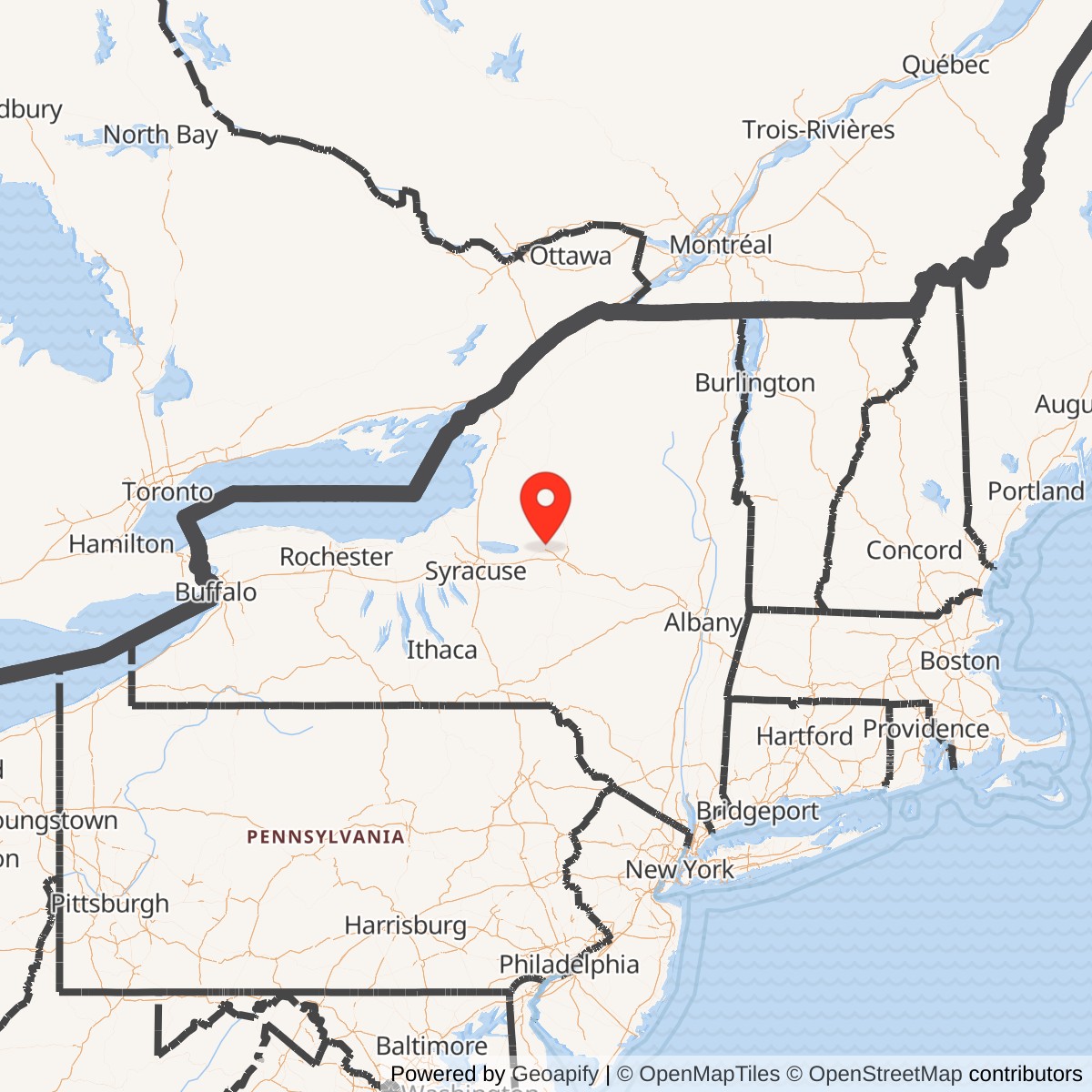
Longitude: -75.4064
Origin of current name: Named in honor of Lt Col Townsend E. Griffiss (1900-1942). Colonel Griffiss died during World War II on a flight to England from the Soviet Union. While returning from an evaluation of ferrying routes for lend lease aircraft on February 15th 1942, RAF pilots mistook him for an enemy and shot his aircraft down southwest of Plymouth.
Date current name was assigned to base: January 29, 1948
Previous Names: Rome Air Depot, February 5th 1942; Air Depot, Rome Army Air Base, October 13th 1942; Rome Army Air Field, November 4th 1942; Rome Air Depot Control Area, December 20th 1942; Rome Air Depot Control Area Command, February 1st 1943; Rome Air Service Command, May 17th 1943; Rome Air Depot, September 4th 1944; Rome Air Technical Service Command, November 14th 1944; Rome Air Materiel Area, July 11th 1946; Rome Army Air Field, July 14th 1946; Rome Air Force Base, January 23rd 1948.
Changes in Capability: Facilities for Rome Air Depot (later, Rome Control Depot; Rome Air Service Command; Rome Air Technical Service Command; Rome Air Materiel Area) completed in February 1942; flying operation on the depot airfield began February 18th 1942; throughout World War II the depot probided aircraft engine maintenance and repair, and trained air depot groups in engine repair; activities sharply curtailed in fall 1945; electronic research activities began 1949; Watson Laboratory complex transferred from Red Bank, NJ, (piecemeal) 1950-1951; Rome Air Development Center established June 12th 1951; runway and other concrete surfaces extended and upgraded September 1952; new intelligence and reconnaissance laboratory building occupied May 27th 1954; 2 1/4 mile runway opened July 23rd 1958; facilities completed for KC-135s (arrived April 17th 1959) and B-52s (arrived January 12th 1960); Rome Air Development Center established AFLC Communications-Electronics Field Office to monitor missile tests August 1962; Rome Air Materiel Area phased out, functions transferred to other Air Materiel Areas and to AFLC 1965; composite medical facility completed June 12th 1974; electronic research facility completed early 1976; weapons system security alert area completed March 1979; control tower completed June 1980; ALCM support facility and NORAD Regional Operational Control Center completed November 1981.
History:
Griffiss Air Force Base (Griffiss) is a 3,900 acre former Air Combat Command (ACC) installation approximately two miles northeast of the City of Rome, Oneida County, New York. The base was opened on February 1, 1942 as the Rome Air Depot. During World War II, the Rome Air Depot served as a staging area for aircraft bound for the European theater of operations, and several research functions were begun at the base during this time. Following World War II the depot mission ceased, however the research functions continued and were expanded. During the 1950s, the Strategic Air Command (SAC) became the host command and stationed long range bombers and refueling aircraft at Griffiss. Many tenant units have been located at Griffiss since the 1950s. Until September 30, 1995, the host unit at the base was the 416th Bombardment Wing, responsible for providing long range combat air power on a global scale. Current tenant units include the 485th Engineering Installation Group (responsible for providing communications systems installation worldwide), the Northeast Air Defense Sector (responsible for continental air defense in the northeastern United States), and the Rome Laboratory (an Air Force research and development organization). Until September 1994, the 509th Air Refueling Squadron was located at Griffiss and its tankers were tasked with air refueling operations worldwide.
Initial construction at Griffiss AFB began just before the United States' entry into World War II, when the current site was chosen as the home for the Rome Army Air Depot. News stories and local historical documents recount that the Rome site was chosen over several other possible sites in the northeast, due in part to the donation of 1800 acres of land by the Oneida County Board of Supervisors, and the offer of up to a million gallons of water per day - without charge - from the City of Rome, as well as availability of sewage treatment facilities. Still recovering from the Depression of the 1930s, and troubled by stagnation in its mainstay industry, the production of copper and brass, Rome and Oneida County enthusiastically welcomed the presence of the military installation as a source of employment.
Additional land was acquired in 1941-1942 and flying operations on the depot airfield began on February 18, 1942. During World War II Rome Air Depot was an extremely active installation; its mission was the repair, modification and maintenance of aircraft, and the storage and shipment of supplies. After creation of the U.S. Air Force in 1947, the depot was renamed Griffiss Air Force Base in January 1948 after Lieutenant Colonel Townsend E. Griffiss, the first American aviator (and a New York State resident) to be killed in action in the European Theater of Operations during World War II. Recently, the local community elected to carry on the Griffiss name by officially renaming the former base "Griffiss Business and Technology Park".
In 1950, the Air Force announced plans to establish an electronics research and development center at Griffiss, to be known as the Rome Air Development Center (RADC), and shortly thereafter, the 49th Fighter Interceptor Squadron was assigned to Griffiss. This marked the beginning of a period of growth and development at the base, and the second and last major phase of land acquisition. By the early-1960's 12,000 people were employed in military and civilian positions at GAFB. The base was sometimes referred to locally as "the city within a city", providing housing, full-scale recreation facilities, a chapel, shopping, and medical services for its military personnel. New construction and remodeling or demolition of outdated buildings and facilities occurred continuously until 1993, when the base was slated for realignment. Although employment levels varied somewhat over the years, at the time of the BRAC decision in 1993, there were still more than 8,000 active civilian and military employees at Griffiss.
National Defense
In 1950, the 49th Fighter Interceptor Squadron was added to Griffiss, and in 1958, crews of the 27th and 465th Fighter Interceptor Squadrons arrived. By 1959 the Strategic Air Command (SAC) activated the 4039th Bombardment Wing, replaced in 1963 by SAC's 416th Bombardment Wing which remained at Griffiss until the 1990s. There is long and detailed history to the presence of various Air Force defense operations at Griffiss, but generally it can be said that Griffiss' primary mission was the maintenance and implementation of both effective air refueling operations and long-range bombardment capability. To accomplish this mission, a variety of the most technologically advanced aircraft were based and maintained at Griffiss over the years. Large weapons storage areas were built to house the most modern weapons and munitions. The 416th was the first SAC wing to receive Air Launched Cruise Missiles.
The operational component of the Northeast Air Defense Sector (NEADS), which was responsible for monitoring the skies over 500,000 square miles of the northeast, became fully functional at Griffiss in 1983, and remains at Griffiss, having been transferred to the New York Air National Guard (NYANG) by BRAC.
The runways remained in use by the Air National Guard for the deployment of troops and equipment from the U.S. Army's 10th Mountain Division, located at Fort Drum, approximately 80 miles to the north. These runways were used for this purpose until adequate runways were constructed at Fort Drum.
In 1950, the U. S. Congress authorized the establishment of an Air Force Electronic Development Center at Griffiss AFB, and immediately thereafter, the operations of the Watson Laboratories (formerly the U.S. Army Signal Corps Radio Laboratory) were transferred to Griffiss from New Jersey. This was the core of what was to become the Air Force's center of expertise for research and development of command, control, communications, computers, intelligence and related technologies. In 1951, the Air Force officially established the Rome Air Development Center (RADC), which for the next 40 years was an Air Force center for research on a variety of projects, including the Ballistic Missile Defense Early Warning System (BMEWS), the Distant Early Warning (DEW) Line, the Semi-Automated Ground Environment (SAGE) system, and the Airborne Warning and Control System (AWACS). RADC scientists helped develop the technology that resulted in the first intercontinental voice transmission sent via satellite.
In 1990, the Air Force realigned 14 laboratories and research centers into four "super" laboratories. One of these became what is now known as Rome Laboratory, and remains at Griffiss, with approximately 1,100 military and civilian employees. Rome Lab is currently the Air Force's lead agency for research and development of photonics technology, and is considered the foundation upon which the newly formed Griffiss Business and Technology Park will be built into a private sector hub of high technology businesses dedicated to the development and provision of state-of-the-art technological goods and services.
In 1993, Griffiss AFB was on the list of bases slated for realignment and/or closure under BRAC. Approximately 136 acres has been retained by the DoD for use by the NY Air National Guard (NYANG), Northeast Air Defense Sector (now named Eastern Air Defense Sector (EADS)), Defense Finance & Accounting Services (DFAS) and Rome Labs.
As part of the 1990 Base Realignment and Closure (BRAC) Act, Griffiss was selected for realignment during the third round of the BRAC process in July 1993. The realignment of Griffiss became public law when the President and the Congress approved the third round of base closures and realignments in 1993. This process was completed September 30, 1995. The 416th Bombardment Wing was deactivated and Griffiss ceased functioning as an Air Force base. Several of the tenant organizations continue to function as "stand alone" entities, with the majority of the base property turned over to the Air Force Base Conversion Agency. This agency will assist local developmental authorities in turning over this base property to private organizations and businesses.