
Laredo Air Force Base, Laredo Texas

Longitude: -99.4616
Site Number: Laredo AAF; 3640th PTW; 38th FTW; FUDS K06TX0213; FFID TX69799F660300
Airport ICAO ID: KLRD
Current Role: City-owned Laredo International Airport; March 2025 official inventory gives approximately 1,796 acres and passenger, cargo and general-aviation uses. Other former-base parcels have separate recipients and redevelopment. FY2024 Corps main-base entry remains properties with projects; no whole-base cleanup certification or complete current title inventory verified.
Earlier name: Laredo Army Air Field
Location: Webb County, Texas
Historical roles: World War II bomber-gunner training and later Air Force jet-pilot training
Military inactivation: September 30, 1973
Principal successor: Laredo International Airport
Representative property coordinates: 27.54166667, -99.46805556 (decimal degrees). This Corps inventory point is a general locator, not an entrance, surveyed center or boundary. View the approximate former-property locator on Google Maps.
Identity and Location
Laredo Air Force Base was a major pilot-training installation at the airfield now operated as Laredo International Airport in Webb County, Texas. Its earlier Army identity, Laredo Army Air Field, belonged to the World War II flexible-gunnery training program. These were successive military uses of the same principal airfield, separated by a period of municipal ownership. They were not the same installation as Laredo Air Force Station, the separate tracking and missile-warning property northeast of the city, or the Laredo Gap Filler Annex associated with the regional aircraft-warning network.
The airport is approximately three miles northeast of central Laredo. The Corps of Engineers' FY2024 Formerly Used Defense Sites inventory identifies the former base as property K06TX0213, with federal facility identifier TX69799F660300. Its representative inventory locator is latitude 27.54166667, longitude -99.46805556, in decimal degrees. This point identifies the former property generally. It is not a surveyed base centroid, FAA airport reference point, historic building position, public entrance, or legal boundary.
The historical acquisition was approximately 2,085.43 acres. That figure describes the original federal airfield acquisition, not a verified constant acreage throughout every Army and Air Force operating year. Later disposals, a National Guard parcel, off-base auxiliary fields, training ranges, and the current airport have different geographic scopes. The modern airport inventory gives approximately 1,796 acres; its approximately 500-acre foreign-trade-zone area is included within that total, not an additional estate.
Establishment and World War II Construction
The airport's official historical summary dates federal acquisition to May 7, 1942. The Army developed the property for a flexible-gunnery school, one of the specialized establishments needed to supply defensive gunners for the expanding bomber force. Flexible gunnery meant firing guns that could be aimed through movable mounts or powered turrets, rather than fixed forward-firing weapons controlled by the aircraft's pilot. Laredo's original purpose was therefore distinct from the later jet-pilot mission for which the base became widely remembered.
AAF Historical Study No. 31 dates activation of the Laredo gunnery school to August 12, 1942. Land acquisition, school activation, arrival of students, and commencement of aerial instruction were separate events. The first aerial-gunnery class began November 30 and graduated during the first week of January 1943. The interval between activation and instruction reflects the work necessary to create a functioning school rather than merely designate a location on an organization chart.
The 1943 classbook describes a mesquite-covered site in July 1942. Colonel William Leroy Kennedy, executive officer Willard R. Ginder, and four enlisted men arrived August 12, initially using warehouse headquarters and contractor-provided furniture. Civilian employees went to Harlingen for preparatory training. Support personnel followed in September; enlisted strength grew from roughly 300 in mid-October to 700 by November. The book dates the students' arrival to November 28, two days before the historical study's first instructional class. By June 1943, it reported a student load exceeding twice the designed capacity.
The same contemporary record identifies the Second Flexible Gunnery Training Group and support organizations including the 415th Base Headquarters and Air Base Squadron, 1022nd Flexible Gunnery Training Squadron, 1023rd Aircraft Maintenance Squadron, and 388th Sub-Depot. It also records an Army nursing staff headed by Clare E. Stanton. This is a dated organizational snapshot, not a complete wartime roster or evidence that every unit retained the same designation throughout the war.
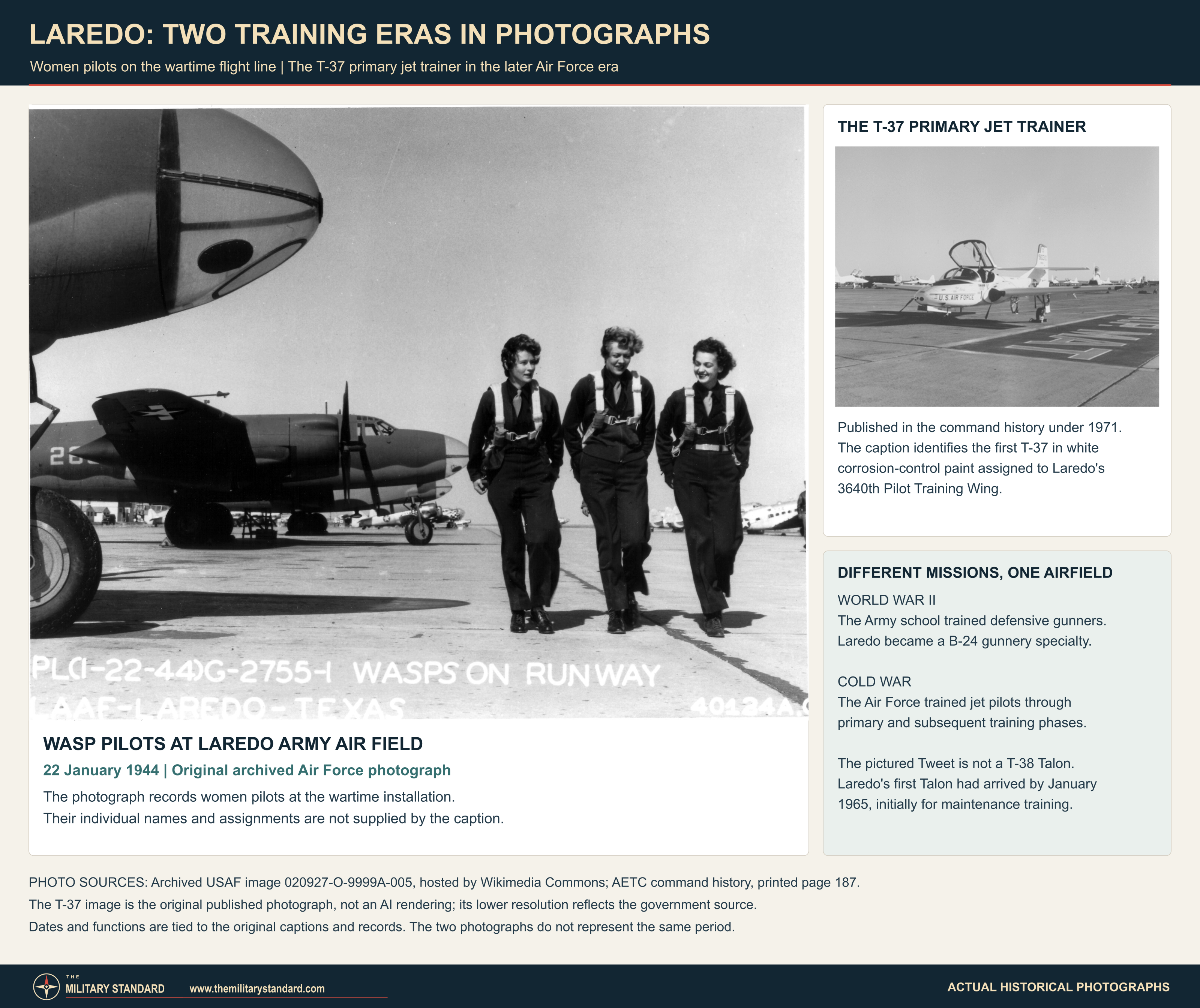
An archived Air Force photograph documents Women Airforce Service Pilots, or WASPs, on Laredo's flight line on January 22, 1944. The original image caption identifies both the installation and date. It provides direct evidence of women pilots at the wartime field, alongside the separate classbook evidence for nursing and support personnel. It does not identify these women as graduates of the gunnery school or supply their individual names and assignments.
Gunnery Training and the B-24 Program
Laredo's output became substantial quickly. The official gunnery study records 27,077 graduates between the school's activation and August 31, 1944. This is a cumulative figure through a stated cutoff, not an annual output, a final wartime total, or the number of people simultaneously stationed at the field. The school was part of a wider system in which graduates continued into operational or replacement training before joining combat crews.
Early in 1943, the Army adopted aircraft and turret specialization to reduce the burden of teaching every gunner numerous incompatible installations. Under the January 3 implementation directive, Laredo and another Texas school became B-24 specialties. The heavy-bomber schools supplied graduates to Second Air Force. Laredo consequently contributed directly to preparation of Consolidated B-24 Liberator crews, although the designation of a B-24 training specialty does not establish that every aircraft present on the airfield was a B-24.
The instructional problem was more complicated than learning to pull a trigger. The AAF study describes the system's requirements for gun identification, stripping and reassembly, ammunition handling, headspace adjustment, malfunction correction, turret operation, and recognition of the attacking aircraft's relative motion. These were service-wide standards within which Laredo operated; the reviewed record does not provide a complete local syllabus for each class. The increasing emphasis on the .50-caliber machine gun and powered turrets made maintenance knowledge and practical manipulation essential parts of defensive-gunner preparation.
Ground training and aerial practice served different purposes. Ground exercises could establish familiarity with weapons and moving targets, while air exercises introduced the complications of movement, visibility, coordination, and firing from an aircraft. The later Corps investigation of the on-base shotgun range independently confirms clay-target training at Laredo. That installation should not be confused with the much larger separately inventoried ground gunnery range, nor should a generic account of all AAF training methods be treated as a verified list of equipment installed at this particular field.
Laredo also became important in improving instruction. The central flexible-gunnery instructors school moved there in early May 1944; the gunnery officers school followed on May 29. These moves added national instructional and supervisory responsibilities to production of ordinary student gunners. The officers' course and the enlisted-instructor program were distinct activities. The arrival of both explains why the installation appears in discussions of training policy as well as lists of graduating aircrew members.
In June 1944, a Camera Training Committee met at the Laredo instructors school. Gun-camera exercises recorded simulated engagements so instructors could evaluate aiming and tracking rather than rely entirely on live-fire results. The committee's standardization proposals connected film assessment with the teaching of sights and firing methods. Laredo was thus involved in a shift toward more systematic evaluation of defensive-gunnery skill, not simply a high-volume school following an unchanged wartime curriculum.
The official study also records shortcomings. Fall 1943 phase checks exposed deficiencies among graduates of Laredo and other schools. Training authorities disputed how much responsibility rested with initial instruction and how much with long delays before subsequent checks. Their response emphasized practical phase checks, standardized instruction, and continuity between schools and operational training organizations. This evidence makes the wartime record more complete: a high graduate total did not mean that the program was free of equipment shortages, instructional weaknesses, or problems retaining skills between assignments.
Postwar Municipal Use and Korean War Reactivation
The drawdown after World War II ended the original Army school era. The Corps property inventory records the airfield as declared excess on June 17, 1947; the airport's summary describes deactivation and transfer to the City of Laredo in June 1947. These sources establish the transition to municipal control without supplying a complete deed-by-deed schedule for every tract or easement. The airport's earlier local aviation history includes an airport established in 1929 at a different location, which should not be used to backdate this military installation.
The Korean War expansion brought the federal government back to the existing airfield. The official airport summary dates a reactivation lease to December 28, 1951. The official Air Training Command history then records reopening of Laredo Air Force Base and organization of the 3640th Pilot Training Wing on April 1, 1952. The lease and military activation were different steps. In 1955, according to the airport's historical account, the city deeded the property back to the government.
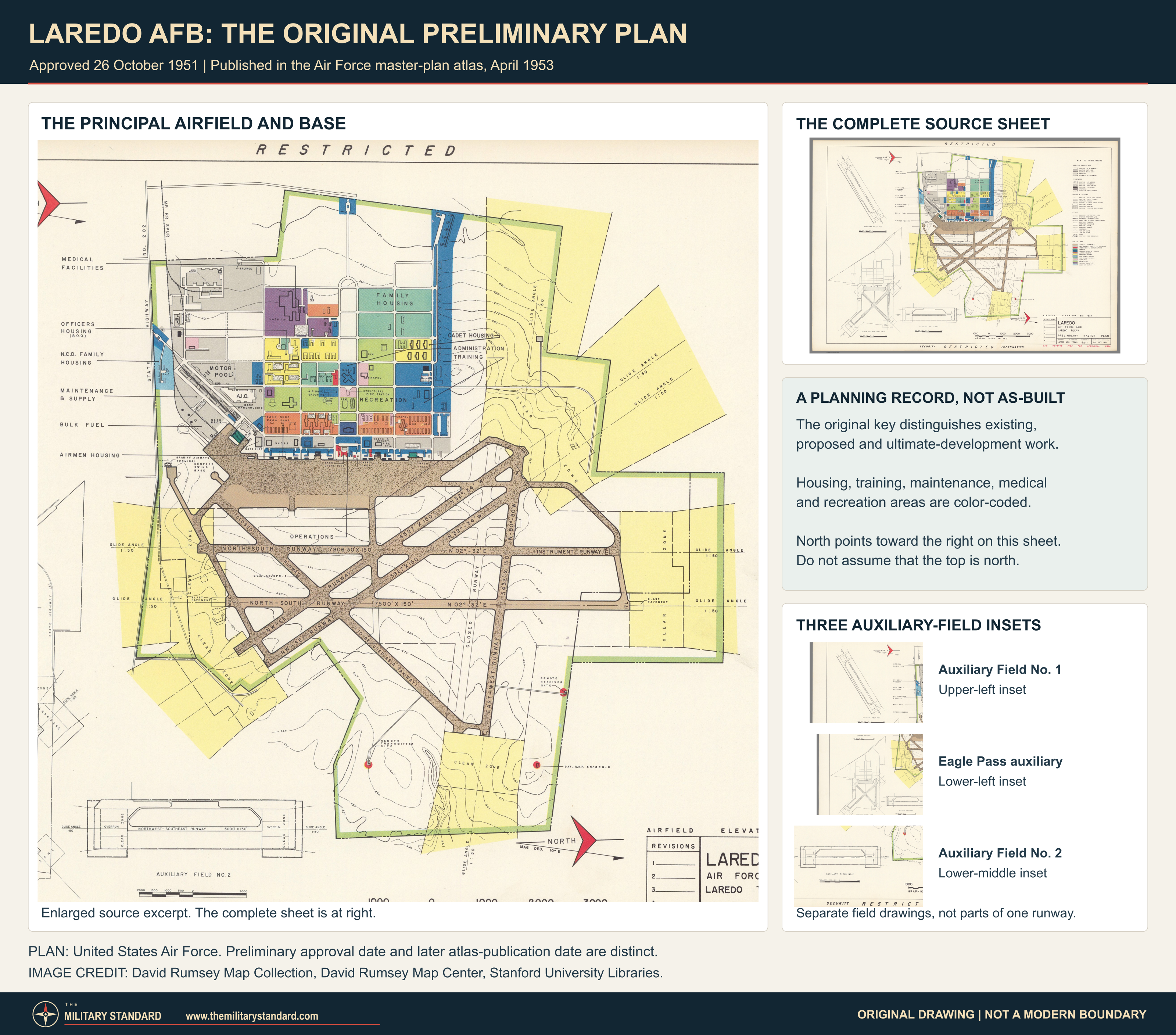
The original preliminary master plan records an approval date of October 26, 1951, preceding the reactivation lease. Published in the Air Force's April 1953 master-plan atlas, it distinguishes existing pavement and structures from proposed and ultimate-development work. Its colored functional areas show how the planners arranged maintenance and supply, administration and training, housing, medical services, recreation, and the flight-line apron. The sheet also contains insets for Auxiliary Field No. 1, Auxiliary Field No. 2, and Eagle Pass Auxiliary Field. Those drawings document planning relationships and proposed facilities, not proof that every depicted feature was built.
Laredo joined an expanded training network serving an Air Force whose jet aircraft required a continuing flow of newly qualified pilots. The 3640th initially belonged to a system that divided pilot preparation among separate phases and institutions. The T-33 became central to Laredo's basic jet-training identity. The two-seat trainer allowed instructor and student to work through jet flying procedures before the graduate moved on to an operational aircraft and its specialized training requirements.
Air Training Command's administrative structure also changed. Flying Training Air Force ceased to exist on April 1, 1958, with its assets transferred directly to Headquarters ATC. This was a command-level consolidation, not closure of Laredo or an end to its local flying mission. The 3640th remained one of the command's pilot-training wings, and the official 1960 organization listing identifies it as a basic-training wing at Laredo.
Consolidated Undergraduate Pilot Training
In 1960, ATC moved toward consolidated undergraduate pilot training, bringing preflight, primary, and basic instruction together at Air Force facilities. The plan replaced civilian flying instructors with military officers and ended the contract primary-school system. Laredo had been added to the selected consolidated-training bases by the end of that year. This development changed the base from a location delivering one part of a distributed program into a school responsible for a broader sequence of a student's pilot preparation.
The new jet-training framework used the T-37 and T-33. The T-37 provided primary jet instruction, while the T-33 served the subsequent training phase before the later T-38 transition. These aircraft had different teaching functions; listing them together without explaining the sequence would conceal the organizational change that made Laredo an undergraduate pilot-training base. The official command history describes the system, while a later account of a specific Laredo class confirms how that framework appeared in practice.
Class 66-E entered training in January 1965 and graduated in February 1966. Its members expected to become the first Laredo class to use the T-38, but the transition was not ready for them and they trained in the T-37 and T-33. This is evidence about actual student training, not proof that no T-38 had yet arrived for maintenance familiarization or other preparatory work. Aircraft acceptance, maintenance preparation, and introduction into student instruction were separate milestones.
The January 14, 1965 issue of the Reese AFB newspaper, The Roundup, carried an Air Training Command Press Service report that Laredo's first T-38 had arrived. Named City of Laredo, it was the 501st T-38 accepted by the Air Force and was intended primarily to train maintenance personnel. The report described 83 aircraft scheduled for Laredo by early 1966, a planned total rather than a verified delivery count. This establishes arrival by the publication date, not the exact arrival day or the first student-course date, and helps explain why an aircraft could be present before Class 66-E's anticipated instructional transition.
The official command history's photograph in its 1971 section shows a different trainer: the first T-37 finished in white corrosion-control paint and assigned to Laredo's 3640th Pilot Training Wing. The side-by-side-seat Tweet should not be misidentified as the tandem-seat T-38 Talon. This image documents continued primary-trainer use and a paint-system change; it cannot establish a local T-38 arrival or student-conversion date.
The wing required much more than aircraft and instructors. In July 1963, Laredo was among the training wings reorganized under a dual-deputy structure, separating operational responsibility from materiel support and including an air-base group and medical function. ATC changed the operations deputy designation to training in early August. The structure provides a documented way to understand the relationship among instruction, aircraft maintenance, base services, and medical support without inventing local manning totals or relying on a generic description of military life.
Graduates, Service, and Community Memory
The later experience of Class 66-E gives a human-scale view of the training mission. Its members called themselves the Laredo Escadrille, drawing on the Lafayette Escadrille tradition and their anticipated T-38 transition. The official 2015 reunion accounts describe the demanding training period, graduation, subsequent assignments, and continuing bonds among classmates. Their recollections also show that the base's significance extended beyond the aircraft parked on its ramp: it supplied officers who would fly and lead during the Vietnam War.
Those accounts identify graduates who served in transport and combat roles, a classmate who survived captivity, and later senior leadership careers. Walt Kross went on to become a four-star general; Dave Burney's service included two Silver Stars. These are examples from a documented class, not claims that all Laredo graduates followed similar careers. The two official reunion articles differ in some graduate and award counts, so those disputed aggregate figures are not repeated as settled statistics.
The contemporary wartime records and the later reunion histories illuminate different populations. World War II enlisted gunners, instructors, maintenance personnel, medical staff, and base-support organizations cannot be treated as equivalent to the Cold War pilot-student community. Nor can command-wide ATC personnel totals establish the population of Laredo AFB. A continuous annual series of local staffing, dependent population, and civilian employment was not recovered; the history therefore retains its dated personnel evidence rather than manufacturing a single base-strength figure.
Auxiliary Fields, Navigation, Ranges, and Related Installations
The principal airfield depended on supporting property beyond its runways. The Corps separately inventories Laredo Auxiliary Field No. 1 as an Army-built field supporting Laredo Army Air Field. Its description assumes dirt runways and a security fence, rather than presenting a verified construction drawing. Its representative inventory point is 27.43222222, -99.07305556. The FY2024 entry lists private ownership and all projects at site closeout; that status belongs to the auxiliary property, not the entire former base.
Laredo Auxiliary Field No. 2 was a later Air Force development. The government leased 317.5 acres on August 5, 1952, at a location described as 18 miles southeast of Laredo. A March 25, 1965 lease increased the total to 465.32 acres. Those are leased-property figures from different dates, not two quantities to add together. The reviewed GIS entry has no coordinates, so the field is not assigned Auxiliary No. 1's position or mapped to an unverified airstrip.
The Laredo Radio Beacon inventory describes an Army low-frequency radio-range property with five metal towers, concrete bases, a fence, and a one-story wooden building measuring 15 by 35 feet. This was a separately inventoried navigation installation, not evidence that the same antenna arrangement stood beside the main runway. Its inventory locator is 27.61888889, -99.49083333. Operating frequencies, call signs, exact service dates, and the survival of individual towers were not established.
The Army's separately inventoried ground gunnery range involved 35,166 leased acres in 1943. The Corps records eventual termination of the leases and return of land and improvements to the owners but supplies no exact surplus date. A different entry identifies the Laredo Aerial Gunnery Range, with an inventory point but no substantive property-history description. It is retained as a distinct documented identity; the available entry does not justify importing acreage, boundaries, or operating dates from the ground range.
The Texas National Guard received three buildings and 13 acres of the former base, according to its separate Corps property entry. Because that record explicitly identifies a parcel of the former base, it is treated as a related Army installation on the shared historical base site, not a second location for the whole airfield. Its shorthand claim of a 1941 base beginning conflicts with the better-supported 1942 acquisition and school-activation evidence and is not used to revise the main chronology.
Laredo AFS and the Laredo Gap Filler Annex belong in the related-installation record but retain separate identities. In particular, the former tracking station's later Army Reserve use was at that station, not proof that the main air base became the Laredo Army Reserve Training Site. Fort McIntosh is another distinct Laredo military property. Laughlin and Randolph provide the broader Texas training context; Moody became the later station of the 38th wing. These relationships do not make the properties geographically interchangeable.
The 38th Wing and Military Closure
On August 1, 1972, the 38th Flying Training Wing replaced the four-digit 3640th organization at Laredo. The official ATC account explains that the service was replacing four-digit training wings with organizations carrying established combat lineage. This was not simply a name change that allowed every earlier 3640th action to be attributed retrospectively to the 38th. The official 38th lineage identifies the 70th and 71st Flying Training Squadrons during the Laredo period.
Reduced pilot-production requirements brought the final military decision. The official command history states that the Secretary of Defense announced in early 1973 that ATC no longer needed Laredo. The 38th wing's official operations account dates its pilot training through August 28, 1973. ATC inactivated the base on September 30 and placed it in caretaker status; the wing's Laredo assignment ended the same day. The training endpoint and military inactivation were therefore separate milestones, neither of which ended every deed, maintenance obligation, or environmental responsibility.
The 38th subsequently activated at Moody AFB on December 1, 1973. Moody was an established Georgia airfield dating to 1941, not a new replacement site built in response to Laredo's closure. The command history identifies Moody's preceding training organization as the 3550th, not the 3350th sometimes repeated in secondary accounts. The lineage continued elsewhere, while the Laredo base ceased to serve as a resident Air Force pilot-training installation.
The Corps records the property as reported excess on March 29, 1974. The airport summary also describes the property-deactivation phase in March 1974 and the city's principal conveyance in February 1975. Approximately 309 acres went to other government or private recipients, with the remainder transferred to the city. September 1973 military inactivation, March 1974 property administration, and February 1975 municipal conveyance should therefore remain separate milestones. A previously recorded April 17, 1973 training-termination date and an exact February deed day are not confirmed by the reviewed original closure account and municipal summary.
Environmental Investigation and Redevelopment
The former base has several environmental investigation areas, not a single uniform cleanup history. Landfills, fire-training pits, industrial treatment equipment, and the shotgun range arose from different activities and were studied with different methods. Some later civilian uses also affected the evidence. The Corps' FY2024 main-base classification remains properties with projects. That classification is different from its closeout entry for Auxiliary Field No. 1 and from the no-project entries for several other supporting properties.
Construction Landfill
The April 2000 limited groundwater assessment addressed concern that earlier geophysical and soil-gas work did not adequately determine whether the construction landfill affected groundwater. Fieldwork occurred October 18-23, 1999. Investigators drilled eight soil borings, completed four monitoring wells, and excavated 28 test pits to help establish the southern landfill limit. Another attempted well was abandoned because it did not yield groundwater. The pits encountered concrete, asphalt, and metal construction debris.
The assessment reported no detected semivolatile organic compounds or PCBs in the groundwater analyses. A low acetone detection was below its comparison standard and was identified as potentially laboratory-related. Detected metals were also below the applicable comparison levels. Validation rejected no data, although some results were estimated. On that evidence, and with the local drinking-water supply not drawn from the underlying groundwater, the report recommended no further investigation. This was a dated limited assessment of one landfill, not a finding that every former-base parcel was free of contamination or that all property projects had closed.
Fire Training Area
The January 1999 Phase I remedial investigation describes two burn pits west of Daugherty Road and north of Hillside Road. The area first appeared in the reviewed aerial sequence in 1956. Military firefighters reportedly burned used oil and gasoline; subsequent municipal training used diesel fuel and gasoline and continued until 1992. One pit had been covered by 1995 while the other remained exposed. The difference between military and later city use matters when interpreting the site's history and assigning responsibility.
The investigation found lead and petroleum hydrocarbons in soil and chlorinated solvents and fuel-related compounds in groundwater. Its conclusions were not a completed risk assessment. The report warned that semivolatile-organic characterization and parts of the groundwater-metals record were inadequate to characterize conditions fully. Recommended work included additional soil sampling, leachability testing, monitoring wells, groundwater analyses, and further characterization before a defensible risk assessment. Paving was discussed as a possible future use affecting exposure, not documented as a completed cleanup remedy.
Industrial Waste Treatment Plant
The September 2000 final site-inspection report describes an industrial waste treatment plant built in 1969 and taken out of service in 1974. It treated storm-sewer flow from the southern flight-line area before discharge through the base sanitary system into the city's system. The facility included a control building, clarifier, lagoon, and piping. Waste volumes and sludge-disposal information were unavailable, an important limit on reconstruction of its operating history.
The May 1999 investigation included three monitoring wells and 21 soil samples. Constituents of potential concern included polycyclic aromatic hydrocarbons, pesticides, a PCB, petroleum hydrocarbons, and certain metals in soil, along with solvents and petroleum-related constituents in groundwater. The report considered possible contributions from former piping, a motor pool, warehouses, a fuel farm, and a commercial dry-cleaning operation. These were source hypotheses, not proven allocations of responsibility to particular military or civilian operators.
Several qualifications prevented a simple no-action conclusion. Some metal non-detect results had been rejected during validation. A formal local background-metals comparison was lacking, groundwater-flow interpretation remained uncertain, and a boring relocated to avoid overhead utilities may have missed the former sludge lagoon. Recommendations included historical piping and source investigation, confirmation sampling, additional wells, seasonal water-level measurements, and background-metals work. The original report recommended further investigation; it should not be summarized as evidence that the plant had already been cleaned up.
Sanitary Landfill and the Laboratory-Data Problem
The revised sanitary-landfill report dated May 2000 describes June-July 1997 work using historical aerial photographs, electromagnetic surveying, soil-gas sampling, and soil, groundwater, and sediment analyses. Sixteen apparent trenches were identified from photographs, with two additional possible trenches indicated by the electromagnetic work. Later residential development and part of an elementary school overlapped former trench areas. This placed investigation of the old landfill within a developed neighborhood rather than an untouched military reservation.
The report interpreted many metal detections as potentially natural background, while acknowledging that a full local background study had not been performed and that turbid, unfiltered groundwater samples could complicate interpretation. It discussed isolated organic detections, possible laboratory contributions to some results, and possible agricultural or pesticide-related sources. It also noted that the city supplied drinking water from the Rio Grande rather than the underlying groundwater. On the data then accepted, the report recommended no further investigation.
That recommendation must be read with the subsequent record. Its separate Appendix F reproduces a December 1997 data-quality conclusion that found no major invalidating problem at that time but qualified results for holding times and blank contamination. The Corps' later project-history account states that the earlier soil, groundwater, and sediment datasets were invalidated because of laboratory irregularities; soil-gas data were validated. The same account describes renewed investigation, including work in 2003. An earlier favorable data-validation statement does not override a later invalidation finding.
The history therefore preserves the May 2000 recommendation as a dated event, not a current parcel-safety certification. The later investigation sequence is part of the site's record precisely because the evidence supporting an earlier interpretation did not remain unqualified. A present-day conclusion would require the later project files and signed decisions for the relevant area, not selective reliance on the old recommendation or individual laboratory tables.
Shotgun Range
The July 31, 2018 draft-final remedial investigation addresses a 52.1-acre shotgun-range area used for World War II clay-target training. Historical photography showed two skeet ranges in the 1950s and early 1960s. Subsequent land uses included a golf course, residential development, and school property. Lead from shot and polycyclic aromatic hydrocarbons associated with coal-tar-pitch clay targets created a different contaminant question from the solvents investigated at the fire-training and industrial-treatment areas.
The study used incremental sampling across 91 decision units and nine planting beds, supplemented by subsurface work. It found some soil results above Texas residential assessment levels, including deeper material requiring delineation. The formal risk evaluation nevertheless placed estimated cancer risk within the evaluated acceptable range and noncancer hazard indices at or below one. Groundwater was evaluated as a Class 3 resource rather than a drinking-water source. Screening-level exceedances and the report's risk conclusions were different steps in the analysis, not contradictory descriptions to be simplified into an unqualified safe-or-unsafe label.
The report also documented limits: access depended on signed rights of entry, some areas were not sampled directly, subsurface sampling was selective, and backyard sampling did not extend beyond the stated shallow depth. It recommended no additional investigation, feasibility study, or response action on its evaluated evidence, while identifying subsequent proposed-plan, public-participation, and decision-document steps. A draft-final investigation is not itself a signed final decision, and its conclusions cannot be applied automatically to all former-base properties.
Taken together, these records show why redevelopment and environmental administration continued long after military closure. The reviewed sources do not establish a current whole-base cleanup certification, complete ownership schedule, or unrestricted access to every former military parcel. This account records the investigations and their qualifications; it is not a substitute for current parcel-specific environmental or title records.
Civilian Airport and Surviving Aviation Infrastructure
The airport historical summary records modernization beginning in 1975 and a new passenger terminal in 1998. The principal reuse retained aviation as an economic function while changing the airfield from a federal training base into a municipal commercial, cargo, and general-aviation airport. Former military land also supported roads, residential and institutional development, and other recipients. The successor airport does not occupy or control every parcel once associated with the military establishment.
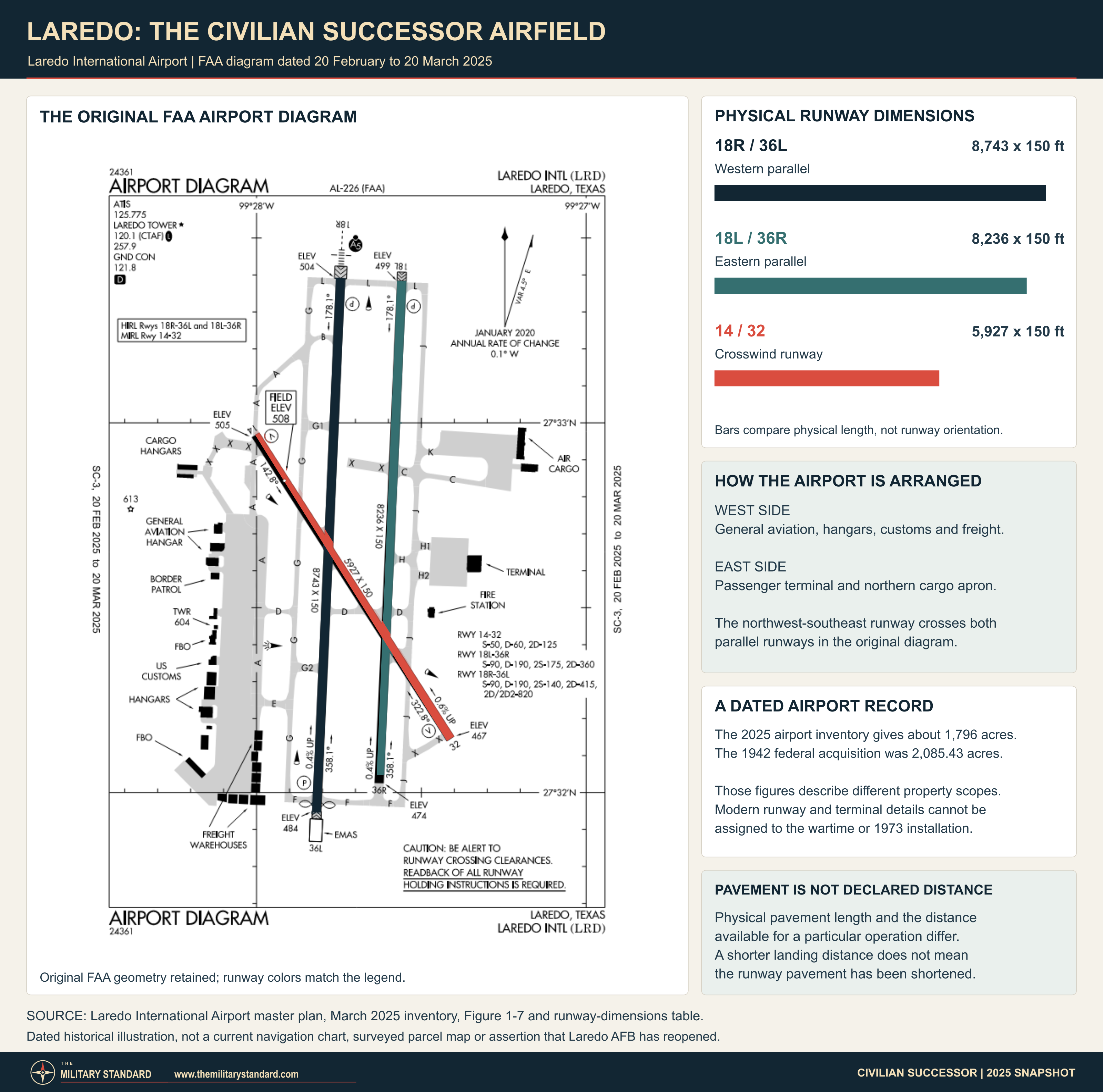
The official inventory dated March 2025, posted in the airport's April 2026 document directory, records three concrete runways. The western parallel runway, 18R/36L, measures 8,743 by 150 feet; the eastern parallel runway, 18L/36R, measures 8,236 by 150 feet. The crosswind runway, 14/32, measures 5,927 by 150 feet. The diagram shows the two principal runways aligned generally north-south, with the crosswind runway on a northwest-southeast alignment. These are dated modern dimensions, not a verified diagram of the base in 1943 or 1973.
The same airport record distinguishes the western general-aviation, hangar, customs, and freight areas from the eastern passenger-terminal and cargo development. It also distinguishes physical runway length from operational declared distances: a shorter landing distance does not mean the pavement itself has been shortened. Such details are important when interpreting an airport diagram or reconstructing a layout graphic. The continuing airfield is the most conspicuous aviation legacy, but the reviewed record does not establish that all present pavement, hangars, or buildings retain their original military configuration.
Military aircraft still appear in the civilian airport's operations record, but visiting or training traffic does not mean that Laredo AFB has reopened as a resident Air Force installation. The 2022 noise study's 2019 observations and 2026 forecasts must also remain distinct; its forecast is not a measured 2026 traffic total. Individual surviving wartime buildings, exact current parcel boundaries, and conditions of public access require separate verification before being represented as a complete heritage inventory.
Laredo's historical importance lies in two different training eras and the transformation that followed them. The wartime field supplied bomber gunners and helped standardize instruction; the Cold War base prepared jet pilots and supported a demanding undergraduate training system. Its later history includes the end of resident military flying, municipal redevelopment, continuing aviation, and investigation of specific former-use areas. Preserving those distinctions produces a fuller record than treating the present airport as either an unchanged military base or a completely separate place without military roots.
Chronology
- May 7, 1942 Federal acquisition of approximately 2,085.43 acres for the airfield, according to the official airport historical summary.
- August 12, 1942 Laredo's Army flexible-gunnery school activated.
- November 28, 1942 The contemporary classbook dates the arrival of the first students to this day.
- November 30, 1942 The first aerial-gunnery class began instruction.
- First week of January 1943 The first aerial-gunnery class graduated.
- January 3, 1943 AAF implementation of aircraft and turret specialization assigned Laredo a B-24 training specialty.
- 1943 Government leased 35,166 acres for the separately inventoried ground gunnery range; exact lease day remains unconfirmed.
- January 22, 1944 An archived Air Force photograph shows WASP pilots on Laredo's flight line.
- Early May 1944 The central flexible-gunnery instructors school moved to Laredo.
- May 29, 1944 The gunnery officers school moved to Laredo.
- June 1944 A Camera Training Committee met at Laredo to develop standardized gun-camera instruction.
- August 31, 1944 Cumulative Laredo gunnery-school graduates reached 27,077 by this cutoff.
- June 17, 1947 The Corps inventory records the airfield as declared excess; the airport summary places municipal transfer in June.
- October 26, 1951 The original preliminary master plan records its approval date; the atlas was published in April 1953.
- December 28, 1951 The airport historical summary dates the reactivation lease to this day.
- April 1, 1952 Laredo AFB reopened and the 3640th Pilot Training Wing organized.
- August 5, 1952 Government leased 317.5 acres for Laredo Auxiliary Field No. 2.
- 1955 The airport summary records the city's conveyance of the airfield back to the federal government.
- April 1, 1958 Flying Training Air Force ended, with assets transferred directly to Headquarters ATC.
- 1960 Laredo was added to the consolidated undergraduate pilot-training program by year's end.
- July 1963 Laredo's training wing reorganized under the dual-deputy structure.
- January 1965 Class 66-E entered training at Laredo.
- By January 14, 1965 An ATC Press Service report in The Roundup announced arrival of Laredo's first T-38 for maintenance training; exact arrival day unspecified.
- March 25, 1965 A second Auxiliary Field No. 2 lease increased its total leased area to 465.32 acres.
- February 1966 Class 66-E graduated after training in T-37s and T-33s rather than its anticipated T-38 course.
- 1969 The industrial waste treatment plant was built, according to its later site-inspection report.
- 1971 The official command history illustrates the first white corrosion-control-painted T-37 assigned to the 3640th at Laredo.
- August 1, 1972 The 38th Flying Training Wing replaced the 3640th organization at Laredo.
- August 28, 1973 The official 38th wing operations account dates its Laredo pilot training through this day.
- September 30, 1973 ATC inactivated Laredo AFB and placed it in caretaker status; the 38th wing's Laredo period ended.
- December 1, 1973 The 38th wing activated at Moody AFB, Georgia.
- March 29, 1974 The Corps records the former base as reported excess.
- 1974 The industrial waste treatment plant was taken out of service, according to the site-inspection report.
- February 1975 The official airport summary records the principal conveyance to the City of Laredo.
- 1975 Civilian airport modernization began; city fire-training use represents a separate post-military period.
- 1992 Municipal fire-training use ended, according to the 1999 remedial investigation.
- June-July 1997 Fieldwork for the sanitary-landfill investigation later reported in May 2000 took place.
- 1998 The airport historical summary records completion of the new passenger terminal.
- January 1999 The fire-training remedial investigation recommended further characterization before risk assessment.
- May 1999 Industrial waste treatment plant field investigation included monitoring wells and soil sampling.
- October 18-23, 1999 Construction-landfill groundwater assessment fieldwork took place.
- April 2000 The limited construction-landfill assessment recommended no further investigation on its evaluated evidence.
- May 2000 The revised sanitary-landfill report recommended no further investigation; the earlier analytical datasets were later qualified by the Corps' invalidation notice.
- September 2000 The industrial-treatment site-inspection report recommended additional investigation.
- 2003 The Corps project-history account records further investigation after problems with earlier laboratory data.
- July 31, 2018 The draft-final shotgun-range RI recommended no response on its evaluated evidence and identified further decision-process steps.
- FY2024 The Corps inventory continued to classify the main former-base property as having projects.
- March 2025 The official airport inventory documented the modern three-runway airfield and approximately 1,796-acre airport.

Information sources (20)
- WEBHistory of Air Education and Training Command, 1942-2002, Office of History and Research, AETC, 2005
SOURCE FOR: April 1952 reopening and 3640th organization, 1958 command consolidation, consolidated UPT, 1963 structure, local 1971 T-37 photograph, 1972 wing replacement and September 1973 military inactivation; selected original pages reviewed, with aircraft caption corrected against the official PDF, printed page 187, PDF page 194.
- PDFLaredo International Airport Historical and Statistical Summary, 2015
SOURCE FOR: May 1942 acquisition and acreage, June 1947 municipal transition, December 1951 lease, 1955 federal conveyance, 1974 property phase, February 1975 city transfer, modernization and terminal development; historical page visually reviewed.
- PDFLaredo International Airport Master Plan, Chapter 1: Inventory of Existing Conditions, March 2025
SOURCE FOR: Current airport acreage and location, FTZ subset, official airport diagram, physical runway dimensions and declared-distance distinctions, terminal, cargo and general-aviation arrangement; posted April 2026.
- PDFLaredo International Airport Noise Exposure Map Report, 2022
SOURCE FOR: Dated operations context, military aircraft use at a civilian airport and the distinction between 2019 observations and 2026 forecasts.
- WEBUSACE Formerly Used Defense Sites FY2024 Property Inventory, Laredo Records
SOURCE FOR: Main-base property identifiers, representative coordinates, 1947 and 1974 excess dates, disposition synopsis, project-status scope, distinct auxiliary fields, radio beacon, National Guard parcel and range entries.
- WEBAAF Historical Study No. 31: Flexible Gunnery Training in the AAF, Chapters I-VI
SOURCE FOR: August 1942 school activation, first class and graduation, 27,077-graduate cutoff, B-24 specialization, instructor/officer-school moves, gun-camera committee, practical training standards and continuity/phase-check problems; primary-study transcription.
- PDFLaredo Army Air Field, Texas, 1943 Classbook
SOURCE FOR: Dated startup and student-arrival account, contemporary support organizations and nursing staff; a limited paraphrase of the contemporary book, not a complete wartime roster.
- WEB38 Combat Support Wing (USAFE), Official Air Force Lineage and Honors
SOURCE FOR: 38th wing's Laredo station period, August 28, 1973 training endpoint, 70th/71st squadrons and Moody station date; indexed full official text and component/station entries reviewed because current article routes returned an index or access error.
- WEBLaredo Escadrille Celebrates 50th Class Reunion, AETC, May 12, 2015
SOURCE FOR: Class 66-E training and graduation dates, expected aircraft transition, later Vietnam service and careers; numerical differences compared with the second official account rather than silently harmonized.
- WEBLaredo Escadrille Steps Back in Time for 50th Anniversary Reunion, JBSA, May 28, 2015
SOURCE FOR: Actual T-37/T-33 training instead of the expected T-38 course, class identity, graduate recollections and later service; inconsistent aggregate figures omitted.
- WEBFormer Laredo Air Force Base Project History, USACE Fort Worth District
SOURCE FOR: Later invalidation of earlier sanitary-landfill soil, groundwater and sediment datasets, validation of soil-gas information and subsequent investigation sequence; dated project narrative, not current cleanup certification.
- WEBLimited Groundwater Assessment, Construction Landfill, Former Laredo AFB, CH2M HILL, April 2000, USACE Document 3
SOURCE FOR: October 1999 fieldwork, borings/wells/test pits, groundwater results and validation qualifications, construction debris and report-specific no-further-investigation recommendation; provided original report reviewed, especially PDF pages 6, 30-33 and 40.
- WEBPhase I Remedial Investigation, Fire Training Area, Former Laredo AFB, CH2M HILL, January 1999, USACE Document 7
SOURCE FOR: Burn-pit location and military/municipal uses, lead/petroleum and groundwater findings, inadequate characterization, further sampling recommendations and distinction between proposed paving and a completed remedy; provided original report reviewed, especially PDF pages 9 and 71-76.
- WEBFinal Site Inspection Report, Industrial Waste Treatment Plant, Former Laredo AFB, CH2M HILL, September 2000, USACE Document 60
SOURCE FOR: 1969-1974 plant operation, treatment route and components, May 1999 investigation, potential-concern constituents, uncertain sources, data/groundwater/lagoon limitations and further-investigation recommendations; provided original report reviewed, PDF pages 3-11 and 100-107.
- WEBRevised Site Investigation Report, Sanitary Landfill, Former Laredo AFB, CH2M HILL, May 2000, USACE Document 63, with Appendix F
SOURCE FOR: 1997 investigation, trench identification, redevelopment overlap, analytical interpretations/limitations and dated recommendation; main 63-1.pdf pages 2-8 and 150-153 and separate 63.pdf Appendix F pages 2-4 and 21-23 reviewed, then compared with the later Corps invalidation notice.
- PDFLaredo Shotgun Range Remedial Investigation Report, Draft Final, July 31, 2018
SOURCE FOR: 52.1-acre range history, lead/clay-target-related PAHs, sampling design, screening versus risk evaluation, groundwater classification, access/depth limitations and remaining decision-process steps; relevant main-report sections reviewed.
- WEBHappy Brrrtttday: Older Than Wild Blue Yonder, 23d Wing Public Affairs, June 24, 2016
SOURCE FOR: Moody's established 1941 airfield identity, contextualizing the later station of the 38th wing rather than treating Moody as a newly built replacement for Laredo.
- WEBLaredo AFB Gets First T-38 Talon, ATC Press Service, The Roundup, January 14, 1965, page 1
SOURCE FOR: First T-38 at Laredo reported by publication date, maintenance-training purpose, City of Laredo name, Air Force acceptance sequence and planned rather than actual future aircraft total; original article and masthead visually reviewed.
- WEBLaredo Air Force Base Preliminary Master Plan, United States Air Force, October 26, 1951 approval, April 1953 atlas
SOURCE FOR: Original preliminary-plan date, functional organization, existing versus proposed and ultimate-development symbols, auxiliary-field planning insets and historical layout graphic; full-resolution original reviewed.
- WEBWASPs on the Flight Line at Laredo Army Air Field, January 22, 1944, Archived U.S. Air Force Photograph
SOURCE FOR: Dated direct photographic evidence of WASP pilots at Laredo and authentic wartime illustration; original Air Force caption and image identification retained in the repository copy.