
Langley BOMARC Ground-Air Transmitter Site, Virginia

Longitude: -76.541944
Current Role: Unverified. May 2001 specialist photographs document a former transmitter building and a lattice tower at the identified GAT site. No authoritative 2026 owner, tenant, access status, demolition record, or surviving-feature inventory was located.
The Langley BOMARC Ground-Air Transmitter Site was a detached United States Air Force radio-guidance installation built to support the 22d Air Defense Missile Squadron and its IM-99A, later CIM-10A, BOMARC interceptors. It was not part of the launcher field at Oyster Point, not a radar station, and not the active Langley airfield. Its function was to receive computer-generated guidance information from the regional Semi-Automatic Ground Environment, or SAGE, network, convert that information into the form required for radio transmission, amplify it, and broadcast commands to missiles already in flight.
The transmitter was an essential physical link in a distributed weapon system. Surveillance radars supplied observations to the air-defense network. SAGE computers and weapons controllers developed the interception solution. The 22d maintained the missiles, launchers, readiness, and local weapon-control equipment. The Ground-Air Transmitter, normally abbreviated GAT, carried the calculated midcourse commands across the final ground-to-air radio path. The missile then used its own seeker for the terminal portion of the attack.
Boeing's December 1959 IM-99A Bases Manual depicts the Langley GAT as a distinct facility separated from Base No. 5's 28-shelter launch area. The plan labels the distance as 4 1/4 miles. The same manual describes the standard A-model GAT plant as a transmitter building with duplex equipment chains, high-power UHF klystron amplifiers, two antennas on approximately 60-foot self-supporting towers, a test-message generator, monitoring equipment, and three 150-kVA diesel generators.
Langley became operational with the A model on October 1, 1960 according to the contemporary NORAD and CONAD history. The detached AN/GKA-4 Frequency-Division Data Link facility was required for that mission. Langley later added the B model, but the strongest site-specific account says the detached GAT was used only for A-model missiles. A 1963 NORAD and CONAD history records the Air Force decision to remove all A-model BOMARCs during fiscal year 1965. That decision defines the probable end of the Langley GAT's original guidance mission more closely than the 22d's final 1972 inactivation, but it does not provide an independently documented transmitter shutdown day.
Photographs taken in May 2001 and published by Radomes.org identify remains at the GAT site, including the former transmitter building and at least one tower. They are valuable site-specific evidence, but they are not a present-day survey. No authoritative current owner, tenant, access status, environmental case, reuse, demolition record, or 2026 structure inventory was found for the unresolved parcel. The installation is therefore classified as closed, with 2001 survival documented and current condition unverified.
Installation Identity And Separate Status
The formal project name is Langley BOMARC Ground-Air Transmitter Site. Period diagrams normally shortened the functional name to GAT Facility. Other useful search forms include Langley BOMARC GAT, Langley Ground-Air Transmitter, Langley BOMARC data-link site, Base No. 5 GAT, and 22d Air Defense Missile Squadron GAT.
The name requires care because several places carried the Langley or BOMARC association. Langley Air Force Base in Hampton provided broad administrative and logistical support. The 22d's launcher and missile-support complex occupied former ammunition-storage property at Oyster Point in Newport News. The GAT stood at a third, detached location. The Washington Air Defense Sector's SAGE direction center at Fort Lee produced the higher-level guidance information. These installations worked as one defense system, but they did not share one parcel or one function.
The GAT was also different from a conventional Ground-Air Transmit-Receive facility. A later ADC GATR site normally handled voice and data communications with manned interceptor aircraft and might contain VHF, UHF, and other radio equipment. The BOMARC GAT described by Boeing was a ground-air transmitter devoted to missile command guidance. Similar initials do not justify assigning receiver equipment, fighter-control voice channels, or later GATR missions to this property.
Location
The 1959 Langley plan is the strongest contemporary location evidence. It shows the GAT symbol beyond the northern side of the launch-area drawing and labels the separation 4 1/4 miles. The diagram is a functional layout, not a survey plat. Its north arrow, roads, property lines, and scale are insufficient to transfer the symbol to a modern parcel with survey accuracy.
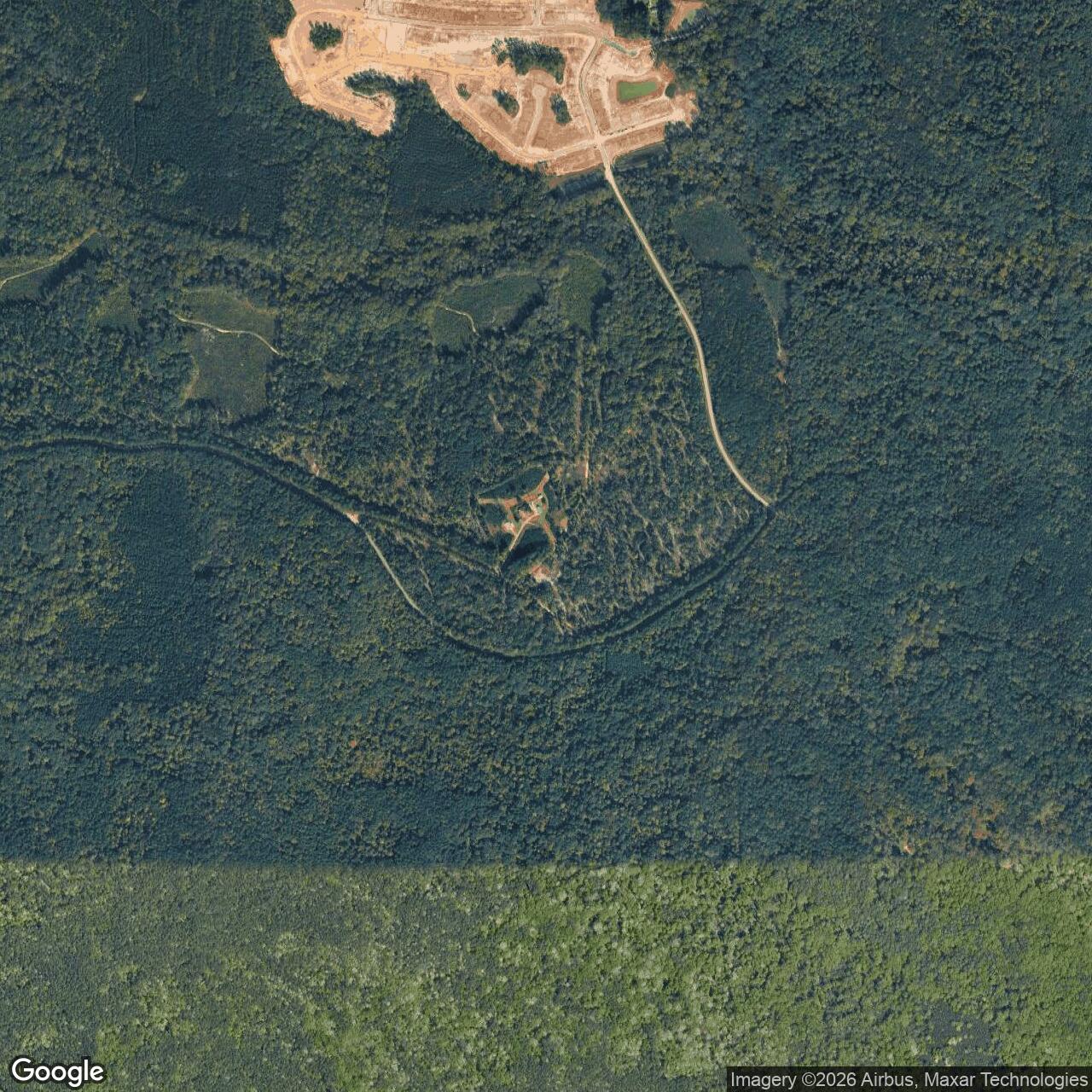
The later Radomes.org entry describes the GAT as a few miles north of the missile site and gives a coordinate equivalent to approximately 37.208472 north latitude and 76.541944 west longitude. That point is materially farther from the launcher than the manual's 4 1/4-mile annotation.
The discrepancy does not undermine the existence of the GAT. Period planning could change during construction, particularly at Langley, where Boeing explicitly noted that the layout was being revised for the advanced missile. The diagram's distance may have been measured between different reference points or may represent a planning estimate. The specialist point may identify a later field observation, an approximate compound center, a tower rather than the building, or a mistaken location.
Why BOMARC Needed a Ground-Air Transmitter
BOMARC was designed to intercept bombers at much greater distance than short-range point-defense missiles. The weapon launched vertically, accelerated, transitioned to ramjet-powered cruise, and flew toward a target area before using its terminal seeker. During the middle portion of flight, it depended on updated instructions from the ground network.
That dependence was a product of the engagement problem. The target could turn, change altitude, alter speed, or be reassigned. Radar reports arrived from multiple sites and required correlation. A large ground computer could maintain the wider air picture and calculate an interception more effectively than the missile's compact onboard equipment could do throughout the entire flight. The airborne weapon therefore needed a dependable command link until it was close enough for terminal homing.
SAGE made this process regional rather than local. Radar observations entered direction centers through communications circuits. Computer equipment organized tracks and supported weapons assignment. Human weapons controllers supervised the engagement and selected an interceptor. The direction center then sent formatted information toward the assigned weapon installation. For an A-model BOMARC, the GAT converted that information into a radio signal the missile could receive.
The GAT did not decide when to fire and did not independently calculate the entire intercept. It was an electronic conversion and transmission site inside a larger command chain. It also did not replace the missile's seeker. Its task ended before the terminal phase, when the onboard guidance system took over against the target.
This architecture explains the consequence of a transmitter outage. A ready missile in a functioning shelter was not enough. If the direction-center circuit, data-link equipment, amplifier, antenna, or power system failed, the weapon might lack its required midcourse guidance. The transmitter therefore deserved the same disciplined readiness attention as more visible launch equipment.
Planning, Construction, And Acceptance
Langley was designated IM-99A Base No. 5 during the first operational deployment program. Its facilities were planned while Boeing, Air Defense Command, SAGE organizations, construction agencies, and local support commands were still refining the weapon system. The December 1959 manual captured that transitional moment. It depicts an initial 28-position A-model launch field but notes revisions for the advanced missile system that later became the B model.
The GAT had to advance with the launcher project. Site work would have included access, grading, drainage, fencing, foundations, grounding, lightning protection, fuel support, communications circuits, and electric distribution within the building. The approximately 60-foot antenna towers required foundations adequate for wind and structural load. Pressurized coaxial lines had to connect high-power amplifiers in the building to the antennas with manageable radio-frequency loss.
The transmitter building was not an ordinary utility shed. It had to accommodate heavy cabinets, high-voltage power supplies, klystron amplifiers, signal-processing equipment, monitoring panels, test instruments, diesel generators, fuel-related systems, ventilation, cable entrances, and maintenance clearances. Separation from the launcher field created an additional requirement for dependable remote communication and access.
Acceptance required more than a completed shell. Technicians had to verify the incoming direction-center circuit, timing, demultiplexing, multiplexing, transmitter stages, modulation, amplifier output, dummy load, coaxial lines, antennas, switching, alarms, generation, and cooling. Testing also had to demonstrate that one complete chain could carry the mission if the other was unavailable.
No Langley GAT construction contract, beneficial-occupancy date, real-property card, or independent commissioning order was found. The 22d activated on September 1, 1959, but unit activation is not proof that the remote plant was operational that day. The contemporary NORAD record places the supported A-model weapon system in operational status on October 1, 1960.
The Transmitter Building
The 1959 manual states that the GAT building housed the equipment that changed midcourse guidance commands from the form in which they left the direction center into the form required for radio-frequency transmission. With the antennas outside, the building contained the rest of the operating chain and its supporting plant.
Each of two equipment portions contained a demultiplexer group, multiplexer group, transmitter, high-power radio-frequency amplifier, and antenna. Either portion was capable of transmitting commands to all missiles at the base. This duplex arrangement allowed maintenance or failure on one side without necessarily eliminating the entire guidance mission.
The incoming information was multiplexed. The GAT demultiplexed it into the form needed to key the subchannel oscillators of the multiplexer. The multiplexer output amplitude-modulated the high-power amplifier. That description identifies a sequence of data handling, signal formation, and power amplification rather than a single all-purpose transmitter cabinet.
A radio-frequency dummy load allowed tuning and adjustment without normal emission from the antenna. This feature protected personnel and equipment and reduced unnecessary radiation during maintenance. Local and remote monitoring equipment supported observation of operating conditions and transfer between the duplicated chains.
The building depended on forced ventilation and special equipment cooling. Boeing stated that GAT buildings, excluding special cooling needed by particular equipment, received ventilation cooling rather than general air conditioning. Heat generated by transmitters, amplifiers, power supplies, and engines made airflow an operational requirement, not merely a comfort feature.
No authenticated Langley floor plan or building number was recovered. Generic arrangements describe the standard system but do not prove the exact placement of every cabinet, door, generator, fuel line, or workbench at Langley.
AN/GKA-4 Frequency-Division Data Link
The Langley specialist record identifies AN/GKA-4 Frequency-Division Data Link transmitters at the detached GAT. That assignment is consistent with the A-model equipment described in the original bases manual. The AN/GKA-4 was a flight-control or data-link group, not a radar.
Frequency division allowed separate guidance subchannels to occupy different frequencies within the composite system. Direction-center information entered the demultiplexer, which separated the command material required for the channels. The multiplexer and associated oscillators prepared the output that modulated the high-power transmitter chain. The radio signal then left the building through coaxial transmission lines and the elevated antennas.
The manual describes a Frequency-Division Data Link Test Message Generator that simulated SAGE outputs to the AN/GKA-4 demultiplexer group. Its functions included a switch matrix, signal generation, modulation, timing distribution, and power. Technicians could use it for installation checkout and periodic testing of the data link and prelaunch distribution equipment without requiring an actual operational intercept.
Public summaries sometimes convert channel counts into an assumed number of simultaneously controlled missiles. That is not done here. Launcher positions, assigned weapons, alert missiles, radio channels, SAGE workload, engagement doctrine, and actual in-flight capacity were different measures. No Langley technical order located establishes a site-specific maximum simultaneous engagement count.
Transmitters, Klystron Amplifiers, And Monitoring
The data-link signal required substantial amplification before broadcast. Boeing describes a duplex radio-frequency amplifier made up of two high-power UHF klystron amplifiers, with power supplies, modulators, monitoring, and automatic-change features. A local monitor-control panel and a remote monitor-control or transfer panel allowed technicians and operators to observe the system and move the mission between chains.
Klystron equipment demanded stable power, cooling, careful adjustment, and high-voltage safety. A technician working at the GAT dealt with hazards and maintenance practices more like those of an industrial transmitter plant than an office communications room. Interlocks, grounding, discharge procedures, ventilation, and test discipline protected both people and expensive components.
The manual associates AN/GRT-3 transmitting equipment with the GAT system diagram. It should be understood as part of the signal chain rather than treated as a complete description of the facility. The AN/GKA-4 processing, transmitter stages, klystron amplification, coaxial distribution, antennas, monitoring, test equipment, and incoming SAGE circuit together produced the operational capability.
Redundancy reduced single-point failures but did not eliminate them. Both chains depended on the building, generation, fuel, incoming communications, environmental control, and correct switching. Duplicated equipment also doubled many inspection and calibration tasks. Readiness required proving that the standby side would actually assume the load.
Exact Langley transmitter power, frequencies, serial numbers, and later modifications were not found in releasable site records. Catalog values from related equipment are not inserted as Langley facts. The history instead preserves the architecture that the period manual establishes.
Antennas And Approximately 60-Foot Towers
The original GAT antenna was an omnidirectional radiator housed in a dielectric cylinder on a self-supporting tower. A pressurized coaxial cable connected the antenna to the amplifier. Boeing specifies approximately 60-foot towers for the standard installation. Two towers corresponded to the duplex radio chains.
The antenna was not a parabolic radar dish and did not rotate to search for aircraft. Its purpose was to radiate command information over the required area. The dielectric enclosure protected the radiating elements while allowing the UHF signal to pass. Any reconstruction or graphic should use this documented form rather than borrowing an unrelated radar antenna.
Tower placement required radio clearance, reliable grounding, lightning protection, structural inspection, and controlled coaxial-line routing. The site's separation from the launcher field did not imply a short-range link limited to the battery. Once the missile climbed, altitude and line of sight supported command reception over the much larger engagement region.
The 2001 photographs identify a surviving lattice tower at the Langley GAT. The image does not prove that the original dielectric antenna cylinder, feed system, or active coaxial line remained. A bare structural tower can survive long after its electronic function ends. No 2026 inspection confirms whether the tower or building still stands.
Independent Power And Facility Support
The standard GAT generated its own electric power. Boeing describes three 150-kVA diesel-driven generators housed in the building, with provision for outside power where available. Independent generation reduced dependence on the launcher plant and allowed the remote installation to sustain the mission through a commercial or base-utility interruption.
Three generators provided operational flexibility for normal load, standby capacity, maintenance, or failure, although the manual does not state a Langley-specific operating rotation. Generator readiness required fuel, cooling, lubrication, batteries or starting systems, exhaust management, periodic load tests, and preventive maintenance. Electrical switching had to protect sensitive transmitter equipment during transfers.
The generator plant also created a separate support burden. Fuel delivery, spill prevention, ventilation, noise control, fire protection, and engine maintenance were necessary even when the radio equipment performed normally. The available Langley sources do not identify tank sizes, fuel-storage locations, generator manufacturer, or a later utility conversion.
SAGE, Fort Lee, And The Command Path
The 22d was assigned to the Washington Air Defense Sector when it activated. The sector's SAGE direction center was at Fort Lee, Virginia. Radar tracks from the regional network entered the direction center, where AN/FSQ-7 computer equipment and weapons controllers supported identification, assignment, and interception.
The command path was distributed. A radar station did not directly steer the missile from its antenna. The direction center processed the wider air picture and generated guidance information. Terrestrial communications carried that information toward Langley's weapon system. The GAT converted and transmitted it. The missile received the commands, adjusted its course, and eventually shifted to its onboard terminal seeker.
The arrangement depended on timing and status information in both directions. The base weapon-control diagrams show commands from SAGE and status from the launch shelters and support equipment. The GAT belonged to that loop but did not contain every launch-control function. Its radio output was one indispensable segment among computer, landline, prelaunch, launcher, missile, and terminal-guidance elements.
Fort Lee and Langley could therefore share an operational mission without being one installation. The direction center, active air base, Oyster Point launcher plant, remote GAT, and regional radars each require their own geographic identity. A network history that merges them loses the very architecture SAGE was designed to create.
The system also had operational vulnerabilities. Track quality, computer availability, terrestrial circuits, GAT power, transmitter condition, antenna serviceability, missile receiver status, and launch readiness all had to align. Training and testing sought to find failures before an actual alert. The GAT's quiet routine was part of maintaining that chain.
The 22d Air Defense Missile Squadron And A-Model Operations
The 22d Air Defense Missile Squadron activated at Langley on September 1, 1959 and joined the Washington Air Defense Sector. Activation created the organization, but the contemporary NORAD and CONAD history identifies October 1, 1960 as the operational milestone. The GAT's A-model command link had to be functioning for that operational capability to be meaningful.
Langley was the fifth American BOMARC squadron reported operational by NORAD at the end of 1960. All five then-operational units used the A model. The GAT supported alert readiness rather than routine launches from Newport News. Operational missiles normally remained in shelters while electronics, propulsion support, communications, security, and crews were tested and maintained.
Daily transmitter work likely centered on scheduled checks, fault isolation, preventive maintenance, generator exercises, antenna and coaxial inspection, alarm verification, and simulated-message testing. These tasks follow directly from the documented equipment, but no Langley GAT duty roster or maintenance log was recovered. Exact staffing, shift patterns, contractor presence, and unit subdivisions therefore remain unresolved.
The site may have been described as unmanned because it lacked a continuously occupied operations center comparable to the launcher facility. That term should not be read literally. Local monitoring, maintenance, generator service, tower inspection, security response, and repair required people to visit and work at the compound. The sources do not prove continuous occupancy or complete automation.
The 22d's mission included communications and electronic equipment as well as missiles and launchers. Its Air Force Outstanding Unit Award period ran from September 1, 1963 through February 28, 1965 in the compiled lineage record. That period overlaps the final A-model era. The award supports high-level unit performance but does not document a particular transmitter action or firing.
No hostile engagement from Langley has been established. The GAT supported continental alert during the Cold War, not an overseas combat deployment. Exercises and system evaluations tested readiness, but no source reviewed ties the remote property to a specific combat launch, Cuban Missile Crisis transmission, or accidental missile firing.
Readiness, Maintenance, And Daily Technical Work
The transmitter site's product was reliable availability. A functioning day might produce no visible event beyond test signals, cabinet indications, generator runs, and completed maintenance records. That routine work protected the ability to guide a missile if the direction center assigned an engagement.
Technicians had to isolate failures across several boundaries. A bad test result could originate in the incoming landline, timing equipment, demultiplexer, oscillator, multiplexer, transmitter, modulator, amplifier, power supply, coaxial line, antenna, monitor, generator, or test set. Duplexing allowed one side to be removed from service, but only if the other side had already passed its checks.
Preventive tasks included cleaning and inspecting cabinets, monitoring temperatures, checking ventilation, measuring power and modulation, verifying voltage standing-wave ratio, testing automatic changeover, exercising engines, checking fuel and batteries, inspecting cable pressurization, examining tower grounds, and controlling vegetation around structures. Period technical orders would have prescribed the details, but the public site record does not preserve Langley's schedules.
Configuration control mattered. Changes to SAGE formats, transmitter components, missile receivers, or system timing had to be coordinated. A modification performed at the launcher plant or direction center could affect the GAT test sequence. Technical records, outage logs, parts accountability, and calibration documentation were consequently part of readiness even though none was located for this particular compound.
Weather on the Virginia Peninsula added practical concerns. Lightning, humidity, heat, salt-bearing coastal air, storms, standing water, and vegetation could affect towers, grounding, insulation, ventilation, roads, and electronics. The site required civil engineering and grounds support in addition to radio specialists.
Security And Safety
The GAT contained critical and potentially classified guidance equipment connected to nuclear-capable interceptors. Physical security protected the building, towers, communications lines, generators, and fuel. Fencing, locked access, identification procedures, inspections, patrol response, and coordination with the supported squadron would have limited unauthorized entry. No Langley-specific security plan was recovered, so exact barriers and manning are not reconstructed.
High voltage and radio-frequency energy were principal technical hazards. Klystron amplifiers and their power supplies required interlocks, grounding, discharge procedures, and disciplined maintenance. The dummy load permitted tuning without radiating through the antenna, but technicians still needed positive control of both duplex chains before working on feed lines or towers.
Diesel generation added fuel, exhaust, heat, fire, noise, and rotating-machinery hazards. Tower work added falls, lightning exposure, and rigging concerns. Batteries, electronic components, cleaning materials, oils, and possible transformers required proper handling. These material classes are plausible from the documented equipment, but they are not evidence of a release at Langley.
The current access status is unknown. The 2001 photographs do not establish that the site was legally open then or now. Any surviving tower, electrical feature, foundation, or building could be unstable. This historical record is not an invitation or permission to enter, climb, excavate, or remove artifacts.
The B-Model Transition And Why The Detached GAT Did Not Last To 1972
Langley's base plan anticipated advanced-missile equipment, and the 22d later operated both A and B models. The B model used a solid booster, greater range, and a Time-Division Data Link associated with the AN/GKA-5. System-level records therefore show that Langley's later weapon system required B-model guidance capability.
That fact does not prove that the original detached GAT building received the AN/GKA-5. The specialist Langley record explicitly says the remote GAT was used only for the A model. The later B-model equipment could have been placed in another part of the revised launcher or support complex, in a new facility, or in an arrangement not recovered.
The distinction matters because a simple 1960-1972 date range would imply that the same remote AN/GKA-4 plant guided both models until final squadron closure. The evidence does not support that interpretation. The original GAT's strongest documented mission is the A-model frequency-division link.
NORAD and CONAD's history for July through December 1963 records an Air Force decision at the end of August to delete all A-model BOMARC missiles during fiscal year 1965. Langley and McGuire were to continue with B-model forces. That program decision provides the best supported upper boundary for the detached A-model GAT mission.
No Langley work order, transmitter shutdown message, AN/GKA-4 removal record, or property deactivation document was found. The GAT may have ceased active guidance work as missiles were withdrawn, remained temporarily available during transition, or supported tests before equipment removal. The close-date field stays blank rather than translating a fiscal-year program decision into an exact calendar day.
The 22d continued under the 33d Air Division from April 1, 1966 and the 20th Air Division from November 19, 1969. It ceased operational status on October 1, 1972 and inactivated on October 31. Those are launcher-squadron milestones. They explain the wider BOMARC history but do not establish that the detached A-model GAT operated until 1972.
Shutdown And Equipment Disposition
Ending the A-model mission would have required controlled shutdown and disposition of communications circuits, data-link cabinets, transmitters, klystron amplifiers, test equipment, antenna components, generators, fuel, and classified or accountable items. Some equipment could be reused, stored, transferred, demilitarized, or scrapped. These are necessary categories of closure work, not a recovered Langley inventory.
The 2001 images indicate that the principal building and at least one structural tower survived long after operational use. They do not show which electronic components remained inside. Antenna radiators, feed equipment, and coaxial lines could have been removed while a lattice support tower stayed in place. No equipment-disposal or salvage date was located.
The Air Force might have retained, transferred, or declared the remote parcel excess independently of the Oyster Point launcher property. No deed or General Services Administration case was found that securely matches the GAT.
Post-Military Condition And Surviving Features
The best post-military evidence consists of Tom Page's May 2001 photographs published in the Radomes.org collection. The series includes directional views identified as the GAT site. It documents a low rectangular building, a lattice tower, and surrounding ground conditions at that time.
The photographs do not support a complete surviving-feature inventory. They do not establish whether both original towers stood, whether the visible tower carried original antenna hardware, whether the building retained generators or transmitter cabinets, or whether additions and removals had changed the plant. They also do not establish structural condition, occupancy, ownership, or legal access.
Detailed Chronology
- 1950s Air Defense Command, Boeing, SAGE organizations, and construction agencies developed the operational BOMARC deployment system, including remote ground-air guidance transmitters.
- 1958 Initial operational-base construction and equipment programs advanced while the A-model missile and SAGE network were still being tested and accepted.
- 1959-09-01 The 22d Air Defense Missile Squadron activated at Langley Air Force Base and was assigned to the Washington Air Defense Sector.
- 1959-12-03 Boeing issued the reviewed IM-99A Bases Manual. Its Langley Base No. 5 plan showed a detached GAT indicated 4 1/4 miles from the launch field and noted that the layout was being revised for advanced-missile equipment.
- 1959-12-03 The manual documented the standard GAT's duplex signal chains, high-power UHF amplification, paired antennas, test-message generator, three 150-kVA diesel generators, and ventilation-cooling arrangement.
- 1960-10-01 The contemporary NORAD and CONAD history recorded the 22d at Langley as operational with the A model. This is the strongest available parent-system readiness milestone for the GAT, not an independent property commissioning date.
- 1960-12-31 At the end of 1960, NORAD reported five operational American BOMARC squadrons, all using A-model missiles.
- 1961 Langley's advanced B-model capability entered the operational program. The detached GAT's original AN/GKA-4 mission remained tied to A-model missiles; exact B-model equipment placement is unresolved.
- 1963-08 The Air Force decided to delete all A-model BOMARC missiles during fiscal year 1965. Langley and McGuire were to continue with B-model forces.
- 1963-09-01 The Air Force Outstanding Unit Award period later listed for the 22d began.
- 1965-02-28 The listed award period ended during the A-model withdrawal era.
- Fiscal year 1965 The planned removal of all A-model BOMARCs provides the best supported end window for the detached Langley GAT's original frequency-division guidance mission. No exact shutdown day was found.
- 1966-04-01 The 22d transferred from the Washington Air Defense Sector to the 33d Air Division. This was a parent-unit change, not evidence that the A-model GAT remained active.
- 1969-11-19 The 22d was reassigned to the 20th Air Division. The detached GAT's status by this date is unresolved.
- 1972-10-01 The 22d ceased operational status with its remaining BOMARC mission.
- 1972-10-31 The 22d inactivated. This ended the Langley BOMARC squadron, but it is not adopted as the remote A-model transmitter's independent closing date.
- 1992 Mark Morgan documented portions of the former Langley BOMARC installation. His observations help trace launcher-site reuse but do not establish a GAT parcel boundary.
- 2001-05 Tom Page photographed views identified as the Langley GAT site, documenting a building and tower remains at that time.
Information sources (16)
- PDFBoeing Airplane Company, IM-99A Bases Manual, D5-4684, December 3, 1959
Primary technical and layout source for Langley Base No. 5, the 4 1/4-mile GAT indication, duplex signal chains, AN/GKA-4-related test equipment, antennas, towers, amplifiers, generators, cooling, and weapon-control diagrams.
- PDFNORAD and CONAD Historical Summary, July-December 1960
Contemporary command history for Langley's October 1, 1960 operational milestone, the five A-model squadrons operating at year-end, and the scheduled B-model transition.
- PDFNORAD and CONAD Historical Summary, July-December 1963
Contemporary command history for the late-August 1963 decision to remove all A-model BOMARC missiles during fiscal year 1965 while retaining B-model forces at Langley and McGuire.
- PDFA Handbook of Aerospace Defense Organization, 1946-1980, Office of History, Aerospace Defense Center
Official organizational reference for the 22d Air Defense Missile Squadron's September 1, 1959 activation, Washington sector assignment, later division assignments, and October 31, 1972 inactivation.
- PDFADC Historical Study 19, A Chronology of Air Defense, 1914-1972
Official chronology separating the 22d's October 1, 1972 cessation of operations from its October 31 inactivation and documenting the wider air-defense program sequence.
- PDFADC Historical Study 14, The Development of the BOMARC Weapon System, 1958-1962
Air Defense Command historical study for program development, deployment reductions, operational-base context, and the relationship between missile, SAGE, guidance, and supporting facilities.
- PDF22 Air Defense Missile Squadron (BOMARC), USAF Unit History compilation
AFHRA and period-source compilation used for squadron mission, training, command, and award context; it is not treated as a parcel survey or independent GAT shutdown record.
- PDFA Brief History of NORAD, North American Aerospace Defense Command, May 2016
Official retrospective for SAGE-era continental air defense and the October 31, 1972 inactivation of the last United States BOMARC squadron at Langley.
- WEBSAGE: Semi-Automatic Ground Environment Air Defense System, MIT Lincoln Laboratory
Institutional history explaining the regional radar, computer, communications, and weapons-control system that produced the guidance information delivered through the BOMARC GAT.
- PDFProtecting America: Cold War Defensive Sites, National Historic Landmarks Theme Study
Federal historic-context study for SAGE, BOMARC, dispersed air-defense installations, and the distinction between continental bomber defense and ballistic-missile defense.
- PDFTo Defend and Deter: The Legacy of the United States Cold War Missile Program
Department of Defense legacy study used for comparative BOMARC siting, Langley's A and B configuration, weapon-system context, and preservation interpretation.
- WEBLangley AFB (BOMARC), Virginia, Radomes site record
Specialist evidence for the detached Langley AN/GKA-4 FDDL site, its A-model-only function, and the later coordinate that conflicts with the 1959 plan distance.
- WEBLangley AFB (BOMARC), Virginia, Radomes recent-photo collection
Dated field photographs and observations, including May 2001 views identified as the GAT building and tower; not treated as a current parcel or 2026 condition survey.
- PDFDepartment of the Air Force, Commander's Call Topics, October 30, 2014
Official retrospective noting the 22d's October 31, 1972 inactivation; used for the parent squadron's final milestone, not the detached GAT closing date.
- PDFAir University Quarterly Review, Summer 1962, Volume XIII, Number 4
Contemporary professional discussion of BOMARC interception and the broader relationship among radar returns, SAGE direction, and ground-to-air transmission; Hurlburt examples are not assigned as Langley equipment records.
- PDFADC Historical Data, 1946-1973, uploaded reference volume (17.67 MB)
Uploaded Air Defense Command reference used for network terminology and organizational cross-checks; it does not independently establish the GAT parcel, equipment suffixes, or shutdown date.