Atlas F Site 578-2 Missile Silo, Albany Texas
Longitude: -99.29727894241501
Site Type: Atlas F vertical silo launch facility
Missile Type: SM-65F Atlas
Number of Launchers/Missiles: 1
Parent Base: Dyess AFB
Missile Wing: 96th Bombardment Wing; 96th Strategic Aerospace Wing after 1963-02-01
Missile Squadron: 578th Strategic Missile Squadron
Current Site Use: Former Atlas F silo complex on private property south of Albany; surface remnants, underground structure, and an original Quonset hut are described in public photo/owner-visit accounts.
Site Ownership: Private/non-federal ownership after surplus disposal; Atlas Missile Museum of Texas account says the site changed hands several times.
Accessible: No public access / private property; owner permission required.
Atlas F Site 578-2 was an SM-65F Atlas intercontinental ballistic missile launch complex assigned to the 578th Strategic Missile Squadron at Dyess Air Force Base, Texas. It was one of the twelve dispersed Atlas F vertical-silo launch facilities built in the Dyess missile field and was operated by Strategic Air Command under the 96th Bombardment Wing, which was redesignated the 96th Strategic Aerospace Wing in 1963. Because it was an Atlas F complex, Site 578-2 did not depend on a separate Minuteman-style remote Launch Control Center. The launch-control, crew-support, and missile-support functions were integrated into the individual launch complex.
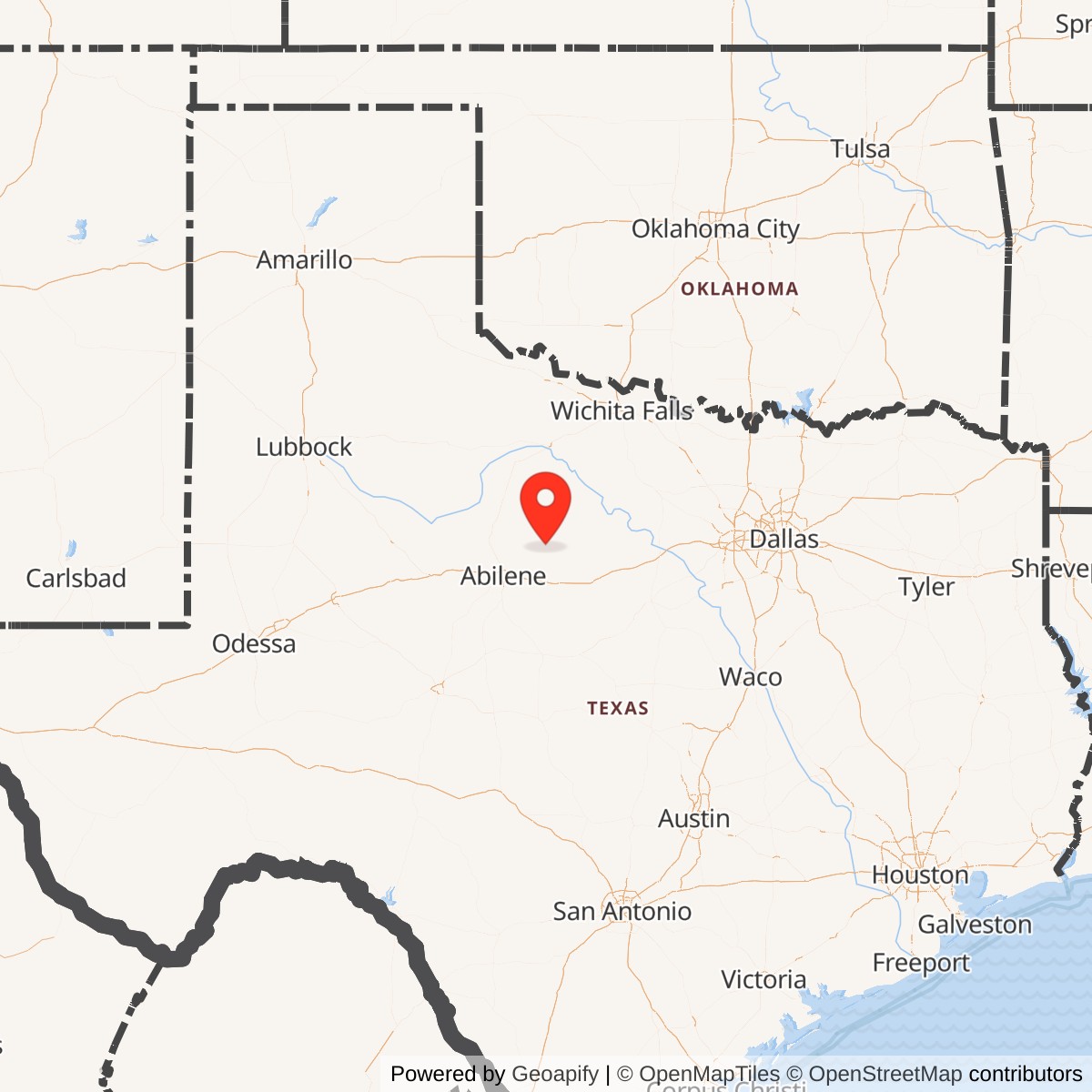
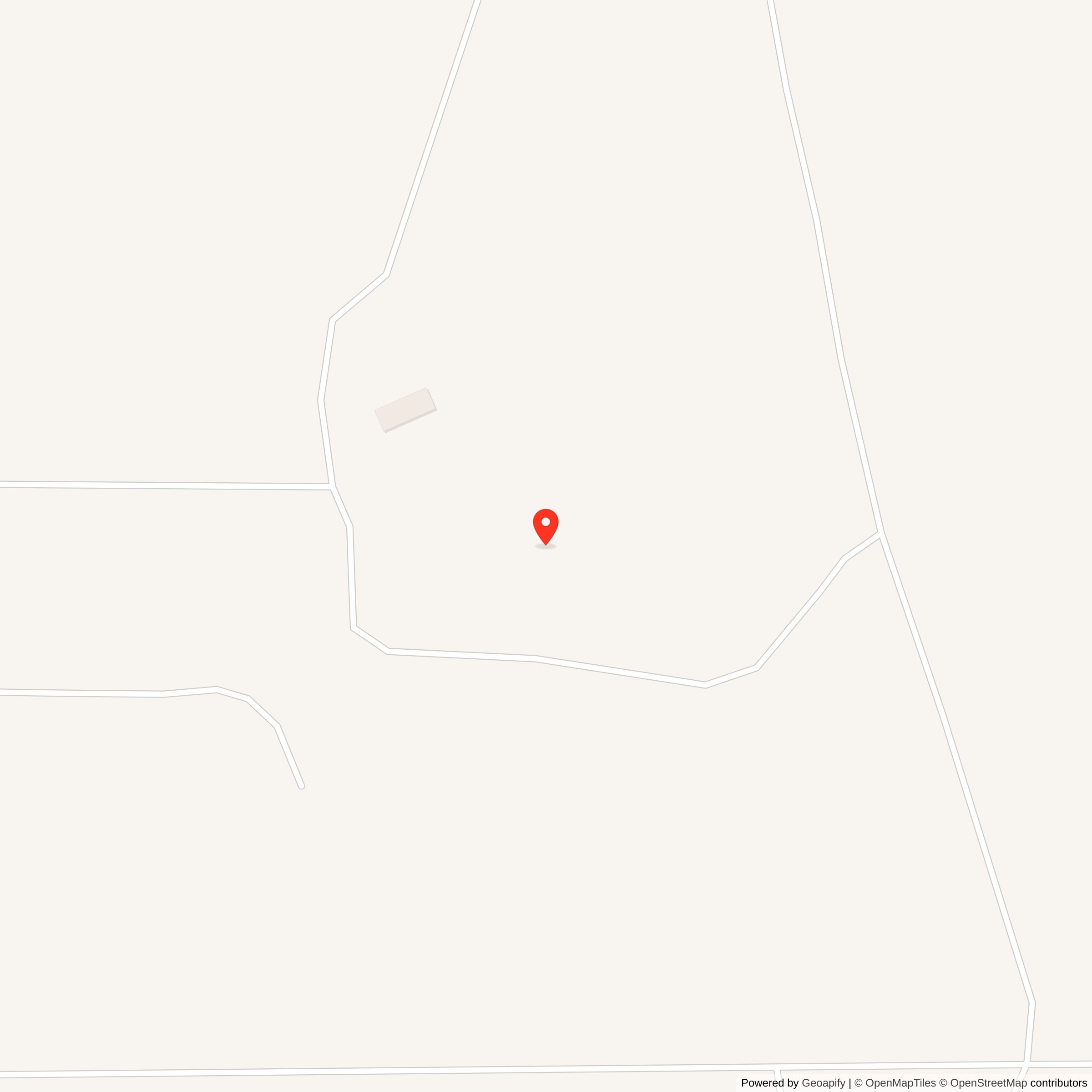
The site was located south of Albany in Shackelford County, Texas.
The 578th Strategic Missile Squadron was activated at Dyess on July 1, 1961, but USAF unit-history material lists the Dyess Atlas F force as operational on November 15, 1962. For that reason, the operational date for Site 578-2 is best treated as November 15, 1962 rather than the earlier squadron activation date. The site was removed from active missile service during the 1964-1965 Atlas phaseout and was decommissioned with the rest of the squadron on March 25, 1965. It is not an active military installation today. It is a decommissioned former Atlas F silo complex on private or non-federal property, with no verified public access.
Location, Landscape, and Site Description
Site 578-2 occupied a rural location about 1.5 miles south of Albany, the county seat of Shackelford County. The setting is characteristic of north-central West Texas: open ranch and agricultural land, sparse settlement, county roads, low relief, and broad visibility. The location placed the site in the northeastern part of the Dyess Atlas field, far enough from Dyess AFB and from other launch sites to improve dispersal but close enough for base-based missile maintenance, security, logistics, and command support.The site was an Atlas F silo-lift launch facility. The missile was stored vertically in a hardened underground silo. In a launch sequence, large overhead doors opened, the missile and launcher were raised to the surface, and the missile was fired from the aboveground launch position. This was different from Atlas E coffin-launcher sites, where the missile was stored horizontally. It was also different from later Minuteman silos, which were designed for direct underground launch. The Atlas F arrangement was a transitional solution: it placed the liquid-fueled missile under blast-resistant cover while still using a raise-before-launch method required by the Atlas system.
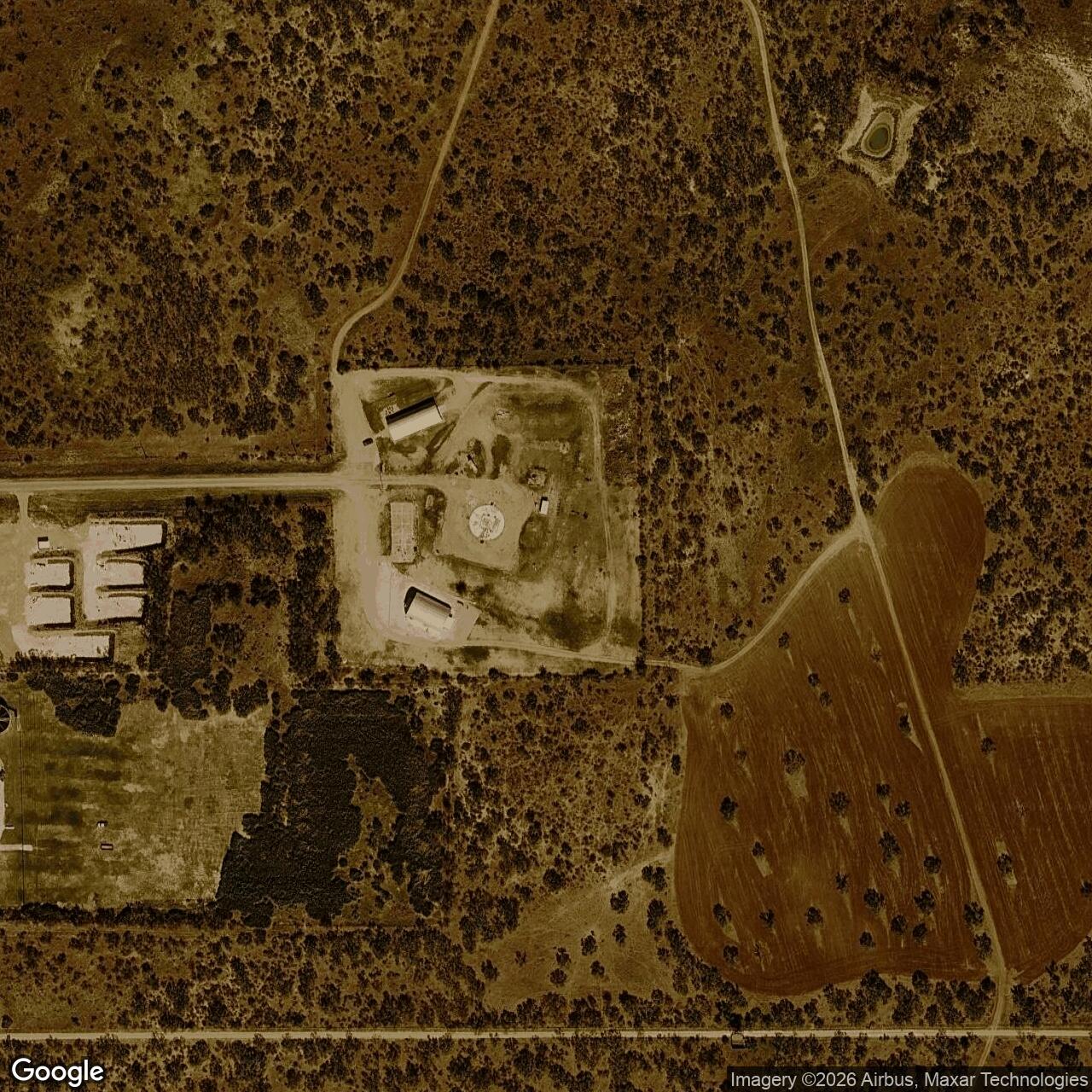
The complex would have included the launch silo, launch doors, elevator or launcher mechanism, underground launch-control and support spaces, crew access, utility systems, propellant-handling equipment, antennas or communications features, surface support structures, hardstands, fencing, and an access road. Public satellite images show the surface footprint of Site 578-2 south of Albany, including the access road pattern and the central launch-complex area. The Atlas Missile Museum of Texas later described an owner-assisted visit to the Site 2 entryway and reported that the first two blast doors were welded shut, the stairwell was flooded below the upper level, the silo reportedly retained an intact crib or internal structure and contained water, and one original Quonset hut remained on the property.
Strategic and Cold War Context
Site 578-2 existed because the United States was trying to build a credible intercontinental ballistic missile deterrent under urgent Cold War conditions. Atlas was the Air Force's first operational ICBM. Early Atlas basing arrangements gave the United States an operational long-range missile force, but they were vulnerable compared with later hardened systems. The Atlas F represented the last operational Atlas basing concept: a dispersed, individual, hardened, vertical-silo complex intended to improve survivability while preserving an acceptable response time.The Atlas F was still a first-generation liquid-fueled missile. It used RP-1 kerosene fuel and liquid oxygen oxidizer. Its structure depended on internal pressure, and its launch sequence required liquid-oxygen loading and raising the missile from the silo before firing. These realities made it more complicated and less immediately responsive than the solid-fueled Minuteman force that was entering service during the same period. Even so, when Site 578-2 became operational, it gave Strategic Air Command another hardened ICBM launch point during a period when the United States was still expanding and diversifying its nuclear deterrent.
The Dyess missile field also formed part of a broader military landscape in the Abilene area. Dyess supported SAC bombers, tankers, and missile operations, and the official Dyess AFB history notes that Army Nike Hercules defenses were positioned in the area to help defend SAC bombers and the Atlas F missile silos. Site 578-2 should therefore be understood not as an isolated rural structure, but as one component in a regional Cold War system that combined bomber operations, air defense, and dispersed ICBM alert sites.
Construction and Activation
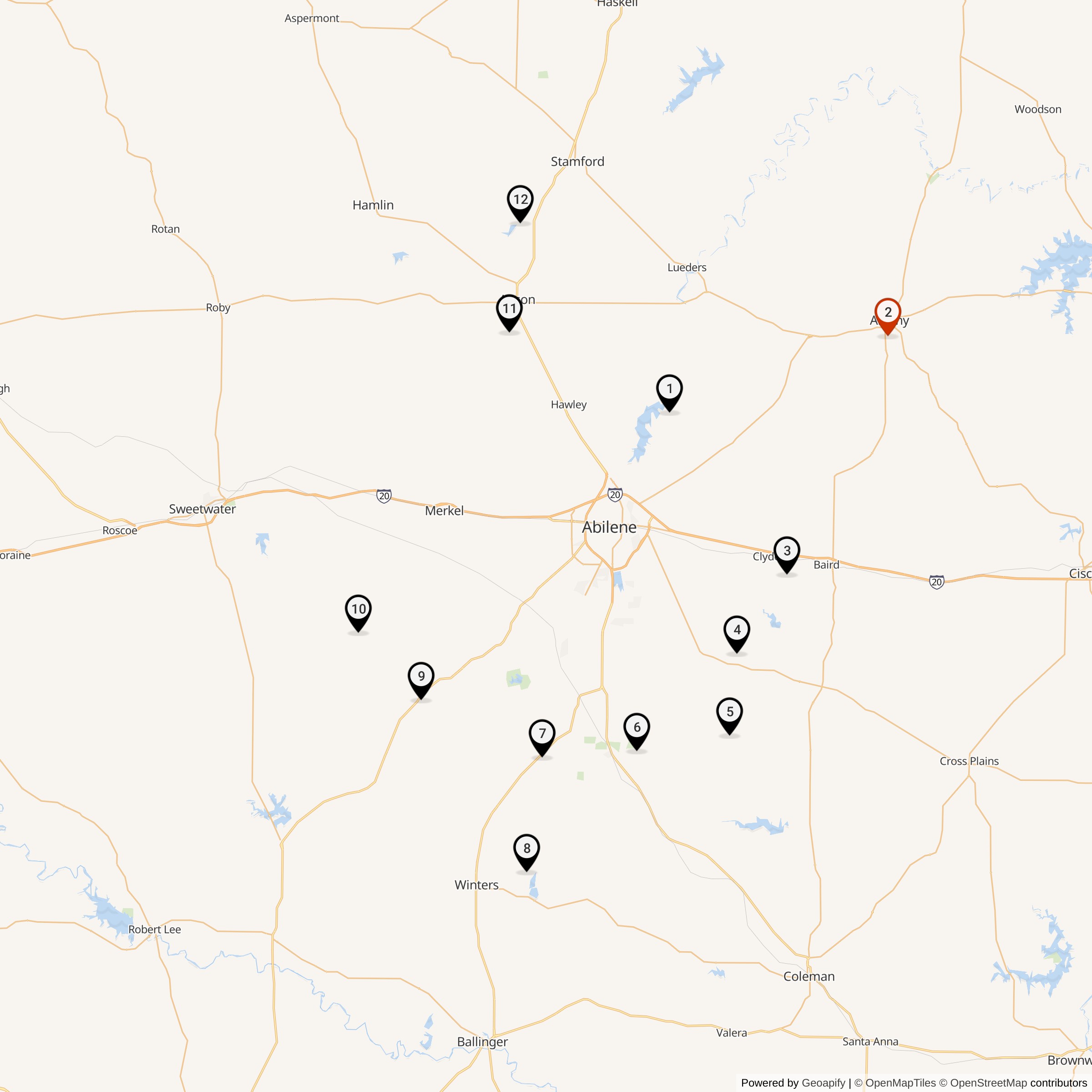
Initial responsibility for constructing the Dyess Atlas F sites fell to the U.S. Army Corps of Engineers Fort Worth District. The Fort Worth District also received responsibility for nationwide procurement of the Atlas F propellant-loading system before the Corps of Engineers Ballistic Missile Construction Office assumed broader oversight of ballistic-missile construction work in 1960. The Military Standard's Dyess summary records that six bids for the Dyess Atlas F project were opened at Abilene on May 26, 1960, and that the low bid of about $20 million came from a joint venture of H. B. Zachry Company and Brown & Root, Inc. Construction began on June 7, 1960.The Dyess project included twelve Atlas F lift-launcher sites located around Abilene at or near Abilene / Phantom Lake, Albany, Clyde, Denton Community, Oplin, Lawn, Bradshaw, Winters, Shep, Nolan, Anson, and Corinth. Site 578-2 was the Albany site. The missile assigned to Site 2 was General Dynamics Missile Serial Number 61-2559, General Dynamics Manufacturing Number 73F, and Air Force Missile Tail Number 559. The missile acceptance date was April 25, 1962 and the delivery date was May 18, 1962.
The overall Dyess missile construction project appears to have been completed unusually smoothly compared with some other missile-field projects. The Dyess project was completed on time and had no work stoppages due to labor unrest. There were three fatalities and thirty-three disabling injuries associated with the project, a reminder that the rapid construction of hardened missile facilities was hazardous civil-engineering work as well as a strategic program.
The 578th Strategic Missile Squadron was activated on July 1, 1961 while construction and site activation work continued. USAF unit-history material lists turnover to SAC on November 4, 1962 and the squadron as operational on November 15, 1962. Site 578-2 therefore entered service as part of a completed twelve-missile Atlas F force around Dyess.
Missile System and Technical Role
Site 578-2 housed the SM-65F Atlas, the final operational Atlas ICBM variant. The National Park Service describes Atlas as the United States Air Force's first operational ICBM and notes that Atlas E and F deployments followed the earlier Atlas D. The Atlas F was placed in a blast-proof silo-lift configuration and could be launched in approximately ten minutes. F. E. Warren Air Force Base's Atlas fact sheet similarly explains that an underground silo was developed because of Atlas vulnerability above ground and that an elevator raised the missile to ground level for launch.The missile was a liquid-fueled, pressure-stabilized system. The National Park Service explains that Atlas missiles had to remain pressurized while on alert because their thin stainless-steel shells depended on internal pressure for structural stability. The RP-1 fuel remained aboard the missile during alert, liquid oxygen was loaded before the missile was raised, and gaseous nitrogen maintained internal pressure. These requirements shaped everything at Site 578-2, from crew procedures and maintenance routines to the need for propellant-handling systems, ventilation, power, communications, and constant technical supervision.
Public sources identify the Atlas E/F reentry system as the Mark 4 reentry vehicle carrying the W-38 nuclear warhead. The Smithsonian National Air and Space Museum states that the Mark 4 reentry vehicle was used on Atlas E/F and Titan I ICBMs and carried a W-38 nuclear warhead with a yield of about 3.75 megatons.
Operational History
The active operational life of Site 578-2 was brief, but it came during one of the most dangerous periods of the Cold War. The 578th Strategic Missile Squadron was a twelve-missile Atlas F squadron at Dyess AFB. Its launch sites were widely dispersed around Abilene, and each Atlas F site was its own crewed launch complex rather than an unmanned launch facility monitored from a distant Minuteman-style LCC. The sites were manned continuously during the squadron's active period.When the Dyess Atlas F force became operational in November 1962, the Cuban Missile Crisis had just underscored the importance and danger of the early ICBM force. The 578th and its twelve missiles were placed on alert during the Cuban Missile Crisis. For Site 578-2, that means the Albany complex was part of the strategic alert posture as SAC pressed its first-generation ICBM forces into readiness at a time of direct U.S.-Soviet confrontation.
Routine operations at Site 578-2 would have involved alert duty, missile status monitoring, communications checks, security control, technical inspections, propellant-system maintenance, power and environmental-system maintenance, and periodic testing. Atlas F crews and maintenance personnel had to manage a weapon system that was both operationally significant and mechanically demanding. The missile's pressurized structure, liquid oxygen loading, RP-1 fuel, hydraulic and elevator systems, and hardened underground facility all required specialized personnel and disciplined procedures.
The 578th missile field also had documented squadron-level events. The squadron underwent the first Operational Readiness Inspection for an Atlas F missile unit from May 28 through June 2, 1963. The Dyess Atlas F sites remained part of the operational ICBM force until the accelerated phaseout of Atlas and Titan I systems began in 1964. On December 1, 1964, the first Atlas F missile at Dyess was removed from alert ahead of schedule to avoid expensive maintenance shortly before retirement of the system. USAF unit-history material lists the last 578th ICBM off alert on February 3, 1965 and the last ICBM shipped on February 10, 1965.
Deactivation and Disposal
The Atlas F system was already being overtaken by newer missile technology when Site 578-2 became operational. Solid-fueled Minuteman missiles offered much faster reaction, simpler alert posture, and lower maintenance burden. Titan II provided a different liquid-fueled but more capable and storable system. The Atlas F remained important, but its operational window was short.On May 16, 1964, Secretary of Defense Robert S. McNamara directed the accelerated phaseout of Atlas and Titan I ICBMs. SAC chronology material records that on December 1, 1964 the first Atlas F missile at Dyess was removed from alert before its normal planned removal date to avoid costly maintenance. USAF unit-history material for the 578th then lists the last 578th ICBM off alert on February 3, 1965 and the last ICBM shipped on February 10, 1965. The 578th Strategic Missile Squadron was deactivated on March 25, 1965.
The official Dyess AFB history states that after decommissioning in 1965, the Atlas missiles were removed and the sites were demilitarized. For Site 578-2, disposal therefore should be understood as a sequence: the missile came off alert, the missile was removed or shipped, military-sensitive systems and equipment were removed or demilitarized, the squadron was inactivated, and the property eventually passed out of active military use. This was not a START-era arms-control demolition, because the site left service decades before those later post-Cold War treaty-elimination programs. The physical underground structure appears to have remained rather than being fully excavated or erased.
Site 578-2 is also documented in environmental records. The U.S. Army Corps of Engineers' 2015 Texas FUDS inventory lists ALBANY ATLAS AF FAC S-2 in Shackelford County under property number K06TX0107, with project categories including HTRW and CON/HTRW. In FUDS terminology, HTRW refers to hazardous, toxic, and/or radioactive waste, while CON/HTRW refers to containerized hazardous, toxic, and/or radioactive waste. This listing confirms that the former Site 2 property has had a recognized FUDS/DERP environmental record. The available pass did not locate a detailed site-specific public remediation narrative, so the history should not overstate the type, extent, or current status of any cleanup beyond what the inventory records support.
Current Status and Site Use
Site 578-2 is a decommissioned former Atlas F missile complex on private or non-federal property south of Albany, Texas. It is not an active missile site, not a staffed public museum, and not known to be open for public visitation. Public imagery and historical-preservation pages show or describe surviving surface and underground features, including the former access pattern, launch-complex footprint, entry features, and at least one original Quonset hut reported on the property.The Atlas Missile Museum of Texas' Site 2 account suggests that parts of the underground complex survived after decommissioning, but access was limited, altered, and hazardous: welded blast doors, flooded stairs, and water in the silo were all reported. The site should be treated as private property. Former missile sites can contain confined spaces, unstable structures, standing water, debris, hazardous materials, and other dangers. Any physical visit would require owner permission and appropriate safety precautions.
Chronology
- 1960-05-26 Six bids for the Dyess Atlas F construction project were opened at Abilene, Texas.
- 1960-06-07 Construction began on the twelve Atlas F lift-launcher sites around Dyess AFB.
- 1961-07-01 The 578th Strategic Missile Squadron was activated at Dyess AFB.
- 1962-04-25 The missile assigned to Site 2, Atlas 73F / General Dynamics serial number 61-2559 / Air Force tail number 559, was accepted.
- 1962-05-18 Atlas 73F was delivered to Dyess AFB.
- 1962-11-04 USAF unit-history material lists turnover to Strategic Air Command for the 578th Atlas F force.
- 1962-11-15 USAF unit-history material lists the 578th Atlas F force as operational.
- 1962 The 578th Strategic Missile Squadron's twelve Atlas F missiles were placed on alert during the Cuban Missile Crisis.
- 1963-05-28 to 1963-06-02 The 578th Strategic Missile Squadron underwent the first Operational Readiness Inspection for an Atlas F missile unit.
- 1964-05-16 Secretary of Defense Robert S. McNamara directed the accelerated phaseout of Atlas and Titan I ICBMs.
- 1964-12-01 The first Atlas F missile at Dyess was removed from alert ahead of schedule.
- 1965-02-03 USAF unit-history material lists the last 578th ICBM off alert.
- 1965-02-10 USAF unit-history material lists the last 578th ICBM shipped.
- 1965-03-25 The 578th Strategic Missile Squadron was deactivated and Site 578-2's active Atlas F service was over.
- 1974-03-06 Atlas 73F, formerly assigned to Site 2, was successfully launched from Vandenberg AFB with a BMRS / SFT-1 payload for a reentry-vehicle test.
- 2015-09-30 The USACE Texas FUDS inventory listed ALBANY ATLAS AF FAC S-2, K06TX0107, in Shackelford County with HTRW and CON/HTRW project categories.
Read about the Atlas at Dyess AFB
All Atlas Missile Silo Locations