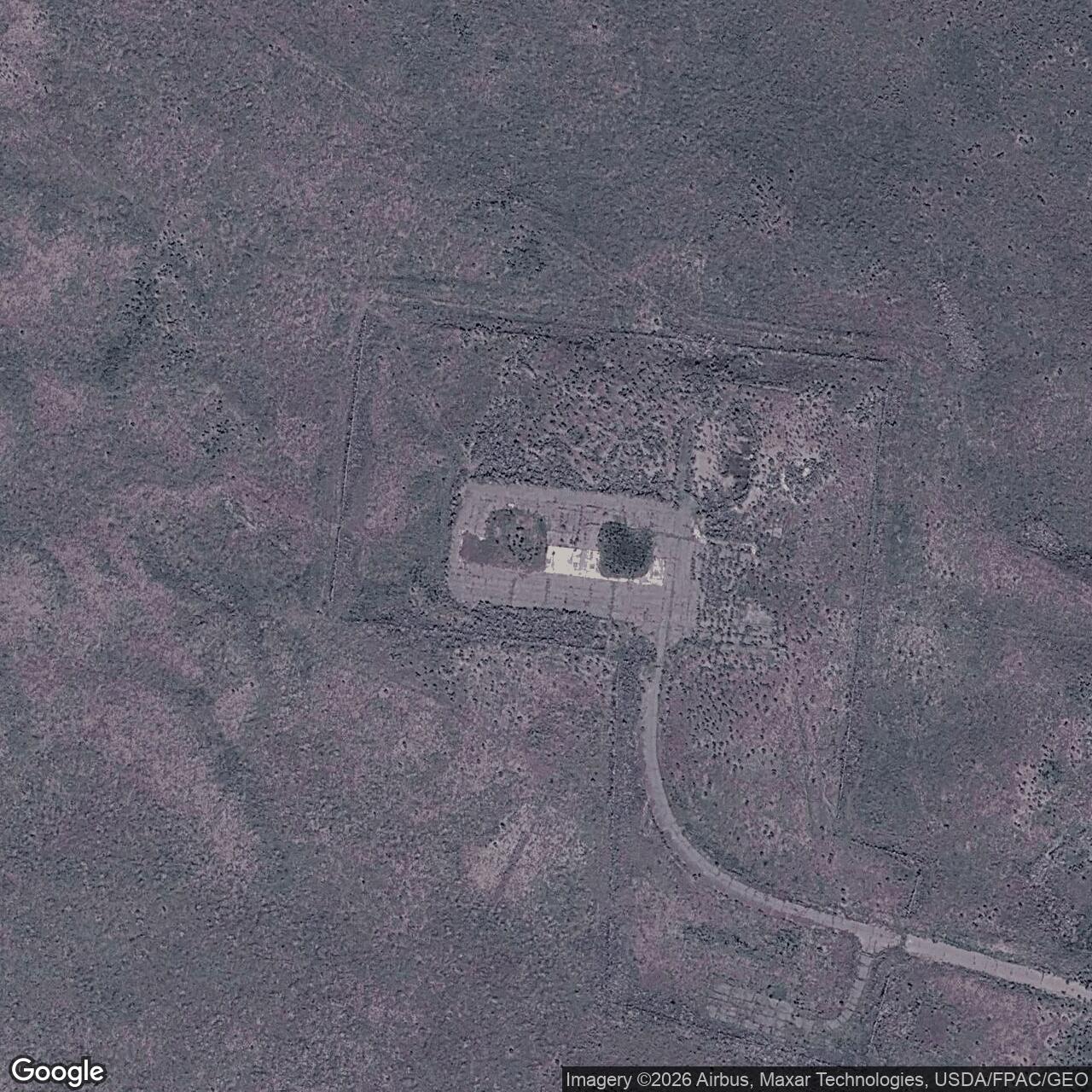
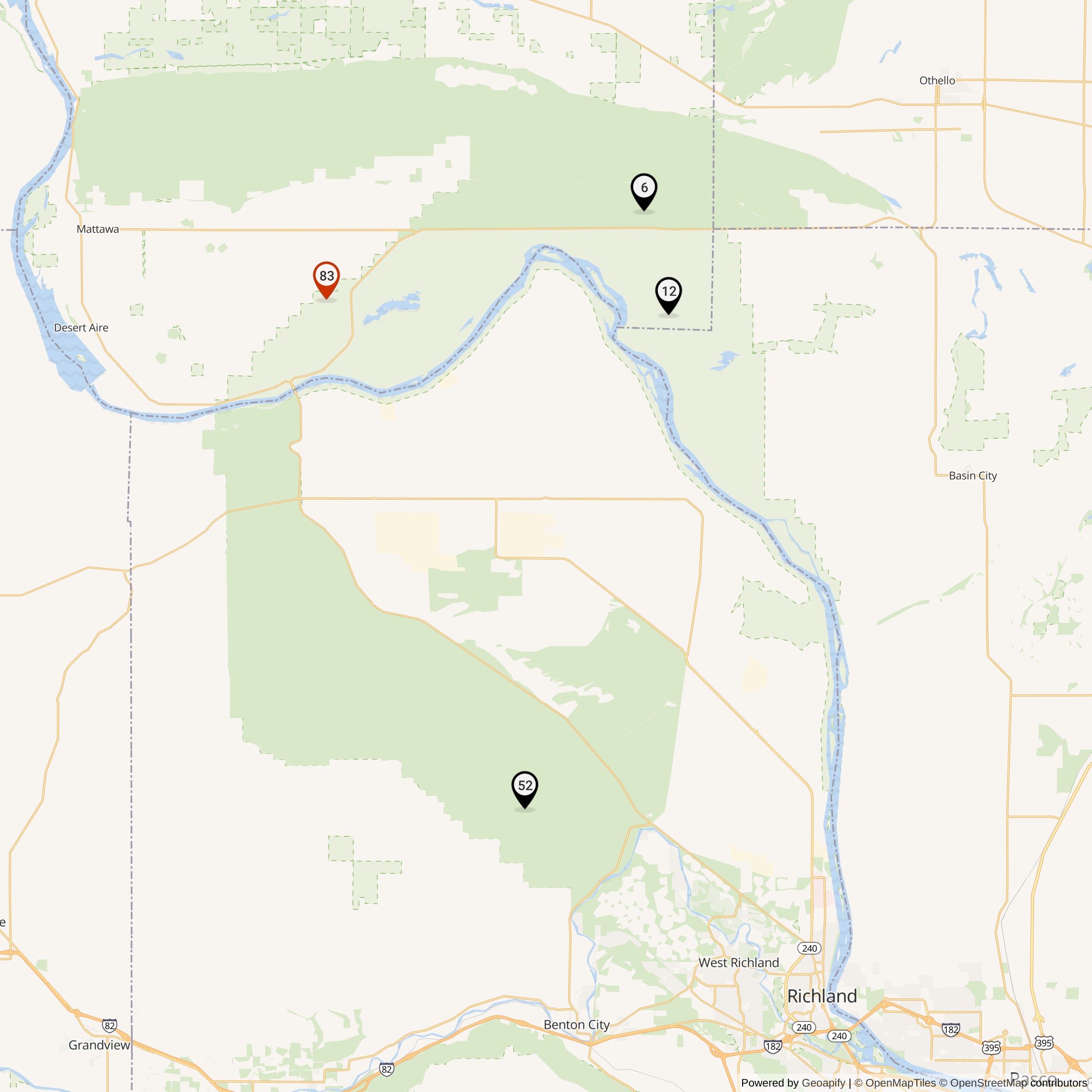
Nike Missile Site H-83 Launcher, Priest Rapids Washington
Longitude: -119.70414945662500
This location was part of the Hanford Defense Area
Site ID: H-83
Missile configuration: 2B/20A/8L-A
The missiles at this Launch Area were controlled by the Integrated Fire Control site located here.
Site Role: Launcher
A typical Nike air defense site consisted of two separate parcels of land. One area was known as the Integrated Fire Control (IFC) Area. This site contained the Nike system's ground-based radar and computer systems designed to detect and track hostile aircraft, and to guide the missiles to their targets.
The second parcel of land was known as the Launcher Area. At the launcher area, Nike missiles were stored horizontally within heavily constructed underground missile magazines. A large, missile elevator brought the Nikes to the surface of the site where they would be pushed across twin steel rails to one of four satellite launchers.
Elaboration on how Nike worked here.
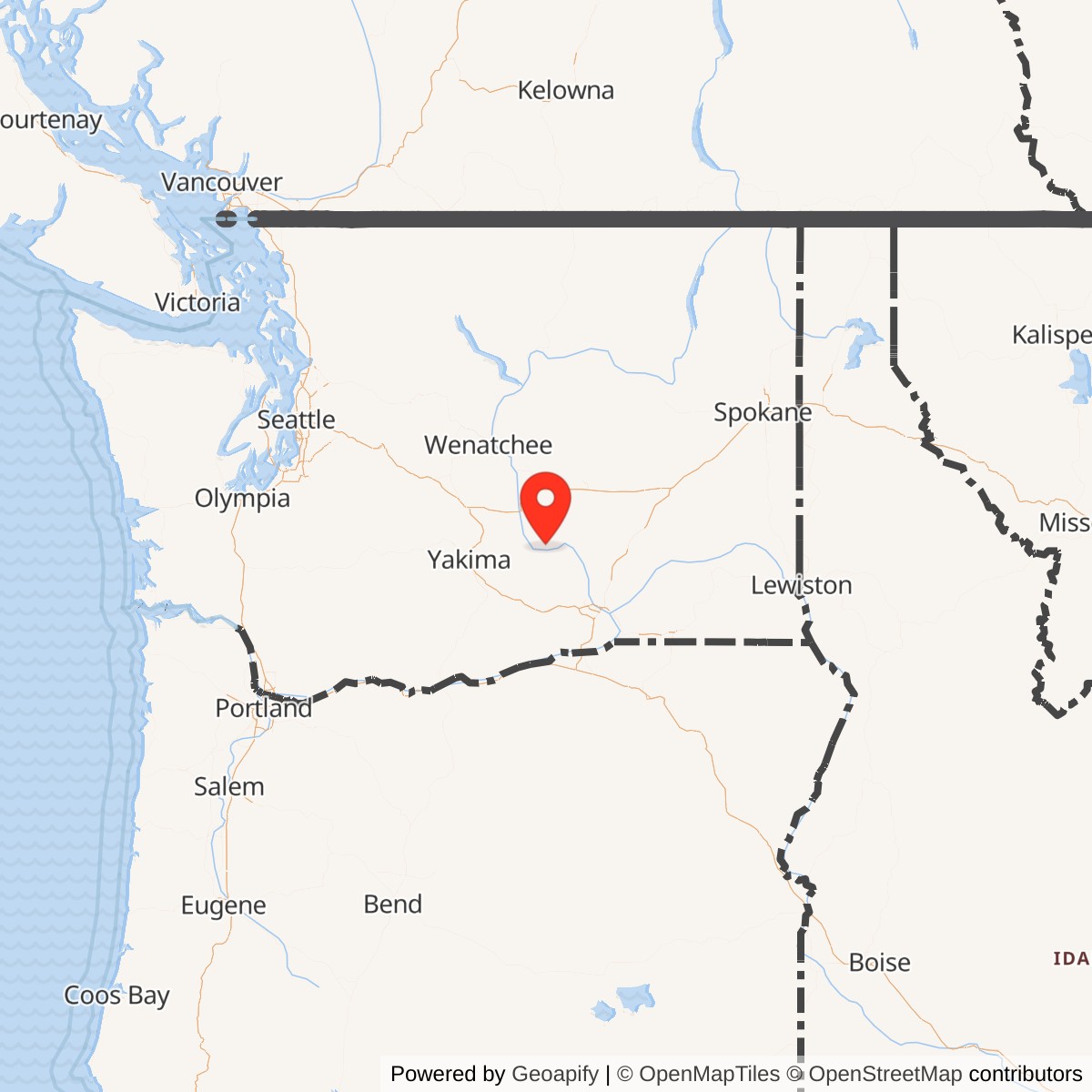
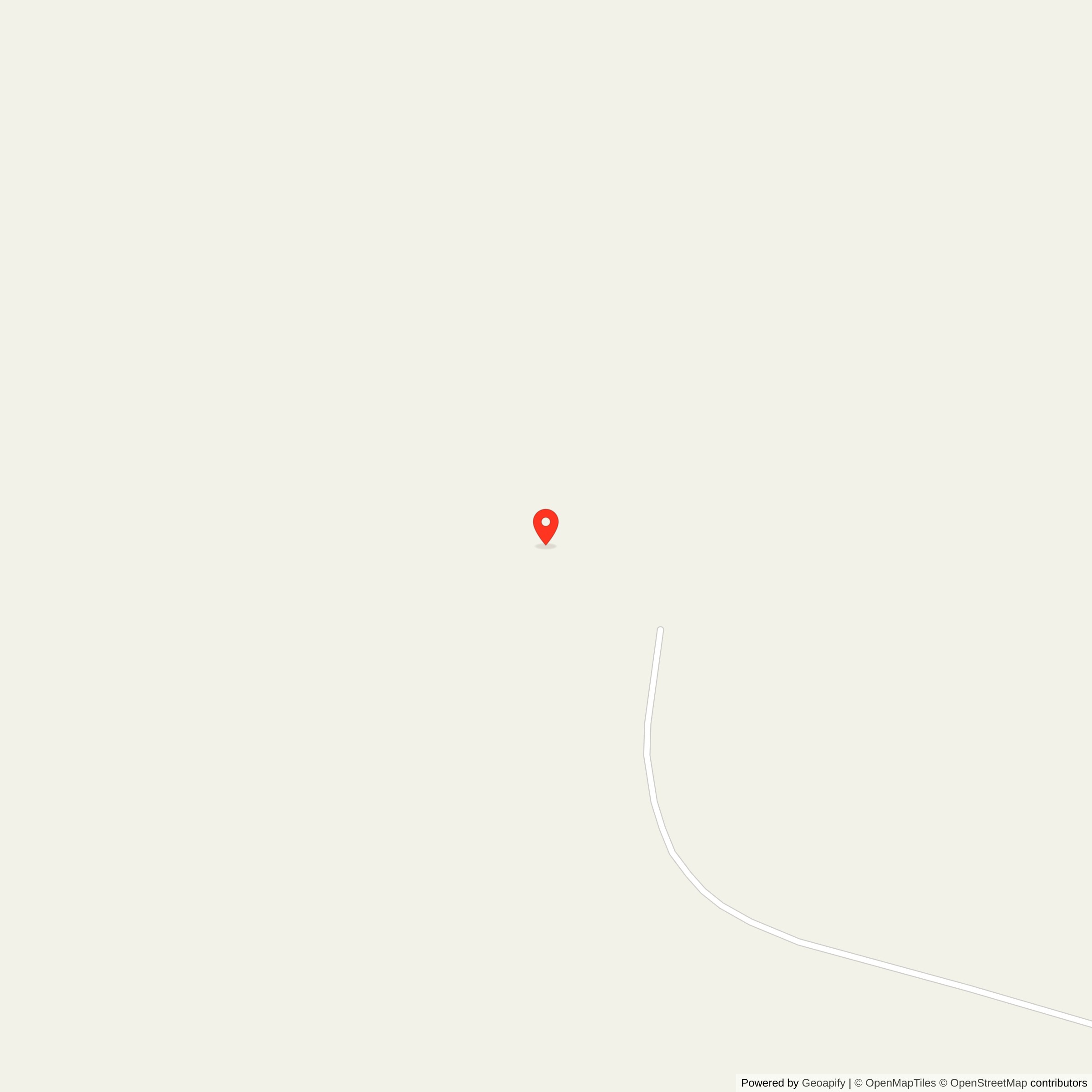
Nike Missile Site H-83 was a former U.S. Army Nike Ajax surface-to-air missile installation in the Hanford Defense Area of south-central Washington. The site was located near Priest Rapids, on the northwestern / western side of the Hanford defensive ring, in the dry Columbia Basin landscape associated with the Hanford Site's North Slope / Wahluke Slope. It is no longer active as a military installation. H-83 entered active service in 1955 and was deactivated in December 1958. It was not converted to Nike Hercules.
H-83 was one of four Nike missile batteries established to defend the Hanford nuclear production complex. The other Hanford Defense Area Nike sites were H-06 at Saddle Mountain, H-12 at Othello, and H-52 at Rattlesnake Mountain. The four sites replaced and augmented an earlier ring of antiaircraft gun defenses that had protected Hanford's reactors, chemical separation plants, laboratories, fuel-fabrication facilities, administrative areas, and supporting transportation and utility infrastructure.
The site's historical importance comes from what it defended. Hanford was built during World War II as a Manhattan Project plutonium-production reservation. Its remote land, Columbia River cooling water, railroad access, and large security buffer made it suitable for producing plutonium at industrial scale. Hanford plutonium was used in the Trinity test and in the Nagasaki weapon, and after World War II the site remained central to the Atomic Energy Commission's Cold War nuclear-weapons production mission. In the early 1950s, before intercontinental ballistic missiles became the dominant strategic threat, planners treated Soviet long-range bombers as a major threat to critical U.S. military-industrial targets. H-83 existed to help prevent such aircraft from reaching Hanford.
Hanford and the Cold War Air-Defense Mission
The Hanford Site was not defended because it was a city. It was defended because it was a nuclear-weapons production landscape. During World War II, the Manhattan Engineer District and DuPont built Hanford to manufacture plutonium. The wartime complex included production reactors along the Columbia River, chemical separation plants, process support buildings, roads, railroads, security zones, construction camps, and the communities and workforce infrastructure required to support a vast secret industrial site.After the war, Hanford's role did not disappear. In 1947, the civilian Atomic Energy Commission took control of the Hanford Site from the Manhattan Engineer District, and Cold War weapons requirements led to further expansion. During the decade in which the Army guarded Hanford, eight of the site's nine nuclear reactors were operating. That placed Hanford among the most important nuclear-production targets in the United States.
The Department of Defense established antiaircraft artillery defenses around Hanford in 1951. This network was known as Camp Hanford and included AAA battery sites, base camps, and field headquarters. Camp Hanford was operated by the Sixth U.S. Army's 5th Artillery Air Defense Group and attached AAA battalions, with an estimated force of roughly 5,000 service members. The Army placed guns around the key Atomic Energy Commission areas: reactors, fuel processing, laboratories and fuel fabrication, and administration. These gun defenses were the immediate predecessor to the Hanford Nike missile system.
By the mid-1950s, guided missiles were replacing heavy antiaircraft guns in U.S. continental air defense. Nike Ajax gave the Army a radar-controlled missile that could reach higher, faster aircraft than conventional guns. At Hanford, three of the existing AAA positions were retrofitted with Nike missiles beginning in 1955, and a fourth Nike site was built at the base of Rattlesnake Mountain. H-83 was part of that transition from gun defense to missile defense.
Site Location and Setting
H-83 was associated with Priest Rapids, near the Columbia River corridor and the northwestern side of the Hanford reservation's defensive perimeter. The location placed the battery on or near the North Slope / Wahluke Slope, a large area north and northeast of the main Hanford production areas and across the Columbia River from many of the site's key facilities. The North Slope was historically tribal land and later included Euro-American homesteading before federal wartime acquisition in 1943 made it part of the Hanford security buffer.The landscape mattered. Nike batteries required both tactical siting and practical operating space. The IFC needed clear radar coverage and line-of-sight geometry. The launch area needed room for underground magazines, launchers, missile-handling surfaces, fuel and warhead handling, power generation, communications, roads, fencing, and crew support. At Hanford, the wide federal reservation and restricted security buffer allowed the Army to place missile batteries in locations that supported coverage of the nuclear complex without the land-use conflicts common around urban Nike sites.
The H-83 IFC lay south of the launch area, with both areas aligned near the same longitude. The launch area was north of the IFC, closer to the riverward / Priest Rapids side of the landscape. This separated layout was normal for Nike sites: the IFC acted as the tactical brain of the battery, while the launch area served as the physical missile magazine and firing point.
Site Layout and Facilities
H-83 followed the standard Nike split-site arrangement. The Integrated Fire Control area contained the radar, guidance, command, and communications equipment used to acquire targets, track hostile aircraft, track launched missiles, compute intercept geometry, and issue missile guidance commands. A Nike Ajax IFC area typically included acquisition radar, target-tracking radar, missile-tracking radar, fire-control computers, control vans or permanent control structures, generator support, communications lines, security fencing, and crew-support facilities.The launch area contained underground missile storage magazines and launch equipment. The Department of Defense inventory lists H-83 as Nike 2B/20A/8L-A. In plain terms, this indicates two Type B underground magazines, a nominal complement of twenty Nike Ajax missiles, and eight Ajax launchers. H-83 was therefore comparable to H-12 and H-52 in configuration: a two-magazine Ajax battery rather than a larger dual or Hercules-converted installation.
The launch area's daily purpose was readiness. Nike Ajax missiles were stored horizontally in underground magazines and brought to the surface by elevator when needed. Missiles required inspection, testing, electrical checks, missile-handling procedures, fueling and oxidizer support, warheading operations, and careful handling of fuels, fluids, solvents, batteries, and other support materials. At Hanford's Nike launch sites, these functions were supported by generator buildings, missile fueling and warheading facilities, missile assembly and maintenance buildings, pump houses, utilities, administrative buildings, housing, recreation facilities, and security perimeters.
Because Ajax was liquid-fueled, the battery also had a hazardous-material profile. The launch area needed procedures for handling missile fuel, oxidizer, solvents, and support fluids. This helps explain why the later environmental record for Hanford Nike sites includes concern over landfill areas, drywells, grease pits, fuel or utility features, buried demolition debris, and possible ordnance-related hazards.
How the Nike Ajax System Worked
Nike Ajax was a command-guided surface-to-air missile system. It did not operate like a modern self-contained homing missile. Instead, the ground system did the tactical work. Acquisition radar searched for and detected aircraft. Tracking radar followed the target. A separate radar tracked the missile after launch. A ground-based computer compared the target and missile tracks, calculated the intercept, and transmitted steering commands to the missile. When the missile reached the calculated intercept point, the ground system commanded detonation.This explains the importance of the IFC area. The launch area contained the missiles, magazines, and launchers, but the IFC controlled the engagement. Without radar tracking and computer guidance, the Nike Ajax missile could not perform its mission. At H-83, the IFC and launch area together formed one battery. The IFC watched and controlled; the launch area stored, raised, and fired the missiles.
Operational History
H-83 became operational in 1955 as one of the four Hanford Nike Ajax batteries. Its mission was to defend the Hanford nuclear production complex from bomber attack. The site was part of a distributed air-defense system rather than a self-contained large post. Headquarters and broader support functions were associated with Camp Hanford, while the missile battery itself was one part of the broader Hanford air-defense ring.The Department of Defense Legacy Program history states that Nike missiles replaced and augmented gun batteries previously installed to defend the Hanford nuclear industrial complex. It identifies four Nike Ajax sites activated in 1955: H-06 Saddle Mountain, H-12 Othello, H-52 Rattlesnake Mountain, and H-83 Priest Rapids. The same account notes that the latter three sites were deactivated in December 1958, because only Saddle Mountain was converted to Nike Hercules.
H-83 therefore had a short operational life. It served during the moment when Nike Ajax represented the Army's new answer to the bomber threat, but it was closed just as the Army was narrowing the Hanford Nike defense. This was not unusual. Across the United States, many early Ajax batteries operated only a few years before being closed, replaced, or consolidated as the Army fielded Nike Hercules and as strategic emphasis began shifting toward ballistic missiles. At Hanford, the decision was especially stark: four Ajax batteries came online in 1955, but only H-06 was retained long enough for Hercules conversion. H-12, H-52, and H-83 were all shut down in December 1958.
Units and Manning
H-83 was part of the Camp Hanford air-defense command structure. The broader Nike force at Hanford was associated with the 83rd Antiaircraft Artillery Missile Battalion and then the 1st Missile Battalion, 52nd Artillery, after the 1958 redesignation/reflagging period. Because H-83 closed in December 1958, its known Army manning falls within the transition from AAA missile battalion nomenclature to missile battalion artillery nomenclature.A secondary battalion-history compilation identifies Priest Rapids H-83 with Battery B after the 1st Missile Battalion, 52nd Artillery was activated at Camp Hanford on September 1, 1958.
Daily life for H-83 soldiers would have been shaped by isolation. Priest Rapids and the Wahluke Slope were not urban settings. Soldiers operated in a sparse, windy, hot-in-summer, cold-in-winter shrub-steppe environment. Duty centered on maintaining readiness: radar checks, generator maintenance, communications tests, launcher and elevator maintenance, missile inspection, security, drills, vehicle maintenance, and constant attention to a mission that might never be executed but had to be immediately available. These routines connected the remote desert battery to the national air-defense network and to the nuclear-weapons production infrastructure it protected.
Closure and Decommissioning
H-83 was deactivated in December 1958. The closure was part of the Hanford Defense Area's reduction from four Ajax sites to a single upgraded Hercules site at H-06 Saddle Mountain. H-83, H-12, and H-52 were not converted to Hercules. H-06 remained in operation until December 1960 and then the Hanford Nike mission ended.Camp Hanford's broader Army mission wound down soon afterward. Camp Hanford became an outpost of Fort Lewis in 1959. The remaining missile battalion and batteries were deactivated in 1960, and Camp Hanford officially closed on March 31, 1961. By that point, the strategic context had changed substantially. Nike Ajax had been built for the era of manned bomber attack; by the late 1950s and early 1960s, intercontinental ballistic missiles were reshaping continental defense planning. Nike missiles still remained in service elsewhere, especially Nike Hercules batteries near major cities and military installations, but Hanford no longer retained a separate active Nike defense.
Current Condition and Environmental / Cleanup History
H-83 is not active. The Department of Defense missile-site inventory lists both the control site and launch site as obliterated and under Department of Energy ownership.DOE and Hanford cleanup records provide additional detail on what "removed" meant in practice. North Slope cleanup documentation states that three Nike missile battery sites, H-06, H-12, and H-83, and seven antiaircraft battery sites were located on the North Slope. It describes remaining evidence of these military sites as reinforced-concrete foundation pads, scattered bottles and metal cans, gravel walkways, building rubble, drywells, and solid-waste landfill disposal areas. The same record explains that aboveground structures were demolished, many structures remained until demolition in 1974, and demolition debris was typically landfilled on site.
H-83-C, the IFC/control area, appears specifically in a Westinghouse Hanford ground-penetrating-radar survey. That report identifies H-83-C as a radar tracking site for a Nike missile installation. It states that buildings that previously occupied the area had been demolished and the remains buried on site, and that the GPR survey was undertaken to try to locate drywells shown on drawings. This is especially useful for H-83 because it confirms the function of the control area and documents the post-military disposition of at least some site features.
The H-83 launch area also appears in cleanup records. A North Slope cleanup action memorandum notes that limited geophysical surveys were performed at three landfill areas, including H-83-L. The survey identified anomalies, soil samples were taken, and the document states that no contamination above the listed applicable or relevant and appropriate requirements was detected during that sampling effort. The same broader cleanup record discusses common military-site debris, including oil and lubricant cans, paint cans, empty solvent cans, asbestos-transite siding, motor-pool features, drywells, possible ordnance concerns, and vehicle-maintenance features.
A more recent DOE NEPA notice, dated January 25, 2023, proposed investigation and repair of sinkholes and subsidence areas in soil caps covering three former Nike Missile Launch Sites: H-06-L, H-12-L, and H-83-L. The project title was "Nike Missile Launch Site Stabilizations." This confirms that the former H-83 launch area remains part of DOE's continuing site-stewardship and maintenance responsibilities, even though the military installation itself has been closed for decades.
Chronology
- 1943 The federal government acquired the Hanford area for the Manhattan Project, displacing local communities and restricting traditional land access.
- 1943-1945 The Manhattan Engineer District and DuPont built the Hanford plutonium-production complex.
- 1945 Hanford-produced plutonium was used in the Trinity test and the Nagasaki weapon.
- 1947 The Atomic Energy Commission took control of Hanford from the wartime Manhattan Engineer District.
- 1951 The Department of Defense established antiaircraft artillery defenses around Hanford's Atomic Energy Commission facilities.
- 1951-1961 Camp Hanford operated as the Army air-defense complex for the Hanford Site.
- 1955 The Army began replacing Hanford antiaircraft guns with Nike surface-to-air missiles.
- 1955 Nike Ajax Site H-83 at Priest Rapids became operational as part of the Hanford Defense Area.
- 1955-1958 H-83 operated as a Nike Ajax battery with two Type B underground magazines, twenty Ajax missiles, and eight Ajax launchers.
- 1958-09 The Hanford Nike battalion structure was in the period of redesignation/reflagging from the 83rd AAA Missile Battalion to the 1st Missile Battalion, 52nd Artillery.
- 1958-12 H-83 was deactivated. H-12 and H-52 were also deactivated; only H-06 Saddle Mountain was retained for Nike Hercules service.
- 1959-07-01 Camp Hanford became an outpost of Fort Lewis.
- 1960 The remaining Hanford missile battalion and batteries were deactivated.
- 1961-03-31 Camp Hanford officially closed.
- 1974 Many remaining North Slope military structures associated with antiaircraft and Nike sites were demolished, with demolition debris typically landfilled on site.
- 1989-1990 DOE investigations of the North Slope identified military and homesteading sites requiring evaluation.
- 1993 A ground-penetrating-radar survey was conducted at H-83-C to locate drywells shown on drawings and to investigate the demolished radar/control-site area.
- 1994 North Slope cleanup records documented H-06, H-12, and H-83 as Nike missile battery sites on the North Slope and described remaining military-site debris and features.
- 2023-01-25 DOE issued a NEPA categorical-exclusion notice for repair of sinkholes and subsidence areas in soil caps covering former launch sites H-06-L, H-12-L, and H-83-L.
- Present H-83 is inactive, closed, decommissioned, and removed/obliterated; the former site remains within the DOE/Hanford stewardship context.
List of all Nike Installations in Washington