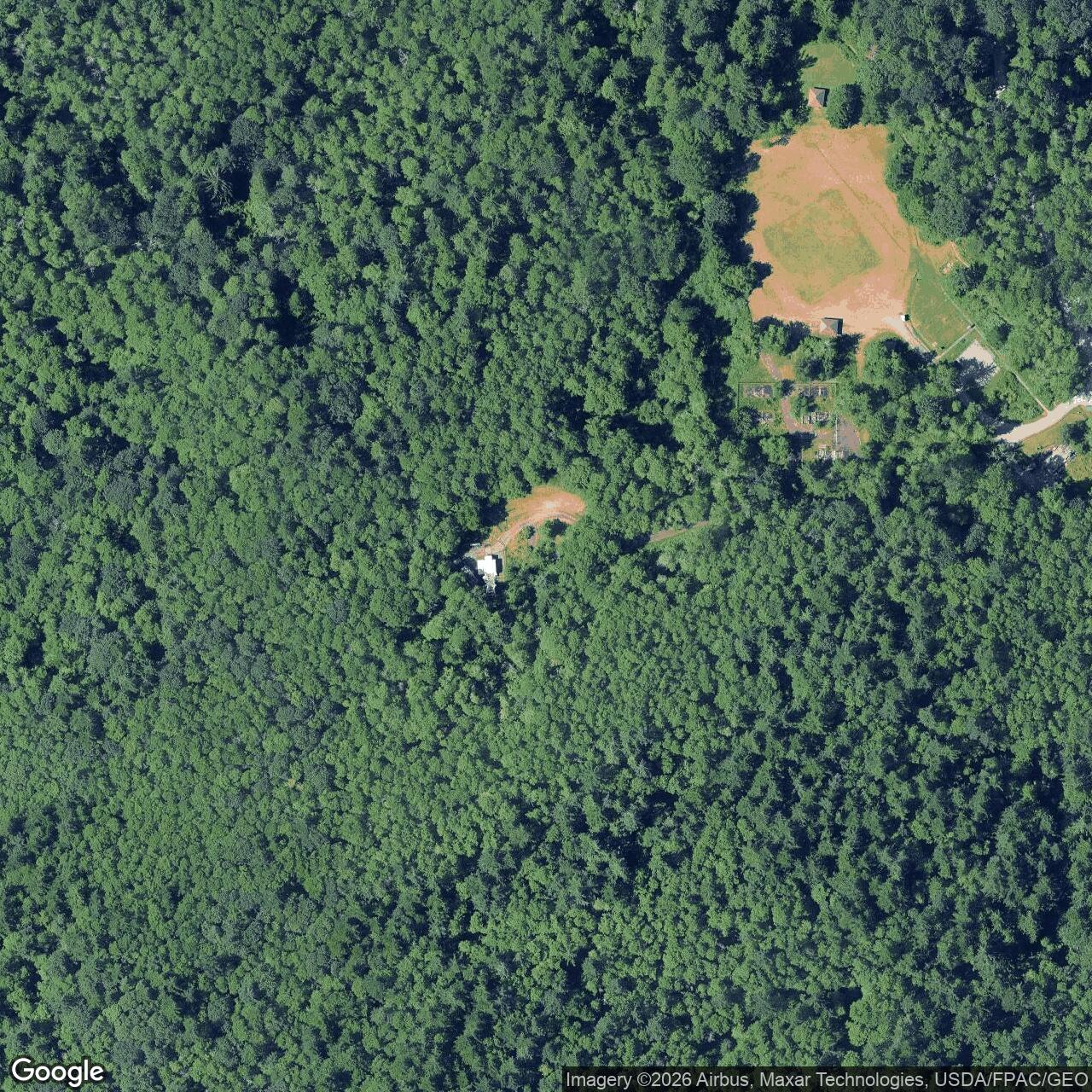
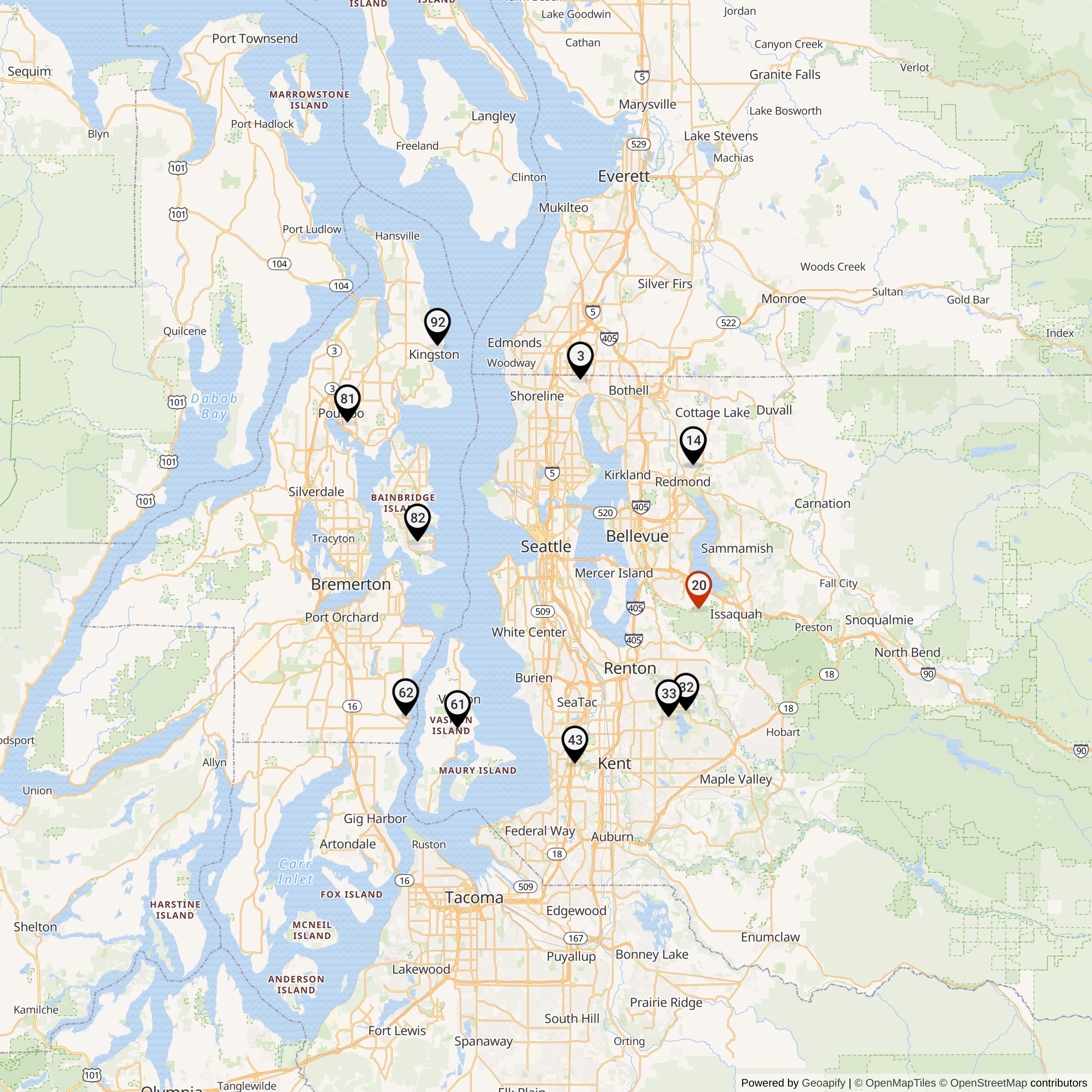
Nike Missile Site S-20 IFC, Cougar Mountain / Issaquah Washington
Longitude: -122.09965999926700
This location was part of the Seattle Defense Area
Site ID: S-20
This site controlled the missiles at the Launch Area located here.
Site Role: IFC
A typical Nike air defense site consisted of two separate parcels of land. One area was known as the Integrated Fire Control (IFC) Area. This site contained the Nike system's ground-based radar and computer systems designed to detect and track hostile aircraft, and to guide the missiles to their targets.
The second parcel of land was known as the Launcher Area. At the launcher area, Nike missiles were stored horizontally within heavily constructed underground missile magazines. A large, missile elevator brought the Nikes to the surface of the site where they would be pushed across twin steel rails to one of four satellite launchers.
Elaboration on how Nike worked here.
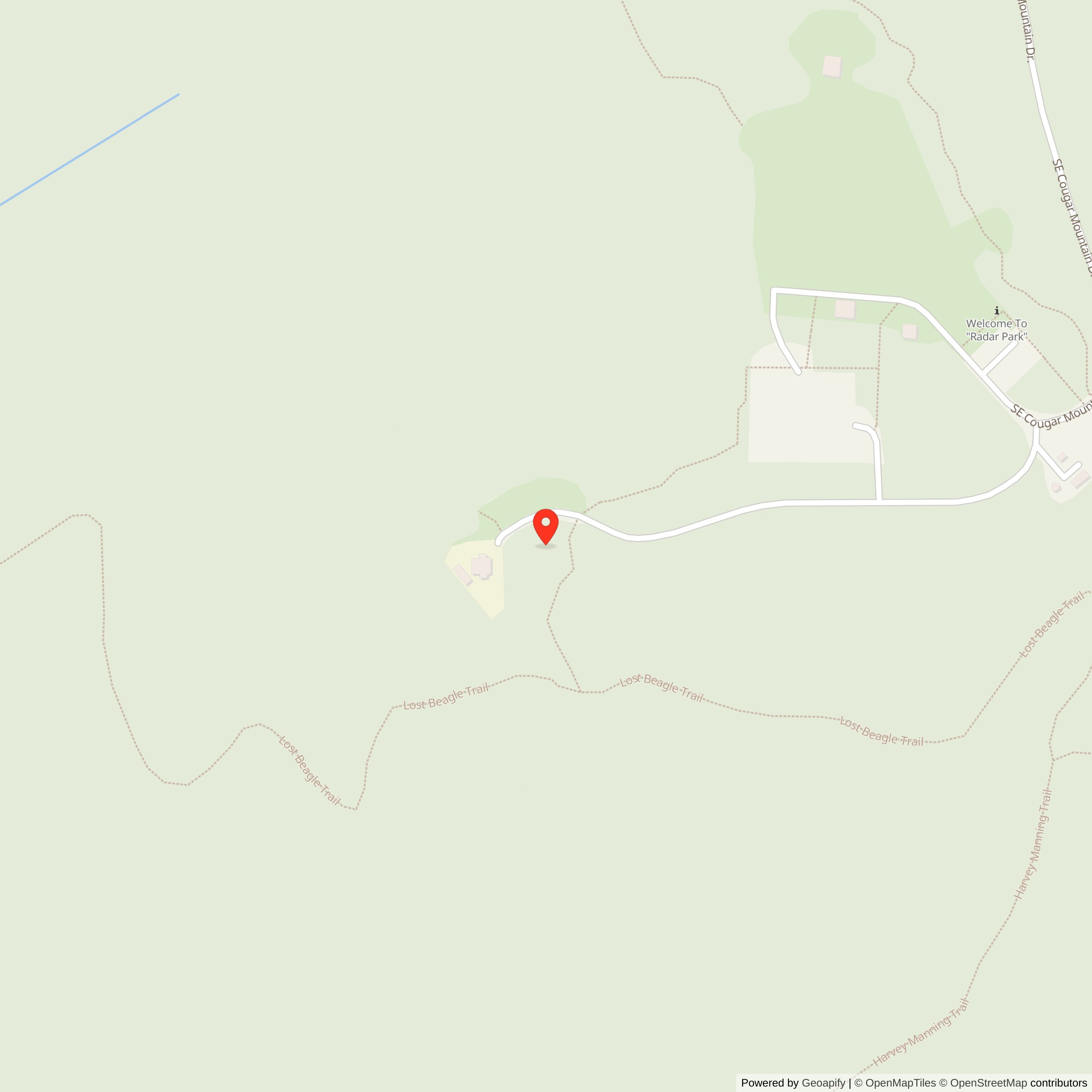
Nike Missile Site S-20 was a United States Army Nike Ajax surface-to-air missile battery on Cougar Mountain, southeast of Bellevue and west of Issaquah, Washington. It was part of the Seattle Defense Area, the ring of Cold War Nike sites built to defend Puget Sound's urban, industrial, military, port, and aircraft-production region from Soviet long-range bomber attack. S-20 was an Ajax-only site. It was not converted to Nike Hercules, and there is no verified evidence that it ever held nuclear-armed Nike Hercules missiles.
The site was active from 1957 to March 1964. Its federal inventory designation was Nike 2B/20A/8L-A, meaning an Ajax-era configuration with two underground magazine sections, about twenty Ajax missiles, and eight Ajax launchers. In practical terms, S-20 was a mid-1950s first-generation Nike battery placed on terrain that gave the Army both a radar advantage and a launch position within the eastern and southeastern sector of the Seattle-area defensive ring.
The IFC/control area was on or near the Cougar Mountain summit/Anti-Aircraft Peak area, later incorporated into Cougar Mountain County Park / Cougar Mountain Regional Wildland Park. The launcher area was roughly southeast of the control area, in the Clay Pit Road / 166th Way SE area, later also incorporated into the Cougar Mountain Regional Wildland Park landscape.
Location, Terrain, and Military Setting
S-20 occupied one of the most militarily useful pieces of terrain in the Seattle Defense Area. Cougar Mountain rises above the east side of Lake Washington and the Issaquah/Bellevue corridor. From a Cold War air-defense perspective, that elevation mattered. The Nike system required line-of-sight radar tracking, rapid communication between the IFC and launch area, and enough separation between the radar/control compound and missile magazines to allow safe and effective missile launch operations.The IFC/control area, placed high on Cougar Mountain, gave Nike operators a radar position with views over the eastern approaches to the Seattle metropolitan area. The launch area, lower and southwest/southeast of the control position depending on the access route, provided the acreage needed for underground missile magazines, launcher rails, assembly/test structures, ready rooms, and support facilities. The terrain was also historically complicated. Cougar Mountain had been a coal- and clay-mining landscape before it became parkland, and later King County archival material notes that Army contractors had to deal with old mine openings during the missile-site construction era. The combination of steep terrain, old industrial disturbance, forest cover, and Cold War construction makes S-20 one of the more layered Nike landscapes in Washington.
S-20's military purpose was not to defend Cougar Mountain itself. It existed because Cougar Mountain could support the defense of the Seattle-Puget Sound region. The Seattle area contained aircraft production, shipyard and port facilities, regional command and communications infrastructure, population centers, and military installations. Nike Ajax batteries such as S-20 were built around the metropolitan perimeter so that hostile aircraft could be detected, tracked, and engaged before reaching their intended targets.
Mission Evolution
S-20 belonged to the first operational phase of the Seattle Nike network. The Nike Ajax system was developed after World War II as a guided-missile replacement for gun-based antiaircraft defenses. Nike Ajax was designed to destroy high-flying bomber formations using radar guidance and a conventional fragmentation warhead. In the Seattle Defense Area, Ajax batteries were arranged around the region so that their engagement zones overlapped and covered approaches to the city, industrial districts, ports, airfields, and military facilities.S-20's mission was therefore straightforward: detect, track, and help intercept enemy aircraft approaching the Seattle area. In a Nike Ajax battery, the IFC controlled the engagement. Its acquisition radar detected aircraft; the target-tracking radar tracked the hostile aircraft; the missile-tracking radar tracked the launched Ajax; and the battery's analog computing equipment generated steering commands to guide the missile toward an intercept point. The launch area stored and launched the missiles. The two areas functioned as one weapon system, but each had a very different physical appearance and operational role.
The site did not follow the later path taken by Redmond S-13/S-14, Vashon Island S-61, and Kingston S-92, which were modernized for Nike Hercules and remained active until the 1970s. S-20 stayed an Ajax site and closed in March 1964. Its closure reflected the broader reduction of first-generation Nike Ajax sites as the Army shifted to fewer, more capable Hercules batteries and as national air-defense priorities changed. By the early 1960s, the primary strategic threat was increasingly understood to include ballistic missiles, against which Nike Ajax could do nothing. Nike Ajax remained a bomber-defense weapon, and Ajax-only sites that were not upgraded became increasingly vulnerable to early closure.
Site Layout and Facilities
S-20 followed the standard split layout of a Nike battery.The IFC/control area was the command and radar site. It would have included radar pads and towers or mounts, battery-control equipment, administrative and support structures, communications facilities, and living/support functions as required by the site's staffing pattern. The IFC's elevation was central to its role. From this area, operators watched radar scopes, identified and tracked targets, coordinated with higher air-defense command channels, and controlled the missile after launch.
The launcher area held the missiles. A Nike Ajax launch area normally included underground magazines with elevator platforms, launcher rails, missile assembly and test facilities, fueling and warheading support areas, generator or utilities support, security fencing, and roads sufficient for military vehicles and missile-handling operations. The federal listing identifies S-20 as an Ajax configuration with eight launchers. The launch area was in the Clay Pit Road / 166th Way SE vicinity, where later park access and trails brought the former missile landscape into public recreational use.
Operational History
1957-1964 was S-20's operational period. During that time it served as an Ajax battery in the Seattle Defense Area. S-20 would have been integrated into the Army air-defense command structure that linked Nike batteries to regional air-defense surveillance and command systems. Its crews trained to maintain a high state of readiness, respond to alerts, track simulated or real aircraft, and prepare missiles for launch under tight time limits.Daily operations at S-20 would have included radar maintenance, launcher and elevator maintenance, missile inspection, warhead and propulsion safety procedures, communications checks, security patrols, generator and utility support, and repeated drills. The Nike Ajax system was complex and labor-intensive. The missile used a booster and sustainer arrangement and was stored in underground magazines. Crews had to raise missiles to the surface, move them onto launchers, test systems, coordinate engagement data from the IFC, and maintain secure control of the launch area. Although the site never fired in combat, its function depended on constant training and readiness.
The location on Cougar Mountain also placed S-20 in a landscape that was visibly separate from the city it protected, yet close enough to be part of the greater Seattle metropolitan region. Like many Nike sites, it was both a military installation and a local landmark. The Army's presence added a Cold War layer to a mountain already associated with mining, quarrying, timber, and rural settlement.
Closure
S-20 closed in March 1964. The immediate reason was the Army's reduction of Ajax-only sites as the national Nike network shifted toward fewer Hercules-capable batteries. In the Seattle Defense Area, that meant longer-lived Hercules service at selected sites, while Ajax-only positions such as S-20, S-03, S-32/S-33, S-43/S-45, S-62, S-81, and S-82 were closed earlier.S-20's closure did not mean the end of the Seattle Defense Area. Other sites continued to operate, and Hercules-capable batteries remained active into the 1970s. S-20's closure instead marks the end of Cougar Mountain's direct role as an operational Army missile battery.
Post-Closure Reuse and Present Condition
S-20's post-closure history is unusually important because the former missile installation became part of one of King County's major public-park landscapes. HistoryLink states that in 1983 the control and launch areas were turned into Cougar Mountain County Park and Cougar Mountain Regional Wildland Park, respectively. King County Archives describes the former Cougar Mountain Nike areas as part of the public-recreation transformation of former military and industrial land.The King County Archives account is especially useful because it connects the missile landscape to both earlier mining history and later environmental work. It notes that Cougar Mountain had been a coal-mining landscape, that the S-20 launch and control sites became park areas after deactivation, and that a 1993 project involving Parks, the Army Corps of Engineers, and contractors removed some remaining buildings, pumped water from missile vaults, and seeded the launch area. That work helps explain why older federal summaries could describe partial remains while later park users see little or nothing that obviously reads as a Nike launcher.
Chronology
- 1950-1954: The United States accelerated continental air-defense planning as the Soviet bomber and atomic-bomb threat became central to Cold War defense policy.
- 1954-1956: The Seattle Defense Area Nike network was planned and built around Puget Sound's urban, military, and industrial region.
- 1957: Nike Site S-20 became operational on Cougar Mountain/Issaquah as a Nike Ajax battery in the Seattle Defense Area.
- 1957-March 1964: S-20 operated as an Ajax-only air-defense missile site with a separate IFC/control area and launcher area.
- Late 1950s-early 1960s: Selected Seattle-area Nike batteries were converted to Nike Hercules, but S-20 was not converted.
- March 1964: S-20 was deactivated as part of the phaseout of Ajax-only sites.
- 1960s-1980s: The former site passed through federal disposal and local park-acquisition processes, eventually becoming part of the Cougar Mountain public-park landscape.
- 1983: The control and launch areas were incorporated into Cougar Mountain County Park / Cougar Mountain Regional Wildland Park.
- 1993: King County Parks, the U.S. Army Corps of Engineers, and contractors carried out environmental and site-work activities at the former Cougar Mountain Nike areas, including removal of some buildings, pumping water from missile vaults, and seeding the launch area.
- Present: The former S-20 landscape is part of Cougar Mountain Regional Wildland Park. The Nike-era military function has ended; the site is closed as a military installation and is reused as public parkland, with few or no obvious surviving Nike features visible to casual visitors.
List of all Nike Installations in Washington