
Titan I 569-B Missile Silo Mountain Home AFB Idaho
Titan I 569-B
Squadron: 569th SMS
Date Activated: June 1st 1961
Date Deactivated: June 25th 1965
Air Force Base: Mountain Home
State: Idaho
Nearest Town: Oreana
Coordinates:
Latitude: 43° 3'59.10"N
Longitude: 116°15'49.49"W
Decimal:
Longitude: -116.263747
Latitude: 43 3.985
Longitude: -116 15.8248333333333
3 silos
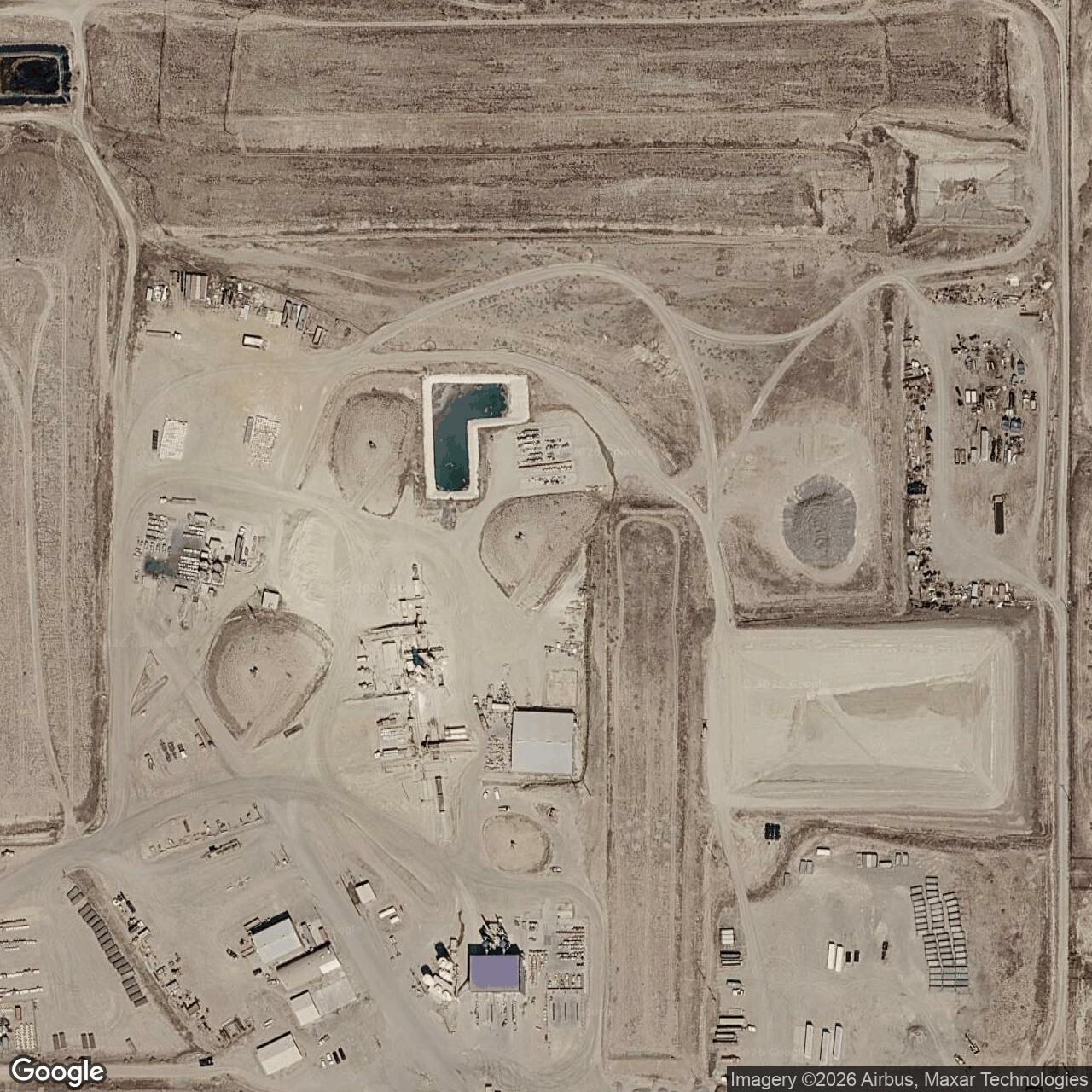
Former Titan I Missile Complex with the 569th Strategic Missile Squadron. This site is also being used for hazardous waste storage. All above ground structures were demolished.
Read about the Titan I at Mountain Home AFB
List of all Titan I site Coordinates
Detailed information about the Titan I Intercontinental Ballistic Missile can be found here.
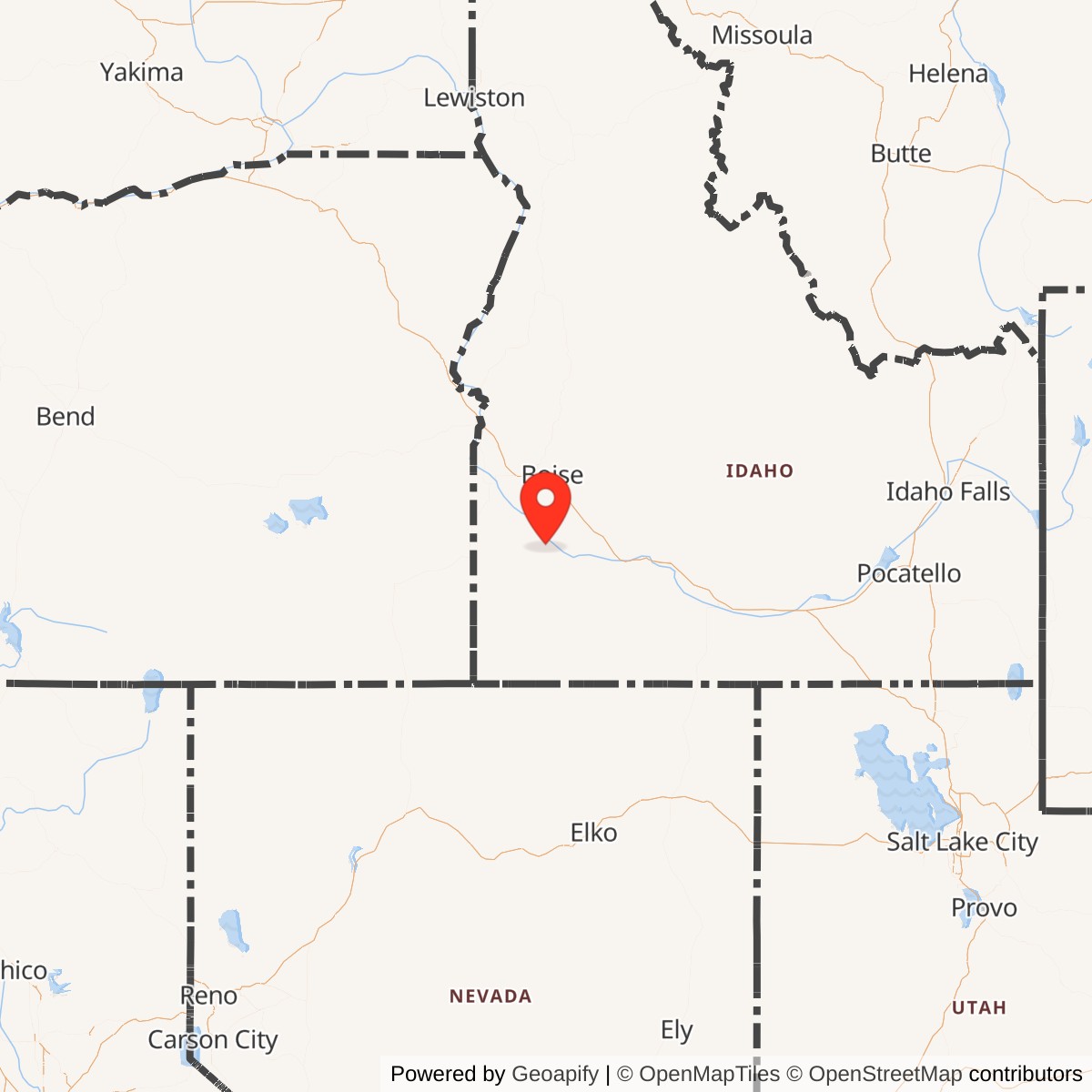
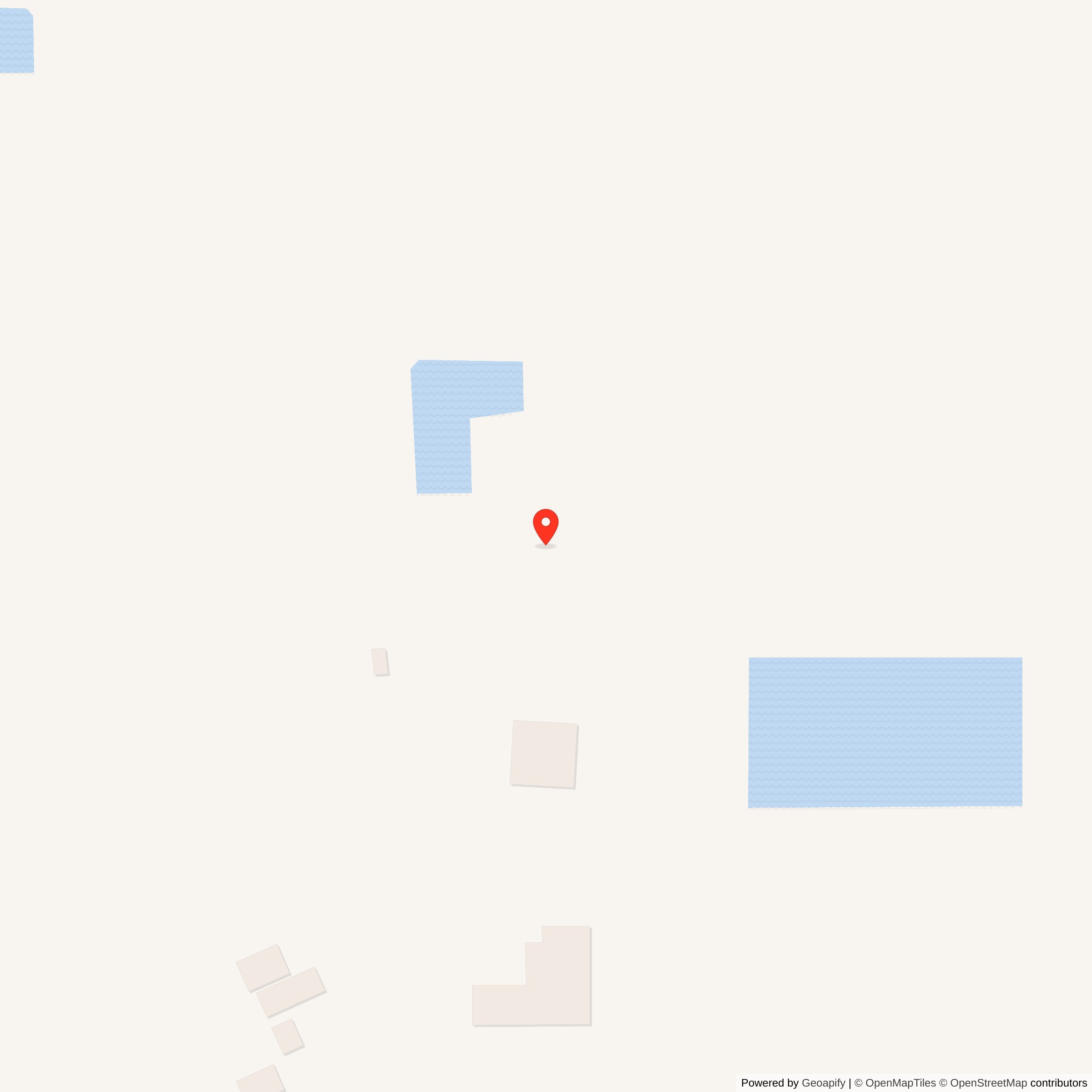
Overview
Titan I Missile Complex 569-B was the western launch complex in the three-site Titan I field controlled by the 569th Strategic Missile Squadron at Mountain Home Air Force Base. It stood in Owyhee County about seven miles east of Oreana and roughly ten and one-half miles west of Grand View. Three HGM-25A Titan I missiles, underground launchers, a control center, powerhouse, guidance antenna silos, propellant and equipment rooms, utility shafts, communications, security works, and crew spaces formed one-third of Mountain Home's nine-launcher force.The site's military career was brief but nationally significant. Construction began in 1960, the Idaho field became operational in August 1962, and the squadron stood alert during the Cuban Missile Crisis. Titan I's demanding liquid-oxygen system and above-silo launch procedure soon became obsolete. The 569th Strategic Missile Squadron was inactivated on June 25, 1965, and Air Force records identify disposal of the detached Oreana installation in May 1972.
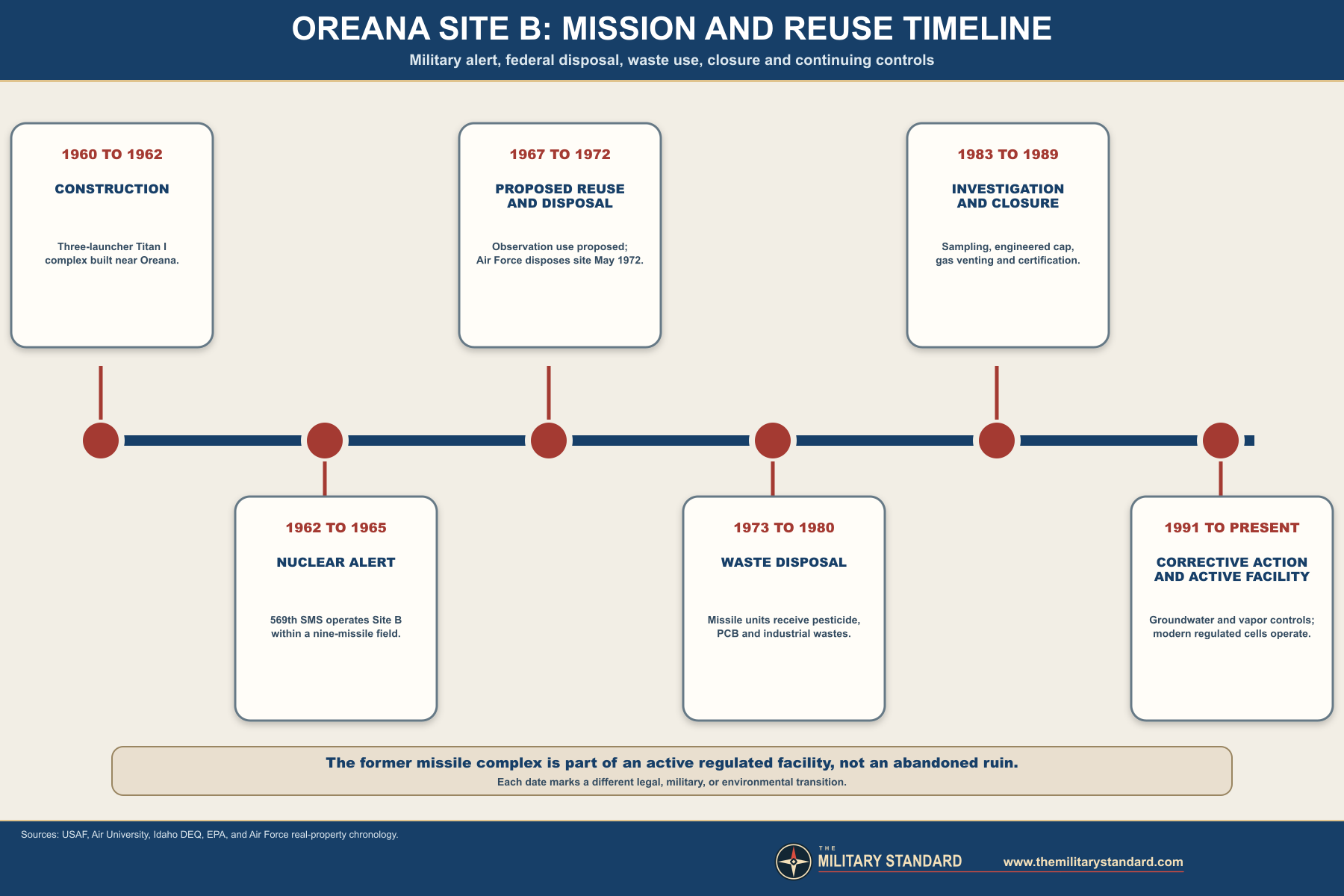
Complex 569-B then acquired an unusually consequential second history. Western Containment, commonly identified as Wes-Con, purchased the former complex in 1972. A county conditional-use permit issued in June 1973 allowed pesticide-waste disposal in the decommissioned Titan structures, and disposal began in November 1973. Pesticide process wastes dominated the early receipts, but the site also received PCB wastes, laboratory wastes, electroplating sludges, and other industrial materials. Missile silos, antenna silos, the control center, elevator shaft, powerhouse, vault, exhaust and intake shaft, trenches, pits, and ancillary areas became regulated or investigated waste-management units.
The former missile units stopped receiving waste by November 1980 and therefore became pre-RCRA units. They were filled, covered, and placed beneath an engineered cap in 1989. The active facility surrounding them continued under later owners and today operates as U.S. Ecology Idaho Site B. EPA records identify it as a hazardous and PCB waste treatment, storage, and disposal facility. The buried Titan plant is therefore neither a preserved museum nor an abandoned site. It is part of a controlled industrial property with continuing monitoring, cap maintenance, groundwater obligations, and vapor collection through activated-carbon canisters.
Installation Identity, Location, and Boundaries
The permanent project identity is Titan I Missile Complex 569-B. Its parent is Mountain Home Air Force Base. Air Force sources use Mountain Home Air Force Missile Site No. 2, Oreana, Site B, and 569-B. Environmental records use U.S. Ecology Idaho Site B and EPA ID IDD073114654. These names describe the same physical complex in different administrative eras.The EPA Facility Registry Service gives the current facility address as 20400 Lemley Road, Grand View, Idaho. Oreana remains the historically associated community, while Grand View is the current postal address.
The official facility plan identifies the former Titan structures within a much larger modern disposal property. It shows three closed silo-complex areas, two former antenna silos, the former control center, powerhouse, elevator and exhaust or intake shafts, historic trenches and pits, monitoring features, and later engineered disposal cells.
No located source established one reliable acreage that can represent the original federal acquisition, the operational security compound, and the modern permitted facility. Those are different legal and functional footprints. Acreage is therefore reported as unknown rather than copied from a commercial listing or inferred from a map.
The current property is an active, secured waste-management facility. Public-road proximity and the survival of buried Cold War structures do not create public access. Coordinates are provided for historical identification only.
The Oreana Landscape
Complex 569-B occupied the Snake River Plain margin in rural Owyhee County between Oreana and Grand View. The open, sparsely populated landscape provided the separation that Strategic Air Command required between launch complexes and between the missile field and Mountain Home Air Force Base. Dispersal reduced the chance that one attack could destroy all nine missiles assigned to the squadron.Isolation imposed costs. Crews, guards, technicians, contractors, spare parts, food, and emergency support traveled long rural routes. Water, communications, commercial power, backup generation, drainage, and all-weather roads had to support a self-contained underground installation. Official Mountain Home history records deep wells, difficult geology, material-shipping problems, labor shortages, weather delays, strikes, and design changes across the Idaho field.
The later waste facility used the same isolation for a different purpose. The underground volume of the missile plant, distance from population centers, and surrounding industrial buffer made Site B attractive for hazardous-waste handling. That reuse also created a layered landscape in which closed military structures lie beneath caps near active engineered cells and support facilities.
The official permit record, not casual surface appearance, governs interpretation. Former launch areas may resemble low mounds or graded ground, while environmental systems such as wells, gas vents, drainage controls, and access restrictions carry the site's continuing legal and safety functions.
The Mountain Home Titan I Field
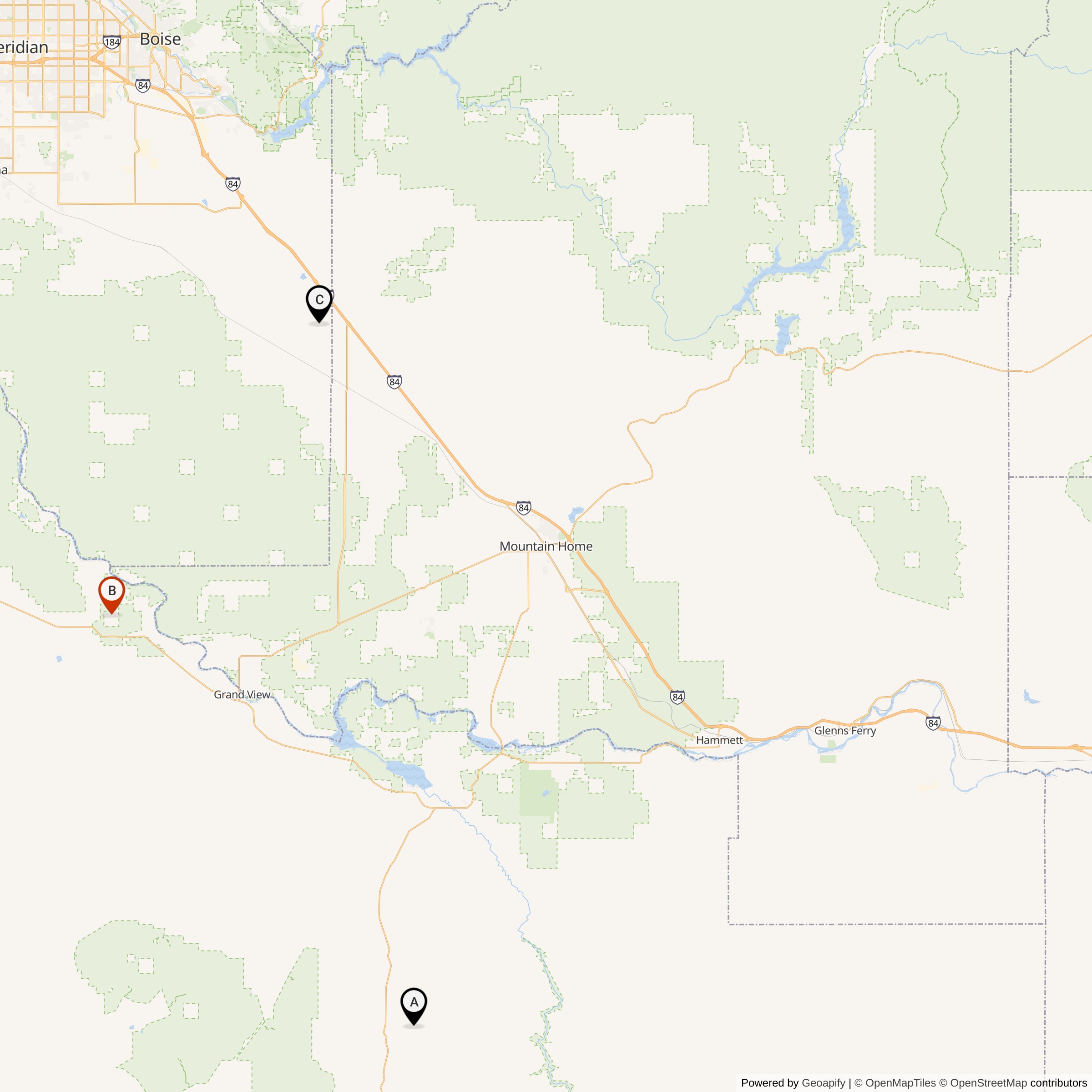
Mountain Home supported three standardized three-launcher Titan I complexes: 569-A near Bruneau, 569-B near Oreana, and 569-C near Orchard and Boise. Together they provided nine launchers for the 569th Strategic Missile Squadron. The sites were remote installations tied to Mountain Home AFB for command, maintenance, security, training, housing, logistics, and administration.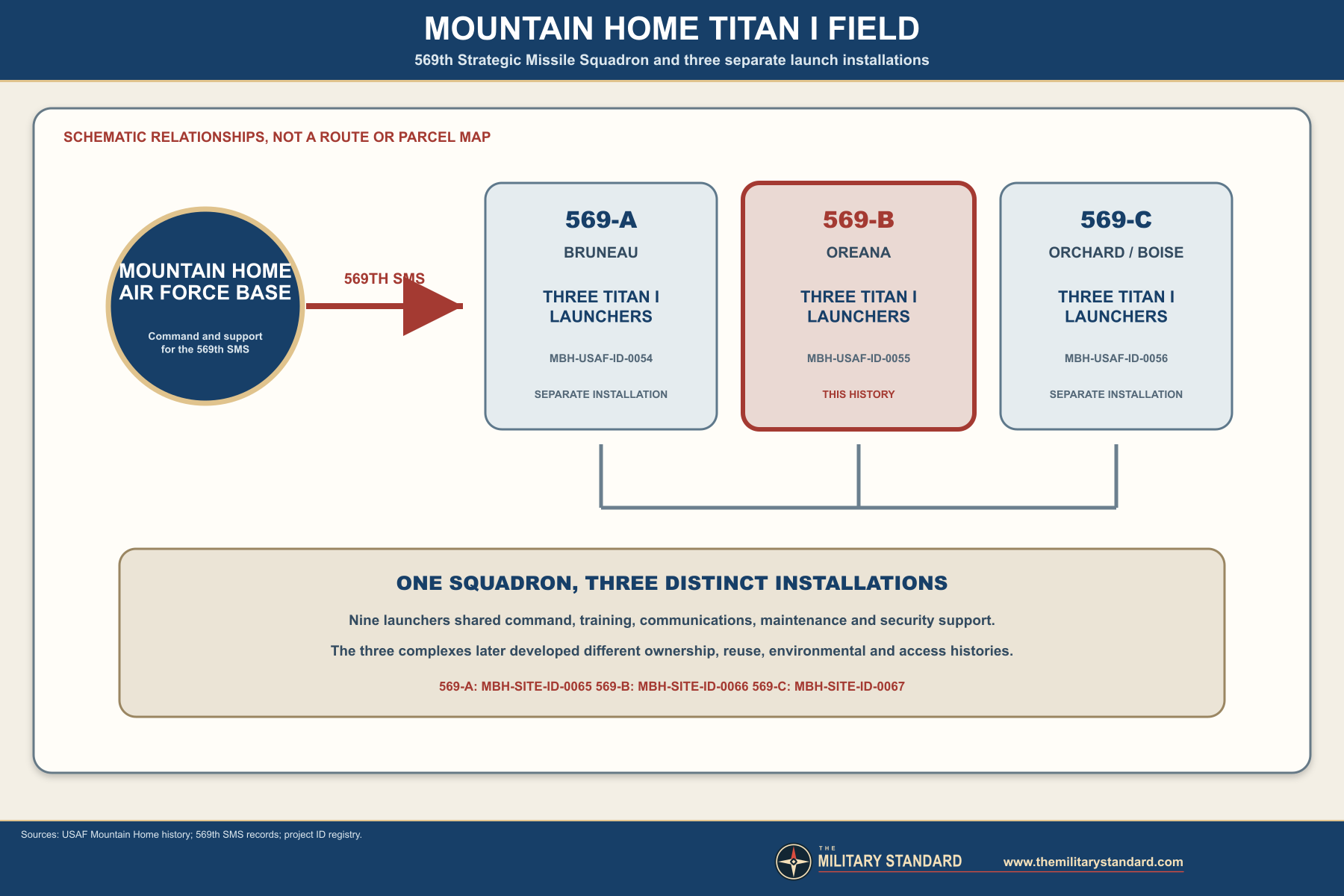
The 9th Bombardment Wing provided the parent organization when the missile mission arrived. The Air Force redesignated it the 9th Strategic Aerospace Wing in April 1962 to reflect combined bomber, tanker, and missile responsibilities. Mountain Home's B-47 and KC-97 missions continued while the underground field entered service.
Official base history states that construction began in 1960 with an initial field-wide estimate of $28.9 million and grew beyond $51 million because of labor shortages, shipping costs, weather, strikes, and design changes. Three workers died during the Idaho program. The reviewed source does not assign those deaths or cost increments to a particular site, so they remain field-wide facts.
The 569th was the last Titan I squadron activated by Strategic Air Command. Its late place in the deployment sequence produced a short operating life, but not an unimportant one. The field entered service shortly before the Cuban Missile Crisis and remained part of the national deterrent until the accelerated Titan I retirement.
Design, Contracting, and Construction
Construction of the Mountain Home field began in 1960 after late-1950s planning and site investigation. Contractors used the standard Titan I cut-and-cover method: excavate immense pits, build reinforced-concrete and structural-steel rooms and shafts, install machinery and utilities, connect the structures with tunnels, and backfill until relatively little remained above ground.The official base history states that all three Idaho complexes were complete before April 1, 1962. Completion of concrete and earthwork did not equal combat readiness. Elevators, doors, power systems, liquid-oxygen equipment, guidance electronics, communications, alarms, launch consoles, and government-furnished missile equipment still required installation, calibration, integrated testing, and acceptance.
Site B's later permit record preserves detailed evidence of the original plant. The missile branch for each of the three launchers included a main silo approximately 40 feet in diameter and 160 feet deep, a propellant room approximately 40 feet in diameter and 35 feet deep, an equipment room approximately 42 feet in diameter and 68 feet deep, and an exhaust vent approximately 9.5 feet in diameter and 57.5 feet deep. The maximum reported disposal volume for each entire silo branch was about 12,566 cubic yards, with a 12,556-cubic-yard value reported for Silo 2.
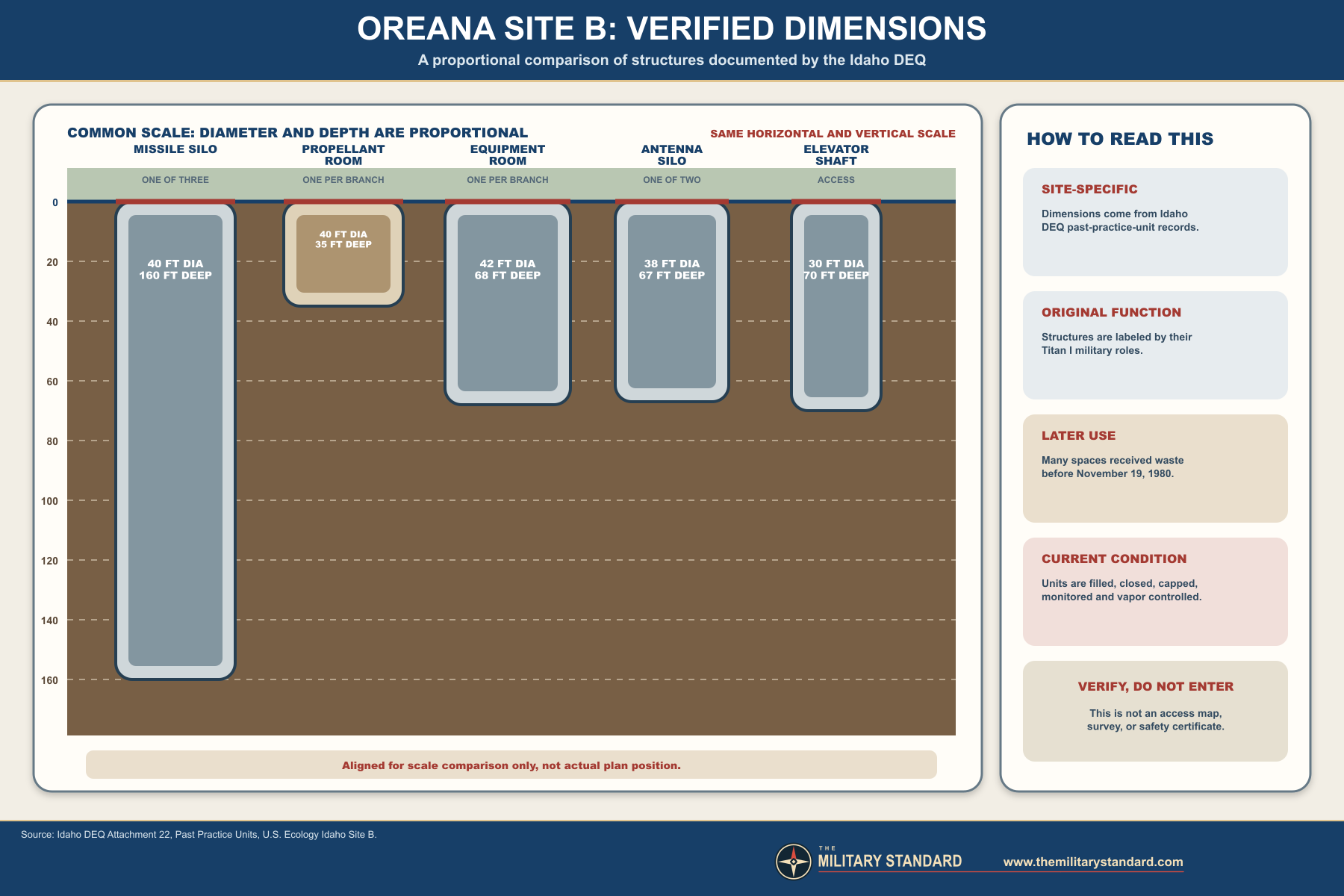
Two antenna silos were approximately 38 feet in diameter and 67 feet deep, each with about 2,815 cubic yards of reported disposal capacity. The control center was approximately 100 feet in diameter and 40 feet deep, with 8,148 cubic yards of reported capacity. The elevator shaft was approximately 30 feet in diameter and 70 feet deep, while the exhaust and intake shaft was approximately 27 feet in diameter and 40 feet deep.
The powerhouse was an especially large circular underground space, approximately 130 feet in diameter and 60 feet deep. The permit table assigns it no disposal-capacity figure, even though waste-placement records give a last-use date. An electrical vault, tunnels, utility spaces, cable passages, and access corridors completed the buried plant.
These dimensions come from the environmental record created after military use. They are highly valuable but describe units as managed during the disposal and closure era. They should not be treated as a complete as-built engineering drawing of every Cold War component.
Standard Underground Design and Surface Layout
No complete site-specific measured drawing of 569-B was located. Its documented three-launcher role and membership in the standardized Mountain Home field permit the use of established Titan I engineering as a strong analogue, but not as a claim that every dimension or later alteration at Oreana matched another surveyed complex. The accompanying layout graphic is therefore labeled representative standard configuration and not a 569-B as-built survey.The underground plant centered on a protected access route, launch control center, powerhouse, utility spaces, antenna terminal, and connecting junctions. The control center housed command consoles, status displays, communications, authentication materials, and crew working space. The powerhouse held diesel generators and electrical distribution equipment so the site could operate after losing commercial power. Ventilation, cooling, water, sewage, compressed air, and hydraulic systems supported both the weapon and the people assigned to it.
Three launcher branches extended from the central area. Each branch incorporated an equipment terminal, a propellant terminal, connecting tunnels, and a missile silo. The equipment terminal supported the launcher elevator and associated machinery. The propellant terminal handled RP-1 kerosene fuel and liquid oxygen equipment. The silo contained the missile on a large elevator beneath paired doors. Titan I could not launch from inside the silo. It had to be fueled, raised into the open, and fired from the surface.
Two retractable guidance antennas occupied protected antenna silos. Titan I carried inertial instruments but relied on radio corrections transmitted from the ground during early flight. Redundant antennas reduced the risk that a single failure would prevent guidance support. Their presence explains why a Titan I complex contained multiple large shafts in addition to the three missile silos.
Surface features included security fencing, access and patrol roads, launcher doors, antenna doors, vents, hatches, utility structures, orientation and survey features, drainage works, and support areas. Salvage, private reuse, weather, standing water, and environmental investigation may have changed many of those elements. Historic design cannot establish current structural condition.
The HGM-25A Titan I was a two-stage liquid-propellant missile approximately 98 feet long. Both stages burned RP-1 kerosene and liquid oxygen. A nuclear reentry vehicle gave the missile its strategic effect, while engines, airframe, inertial components, radio guidance, communications, and launch equipment came from a national contractor network. At 569-B, these elements operated as one system. The missile could not fulfill its mission without the site's power, oxidizer plant, elevators, doors, antennas, crew, and authenticated command link.
Liquid oxygen governed readiness. Its extremely low temperature and continual boil-off prevented long-term storage aboard the missile, so the launch sequence included oxidizer loading. Crews treated oxygen equipment as surgically clean because oil, dirt, or incompatible material could cause fire or explosion. HAER interviews describe cleanliness standards below 150 microns, pressurized clean rooms, vapor degreasing, caustic cleaning, black-light inspection, and repeated checks. Liquid nitrogen, high-pressure nitrogen and helium, diesel fuel, hydraulic fluid, lubricants, batteries, and other industrial materials added more hazards.
Propellant Loading Exercises tested every missile on a roughly 90-day cycle, which meant approximately one exercise each month at a three-launcher complex. The procedure forced operations and maintenance personnel to verify tanks, pumps, lines, valves, sensors, timing, and emergency actions under conditions approaching a real countdown. These exercises were essential because Titan I's deterrent value depended on machinery that normally remained idle. They also placed sustained demands on the environmental, safety, and waste-handling systems later examined during cleanup.
A launch order required authenticated messages and controlled cooperation by trained crew members. Once the sequence began, the system loaded liquid oxygen, checked missile and site status, opened the selected silo doors, raised the missile on its elevator, deployed a guidance antenna, and completed ignition preparations. The three missiles could be launched in sequence. Titan I was dramatically faster than an aircraft-delivered weapon, but the fueling and elevation process left it more exposed and slower to respond than the later Titan II and Minuteman systems that launched directly from closed, fueled or solid-propellant silos.
Site Activation and Acceptance
The 569th Strategic Missile Squadron was organized at Mountain Home Air Force Base on June 1, 1961. The first Titan I missiles arrived in April 1962. Contractors and Air Force activation teams then completed installation, calibration, integrated testing, practice countdowns, and turnover of the three complexes.Idaho's Titan field was publicly declared operational on August 16, 1962, during a ceremony involving Senator Len B. Jordan. The declaration applied to the Mountain Home field and squadron. The reviewed official and secondary sources do not prove that every technical acceptance action at 569-B occurred on that exact day, so the date is labeled as a field-level operational milestone.
Activation required far more than placing missiles into silos. Elevators, doors, oxidizer systems, power generation, environmental controls, guidance antennas, communications, alarms, security systems, and launch consoles had to function together. Crews practiced normal and emergency procedures while maintenance specialists resolved deficiencies.
The declared operational date came less than two months before the Cuban Missile Crisis. The short interval illustrates the speed with which the new force moved from construction into national alert responsibility. It also explains why precise distinctions among construction completion, contractor acceptance, Air Force turnover, operational declaration, first alert, and individual missile status are necessary.
Organization and the 569th Strategic Missile Squadron
The 569th Strategic Missile Squadron traced its lineage to the 569th Bombardment Squadron. It was redesignated for the intercontinental ballistic missile mission, activated in December 1960 without immediate organization, and organized at Mountain Home on June 1, 1961. It operated the HGM-25A Titan I under the 9th Bombardment Wing and then the 9th Strategic Aerospace Wing.The squadron used a three-by-three deployment. Complexes 569-B, 569-B, and 569-C each held three launchers. A crew at Oreana controlled one complete three-missile complex, while squadron leadership, maintenance, security, communications, and parent-wing support connected the three remote installations to Mountain Home AFB.
Personnel trained in nuclear command and control, authentication, console procedures, liquid-oxygen safety, electrical and hydraulic systems, guidance, communications, security, fire protection, and emergency response. Titan I's labor-intensive design required extensive daily surveillance and periodic propellant-loading exercises.
The missile squadron was part of a broader Strategic Air Command installation. The 9th wing also operated alert bombers and tankers. The combined mission produced the 1962 Strategic Aerospace Wing designation, but Oreana remained a distinct remote launch installation rather than a section of the airfield property.
Alert Operations
Alert duty combined routine checks with readiness for an event of extraordinary consequence. Crews monitored status lights, communications, environmental controls, electrical systems, security reports, and missile condition. They maintained logs, ran prescribed tests, and followed two-person control procedures. Security forces controlled entry and patrolled the surface, while maintenance teams responded to equipment discrepancies without compromising nuclear surety.The underground complex was designed to continue functioning after outside utilities failed. Diesel generation, stored supplies, filtered ventilation, protected communications, and hardened access supported survivability. Hardening did not make the installation invulnerable. Its dispersal, burial, blast-resistant construction, redundancy, and rapid launch sequence together sought to preserve retaliatory capability long enough to deter attack.
Titan I's cryogenic design placed a special burden on alert operations. Liquid oxygen could not remain indefinitely in the missile. A launch order would initiate a controlled sequence involving authentication, system checks, propellant loading, guidance preparation, silo-door operation, elevator movement, and surface launch. The need to raise the missile left the weapon exposed during the final sequence, one reason later Titan II and Minuteman systems emphasized in-silo launch and more readily stored propellants.
The radio-guidance system linked the missile to protected ground antennas. Inertial instruments provided basic navigation, while ground equipment calculated and transmitted corrections during early flight. That arrangement demanded reliable electronics, precise surveying, communication among subsystems, and functioning antenna machinery. Guidance was not an accessory. It was part of the operational weapon system.
The Cuban Missile Crisis
The squadron reached operational status just weeks before the Cuban Missile Crisis of October 1962. The timing placed the new Mountain Home force on alert during the most dangerous confrontation of the Cold War. Official sources establish the squadron's operational status and the national alert environment, but the records reviewed do not provide a surviving 569-B crew log or a site-specific narrative of those days.The significance therefore lies in confirmed readiness rather than invented drama. Men at Oreana maintained a live intercontinental ballistic missile installation while national command authorities confronted Soviet missile deployment in Cuba. Communications, authentication, security, mechanical reliability, and disciplined adherence to procedure all carried immediate strategic importance. The site's purpose was deterrence, and the crisis tested whether that deterrent could be presented as credible without being used.
Communications, Guidance, Power, Security, and Maintenance
Reliable communications connected the remote complex to squadron and Strategic Air Command channels. Emergency Action Messages required authentication and controlled handling. Two-person procedures reduced the possibility that one individual could initiate critical actions. Exact equipment complements changed during construction and service, and no complete 569-B communications inventory was located, so standard Titan I functions are described without assigning an unsupported model number to every rack or circuit.The powerhouse served as the site's mechanical heart. Multiple diesel generators, switchgear, batteries, hydraulic equipment, ventilation, pumps, and cooling systems allowed the complex to support missile readiness independent of ordinary utilities. Machinery also created maintenance demands and potential environmental sources. Fuels, lubricants, solvents, electrical components, sumps, drains, and wastewater systems later became part of the broader environmental inquiry at former missile sites.
Security began with remoteness, fencing, controlled gates, alarms, patrols, identification procedures, and armed response. It continued underground through protected portals and controlled areas. Modern private ownership and the visibility of large surface doors do not erase those historic layers, but neither do they make the site safe to enter. Deep shafts, decayed floors, unguarded openings, poor air, standing water, electrical remnants, and contaminated media can turn curiosity into a fatal hazard.
Maintenance was continuous because Titan I combined cryogenic propellant systems, high-pressure gases, mechanical elevators, heavy doors, guidance electronics, power generation, ventilation, and early command equipment. A failure in one component could remove a launcher from alert. Preventive maintenance, periodic tests, parts supply, contractor support, and disciplined documentation were as essential to readiness as the missile itself.
Phaseout and Deactivation
Titan I became obsolete rapidly as Titan II and Minuteman offered faster reaction, simpler alert procedures, improved survivability, and launch directly from the silo. Headquarters Air Force decided in May 1963 to phase out Titan I. Secretary of Defense Robert McNamara accelerated the schedule in 1964, and Mountain Home's closure was announced that November.The Idaho field left alert during the nationwide 1965 drawdown. The 569th Strategic Missile Squadron was inactivated on June 25, 1965. Missiles, classified material, reusable equipment, wiring, and valuable metals were removed during decommissioning and salvage. Exact launcher-by-launcher alert termination dates for 569-B were not located.
An Air University study published in 1967 described Oreana Site B and the Bennett Titan site near Lowry as installations preliminarily retained for possible atmospheric-observation use. The study demonstrates a proposed postmissile federal reuse, not proof that an operational observing station was established at Oreana. No located source documents activation of that mission.
The Air Force's official base-disposal chronology lists Mountain Home Air Force Missile Site No. 2, Oreana, as assigned on August 2, 1961 and disposed in May 1972. The assignment date is an administrative real-property milestone, not the beginning of construction or alert operations. The May 1972 date provides a stronger federal-disposal endpoint than generalized statements that the site was simply abandoned after 1965.
Disposal, Salvage, and Private Ownership
Western Containment, commonly identified as Wes-Con, purchased the former complex in 1972. Owyhee County issued a conditional-use permit in June 1973 allowing pesticide-waste disposal in the decommissioned Titan silos, and disposal began in November 1973.Idaho's official past-practice-unit history states that about 95 percent of waste received from 1973 through 1978 consisted of pesticide process waste from plants in Portland, Oregon, and Denver, Colorado. The remaining material included PCB wastes, laboratory wastes, and electroplating sludges from the United States and Canada. PCB waste came from Idaho, Washington, Oregon, and Alaska in 1974 and 1975. The record states that the site did not accept Kepone, radioactive waste, Department of Defense poisonous gases, or pressurized gases.
Drums were dropped or lowered into former silos. Soil or clay was added to fill voids, control dust, and improve stability. Water was used for dust suppression, mud control, spark prevention, and fire protection. The permit history records two occasions when significant water was used to suppress silo fires. These practices belong to the early disposal era and should not be confused with current operating procedures.
Wes-Con obtained RCRA interim status in 1980. Envirosource acquired the property in June 1981, and Envirosafe Services of Idaho operated it until January 2001, when U.S. Ecology Idaho acquired the facility. U.S. Ecology became a wholly owned indirect subsidiary of Republic Services on May 2, 2022. EPA's current facility registry continues to identify U.S. Ecology Idaho Inc. as the RCRA owner and operator, so the facility name and corporate parent must be distinguished.
The three silo branches and associated support openings stopped receiving waste by November 19, 1980 and are treated as pre-RCRA units. Reported last-use dates include December 17, 1979 for Silo 1, November 13, 1980 for Silo 2, November 14, 1980 for Silo 3, May 29, 1980 for the two antenna silos, October 16, 1980 for the control center, October 27, 1980 for the elevator shaft, August 25, 1980 for the exhaust and intake shaft, and November 18, 1980 for the powerhouse.
As the missile structures filled, operators also used unlined trenches and other surface or near-surface units. The later facility plan identifies historic trenches, acid pits, buried drums, transformer skins, and additional past-practice areas as well as modern engineered cells. The postmilitary site therefore cannot be reduced to the phrase waste placed in missile silos.
Environmental Registration and Response
An administrative order in 1983 required soil and groundwater sampling. Groundwater monitoring began in that period, and routine RCRA monitoring followed in 1988. The silos and connected openings were closed beneath an engineered cap in August 1989. The closure system included a gas-venting layer, high-density polyethylene liner, low-permeability soil or clay, graded cover, and a vent and carbon-adsorption system. Closure was certified on October 30, 1989.Environmental investigation found releases requiring long-term control. Chloroform, chloromethane, and dichlorodifluoromethane were detected in monitoring well U-21 downgradient of Silo 2 in October 1991, with chloroform exceeding the applicable criterion. An alternative concentration limit and compliance-monitoring program followed in November 1993. The corrective-measures study identified fugitive vapors from the Silo 2 area as the source mechanism.
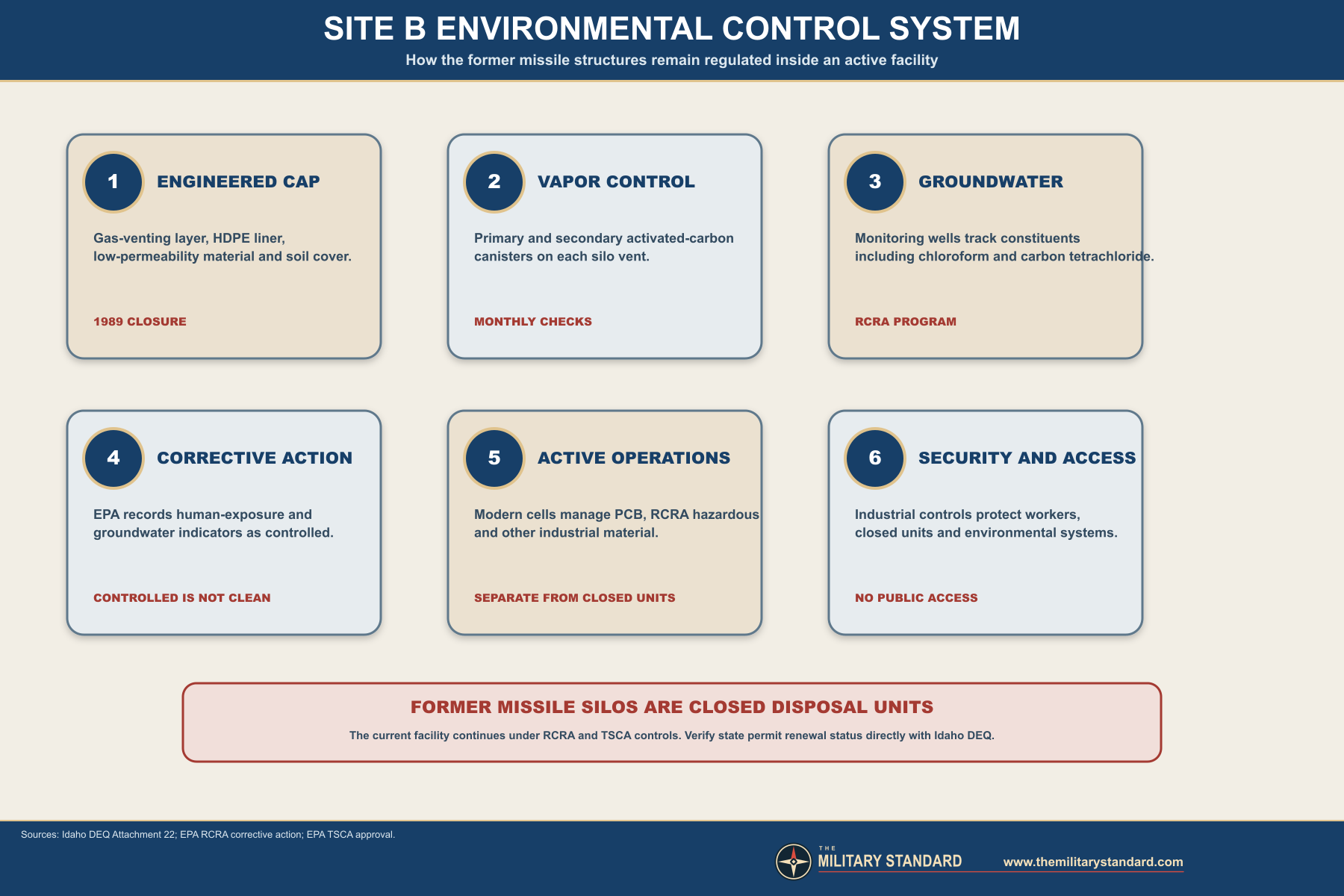
Carbon tetrachloride was detected in monitoring wells U-23 and U-1 during 1996 and 1997. Hazardous constituents were also found in subsurface soils near former missile silos. The permit record reports no known releases affecting surface water. EPA's RCRA corrective-action profile records the human-exposure and groundwater environmental indicators as controlled on September 18, 2012. Controlled does not mean contaminants were absent or that obligations ended.
Vapor control remains a defining part of the closed missile units. A 2004 evaluation found that uncontrolled chloroform emissions could exceed Idaho ambient-air concentrations at the property boundary. Current controls described in the permit use primary and secondary activated-carbon canisters on each silo vent, monthly measurements, and canister replacement at specified breakthrough criteria.
The modern facility also manages active PCB, RCRA hazardous-waste, and industrial-material units outside the closed missile structures. EPA issued a TSCA PCB approval on September 29, 2022 and later modifications, including Modification 3 dated March 2, 2023. The current state issued-permits page still displays a RCRA permit effective July 28, 2016 with an expiration date of July 28, 2026. Because that date has passed, the legal effect of any renewal, continuation, or replacement should be confirmed directly with Idaho DEQ rather than inferred.
EPA does not list the property as a final National Priorities List site. Its Superfund profile says the evaluation was deferred to RCRA Subtitle C and identifies the property as nonfederal. That status does not eliminate RCRA, TSCA, corrective-action, post-closure, monitoring, or state permit obligations.
Surviving Features and Current Status
The Titan I complex survives principally as buried industrial infrastructure beneath engineered closure systems. Missile silos, propellant rooms, equipment rooms, exhaust vents, antenna silos, powerhouse, control center, elevator shaft, electrical vault, exhaust and intake shaft, and connecting passages remain identifiable in regulatory records even where their original internal machinery, floating floors, metalwork, and military equipment were removed during salvage.The official facility plan shows the closed silo complexes and associated past-practice units within an active disposal property that also contains modern cells, roads, support buildings, wells, drainage features, and operational areas. The visible landscape therefore reflects several eras at once: Cold War construction, salvage, improvised 1970s disposal, 1980s closure, corrective action, and continuing regulated waste management.
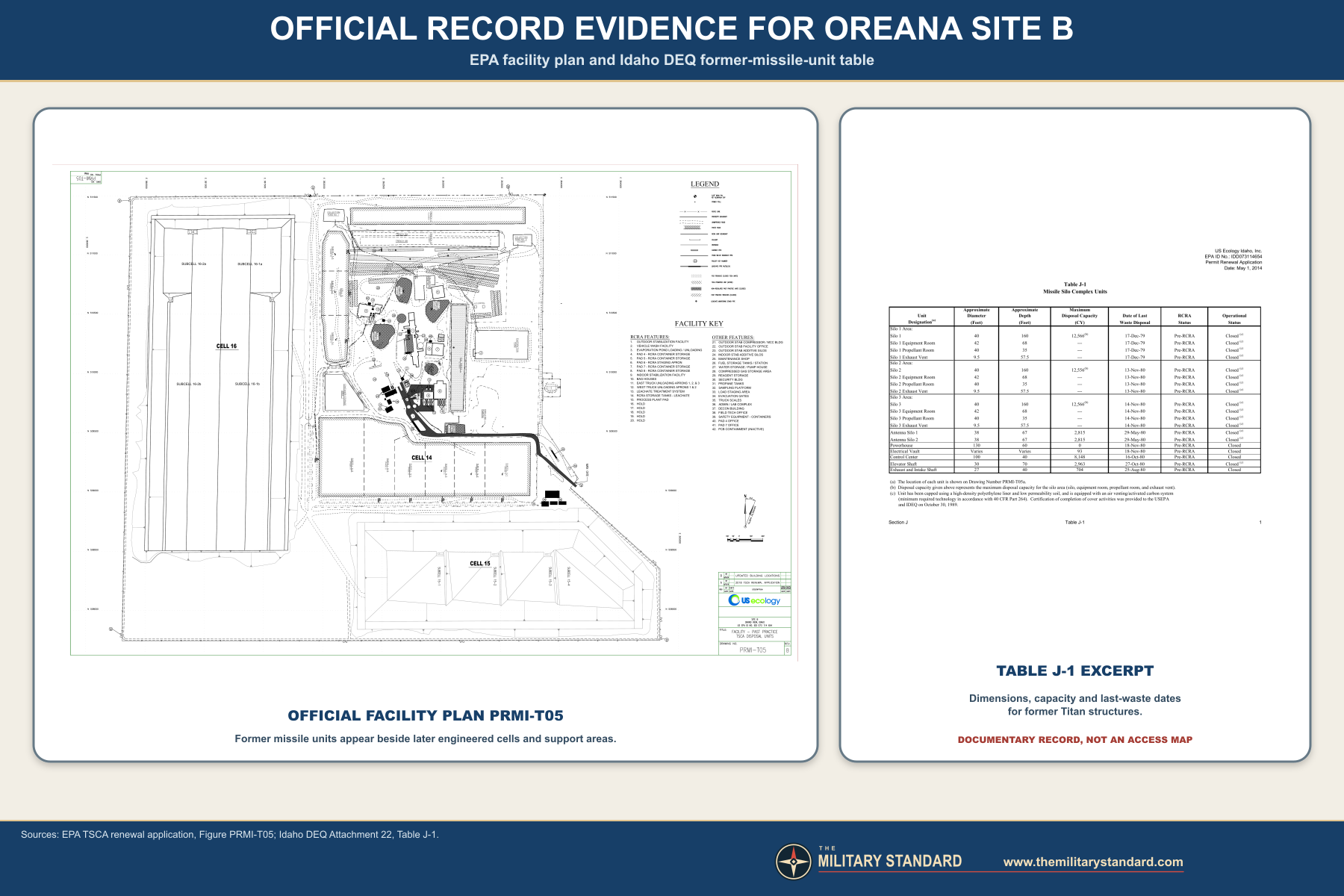
The property is not open for historical visitation. It is a secure industrial facility with hazardous-waste operations and controlled closed units. No coordinate, map, or historic interest overrides ownership, security, worker-safety, or environmental restrictions.
Well-known Emmet Gowin aerial photographs labeled only as an abandoned Mountain Home Titan complex are valuable evidence of the broader Idaho field but cannot safely be assigned to Oreana without additional proof. Official permit plans and unit tables provide the strongest verified visual documentation for this site.
The surviving record also helps explain why the old structures cannot be interpreted only from modern aerial imagery. The original launch equipment was arranged vertically through deep shafts and horizontally through tunnels that are now filled, altered, sealed, or hidden beneath cover systems. A surface road or mound may outline part of the former plan without revealing the condition or contents below it.
The current industrial plant has continued to evolve around the closed military units. Later disposal cells, treatment areas, support buildings, internal roads, drainage systems, and monitoring networks belong to the environmental era, not to the Air Force launch complex. The official plan is used to separate these layers and to prevent modern features from being misidentified as Cold War components.
Detailed Chronology
- Late 1950s The Air Force evaluates locations for a three-complex Titan I field supported by Mountain Home Air Force Base.
- 1960 Construction begins on the Bruneau, Oreana, and Orchard or Boise complexes.
- December 12, 1960 The 569th Strategic Missile Squadron is activated administratively before organization at Mountain Home.
- June 1, 1961 The 569th Strategic Missile Squadron is organized at Mountain Home Air Force Base.
- August 2, 1961 The Air Force's later real-property chronology lists Mountain Home Air Force Missile Site No. 2, Oreana, as assigned on this date.
- Before April 1, 1962 Official Mountain Home history says construction of all three Idaho complexes is completed before the contractual deadline.
- April 1962 The first Titan I missiles arrive for the Mountain Home field.
- August 16, 1962 The Mountain Home Titan I field is publicly declared operational.
- October 1962 The newly operational field stands alert during the Cuban Missile Crisis.
- May 1963 The Air Force decides to phase out Titan I.
- November 1964 Mountain Home's impending Titan I closure is announced as part of the accelerated retirement.
- Early 1965 The Mountain Home field leaves alert during the national Titan I drawdown.
- June 25, 1965 The 569th Strategic Missile Squadron is inactivated.
- 1965 to 1966 Missiles, classified equipment, reusable machinery, wiring, and valuable metals are removed during decommissioning and salvage.
- 1967 An Air University study reports that Oreana Site B is preliminarily retained for possible atmospheric-observation use. No reviewed evidence confirms an operating station.
- May 1972 The Air Force's official base-disposal chronology lists the detached Oreana missile site as disposed.
- 1972 Western Containment, or Wes-Con, purchases the former missile complex.
- June 1973 Owyhee County issues a conditional-use permit for pesticide-waste disposal in the decommissioned Titan structures.
- November 1973 Waste disposal begins at Site B.
- 1973 to 1978 About 95 percent of receipts are pesticide process wastes from Portland and Denver plants. Other receipts include PCB, laboratory, and electroplating wastes.
- 1974 to 1975 PCB wastes arrive from Idaho, Washington, Oregon, and Alaska.
- December 17, 1979 The permit table gives the last waste-placement date for the Silo 1 branch.
- May 29, 1980 The two former antenna silos receive their last recorded waste.
- August 25, 1980 The exhaust and intake shaft receives its last recorded waste.
- October 16, 1980 The former control center receives its last recorded waste.
- October 27, 1980 The elevator shaft receives its last recorded waste.
- November 13, 1980 The Silo 2 branch receives its last recorded waste.
- November 14, 1980 The Silo 3 branch receives its last recorded waste.
- November 18, 1980 The powerhouse receives its last recorded waste.
- By November 19, 1980 The former missile structures have stopped receiving waste and are classified as pre-RCRA units.
- June 1981 Envirosource acquires the facility. Envirosafe Services of Idaho operates it.
- 1983 An administrative order requires soil and groundwater sampling.
- 1988 Routine RCRA groundwater monitoring begins.
- August 1989 Former missile units and connected openings are covered by an engineered cap with gas venting, a synthetic liner, low-permeability material, soil cover, and carbon control.
- October 30, 1989 Closure certification is completed.
- October 1991 Chloroform, chloromethane, and dichlorodifluoromethane are detected in monitoring well U-21 downgradient of Silo 2.
- November 1993 An alternative concentration limit and compliance-monitoring program is adopted for the chloroform condition.
- 1996 to 1997 Carbon tetrachloride is detected in monitoring wells U-23 and U-1.
- January 2001 U.S. Ecology Idaho acquires the facility from Envirosafe Services of Idaho.
- 2004 A vapor study finds that uncontrolled chloroform emissions could exceed Idaho ambient-air concentrations at the property boundary, supporting continued activated-carbon controls.
- September 18, 2012 EPA records human-exposure and groundwater environmental indicators as controlled under RCRA corrective action.
- July 28, 2016 The RCRA permit displayed on Idaho's issued-permits page becomes effective.
- May 2, 2022 U.S. Ecology becomes a wholly owned indirect subsidiary of Republic Services.
- September 29, 2022 EPA issues the current-generation TSCA PCB approval for the facility.
- March 2, 2023 EPA issues Modification 3 to the PCB approval.
- August 1, 2024 The reviewed Idaho Attachment 22 past-practice-unit document carries this modification date.
- July 28, 2026 The state permit displayed online reaches its printed expiration date. Renewal or continuation status requires agency confirmation.
- September 2026 The former Titan complex remains within active U.S. Ecology Idaho Site B. Closed military disposal units remain capped, monitored, and vented through carbon controls.

Sources & References
- WEB Peace Through Deterrence: The Titan ICBM Program SOURCE FOR: Mountain Home field construction, costs, completion, well depths, first missiles, operational declaration, and field-wide worker fatalities
- PDF Air Force Bases, Volume I, Active Air Force Bases Within the United States of America on 17 September 1982 SOURCE FOR: Mountain Home Air Force Missile Site No. 2 administrative assignment and May 1972 disposal
- PDF Air University Review, May-June 1967 SOURCE FOR: Preliminary retention of Oreana Site B for proposed atmospheric-observation use after Titan I deactivation
- WEB Attachment 22, Past Practice Units, U.S. Ecology Idaho Site B SOURCE FOR: Missile-unit dimensions, waste history, unit capacities, last-use dates, ownership sequence, cap construction, releases, groundwater history, and vapor controls
- WEB Attachment E, Groundwater Monitoring Plan, U.S. Ecology Idaho SOURCE FOR: Groundwater-monitoring framework, wells, hydrogeologic interpretation, and regulated monitoring context
- WEB Idaho Department of Environmental Quality Issued Permits and Water Quality Certifications SOURCE FOR: Public state permit listing, EPA identifier, July 28, 2016 effective date, and displayed July 28, 2026 expiration date
- WEB Approval for Managing PCB Wastes, U.S. Ecology Idaho Inc SOURCE FOR: Current EPA description of Site B, facility address, PCB functions, TSCA approval date, and approval modifications
- PDF TSCA PCB Approval, U.S. Ecology Idaho, Modification 3 SOURCE FOR: Federal PCB approval conditions and March 2, 2023 modification record
- PDF U.S. Ecology Idaho TSCA Renewal Application, 2021 SOURCE FOR: Official facility plan, closed former missile units, closure certification, modern cells, and current waste-management context
- WEB EPA RCRA Corrective Action Facility Profile, IDD073114654 SOURCE FOR: Corrective-action milestones and controlled environmental-indicator dates
- WEB EPA Facility Registry Service, U.S. Ecology Idaho Inc SOURCE FOR: Current facility address, EPA registry identifier, and RCRA owner and operator identity
- WEB EPA Superfund Site Information, Envirosafe Services of Idaho Site B SOURCE FOR: Non-NPL status, RCRA deferral, Owyhee County location, and nonfederal-facility classification
- WEB Republic Services Acquisition of U.S. Ecology, Form 8-K SOURCE FOR: May 2, 2022 corporate acquisition and subsidiary relationship
- WEB 366th Fighter Wing Fact Sheet SOURCE FOR: Mountain Home Air Force Base lineage and parent-installation context
- PDF The Development of Ballistic Missiles in the United States Air Force, 1945-1960 SOURCE FOR: Titan I development, radio-inertial guidance, cryogenic propellant, and deployment context
- PDF SAC Missile Chronology 1939-1988 SOURCE FOR: Titan I activation, operational, phaseout, and Strategic Air Command chronology
- WEB The Titan Missile, National Park Service SOURCE FOR: Titan I system description, launch sequence, complex organization, and historical context
- WEB Titan I Missile Complex 2A, Historic American Engineering Record CO-89 SOURCE FOR: Standard Titan I complex design, measured drawings, terminology, and comparative engineering evidence
- WEB Historic American Engineering Record, Titan I Missile Complex 2A Collection SOURCE FOR: Comparative measured drawings, photographs, and engineering documentation of the standard Titan I configuration