
Titan I 724-C Missile Silo Lowry AFB Colorado
Titan I 724-C
Squadron: 724th SMS
Date Activated: February 1st 1960
Date Deactivated: June 25th 1965
Air Force Base: Lowry
State: Colorado
Nearest Town: Denver
Coordinates:
Latitude: 39°39'55.30"N
Longitude: 104°29'34.58"W
Decimal:
Longitude: -104.492939
Latitude: 39 39.9216666666667
Longitude: -104 29.5763333333333
3 silos
Former Titan I Missile Complex with the 724th Strategic Missile Squadron
Read about the Titan I at Lowry AFB
List of all Titan I site Coordinates
Detailed information about the Titan I Intercontinental Ballistic Missile can be found here.
Overview
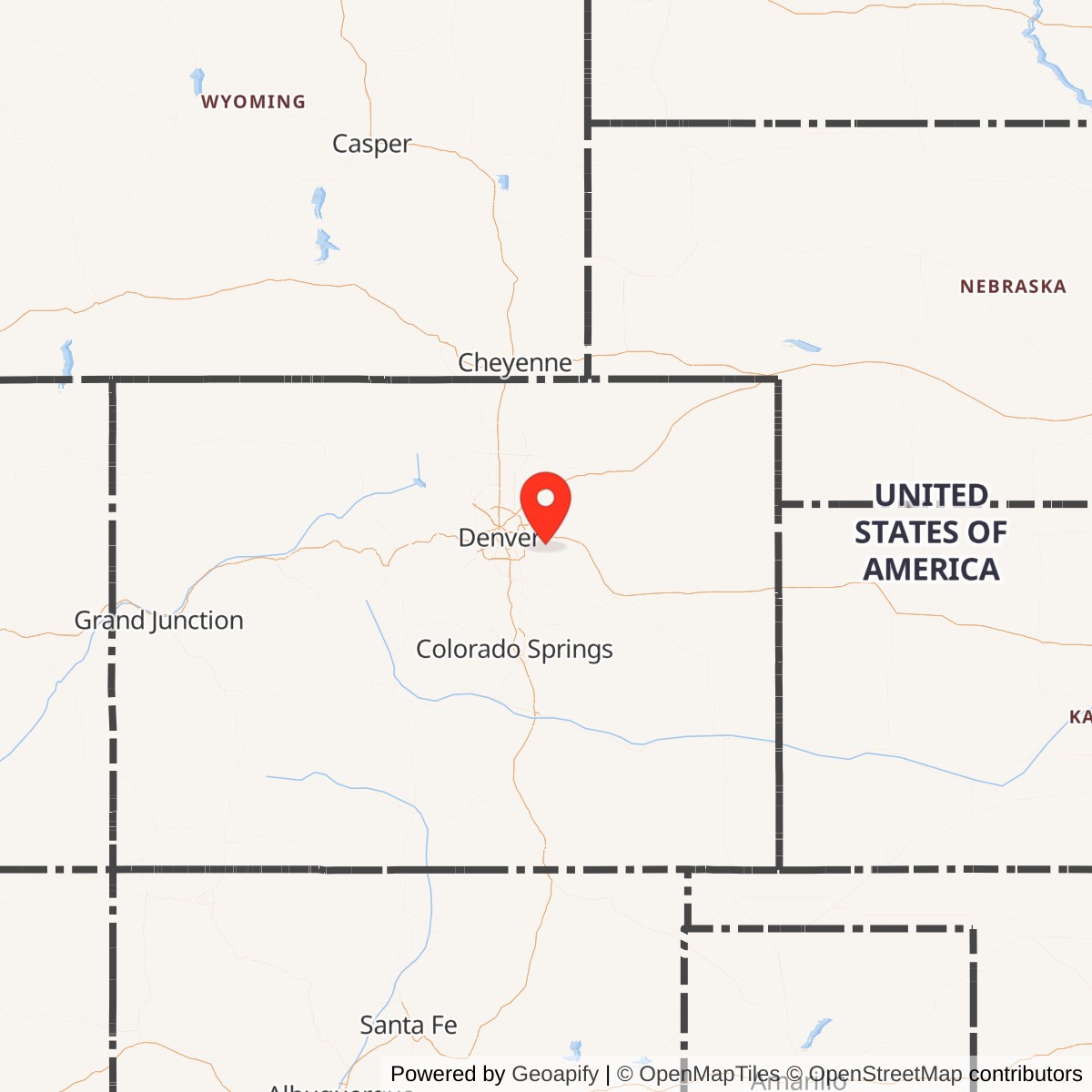
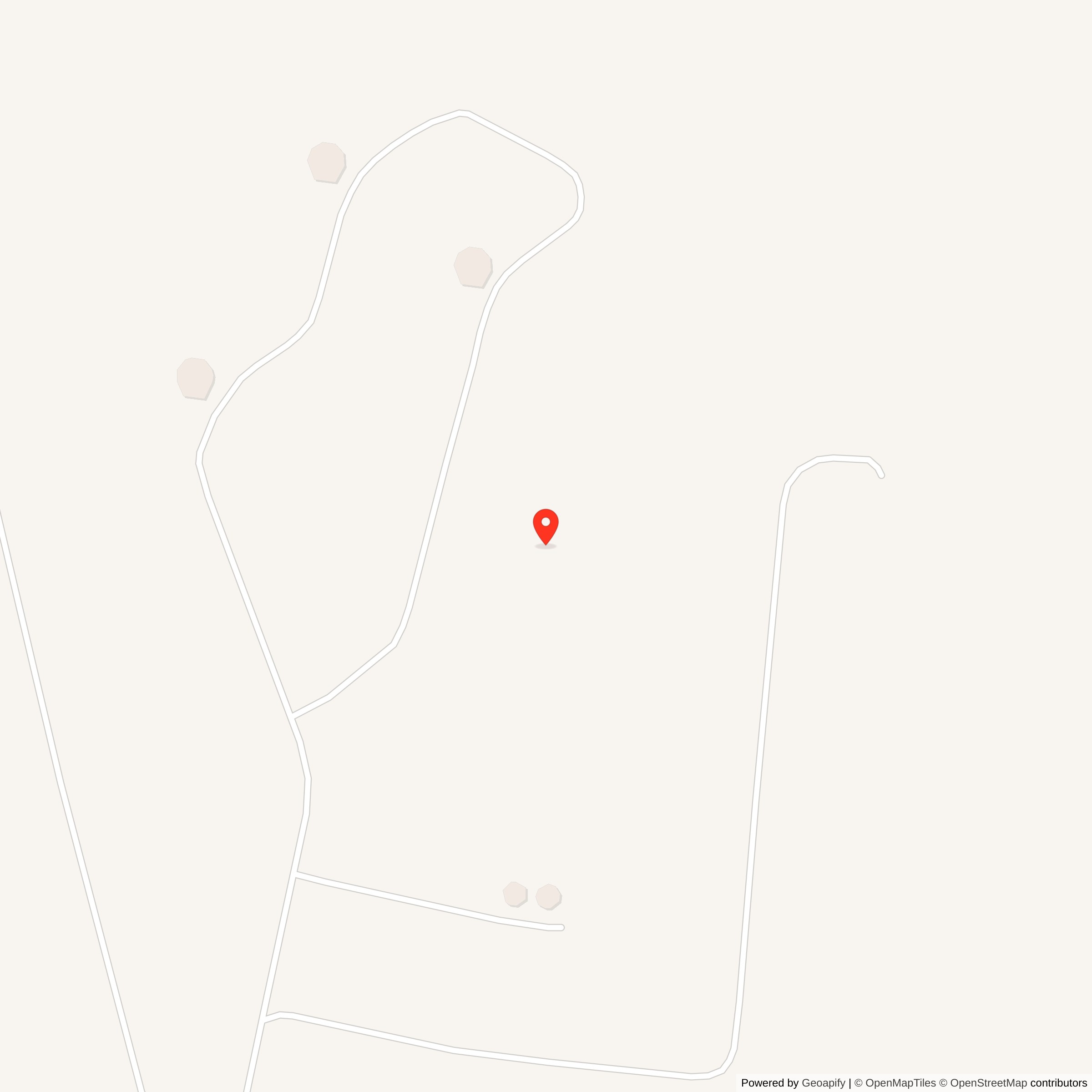
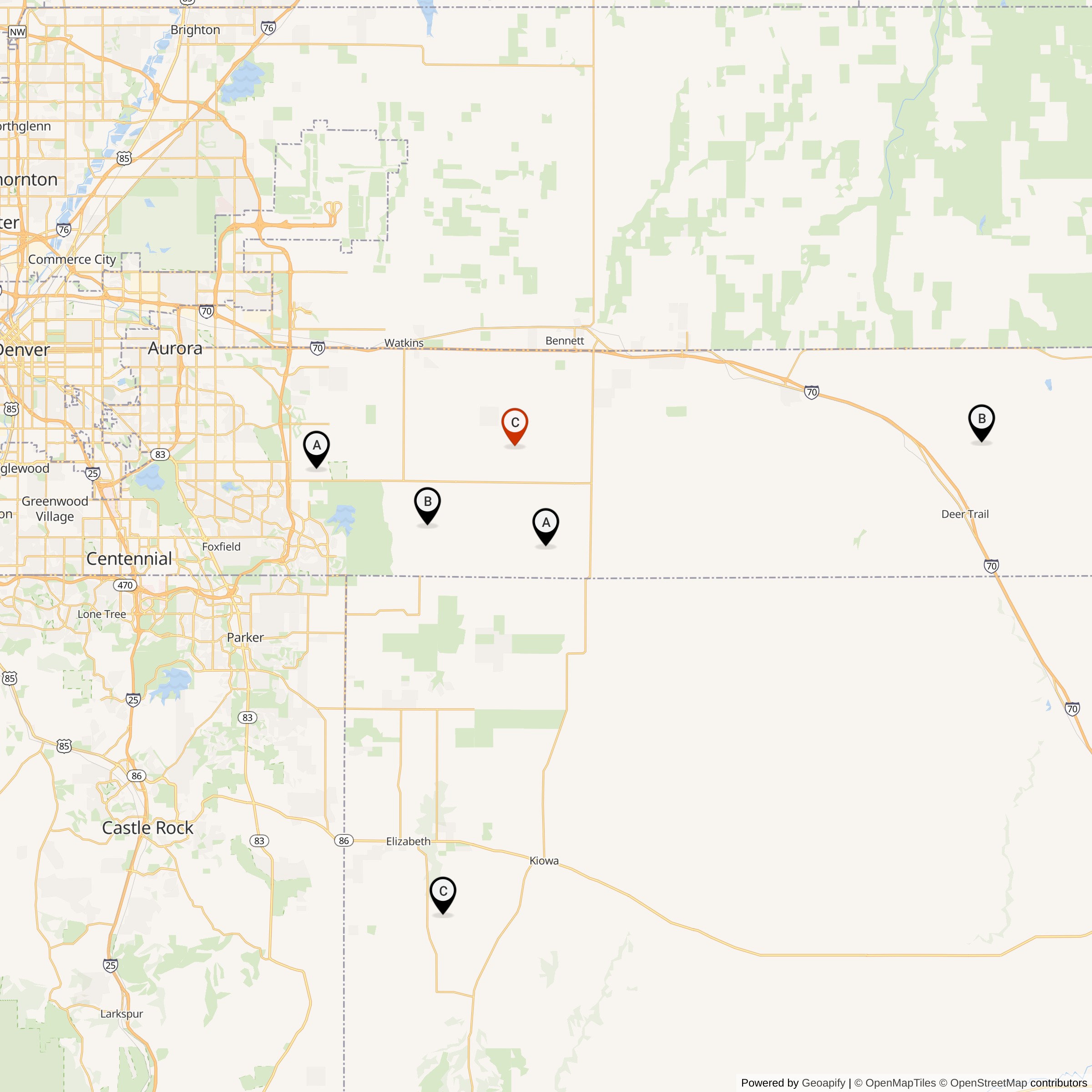
Titan I Missile Complex 724-C was a hardened underground intercontinental ballistic missile installation built east of Aurora on the high plains of Arapahoe County. It was one of three launch complexes assigned to the 724th Strategic Missile Squadron at Lowry Air Force Base. Each complex held three HGM-25A Titan I missiles, so 724-C formed one-third of the squadron's nine-missile field. The site was not a single silo. Beneath a comparatively sparse surface compound were three missile silos, three equipment terminals, three propellant terminals, a shared control center, a powerhouse, two guidance-antenna silos, utility spaces, protected entrances, and an extensive tunnel network. The U.S. Army Corps of Engineers identifies the former defense property as a 211-acre tract.
The complex belonged to the first generation of hardened American ICBM bases. Titan I missiles were stored vertically below ground, protected against nearby blast effects, but could not launch from their silos. A launch sequence required loading cryogenic liquid oxygen, opening the massive silo doors, elevating a fueled missile to the surface, raising a guidance antenna, and completing final checks. This machinery made 724-C both a weapons installation and a buried industrial plant. It protected a small combat crew and its equipment more effectively than an exposed launch pad, but the fueling and elevation sequence demanded time, careful maintenance, and repeated training. Those limitations helped make Titan I operationally important and technologically transitional. The 724th became the Air Force's first operational Titan I squadron in April 1962, but its missiles began leaving alert less than three years later.
Complex 724-C acquired a post-military history unlike the neighboring 724-A and 724-B complexes. The Department of Defense declared the site excess in August 1965, and a contractor began dismantling work in 1966. Falcon Research & Development Company leased the property in March 1969 and used it primarily for federally sponsored explosive testing. Most work occurred on the surface, although a small underground area was used briefly for ballistic impact testing. Applied Research Associates entered a lease in March 1988 to store, assemble, manufacture, and test explosive devices for defense and aerospace work. This continuing technical use preserved the site's association with national defense while changing its mission from nuclear deterrence to research and testing.
The environmental record is correspondingly complex. The Corps lists 724-C as LOWRY AFB S-1 (COMPLEX 1C), property B08CO0010, and the Department of Defense identifies it by FFID CO89799F694400. EPA lists the property as a federal facility that is not on the National Priorities List, under EPA ID CO0010104216. PCE and TCE are the principal groundwater contaminants, with source areas associated with the powerhouse and a former building foundation. Investigators also found localized Aroclor-1254 near a chemical-waste clarifier, PAHs near an incinerator cleanout, and additional chlorinated compounds. The long chain from missile operations through private defense testing and environmental restoration is central to understanding 724-C.
Installation Identity, Location, And Boundaries
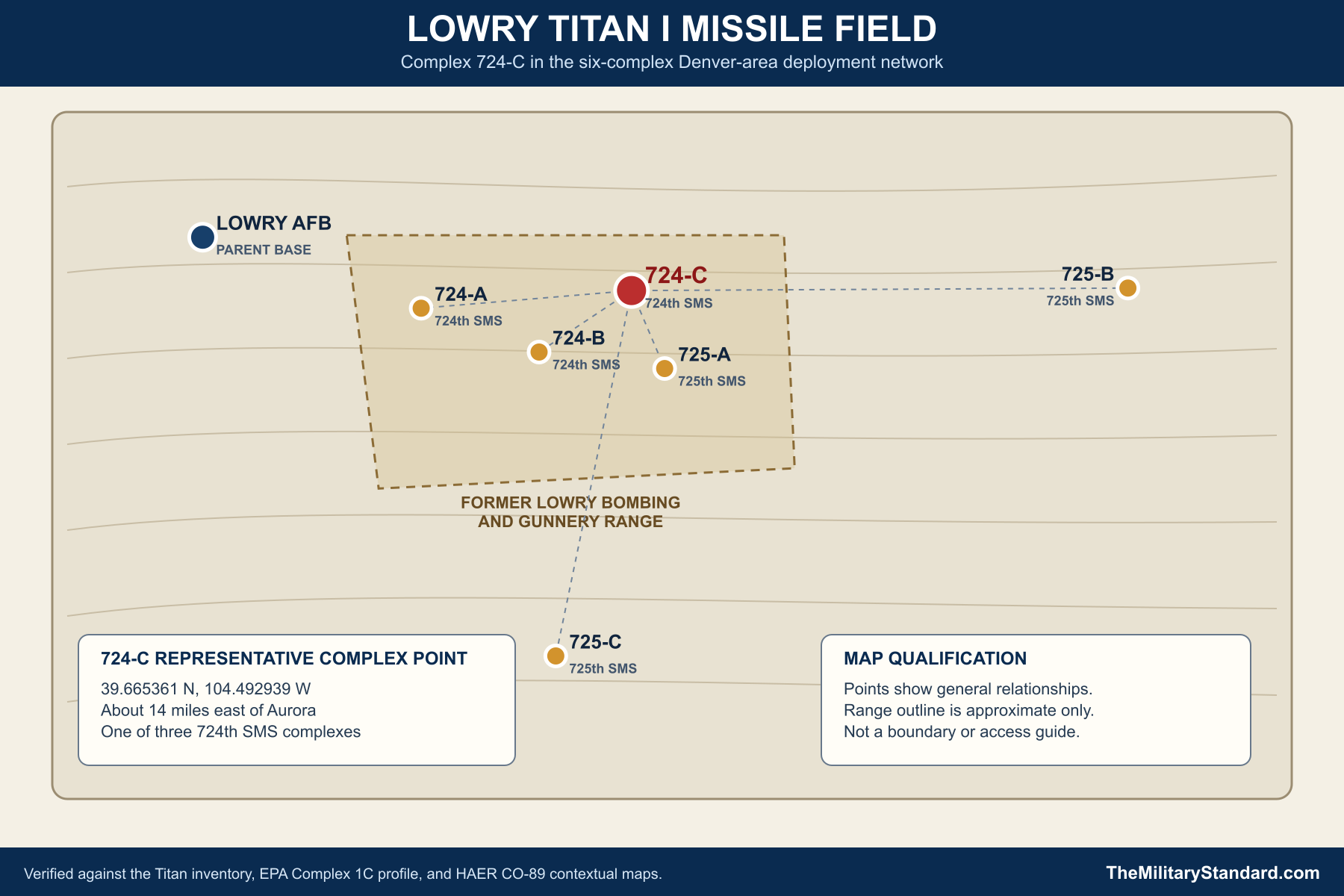
The installation appears under several names because operational, engineering, property, and environmental systems cataloged it differently. Strategic Air Command used 724-C, meaning the C complex of the 724th Strategic Missile Squadron. Corps and environmental records generally call it Lowry Missile Site 1, Complex 1C, Titan Site 1C, or LOWRY AFB S-1 (COMPLEX 1C). EPA uses Former Lowry AFB Titan Missile Site 1 Complex 1C. These names identify the same integrated three-launcher complex. They do not identify Lowry Air Force Base proper, the entire former Lowry Bombing and Gunnery Range, adjacent 724-A or 724-B, or any one launcher. The individual launch positions may be described as 724-C-1, 724-C-2, and 724-C-3, but all depended on one control, power, guidance, security, and support system.
The Corps states that the former defense property consists of 211 acres. That is the best supported acreage for the installation record, but it needs a careful label. A disposal property can include the operational core, roads, easements, buffers, testing areas, and other interests that are not identical to the fenced launch compound. The Corps also says that several leases and a commercial agreement to buy and sell real estate have existed. The consulted public sources do not establish the exact 2026 parcel boundaries or ownership. Accordingly, the 211-acre figure should not be used to infer current title, access rights, or the extent of groundwater contamination.
The Landscape Before The Missile Complex
The 724th Squadron complexes were selected within or near the broad military landscape of the Lowry Bombing and Gunnery Range southeast of Denver. The range originated during World War II as a large training area supporting Lowry Field. Bombing, gunnery, and other weapons training left a network of targets, roads, impact areas, and residual munitions across the region. Federal, Navy, Colorado National Guard, and other military uses continued during the early Cold War. The range offered the Air Force controlled, sparsely developed land close enough to Lowry for support but far enough from the city and from neighboring missile complexes to improve dispersal.
The missile complex must therefore be understood as a later use imposed on an earlier defense landscape. Construction crews at Lowry Titan sites had to consider former target areas and possible ordnance, while roads, land-control arrangements, and military familiarity with the area influenced site selection. After Titan operations ended, the larger range retained its own munitions-response history. That surrounding history is related to 724-C but not interchangeable with it. Complex 1C has a separate FUDS property number and a separate hazardous-substance cleanup record. The wider Lowry range and the 211-acre missile property must remain distinct in research, mapping, and public interpretation.
Strategic Origins Of Titan I
Titan I emerged from the urgent American effort to field operational intercontinental ballistic missiles after the Soviet Union demonstrated thermonuclear weapons and increasingly capable long-range rockets. The Air Force pursued Atlas as its first ICBM while developing Titan as a complementary system. Parallel programs reduced the risk that failure in one design would delay the national deterrent. Titan used two stages, a more conventional load-bearing airframe than Atlas, and radio-inertial guidance. Martin built the missile in the Denver area, creating an unusually close geographic relationship between the first operational Titan field and the principal contractor.
Early missile planners considered relatively exposed launch arrangements, but concern about a surprise nuclear attack pushed Titan I underground. A launch complex needed to protect its crew, command equipment, power plant, fuel systems, and missiles from effects short of a direct hit. It also needed reliable communications and enough independence to continue functioning after disruption to commercial power or nearby installations. The solution was a dispersed network of heavily reinforced underground complexes. Each squadron operated three complexes, and each complex held three missiles. This 3-by-3 arrangement made it harder for one enemy weapon to destroy an entire squadron while avoiding the cost of a completely independent control and utility plant for every missile.
Titan I was hardened but was not yet a launch-from-silo weapon. RP-1 kerosene fuel could be kept in the system, but cryogenic liquid oxygen had to be loaded before launch and could not remain indefinitely in the missile. The fueled missile then rose on a large elevator and launched from the surface. Ground-based radio guidance also required protected antennas to emerge. The design was a remarkable step beyond open pads, yet it depended on elaborate mechanical, electrical, pneumatic, hydraulic, propellant, communications, and guidance systems. Complex 724-C embodied both the achievement and the limitations of this first hardened ICBM generation.
Site Selection And The Lowry Relationship
The Air Force selected Lowry for the first operational Titan I deployment in March 1958. The Denver region combined favorable western geography, high-plains terrain, a large controlled range, an established technical base, and proximity to the Martin plant. Lowry could provide headquarters, training, supply, maintenance, reentry-vehicle support, administration, housing, and other functions that would have been wastefully duplicated at each launch complex. Buckley Field and regional military engineering offices also supported the broader construction and activation effort.
A selection group representing the Air Force Ballistic Missile Division, regional engineers, architects, and the Army Corps of Engineers chose the three 724th Squadron locations within the Lowry field. Their spacing was strategic. A complex had to remain accessible to operating and maintenance units while being far enough from its companions that a single nuclear burst would not eliminate all nine missiles. Site conditions also had to permit deep excavation, roads, commercial power, wells, drainage, communications, and heavy construction. The C complex lay east of the other two 724th sites and became the eastern member of the squadron's dispersed triangle.
Lowry Air Force Base was the parent and support installation, not the physical location of 724-C. Wing and squadron headquarters, major maintenance, technical supply, missile handling, training, personnel administration, and many support services remained at Lowry. Combat crews, security forces, and maintenance specialists traveled to the remote complex. Once on alert, however, 724-C had to function as an independent combat plant. Its underground spaces provided command, communications, power generation, air handling, water, sanitation, food support, and protected work areas. The relationship was therefore both dependent and autonomous: Lowry sustained the site over time, while the complex had to execute an authenticated launch order even if outside support had been disrupted.
Design, Contracting, And Construction
The available record is strongest for the combined Lowry construction program rather than for a separate 724-C groundbreaking. The Air Force and Corps moved from site selection in 1958 to access roads, wells, drainage, excavation, and principal construction during 1959. A Morrison-Knudsen-led joint venture received the contract for the first three Lowry complexes, 1A, 1B, and 1C, in April 1959. Construction continued through 1961, followed by ground-equipment installation, technical demonstrations, acceptance, and squadron turnover. The 724th did not become operational until April 1962. These milestones should not be collapsed into a single opening date.
The Omaha District of the Army Corps of Engineers administered the work for the Air Force. The first three-site contract reportedly began near $40.7 million and increased substantially as hundreds of modifications accumulated. Titan I was still developing at Cape Canaveral and Vandenberg while the Lowry complexes were being excavated. Test failures and engineering discoveries drove revisions to launcher elevators, shock mounting, liquid-oxygen storage, drainage, wiring, seals, and equipment interfaces. Contractors were building a weapon system whose final configuration was still evolving, not merely reproducing a settled blueprint.
Construction required immense excavation and concrete work. Crews removed the upper earth in open cuts, sank the deep missile and antenna shafts, placed reinforced structures, connected them with corrugated-steel tunnels, installed utilities and machinery, and then backfilled the complex until little remained visible. Work proceeded through winter, labor disputes, a national steel strike, equipment delays, and continuing design changes. Thousands of workers were employed across the six Lowry sites at the program's peak. The construction footprint was broad, even though the completed installation presented only roads, security features, hatches, doors, vents, and small surface structures to an observer.
The Air Force created the Lowry Site Activation Task Force in 1960 to integrate civil construction, equipment installation, missile support systems, training, testing, and acceptance. Technical Acceptance Demonstrations required complete simulated countdowns first by contractor personnel and then by Strategic Air Command crews. A hardened shell did not become an operational installation merely because concrete work was complete. Power, guidance, communications, fuel, elevators, doors, environmental controls, safety interlocks, and crew procedures had to operate as one system. This lengthy checkout explains the gap between major construction in 1961 and the squadron's operational declaration in April 1962.
Underground Design And Surface Layout
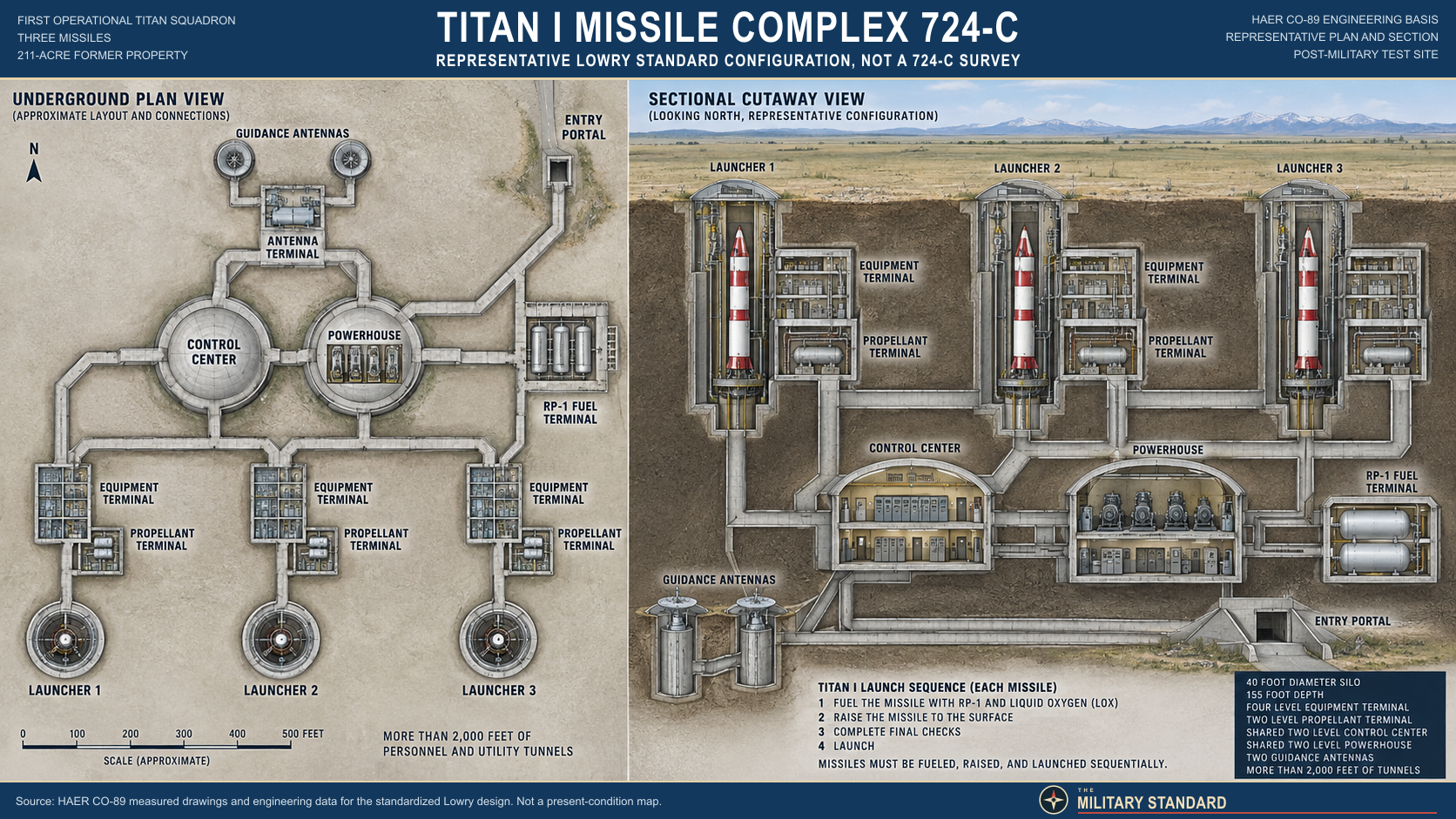
Complex 724-C used the standardized Lowry Titan I arrangement documented most completely by Historic American Engineering Record CO-89 at Complex 2A. The HAER measured drawings are representative engineering evidence, not site-specific present-condition documentation for 724-C. They show an integrated plan organized around shared command and utility spaces with three launcher branches. A secured entrance portal and a separate personnel hatch led into protected passages. Blast locks and heavy doors separated critical rooms so that shock or an internal accident in one area would be less likely to disable the entire complex.
The shared core included a two-level control center, a two-level powerhouse, an antenna terminal, two guidance-antenna silos, utility rooms, and the principal tunnel junctions. The control center contained communications, status displays, launch-control equipment, and workstations for the combat crew. The powerhouse contained diesel generators and the machinery needed to sustain power and building services if the commercial grid failed. The antenna terminal supported the radio-guidance equipment and connected to two retractable antenna systems, giving the complex redundancy for missile guidance.
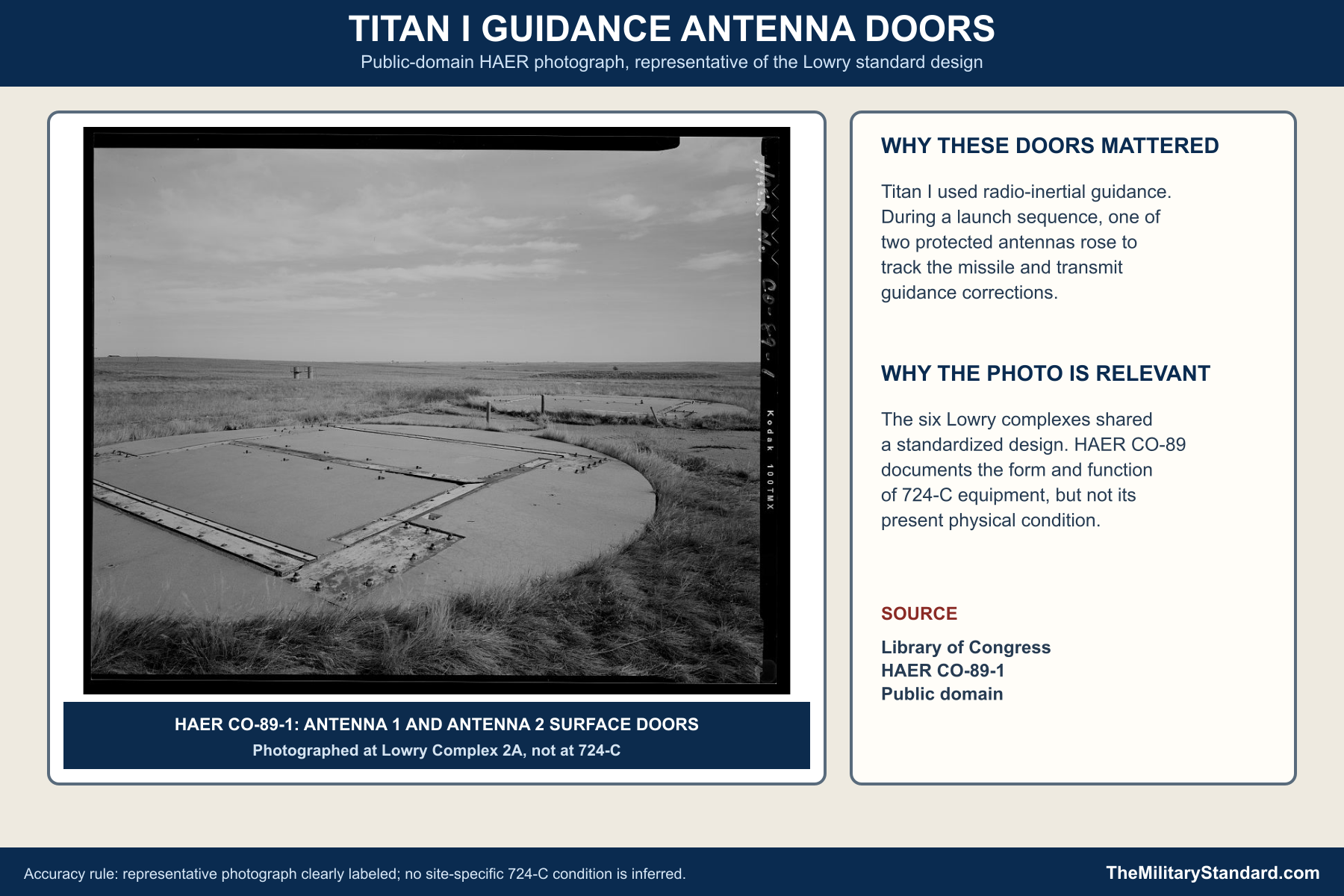
Three tunnel branches led to the launch stations. Each branch passed through an equipment terminal and a propellant terminal before reaching its missile silo. The equipment terminal held machinery associated with the launcher elevator and missile support. The propellant terminal contained tanks, pumps, valves, piping, and controls for liquid oxygen and RP-1 fuel service. The silo was a reinforced shaft roughly 160 feet deep and 40 feet in diameter, with the missile standing vertically on an elevator platform. Massive paired doors closed over the top. During a launch sequence the doors opened and the elevator raised the missile to the surface.
Waste and utility systems were as essential as the dramatic launch machinery. Titan complexes used wells, water storage, ventilation, cooling, drainage, sumps, sanitary facilities, and chemical-waste handling. The later environmental record at 724-C identifies a powerhouse area, chemical-waste clarifier, incinerator cleanout, underground storage tanks, and a former building foundation as locations requiring investigation. These references help connect the general Titan design to the specific property, but they do not justify transferring every feature or contaminant found at another Lowry complex to 724-C.
Topside facilities supported security, crew change, maintenance, deliveries, and emergency response. Roads and parking connected the remote installation with Lowry and public routes. Fencing and controlled gates enclosed the operational compound. Silo doors, antenna doors, ventilation structures, hatches, orientation targets, utility connections, and limited support buildings interrupted the otherwise open prairie surface. The site was not invisible, but its combat equipment was protected below grade and distributed so that the loss of one launcher branch did not automatically destroy the others.
Missile, Guidance, And Propulsion Systems
The HGM-25A Titan I was approximately 98 feet long and used two liquid-propellant stages. Both stages burned RP-1 kerosene with liquid oxygen. The missile carried a nuclear reentry vehicle and used a combination of onboard inertial sensing and ground radio guidance. The Denver-area Martin plant assembled the missile, while other contractors supplied engines, guidance components, reentry systems, communications, and launch equipment. The operational weapon was therefore the product of a national industrial network concentrated at 724-C as one integrated system.
Cryogenic liquid oxygen shaped almost every launch-site procedure. It boiled away and could not remain aboard a missile for long-term alert, so it had to be loaded after a launch order. The complex stored and handled oxygen through insulated tanks, piping, and pumps. RP-1 was less volatile but still required strict handling and fire-safety controls. Liquid nitrogen, high-pressure gases, hydraulic fluid, lubricants, diesel fuel, coolants, solvents, batteries, and electrical equipment supported the larger plant. These materials later became important to environmental investigators, especially where spills, maintenance practices, drainage, waste handling, or dismantling could have released contaminants.
Titan I's radio-inertial guidance required the complex to transmit corrections during flight. Two antennas were stored in separate protected silos and elevated for operations. Ground equipment tracked the missile, compared its observed path with the planned trajectory, and sent steering corrections. Redundant antennas and equipment reduced the risk that a single failure would defeat the guidance mission. This arrangement connected 724-C to a broader technical network of range testing, target planning, communications, timing, and command systems while making each launch complex an unusually sophisticated electronics installation.
The launch sequence joined human authentication to automatic machinery. Crew members received and decoded a message, verified its authenticity through required two-person procedures, and initiated the prescribed sequence. The system loaded liquid oxygen, performed checks, opened silo doors, raised a missile, elevated a guidance antenna, and moved toward ignition. Missiles could be launched sequentially from the three launchers. The exact sequence was designed to minimize time while preventing one fault or unsafe condition from cascading through the complex. Estimates commonly place Titan I response in the range of about 15 minutes, but actual readiness depended on equipment condition, crew proficiency, and the status of each launcher.
Organization, Personnel, And Support
The 724th Strategic Missile Squadron operated the A, B, and C complexes under the 451st Strategic Missile Wing at Lowry. The 703rd Strategic Missile Wing had initially carried the developing mission before the 451st designation became the operational wing framework. The 848th Strategic Missile Squadron preceded the 724th during activation, and the 724th organized on July 1, 1961, inheriting the mission and resources. This sequence matters because an activated or organized unit did not yet mean that every launcher was accepted and on alert.
Combat crews worked under Strategic Air Command's strict reliability and two-person-control system. A crew normally included officers responsible for command, launch control, communications, and system status, supported by enlisted specialists and overlapping relief personnel. Crew change required identity checks, briefings, accountability for classified material, review of maintenance limitations, and formal assumption of responsibility. Alert tours placed personnel in an underground industrial environment filled with machinery noise, artificial light, alarms, checklists, and constant attention to system status.
Maintenance was continuous and specialized. Missile, propellant, electrical, mechanical, communications, guidance, power, environmental-control, security, and facility teams supported the site. The 451st Missile Maintenance Squadron and contractor technical representatives handled work beyond immediate crew capability. Preventive maintenance, inspections, component changes, calibration, corrosion control, liquid-oxygen exercises, generator tests, communications checks, and recurring evaluations consumed far more time than the dramatic launch procedure. The absence of an actual launch from 724-C does not mean the site was inactive. Its mission was to remain ready every day without being used.
Security forces controlled the gate and protected the nuclear installation. Patrols, alarms, fences, controlled zones, access lists, weapons, and response plans guarded against intrusion or sabotage. Fire protection and emergency plans had to account for cryogenic oxygen, fuel, explosives, high voltage, machinery, deep shafts, confined spaces, and the nuclear warhead. Medical, food, transportation, and administrative support linked the remote complex to Lowry. The site could survive temporary isolation, but sustained alert depended on a large human network extending well beyond the 211-acre property.
Operational Acceptance And Strategic Alert
Strategic Air Command declared the 724th Strategic Missile Squadron operational on April 18, 1962, making it the Air Force's first operational Titan I squadron. The squadron placed its first missile on alert on April 20. The surviving program-level record does not identify which complex or launcher held that first alert missile, so this history does not assign the distinction to 724-C. By May 1, all 18 missiles of the two Lowry Titan squadrons were in their silos. Operational status meant the dispersed field could provide an authenticated nuclear response under national command, not simply that construction had ended.
Routine alert combined waiting with repeated proof that the system would work. Crews monitored status panels and communications, maintained classified materials, practiced emergency procedures, and responded to faults. Major propellant-loading exercises cycled launchers through controlled removal from alert, liquid-oxygen loading and unloading, checks, and return to readiness. Strategic Air Command evaluations tested crew knowledge and reaction, while maintenance personnel corrected discrepancies. This constant cycle preserved readiness but also imposed mechanical wear and created opportunities for leaks, spills, and waste generation.
The Cuban Missile Crisis in October 1962 occurred only months after the 724th entered operational service. Squadron-level records establish that the Lowry Titan force formed part of the national deterrent during the crisis. They do not provide a site-specific 724-C crew log or prove a unique action at one launcher. The historically sound conclusion is that 724-C shared the heightened readiness, command discipline, and strategic significance of the 724th field. It should not be credited with an undocumented individual event merely because the squadron was on alert.
Titan I's operational value lay in complicating Soviet attack planning and strengthening the retaliatory force. A potential adversary had to consider dispersed, hardened launchers in addition to bombers, Atlas sites, other Titan fields, submarine-launched missiles, and later Minuteman. Even if a single Titan I complex could be destroyed, the enemy could not assume that all American nuclear forces would be eliminated. This logic of survivability and uncertainty was the central military purpose of 724-C.
Role In The Wider Military Network
Complex 724-C was one node in a layered national system. Its closest operational partners were 724-A and 724-B, which completed the 724th Squadron's nine-missile force. The nearby 725th Strategic Missile Squadron operated three more Lowry-area complexes, bringing the field to 18 launchers. Lowry Air Force Base provided command, maintenance, supply, training, administration, reentry-vehicle support, and personnel services. The Martin plant contributed missile production and engineering. Vandenberg supported testing and training, while Cape Canaveral development launches shaped the design changes incorporated into operational sites.
Above the local field, the 451st Strategic Missile Wing reported through Strategic Air Command's command structure. National command authorities, warning systems, communications networks, war planning, targeting, weather support, navigation and guidance data, depots, contractors, and nuclear-material organizations all contributed to the site's mission. 724-C could not select its own target or act independently. Its power came from reliable integration: a national command decision had to become a secure message, a verified crew action, a functioning machine sequence, and a correctly guided missile.
The network also explains why Titan I could be retired so quickly. Titan II used storable propellants and launched from inside the silo, while Minuteman used solid fuel and required far less support at each launch facility. These newer systems shortened response time, reduced mechanical complexity, and lowered manpower demands. Once sufficient Titan II and Minuteman forces became operational, maintaining a large cryogenic Titan I infrastructure no longer offered the best military return. The same network that had made 724-C useful in 1962 made it redundant by 1965.
Phaseout, Dismantling, And Disposal
Secretary of Defense Robert McNamara announced the phaseout of remaining first-generation Atlas and Titan I forces in November 1964. The 724th began removing missiles from alert on February 17, 1965, and the last squadron Titan I left alert on March 26. Missile shipment continued into April, and the squadron inactivated on June 25. These dates distinguish alert withdrawal, physical removal, and organizational closure. The site could no longer perform its wartime mission once the missiles and essential controlled equipment were gone, even if buildings and machinery remained.
The Department of Defense declared Complex 1C excess to the General Services Administration in August 1965. Sensitive materials, warheads, missiles, guidance equipment, communications gear, and useful components were removed through Air Force and contractor processes. The Corps records that Mid-Continent Construction Company of Salt Lake City was expected to begin dismantling the Lowry Titan silos in March 1966 and finish before February 1967. Dismantling did not mean complete excavation of every buried structure. It generally involved salvage, removal or destruction of equipment, disabling of launch systems, and measures intended to make the property suitable for disposal.
Several leases and a commercial agreement to buy and sell real estate followed. The public fact sheet does not provide a complete chain of title, and the legal relationship among federal disposal, leases, commercial agreements, and later ownership should not be inferred beyond the record. What can be stated is that the site did not pass directly from military alert to passive abandonment. It entered a new period of defense-related research and testing that used the surface property and, briefly, a small part of the underground complex.
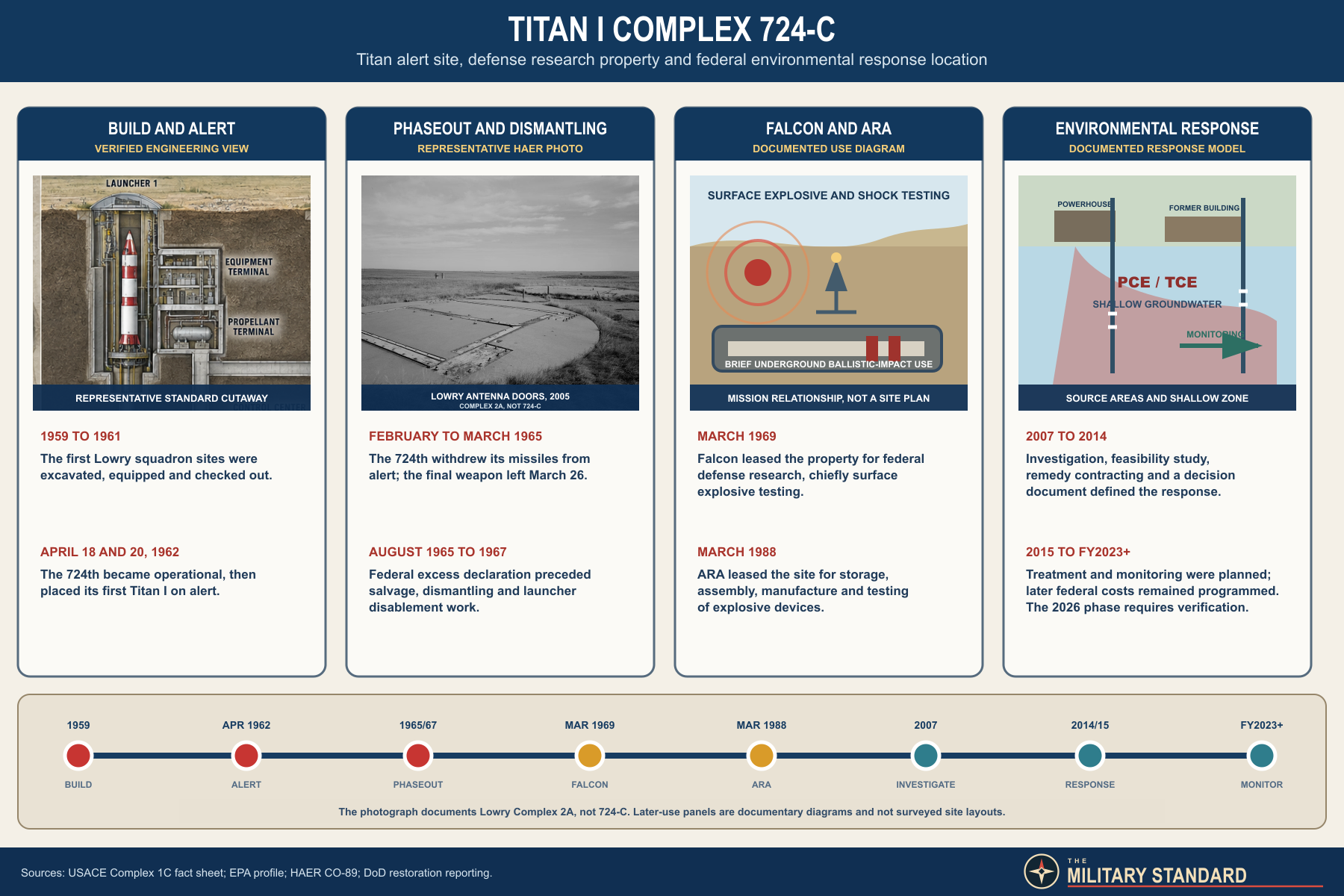
Falcon Research And Development Company
Falcon Research & Development Company leased the site in March 1969. According to the Corps, Falcon's business involved research and engineering for the federal government, with virtually all work performed for the Department of Defense. Its contracts included the Army, Navy, Air Force, and other defense agencies. The vast majority of Falcon's projects at Complex 1C involved explosive tests. This activity gave the former missile property a second defense mission, although Falcon was a private contractor and the installation was no longer an operational Air Force missile base.
Falcon conducted its work on the surface except for a period of a few months when a small underground area was used for ballistic-impact testing. That distinction prevents two opposite errors. The Titan complex was not wholly abandoned after 1965, but neither was the entire underground network converted into a permanent research laboratory. The broad surface tract, separation from urban development, existing security potential, and defense history made the property suitable for controlled testing. The surviving underground volume offered a specialized environment for limited work.
Explosive testing can alter a former missile property's environmental and physical record. Test articles, energetic materials, metals, fragments, residues, temporary structures, storage, and disposal practices may create evidence unrelated to Titan operations. Later investigators therefore had to distinguish Air Force-era chemicals from post-disposal contractor activities and assign responsibility appropriately. The Corps' account does not attribute every contaminant to Falcon, but it establishes a major post-military activity that any accurate site history must include.
Applied Research Associates And Later Technical Use
Applied Research Associates entered a lease in March 1988 for storing, assembling, manufacturing, and testing explosive devices. Most of its Complex 1C work supported the Department of Defense and aerospace companies. The Corps describes field testing that included shock physics and explosive characterization, methods used to measure how materials and structures behave under extreme forces. This work continued the site's association with weapons effects and defense engineering while remaining institutionally separate from the former Strategic Air Command mission.
ARA was to be fully responsible for cleanup, disposal, and disposition of hazardous materials generated by its activities. That provision is important because the environmental record spans more than one operator. Federal responsibility under the Formerly Used Defense Sites program concerns contamination attributable to prior Department of Defense use, while a lessee can bear responsibility for later releases. The presence of a cleanup program does not by itself prove which operator caused a particular contaminant. Source areas, chemical signatures, operational records, dates, and legal agreements are required to separate liabilities.
The Corps' 2015 public summary confirms the lease and historical operations but does not establish whether identical activities continued through 2026. Current ownership, tenancy, testing, security, and land use therefore remain unverified.
Environmental Investigation And Restoration
Complex 1C is a Formerly Used Defense Sites property under the Defense Environmental Restoration Program. The Corps inventory lists LOWRY AFB S-1 (COMPLEX 1C) as property B08CO0010 and identifies both hazardous, toxic, and radioactive waste and containerized-waste project categories. The Department of Defense uses FFID CO89799F694400. EPA records the facility under EPA ID CO0010104216, identifies it as a federal facility in Arapahoe County, and states that it is not on the National Priorities List. EPA classifies it as other federal-facility-led cleanup activity and records an Eligible Response Site exclusion decision.
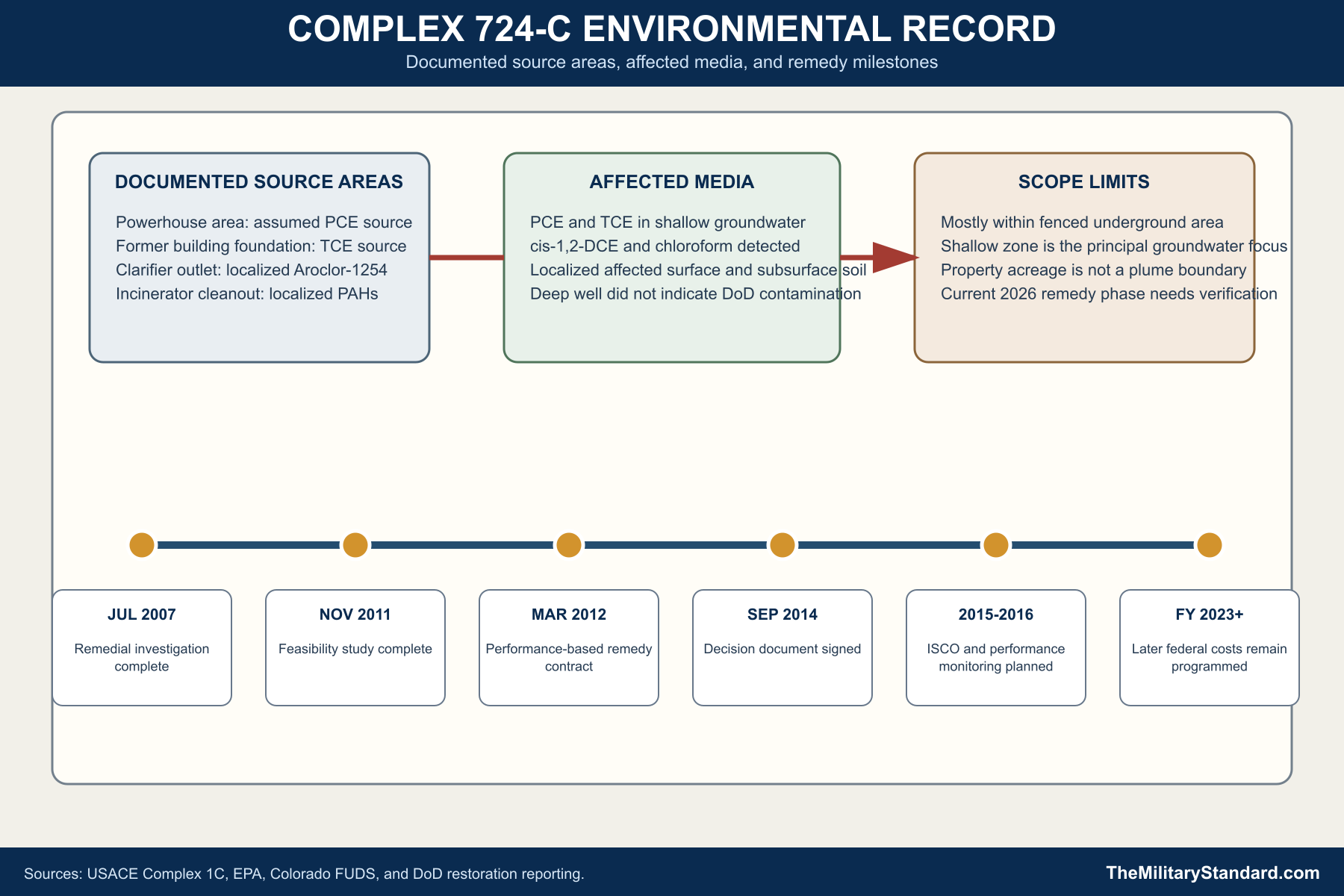
PCE and TCE are the primary groundwater contaminants identified by the Corps. They occur mainly in the shallow saturated zone within the fenced underground-facility area. Investigators assumed two source areas: PCE to the north near the powerhouse and TCE near a former building foundation. A deep monitoring well indicated that groundwater below the intermediate saturated zone was believed not to have been contaminated by Department of Defense activity. That conclusion is evidence from a defined investigation, not a guarantee about every future sample or every off-property pathway.
Soil findings included Aroclor-1254, a PCB mixture, near the chemical-waste clarifier and polynuclear aromatic hydrocarbons near the incinerator cleanout. The Corps described those affected areas as delineated and localized within approximately five feet of the clarifier outlet and five feet of the incinerator cleanout, with removal scheduled. Investigators also detected cis-1,2-dichloroethene, a breakdown product associated with TCE degradation, and chloroform. These chemicals connect the site record to solvent use, waste handling, treatment, and degradation processes rather than to the missile warhead itself.
The remedial investigation report was completed in July 2007. Four underground storage tanks were permanently closed, and soil next to the tanks was investigated as part of closure. A feasibility study followed in November 2011. In March 2012 the government awarded a firm fixed-price, performance-based contract for a remedy-in-place objective. After public review of a proposed plan, the Corps signed the decision document on September 26, 2014. These steps moved the property from characterization through remedy selection.
The 2015 plan called for final remedial design and in-situ chemical oxidation using potassium permanganate, followed by a remedy-in-place report. The proposed 2016 program included full-scale performance monitoring and semiannual reports. In-situ chemical oxidation introduces an oxidant into affected groundwater to break down chlorinated solvents. It can reduce contaminant mass without pumping all groundwater to the surface, but it requires monitoring to determine whether the treatment reached the plume and whether concentrations rebound.
Later Department of Defense restoration tables continued to carry Complex 1C costs and future requirements. The 2023 environmental-restoration transparency report listed actual obligations through fiscal year 2022, planned fiscal year 2023 work, and additional estimated costs after fiscal year 2023. Those financial entries show that the property remained in the restoration program beyond the early implementation schedule. They do not, by themselves, identify the exact 2026 field activity or prove whether every remedy objective has been met. Current remedy phase, monitoring results, land-use controls, and regulator concurrence require a current Corps project update.
Surviving Features, Condition, And Safety
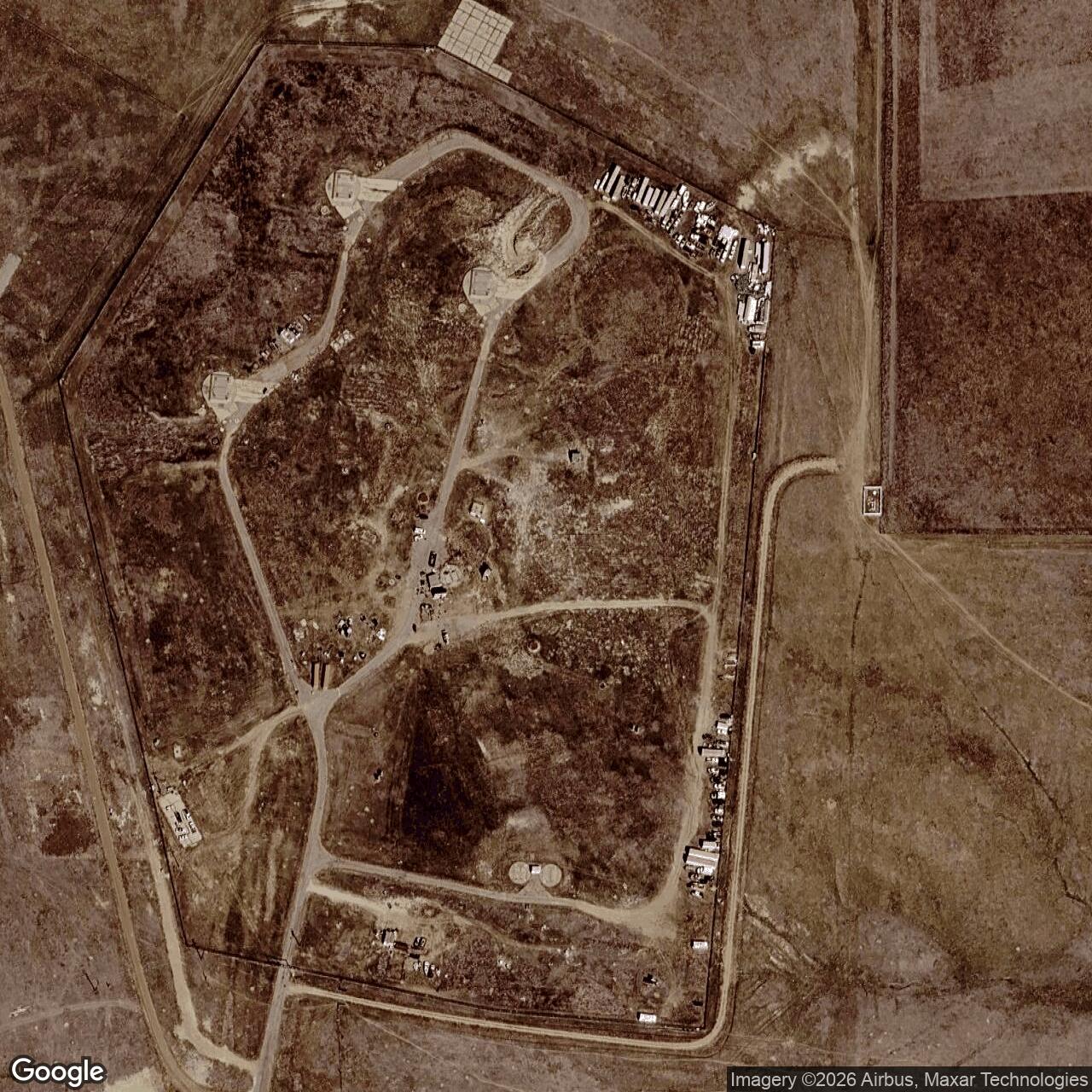
The buried scale of Titan I makes surviving remains historically significant even when the missile and equipment are gone. Likely remnants include the three deep silo structures, equipment and propellant terminals, central control and powerhouse chambers, antenna shafts, tunnels, doors or door foundations, hatches, vents, paved areas, drainage features, waste-system structures, and altered terrain. The post-military testing period may also have added buildings, pads, berms, test areas, or disturbed ground. Exact survival and condition in 2026 cannot be established from the consulted public records and must not be guessed from imagery alone.
HAER CO-89 provides the best official visual record of a Lowry Titan I complex, but it documents Complex 2A rather than 724-C. Its measured drawings and 24 photographs are authoritative for the shared standardized design and for the kinds of features that can survive. They are not proof that a particular 724-C room is accessible, dry, intact, or configured exactly as 2A appeared when documented.
Former missile complexes present severe hazards. Open or inadequately sealed shafts can be fatal. Underground spaces may contain oxygen-deficient air, toxic gases, contaminated water, unstable concrete, corroded ladders, unguarded drops, electrical hazards, sharp metal, and confined-space conditions. Surface soils and groundwater may remain under environmental controls. Explosive-testing history adds possible energetic-material and fragment hazards. The site is not represented as publicly accessible, and this history provides no route, entrance, or encouragement to visit without current owner authorization and appropriate safety controls.
Detailed Chronology
- 1940 Denver-area land southeast of the city enters the military training landscape associated with Lowry Field and the developing bombing and gunnery range.
- 1942-1963 The larger Lowry Bombing and Gunnery Range supports varied inert and live munitions training; its history overlaps but does not duplicate the later Complex 1C property.
- 1954 The Air Force authorizes Titan development as a complementary intercontinental ballistic missile program.
- March 1958 The Air Force selects Lowry Air Force Base and the Denver region for the first operational Titan I deployment.
- September 25, 1958 The 703rd Strategic Missile Wing activates at Lowry to develop the Titan mission.
- Late 1958 Air Force and Army Corps representatives select the three 724th Squadron complex locations in the Lowry field.
- January 1959 The national defense program approves the Lowry Titan construction effort under an economy-driven initial plan.
- Early 1959 Road, drainage, well, survey, and other preparatory work advances across the Lowry missile field.
- April 1959 The Omaha District awards the main contract for Complexes 1A, 1B, and 1C to a Morrison-Knudsen-led joint venture.
- May 5, 1959 Ceremonial groundbreaking marks the Lowry Titan construction program; a separate 1C groundbreaking date has not been confirmed.
- 1959-1961 Crews excavate and construct the three silos, launcher terminals, control center, powerhouse, antenna facilities, tunnels, and surface systems at 724-C.
- 1959-1961 Design changes driven by concurrent testing revise elevators, shock mounting, oxygen systems, wiring, drainage, and equipment interfaces.
- August 1960 The Air Force establishes the Lowry Site Activation Task Force to integrate construction, installation, training, testing, and acceptance.
- December 3, 1960 A Titan I accident at Vandenberg reveals elevator vulnerabilities and contributes to operational-site changes.
- 1961 Major civil construction across the Lowry field approaches completion while technical installation and demonstrations continue.
- July 1, 1961 The 724th Strategic Missile Squadron organizes and inherits the mission and resources of the 848th Strategic Missile Squadron.
- October 5, 1961 The first operational Lowry Titan I is lowered into a silo; the available record does not identify it as a 724-C launcher.
- April 18, 1962 Strategic Air Command declares the 724th Strategic Missile Squadron operational.
- April 20, 1962 The 724th places its first Titan I on alert; the source does not identify the complex holding that missile.
- May 1, 1962 All 18 missiles of the two Lowry Titan I squadrons are in their silos.
- October 1962 Complex 724-C shares the 724th Squadron's alert mission during the Cuban Missile Crisis.
- 1962-1964 Combat crews, security forces, and maintenance teams sustain continuous alert, exercises, evaluations, and repairs.
- November 19, 1964 Secretary of Defense Robert McNamara announces phaseout of the remaining Atlas and Titan I systems by the end of June 1965.
- February 17, 1965 The 724th begins removing Titan I missiles from alert.
- March 26, 1965 The last 724th Squadron Titan I leaves alert status.
- April 15, 1965 Shipment of the last 724th missile from the operational field is completed.
- June 25, 1965 The 724th Strategic Missile Squadron inactivates.
- August 1965 The Department of Defense declares Complex 1C excess to the General Services Administration.
- March 1966 Mid-Continent Construction Company is scheduled to begin dismantling the Lowry Titan silos.
- Before February 1967 The planned dismantling period ends, although large buried structures remain.
- March 1969 Falcon Research & Development Company leases Complex 1C for federally sponsored research and engineering.
- 1969 and after Falcon performs predominantly explosive testing on the surface and briefly uses a small underground area for ballistic-impact tests.
- March 1988 Applied Research Associates enters a lease for storage, assembly, manufacture, and testing of explosive devices.
- 1988 and after ARA conducts defense and aerospace field testing, including shock-physics and explosive-characterization work.
- 1997 Federal restoration reporting shows remedial investigation and feasibility study activity underway for the Complex 1C hazardous-waste project.
- July 2007 The Complex 1C remedial investigation report is completed.
- By 2007 Four underground storage tanks are permanently closed and adjacent soil is investigated.
- November 2011 The feasibility study is completed.
- March 2012 A performance-based remedy-in-place contract is awarded.
- September 26, 2014 The Corps signs the Complex 1C decision document after public review of the proposed plan.
- April 15, 2015 The Omaha District publishes its detailed Complex 1C fact sheet.
- 2015 The planned work includes final remedial design, in-situ chemical oxidation with potassium permanganate, and a remedy-in-place report.
- 2016 The planned program moves to full-scale remedy performance monitoring and semiannual reporting.
- Fiscal year 2022 Later Defense Department reporting continues to show restoration obligations for Complex 1C.
- Fiscal year 2023 and after Federal transparency reporting carries planned work and additional future environmental-restoration costs.
- September 19, 2026 This Gold Plus history, CMS review copy, verified graphics, and Titan inventory update are completed.

Sources & References
- WEB U.S. Army Corps of Engineers Omaha District, Former Lowry Air Force Base Titan Missile Site 1, Complex 1C Used for: Primary site-specific evidence for location, 211-acre property extent, excess declaration, dismantling, leases, Falcon and ARA operations, contaminants, source areas, investigations, remedy decision, and planned treatment.
- WEB U.S. Environmental Protection Agency, Former Lowry AFB Titan Missile Site 1 Complex 1C CERCLA Site Profile Used for: EPA ID CO0010104216, Arapahoe County location, EPA coordinate, federal-facility status, non-NPL classification, federal-facility-led cleanup, and Eligible Response Site exclusion.
- PDF U.S. Army Corps of Engineers, Formerly Used Defense Sites Inventory for Colorado Used for: Official identification of LOWRY AFB S-1 (COMPLEX 1C), property number B08CO0010, project categories, Northwestern Division, and Omaha District routing.
- PDF Historic American Engineering Record HAER CO-89, Titan One Missile Complex 2A data pages Used for: Primary federal engineering history of the standardized Lowry Titan I design, site selection, construction contracts, facilities, operations, organization, and deactivation. Complex 2A is representative and is not 724-C.
- WEB Library of Congress, HAER CO-89 collection record Used for: Official catalog record for 24 photographs, three measured drawings, 101 data pages, and captions documenting a representative Lowry Titan I complex.
- PDF U.S. Air Force History and Museums Program, Ballistic Missiles in the United States Air Force, 1945-1960 Used for: Official Air Force program history for Titan development, acquisition, strategic purpose, deployment decisions, and early operational organization.
- PDF Air Force Historical Support Division, Air Force Historical Chronology, 1907-2012 Used for: Official chronological controls for Lowry selection, Titan I development, operational deployment, and phaseout.
- PDF Air Force Historical Support Division, 1962 Chronology Used for: Confirmation that the 724th was declared the first operational Titan I squadron on April 18, 1962, with nine hardened launchers.
- WEB National Park Service, Titan Intercontinental Ballistic Missile Used for: Federal interpretive context for Titan I development, hardened deployment, missile characteristics, launch sequence, and transition to Titan II.
- WEB National Park Service, The Arms Race Goes Underground Used for: Federal context for underground ICBM survivability, launch-site development, and the transition to launch-from-silo systems.
- PDF National Park Service, Defend and Deter: The Legacy of the United States Cold War Missile Program Used for: National Cold War missile context and inventory identification of Lowry Titan I launchers 724-C-1 through 724-C-3.
- PDF Office of the Secretary of Defense, Report on Environmental Restoration Program Transparency, 2023 Used for: Later program evidence of actual obligations through fiscal year 2022, planned fiscal year 2023 work, and estimated Complex 1C restoration costs after fiscal year 2023.
- PDF Department of Defense, Environmental Restoration Program Appendix identifying Formerly Used Defense Sites Used for: Official confirmation of FFID CO89799F694400 for LOWRY AFB S-1 (COMPLEX 1C).
- WEB U.S. General Accounting Office, Formerly Used Defense Sites Cleanup Program, Colorado Used for: Historical federal oversight context for Complex 1C risk ranking, project categories, investigation status, and cost estimates at the time of reporting.
- WEB U.S. Army Corps of Engineers Omaha District, Former Lowry Bombing and Gunnery Range Used for: Official context for the larger 59,000-acre predecessor range, its 1942-1963 use, munitions-response areas, and the need to distinguish the range from Complex 1C.
- WEB Cold War Geodesy, Titan I Missile Sites Used for: Secondary technical inventory used only to crosscheck site identity and coordinate history against official EPA and project records.