
Titan I OSTF-8 Missile Silo Vandenberg AFB California
Titan I OSTF-8
Air Force Base: Vandenberg
State: California
Coordinates:
Latitude: 34°48'15.47"N
Longitude: 120°32'46.35"W
Decimal:
Longitude: -120.546208
Latitude: 34 48.2578333333333
Longitude: -120 32.7725
View on Google Maps
This was a Operational Suitability Test Facility for Titan I.
The reason this silo opening has no doors is due to an explosion in the 60's. Part of the debris is still visible in the image below, although it blends well with the ground after all of these years. The specific launch was, I believe, on December 3, 1960.
List of all Titan I site Coordinates
Detailed information about the Titan I Intercontinental Ballistic Missile can be found here.


Overview
The Titan I Operational System Test Facility at Vandenberg was built to prove a complete missile-and-ground-equipment system before the Air Force placed Titan I launchers on strategic alert. Its single hardened silo, elevator, blast doors, propellant-handling equipment, and control arrangements let crews rehearse the sequence that a fielded Titan I site would have to perform. A photograph from October 1960 shows a missile raised above the silo. Yet OSTF never launched a missile. On December 3, 1960, its elevator system failed as a fueled test article was lowered. The ensuing explosion destroyed the launch facility, and the Air Force elected not to rebuild it. The story is therefore about integrated ground testing, a consequential mechanical failure, and the transfer of the planned flight-test mission to other Vandenberg facilities, not about an OSTF launch record.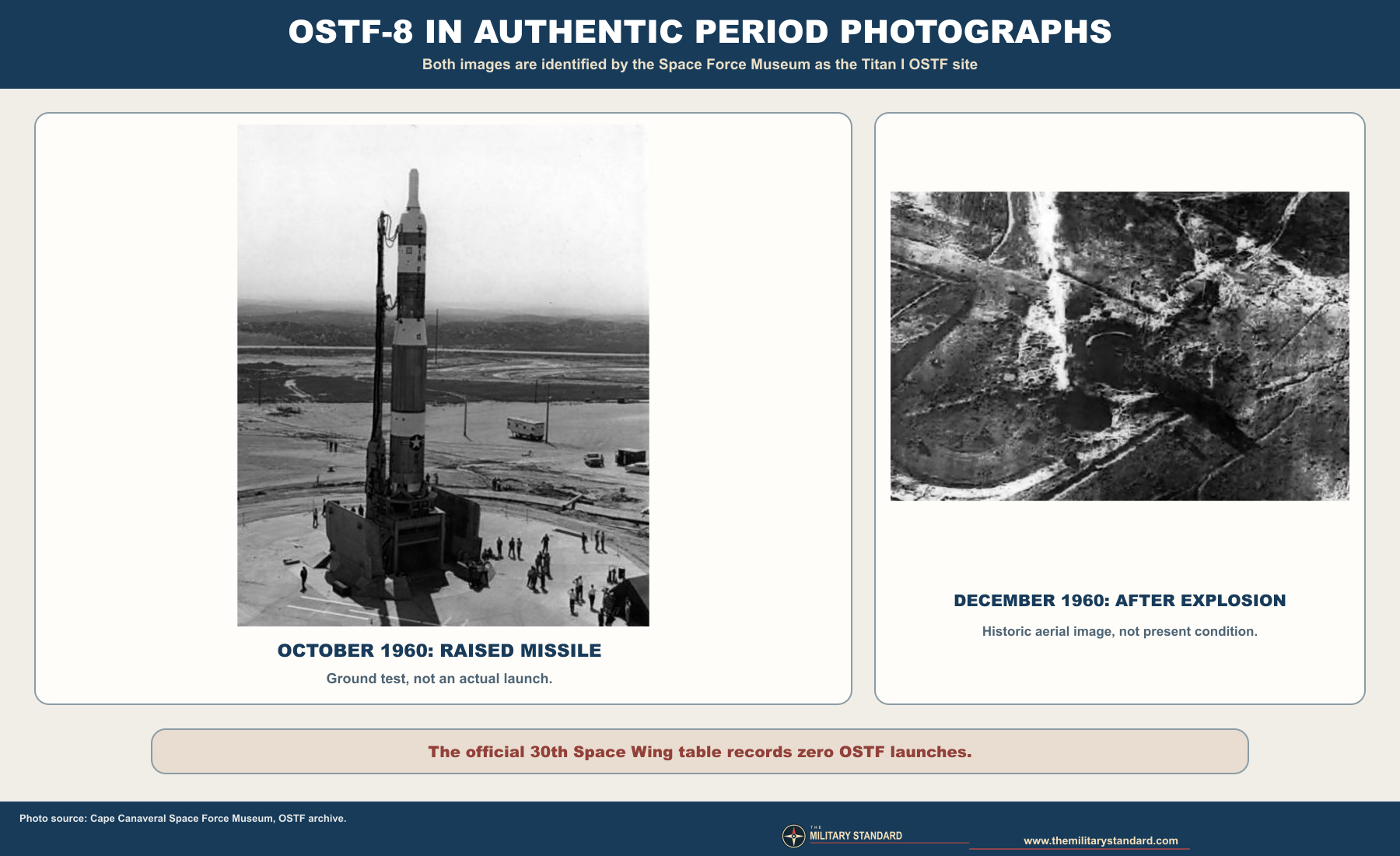
The official 30th Space Wing facility table identifies the site as building 1861, calls its configuration a hard silo-lift Titan I test facility, assigns it a weapon-system demonstration purpose, and records no actual launches. The Space Force Museum uses Operational Silo Test Facility as its page title and Operational Suitability Test Facility as an alternate name. Air Force historical writing also uses Operational System Test Facility. Published lists and the site's existing inventory use OSTF-8, while the museum labels its historic photographs Complex 395 OSTF-1. These are naming variants for the Titan I installation described here, not evidence of an extra Titan silo. They must not be confused with the separate Atlas E OSTF-1 or Atlas F OSTF-2 elsewhere at Vandenberg.
Installation Identity and Location
OSTF stood in the northern missile-test area of the former Cooke Air Force Base, renamed Vandenberg Air Force Base in 1958 and Vandenberg Space Force Base in 2021. The museum's historic base map places the facility generally in the northern base area. The larger Vandenberg installation remains under military control; an online location marker conveys historical identity, not public access authorization.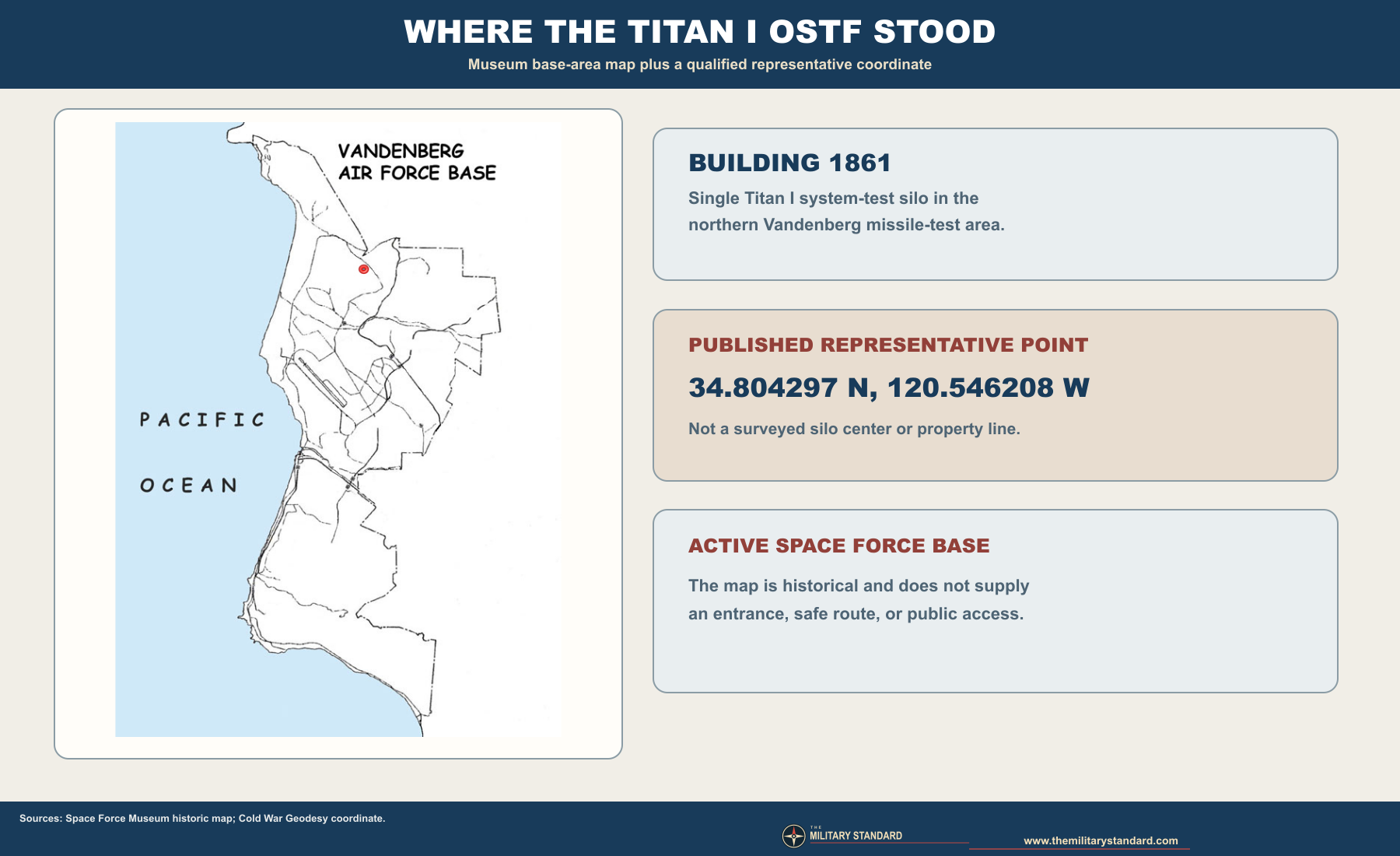
The facility's one-silo identity matters because several missile sites occupied the same broad Vandenberg test landscape. The separate 395-A complex had three Titan I silo-lift launchers and eventually conducted 19 flights. The Silo Launch Test Facility, or SLTF, was a different prototype silo used for Vandenberg's first in-silo Titan I launch. Later Titan II 395-B, 395-C, and 395-D were distinct launch facilities. The Air Force's building-number crosswalk reinforces that separation: OSTF was 1861, SLTF was 1885, and the 395-A launchers were 1875, 1877, and 1879. Proximity and shared missile ancestry do not merge these properties or their permanent installation identifiers.
Construction and Purpose
The Air Force's Titan I program sought a protected, operationally credible complement to the Atlas missile. Test flights at Cape Canaveral could demonstrate the missile's performance, but they could not alone establish that a field crew could store, fuel, raise, service, and control it as an integrated weapon in a hardened installation. Vandenberg supplied that missing setting. Its Pacific test-range geography supported eventual long-range missile trials, while the OSTF gave engineers and launch crews a place to exercise the ground plant before a flight. The Army Corps of Engineers managed construction of the test facility as part of the broader first-generation ICBM construction effort. This was a developmental installation, not one of the 54 Titan I launchers later held on operational alert at five inland bases.The start of construction is not recorded uniformly. A Strategic Air Command missile chronology places the beginning on July 31, 1958, at Cooke Air Force Base. The Space Force Museum says June 1958. A Historic American Engineering Record history refers to Corps work beginning in June 1957, a year earlier, but does not reconcile that statement with the other two accounts. The safest record is that planning and construction were underway in the late 1950s, with July 31, 1958 used only when explicitly attributed to the SAC chronology. The museum places equipment installation in July 1959. The official Vandenberg launcher table records Air Force acceptance of building 1861 on December 15, 1959, whereas the museum calls June 6, 1960 a site acceptance date. These may reflect different acceptance milestones, but the available summaries do not establish that explanation.
Silo Lift and Facilities
The single launcher replicated the defining Titan I operating method. A missile was sheltered vertically below ground behind heavy doors; before launch, ground equipment would handle propellants and a hydraulic elevator would raise the missile to the surface. The missile could not be launched from the bottom of its Titan I silo. The Historic American Engineering Record describes OSTF's blast doors, propellant-handling system, and elevator as configured to develop operational launch procedures, including loading, raising, and lowering a test airframe. This was more than a concrete tube. The value of the test lay in proving the interaction among missile, support equipment, control procedures, and hardened structure, and in finding faults before those procedures were standardized across field complexes.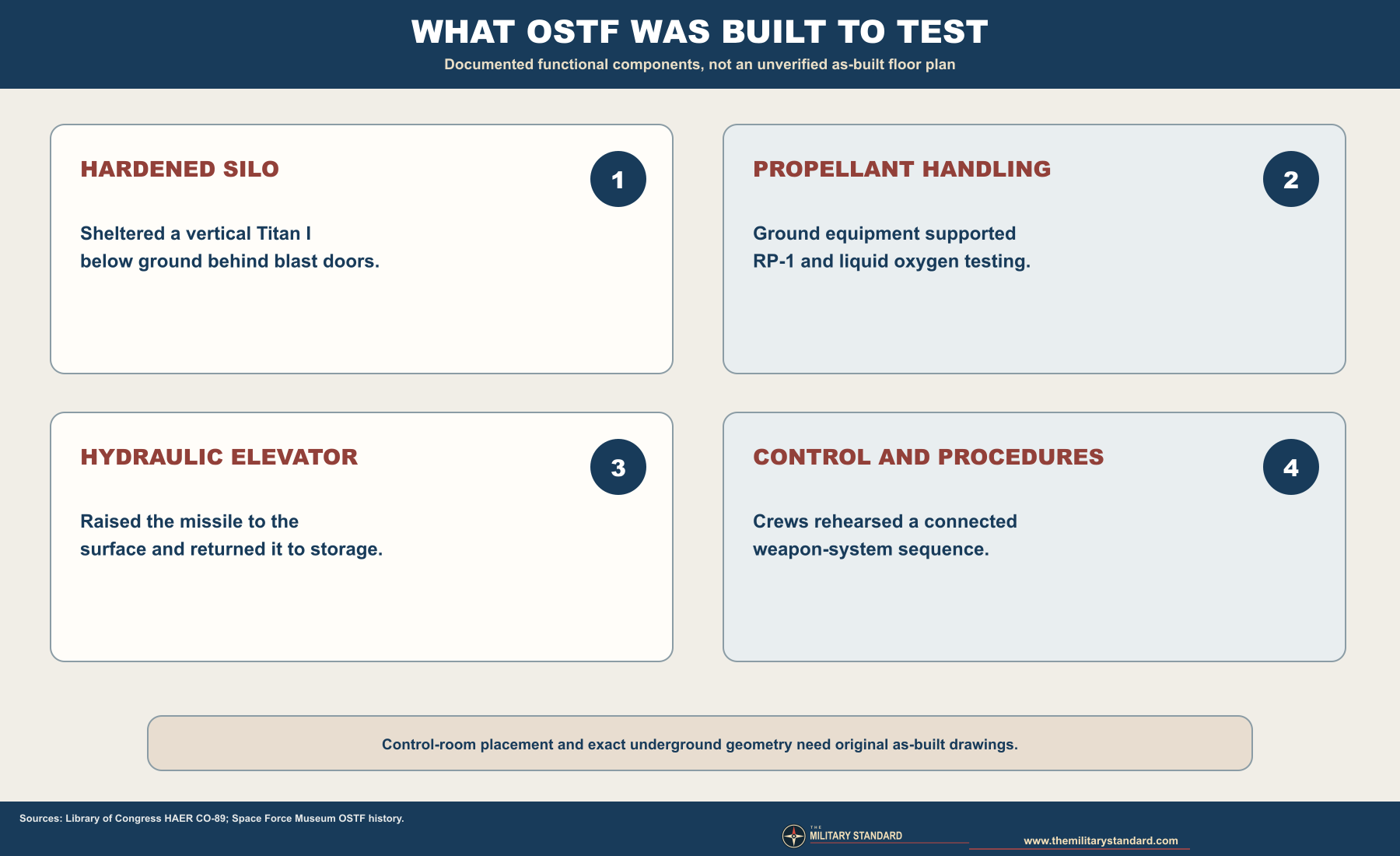
The museum describes a single silo with an above-ground launch-control building, while the Historic American Engineering Record says 25 crewmen were in a nearby underground launch center during the accident. The two summaries may use different terms for different control or support spaces, but a reviewed as-built plan is needed before assigning exact room positions or claiming that either account fully describes the plant. An independent specialist's published diagram depicts an antenna silo associated with OSTF, yet that diagram has not been reconciled here with official property drawings. The history therefore treats communications and control as essential functions, without inventing a detailed tunnel, room, utility, or antenna layout. No facility-specific acreage, construction cost, housing inventory, or surveyed boundary was verified.
Ground Test Campaign
Air Force program history records a Titan I emerging from the Vandenberg OSTF silo in 1960 and explains that the operational missile had to be raised before firing. The museum dates installation of Titan I VS-2 to October 16, 1960, and its October photograph shows the raised missile and surface handling equipment. Such scenes can be mistaken for an actual launch if separated from their captions. The official launcher table settles the site's flight count at zero. Ground exercises were still substantive: they tested the sequence of installation, fueling, elevation, simulated launch preparation, and return to storage, exposing a coupled mechanical and procedural system to realistic conditions.The Historic American Engineering Record calls one test article a steel battleship airframe that could not be launched and was used to train on propellant loading and elevator operation. The museum instead labels its October 1960 missile VS-2 and the December accident photograph Titan I V-2. Those descriptions may refer to different stages of the test campaign, or may represent inconsistent nomenclature in later summaries; the reviewed evidence does not permit a confident reconciliation. What is established across the records is the facility's full-system ground-test purpose and the absence of a completed flight. The distinction is important both historically and for the website: an image of a raised Titan at OSTF is evidence of a ground test, not proof that a missile was fired from this silo.
December 3, 1960 Accident
During a simulated launch exercise on December 3, 1960, a fully fueled Titan test article was being returned from the raised position into the silo. The elevator descended abnormally fast, the platform and missile fell to the bottom, propellant tanks ruptured, and an explosion wrecked the facility. A contemporary Air Force Association account attributes the initiating problem to a hydraulic flow-control valve and says the missile dropped about five times faster than intended. The Historic American Engineering Record likewise cites an official incident report's failed hydraulic control valve and failed elevator braking. The museum names the propellants as RP-1 and liquid oxygen. This was a ground accident during an exercise, not a failed missile launch or nuclear event.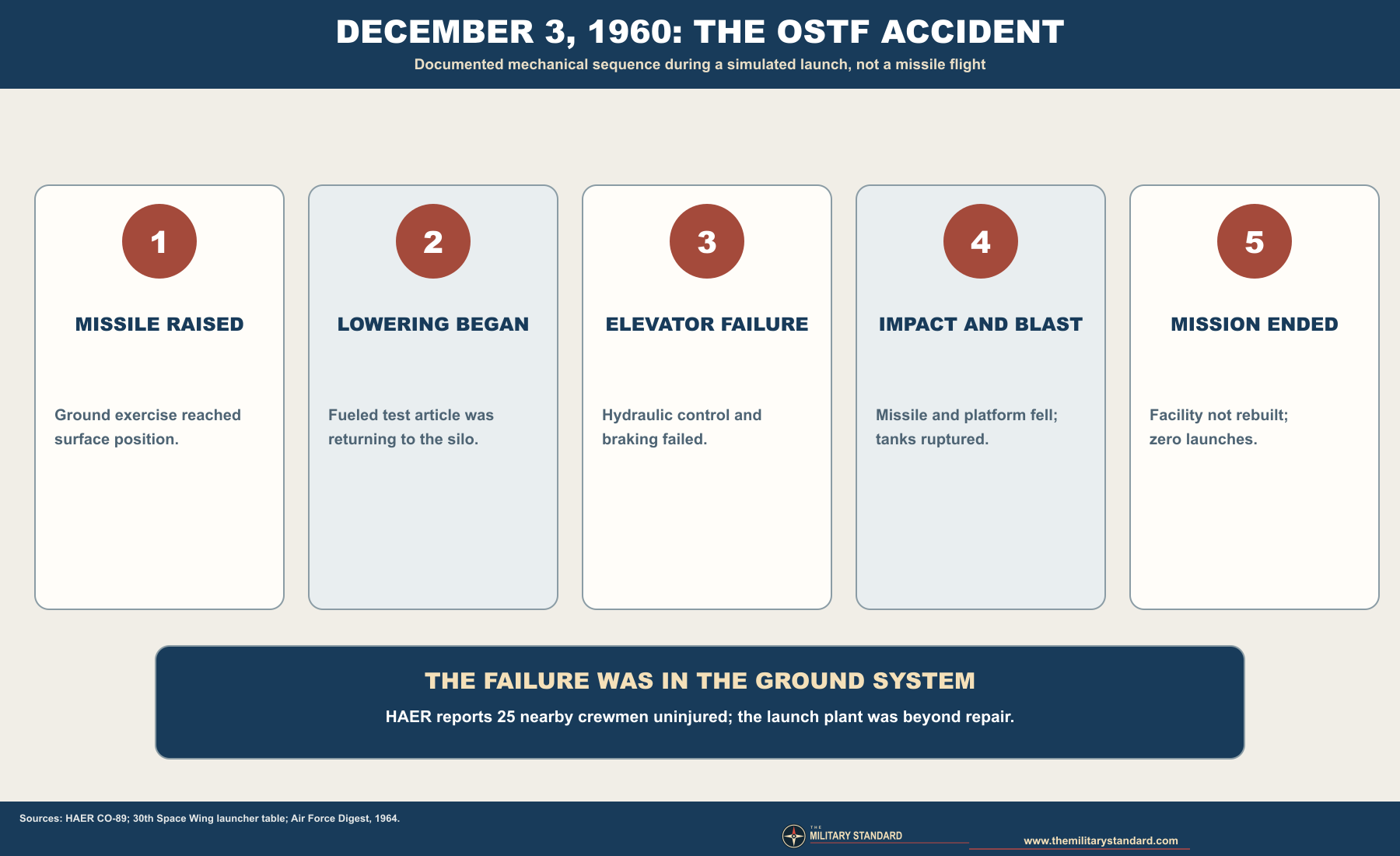
The scale of structural damage was exceptional. The Historic American Engineering Record reports destruction of one half of the concrete silo cap, displacement and rotation of another massive section, shattered upper silo walls, and cracking farther down the shaft. Its account says 25 missile crewmen in a nearby control area were uninjured; it does not establish that every person anywhere on the base was absent or safe. The museum's post-accident aerial photograph documents the scarred launch area. It is a period image, not a present-condition survey. The Air Force's later launcher table says a scarred hole remained in 1983 and that the facility had been deleted from real-property records. That dated statement cannot establish the precise physical condition of the site today.
Investigators and commanders had to distinguish a missile-design problem from a ground-system failure. The cited incident account points to the hydraulic elevator control and braking sequence, not to an in-flight malfunction. A ground plant intended to validate safe operating procedures instead exposed a critical single-component vulnerability in the process of moving a fueled missile. The Air Force did not repair the multimillion-dollar OSTF. A later Air Force Association review says the operational launch-test program moved to a training facility, where the first successful integrated operational Titan I test occurred on September 23, 1961. That date belongs to Complex 395-A, not to OSTF; the earlier May 3, 1961 Titan I flight from the separate SLTF tested an in-silo launch environment.
Program Continuity
The accident did not terminate the Titan I program, but it changed which Vandenberg facilities would carry its next demonstrations. The SLTF's May 1961 launch addressed a different engineering question: how an emplaced missile would behave when fired from within a prototype silo associated with the next Titan generation. Complex 395-A then handled Titan I silo-lift flights, including development, operational evaluation, Strategic Air Command tests, and target missions. These successor activities should not be backdated or assigned to building 1861. OSTF supplied lessons from integrated ground operations and its failure; its neighboring facilities supplied the flight record that OSTF never acquired.The 395th Strategic Missile Squadron later became strongly associated with Vandenberg Titan launches, but the reviewed site-specific records do not identify a permanent OSTF squadron detachment or a complete test-crew roster. The existing inventory's squadron field merely repeats the facility name and should not be treated as an assigned unit. Program responsibility involved Air Force ballistic-missile development organizations, Strategic Air Command's growing operational role, the Corps of Engineers' construction management, and the contractor and crew specialists who exercised the launcher. The Historic American Engineering Record cites 1st Missile Division records for the decision not to rebuild. A unit assignment at this one silo should be asserted only if a dated order or contemporary facility record identifies it.
Role in the Wider Military Network
OSTF was a bridge between missile development and deployed deterrence. Cape Canaveral flight tests had to establish propulsion, guidance, and range performance; Vandenberg's OSTF had to establish that a Titan I missile and its hardened ground plant could function together through an operational sequence. Information from the site therefore mattered to the eventual Titan I field complexes even though OSTF itself was not an alert launcher. The failure also had network-wide consequences: the program's schedule and proof burden shifted to the remaining Vandenberg training and test facilities. Later Titan II and Minuteman designs reduced reliance on the laborious fueled silo-lift method by adopting different propellants and launch arrangements.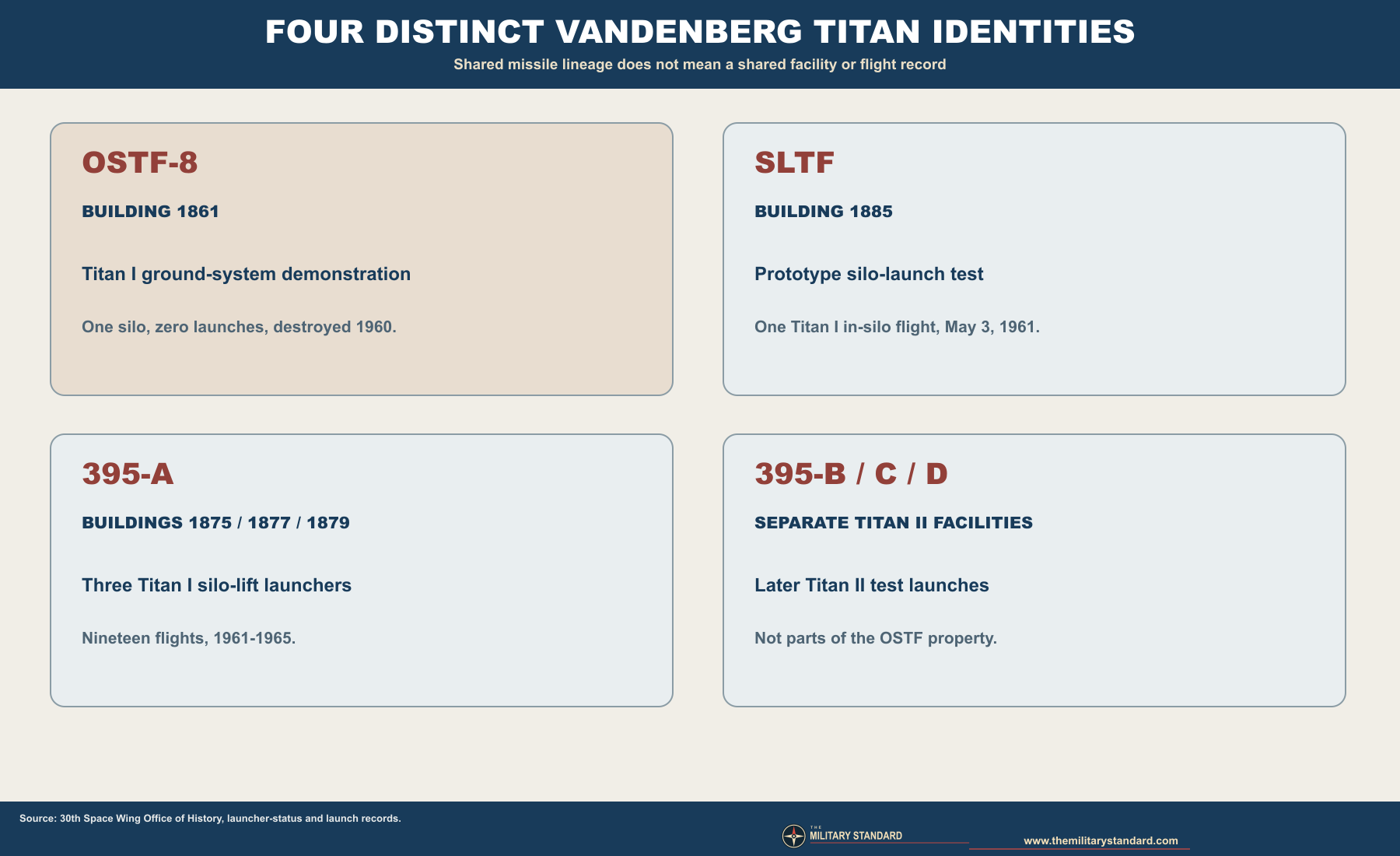
The same broad northern Vandenberg landscape also hosted Atlas facilities, and the acronym OSTF appears in Atlas site names. Atlas E OSTF-1 and Atlas F OSTF-2 were separate properties with their own missile systems and histories. This Titan site's museum photo label OSTF-1 must not be used to assign Atlas launches or Atlas environmental findings to building 1861. Likewise, a 2005 Air Force environmental assessment calls building 1885 the old Titan I/II launch-test facility. Building 1885 is the SLTF, not the destroyed Titan I OSTF.
Postservice Property and Environmental Record
The immediate post-accident decision was to abandon the OSTF launch mission rather than reconstruct the silo. The official 1983 facility table describes a remaining scarred hole and says the property had been deleted from real-property records. A 2005 Vandenberg Air Force programmatic environmental assessment nevertheless uses building number 1861 in its planning tables and maps. It lists that number among facilities proposed for demolition or abandonment, identifies its asbestos survey as not completed with material suspected, and places it in an area for which explosive-ordnance specialists would review demolition plans because of possible legacy range ordnance. These are 2005 planning and screening statements, not proof of asbestos at a particular OSTF surface or of unexploded ordnance in the silo.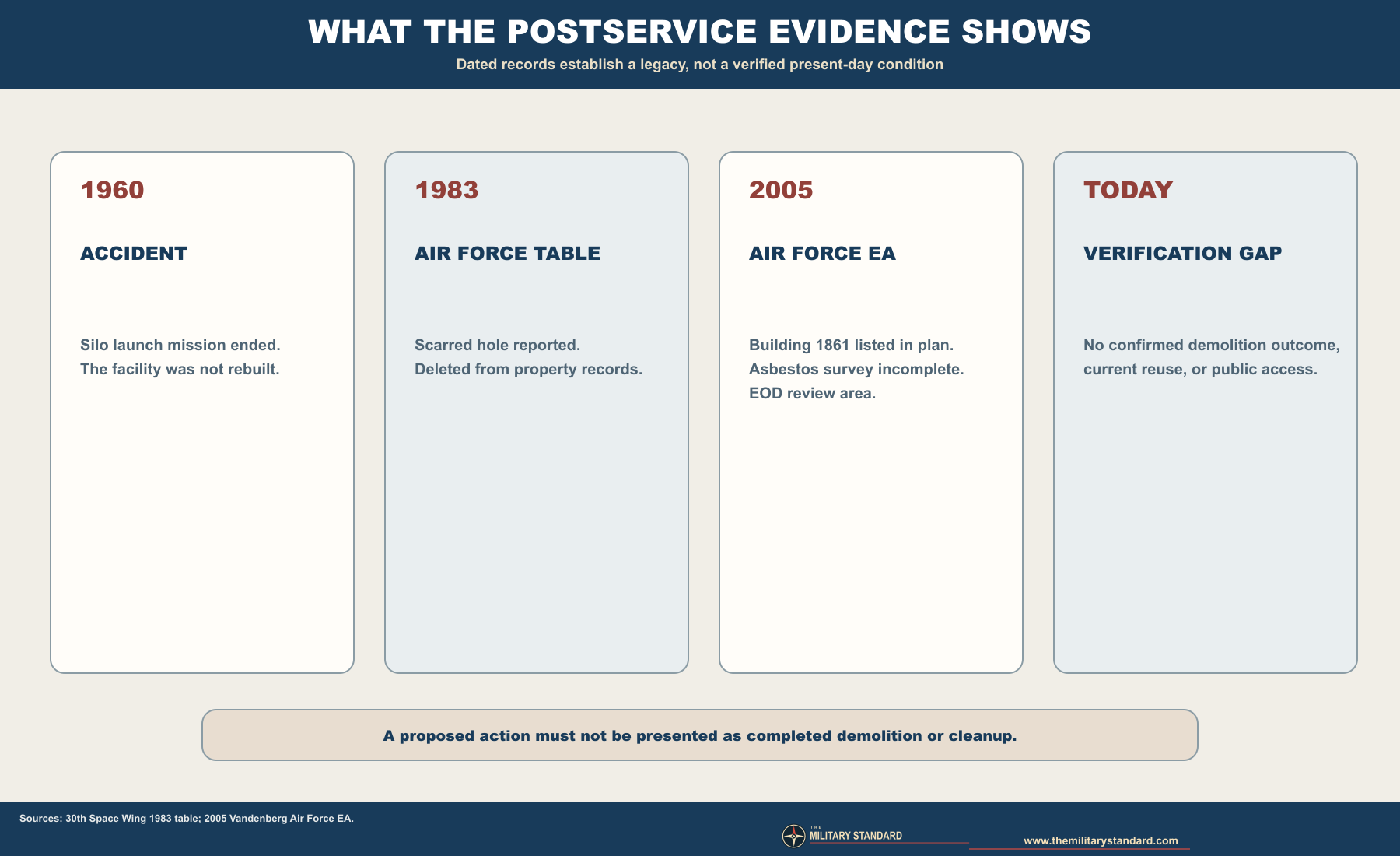
The environmental assessment explains that actual demolition or abandonment methods would depend on structure-specific decisions and further surveys. It does not establish from the reviewed text that work at building 1861 was completed, what debris remains, or whether a current remedial action closed the site. Nor does a site inside today's active Vandenberg Space Force Base become a Formerly Used Defense Site simply because its 1960 mission ended. Parent-installation ownership is clear, but a separately surveyed OSTF parcel, current reuse, facility-level transfer, comprehensive contamination finding, and visitor access have not been verified. The museum's historic photograph and dated accounts document the past; they cannot substitute for present engineering, property, and environmental records.
Source Disagreements and Research Limits
Several apparently small discrepancies materially change the story if left unexplained. The construction start appears as June 1957 in one Corps-based historic study, June 1958 in the museum summary, and July 31, 1958 in the SAC chronology. The facility acceptance is December 15, 1959 in the official launcher table but June 6, 1960 in the museum. The museum calls the site OSTF-1 and identifies VS-2/V-2, while other records use OSTF or OSTF-8 and describe a nonflying battleship airframe. None of these disagreements licenses a precise invented sequence. The accident date, building number, no-launch count, and decision not to rebuild have much stronger multi-source support.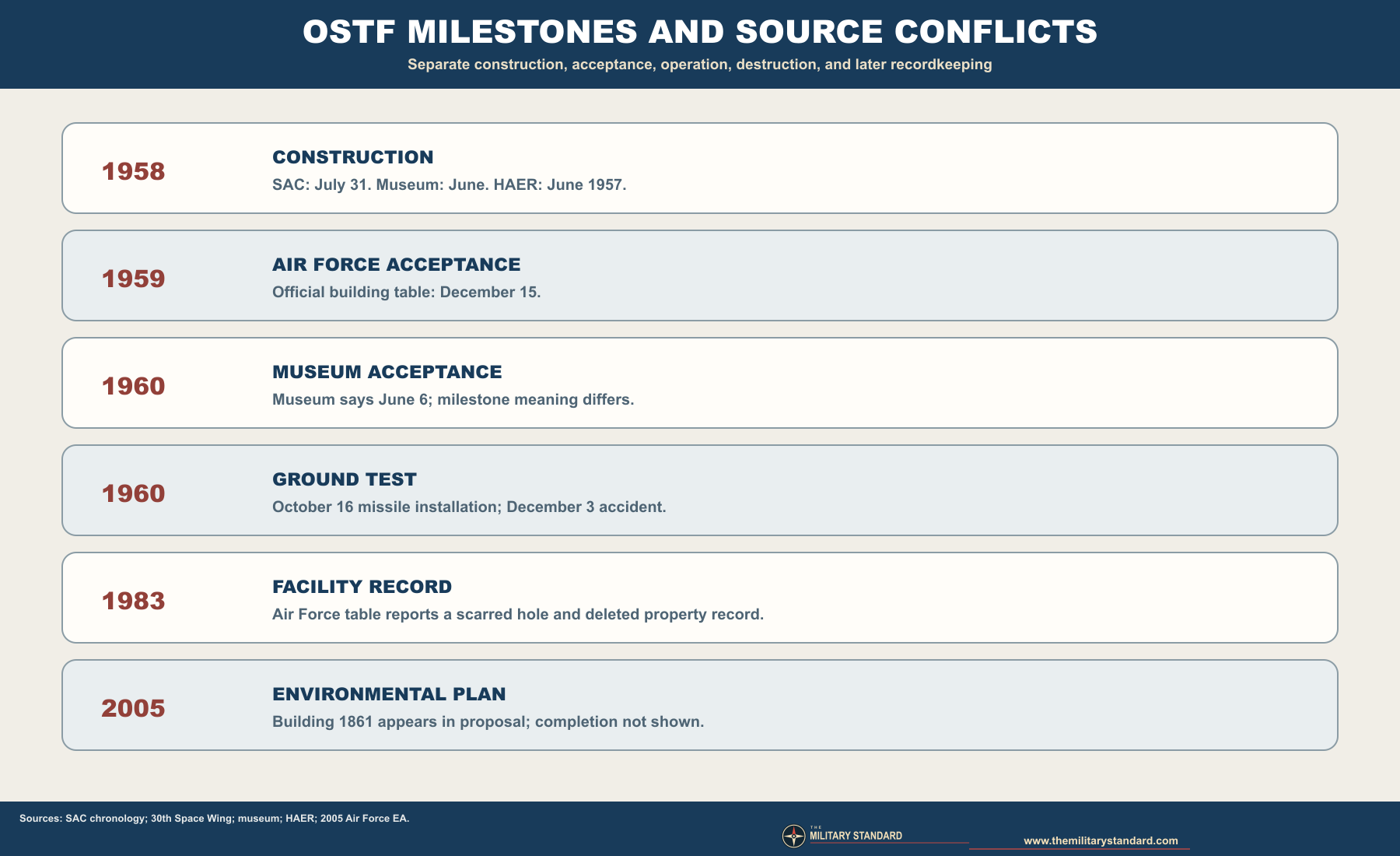
The highest-value next archival documents would be the December 3, 1960 incident report cited by the Historic American Engineering Record, original Corps construction and acceptance records, Vandenberg as-built drawings for building 1861, a contemporary crew/organization roster, and current Space Force property and environmental records. Those could resolve the naming, milestone, physical-layout, test-article, and present-condition questions. Until then, this history deliberately distinguishes a reported historical fact from a reasonable program inference. The site is historically significant as a failed but consequential integrated weapon-system test, not as a launch pad with a hidden flight manifest.
Chronology
- 1957-06 A later Historic American Engineering Record account places the beginning of Corps work on OSTF in June 1957; this conflicts with the 1958 dates in other summaries.
- 1958-06 The Space Force Museum dates the start of OSTF construction to June 1958.
- 1958-07-31 A Strategic Air Command missile chronology records the beginning of Titan I OSTF construction at Cooke Air Force Base.
- 1958 Cooke Air Force Base is renamed Vandenberg Air Force Base during the missile-range transition.
- 1959-07 The Space Force Museum dates equipment installation at OSTF to July 1959.
- 1959-12-15 The official Vandenberg launcher table records Air Force acceptance of OSTF building 1861.
- 1960-06-06 The Space Force Museum records a site acceptance date, differing from the official building acceptance entry.
- 1960-10-16 The museum records installation of Titan I VS-2 at OSTF.
- 1960-10 A museum-labeled historic photograph shows a Titan I raised at the OSTF launch area.
- 1960-12-03 A hydraulic elevator failure during a simulated launch exercise sends a fueled Titan into the silo; an explosion destroys the facility and no OSTF flight occurs.
- 1961 The Air Force decides not to rebuild OSTF and shifts integrated operational test work to another Vandenberg facility.
- 1961-05-03 The separate Silo Launch Test Facility conducts Vandenberg's first Titan I in-silo launch.
- 1961-09-23 The separate Complex 395-A makes its first Titan I flight and carries forward integrated operational testing.
- 1983-03 A 1st Strategic Aerospace Division launcher table describes a scarred OSTF hole and says the facility had been deleted from real-property records.
- 2005-09-13 A Vandenberg programmatic environmental assessment includes building 1861 in demolition and abandonment planning, but does not prove the work was carried out.
- 2021 The parent installation is renamed Vandenberg Space Force Base.


Sources & References
- PDF Vandenberg AFB Launch Summary, 1958-2000, including March 1983 Launcher Status and History; 30th Space Wing Office of History SOURCE FOR: Building 1861, December 15, 1959 acceptance entry, no launches, December 3, 1960 destruction, 1983 condition, and facility crosswalk.
- WEB Operational Silo Test Facility (OSTF); Cape Canaveral Space Force Museum SOURCE FOR: Historic photographs, June 1958 construction date, July 1959 installation, June 6, 1960 acceptance, October 16 missile installation, silo/control description, accident, and no rebuilding.
- WEB Titan I Missile Complex 2A, Historic American Engineering Record CO-89; National Park Service and Library of Congress SOURCE FOR: Titan I program and Corps context, OSTF configuration and exercise, accident mechanics and damage, crew safety, decision not to rebuild, and documented source citations.
- PDF SAC Missile Chronology, 1939-1988; Strategic Air Command historical chronology SOURCE FOR: July 31, 1958 OSTF construction date; consulted through a digital copy of the SAC chronology.
- WEB Space and Missile Systems Center Historical Heritage; United States Air Force SOURCE FOR: Official photograph of a Titan I emerging at OSTF in 1960, silo-lift operation, and later Titan I deployment context.
- PDF Titan, Air Force and Space Digest, May 1964; Air Force Association SOURCE FOR: Hydraulic flow-valve account, rapid elevator descent, loss beyond economic repair, and transfer of integrated operational testing to the training facility.
- PDF Final Programmatic Environmental Assessment, Demolition and Abandonment of Atlas and Titan Facilities; United States Air Force, Vandenberg Air Force Base SOURCE FOR: 2005 building 1861 planning entry, incomplete suspected-asbestos survey, ordnance-review zone, historic-resource process, and limits of a proposed action.
- WEB Vandenberg Space Force Base History; United States Space Force SOURCE FOR: Parent-base mission, 1958 transition, Strategic Air Command responsibilities, and current parent-installation name.
- WEB Titan I Site Coordinates; Cold War Geodesy SOURCE FOR: Published approximate OSTF-8 coordinate and distinct Vandenberg Titan I facilities; location is representative, not surveyed.