
Ocean Cape Air Force Station / Radio Relay Station, Alaska
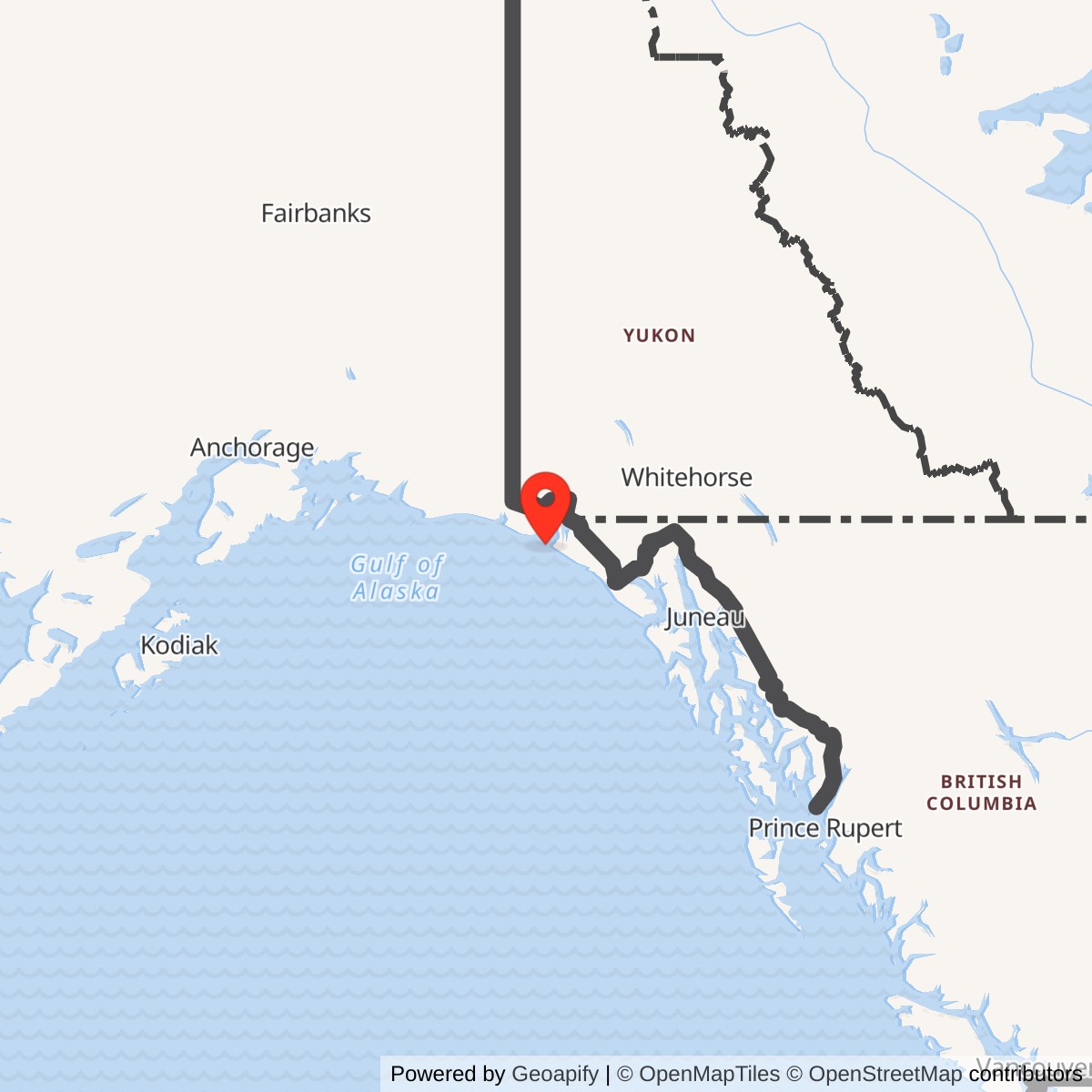
Longitude: -139.860827
Approximate location: 59.541344 N, 139.860617 W. This Alaska DEC WGS84 point identifies the former relay area, not a surveyed antenna location or property boundary. [6]
- Mission
- White Alice tropospheric-scatter communications relay on the BMEWS-era coastal A Route.
- Direct links
- Cape Yakataga and Hoonah.
- Antennas
- Four 60-foot fixed billboard reflectors, paired by route direction.
- Air Force service
- 1960 to the June 30, 1974 operating-lease transfer to RCA Alascom.
- Final service
- RCA closed the relay in June 1976 after a nearby satellite earth station was built.
Overview
Ocean Cape Radio Relay Station stood on the Phipps Peninsula at the western edge of Yakutat Bay, about five miles west of Yakutat. It was an Air Force communications relay in the White Alice system, carrying BMEWS-era traffic across two long coastal radio paths. Its antennas did not search for aircraft or track missiles: they relayed communications between Cape Yakataga and Hoonah. The station began operating in 1960. [1] [4] [5]
Coastal A Route
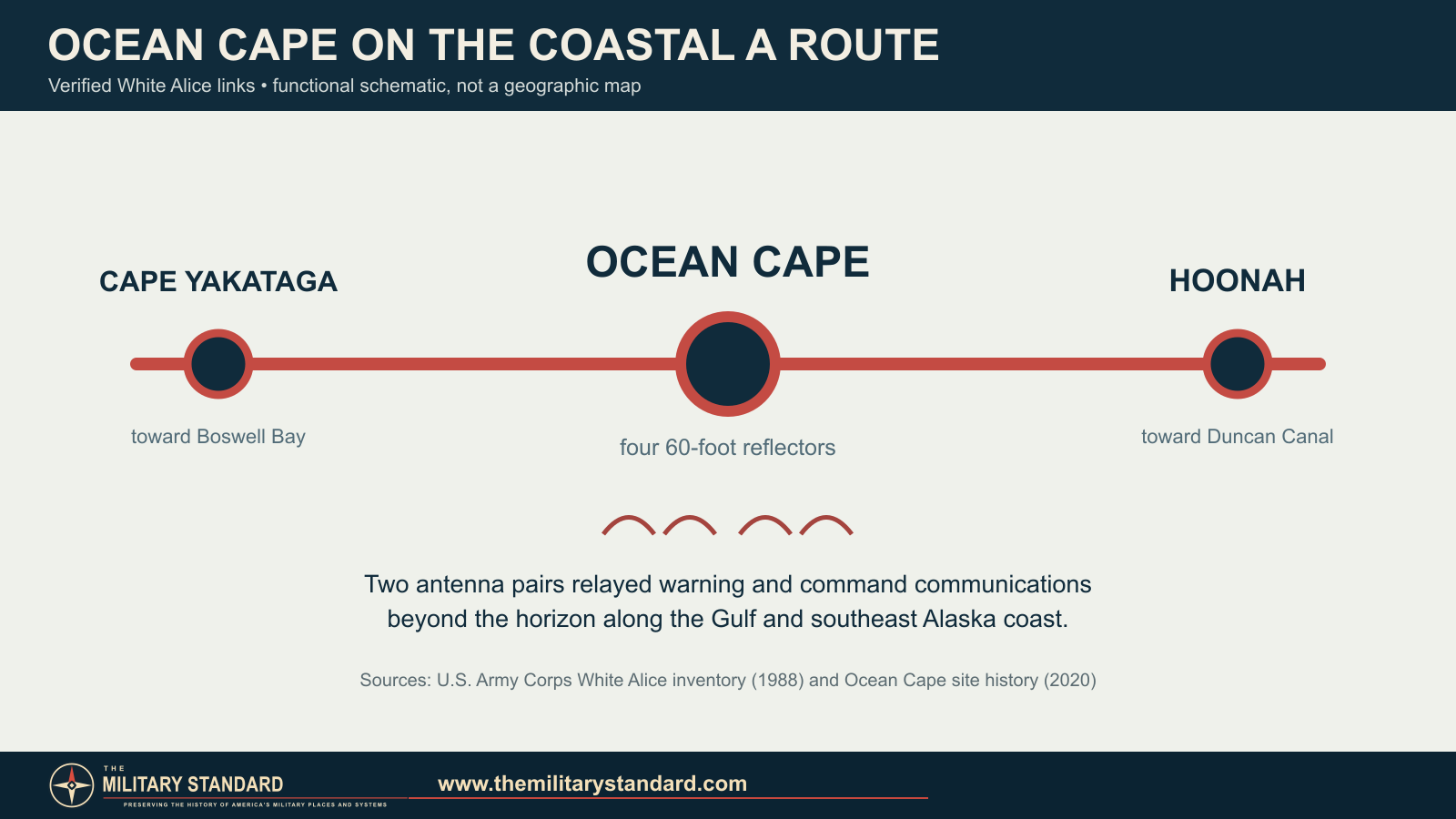
The A Route was a series of White Alice relays extending along Alaska's Gulf and southeast coasts. Ocean Cape's two direct paths connected Cape Yakataga to the northwest and Hoonah to the southeast. Beyond those stations, the chain continued toward Boswell Bay and Duncan Canal. The route gave defense communications a long-distance coastal channel while also carrying civilian traffic. [1] [3]
Station and Antennas
The Air Force assembled the relay site in 1960 and first called it Ocean Cape Air Force Station. It was redesignated Ocean Cape Radio Relay Station on July 6 of that year. The property included separate federal land tracts and a temporary state tideland gravel permit. The facility was government-owned and contractor-operated. [4] [5]
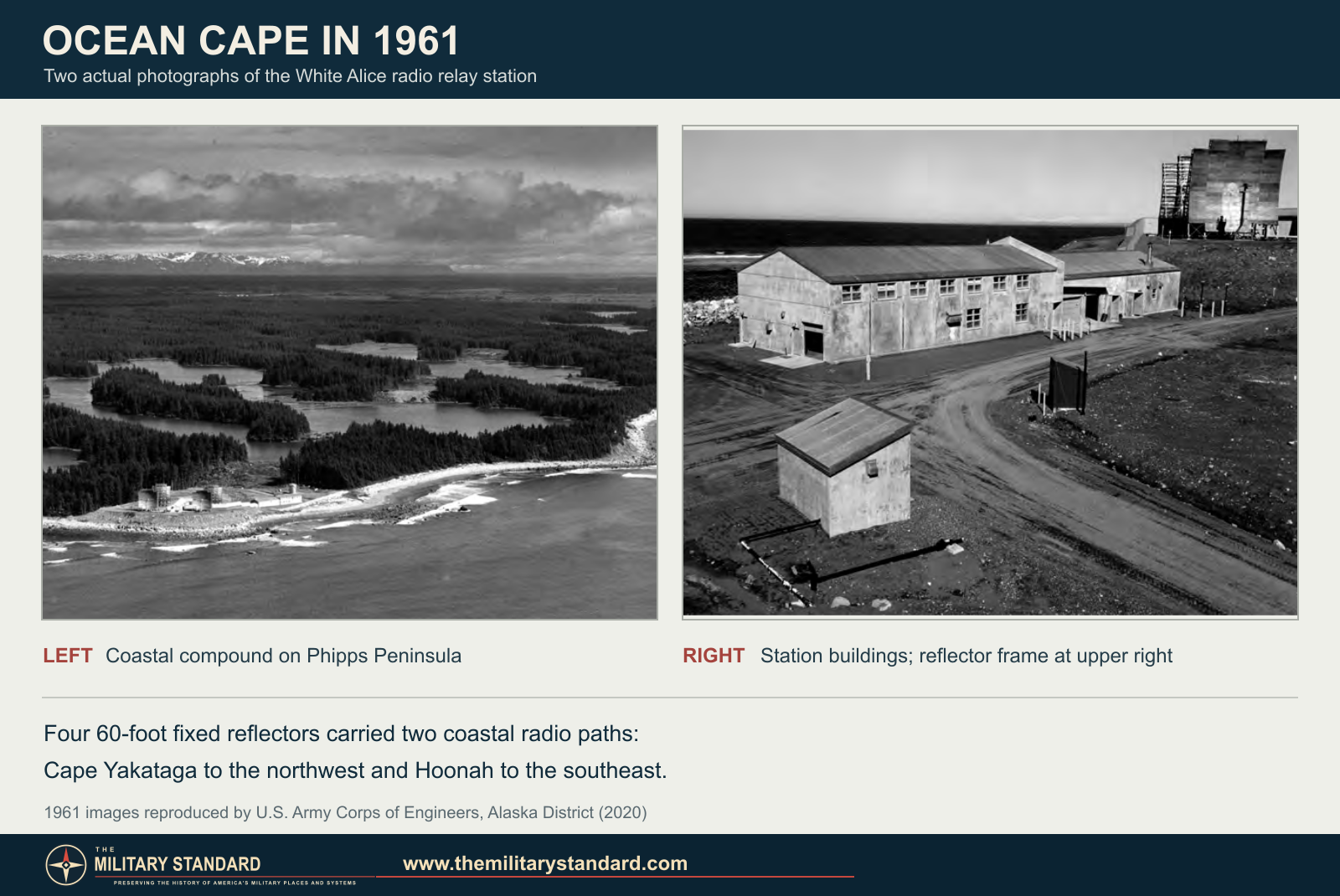
Four fixed, 60-foot parabolic billboard antennas served the two radio paths. Their curved screens and feedhorns sent communications signals beyond the visible horizon through tropospheric scatter. The compound also had a composite building, two radio-relay buildings, maintenance and switching structures, fuel and water facilities, a bridge, access roads, and utility lines. The 1961 photographs show the coastal setting and part of this working plant. [1] [4] [5]
Fresh water was difficult to obtain at the saltwater-exposed cape. The first well became too salty, so the Air Force and RCA White Alice project used a shallow infiltration gallery near the shoreline. The U.S. Geological Survey documented the solution in 1967. [7]
Air Force and RCA Service
By early 1974 the Air Force had decided it could meet its defense communications needs without operating the southeastern A Route. Alaska officials objected to losing a route that also served civilian users. The Air Force instead arranged for RCA Alaska Communications to operate six coastal stations under lease. Teams from the 1931st Communications Group, RCA Alascom, and ITT Arctic Services inventoried the route in June. The transfer took effect at midnight on June 30, 1974. [3] [4]
Ocean Cape continued as a relay after that handoff. RCA discontinued it in June 1976 when a nearby satellite earth station provided a replacement. The Air Force declared the former station excess on June 22, 1976. The end of Air Force operation in 1974 and the end of all relay service in 1976 were separate milestones. [2] [3] [4]
Later Property and Condition
The Air Force granted Yak-Tat Kwaan, Inc. temporary occupancy rights in August 1976. The property was relinquished to the Bureau of Land Management in May 1977. Surface and subsurface interests were later conveyed to Yak-Tat Kwaan and Sealaska, respectively, with formal conveyance in 1983. Ocean Cape was not among the five coastal stations sold to RCA as an operating property package. [3] [4] [5]
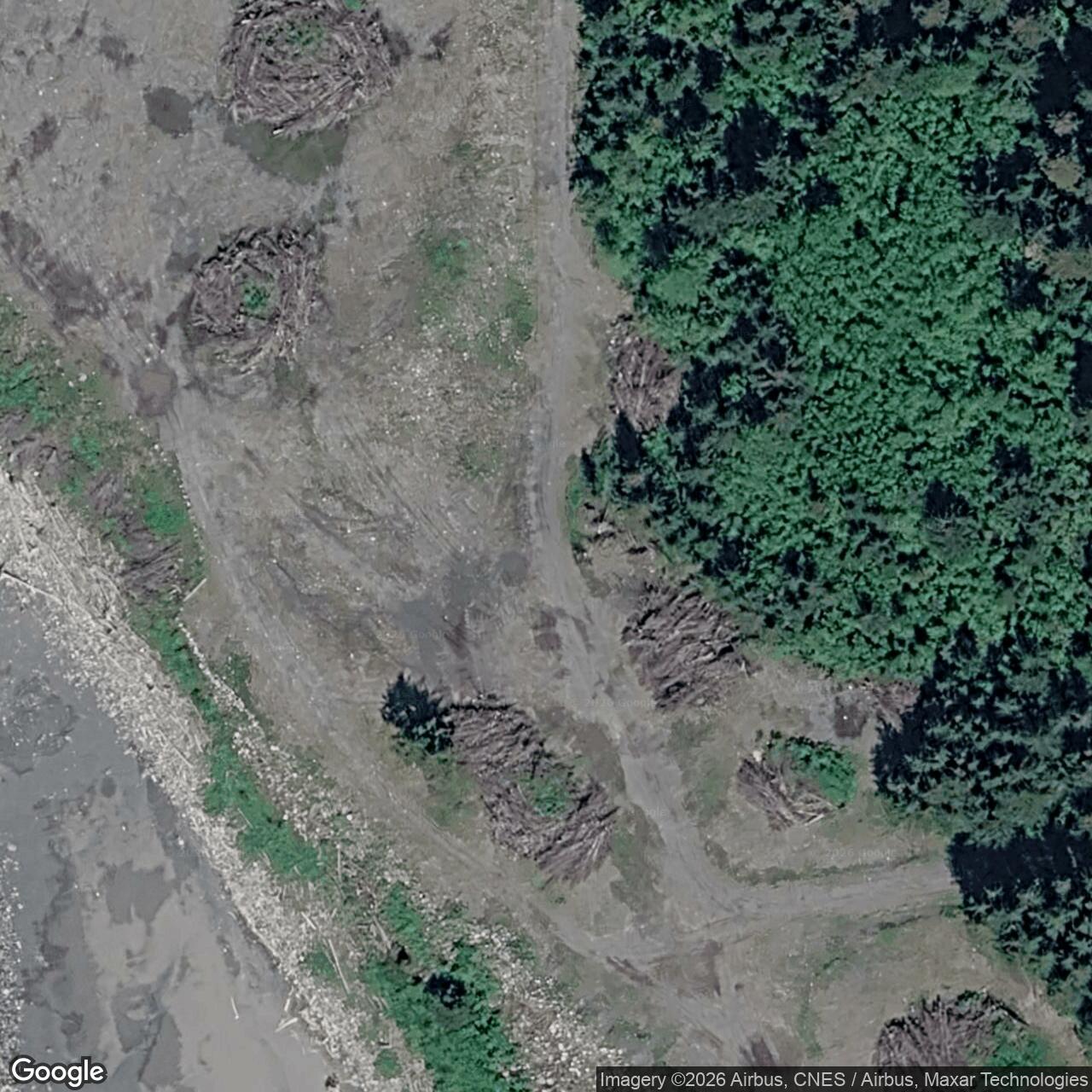
The Corps removed the four antennas and major relay structures in 1984. Other tanks and buildings were retained for possible local use, then removed through later Corps and Yakutat Tlingit Tribe work. Part of the former station area now serves as a tribal Culture Camp. Alaska DEC continues to list an active environmental case for the site; the end of one cleanup project did not close the overall site case. [4] [6]
Nearby Military Sites
Ocean Cape's White Alice relay was separate from the World War II Yakutat Air Base and the Point Carrew coast-artillery garrison. The Coast Guard also maintained a separate Ocean Cape/Yakutat LORAN-A station on the wider peninsula from 1951 to 1979. That station transmitted navigation signals for aircraft and ships, while the Air Force relay carried communications traffic between White Alice stations. [4] [5] [8]
Chronology
- 1960 The Air Force assembles land interests and Ocean Cape begins relay operations.
- July 6, 1960 Ocean Cape Air Force Station is redesignated Ocean Cape Radio Relay Station.
- 1961 Photographs document the station and its coastal setting.
- 1967 The Air Force obtains an additional tract; the Geological Survey publishes the station water-supply study.
- January 1974 The Air Force announces plans to leave the southeastern A Route.
- June 1974 Air Force, RCA Alascom, and contractor teams inventory the coastal stations.
- June 30, 1974 RCA Alascom takes over A Route operation under lease.
- June 1976 RCA closes Ocean Cape following construction of a nearby satellite earth station.
- June 22, 1976 The Air Force declares the former relay excess.
- May 1977 The property is relinquished to the Bureau of Land Management.
- 1983 Former station interests are formally conveyed to Native corporations.
- 1984 The Corps removes four antennas and major relay facilities.
- 2007-2013 Later tribal and Corps work removes remaining structures and materials.
- 2026 Alaska DEC's Ocean Cape environmental case remains active.
Information sources (8)
- PDF1. Historical Overview and Inventory: White Alice Communications System, U.S. Army Corps of Engineers, 1988
Source for: BMEWS A Route role, Ocean Cape's direct Cape Yakataga and Hoonah links, and 60-foot tropo antenna class.
- PDF2. The Cold War in Alaska: A Management Plan for Cultural Resources, U.S. Army Corps of Engineers, 1994
Source for: 1960-1976 operational sequence, relay and LORAN distinction, 1983 conveyance, and historic resource identification.
- PDF3. A Special Study of the Sale of the White Alice Communications System, U.S. Air Force, October 1983
Source for: 1974 A Route lease, June 1976 excess declaration, 1977 disposition, and exclusion from the five-station sale.
- PDF4. Yakutat Air Base and Ocean Cape Radio Relay Site, U.S. Army Corps of Engineers Alaska District, June 2020
Source for: military and civilian handoff, 1961 Ocean Cape photographs, site plant, closure, conveyance, and later demolition.
- PDF5. Final Remedial Investigation Report, Ocean Cape Radio Relay Site and Runway Safety Area 20, U.S. Army Corps of Engineers, December 2017
Source for: original Air Force Station designation, July 6, 1960 redesignation, land interests, station buildings, and distinct Point Carrew/Yakutat sites.
- WEB6. Yakutat Ocean Cape Radio Relay Station Site Report, Alaska Department of Environmental Conservation, hazard ID 1985
Source for: WGS84 site marker, former facility, Culture Camp, structure removal, and current environmental case.
- PDF7. Use of an Infiltration Gallery to Obtain Fresh Water at Ocean Cape, Alaska, U.S. Geological Survey Professional Paper 575-C, 1967
Source for: station water-supply problem and Alaskan Air Command/RCA White Alice cooperation.
- PDF8. LORAN-A Context, Alaska Office of History and Archaeology
Source for: separate Ocean Cape/Yakutat Coast Guard LORAN-A station, 1951-1979.