
Titan I 724-B Missile Silo Lowry AFB Colorado
Titan I 724-B
Squadron: 724th SMS
Date Activated: February 1st 1960
Date Deactivated: June 25th 1965
Air Force Base: Lowry
State: Colorado
Nearest Town: Denver
Coordinates:
Latitude: 39°36'16.89"N
Longitude: 104°34'46.64"W
Decimal:
Longitude: -104.579622
Latitude: 39 36.2815
Longitude: -104 34.7773333333333
3 silos
Former Titan I Missile Complex with the 724th Strategic Missile Squadron
First 724th SMS Titan I alert: April 20, 1962; specific complex not established
Unit inactivation: June 25, 1965
Present status: Decommissioned Titan I complex; state ownership and grazing use documented for 2012-2015, with exact 2026 title, lease, access, condition, and current remedy phase requiring verification
Read about the Titan I at Lowry AFB
List of all Titan I site Coordinates
Detailed information about the Titan I Intercontinental Ballistic Missile can be found here.
Overview
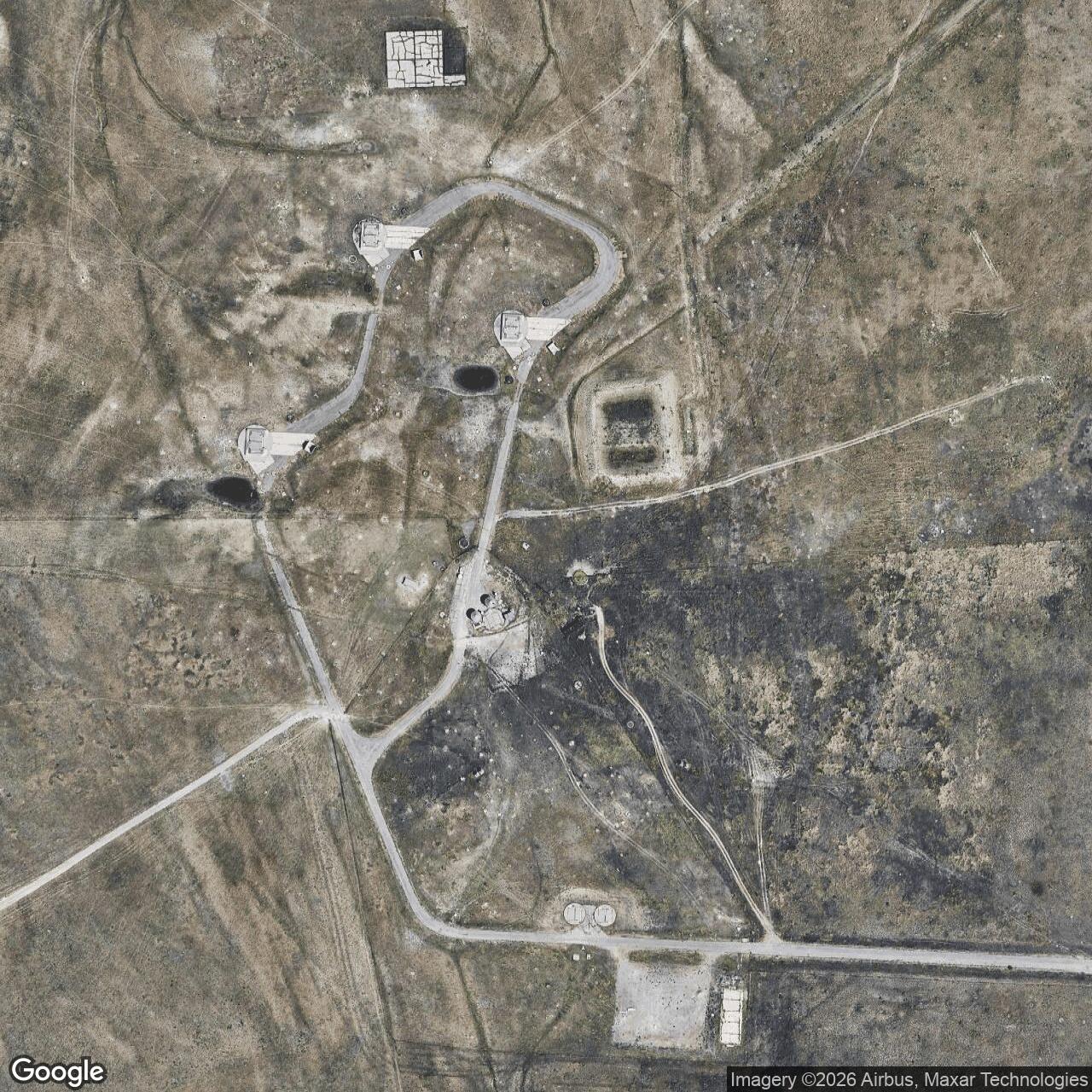
Titan I Missile Complex 724-B was a hardened, underground intercontinental ballistic missile installation built on the south-central portion of the former Lowry Bombing and Gunnery Range southeast of Denver. It was one of three launch complexes assigned to the 724th Strategic Missile Squadron at Lowry Air Force Base. Each complex held three HGM-25A Titan I missiles, so 724-B formed one-third of the squadron's nine-missile operational force. Its surface appearance was intentionally sparse, but beneath the prairie lay three missile silos, three equipment terminals, three propellant terminals, a shared control center, a powerhouse, two guidance-antenna silos, utility spaces, sewage facilities, and more than 2,000 feet of connecting tunnels.
The complex belonged to the first generation of hardened American ICBM bases. Titan I was stored vertically below ground, protected against nearby blast effects, but it still had to be fueled with RP-1 kerosene and liquid oxygen and raised above the silo before launch. This combination produced an extraordinary installation: a buried industrial plant, command post, fuel-handling facility, and weapons system operated by a small combat crew. The design greatly improved protection over exposed launch pads, yet fueling and elevation required time, complicated machinery, and intensive maintenance. Those limitations helped make Titan I operationally important but brief. The 724th became the Air Force's first operational Titan I squadron in April 1962, and its missiles began leaving alert less than three years later.
Complex 724-B has a post-military history distinct from neighboring 724-A and 724-C. The Army Corps of Engineers identifies it as Formerly Used Defense Sites property LOWRY AFB S-1 (COMPLEX 1B), FFID CO89799F694300. Federal and state records document investigations of soil, groundwater, underground water, sumps, and air. Soil affected by polychlorinated biphenyls was removed, while tetrachloroethene and trichloroethene became the principal groundwater contaminants of concern. A 2015 Corps fact sheet described state ownership and livestock grazing, and later Defense Environmental Restoration Program tables continued to carry restoration work and projected response-complete dates. The site's historical meaning therefore includes both its short period on nuclear alert and the much longer work required to understand and manage its physical and environmental legacy.
Installation Identity, Location, And Boundaries
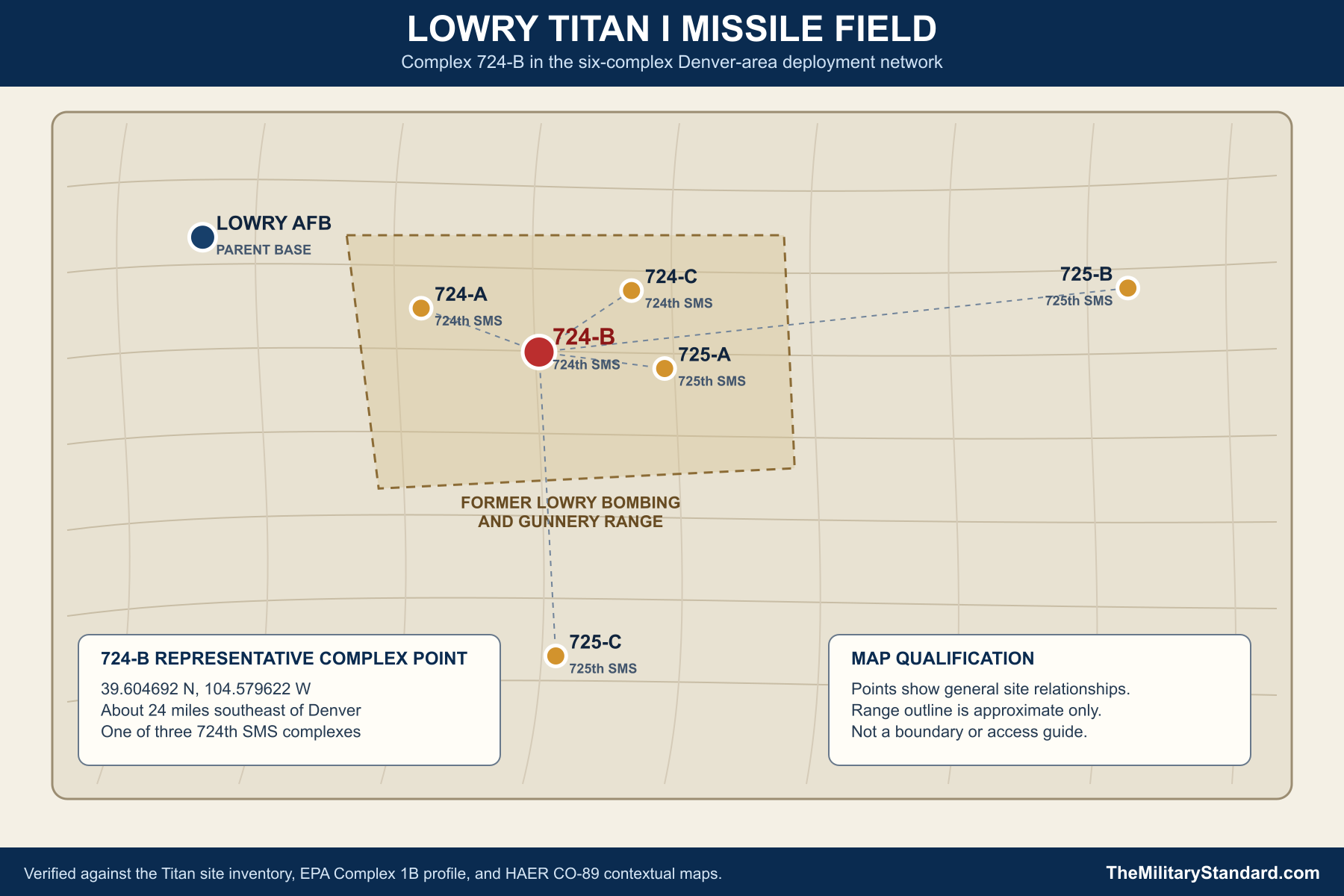
The installation is best identified through several linked naming systems. Strategic Air Command used 724-B, showing that the complex belonged to the 724th Strategic Missile Squadron and was the squadron's B complex. Construction, environmental, and land-management records generally call it Lowry Missile Site 1, Complex 1B, Titan Site 1B, or LOWRY AFB S-1 (COMPLEX 1B). These names refer to the same three-silo launch complex. They do not refer to Lowry Air Force Base proper, the entire Lowry Bombing and Gunnery Range, neighboring 724-A or 724-C, or any one of the three individual launchers. The launchers may be described as 724-B-1, 724-B-2, and 724-B-3, but they were components of one integrated installation sharing command, power, guidance, security, and support systems.
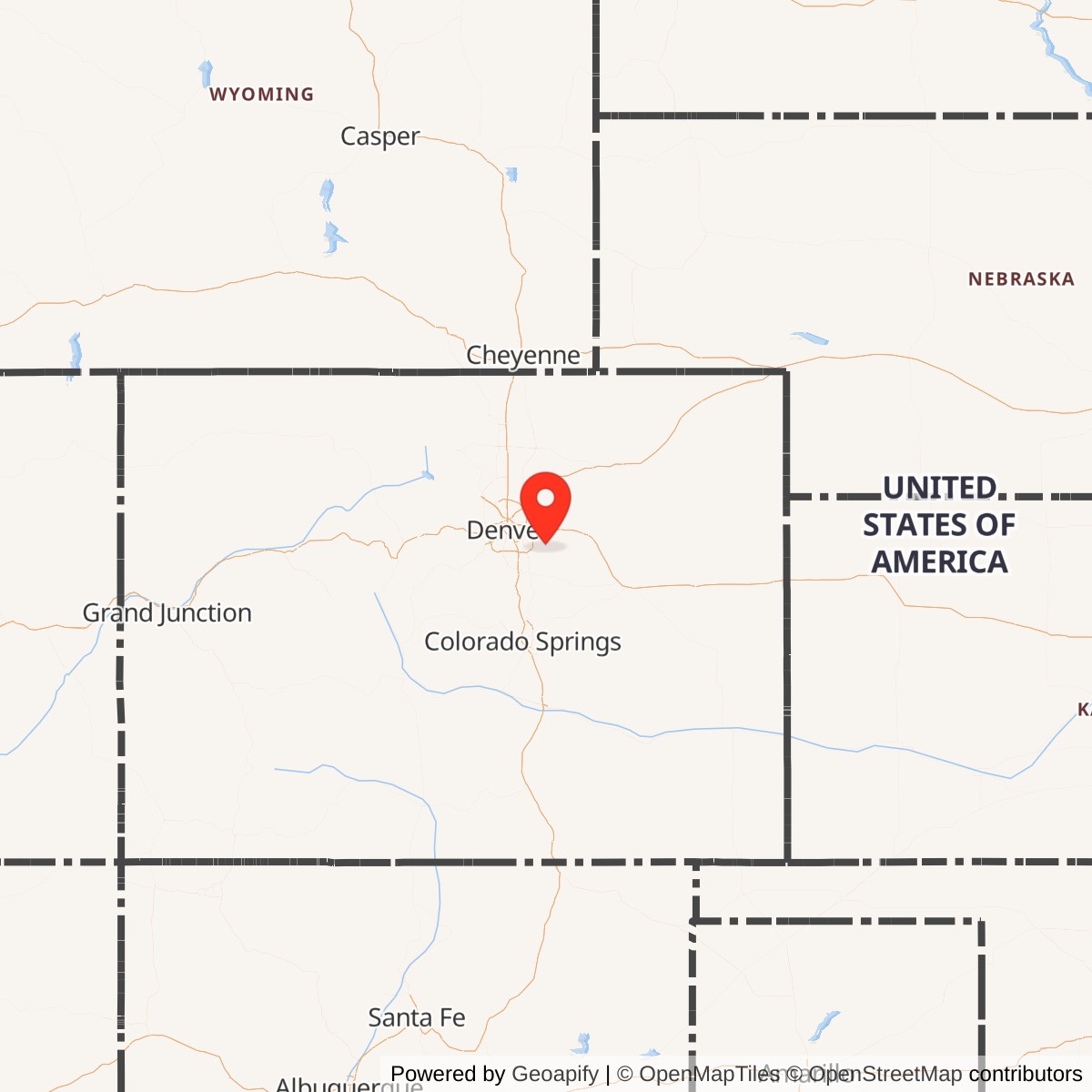
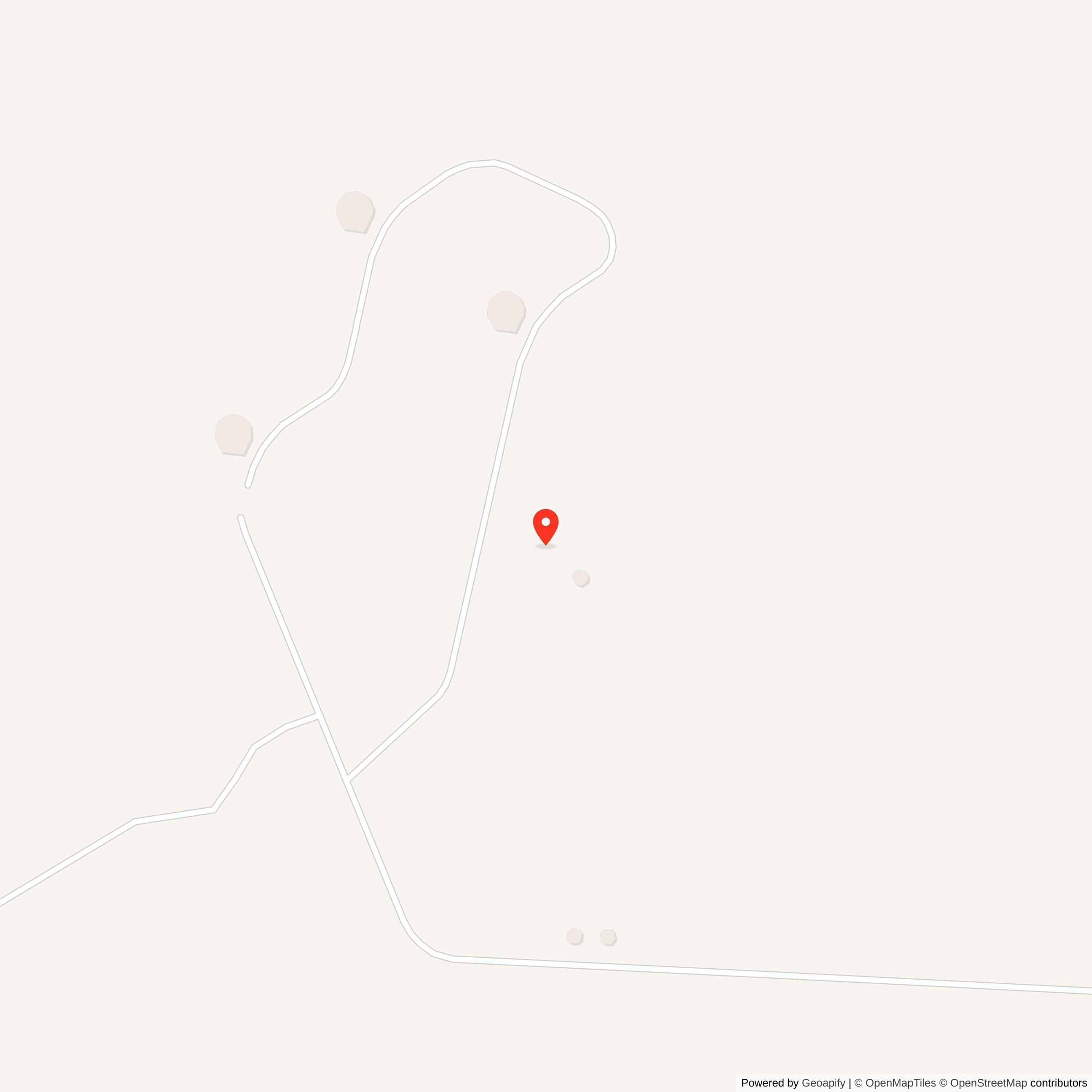
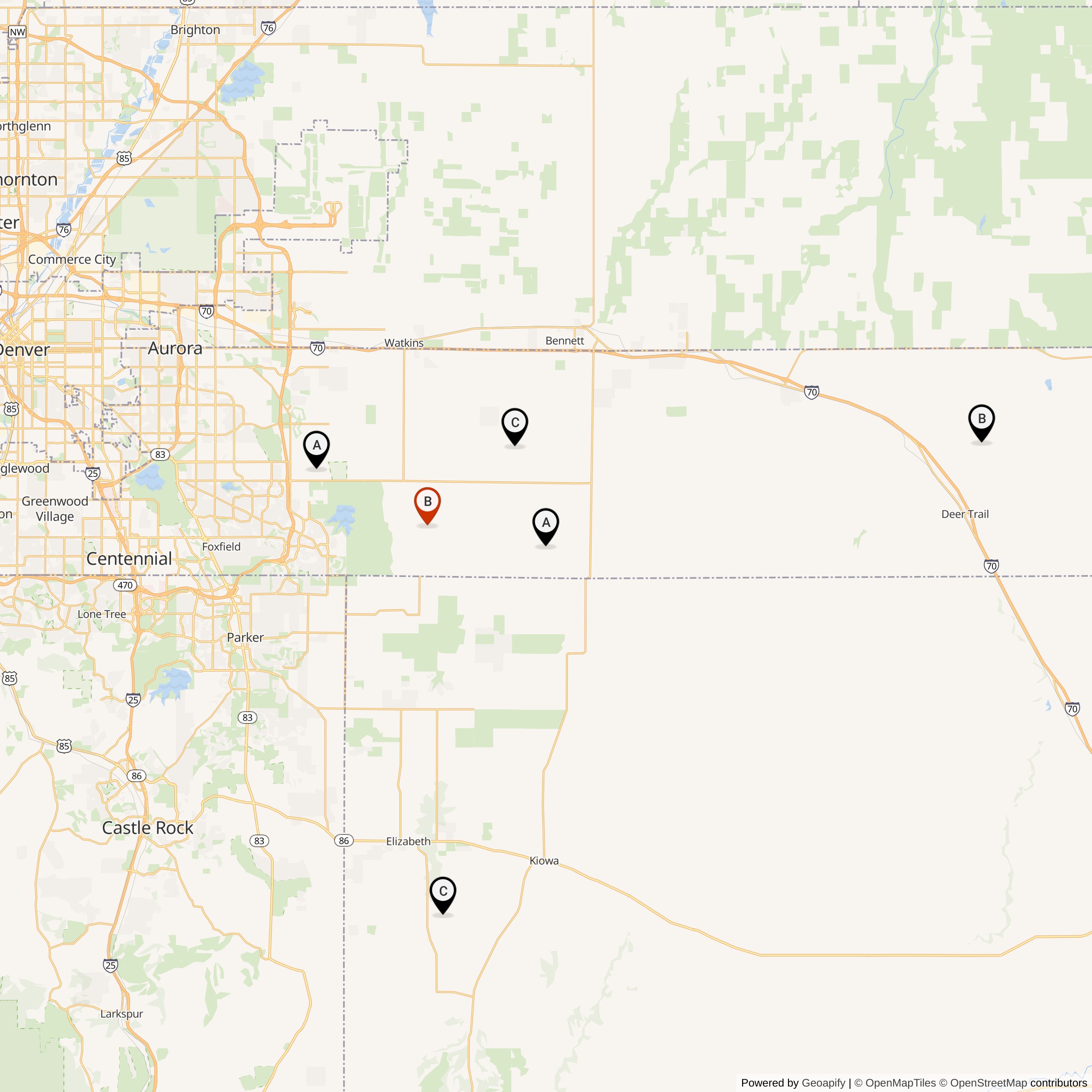
The Historic American Engineering Record places 724-B on the south-central portion of the Lowry range, off Airline Road, approximately 24 miles from Lowry Air Force Base. The Corps later described the property as 24 miles southeast of Denver, and EPA locates its CERCLA record east of Quincy Avenue and about three miles southeast of Watkins Road. The representative point used here, 39.604692 north latitude and -104.579622 west longitude, identifies the general complex and closely agrees with EPA's 39.601944, -104.580555 site point. The two coordinates are not contradictory because neither is represented as a legal survey. EPA's point supports the environmental record; the project point supports mapping of the historic complex. Neither should be used as an entrance, boundary, or permission to approach the property.
No single acreage figure has been entered as the historic property total because the consulted official sources describe different scopes but do not provide a verified deed acreage for 724-B. Colorado's 2012 Lowry Range plan places most of Complex 1B in Section 20, Township 5 South, Range 64 West, within the State Land Board's much larger 25,590-acre Lowry Range holding. State historical material notes that Titan I operational compounds commonly covered about 30 to 60 acres, but that family range is not a parcel measurement for 724-B. The surface compound, underground complex, monitoring network, environmental response areas, easements, and surrounding state trust land are not interchangeable acreage concepts. A future deed or survey can refine the record without displacing the clearly established installation identity.
The Range Before The Missile Complex
Before 724-B existed, the land belonged to the broad military landscape of the Lowry Bombing and Gunnery Range. Denver acquired a large tract southeast of the city in 1940 and made it available to the Army for bombing and gunnery training associated with Lowry Field. Federal use continued through World War II and the early Cold War. The Corps' site summary specifically notes Navy and Colorado National Guard use between 1946 and 1958. The range contained targets, practice areas, roads, and residual ordnance, so selecting a missile site within it offered military control and separation from urban development but also introduced construction hazards.
That prior use affected 724-B immediately. When workers broke ground at Site 1B, they encountered fragments of ordnance left from range activity. Demolition personnel swept the missile construction areas and removed varied hazardous munitions and about three tons of scrap metal during the following month. This episode explains why the missile complex cannot be interpreted only as a 1959-1965 property. Its land-use history began as part of a much larger training range, and the range's ordnance, infrastructure, and later environmental-management requirements continued to shape how the state and federal government treated the site after missile operations ended.
Strategic Origins Of Titan I
Titan I emerged from the urgent American effort to field intercontinental ballistic missiles after the Soviet Union demonstrated thermonuclear weapons and long-range rocket capabilities. The Air Force pursued Atlas as its first operational ICBM while developing Titan as a complementary system. Titan used two stages, radio-inertial guidance, and a more conventional airframe arrangement than Atlas. Its two-stage design provided greater range and payload potential, while parallel development reduced the risk that a single technical failure would delay the national deterrent. Martin built the missile southwest of Denver, giving the Colorado deployment field an unusually close relationship to its manufacturer.
Early missile planners had first considered relatively exposed launch arrangements, but growing concern about a surprise nuclear attack drove the Titan I program underground. The launch complex had to survive effects short of a direct hit, maintain communications, protect its crew and machinery, and bring a missile from protected storage to launch readiness quickly enough to support retaliation. The resulting system was hardened but not a true launch-from-silo weapon. The missile had to receive liquid oxygen shortly before use, rise on a massive elevator, and fire from the surface. Its two radio-guidance antennas also had to emerge from protected silos. Every phase depended on closely coordinated mechanical, electrical, pneumatic, hydraulic, fuel, guidance, and command systems.
The Air Force dispersed each operational Titan I squadron into three complexes placed many miles apart. Each complex held three launchers and its own command and support plant. That 3-by-3 arrangement reduced the chance that one attack could destroy all nine squadron missiles, while shared facilities within each complex limited the manpower and cost that nine completely independent launch sites would have required. Lowry received two squadrons, the 724th and 725th, for six complexes and 18 operational launchers. Complex 724-B was therefore a discrete hardened installation, but its military value depended upon the coordinated squadron, wing, guidance, maintenance, communications, logistics, and national command network around it.
Site Selection And The Lowry Relationship
Lowry was selected for the first operational Titan I deployment in March 1958. Geography and infrastructure made the Denver area attractive. The western location placed Soviet targets within Titan I range; the high plains offered broad, relatively open ground; the existing bombing range offered controlled land; Lowry could provide administration, training, supply, maintenance, and personnel support; and Martin's Denver-area plant could assemble and service missiles nearby. Lowry already operated a guided-missile training program, and the Denver region also contained Buckley Field and the construction-management offices needed for a large deployment effort.
A selection committee representing the Air Force Ballistic Missile Division, Air Force regional engineers, architects, and the Army Corps of Engineers chose 724-A, 724-B, and 724-C within the Lowry range. The A complex occupied the northwestern portion, while B and C lay on the south-central range. The spacing was deliberate. A launch complex had to be reachable from Lowry and support organizations while far enough from its companions that one nuclear burst would not eliminate the squadron. Site 724-B's prairie location also had to accept heavy construction, roads, wells, commercial power connections, communications, drainage, security fencing, and sustained crew access in all seasons.
The parent-child relationship must remain clear. Lowry Air Force Base was the wing headquarters and principal support installation, but 724-B was not physically part of the base cantonment. Missile assembly and maintenance shops, technical supply, reentry-vehicle work, administration, training, and much depot-level support remained at Lowry. Combat crews and maintenance teams traveled to the dispersed sites. At 724-B, however, the underground control center and launch plant could conduct alert operations as a self-contained combat installation. In an emergency it had its own generation, air treatment, water, sanitation, food-service capability, communications, and protected working spaces.
Design, Contracting, And Construction
The documentary record uses several construction dates because it measures different events. The Corps' later Complex 1B fact sheet and the State Land Board plan describe construction as beginning in September 1958 and ending in June 1961. The HAER engineering history identifies early 1959 road, drainage, and well work; approval of the main program in January 1959; a Morrison-Knudsen-led general contract in April 1959; and ceremonial groundbreaking on May 5. It then describes construction completion by fall 1961, followed by equipment installation, technical demonstrations, and acceptance work. These dates can coexist: program and preparatory activity began before the main excavation contract, structural completion preceded full weapon-system checkout, and operational turnover did not occur until April 1962.
The Army Corps of Engineers Omaha District administered construction for the Air Force. Morrison-Knudsen led the joint venture for the first three Lowry complexes, including 1B, under Contract 5558. The original bid of about $40.7 million for 1A, 1B, and 1C grew to about $66.1 million after 230 modifications. Design was still evolving while Cape Canaveral and Vandenberg tests exposed new requirements. Shock mounting, liquid-oxygen tank design, elevator changes, wiring, drainage, sealing, and equipment interfaces all generated revisions. The project was not simply a civil-works excavation followed by installation of a finished missile. The missile, its ground equipment, and the hardened base matured together.
Construction required removal of vast quantities of earth, installation of deep reinforced-concrete structures, and placement of long corrugated-steel personnel and utility tunnels. Crews excavated the upper portions openly, then sank and lined the silos and constructed buried rooms before backfilling the site. Work continued through winter weather, labor disputes, a long national steel strike, and late design changes. At peak, contractors employed roughly 3,500 workers across the six Lowry sites. Two long daily shifts and later additional shifts pressed toward a nationally directed completion schedule. The scale was nearly invisible after backfilling, but each complex was one of the largest and most intricate military construction projects in Colorado.
Site 1B also illustrates the safety and schedule pressures of concurrency. Ordnance from the bombing range interrupted early work. At the same time, changes driven by missile testing required previously planned structures to be modified. The Air Force created the Lowry Site Activation Task Force in August 1960 to integrate construction, equipment, checkout, training, and turnover. The Corps retained contract administration, while Air Force and Martin personnel worked toward a Technical Acceptance Demonstration in which the contractor and then a Strategic Air Command crew performed complete simulated countdowns. A concrete shell was not an operational missile site until every subsystem could function as a weapon.
The Underground Complex And Surface Layout
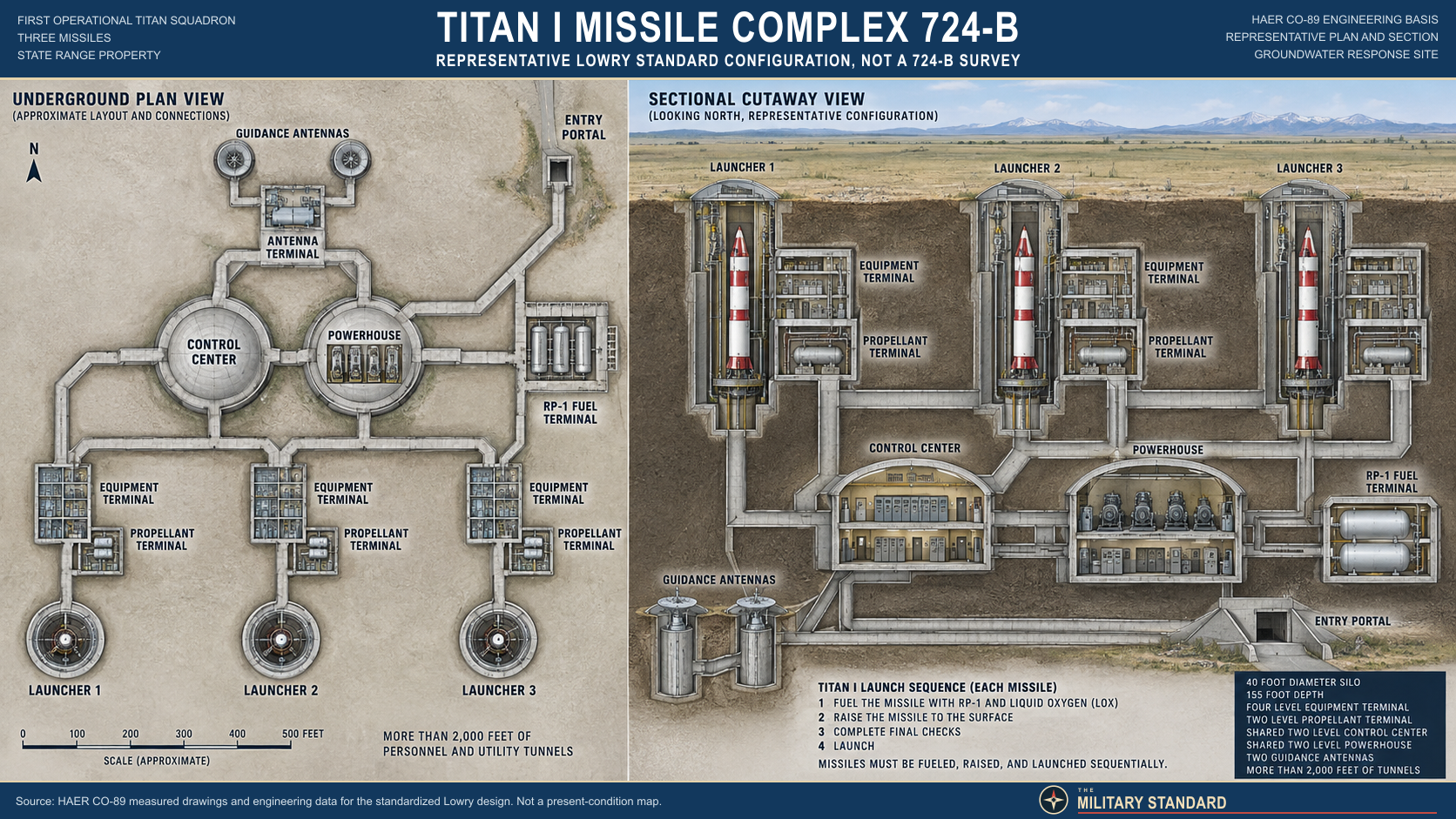
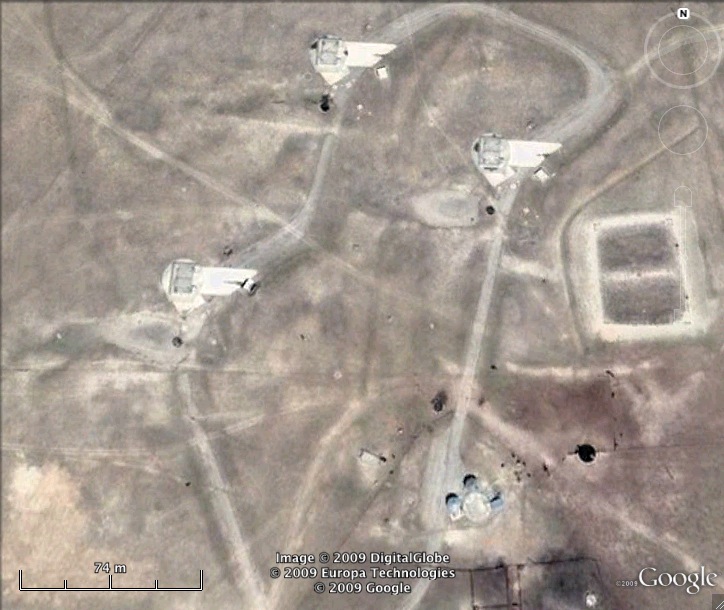
The visible surface compound concealed an interconnected underground plan. A secured entrance portal and a separate personnel hatch led into protected passages. The shared portion of the complex included a two-level control center, a two-level powerhouse, an antenna terminal connected to two guidance-antenna silos, utility spaces, and the principal tunnel system. Three launcher branches extended from that core. Each branch led first to an equipment terminal and propellant terminal and then to a missile silo. Blast locks and heavy doors divided critical areas so that shock or an accident in one portion would not immediately disable the entire complex.
Each launcher branch functioned as a semi-independent industrial line. The equipment terminal housed machinery associated with the launcher elevator and missile support. The propellant terminal contained liquid-oxygen equipment and systems for RP-1 fuel handling. The silo held the missile on an elevator platform inside a reinforced shaft approximately 160 feet deep and 40 feet in diameter. Massive paired doors closed over the top. In the protected position the missile stood below grade; during a launch sequence the doors opened, the fueled missile rose to the surface, and final launch steps occurred above ground.
The Corps' site-specific inventory adds several 724-B features that general summaries often omit. The complex included two sewage stabilization cells, a chemical-waste clarifier, and five concrete sealed chambers, in addition to the three launch stations, guidance center, utility facilities, and tunnels. Four diesel generators in the powerhouse supplied emergency and operational power. Wells, storage, ventilation, air conditioning, drainage, communications, and waste systems made the complex a functioning installation rather than only a set of silos. Kitchens and crew-support spaces had to accommodate overlapping shifts, a requirement the original plans underestimated and later modifications corrected.
Topside features were comparatively modest but operationally essential. Roads and parking supported crew change, maintenance vehicles, security patrols, and delivery of equipment and supplies. Fencing and controlled gates defined the protected compound. Concrete launch doors, antenna doors, ventilation structures, escape hatches, orientation targets, communications mounts, and utility connections punctuated the surface. The sparse appearance reduced prominent targets, but the complex was not hidden from observation. Its protection depended on reinforced construction, separation, controlled access, warning time, and Strategic Air Command procedures.
Missiles, Guidance, And Launch Operations
The HGM-25A Titan I was about 98 feet long and used two liquid-fueled stages. RP-1 kerosene could remain associated with the missile system, but cryogenic liquid oxygen had to be loaded for launch and could not be stored indefinitely in the missile. Liquid nitrogen, high-pressure gases, hydraulic systems, and electrical equipment supported fueling, pressurization, elevation, and checkout. The weapon carried a nuclear reentry vehicle and depended on ground-based radio-inertial guidance during flight. The missile's capability was formidable, but the launch site had to act as a highly synchronized machine.
An emergency sequence began with authenticated command messages in the control center. Crew members decoded and confirmed the order, brought stations to launch readiness, and secured personnel behind blast doors. The system loaded liquid oxygen, completed checks, opened the silo doors, and raised the missiles sequentially. A guidance antenna also rose from its protected silo. Titan I missiles at a three-launcher complex could not all be fueled and elevated simultaneously without regard to system limits; operations followed carefully timed sequences. The design sought a launch response of approximately 15 minutes, a demanding goal for a cryogenic missile in an underground facility.
Routine readiness depended on repeated exercises rather than actual launches. Propellant-loading exercises normally cycled each missile about once every 90 days, producing roughly one major launcher exercise per month at a three-silo complex. A missile came off alert, equipment and simulated reentry-vehicle connections were installed, liquid oxygen was loaded and unloaded, the launcher was raised and lowered, and maintenance followed. If the exercise exposed a fault, crews corrected the system and repeated the sequence. Technicians had to keep the oxygen system exceptionally clean because tiny hydrocarbon contamination could produce fire or explosion in contact with liquid oxygen.
Guidance created another network dependency. The two retractable antennas at a complex provided radio commands needed after launch. Equipment computed and transmitted corrections based on tracking. Antenna redundancy improved survival, and the broader Titan I system provided intersite relationships so a surviving guidance installation could support a launch if local capability were impaired, subject to system configuration. The guidance terminal, antenna silos, communications links, and target-data control inside 724-B were therefore as important as the three missile shafts. A Titan raised without command, targeting, and guidance support was not an operational deterrent.
Organization, Personnel, And Support
The 703rd Strategic Missile Wing activated at Lowry on September 25, 1958 as the first operational Titan I wing. Its initial missile units included the 848th and 849th Strategic Missile Squadrons. On July 1, 1961, the Air Force replaced those designations with the 724th and 725th Strategic Missile Squadrons while transitioning the wing to the 451st Strategic Missile Wing lineage. The 724th inherited the first squadron's people, equipment, and mission. Its three complexes were 724-A, 724-B, and 724-C. The 725th operated the three more distant complexes identified as A, B, and C in its own squadron sequence.
Combat crews at each site worked within a larger wing structure. The HAER record describes approximately three rotating crews of 11 personnel for each complex during the mature period, while the wing maintained 26 to 30 combat-ready crews. Two officers staffed the command positions, with enlisted specialists responsible for power, propellants, launch equipment, guidance, communications, and other functions. Crew members lived and worked underground during alert tours, but the site was not a permanent family cantonment. Housing, medical care, major administration, supply, training, and most community services remained at Lowry or in the Denver area.
The 451st Missile Maintenance Squadron provided specialists who moved among the six dispersed complexes and worked from facilities at Lowry. Its responsibilities included the missiles, launch equipment, hydraulics, plumbing, electrical systems, communications, guidance components, diesel generation, and cryogenic systems. The wing's missile assembly and maintenance shops, weapons technical supply building, and reentry-vehicle facility connected 724-B to a supply and maintenance chain reaching Martin, Air Force depots, and Strategic Air Command. Site security personnel controlled the compound and responded to alarms, while civil engineering and communications organizations maintained infrastructure beyond the immediate launch plant.
Life at 724-B combined long stretches of monitoring with episodes of intense coordinated work. At least two qualified personnel had to remain ready at control consoles while others performed inspections, exercises, maintenance, meals, or rest. Equipment noise, artificial light, filtered air, thick blast doors, and limited views separated the crew from the prairie above. During serious alerts, personnel could remain below ground for extended periods. The human system was therefore as carefully organized as the machinery: crew certification, two-person procedures, authenticated messages, maintenance discipline, and repeated evaluations reduced the risk of unauthorized action or technical failure.
Operational Acceptance And Strategic Alert
The first Lowry Titan I entered a silo on October 5, 1961, and all 18 missiles for the two Lowry squadrons were installed by May 1, 1962. The available program history does not identify 724-B as the first receiving complex or assign a surviving missile serial number to each of its three launchers. It is safer to state the squadron sequence than to invent a launcher-level chronology. Installation, technical demonstrations, crew training, and correction of deficiencies continued after the major concrete work ended.
On April 18, 1962, Strategic Air Command declared the 724th Strategic Missile Squadron operational. A formal ceremony at 724-A marked the transfer, but the operational declaration covered the squadron's nine launchers at 724-A, 724-B, and 724-C. On April 20 the squadron placed its first Titan I on alert, the first Titan I alert commitment in the Air Force. The exact complex and launcher holding that first alert missile are not established in the sources used here, so that distinction is not assigned to 724-B. What is certain is that 724-B entered the operational squadron and contributed three launchers to the new hardened deterrent.
The squadron's readiness soon acquired immediate strategic significance. During the Cuban Missile Crisis in October 1962, Strategic Air Command increased readiness as the United States and Soviet Union approached nuclear confrontation. Titan I crews at Lowry remained prepared to execute war orders. Recollections preserved in the HAER study describe extended underground duty and the realization that a simulated sequence could become real. The record does not isolate a 724-B crew narrative, but 724-B was an alert complex in the affected squadron. Its presence helped make retaliation credible and thereby supported the deterrent pressure underlying national policy.
After the crisis, alert duty remained demanding. Crews conducted evaluations, propellant-loading exercises, inspections, maintenance, and target-data procedures. Missiles were periodically removed or handled for work at Lowry, and technical teams had to keep a first-generation system reliable despite its many interfaces. No Titan I launched from 724-B in combat. That absence does not make the installation inactive in a historical sense. Strategic deterrence was its daily mission: weapons, trained crews, communications, and launch machinery had to remain demonstrably ready so an adversary would calculate that an attack could not prevent retaliation.
Role In The Wider Military Network
Complex 724-B occupied one node in a national command-and-control and logistics network. At the local level it worked with 724-A and 724-C as the 724th Strategic Missile Squadron's dispersed nine-missile force. Lowry Air Force Base provided wing command, administration, technical supply, missile assembly, reentry-vehicle support, and major maintenance. The 451st Missile Maintenance Squadron linked the launch sites through mobile technical teams. The 725th Squadron's three complexes gave the wing a second nine-missile force, making Lowry the only Titan I host with two tactical missile squadrons.
Beyond Colorado, Strategic Air Command directed operational standards and alert requirements. The 1st Missile Division at Vandenberg oversaw the developing missile force, while Air Force Ballistic Missile Division and later Ballistic Systems Division managed system acquisition and site activation. Vandenberg supplied operational testing and training experience. Cape Canaveral test launches drove technical changes. Martin's Denver-area plant built Titan missiles, and Lowry became a shipping and supply center for the broader Titan force. Air Force depots, contractors, communications organizations, and nuclear-warhead custodial systems completed the network that allowed a remote prairie complex to serve national strategy.
The installation also belonged to a geographic system of dispersed western ICBM bases. Titan I squadrons operated from Lowry, Mountain Home, Larson, Beale, and Ellsworth, with test and training launchers at Vandenberg. Atlas bases and the emerging Minuteman force provided complementary capabilities. Bomber and tanker forces remained central to Strategic Air Command, giving the United States several ways to retaliate. Titan I's three-launcher complexes were not intended to fight independently; they contributed to a diversified deterrent whose survivability came from hardness, dispersal, readiness, and multiple weapon systems.
Phaseout And Deactivation
Titan I became obsolete with unusual speed because its successors addressed its central weaknesses. Titan II used storable hypergolic propellants and could launch from within its silo. Minuteman used solid fuel, required fewer personnel, and dispersed single missiles across much larger fields. Both reduced response time and operating complexity. On November 19, 1964, Secretary of Defense Robert McNamara announced that the remaining Atlas and Titan I forces would leave service by the end of June 1965. This decision ended the mission for a facility that had been operational less than three years.
The 724th began taking missiles off alert on February 17, 1965. Its last Titan I left alert on March 26, and the last squadron missile was shipped on April 15. Deactivation separated nuclear reentry vehicles, removed missiles and classified material, disposed of propellants and high-pressure gases, and made launch equipment safe. Missiles moved first to Lowry for processing and then through the Air Force disposition system. The squadron inactivated on June 25, 1965. The later Corps description of Complex 1B as becoming inactive in approximately 1965 reflects the same process without claiming one event to be the sole closure date.
Equipment disposition continued after operational shutdown. Contractors removed hydraulic systems, computers, plumbing, transformers, diesel equipment, oxygen-handling machinery, controls, and other reusable or saleable material. Some components were reserved for federal agencies, schools, or research organizations. Salvage changed the interior profoundly but did not remove the massive concrete shells. The General Services Administration then managed real-property disposition. Proposals for records storage, civil defense, agriculture, training, data processing, and other reuse generally failed because the buried complex was expensive to maintain and poorly suited to ordinary occupancy.
Post-Military Property And Land Use
Complex 724-B remained associated with the former Lowry range rather than following the private-sale path of every neighboring complex. The 2012 Colorado State Board of Land Commissioners plan identifies Complex 1B within the 25,590-acre Lowry Range property, largely in Section 20 of Township 5 South, Range 64 West. The plan describes the larger range as state trust land managed for revenue and resource stewardship, with grazing, oil and gas, sand and gravel, and limited recreational leases in various areas. The 2015 Corps fact sheet specifically states that the Board of Land Commissioners owned the complex property and leased the land for livestock grazing.
Those records establish a documented ownership and use period, but they do not justify assuming that every 2026 parcel, lease, or surface activity remains unchanged. State trust land can be subject to leases, easements, environmental controls, mineral development, and management zones that do not follow the historic missile fence. The complex also lies within a former bombing range where unexploded-ordnance procedures may affect intrusive work. Current ownership and access should therefore be confirmed through the State Land Board and county records before any field visit. No historical interest in the site creates a right to enter it.
The larger Lowry Range plan treats the Titan complex as a special management concern. It recognizes the underground installation, the potential hazards of residual military structures and contamination, and the need to coordinate with the Corps and Colorado Department of Public Health and Environment before activities that could disturb affected ground. Grazing is compatible with much of the open surface, but it does not imply that underground spaces are safe, accessible, or cleared for reuse. The military plant was designed for trained crews under controlled conditions, not public exploration.
Environmental Investigation And Restoration
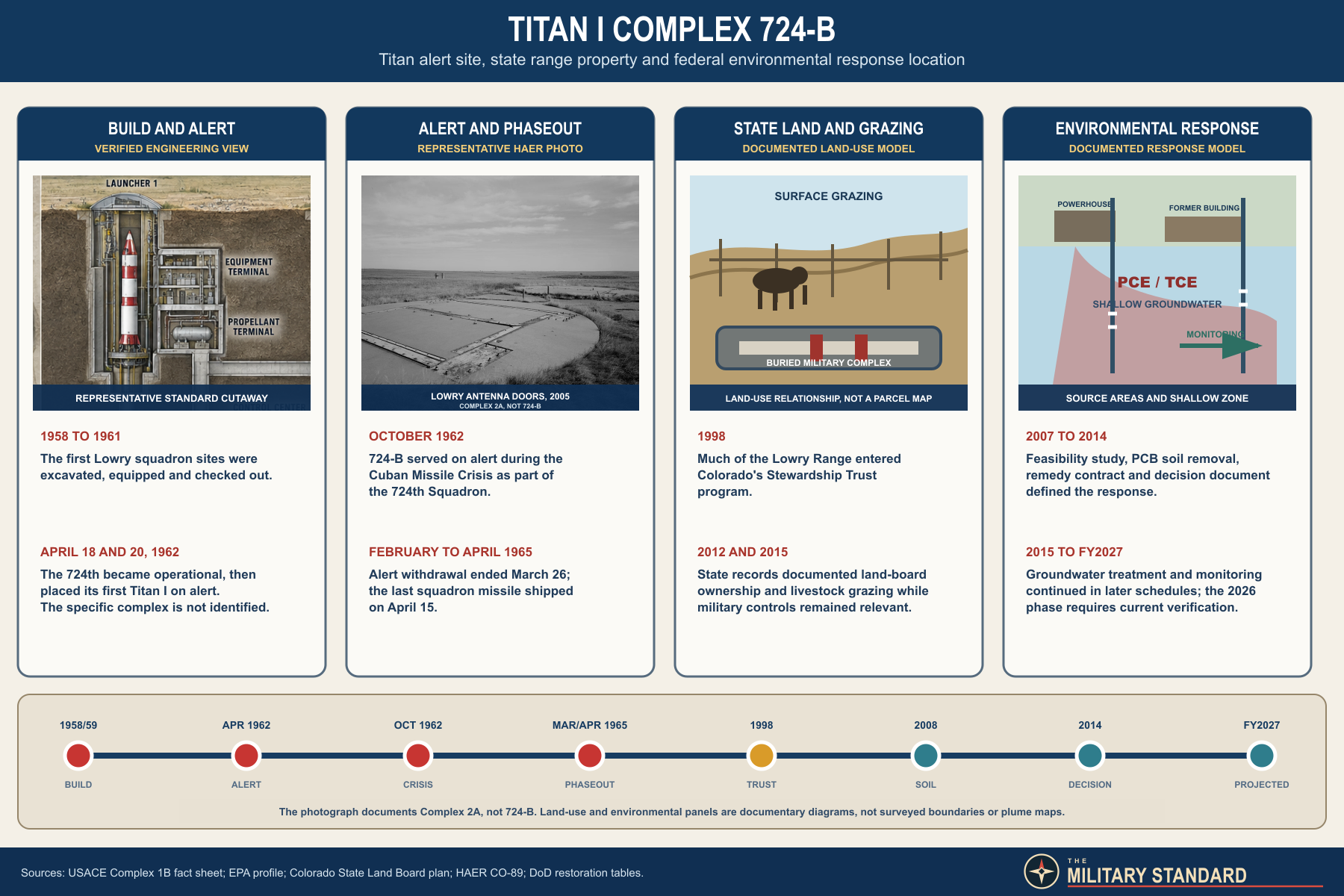
Complex 724-B entered the Formerly Used Defense Sites program as LOWRY AFB S-1 (COMPLEX 1B), property number B08CO0009 and federal facility identifier CO89799F694300. EPA also maintains the site as CO0010104188. Its CERCLA profile lists the property as not on the National Priorities List and records a No Further Remedial Action Planned screening status for NPL listing. That status means the site did not qualify for the NPL based on available information; it does not mean that all contamination disappeared, every restoration phase ended, or the underground complex became safe to enter.
The Corps identified a broad set of materials associated with missile operations: PCBs, ethylene glycol, sodium hydroxide, pesticides, RP-1 fuel, lubricating oil, diesel fuel, liquid oxygen, liquid nitrogen, and cleaning solvents. Investigations sampled surface and subsurface soil, groundwater, water in underground spaces and sumps, and air. Soil, groundwater, and subsurface soil were evaluated as possible media of concern. Groundwater became the main long-term issue, with tetrachloroethene, commonly called PCE, and trichloroethene, commonly called TCE, identified as contaminants of concern. Metals appeared in monitoring wells, but the Corps' 2015 summary identified PCE and TCE as the principal groundwater contaminants requiring remedy.
A removal action addressed PCB-contaminated soil in 2008, and the Corps later reported that contaminated soil identified during the remedial investigation had been removed. The final feasibility study went to the Colorado Department of Public Health and Environment in December 2007 and received approval on February 26, 2008. A performance-based remedy-in-place contract followed on March 31, 2010. Pre-design investigation refined the approach for the highest remaining dissolved PCE and TCE concentrations. The decision document was completed in January 2014 and signed by the Omaha District commander on February 3.
The 2015 Corps schedule anticipated remedy-in-place completion and a response-complete award, followed by in-situ chemical oxidation to remove contaminant mass. Subsequent Defense Environmental Restoration Program tables show why an old web fact sheet cannot be treated as the final word. Published program tables continued to list two Installation Restoration Program sites and moved projected final response-complete dates as additional work, monitoring, or scope changes were recognized. A 2020-era table projected final response complete in fiscal 2024, while a later table carried fiscal 2027. More recent federal reporting also identifies continuing remedial-action operation and groundwater monitoring. The defensible conclusion is that substantial investigation and cleanup occurred, but current remedy status should be confirmed with the Corps rather than inferred from an earlier planned date.
Surviving Features And Preservation Value
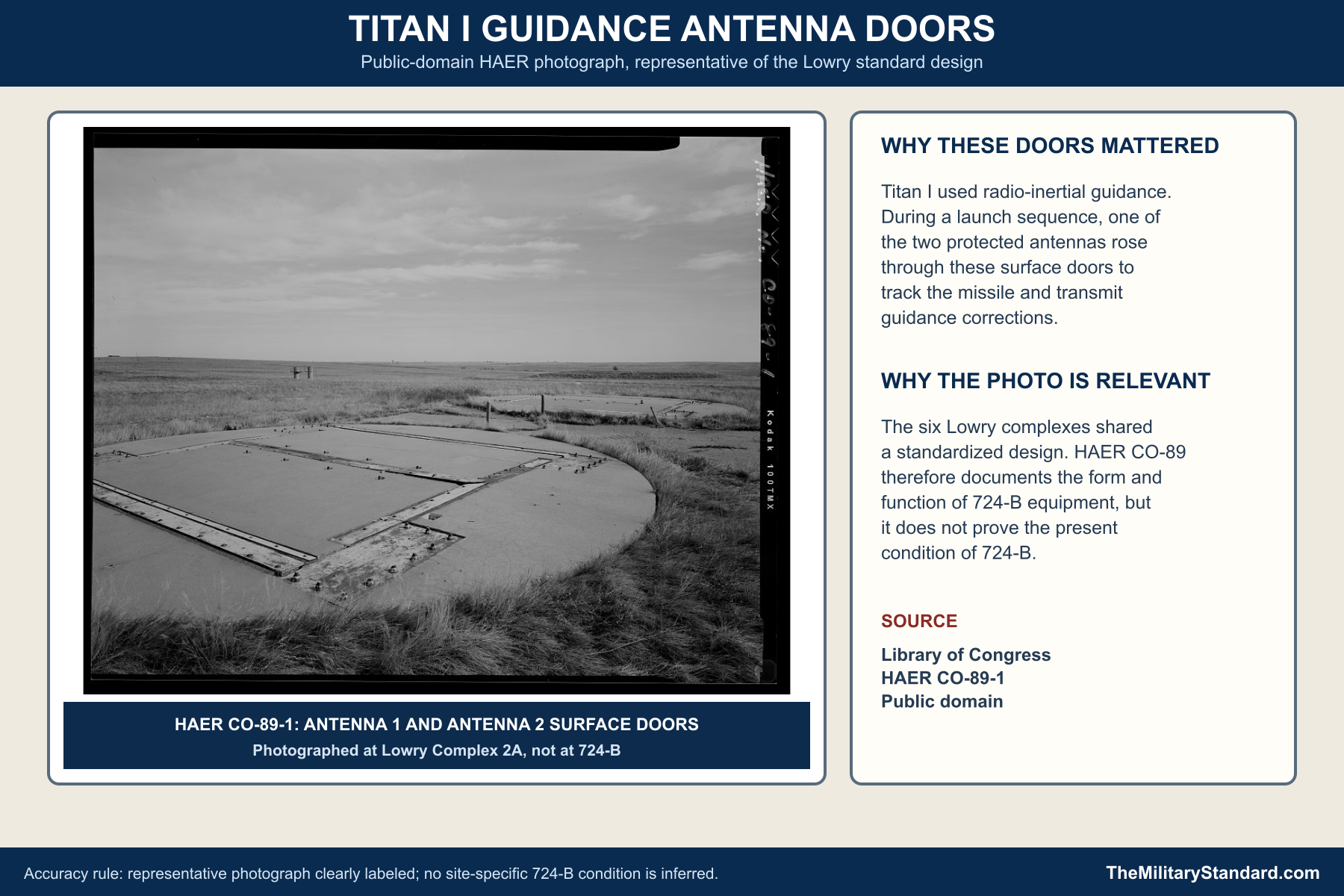
The consulted official records describe the original facility in detail but do not provide a current, structure-by-structure 2026 condition survey for 724-B. The reinforced silos, buried terminals, control center, powerhouse, antenna spaces, and tunnels were not normally removed during Titan I disposal because demolition would have been extremely costly. Salvage stripped machinery and movable equipment, and entrances or openings may have been sealed, altered, damaged, or flooded. Surface doors, concrete pads, ventilation features, roads, fencing, and utility remnants can change through reuse, weather, remediation, or safety work. It is reasonable to identify the underground structural complex as historically persistent, but not to claim that every room, launcher mechanism, door, or tunnel survives intact.
As an archaeological and engineering resource, 724-B represents the first hardened generation of American ICBM deployment. Its arrangement records the transition from surface launch pads to buried, blast-resistant systems. The tunnels and shared facilities also reveal the compromises of early missile design: three missiles gained protection but depended on common power, control, fuel handling, and guidance infrastructure. Later Minuteman sites dispersed individual missiles more widely and required far less machinery. Titan I complexes are therefore unusually legible monuments to a short technological stage between exposed launch systems and mature launch-from-silo weapons.
Detailed Chronology
- 1940 The City and County of Denver acquires a large tract southeast of Denver and makes it available for Army bombing and gunnery training associated with Lowry Field.
- 1946-1958 The U.S. Navy and Colorado National Guard use portions of the range during the postwar period documented by the Corps.
- 1954 The Air Force authorizes development of Titan as a complementary intercontinental ballistic missile program.
- March 1958 The Air Force selects Lowry Air Force Base and the Denver region for the first operational Titan I deployment.
- September 25, 1958 The 703rd Strategic Missile Wing activates at Lowry.
- September 1958 The later USACE and State Land Board site chronology begins the Complex 1B construction period.
- Late 1958 A joint Air Force and Army Corps committee selects 724-A, 724-B, and 724-C within the Lowry Bombing and Gunnery Range.
- January 1959 The Defense Department approves the Lowry Titan I construction program with an initial economy-driven budget.
- February 1959 Air Force Ballistic Missile Division establishes a field office for Lowry site activation.
- Early 1959 Separate contractors begin access-road, drainage, and well work at the Lowry complexes.
- April 1959 The Omaha District awards the main construction contract for 1A, 1B, and 1C to a Morrison-Knudsen-led joint venture.
- May 5, 1959 Ceremonial groundbreaking occurs in the Lowry field. Work at 1B encounters residual bombing-range ordnance, prompting clearance activity.
- Summer 1959 A national steel strike and regional labor disputes complicate the construction schedule.
- 1959-1961 Design changes driven by concurrent missile testing alter shock mounting, liquid-oxygen storage, launcher elevators, and other systems.
- August 1960 The Ballistic Systems Division creates the Lowry Site Activation Task Force to integrate construction, equipment installation, training, and acceptance.
- December 3, 1960 A Titan I accident at Vandenberg exposes launcher-elevator vulnerabilities and contributes to design changes applied to operational sites.
- February 1961 Additional work shifts are added as the Lowry complexes approach completion.
- June 1961 The Corps' later site-specific summary dates completion of Complex 1B construction to this month, although system installation and acceptance work continue.
- July 1, 1961 The 724th Strategic Missile Squadron organizes and replaces the 848th Strategic Missile Squadron, inheriting its mission and resources.
- Fall 1961 Major construction across the Lowry Titan complexes is substantially complete; Martin and Air Force personnel continue equipment installation and technical demonstrations.
- October 5, 1961 The first operational Lowry Titan I is lowered into a silo. Available records do not identify that launcher as 724-B.
- April 18, 1962 Strategic Air Command declares the 724th Strategic Missile Squadron operational after turnover of its nine-launcher system.
- April 20, 1962 The 724th places its first Titan I on alert. The source record does not establish which of the three complexes held that missile.
- May 1, 1962 All 18 missiles assigned to the two Lowry Titan I squadrons are in their silos.
- October 1962 Complex 724-B serves on alert during the Cuban Missile Crisis as part of the 724th Squadron's hardened deterrent force.
- 1962-1964 Combat crews, security forces, and maintenance teams sustain alert duty, propellant-loading exercises, evaluations, inspections, and repeated system maintenance.
- November 19, 1964 Secretary of Defense Robert McNamara announces phaseout of the remaining first-generation Atlas and Titan I systems by the end of June 1965.
- February 17, 1965 The 724th begins removing Titan I missiles from alert.
- March 26, 1965 The last 724th Squadron Titan I leaves alert status.
- April 15, 1965 The last 724th Squadron Titan I is shipped from the operational field.
- June 25, 1965 The 724th Strategic Missile Squadron inactivates.
- Mid-to-late 1960s The Air Force and contractors remove missiles, classified material, reusable equipment, and salvage; federal property-disposal activity follows.
- 1991 The larger former Lowry range is recognized within the Formerly Used Defense Sites program context.
- 1994 Environmental investigation activity at Complex 1B is underway in federal restoration reporting.
- 1998 Much of the Lowry Range enters the Colorado State Land Board's Stewardship Trust program.
- December 2007 The final Complex 1B feasibility study is submitted to the Colorado Department of Public Health and Environment.
- February 26, 2008 Colorado approves the final feasibility study.
- Fall 2008 A removal action for PCB-contaminated soil is completed.
- March 31, 2010 A performance-based remedy-in-place contract is awarded.
- April 2012 The Colorado State Land Board issues its Lowry Range Integrated Resource Management Plan, describing Complex 1B, state ownership, land uses, and safety coordination.
- January 2014 The Complex 1B decision document is completed.
- February 3, 2014 The Omaha District commander signs the decision document.
- April 15, 2015 The Corps publishes its Complex 1B fact sheet describing groundwater contaminants, remedy activity, state ownership, and grazing use.
- 2016 and after Remedial action, monitoring, and schedule refinement continue; later federal program tables carry projected response-complete dates beyond the 2015 plan.
Sources & References
- WEB U.S. Army Corps of Engineers Omaha District, Former Lowry Air Force Base Missile Site 1, Complex 1B Primary site-specific source for location, construction period, original facilities, documented ownership and grazing use, contaminants, investigation, feasibility study, decision document, and planned remedial action.
- WEB U.S. Environmental Protection Agency, Former Lowry AFB Titan Missile Site 1 Complex 1B CERCLA Site Profile Primary federal source for EPA ID CO0010104188, Arapahoe County location, EPA coordinate, non-NPL and NFRAP screening status, and Eligible Response Site exclusion.
- PDF Colorado State Board of Land Commissioners, Lowry Range Integrated Resource Management Plan, April 2012 Primary state planning source for the larger Lowry Range, Complex 1B township and section, facilities, ownership context, grazing and other leases, and coordination requirements for military and environmental hazards.
- PDF Historic American Engineering Record HAER CO-89, Titan One Missile Complex 2A data pages Primary federal engineering history used for the standardized Lowry Titan I design, selection of 724-B, construction contracts, organization, personnel, operations, deactivation, and representative facilities. Complex 2A is not 724-B.
- WEB Library of Congress, HAER CO-89 collection record Official catalog record for 24 photographs, three measured drawings, 101 data pages, and photo captions documenting the representative Lowry Titan I complex.
- PDF U.S. Air Force History and Museums Program, Ballistic Missiles in the United States Air Force, 1945-1960 Official Air Force history for Titan development, acquisition, deployment, squadron milestones, Lowry turnover, operational dates, alert withdrawal, missile shipment, and inactivation.
- WEB National Park Service, Titan Intercontinental Ballistic Missile Federal interpretive source for Titan I development, missile characteristics, hardened deployment, launch procedure, and transition to Titan II.
- WEB National Park Service, The Arms Race Goes Underground Federal context for hardened underground ICBM deployment, survivability, and the transition from early liquid-fueled systems to launch-from-silo missiles.
- PDF Office of the Secretary of Defense, Defense Environmental Restoration Program Status Table 7 Official program-level source showing two Installation Restoration Program sites and later projected response-complete scheduling for FFID CO89799F694300.
- PDF Department of Defense, Report on Schedule and Cost Estimates for PFAS and Restoration Activities, Appendix C Recent official restoration table used to confirm that remedial-action operation for Complex 1B continued beyond early planned completion dates.
- PDF U.S. Army Corps of Engineers, Formerly Used Defense Sites Inventory for Colorado Official inventory establishing LOWRY AFB S-1 (COMPLEX 1B), property number B08CO0009, project category, division, and district.
- WEB U.S. General Accounting Office, Formerly Used Defense Sites Cleanup Program, Colorado Federal oversight source documenting Complex 1B's FUDS identity, restoration phase, risk category at the time of reporting, and historical cost estimates.
- PDF Air Force Historical Support Division, Air Force Historical Chronology, 1907-2012 Official chronology confirming selection of Lowry for Titan I, construction and operational development, and the rapid transition away from cryogenic first-generation missiles.
- PDF Air Force Historical Support Division, 1962 Chronology Official chronology confirming the April 18, 1962 declaration of the 724th as the Air Force's first operational Titan I unit with nine hardened launchers.
- PDF National Park Service, Defend and Deter: The Legacy of the United States Cold War Missile Program Federal historical study used for national ICBM context and its inventory entry for Lowry Site 2, launchers 724-B-1 through 724-B-3.
- WEB Cold War Geodesy, Titan I Missile Sites Secondary technical inventory used only to crosscheck site identity and coordinate history against official EPA and project records.