Tinker Air Force Base, Oklahoma
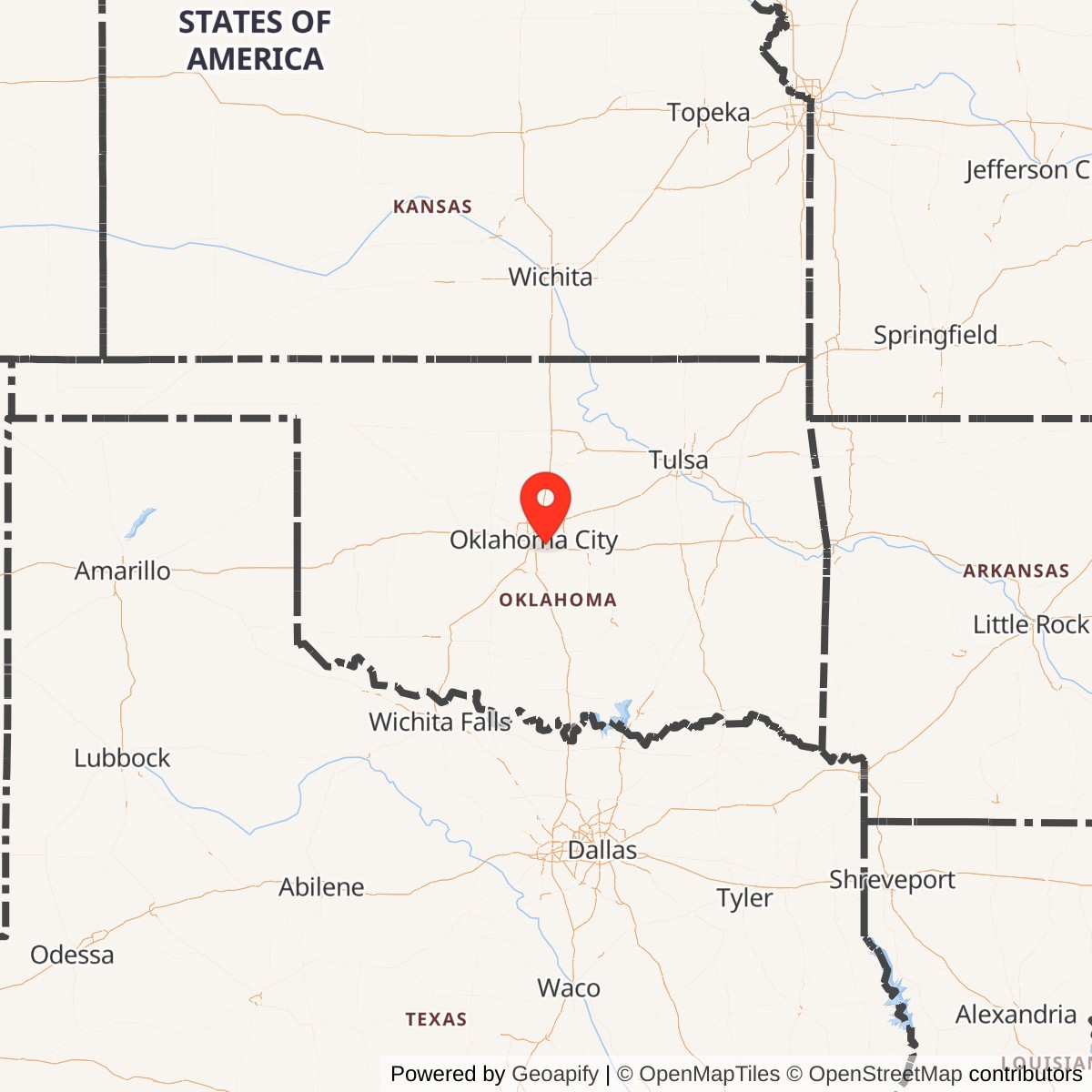
Longitude: -97.3866
Origin of current name: Named in honor of Maj Gen Clarence Leonard Tinker (1887-1942). Part Osage Indian, General Tinker received his wings in 1921. In 1926 he was awarded the Soldiers Medal for returning to his blazing aircraft to rescue a fellow officer. On 7 Jun 1942 he led a flight of bombers in a predawn attack on Wake Island. His LB-30 presumably crashed into the sea. At the time of his death, General Tinker was commander of the Hawaii-based Seventh Air Force.
Date current name was assigned to base: 13 Jan 1948
Previous Names: Midwest Air Depot, 21 May 1941; Oklahoma City Air Depot, 1 Mar 1942; Tinker Field, 11 Nov 1943
Changes in Capability: Installation produced A-26s, C-47s, and C-54s, and repaired and modified B-17s, B-24s, and B-29s 1943-1945; Douglas Aircraft Company maintenance center added Jun-Nov 1945; reconditioning and modification of aircraft, aircraft engines, and associated equipment following World War II; Tinker became USAF's largest maintenance and supply depot by 1950; jet engine test building completed 21 May 1954; hazardous test facility opened 15 Jul 1957; 75-bed USAF hospital occupied 23 Jan 1960; HQ OCAMA annex completed 1 Apr 1966; work shifted to B-47, B-52, KC-97, and KC-135 systems as part of SEA buildup 1967-1969; major building construction included an AFRES facility and maintenance shops, additional acreage acquired, 1968-1969; two engine shops and plating shop completed 1971; 102-foot control tower commissioned, data automation control complex opened 1972; hazardous test, aircraft inspection and repair shops, data processing plant, 100-unit family housing project completed 1972-1973; major industrial waste treatment plant opened 1974; logistics material processing facility completed 3 Jan 1975; four jet engine test cells completed Mar 1974; alternator drive (vibration-free) facility completed 20 Oct 1975; airman dormitory opened and AWACS simulator installed late 1976; oxygen equipment overhaul and test facility completed Jul 1977; engine parts cleaning facility operational 1 Mar 1978; aircraft protective coating facility completed 3 Jul 1979.
Major Changes in Status: None
Official Base Website: tinker.af.mil
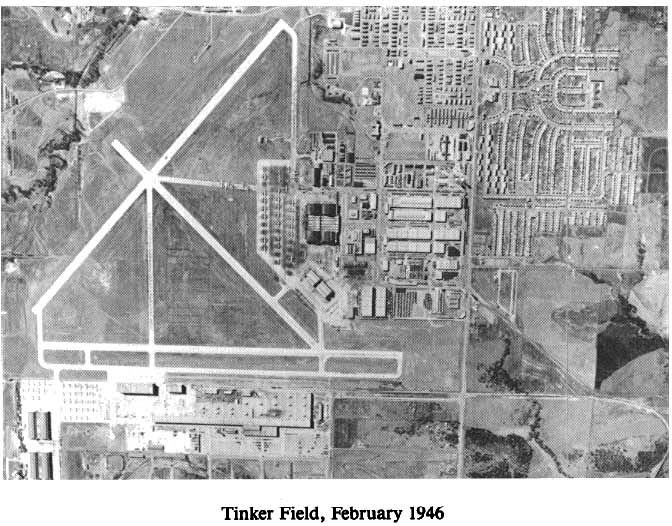
In October 1940, as German troops rolled through Europe and Japan expanded its empire, a dozen Oklahoma City businessmen formed the Oklahoma Industries Foundation to attract a bomber base, an aircraft plant or an air repair depot to the area. Their efforts proved successful when the War Department announced, on April 8, 1941, Oklahoma City as the site of a new air materiel depot that would cover more than 1,500 acres and employ 3,500 people. Construction on the new Midwest Air Depot began on July 18, 1941. Since the airfield was not ready for occupancy until March 1, 1942, official depot operations began in a downtown office building on January 15, 1942. Just eight days later, Oklahoma citizens learned that the Army Air Forces had decided to build a huge Douglas Aircraft Assembly Plant next to the depot.
Maj. Gen. Clarence L. Tinker, an Oklahoma native and part Osage Indian, lost his life while leading a group of LB-30 bombers on a mission against the Japanese in the region of Wake Island on June 7, 1942. Accordingly, Gen. H.H. "Hap" Arnold ordered the installation named Tinker Field on Oct. 14, 1942. During World War II, more than 18,000 military and civilian employees repaired and modified B-17, B-24 and B-29 bombers as well as C-47 and C-54 cargo planes. They also overhauled thousands of aircraft engines and shipped supplies around the world. Meanwhile, the Douglas Plant, employing close to 24,000 people, produced more than 5,300 C-47 Skytrain aircraft and parts to build 400 C-54 Skymaster cargo planes and 900 A-26 Invader attack bombers.
At the end of the war, the Oklahoma City Air Depot acquired the adjacent Douglas Plant complex and moved new workloads into the facilities after the War Department declared Tinker Field a permanent air base. Renamed the Oklahoma City Air Materiel Area (OCAMA) on July 2, 1946, the depot continued work on bombers, engines and aircraft parts and played an important role in supporting the Berlin Airlift. Following the creation of the Department of the Air Force in 1947, the installation officially became Tinker Air Force Base on January 13, 1948.
In the 1950s, Tinker AFB modified and repaired the B-29 Superfortress, the B-47 Stratojet, and the C-97 Stratofreighter. In 1953, OCAMA's engine line became 100-percent jet propulsion. Throughout the decade, the depot performed maintenance on such powerplants as the J47, J57 and J75. In the mid-50s, Tinker assumed management responsibility for the KC-135 Stratotanker and the B-52 Stratofortress, and in 1959, completed maintenance of its first B-52 and KC-135 aircraft. With the increased importance of OCAMA in the national defense network, the base soon grew and expanded its western boundary from Air Depot Boulevard to Sooner Road. The area later housed a new chapel, hospital, dormitories, enlisted and officer clubs, and modern military family housing.
In the 1960s, Tinker accelerated production due to the Cuban Missile Crisis and the continued Cold War. Soon, OCAMA shifted its focus to support the Vietnam War and Tinker AFB became an inland aerial port for Southeast Asia activities. In January 1968, Tinker employment reached an all-time high of 24,778 civilians and 4,404 military members assigned to OCAMA and its associate organizations.
Tinker AFB gained new work in the 1970s as skilled employees repaired F-4 and F-105 fighter jets as well as the A-7 attack aircraft and the new TF41 engine. OCAMA became the Oklahoma City Air Logistics Center (OC-ALC) on April 1, 1974. The next year, the OC-ALC assumed management responsibility for the E-3 Sentry aircraft and the 552nd Airborne Warning and Control Wing activated its units at Tinker AFB on July 1, 1976.
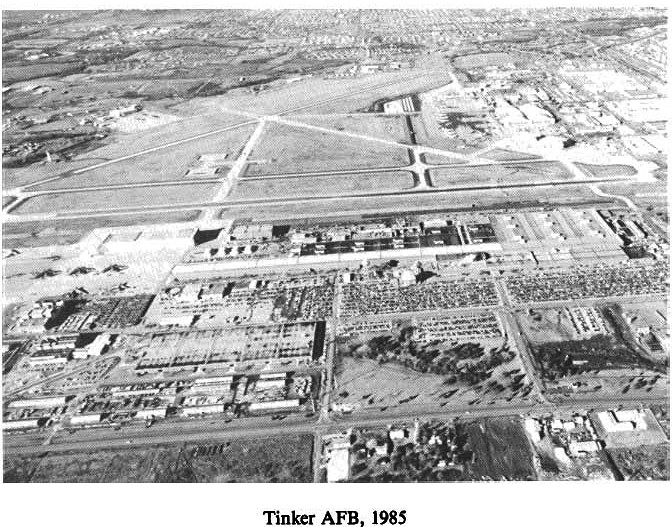
In the 1980s, the OC-ALC added management responsibilities for the B-1 Lancer and B-2 Spirit bombers and completed maintenance work on its first B-1 in 1988. More depot work on the F101, F107, F108 and F110 engines started in the mid-1980s along with management responsibilities for a host of engines. Despite a near disastrous fire in Bldg. 3001 in November 1984, ALC workers continued their support of warfighters throughout the world.
Even as Tinker people prepared to celebrate the golden anniversary of the airfield, they supported the war efforts of Operations DESERT SHIELD and DESERT STORM in 1991. A year later, the Navy's Strategic Communications Wing ONE completed its move to Tinker, the first time a Navy wing had relocated to an Air Force base. In 1993 and 1995, Tinker and Oklahoma City survived rounds of base closures, becoming one of three remaining ALCs. After terrorists bombed the Alfred P. Murrah Federal Building in downtown Oklahoma City, Tinker people provided humanitarian support and relief efforts. Base workers responded in a similar fashion after a May 3, 1999, tornado destroyed homes and businesses throughout central Oklahoma and damaged the northwest section of the base. The decade ended with the 1999 announcement that Tinker and the OC-ALC had won the largest-ever public-private competition for an engine workload. It would be transferred from the closing ALC at Kelly AFB, Texas.
With the dawn of a new century, Tinker AFB celebrated its role as the premier U.S. Air Force propulsion facility with the official transition of the new Fighter Propulsion Division from Kelly AFB on Sept. 1, 2000. Then on Sept. 11, 2001, after foreign terrorists hijacked civilian airliners and crashed them into the World Trade Center in New York City, the Pentagon in Washington D.C. and a field in Pennsylvania, Tinker workers responded by providing support to U.S. troops at home and abroad in Operations ENDURING FREEDOM (starting in 2001) and IRAQI FREEDOM (starting in 2003). As in all previous wars and conflicts, the spirit of Oklahoma and America's military resolve could be vividly seen at Tinker AFB.
After the events of Sept 11th, 2001, Tinker AFB had many responsibilities and played many roles in the Global War on Terror. On 9 October 2001, the North Atlantic Treaty Organization (NATO) made history when it deployed five Airborne Warning and Control System (AWACS) aircraft to the United States. The aircraft, crews and support personnel came from Geilenkirchen, Germany to assist the 552nd Air Control Wing (ACW) at Tinker AFB in support of Operation NOBLE EAGLE, a homeland defense operation, which continued until May of 2002.
While the 552 ACW and its NATO counter parts watched the skies, the men and women of the OC-ALC provided the aircraft, weapons and other materiel critical to the wartime operations during Operations ENDURING FREEDOM and IRAQI FREEDOM. In the years since Sept 11 many military members from the active duty, Air Force Reserve, and Air National Guard departed from Tinker AFB to the theaters in Afghanistan and Iraq to combat our foes. To meet the demands of the growing war effort, the Air Force authorized the activation of three new wings under the OC-ALC, the 76th Maintenance Wing, the 327th Aircraft Sustainment Wing (later inactivated June 2010) and the 448th Combat Sustainment Wing (later Redesignated the 448th Supply Chain Management Wing [448 SCMW] Apr 2008) in February 2005.
In January 2007, the OC-ALC received a mission assignment gaining new depot management responsibility for the C-32, C-37, and C-40 aircraft and the CF6-80C2-L1F engine.
In November 2011, HQ AFMC announced a major restructuring effort that would reduce overhead by cutting the number of centers from 12 to five. For Tinker AFB, the five center construct meant the establishment of a new organization on base, the Air Force Sustainment Center. In July 2012, the Air Force Sustainment Center activated at Tinker AFB as the center in charge of the three air logistic complexes and three airbase (Hill, Robins and Tinker) and the two supply chain wings (448 SCMW and 635th Supply Chain Operations Wings at Scott AFB, Illinois). With the establishment of AFSC came new management responsibilities and tools to effectively and efficiently command the large organization.