Hill Air Force Base, Ogden Utah
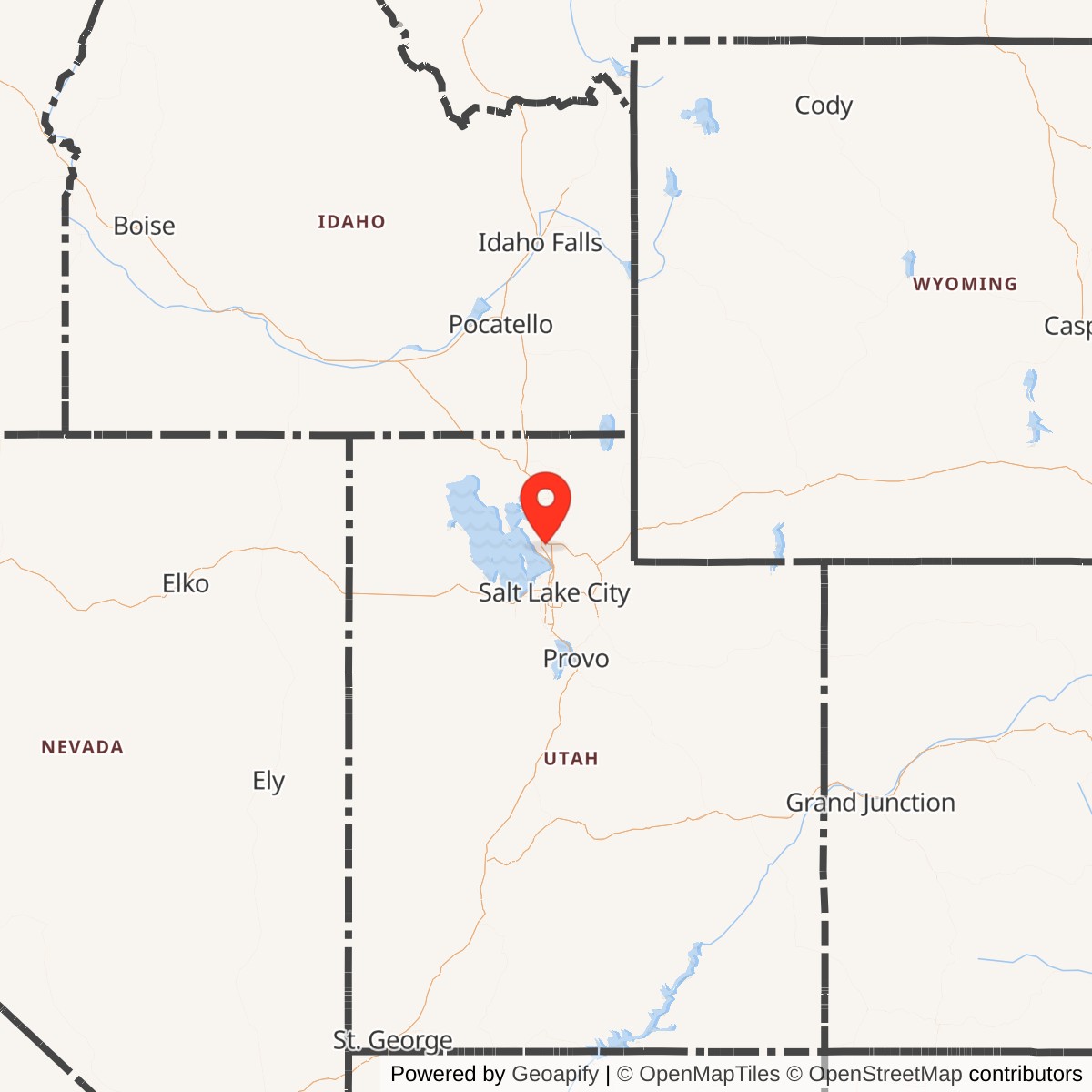
Longitude: -111.9738
Origin of current name: Named in honor of Maj Ployer Peter Hill (1894-1935). An early military aviator and test pilot, Major Hill was killed on 30 Oct 1935 in the crash of the Boeing Model 299, the original Flying Fortress, at Wright Field, OH.
Date current name was assigned to base: 13 Jan 1948
Previous Names: Ogden Air Depot, 12 Jan 1939; Hill Field, 1 Dec 1939
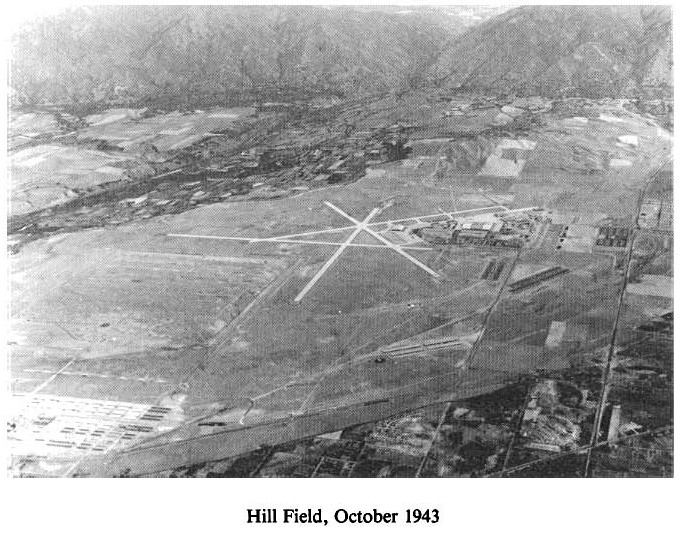
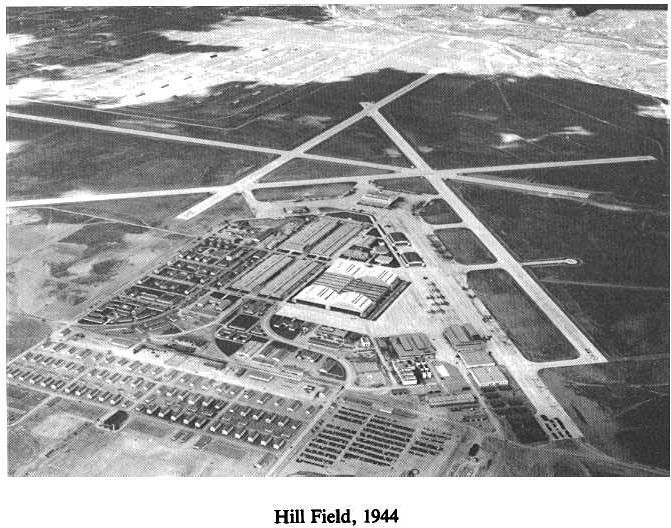
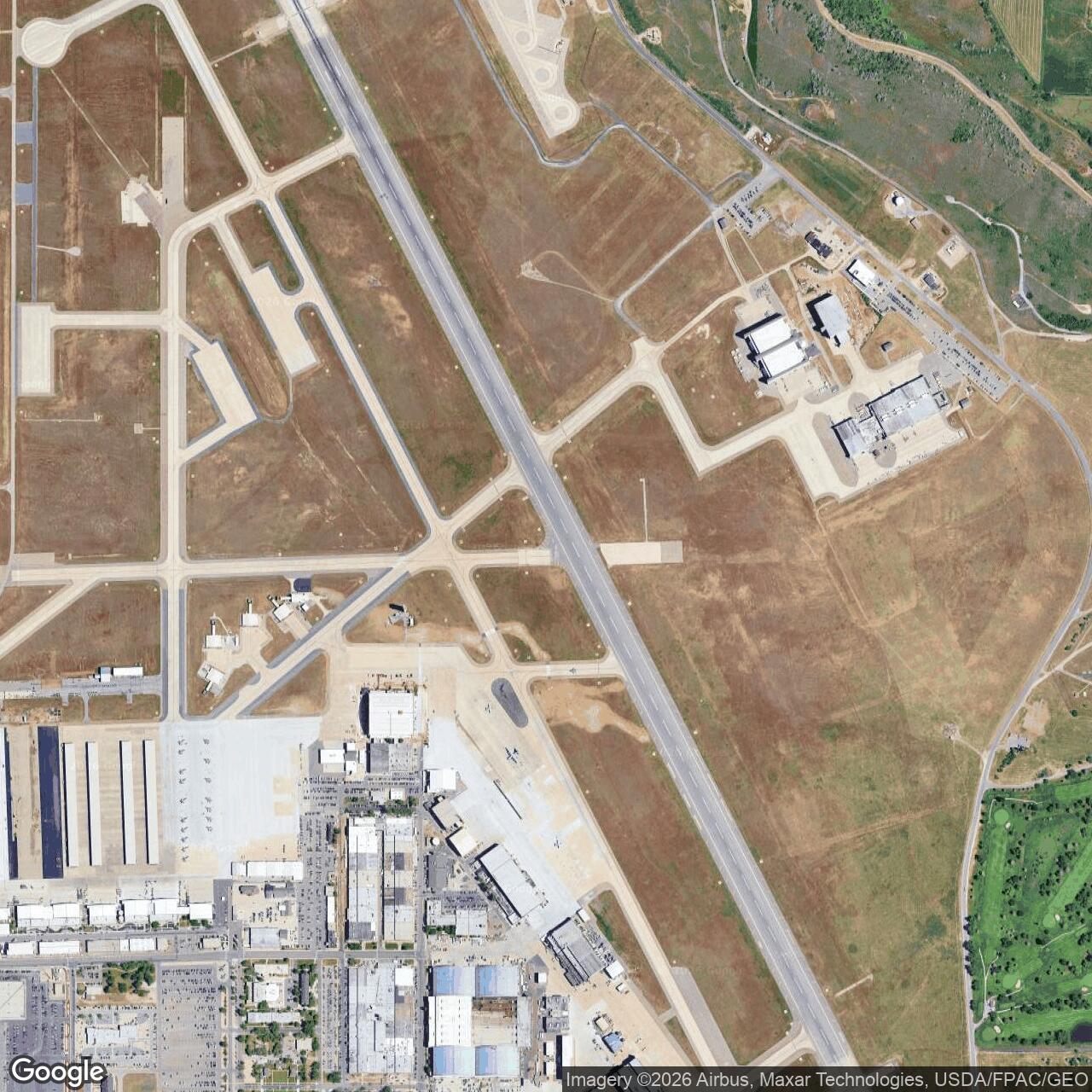
Changes in Capability: Four 7,500-foot runways, taxiways, barracks, and hangar completed Sep 1941; airplane repair shop completed Mar 1942; Ogden Air Depot attained command status as Ogden Air Depot Control Area Command 1 Feb 1943; general expansion project including air freight terminal constructed during 1943; engine repair building completed 1944 (enlarged 1946); field was a B-29 (later converted to KB-29), C-45, and C-82 storage site 1945-1953; original main runway lengthened to 8,700 feet, parking areas increased to a total of 177 acres spring 1951; hospital bed capacity increased from 50 to 75 May 1951; 350-unit Wherry housing project completed 1953; Ogden Arsenal acquired from USA c. 1954, doubling size of base, as it became center for AF munitions; tire and landing gear warehouses built 1955; new 13,500-foot runway (then world's second longest) completed 4 Mar 1957; painting and cleaning hangar completed Feb 1957; AF Marquardt Jet Laboratory, Little Mountain, UT, dedicated 5 Oct 1959; AF Plant #77 (SM-80 missiles) dedicated Apr 1962; Capehart housing accepted 1963; Minuteman engineering test facility dedicated 19 Jan 1966; Precision Measurement Equipment Laboratory completed 15 Jan 1974; new control tower accepted Mar 1974; composite medical facility (45-bed hospital) and ballistic missile support equipment overhaul facility completed Aug 1974; material processing facility completed 4 Aug 1975; housing unit occupied Nov 1975; aircraft landing gear overhaul facility completed 26 Feb 1977; logistic material storage facility completed 2 Dec 1977; first F-16 training facility completed 5 Oct 1978; depot aircraft maintenance hangar completed 3 Jul 1979; missile service shop completed Nov 1979; taxiway and lighting system rehabilitation project completed 9 Nov 1979; depot aircraft fuel maintenance facility completed 10 Apr 1980; hazardous material storage facility completed 30 Jun 1980; F-16 flight simulator building completed 9 Dec 1980.
Major Changes in Status: None
Official Base Website: hill.af.mil
Hill AFB is bordered by the colorful Wasatch Mountains on the east and overlooks the Great Salt Lake to the west. In general, the history of the base reflects the history and heritage of the U.S. Air Force and, in particular, that of the Air Force Materiel Command.
The base traces its beginning to 1934. Successful operation of a temporary Army Air Corps depot in Salt Lake City to support airmail operations focused attention of top-level officials in this area as a possible site for a permanent installation. Representatives from the Ogden and Salt Lake City Chambers of Commerce, together with Utah's congressional delegation, promoted the advantages of locating an intermountain air depot here-good year-round flying weather; unexcelled climate for both storage purposes and living; center of transportation routes; adequate land, water, power and labor force; and a strategic location inland to ensure maximum protection from possible enemy coastal attack.
As a result, in July 1934, the Air Corps Materiel Division (now Air Force Materiel Command) recommended that a depot be located in this area. Congressional passage of the Wilcox Act in 1935 authorized site selection and construction of seven permanent Air Corps stations, one of which was to be a supply and maintenance depot in the Rocky Mountain area. This prompted the Ogden Chamber of Commerce to take options on several thousand acres of land in Davis County in 1936 and to donate several hundred acres to the U.S. Government. By April 1939 the government had acquired nearly 3,000 acres of land held in escrow by the Ogden Chamber of Commerce as a site for the Ogden Air Depot (forerunner of the Ogden Air Logistics Center).
The Military Appropriations Bill for fiscal year 1940, passed by Congress in June 1939, included $8 million for construction of an air depot near Ogden, Utah. The site for the new depot was officially named Hill Field on Dec. 1, 1939, in honor of Maj. Ployer P. Hill.
Official groundbreaking ceremonies for construction of permanent facilities on Hill Field occurred on Jan. 12, 1940. Col. Morris Berman, the first commanding officer of the Ogden Air Depot, began his tour of duty on Nov. 7, 1940, marking the formal activation of the fledgling command. January 1941 saw the arrival of the first civilian employee, the first enlisted man and the second officer to take charge of supply operations. From this humble beginning, depot strength grew to a World War II peak of nearly 22,000, some 15,780 civilians and 6,000 military personnel.
During World War II the depot was renowned for its supply support and repair of such aircraft as the B-17, B-24, B-26, P-40, P-47, A-20 and AT-11, as well as several widely used reciprocating engines. Other state-of-the-art aircraft parts, such as the Norden bombsight, were repaired and returned to strategic service. Air depot wings trained here for service overseas as Hill personnel supported air operations throughout the intermountain west. They performed important wartime work at the nearby Wendover Range area. Scores of heavy bomber crews trained in air combat operations and aircraft and munitions maintenance. Crews of the 509th Composite Group practiced bombing runs at the Wendover Range in preparation for the Hiroshima and Nagasaki missions that ended World War II.
On Sept. 18, 1947, the Army Air Forces became the U.S. Air Force, ending an association with the Army that had lasted 40 years. Following an Air Force-wide pattern of renaming fields as bases, Hill Field became Hill Air Force Base on Feb. 5, 1948. After a succession of name changes, the Ogden Air Depot became the Ogden Air Materiel Area in 1946, succeeded by the Ogden Air Logistics Center in 1974.
Workload and personnel diminished after World War II, but started an upward trend with the outbreak of hostilities in Korea in June 1950. Hundreds of B-26 and B-29 aircraft, long stored at Hill AFB, were rapidly made fit to fight over Korea. Following the Korean conflict in July 1953, the depot's maintenance production lines continued work on jet aircraft such as the F-84, F-89, F-101 and F-102. Hundreds were renewed and returned to service throughout the world.
Hill's acreage doubled in size April 1, 1955, when the Department of Defense added the adjacent Ogden Arsenal property. This is now the West Area of Hill. The new acreage added more than 600 buildings and structures. As a result, base capabilities increased substantially. In 1960, all Air Force air munitions depot operations were consolidated under the 2701st Air munitions Wing.
In 1959, the depot became the logistics manager of the Minuteman ICBM. Also for decades, depot personnel managed and maintained the F-101 "Voodoo" and F-4 "Phantom" fighter aircraft. In the mid 1970s, the Ogden ALC assumed logistics management and depot maintenance responsibilities for the F-16 "Fighting Falcon." In 1982, the center was designated as system manager of the Peacekeeper ICBM. Hill AFB's depot personnel also conduct a significant portion of the Department of Defense's C-130 "Hercules" transport fleet's maintenance workload. In addition to air munitions and photographic equipment, they sustain the Air Force's training devices, including flight simulators, and 80 percent of the DoD's aircraft landing gear.
By 1998, after downsizing to the national defense structure of the post Cold War world and surviving rounds of scrutiny by the nation's Base Realignment and Closure Commission, Hill AFB was prepared for growth and development. In 1998, Ogden ALC won the competition for the Sacramento ALC depot maintenance workload. The center teamed with Boeing for the first public/private contract of its kind. The $1.7 billion contract is over a five-year period to accomplish repair of additional aerospace commodities, along with the A-10. Boeing contributes to the partnership by performing programmed depot maintenance on KC-135 aircraft in Texas.
Combined with other workload directed by the BRAC Commission to the Ogden ALC from both the closing San Antonio and Sacramento ALCs, along with increases to support Aerospace Expeditionary Forces, Hill's horizon is broad.
The 20th century is the century of flight, and the men and women of Hill continue to use the third dimension and the technology of flight for the betterment of society and national defense.
From just over 3,000 acres in 1939, Hill AFB has grown to encompass 6,698 acres in both Davis and Weber Counties, with management of an additional 962,076 acres throughout Northern Utah. Hill AFB is the state's leading employer, providing employment for nearly 23,000 military and civilian personnel (approximately 4,500 active duty, 1,200 reservists, 13,000 federal civil servants, and 4,000 civilian contractors) in the Ogden ALC, 75th Air Base Wing, 388th and 419th Fighter Wings, and various other tenant organizations. In addition to the salaries paid to the military and civilian force, Hill AFB spends funds locally for contracts and construction. This results in a national economic impact of $2.02 billion, more than $1.2 billion of which benefits Utah's economy.
History of the Hill's role in US Missiles can be found here.