
Atlas F Site 550-10 Missile Silo, Tescott / Brookville Kansas
Longitude: -97.85049749
Site Type: Atlas F vertical silo launch facility
Missile Type: SM-65F Atlas
Missile Assigned to this Silo: GD mfg no. 97F; GD serial no. 62-12133; AF tail no. 133; assigned to 550th SMS Site 10; launched 1974-03-23 from Vandenberg AFB Gantry A-3 as BMRS ACE-2, successful. Note: 97F replaced damaged Atlas 36F.
Number of Launchers/Missiles: 1
Parent Base: Schilling AFB
Missile Wing: 310th Strategic Aerospace Wing
Missile Squadron: 550th Strategic Missile Squadron
Corps of Engineers Site ID: 12
Approximate Base Size: 20-acre property with 9 privately gated acres (current rental listing); acreage not independently verified against county parcel record.
Current Site Use: Former Atlas F silo complex operated as The Missile Silo Ranch, a private tour, event, and vacation-rental property with renovated underground control-room/bunker spaces and surviving silo features.
Site Ownership: Private ownership / operated as The Missile Silo Ranch.
Accessible: Public access only by paid reservation, tour, event booking, or owner/operator permission; private property, no unscheduled access.
North of the Smoky Hills and west of Salina, a former nuclear launch complex has become a place people can tour, rent, and photograph, but its Cold War purpose was far more severe. Atlas F Site 550-10 was built so that a two-man missile crew could sit inside a hardened underground complex, maintain one liquid-fueled SM-65F Atlas on alert, and, during a national emergency, raise that missile from its silo for launch. Its current identity as The Missile Silo Ranch makes the site unusually visible today, but the visible ruins and renovated rooms still point back to a short, intense military life under Strategic Air Command.
Atlas F Site 550-10 was the Tescott, Kansas, launch complex of the 550th Strategic Missile Squadron. The site code was 550-10. The missile system was the SM-65F Atlas, commonly called Atlas F. The parent base was Schilling Air Force Base at Salina, Kansas. The operating unit was the 550th Strategic Missile Squadron, under the 310th Strategic Aerospace Wing. Because an Atlas F launch complex had its own underground control and support spaces rather than a Minuteman-style remote launch-control center.
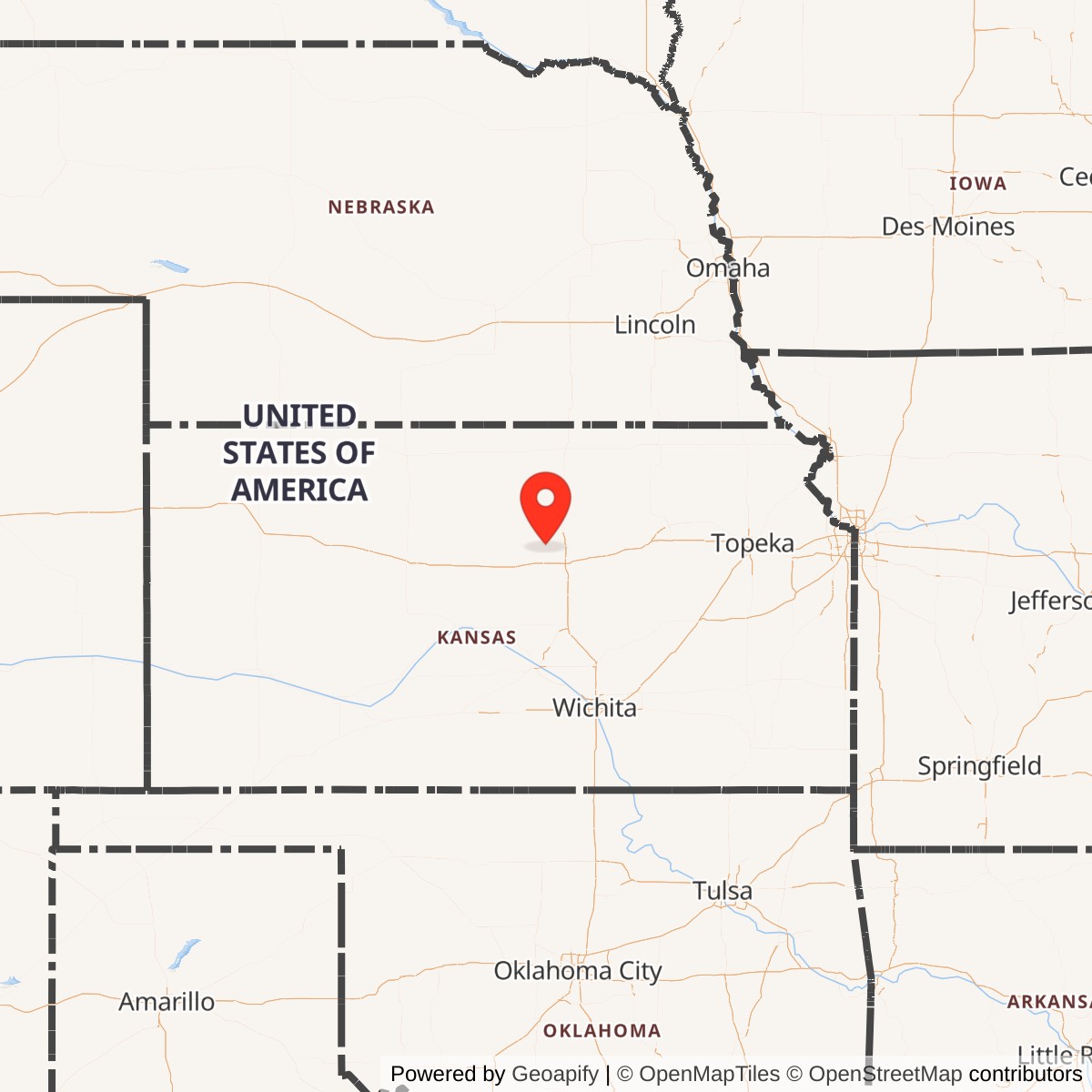
The site is in Ottawa County, Kansas, near Tescott and the modern Brookville-area address used by The Missile Silo Ranch. EPA's environmental record for SCHILLING (EX) AIR FORCE ATLAS FAC S-10 identifies the related site in Tescott, Ottawa County, Kansas, using EPA ID KSSFN0703173.
The complex is inactive and decommissioned. The former complex is now private property operated as The Missile Silo Ranch, with tours, event rentals, and overnight stays available only through reservation or operator permission.
Location, Landscape, and Site Description
Atlas F Site 550-10 sits in rural central Kansas. The site is historically identified with Tescott, while current public-facing material for The Missile Silo Ranch uses the address 2432 Ave I, Brookville, KS 67425. This is flat-to-rolling agricultural country within the former Schilling missile field, far enough from Schilling AFB to serve the dispersed-survivability logic of the Atlas F system but close enough to remain within the squadron's support, maintenance, security, and supply network.The 550th Strategic Missile Squadron operated twelve Atlas F launch complexes placed in a ring around Salina. Site 550-10 was one of those dispersed nodes. Its purpose was not to be seen from a distance. Atlas F was a hardened silo-lift system: the missile stood vertically underground in a reinforced silo, protected until a launch order would require doors to open, the missile to be raised, liquid oxygen to be loaded or topped, and the vehicle to launch from above the silo. Public descriptions of Atlas F complexes show an underground launch control center, a deep silo launcher, tunnels, utility systems, air-handling systems, power equipment, cryogenic-support equipment, and secured access aboveground.
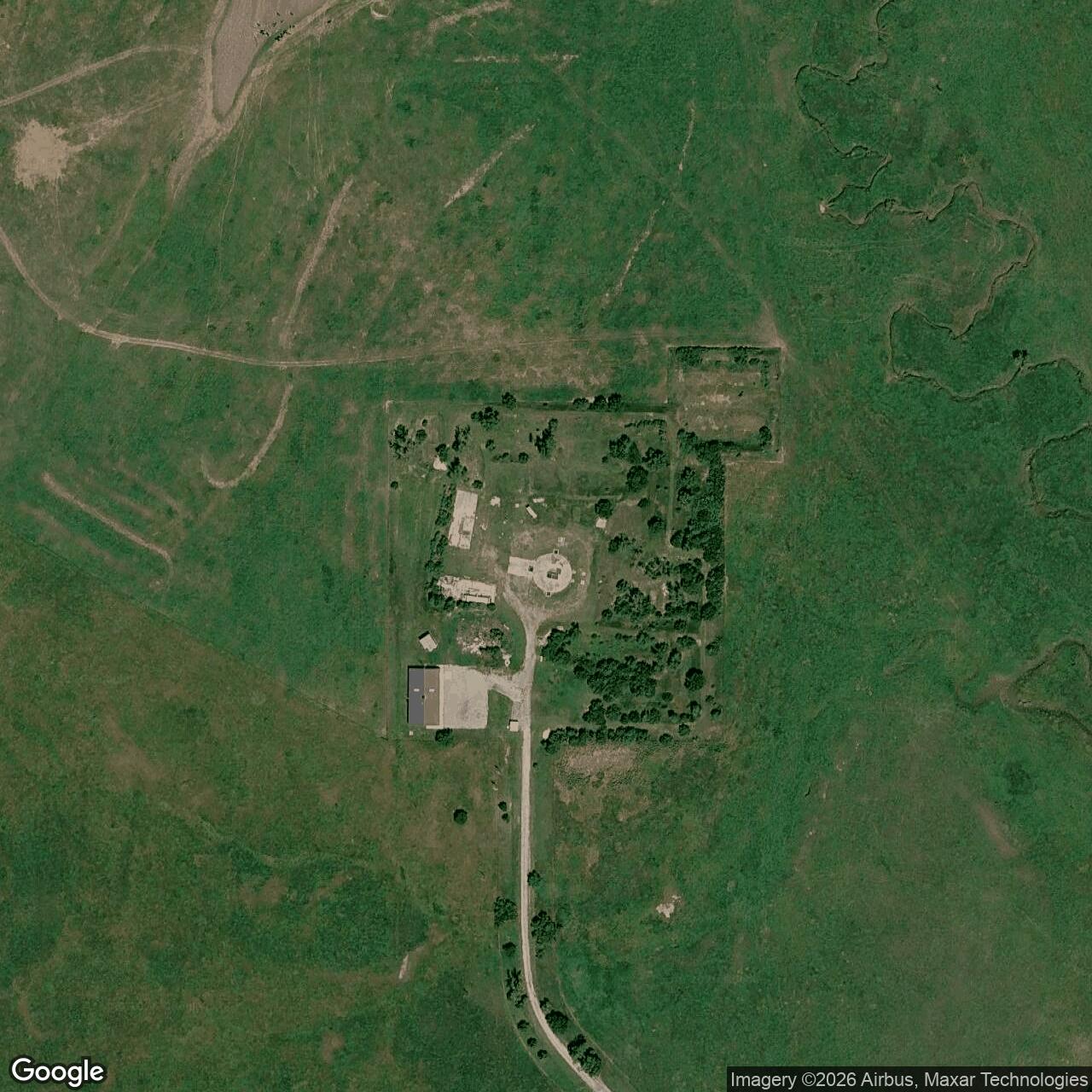
The current reuse confirms that substantial underground spaces survive. The Missile Silo Ranch describes a historical missile control-room setting with two underground levels, bedrooms, bathrooms, a living room, kitchen, pool table, and arcade/game spaces. The VRBO/Evolve listing describes a restored underground control room, a two-level underground bunker, surviving historic missile-silo features on site, three bedrooms, three bathrooms, and group lodging. The listing also describes a 20-acre property with 9 privately gated acres, a camping area, RV spaces, outdoor restrooms/shower, and secured grounds. Those public details should be read as current-use descriptions, not as a complete inventory of every surviving military feature.
Strategic and Cold War Context
Site 550-10 existed because the early ICBM age demanded speed, hardness, and geographic dispersal before missile technology had become simple or routine. Atlas was the Air Force's first operational intercontinental ballistic missile. The National Park Service describes Atlas as the first operational U.S. Air Force ICBM and notes that Atlas E and F were deployed across the United States, with a peak of 132 operational Atlas sites from December 1962 through May 1964 before the missile was phased out in favor of Titan and Minuteman systems.Atlas F was the most hardened fielded member of the Atlas family. It used a silo-lift arrangement rather than the earlier aboveground gantry or coffin-launcher arrangements. It also remained part of the first generation of liquid-fueled ICBMs: powerful, fast by bomber-era standards, but operationally demanding. The Atlas airframe was pressure-stabilized. Its thin stainless-steel structure required internal pressure to keep its shape, a design sometimes described in public histories as a "balloon tank." The missile used RP-1 kerosene fuel and liquid oxygen oxidizer. RP-1 could be kept on board during alert, but liquid oxygen was cryogenic and could not simply be stored in the missile indefinitely.
For Atlas F sites were "on alert" or operationally launch-ready, that does not mean the missile sat continuously raised above the silo or continuously loaded with liquid oxygen. It means the complex, crew, missile, communications, support systems, and war-order procedures were maintained so the site could respond rapidly if SAC received a valid launch order. In Atlas F practice, the missile was protected underground and would be elevated and prepared during the launch sequence. The Atlas F's roughly ten-minute launch-response claim was impressive for the early 1960s, but it still depended on carefully choreographed mechanical, cryogenic, electrical, and crew actions.
Construction and Activation
Site 550-10 construction began in 1960 and turned over to the Air Force in 1962. The Schilling Atlas F plan grew from nine silos to twelve, and the Utah-Manhattan-Sundt joint venture received the nine-silo contract, with a later contract for the three additional lift-launcher silos. Records show major cost growth, high-water-table pumping problems at some excavations, construction safety problems, and five fatalities across the Schilling missile construction effort.Atlas F construction was among the hardest military construction jobs of the period. Each site required a deep reinforced-concrete silo, underground launch-control and support spaces, tunnel connections, power systems, HVAC and air-filtration systems, water and sewage systems, emergency equipment, communications, access roads, security boundaries, and specialized launch equipment. FAS's Atlas F material includes Schilling construction captions showing the subterranean launch control center and silo launcher under construction in 1960 and noting water problems during excavation. Those details fit the broader Schilling construction history and help explain why the Atlas F complexes were expensive, slow to finish, and hazardous to build.
The 550th Strategic Missile Squadron was one of the first Atlas F units. The activation of the 550th SMS at Schilling and its sister squadron at Lincoln on 1961-04-01 marked the first standing up of Atlas F units; the first operational Atlas F sites were accepted by SAC in June 1962 and the squadron was declared operational in September 1962.
Missile System and Technical Role
Site 550-10 was built for one SM-65F Atlas missile. The Atlas F was an intercontinental ballistic missile in a hardened silo-lift configuration. Public sources describe Atlas F as approximately 82 feet tall and capable of being launched in about ten minutes from its silo-lift complex. It was not a solid-fueled missile like Minuteman. It was a liquid-fueled system using RP-1 and liquid oxygen, and it required constant attention to pressure, propellants, ground support equipment, electrical systems, communications, and safety procedures.The missile associated with Site 10 was Atlas 97F, General Dynamics serial number 62-12133, Air Force tail number 133. The missile acceptance and delivery dates were 1962-10-23 and 1962-10-24. The missile later launched successfully from Vandenberg AFB Gantry A-3 on 1974-03-23 as a BMRS ACE-2 reentry-vehicle test. 97F replaced Atlas 36F, which had been damaged and sent to General Dynamics/Astronautics.
The likely warhead/reentry-vehicle context was the Mark 4 reentry vehicle and W-38 nuclear warhead used with Atlas E/F missiles. The Smithsonian's National Air and Space Museum describes the Mark 4 reentry vehicle as used on U.S. Air Force Atlas E/F and Titan I ICBMs and states that it carried a W-38 warhead with a yield of about 3.75 megatons.
Operational History
Atlas F Site 550-10's operational history was short but intense. It belonged to the 550th Strategic Missile Squadron, the Schilling Atlas F squadron. The site was one of twelve launch complexes spread around Salina and manned around the clock during the squadron's active life. In the Atlas F system, unlike later Minuteman launch facilities, the individual launch complex had its own underground control spaces and crew presence. Maintenance, security, propellant, communications, and inspection routines had to be sustained across each remote site.The operational heart of the site was alert duty. During alert periods, crew readiness, secure communications, missile status, power, environmental controls, and launch-system readiness mattered as much as the missile itself. The sites were manned 24 hours a day, 7 days a week, 365 days a year during the squadron's active period. During the Cuban Missile Crisis all operational 550th sites were maintained at a high alert level and ready to launch if necessary.
For Site 550-10, this alert status meant a crewed and monitored launch complex ready to move through the launch sequence if ordered. It did not mean public-facing ideas of a missile sitting exposed aboveground at all times, nor did it mean continuous liquid-oxygen loading. The Atlas F weapon system's readiness was an integrated state: the missile, silo elevator, doors, cryogenic handling, launch-control equipment, power systems, communications circuits, security forces, and SAC command chain all had to function together.
No documented site-specific accident, explosion, fire, protest, treaty inspection, or security incident tied uniquely to Site 550-10 was found in the public-source pass. The most documented site-level operational detail is the assigned missile record for Atlas 97F and the later post-ICBM test history of that missile. The strongest documented squadron-level event is the Cuban Missile Crisis alert posture.
Deactivation and Disposal
The Atlas F system was overtaken quickly. By the mid-1960s, solid-fueled Minuteman missiles and other newer systems provided a more practical alert posture than the liquid-fueled Atlas. The Military Standard ties the Schilling phaseout to Secretary of Defense Robert McNamara's May 1964 directive accelerating deactivation of first-generation ICBMs.The missile, nuclear components, and operational launch equipment were removed as part of Atlas phaseout and surplus disposition. With Schilling AFB's closing, responsibility for the sites passed to F.E. Warren AFB in July 1967 and the sites were disposed of in March 1971. As with other Atlas F complexes, post-service history included private transfer and reuse rather than ongoing military launch status.
The environmental record for Site 550-10 is documented in EPA and older FUDS-related data. EPA lists SCHILLING (EX) AIR FORCE ATLAS FAC S-10, EPA ID KSSFN0703173, in Tescott, Ottawa County, Kansas. EPA lists the site as not on the National Priorities List, NFRAP because existing information did not qualify it for the NPL, and NFFA, meaning no further federal action will be taken at the site. It also lists the property as not a federal facility. An older GAO table of Kansas properties identified for potential inclusion in the FUDS cleanup program lists SCHILLING AFB-FAC S-10, property number B07KS0268, in Ottawa County.
Current Status and Site Use
Atlas F Site 550-10 is decommissioned and privately reused. The former launch complex is now operated publicly as The Missile Silo Ranch, with the address 2432 Ave I, Brookville, KS 67425. It is not a public park or an unrestricted historic site. Access is by reservation, event booking, tour booking, lodging rental, or permission from the operator/owner.The current operation emphasizes both preservation and commercial reuse. The Missile Silo Ranch describes tours, events, and stays in a historic missile-control-room environment. Its about page describes two underground levels, bedrooms, bathrooms, living and entertainment spaces, and Airbnb/event uses. Its pricing page describes event rentals and overnight stays in a decommissioned Atlas F nuclear missile silo, with access to a 20-acre aboveground property. A VRBO listing describes a restored underground control room, three bedrooms, three bathrooms, a two-level underground bunker, a 20-acre property with 9 pr
Chronology
- 1958 The Air Force turned to the U.S. Army Corps of Engineers to build launch facilities for the Atlas ICBM program.
- 1960-10 The Corps of Engineers Ballistic Missile Construction Office consolidation placed CEBMCO in charge of Atlas construction management.
- 1961-04-01 The Military Standard lists the activation of the 550th Strategic Missile Squadron at Schilling AFB, one of the first Atlas F units.
- 1962-06 The first operational Atlas F sites at Schilling were accepted by SAC in June 1962.
- 1962-08-23 Atlas 97F was accepted on this date.
- 1962-08-24 Atlas 97F was delivered on this date.
- 1962-09 The 550th Strategic Missile Squadron was declared operational in September 1962.
- 1962-10 During the Cuban Missile Crisis, the 550th Strategic Missile Squadron's operational sites were maintained at a high alert level; this meant crews and systems were launch-ready, not that the Atlas F missiles were continuously raised or continuously loaded with liquid oxygen.
- 1964-05 Secretary of Defense Robert McNamara directed accelerated phaseout of first-generation ICBMs, including Atlas F.
- 1965-06-25 The 550-10 deactivation date was 1965-06-25, corresponding to the final Schilling/550th Atlas phaseout context.
- 1967-07 Responsibility for the former Schilling Atlas sites passed to F.E. Warren AFB after the closing of Schilling AFB.
- 1971-03 The former Schilling Atlas sites were disposed of as surplus property.
- 1974-03-23 Atlas 97F, the missile associated with Site 550-10, launched successfully from Vandenberg AFB Gantry A-3 as a BMRS ACE-2 reentry-vehicle test.
- 2001 GAO's Kansas table listed SCHILLING AFB-FAC S-10 / B07KS0268 in Ottawa County among properties identified for potential FUDS cleanup-program inclusion.
- 2024 The Missile Silo Ranch public materials described tours, events, and overnight stays at the former 550th Strategic Missile Squadron site.
- 2024 VRBO/Evolve public listing material described the property as renovated in 2024, with a restored underground control room and a 20-acre property with 9 privately gated acres.
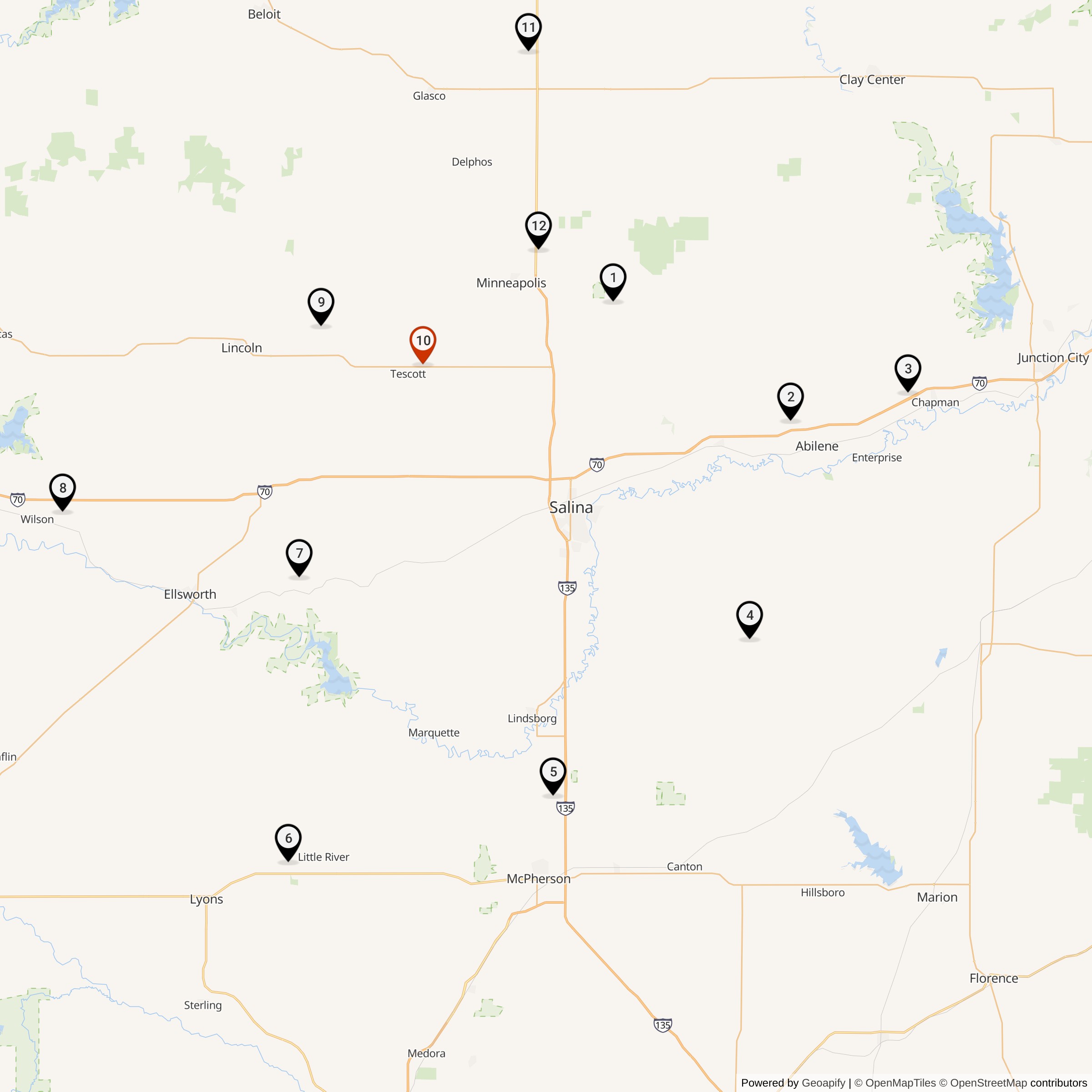
Read about the Atlas at Schilling AFB
All Atlas Missile Silo Locations