
Atlas F Site 550-3 Missile Silo, Chapman Kansas
Longitude: -97.0658
Site Type: Atlas F vertical silo launch facility
Missile Type: SM-65F Atlas
Missile Assigned to this Silo: GD mfg no. 37F; GD serial no. 61-2523; AF tail no. 523; accepted 1961-12-29; delivered 1962-03-16; 550th SMS Site 3; not launched; salvaged as scrap.
Number of Launchers/Missiles: 1
Parent Base: Schilling AFB
Missile Wing: 310th Strategic Aerospace Wing
Missile Squadron: 550th Strategic Missile Squadron
Corps of Engineers Site ID: 2
Approximate Base Size: about 18 acres
Current Site Use: Former Atlas F silo complex west of Chapman; KDHE states the approximately 18-acre property is privately owned by the adjacent landowner, unoccupied, and used primarily as hayfields.
Site Ownership: Former USAF; transferred in 1966 to the Kansas State Engineering School for research use; later private ownership by adjacent landowner per KDHE.
Accessible: No public access confirmed; private former missile/FUDS site. Do not enter without owner permission.


West of Chapman, Kansas, the remains of Atlas F Site 550-3 sit in the kind of open farm-and-pasture country that made the early missile age feel both remote and immediate. This was once a hardened nuclear launch complex tied to Schilling Air Force Base at Salina, an underground control center, a vertical missile silo, a crewed alert site, and one SM-65F Atlas ICBM kept ready in a landscape that otherwise looked like ordinary Kansas. The missile never launched, but the site left a long paper trail after the Air Force departed, research reuse, private ownership, environmental investigations, groundwater sampling, a possible demolition landfill, suspected underground storage tanks, and a final state no-further-action determination.
Atlas F Site 550-3, also identified in environmental records as Schilling AFB Atlas S-03 or Schilling Atlas Missile S-3, was an SM-65F Atlas intercontinental ballistic missile launch complex of the 550th Strategic Missile Squadron, 310th Strategic Aerospace Wing, Strategic Air Command. Its parent base was Schilling Air Force Base at Salina, Kansas. The site was located near Chapman in Dickinson County, Kansas. The individual Atlas F complex had its own underground launch-control and support facility, so it did not have a separate Minuteman-style parent Launch Control Center.
The site was one of twelve single-missile Atlas F complexes assigned to the 550th Strategic Missile Squadron. Air Force unit history lists the 550th Strategic Missile Squadron as organized at Schilling AFB on 1961-04-01, operational on 1962-09-09, and discontinued on 1965-06-25.
Today Site 550-3 is decommissioned and privately owned. KDHE's Identified Sites List describes the property as privately owned by the adjacent landowner, unoccupied, and used primarily as hayfields. The same KDHE narrative states that the site consists of about 18 acres and lies approximately 2 miles west of Chapman and approximately 11 miles northeast of Abilene. There is no confirmed public access. The coordinates identify the former silo/launch-complex location, not a public entrance, and the site should be treated as private property.
Location, Landscape, and Site Description
Site 550-3 was placed in rural Dickinson County west-northwest of Chapman, Kansas.
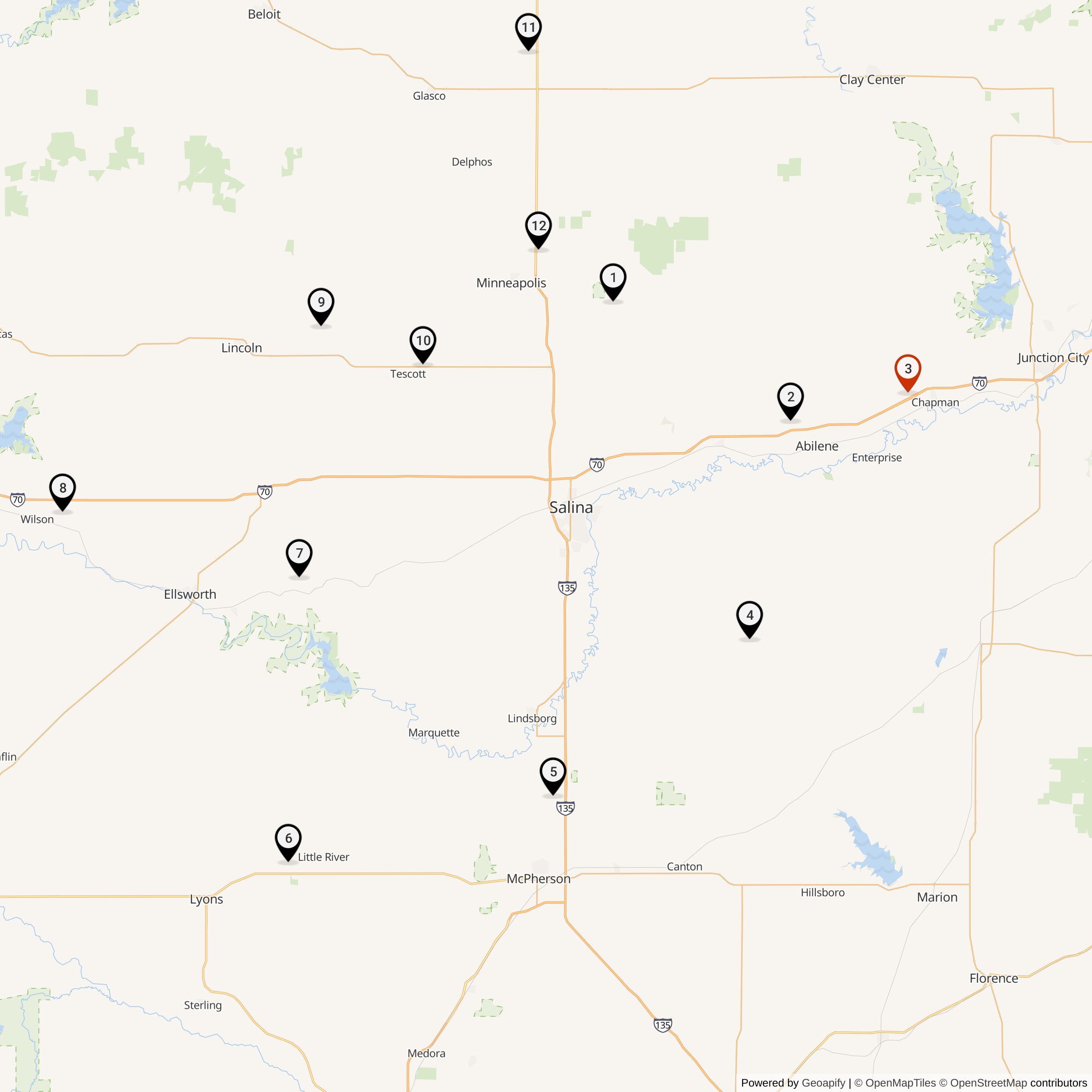
The setting was typical of the Schilling Atlas F field, sparse rural land, agricultural and pasture use, dispersed roads, and enough separation from nearby communities to reduce concentration of risk while keeping the site reachable by convoy, maintenance teams, liquid-oxygen support, and security forces. Schilling AFB itself was at Salina, southwest of the site. The twelve Atlas F sites formed a wide ring around the base, with Site 550-3 anchoring the eastern side of the missile field near Chapman.
An Atlas F complex was a self-contained vertical-silo launch installation. The missile stood upright in a deep reinforced-concrete and steel silo. The crewed underground launch-control center and support spaces were connected to the missile silo by a tunnel. Surface features normally included an access road, security fencing, entry-control features, utility structures, communications equipment, support buildings, and the heavy silo doors above the launcher. Unlike later Minuteman launch facilities, which were unmanned missile silos controlled from remote Launch Control Centers, Atlas F sites had on-site launch crews and support facilities within the individual complex.
KDHE's site narrative provides unusually specific later physical details for Site 550-3. It states that after decommissioning, the site was transferred in 1966 to the Kansas State Engineering School for use in a research program. During a 1988 site visit, the property was described as recently mowed with no visible vegetation stress; the only remaining buildings noted were the pump house and water treatment building, and the security fence had been removed. A 1990 O'Brien and Gere report recorded discussions with the property owner about a possible demolition landfill north of the launch-control-center entrance. By the time of KDHE's summary, the land was privately owned, unoccupied, and used mainly for hayfields.
Strategic and Cold War Context
Site 550-3 existed because the United States wanted a land-based nuclear deterrent that could reach intercontinental targets and survive long enough to be useful under attack. The Atlas program was the first operational American ICBM family, and Atlas F was the final and most hardened operational Atlas variant. Earlier Atlas D and E sites relied on exposed or semi-hardened launch arrangements. Atlas F moved the missile into a vertical underground silo, giving it more protection before launch and making the launch complex harder to destroy than the earlier Atlas layouts.
The Schilling field was part of that transition. The 550th Strategic Missile Squadron at Schilling AFB and the 551st Strategic Missile Squadron at Lincoln AFB were among the first Atlas F operational units. At Schilling, twelve independent launch sites were dispersed around Salina, each holding a single SM-65F missile. The intent was not to make any one site invulnerable, but to complicate an enemy's attack problem: a strike on the base or on one launch complex would not necessarily eliminate every missile assigned to the squadron.
Atlas F also reflected the limits of first-generation missile technology. The missile used RP-1 kerosene fuel and liquid oxygen oxidizer. RP-1 could be stored aboard the missile during alert, but liquid oxygen was cryogenic and had to be loaded shortly before launch. For Atlas F, an operational launch-ready alert posture did not mean the missile was continuously raised above ground or continuously filled with liquid oxygen. It meant the missile, crew, communications, security, maintenance, fueling systems, and command procedures were kept ready so that, if a valid launch order arrived, the site could open the silo doors, raise the missile, load or top off liquid oxygen, maintain pressurization with gaseous nitrogen, and launch after the required final preparations. This was fast for its era, but the missile was still vulnerable during the final aboveground launch sequence in a way that later silo-launched missiles such as Minuteman were not.
Construction and Activation
Construction of the Schilling Atlas F missile field began as the Air Force expanded and modernized Schilling AFB in the late 1950s and early 1960s. Schilling AFB history states that in 1959 the Department of Defense began major renovation of the base and construction of the twelve-silo Atlas complex. It also states that beginning in August 1960, the Site Activation Task Force at Schilling constructed and turned over to Strategic Air Command the first operational Atlas F hardened-silo missile squadron.
Building an Atlas F site required excavation for a very deep launch silo, extensive reinforced-concrete placement, blast-resistant doors, a missile elevator/launcher system, underground crew and equipment spaces, tunnel connections, power and environmental-control systems, propellant-handling systems, water treatment and pump facilities, communications equipment, security systems, and surface support buildings.
Air Force unit history lists the 550th Strategic Missile Squadron as organized at Schilling AFB on 1961-04-01. In June 1962, the first Series F Atlas operational sites at the 550th Strategic Missile Squadron, Schilling AFB, and the 551st Strategic Missile Squadron, Lincoln AFB, were accepted by Strategic Air Command. The same Air Force history lists turnover of the 550th to SAC on 1962-09-07 and operational status on 1962-09-09.
Site 550-3's assigned missile was Atlas 37F, General Dynamics missile serial number 61-2523, Air Force tail number 523.The missile acceptance date was 1961-12-29 and delivery date was 1962-03-16. The missile was assigned to the 550th Strategic Missile Squadron's Site 3 at Schilling AFB for the operational ICBM mission. It was not later used for a space or test launch and was ultimately salvaged as scrap.
Missile System and Technical Role
Site 550-3 housed the SM-65F Atlas, the final operational Atlas ICBM model. The Atlas F was stored vertically in a hardened underground silo and raised to the surface for launch. It was not fired from within the silo. The missile used RP-1 kerosene fuel and liquid oxygen oxidizer, inertial guidance, and a launch sequence that depended on the missile being elevated above the silo before firing.
Public museum and Air Force-associated sources identify the Atlas E/F reentry vehicle as the Mark 4. The Smithsonian National Air and Space Museum describes the Mark 4 as a reentry vehicle used on U.S. Air Force Titan I and Atlas E/F ICBMs deployed in the early 1960s and states that it carried a W-38 nuclear warhead with a yield of about 3.75 megatons.
Operationally, the Atlas F complex combined the missile, silo, launch-control center, crew living/support spaces, communications, fueling support, security, and maintenance access within one hardened site. A launch crew could monitor the weapon from the underground control area. Maintenance and security personnel supported the complex, while larger command, logistics, and missile-maintenance functions were tied back to Schilling AFB. Site 550-3 was therefore both an individual launch point and one component of a squadron-wide deterrent system.
Operational History
The operational life of Site 550-3 was short but intense. The 550th Strategic Missile Squadron was one of the earliest Atlas F units and operated twelve dispersed Atlas F sites from Schilling AFB. Unit history states that the squadron was turned over to SAC on 1962-09-07 and declared operational on 1962-09-09. Site 550-3, with Atlas 37F assigned, formed part of that operational force.
During alert service, the site's purpose was readiness rather than routine launching. The missile remained in its hardened underground launch complex, while the crew, security force, communications systems, maintenance programs, and propellant-support arrangements were kept ready for a valid launch order. The site needed enough on-site and base-supported infrastructure to support alert duty around the clock: power, water, environmental control, security, communications, and missile maintenance. The squadron's sites were manned 24 hours a day, 7 days a week, 365 days a year during the active Atlas period.
The Cuban Missile Crisis in October 1962 occurred soon after the 550th was declared operational. During the crisis all operational 550th sites were at a high level of alert and ready to launch if ordered. For Site 550-3, that meant its assigned missile and crew would have been held in a heightened launch-ready posture as part of the squadron, but it does not mean the missile was continuously raised or continuously loaded with liquid oxygen. Atlas F readiness depended on the ability to begin and complete the launch sequence quickly after authorization, not on keeping the missile exposed above the silo.
Deactivation and Disposal
The Atlas F system was overtaken quickly by newer solid-fueled ICBMs, especially Minuteman. In May 1964, Secretary of Defense Robert McNamara directed that the phaseout of remaining first-generation ICBMs - Atlas and Titan I - be accelerated. For the 550th SMS, Air Force unit history lists the first ICBM off alert on 1965-02-01, the last ICBM off alert on 1965-03-05, and the last ICBM shipped on 1965-03-11. The 550th Strategic Missile Squadron was discontinued on 1965-06-25.
Those dates represent different steps in the shutdown process. A missile could be removed from alert before being physically shipped. The individual launch complex could be decommissioned before or apart from the formal discontinuance of the squadron. Schilling AFB itself was also in the process of closing and conversion. Schilling AFB closed in 1965, and responsibility for the sites later passed to F.E. Warren AFB in July 1967, and the sites were disposed of in March 1971. KDHE's site-specific narrative adds that Site 550-3 was transferred in 1966 to the Kansas State Engineering School for use in a research program.
Site 550-3 later entered environmental tracking as Schilling AFB Atlas S-03. The 2015 USACE FUDS inventory lists SCHILLING AFB ATLAS S-03 / B07KS0261 at Chapman, Dickinson County, Kansas, with site numbers 01 CON/HTRW and 04 HTRW. EPA identifies SCHILLING (EX) AIR FORCE ATLAS FAC S-3 by EPA ID KSN000703287, lists it as not on the National Priorities List, and gives a non-NPL status of NFRAP, meaning the site did not qualify for the NPL based on existing information.
KDHE's Identified Sites List gives the site project code C502103053 and marks the site status as Resolved. Its narrative states that early sampling found trichloroethene (TCE) in groundwater below its maximum contaminant level, methylene chloride above a risk-based value, and later detections of arsenic, lead, and TCE in on-site monitoring wells, with only lead exceeding its action level in the cited assessment. A private well showed TCE below the maximum contaminant level. Later USACE sampling and remedial investigation found that TCE was not detected above the maximum contaminant level. KDHE concurred with no further action on 2017-09-19. DoD DERP Table 9 later listed SCHILLING AFB ATLAS S-03 / KS79799F030500 among properties achieving final response complete before FY2022, with two IRP sites and no MMRP sites.
Current Status and Site Use
Site 550-3 is a decommissioned Atlas F launch complex in rural Dickinson County, Kansas. KDHE describes the approximately 18-acre site as privately owned by the adjacent landowner, unoccupied, and used primarily as hayfields. It also states that by a 1988 site visit the security fence had been removed and only the pump house and water treatment building were noted as remaining buildings. The former underground launch complex, tunnel, and silo should be presumed to remain part of the former military property unless reliable site-specific demolition documentation shows otherwise; the reviewed KDHE narrative emphasizes environmental and surface-feature observations rather than a complete structural demolition record.
The site is not a public museum or public attraction. There is no confirmed public access. Any visit would require permission from the owner. Former missile complexes can contain confined spaces, unstable structures, open shafts, standing water, hazardous materials, and contamination concerns, and the site should be viewed only from public rights-of-way unless lawful permission and appropriate safety arrangements exist.
Chronology
- 1959 The Department of Defense began major renovation of Schilling AFB and construction of the twelve-silo Atlas F complex around the base.
- 1960 Construction began at Site 550-3, with the exact month and day not identified in the reviewed source.
- 1961-04-01 The 550th Strategic Missile Squadron was organized at Schilling AFB, Kansas.
- 1961-12-29 Atlas 37F, General Dynamics serial 61-2523 and Air Force tail number 523, was accepted.
- 1962-03-16 Atlas 37F was delivered for the Schilling AFB / 550th SMS operational ICBM mission.
- 1962-06 The first Series F Atlas ICBM operational sites at the 550th SMS, Schilling AFB, and 551st SMS, Lincoln AFB, were accepted by Strategic Air Command.
- 1962 Site 550-3 was turned over to the Air Force; the exact site-specific month and day were not identified in the reviewed source.
- 1962-09-07 Air Force unit history lists turnover of the 550th Strategic Missile Squadron to SAC.
- 1962-09-09 Headquarters SAC declared the 550th Strategic Missile Squadron operational.
- 1962-10 During the Cuban Missile Crisis, operational 550th SMS sites were held at a high level of alert; for Atlas F this did not mean the missiles were continuously raised or continuously LOX-loaded.
- 1965-02-01 Air Force unit history lists the first 550th SMS ICBM as removed from alert.
- 1965-03-05 Air Force unit history lists the last 550th SMS ICBM as removed from alert.
- 1965-03-11 Air Force unit history lists the last 550th SMS ICBM as shipped.
- 1965-06-25 The 550th Strategic Missile Squadron was discontinued as part of the Atlas phaseout.
- 1966 KDHE records state that Site 550-3 was transferred to the Kansas State Engineering School for use in a research program.
- 1971-03 The Military Standard's Schilling AFB history states that the former Schilling Atlas sites were disposed of in March 1971.
- 1985 USACE conducted an initial site visit at Site 550-3.
- 1988 A later site visit described the site as recently mowed, with no visible vegetation stress, the security fence removed, and the pump house and water treatment building remaining.
- 1990 An O'Brien and Gere report noted discussions about a possible demolition landfill north of the launch-control-center entrance.
- 1993 USACE investigated possible remaining underground storage tanks, but right of entry was denied and the tanks may have remained on site.
- 2001 EPA conducted a pre-CERCLIS screening assessment and concluded that additional pre-remedial activity was warranted.
- 2006-02-28 EPA completed a Preliminary Assessment for the site.
- 2011 A Site Inspection was conducted at S-3, including soil and groundwater sampling and new monitoring wells.
- 2012-11-26 A remedial investigation began according to KDHE action records.
- 2016-06-16 The remedial investigation was completed according to KDHE action records.
- 2017-09-19 KDHE concurred with a no-further-action determination for Site 550-3.
- 2021 KDHE's Identified Sites List data, last updated 2021-06-03, listed the site as Resolved.
- 2022 DoD DERP Table 9 listed SCHILLING AFB ATLAS S-03 / KS79799F030500 among properties achieving final response complete before FY2022.

Read about the Atlas at Schilling AFB
All Atlas Missile Silo Locations