Atlas F Site 550-12 Missile Silo, Minneapolis Kansas
Longitude: -97.6640958609705
Site Type: Atlas F vertical silo launch facility
Missile Type: SM-65F Atlas
Missile Assigned to this Silo: GD mfg no. 24F; GD serial no. 60-5547; AF tail no. 547; accepted 1961-11-29; delivered 1962-01-17; assigned to 550th SMS Site 12; not launched; salvaged as scrap.
Number of Launchers/Missiles: 1
Parent Base: Schilling AFB
Missile Wing: 310th Strategic Aerospace Wing
Missile Squadron: 550th Strategic Missile Squadron
Corps of Engineers Site ID: 10
Current Site Use: Former Atlas F launch complex in rural Ottawa County northeast of Minneapolis; current owner/use not independently verified; former complex footprint visible in public imagery/site photography.
Site Ownership: Former USAF; current ownership not independently verified; EPA flags the site as not a federal facility, so treat as private property unless later parcel records prove otherwise.
Accessible: No verified public access; private property/former military-industrial site; do not enter without owner permission.

Atlas F Site 550-12 was the northern reach of Schilling Air Force Base's Atlas F ring: a buried launch complex set into the farm country northeast of Minneapolis, Kansas. From the road it could pass as another quiet rural utility or former industrial site, but in 1962 it represented the edge of a new kind of American deterrent, one missile, one hardened underground complex, one crewed launch-control space, and one first-generation intercontinental ballistic missile waiting below the prairie.
The site's operational designation was Atlas F Site 550-12. It belonged to the 550th Strategic Missile Squadron, assigned to the 310th Bombardment Wing, later the 310th Strategic Aerospace Wing, at Schilling Air Force Base near Salina, Kansas. The missile system was the SM-65F Atlas, also known later as HGM-16F. The nearest town is Minneapolis in Ottawa County, Kansas.
Unlike a Minuteman launch facility, an Atlas F launch complex was not a small unmanned launch facility controlled from a separate remote Minuteman-style Launch Control Center. Atlas F sites were self-contained launch complexes with the missile silo, launch-control space, support equipment, utilities, and crew areas built into the individual facility.
Site 550-12 is inactive and decommissioned. The 550th Strategic Missile Squadron record shows the first 550th ICBM removed from alert on 1965-02-01, the last removed from alert on 1965-03-05, the last ICBM shipped on 1965-03-11, and the squadron discontinued on 1965-06-25. EPA and USACE environmental records identify the corresponding former missile facility as SCHILLING AFB ATLAS S-12 / B07KS0270 in Ottawa County, Kansas. The site is not an active military installation.
Location, Landscape, and Site Description
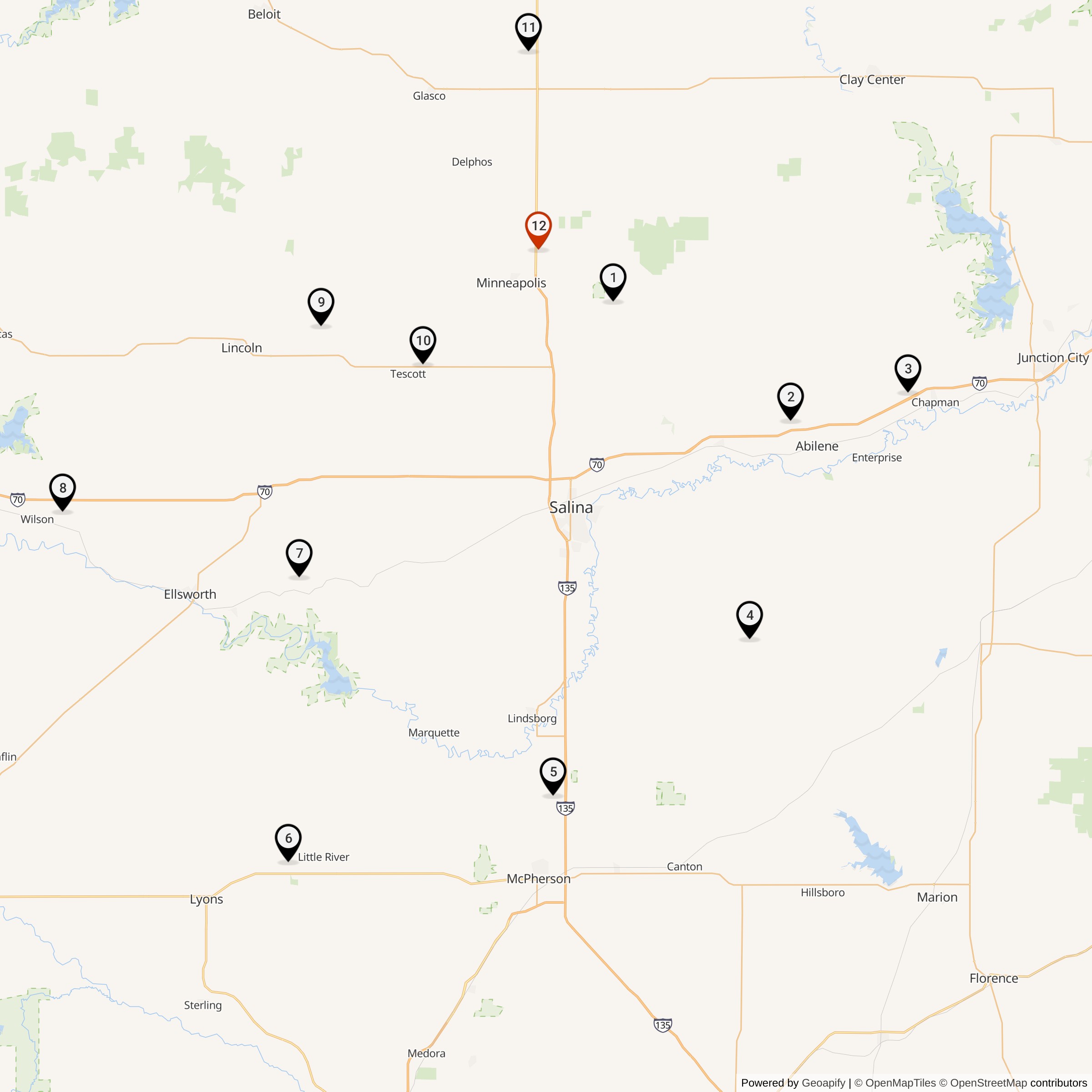
Site 550-12 lies in rural Ottawa County, Kansas, northeast of Minneapolis. EPA's site-address field describes the former facility as 6.3 miles northwest of Minneapolis.The surrounding landscape is the open agricultural country of north-central Kansas. The Schilling Atlas F sites were intentionally dispersed around Schilling AFB at Salina rather than concentrated on the base itself. This gave the 550th Strategic Missile Squadron twelve separated launch complexes, each far enough from the others that an attack on one site or the parent base would not automatically destroy the whole missile force. Site 550-12 was one of the northern/northeastern points in that ring.
As an Atlas F vertical-silo launch facility, Site 550-12 was built around a deep hardened silo containing the missile on a massive elevator. Public Atlas F diagrams and descriptions show the standard arrangement: the underground missile silo, adjoining underground launch-control and support spaces, surface access road, security fencing, utility areas, ventilation and power-support equipment, propellant and launch-support systems, and large silo doors at the surface. Satellite images of the Minneapolis site show the compact launch-complex footprint, access road, and surrounding cultivated land.
It should be treated as private property and as a former military-industrial site with potential physical hazards, including deteriorated underground structures, confined spaces, standing water, exposed metal, unstable surfaces, and environmental issues typical of former missile facilities.
Strategic and Cold War Context
Atlas F Site 550-12 existed because the United States was trying to make its first operational ICBM force more survivable during the most dangerous years of the Cold War. The Atlas was the first operational U.S. Air Force intercontinental ballistic missile, but the earliest Atlas launchers were vulnerable because the missile had to be exposed, fueled, or otherwise prepared in ways that took time and invited destruction by a first strike. The Atlas F was the final operational Atlas configuration and attempted to solve part of that problem by placing each missile vertically inside a hardened underground silo.The National Park Service summarizes the Atlas F as a silo-lift missile and notes that 72 Atlas F missiles were placed in the field, including twelve assigned to Schilling Air Force Base in Kansas. Site 550-12 was one of those twelve Schilling missiles. Its strategic purpose was not local defense of Minneapolis, Ottawa County, or Salina; it was part of a national deterrent system intended to give Strategic Air Command a retaliatory nuclear capability if ordered by national command authority.
The Atlas F still belonged to the liquid-fueled first generation of ICBMs. The missile used RP-1 kerosene fuel and liquid oxygen oxidizer. RP-1 could be kept aboard the missile while on alert, but liquid oxygen was loaded during the launch countdown. The missile could not launch from underground. It had to be raised by elevator to the surface before firing. This made the Atlas F more protected while stored than earlier Atlas configurations, but still more vulnerable during final launch preparation than later missiles such as Titan II and Minuteman, which were designed around different propellant and silo-launch concepts.
During events such as the Cuban Missile Crisis, placing an Atlas F site in an operational launch-ready alert posture did not mean the missile was continuously raised above ground or continuously loaded with liquid oxygen. It meant that the crew, communications, command procedures, missile systems, propellant support, and site status were positioned to execute emergency-war-order procedures rapidly if ordered. The missile could have RP-1 aboard and the site could be maintained at heightened readiness, but the liquid oxygen loading and elevator rise to launch position were countdown actions, not a normal continuous posture.
Construction and Activation
Its construction began in 1960, and it was turned over to the Air Force sometime in 1962. The site was part of the broader Schilling Atlas F construction program, which built twelve single-missile hardened lift-launcher sites around Salina.The Schilling construction program was large, expensive, and difficult. The Schilling Atlas summary states that the field was originally planned for nine silos, then increased to twelve individual sites. A Utah-Manhattan-Sundt joint venture received the nine-silo contract for $17.2 million and also received a $6.2 million contract for the three additional lift-launcher silos. The same summary notes that design changes doubled the final cost, high water tables at some excavation sites increased pumping costs, and construction safety was a continuing problem across the Schilling Atlas project. Those construction problems are field-wide context; no source found ties a specific construction fatality or major construction accident directly to Site 550-12.
Building Site 550-12 required far more than digging a hole in the prairie. A functional Atlas F complex required a deep silo, elevator, blast doors, underground control and support spaces, ventilation systems, power production equipment, communication links, missile-guidance and checkout equipment, propellant-support systems, drainage and pumping systems, access roads, fencing, and a trained crew-and-maintenance network tied back to Schilling AFB. The Site 550-12 construction footprint was therefore only one visible piece of a larger military, engineering, communications, and logistics system.
The 550th Strategic Missile Squadron was organized at Schilling AFB on 1961-04-01. USAF unit-history material records turnover to Strategic Air Command on 1962-09-07 and operational status on 1962-09-09. The first Series F Atlas operational sites at the 550th SMS at Schilling and the 551st SMS at Lincoln were accepted by SAC in June 1962. Site 550-12 was part of that first wave of operational Atlas F capability.
Missile System and Technical Role
The missile assigned to Site 550-12 was Atlas 24F. It was General Dynamics manufacturing number 24F, General Dynamics missile serial number 60-5547, and Air Force tail number 547. The missile acceptance was on 1961-11-29, delivery on 1962-01-17, assignment to the 550th Strategic Missile Squadron's Site 12, destination Schilling Air Force Base, mission "Operational ICBM," and no launch. It was salvaged as scrap after its operational career.Atlas F was a liquid-fueled, inertially guided ICBM. The Association of Air Force Missileers describes Atlas F as housed in a vertical silo with an adjoining control center, hardened to 100 psi overpressure, using inertial guidance, filled with RP-1 while on alert, loaded with liquid oxygen at the start of countdown, and raised to ground level by the silo elevator. The same source describes Atlas F combat crews as consisting of two officers and three enlisted members, with crew positions covering command, deputy command, missile facilities, ballistic-missile analysis, and electrical power production.
Public museum and historical sources give the basic missile capability. The National Park Service describes Atlas F as an 82-foot silo-lift missile with a launch response time of roughly ten minutes in the silo-lift configuration. The National Museum of the U.S. Air Force states that the Atlas ICBM could deliver a nuclear warhead more than 6,300 miles from its launch site. For the reentry vehicle and warhead, the Smithsonian National Air and Space Museum identifies the Mark 4 reentry vehicle as used on Atlas E/F and Titan I ICBMs and states that it carried the W-38 nuclear warhead with a yield of about 3.75 megatons. This warhead and reentry-vehicle information is included only from public museum and official-history sources.
Operational History
Site 550-12's active service was intense but brief. The 550th Strategic Missile Squadron was organized on 1961-04-01 at Schilling AFB and became one of Strategic Air Command's first Atlas F squadrons. The squadron's twelve sites formed a dispersed 1-by-12 missile field around Salina, with each site containing one missile. The sites were manned around the clock during the time the squadron was active.A duty day at an Atlas F site was not like later Minuteman alert duty. A Minuteman crew normally sat in a remote launch-control center controlling multiple unmanned launch facilities. At an Atlas F site such as 550-12, the crew served at the individual launch complex itself. The launch crew and support systems had to keep the missile, power, communications, environmental controls, propellant readiness, emergency procedures, security posture, and technical status in a launch-ready condition. Maintenance, security, communications, and real-property installed equipment support remained essential because the Atlas F was a complex liquid-fueled system that required constant attention.
The Cuban Missile Crisis was the most important operational moment in the life of the 550th SMS. During the crisis, all operational 550th sites were at a high level of alert and ready to launch if required. In October 1962 the 550th received orders to maintain all twelve missiles on alert status. This did not mean that the missiles sat continuously above ground or continuously loaded with liquid oxygen. It meant that the Schilling Atlas F field was placed in a posture intended to make all twelve missiles available for launch if national command authority ordered it. For Site 550-12, that meant crew readiness, secure communications, missile system readiness, propellant availability, and countdown capability mattered every day.
Deactivation and Disposal
Atlas F Site 550-12 left active missile service as part of the rapid retirement of the first-generation Atlas force. The Atlas F system had been an important step forward from earlier exposed and semi-hardened launchers, but by 1964 it was already being overtaken by solid-fueled Minuteman and other missile systems with more favorable alert, maintenance, and survivability characteristics. The Military Standard's Schilling summary ties the squadron's phaseout to Secretary of Defense Robert McNamara's May 1964 directive accelerating the deactivation of first-generation ICBMs.The USAF unit-history summary for the 550th Strategic Missile Squadron separates the phaseout into several events. The first 550th ICBM came off alert on 1965-02-01. The last 550th ICBM came off alert on 1965-03-05. The last ICBM was shipped on 1965-03-11. Headquarters SAC discontinued the 550th SMS on 1965-06-25, and Schilling AFB officially closed on 1965-06-30. These dates should not be compressed into a single "closed" date: missile off-alert status, missile shipment, site decommissioning, squadron discontinuance, and parent-base closure were related but distinct steps.
The missile assigned to Site 550-12, Atlas 24F / serial 60-5547 / Air Force tail 547, was not test-launched after its assignment, rather it was salvaged as scrap. At former Atlas F launch complexes, deactivation generally meant removing the missile and operational equipment, ending launch readiness, disposing of or transferring the real property, and leaving the remaining structure to later private use, environmental tracking, or deterioration.
Atlas F Site 550-12 was retired before the later strategic arms-control demolition regimes that shaped many Minuteman and Peacekeeper sites. Its post-military history therefore belongs more to surplus-property disposal and environmental oversight than to START-style silo elimination. The Military Standard's Schilling page states that after Schilling AFB closed, responsibility for the sites passed to F.E. Warren AFB in July 1967 and the sites were disposed of in March 1971.
Environmental records continued the site's federal afterlife. EPA identifies SCHILLING (EX) AIR FORCE ATLAS FAC S-12, EPA ID KSN000703174, as a CERCLA site at Minneapolis, Ottawa County, Kansas, not on the National Priorities List, with Non-NPL status listed as NFRAP, meaning the site did not qualify for the NPL based on existing information. The 2015 USACE Kansas FUDS inventory lists SCHILLING AFB ATLAS S-12 / B07KS0270 / Site 01 in the HTRW category. Those records confirm that the former launch complex remained part of environmental tracking long after the missile and the squadron disappeared.
Current Status and Site Use
Atlas F Site 550-12 is inactive and decommissioned. The best available public-source description is that it is a former Atlas F launch complex in rural Ottawa County, northeast of Minneapolis, Kansas. The former site is FUDS-listed and EPA-tracked, but no public source found verifies an active museum, tour, lodging, commercial reuse, or owner-sanctioned public access program at this specific site.
Chronology
- 1960 Construction began at Atlas F Site 550-12, exact month and day not identified in the public site page.
- 1961-04-01 The 550th Strategic Missile Squadron was organized at Schilling AFB, Kansas.
- 1961-11-29 Atlas 24F / serial 60-5547 / Air Force tail 547 was accepted.
- 1962-01-17 Atlas 24F was delivered to the 550th Strategic Missile Squadron's Site 12 assignment at Schilling AFB.
- 1962 Site 550-12 was turned over to the Air Force, exact month and day not identified in the public site page.
- 1962-06 The first Series F Atlas operational sites at the 550th SMS, Schilling AFB, Kansas, and the 551st SMS, Lincoln AFB, Nebraska, were accepted by Strategic Air Command.
- 1962-09-07 The 550th SMS recorded turnover to Strategic Air Command.
- 1962-09-09 The 550th SMS was recorded as operational.
- 1962-10 During the Cuban Missile Crisis, operational 550th SMS sites, including the Schilling Atlas F field, were placed at a high level of alert.
- 1964-05 Secretary of Defense Robert McNamara directed accelerated phaseout of first-generation Atlas E, Atlas F, and Titan I ICBMs.
- 1965-02-01 The first 550th SMS ICBM was removed from alert, according to the USAF unit-history summary.
- 1965-03-05 The last 550th SMS ICBM was removed from alert, according to the USAF unit-history summary.
- 1965-03-11 The last 550th SMS ICBM was shipped, according to the USAF unit-history summary.
- 1965-06-25 The 550th Strategic Missile Squadron was discontinued.
- 1965-06-30 Schilling Air Force Base officially closed, although closure actions were not complete until 1967.
- 1967-07 Responsibility for the former Schilling Atlas sites passed to F.E. Warren AFB.
- 1971-03 The former Schilling Atlas sites were disposed of.
- 2015-09-30 The USACE Kansas FUDS inventory listed SCHILLING AFB ATLAS S-12 / B07KS0270 in Ottawa County, Kansas, with Site 01 in the HTRW category.

Read about the Atlas at Schilling AFB
All Atlas Missile Silo Locations