
Atlas E Site 567-5 Missile Silo, Lamona Washington
Longitude: -118.490772225841
Site Type: Atlas E single-missile coffin launcher complex
Missile Type: SM-65E Atlas
Number of Launchers/Missiles: 1
Parent Base: Fairchild AFB
Missile Wing: 92d Bombardment Wing; 92d Strategic Aerospace Wing after 1962-02-15
Missile Squadron: 567th Strategic Missile Squadron
Approximate Base Size:
Current Site Use: Former Atlas E launch complex near Lamona; NRHP documentation for Site 9 states Site 5 had been converted to farm machinery storage and several components had been lost; former launcher footprint remains visible in aerial/photo sources.
Site Ownership: Private ownership after post-1965 disposal; EPA lists the CERCLA record as not a federal facility.
Accessible: No public access / private property.
Atlas E Site 567-5 was a single-missile SM-65E Atlas intercontinental ballistic missile launch complex operated by the 567th Strategic Missile Squadron in the Fairchild Air Force Base missile field. It was one of nine Atlas E "coffin launcher" sites dispersed around Fairchild Air Force Base near Spokane, Washington. Its parent base was Fairchild Air Force Base. Its parent wing was the 92d Bombardment Wing during the first deployment period and the 92d Strategic Aerospace Wing after the wing was redesignated on 1962-02-15. The operating squadron was the 567th Strategic Missile Squadron. The site did not have a separate parent Launch Control Center in the later Minuteman sense. Atlas E launch-control functions were located at each launch complex.
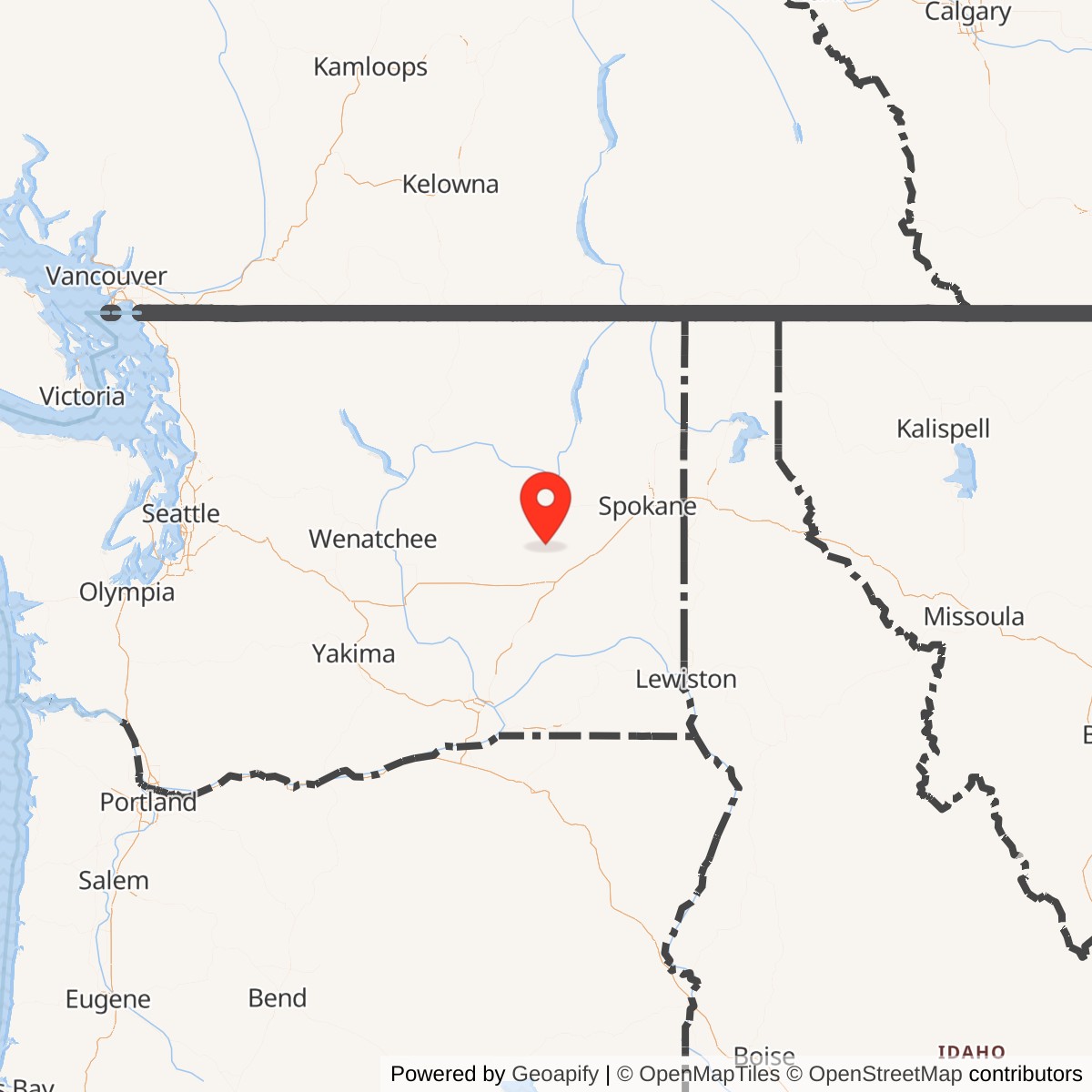
The site was Air Force Operational Site Number 5 of the 567th Strategic Missile Squadron and is best identified as Atlas E Site 567-5, Lamona, Washington. It stood in rural Lincoln County in eastern Washington, in the Lamona/Odessa area west-southwest of Spokane and west of the other Fairchild Atlas E launch complexes. EPA independently identifies the cleanup/property record as the Former Fairchild Atlas E Missile S-5 Site, EPA ID WAN001002986, at Kaputa Road East, ten miles east of Odessa, T22N R34E Section 26, parcel 223406900010, Lamona, Lincoln County, Washington.
The site is inactive and decommissioned. The 567th Strategic Missile Squadron was organized at Fairchild on 1960-04-01 and was inactivated on 1965-06-25. The Fairchild Atlas E missile field became operational during 1961, with Strategic Air Command declaring the squadron operational on 1961-09-28 and the first Fairchild Atlas E missile placed on alert on 1961-10-01. The former launch complex is now private property. National Register documentation for the Fairchild Atlas E Site 9 states that Site 5 had been converted to farm-machinery storage and that several site components had been lost. EPA lists the site as not on the National Priorities List and as NFRAP, meaning it did not qualify for the NPL based on the information available to EPA.
Location, Landscape, and Site Description
Site 567-5 occupied a rural wheat-country setting in Lincoln County, Washington, near the small community of Lamona and the State Route 28 corridor between Odessa and Davenport. The surrounding landscape is agricultural, open, and sparsely settled. This was not a launch pad on Fairchild Air Force Base itself; it was an off-base hardened launch complex placed in rural land so that the 567th Strategic Missile Squadron's missiles would be dispersed across a broad regional field rather than concentrated at the main base.The Fairchild Atlas E sites were designed as dispersed, semi-hardened launch complexes. Each Fairchild Atlas E site was a roughly 20-acre facility with an inner launch-and-control area. The inner area originally included a reinforced-concrete launch-operations building, crew space, power equipment, control consoles, a tunnel connecting the operations building to the missile structure, a missile-launch structure measuring about 105 by 100 feet, adjacent propellant storage, a metal storage building, security fencing, support roads, and security patrols. National Register documentation for Site 9, the best-documented surviving Fairchild Atlas E complex, describes the common Fairchild Atlas E layout as including an Upper Missile Bay, Launch Operations Building, Butler Building, entrance driveway, and tunnel-connected underground structures within the original secured launch area. Site 567-5 was built to the same Atlas E mission pattern, although later reuse and loss of components mean that its present integrity is not equivalent to the preserved Site 9 complex at Reardan.
Site 567-5 was an Atlas E coffin launcher rather than a later Minuteman-style vertical Launch Facility. The missile was stored horizontally in a semi-hardened reinforced-concrete bay beneath a heavy roof or door. To launch, the crew would move the launcher roof, raise the missile to vertical position, fuel it with liquid oxygen and RP-1 kerosene, complete countdown checks, and fire it from the open launcher. The design offered more protection than the earliest Atlas pads but less survivability and speed than later solid-fueled missiles housed vertically in hardened underground silos.
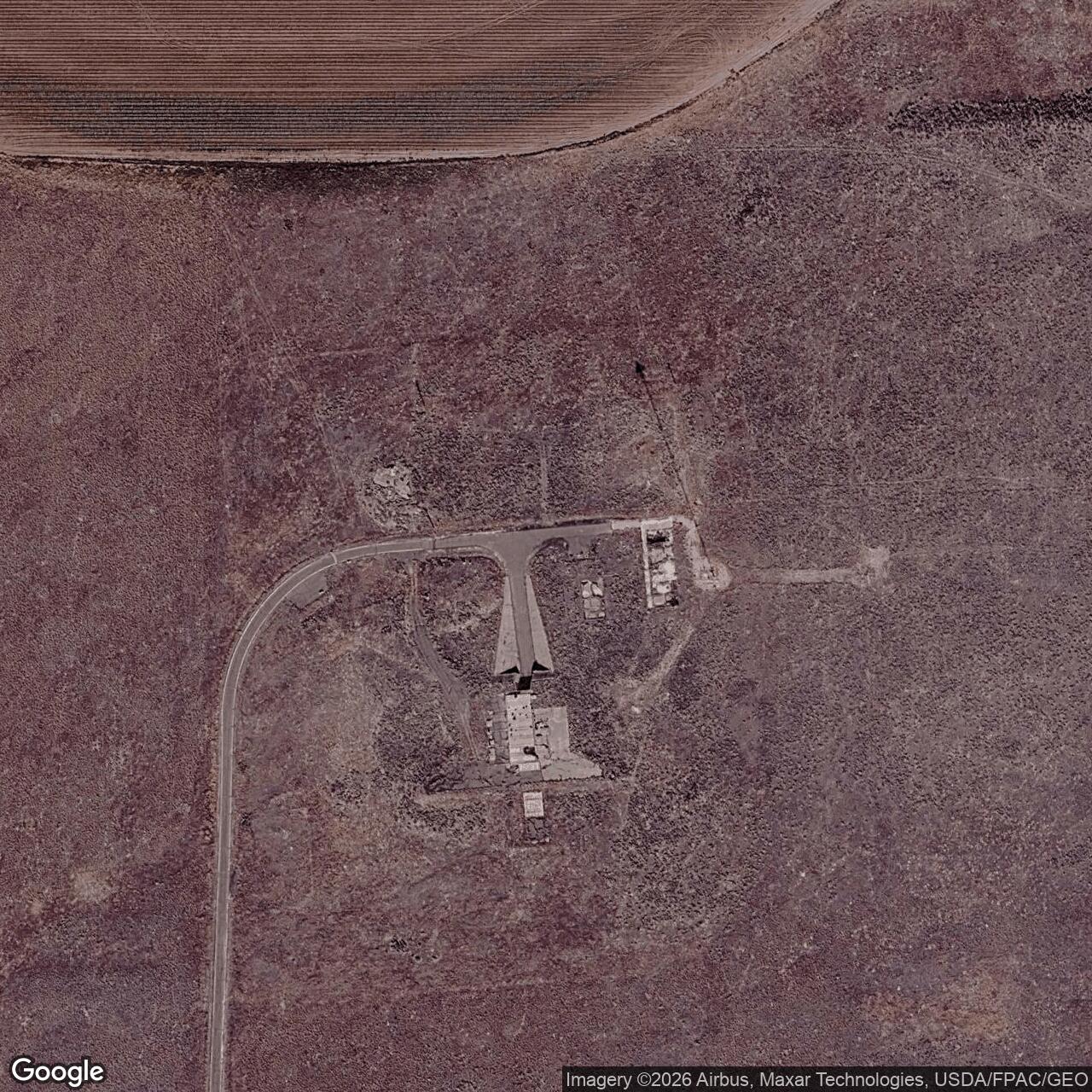
The later landscape retained visible missile-site traces into the late twentieth and early twenty-first centuries. Aerial photographs and missile-history photo collections show the distinctive former launcher area, access road, and remaining structural pads or bays. National Register documentation prepared for the Reardan site states that Site 5 had been converted to farm-machinery storage and that several components had been lost. That description is consistent with an agricultural adaptive reuse rather than public museum preservation. The former site should therefore be understood as private rural property containing former missile-complex remains, not as a public historic site.
Strategic and Cold War Context
Atlas E Site 567-5 existed because the United States moved rapidly in the late 1950s and early 1960s to field an operational intercontinental ballistic missile force. The Atlas program was the first operational American ICBM program. It was pushed forward during a period of intense Cold War concern about Soviet long-range missile capability and the perceived "missile gap." Strategic Air Command needed missiles that could contribute to national nuclear deterrence alongside bombers and other strategic systems.The Lamona site's role was strategic nuclear deterrence, not local air defense. Its crew and missile were part of a national retaliatory force. If ordered through authenticated emergency channels, the launch crew at the site would prepare and launch the missile against a preassigned target. The site's rural isolation was part of the weapon system. Dispersal forced an attacker to identify and strike nine separate Fairchild Atlas E complexes, rather than one compact missile installation at the main base.
Eastern Washington and nearby north Idaho offered several advantages for the Fairchild Atlas E field. The region had open land, long road distances between potential target points, and existing Strategic Air Command support infrastructure at Fairchild Air Force Base. It was inland from the Pacific coast but still close enough to the Soviet Union's polar approach routes to fit the strategic geography of the period. The Fairchild launch complexes show how national nuclear policy was embedded in agricultural landscapes: small communities such as Lamona, Davenport, Wilbur, Sprague, and Reardan became points in a nuclear-alert network.
The Atlas E was a transitional missile. It was more advanced than the earliest Atlas D because it used an all-inertial guidance system and was deployed singly at independent launch complexes rather than tied to a central radio-guidance arrangement. The Association of Air Force Missileers describes the Atlas E as a coffin-deployed missile with one control center per missile and a semi-hardened launcher roof at ground level. But it remained a liquid-fueled system. It could not sit indefinitely ready to fire with liquid oxygen loaded. Crews had to expose, raise, fuel, and launch the missile. Public sources describe a launch sequence on the order of fifteen to twenty minutes. By 1964 and 1965, solid-fueled Minuteman missiles had made Atlas E and other first-generation liquid-fueled systems obsolete because solid fuel reduced launch time, simplified readiness, and improved safety and survivability.
Construction and Activation
Fairchild's Atlas E missile field was built during the emergency first-generation ICBM construction program. A Fairchild Air Force Base history article states that work on the nine Fairchild Atlas E missile complex sites began on 1959-05-12. The 567th Strategic Missile Squadron was organized at Fairchild on 1960-04-01, marking the first time Strategic Air Command activated an E-series Atlas missile unit. The first Atlas E missile arrived at Fairchild on 1960-12-03. Work on the last of the nine Fairchild launch sites was completed on 1961-02-10. Strategic Air Command accepted the first Fairchild Atlas E complex on 1961-07-29, and operational readiness training began in August 1961.The National Register documentation for the Reardan site identifies the U.S. Army Corps of Engineers Seattle District as having begun initial planning and mapping for the Fairchild Atlas E field in 1958 and notes a Corps history of construction for the WS-107A Atlas E missile complexes covering January 1959 through February 1961.
The construction challenge was to build a hardened, self-contained launch complex in a rural area, connect it to power, roads, communications, security, and support systems, and integrate it into Strategic Air Command's alert procedures. The construction program placed major reinforced-concrete structures, propellant systems, control equipment, crew facilities, security fencing, and support buildings into farmland and open prairie. Missile-site construction in Washington was dangerous work, accidents were frequent although no deaths occurred at the Washington ICBM sites, strikes and construction problems contributed to delays.
By late 1961, the Fairchild Atlas E field had reached operational status. Headquarters Strategic Air Command declared the 567th Strategic Missile Squadron operational on 1961-09-28. The first Fairchild Atlas E missile went on alert on 1961-10-01, and most of the Fairchild force was on alert by November 1961. Public sources do not identify which individual Fairchild launch complex held the first alert missile.
Missile System and Technical Role
Site 567-5 housed an SM-65E Atlas, later redesignated CGM-16E. The Atlas was a large, liquid-fueled, one-and-one-half-stage intercontinental ballistic missile built by Convair/General Dynamics. The National Museum of the United States Air Force describes Atlas as Strategic Air Command's first ICBM and notes that it could deliver a nuclear warhead more than 6,300 miles from its launch site. The Fairchild Atlas E was an 82-foot-tall missile with an automatic inertial guidance system, nearly 16,000 miles per hour ICBM speed, and a liquid-fueled propulsion system using liquid oxygen and kerosene. The SAC Aerospace Museum describes the second Atlas ICBM configuration as having all-inertial guidance, improved engines, a larger warhead, and horizontal storage in a semi-hard coffin-type launcher.The Atlas E's launch method was central to the site's design. The missile was stored horizontally in the protected launcher bay. The Association of Air Force Missileers describes the launch process as opening the coffin roof, erecting the missile, loading liquid oxygen and RP-1, and then initiating the launch sequence after the propellants were loaded. The same source describes Atlas E crews as including officers and enlisted specialists and notes that the crew changed daily, with a new crew departing the main base to replace the crew on alert duty.
Unlike later Minuteman launch facilities, Atlas E sites were manned alert complexes. Each Fairchild Atlas E site was staffed by three squadron airmen and two officers. The crew included a Missile Combat Crew Commander, a deputy commander, and enlisted technicians. National Register documentation for the Reardan site identifies crew positions such as the Missile Combat Crew Commander, Deputy Missile Combat Crew Commander, Electric Power Production Technician, Missile Maintenance Technician, and Ballistic Missile Analyst Technician. One of the officers had to remain in the launch-control facility at all times, and launch orders would be received and authenticated through coded emergency procedures.
Public-source information on the Atlas E/F warhead and reentry vehicle identifies the general strategic payload without revealing modern sensitive information. The 567th Strategic Missile Squadron historical site states that the Atlas E carried a Mark IV reentry vehicle developed by General Electric and a W-38 thermonuclear warhead with a yield of about 3.8 megatons. Other public museum and historical sources describe the Atlas as carrying a nuclear warhead and emphasize that its destructive power was more than 100 times the Nagasaki atomic bomb. The missile at Site 567-5 therefore represented a first-generation but city-destroying strategic weapon, not a tactical or battlefield missile.
Operational History
Atlas E Site 567-5's operational life was brief but intense. It served during the short period when the Atlas E formed part of Strategic Air Command's ready intercontinental missile force. The site's day-to-day mission was alert duty. A combat crew lived and worked at the launch complex, monitored the missile and launch systems, maintained communications with command channels, guarded the site, and remained ready to authenticate and carry out launch orders if directed.The 567th Strategic Missile Squadron was the first Atlas E squadron activated by Strategic Air Command. The Fairchild AFB history article states that the unit was redesignated and activated in December 1959, organized at Fairchild on 1960-04-01, and assigned the Atlas E mission during a period when Fairchild was already a major bomber and tanker base. The 92d Bombardment Wing was redesignated the 92d Strategic Aerospace Wing on 1962-02-15, reflecting the combination of bomber, tanker, and missile roles. The Atlas E missile field made Fairchild part of the early American ICBM force as well as the manned-bomber deterrent.
Operationally, Site 567-5 depended on a mix of local crew duty and base support. The launch complex itself had launch control and crew spaces, but Fairchild AFB supplied broader command, maintenance, logistics, weapons-handling, security, transportation, and administrative support. Maintenance personnel and specialists would have worked on missile, power, propellant, communications, and real-property equipment. Security police patrolled the launch complexes and the fenced areas. The remote location near Lamona meant that alert crews and support teams had to travel significant distances from the main base and from larger communities.
The Cuban Missile Crisis in October 1962 was the most important operational episode for the Fairchild Atlas E missile field as a whole. Public accounts state that the 567th Strategic Missile Squadron's sites were placed on heightened alert during the crisis. Strategic Air Command directed that Atlas E missiles off alert for modifications be returned to alert as covertly as possible and that missiles used for operational readiness training be placed on alert when liquid oxygen became available. The target boards in the Fairchild Atlas E system were changed during the crisis to target Cuba. The available sources do not prove a uniquely documented action at Site 567-5 during the crisis, but as one of the nine 567th SMS launch complexes, the Lamona site belonged to the missile field affected by those squadron-level orders.
The 567th Strategic Missile Squadron developed a strong reputation during its short life. Fairchild's official history article states that the squadron was the first Strategic Air Command missile squadron to pass an Operational Readiness Inspection and that it was the only missile squadron never to fail one. The article lists honors that included a General Dynamics-Astronautics safety trophy, Headquarters "Outstanding Achievement in Missile Safety for 1961," SAC's Charles D. Trail Material Trophy, the Colonel Lee R. Williams Award, the Air Force Association's Outstanding Missile Unit Award, the "Best Maintenance Unit in SAC" Trophy, and the Air Force Outstanding Unit Award. These were squadron-level achievements; the available sources do not assign each award to Site 567-5 individually. They nevertheless help explain the operational culture and performance standards of the crew and maintenance system that supported Site 567-5.
The Lamona site's active alert career ended as the Atlas E force was overtaken by newer missile technology. Public sources agree that Atlas E and other first-generation liquid-fueled systems were removed from service in 1965. The official Fairchild account states that Fairchild's first Atlas E missile came off alert in January 1965, that by 1965-03-31 the last missile had come off alert and been shipped to storage, and that the 567th Strategic Missile Squadron inactivated on 1965-06-25. The Air Force Order of Battle fact sheet gives closely related milestones: operational turnover and operational status on 1961-09-28, first ICBM off alert on 1965-02-17, last ICBM off alert on 1965-04-05, removal of the last Series E Atlas ICBMs from alert at Fairchild on 1965-03-31, and shipment of the last Series E Atlas ICBM from Fairchild to storage on 1965-04-05. Those inconsistencies appear to reflect different definitions of "off alert," "removed from alert," and "shipped," rather than disagreement that the Fairchild Atlas E mission ended in spring 1965.
The National Register documentation for Atlas E Missile Site 9 states that, based on oral testimony and web research including aerial photography, Site 5 had been converted to farm machinery storage and that several of its site components had been lost.
Deactivation and Disposal
The deactivation of Site 567-5 was part of the national phaseout of first-generation Atlas and Titan I ICBMs. Secretary of Defense Robert McNamara announced the closure of older Atlas E and Titan I sites in 1964 as solid-fueled Minuteman missiles and more capable Titan II missiles changed the strategic force. The Atlas E's liquid oxygen fueling requirements, horizontal coffin-launcher exposure, and relatively slow launch process were increasingly unacceptable compared with missiles that could remain fueled and sealed in hardened silos.The precise sequence for Site 567-5 must be separated into several milestones. The Fairchild AFB official history article states that the first Fairchild Atlas E missile came off alert in January 1965, the last came off alert and was shipped to storage by 1965-03-31, and the 567th SMS inactivated on 1965-06-25. The Air Force Order of Battle fact sheet gives 1965-02-17 for the first ICBM off alert, 1965-03-31 for the last Series E Atlas ICBMs removed from alert at Fairchild, and 1965-04-05 for the last Series E Atlas ICBM shipped from Fairchild to storage.
Available sources do not provide a detailed Site 567-5 dismantling contract, GSA sale date, or disposal file. For the Fairchild Atlas E field as a whole, when the sites closed, equipment and salvageable material were removed and the sites were auctioned to the highest bidder. All but one of the Washington missile complexes were sold to private individuals and remained in private ownership; the one exception was Site 9 near Reardan, retained by the federal government and reused by the U.S. Bureau of Mines and later NIOSH. The National Register documentation for Site 9 confirms that Site 5, unlike Site 9, was not in public ownership and had been converted to farm-machinery storage, with several components lost.
The post-closure process for Site 567-5 therefore appears to have included missile removal, removal of reusable and salvageable military equipment, federal disposal or sale into private hands, and agricultural storage reuse. The available public record does not show that the launcher was imploded under an arms-control treaty. Atlas E sites were deactivated decades before the Strategic Arms Reduction Treaty implementation that led to monitored demolition of many Minuteman and Peacekeeper launch facilities. Instead, Site 567-5 reflects the earlier 1960s phaseout of obsolete liquid-fueled ICBM systems and the practical disposal of hardened launch properties into private rural use.
EPA's CERCLA profile identifies the former site as the Former Fairchild Atlas E Missile S-5 Site, EPA ID WAN001002986. It lists the site as not on the National Priorities List and as NFRAP, stating that the site did not qualify for the NPL based on existing information. EPA also identifies the site as not a federal facility in its public profile.
Current Status and Site Use
Atlas E Site 567-5 is no longer an active missile installation. It is decommissioned, privately held, and associated with rural agricultural reuse. The best available post-military use description comes from the National Register documentation for Site 9, which states that Site 5 had been converted to farm machinery storage and that several site components had been lost. Aerial imagery and site-history photo collections show that the former launch area remained visible after decommissioning, with the recognizable Atlas E launch-complex footprint still apparent even though some components had been altered or lost.
Chronology
- 1958 The U.S. Army Corps of Engineers Seattle District began planning and mapping work for the Fairchild Atlas E missile field, according to National Register documentation for the Reardan site.
- 1959-05-12 Work began on the nine Fairchild Atlas E missile complex sites, according to Fairchild Air Force Base's official history article.
- 1960-04-01 The 567th Strategic Missile Squadron was organized at Fairchild Air Force Base; Strategic Air Command activated its first E-series Atlas missile squadron.
- 1960-12-03 The first Atlas E missile arrived at Fairchild Air Force Base.
- 1961-02-10 Work on the last of the nine Fairchild Atlas E launch sites was completed.
- 1961 Site 567-5 was turned over to the Air Force.
- 1961-07-29 Strategic Air Command accepted the first Fairchild Atlas E complex.
- 1961-08 Operational readiness training began in the Fairchild Atlas E missile field.
- 1961-09-28 Headquarters Strategic Air Command declared the 567th Strategic Missile Squadron operational.
- 1961-10-01 The first Fairchild Atlas E missile went on alert.
- 1961-11 Most of the Fairchild Atlas E missile force was on alert.
- 1962-02-15 The 92d Bombardment Wing was redesignated the 92d Strategic Aerospace Wing.
- 1962-10 The Fairchild Atlas E missile field was placed in a heightened alert posture during the Cuban Missile Crisis.
- 1963-04 The 567th Strategic Missile Squadron passed its first Operational Readiness Inspection and was recognized as the first Strategic Air Command missile squadron to pass an ORI.
- 1964-02 Secretary of Defense Robert McNamara announced the closing of older Atlas E and Titan I missile sites as part of the national phaseout of first-generation liquid-fueled ICBMs.
- 1965-02-17 The Air Force Order of Battle fact sheet lists the first 567th SMS ICBM as off alert on this date.
- 1965-03-25 The 567th Strategic Missile Squadron historical Site 5 page lists Site 567-5 as decommissioned on this date.
- 1965-03-31 Public Air Force sources state that the last Series E Atlas ICBMs at Fairchild had been removed from alert by this date.
- 1965-04-05 The Air Force Order of Battle fact sheet states that the last Series E Atlas ICBM left Fairchild for storage on this date.
- 1965-06-25 The 567th Strategic Missile Squadron was inactivated.
- 1965 and after The former missile was removed, salvageable equipment was removed, and the Fairchild Atlas E sites other than Site 9 were sold into private ownership, according to Washington ICBM history sources.
- 2009 National Register documentation for Atlas E Missile Site 9 stated that Site 5 had been converted to farm machinery storage and that several components had been lost.
- 2026 EPA's public CERCLA profile listed the Former Fairchild Atlas E Missile S-5 Site as not on the NPL and NFRAP.
Read about the Atlas at Fairchild AFB
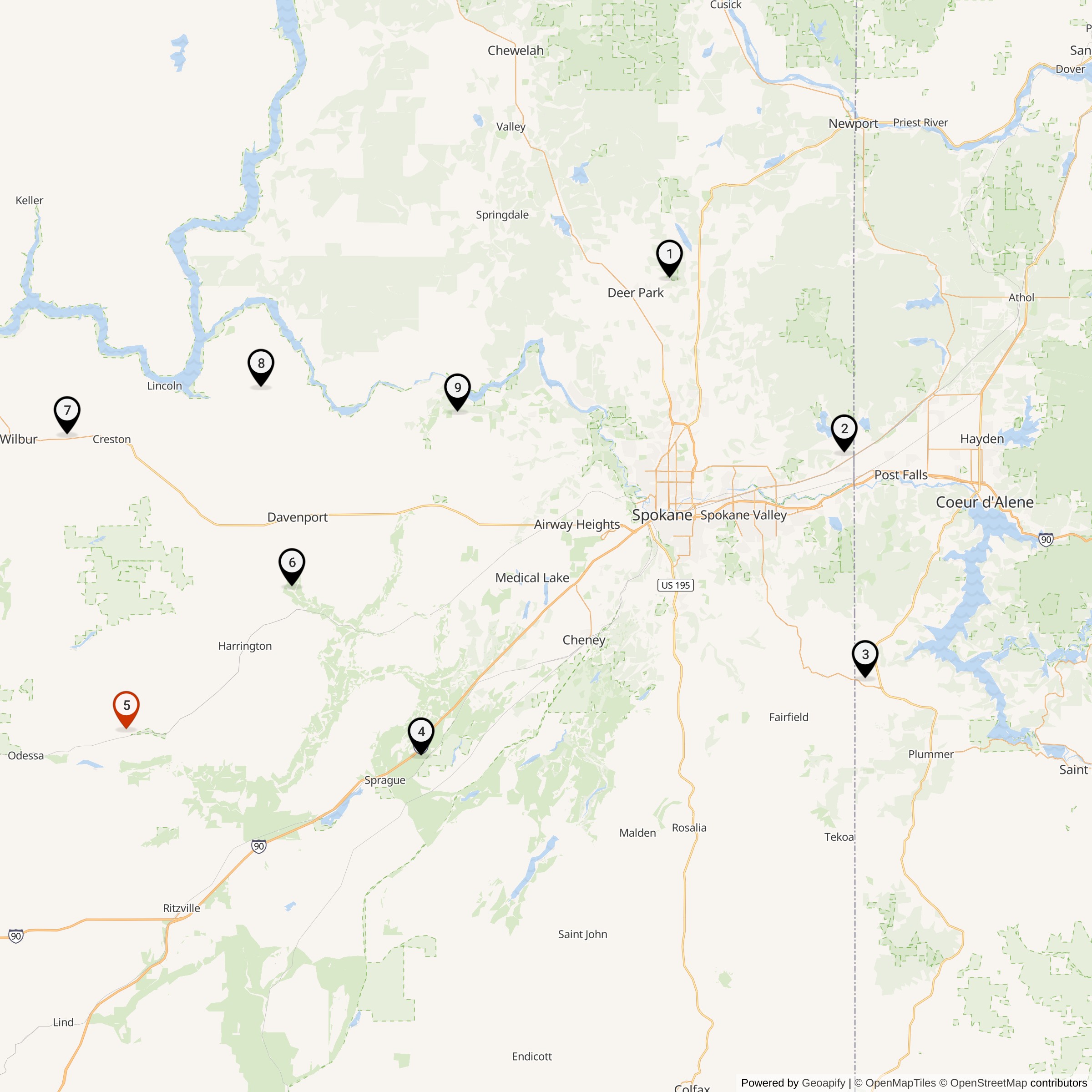
All Atlas Missile Silo Locations