
Atlas E Site 567-7 Missile Silo, Wilbur Washington
Longitude: -118.60864656382
Site Type: Atlas E coffin launcher site
Missile Type: SM-65E Atlas
Number of Launchers/Missiles: 1
Parent Base: Fairchild AFB
Missile Wing: 92d Bombardment Wing; 92d Strategic Aerospace Wing after 1962-02-15
Missile Squadron: 567th Strategic Missile Squadron
Approximate Base Size:
Current Site Use: Former missile site / private property; visible launcher-area remains in aerial imagery; specific current use not publicly verified in pass 1.
Site Ownership: Private ownership after post-1965 disposal; EPA lists the CERCLA record as not a federal facility.
Accessible: No public access / private property.
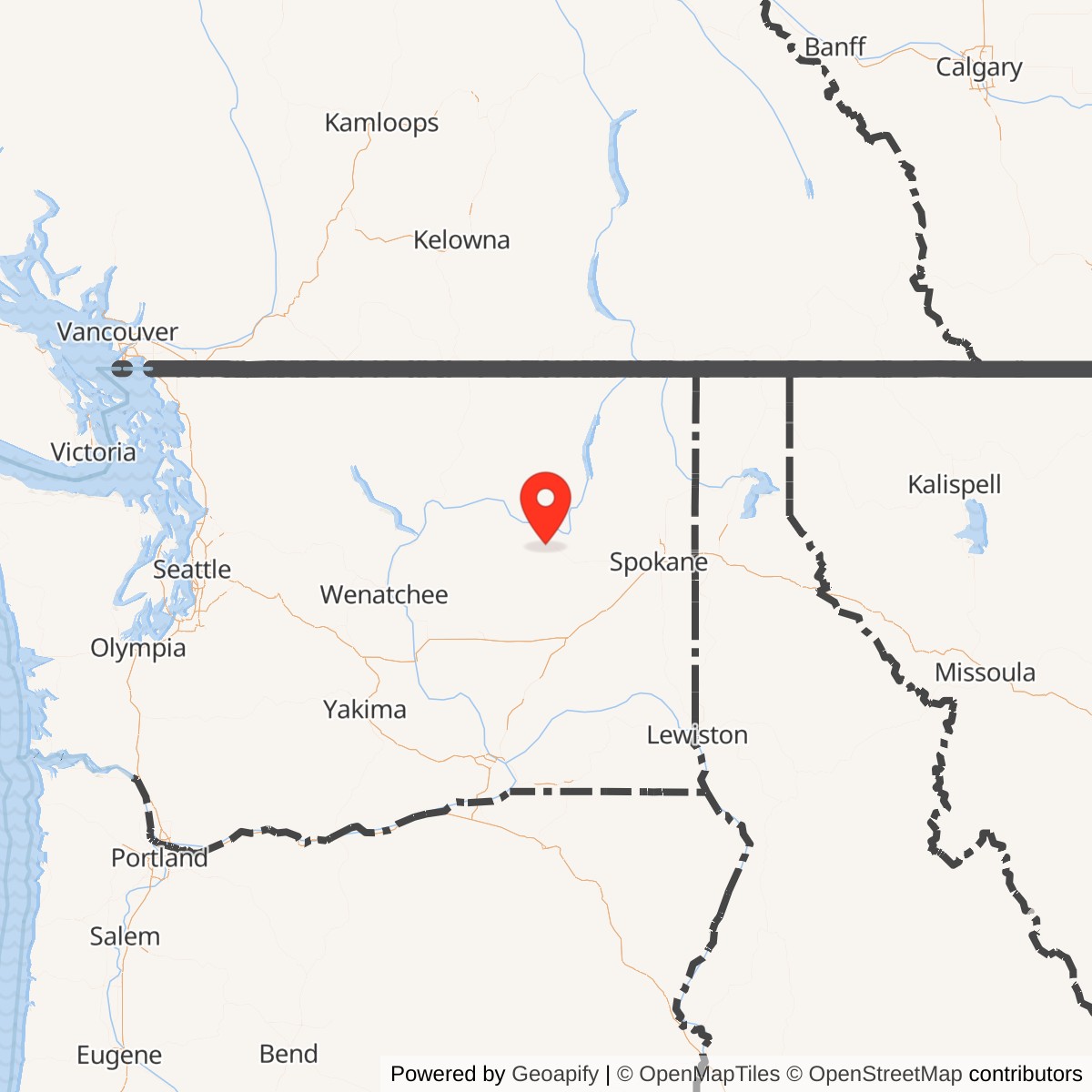
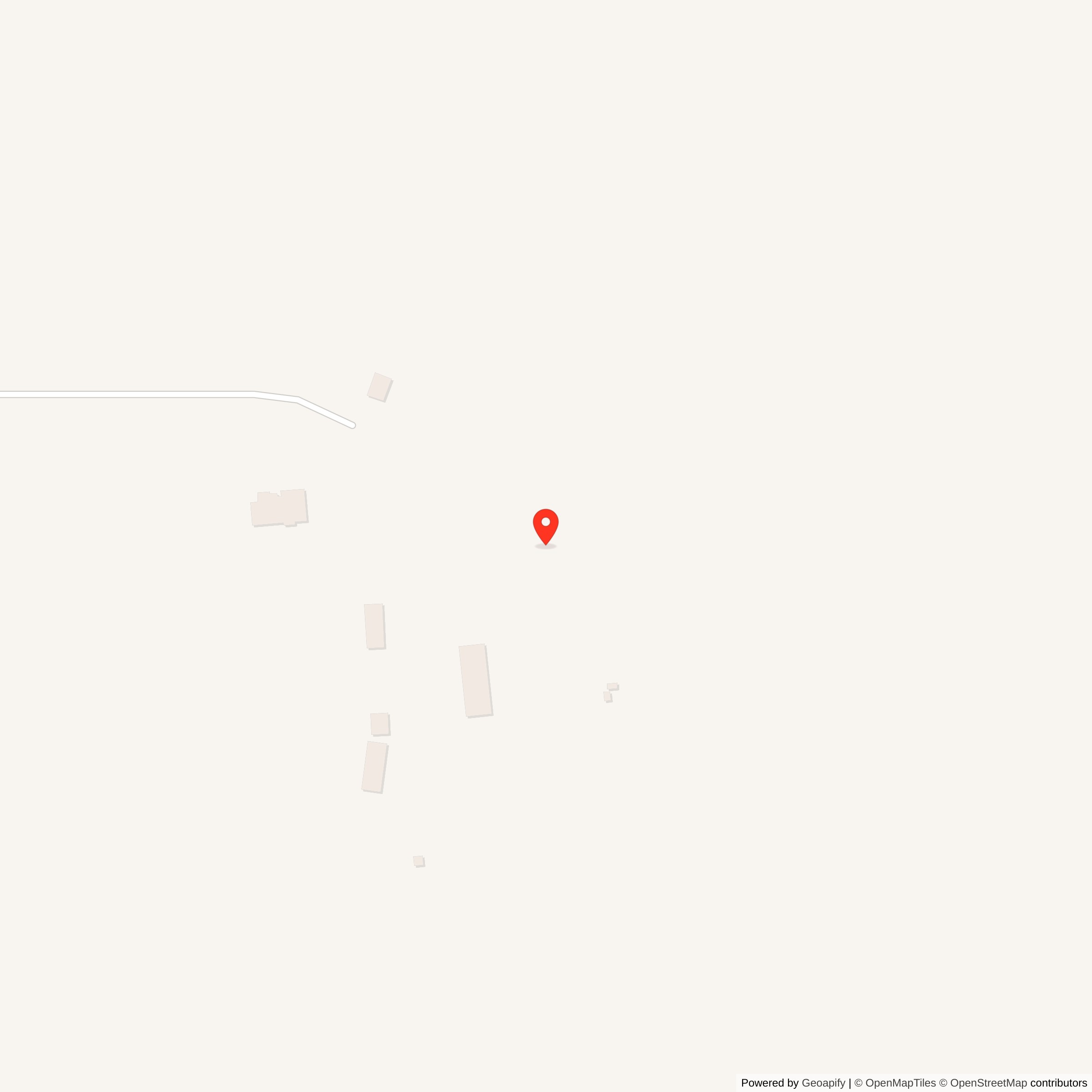
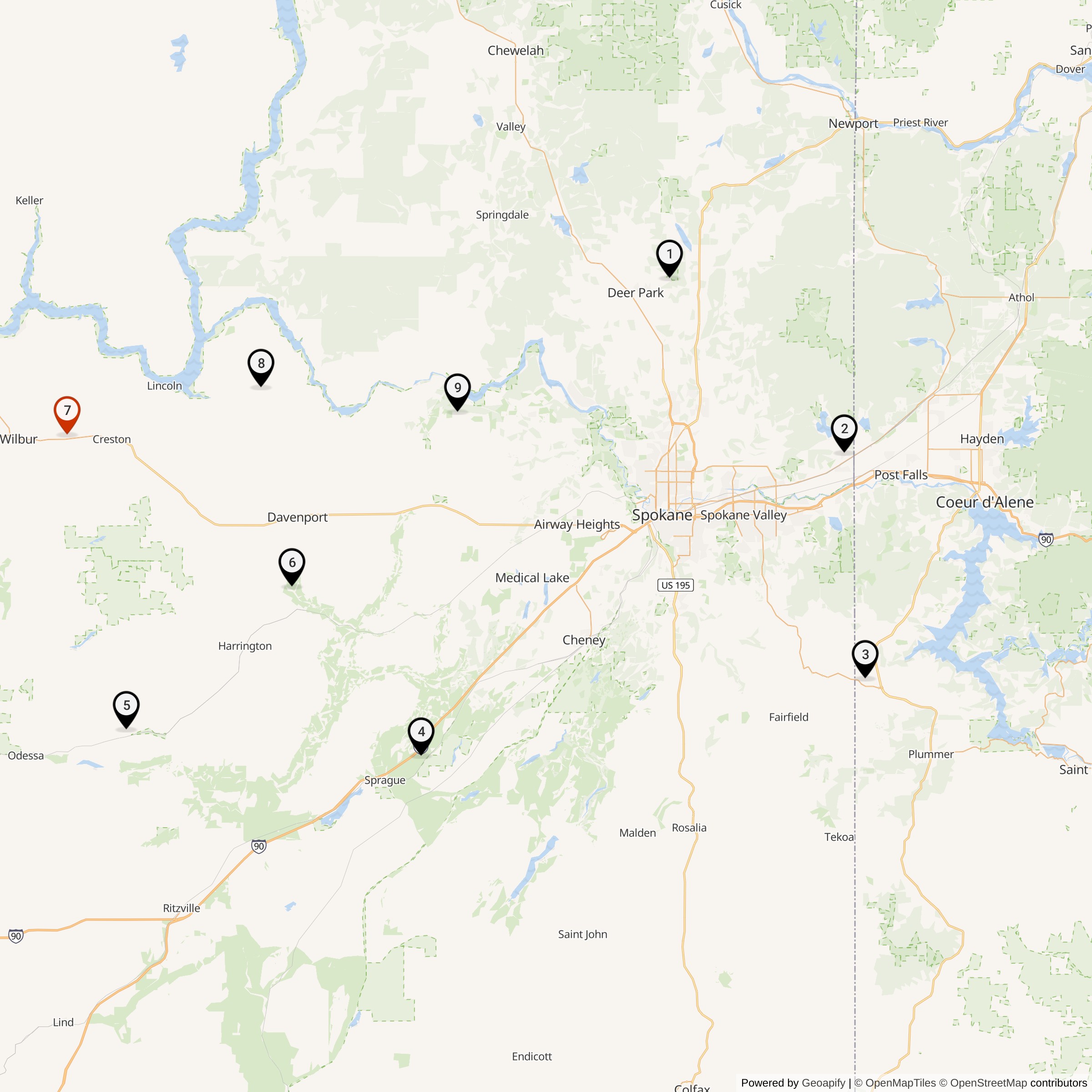
Atlas E Site 567-7 was a single-missile SM-65E Atlas intercontinental ballistic missile launch complex operated by the 567th Strategic Missile Squadron in the Fairchild Air Force Base missile field. It was one of nine Atlas E "coffin launcher" sites dispersed around Fairchild Air Force Base near Spokane, Washington. Its parent base was Fairchild Air Force Base. Its parent wing was the 92d Bombardment Wing during the first deployment period and the 92d Strategic Aerospace Wing after the wing was redesignated on 1962-02-15. The operating squadron was the 567th Strategic Missile Squadron. The site did not have a separate parent Launch Control Center in the later Minuteman sense. Atlas E launch-control functions were located at each launch complex.
The site was Air Force Operational Site Number 7 of the 567th Strategic Missile Squadron and is best identified as Atlas E Site 567-7, Wilbur, Washington. It stood in rural Lincoln County, Washington, east of Wilbur and west of the main Fairchild support base. EPA independently identifies the cleanup/property record as the Former Fairchild Atlas E Missile S-7 Site, EPA ID WAN001002988, at 450 Logan Street, 4.6 miles east of Wilbur, T26N R33E Section 12, parcel 2633012900023, Wilbur, Lincoln County, Washington.
The site is inactive and decommissioned. The 567th Strategic Missile Squadron was organized at Fairchild on 1960-04-01 and was inactivated on 1965-06-25. The Fairchild Atlas E missile field became operational during 1961, with Strategic Air Command declaring the squadron operational on 1961-09-28 and the first Fairchild Atlas E missile placed on alert on 1961-10-01. The former launch complex is now private property. EPA lists the site as not on the National Priorities List and as NFRAP, meaning it did not qualify for the NPL based on existing information. Public access is not available without owner permission.
Location, Landscape, and Site Description
Site 567-7 occupied a rural wheat-country and scabland setting in Lincoln County, Washington. Public Atlas location lists identify it with Wilbur, and EPA places it 4.6 miles east of Wilbur. The Military Standard and the US ICBM Sites KMZ coordinate identify the launcher area in open agricultural country, with rural roads, dry fields, and coulee terrain nearby. The site was not a facility on Fairchild Air Force Base itself. It was an off-base hardened launch complex placed far enough from Fairchild and from the other Atlas E launchers to support the squadron's dispersal concept.The site's isolation was a military design feature. An enemy attack that could damage Fairchild Air Force Base would not automatically destroy all nine Fairchild Atlas E missiles, and an attack on one isolated launcher would not necessarily destroy the others. That concept was especially important for first-generation ICBM sites because the Atlas E was only partly hardened and still had to be raised and fueled before launch.
Public sources describe the general Fairchild Atlas E layout in considerable detail. National Register documentation for the best-preserved Fairchild Atlas E site, Site 9 at Reardan, states that each of the nine Fairchild Atlas E complexes was built as a roughly twenty-acre rural site with a central five-acre fenced missile area. The original inner area contained the major missile structures: the Upper Missile Bay, Launch Operations Building, Butler Building, access road, service areas, and security fencing. The Atlas E missile was stored horizontally in the upper missile bay. A heavy retractable concrete-and-steel roof or door opened before the missile could be raised, fueled, and launched. The launch operations building contained the crew, launch equipment, power plant, and support spaces and was connected to the missile structure by an underground access tunnel.
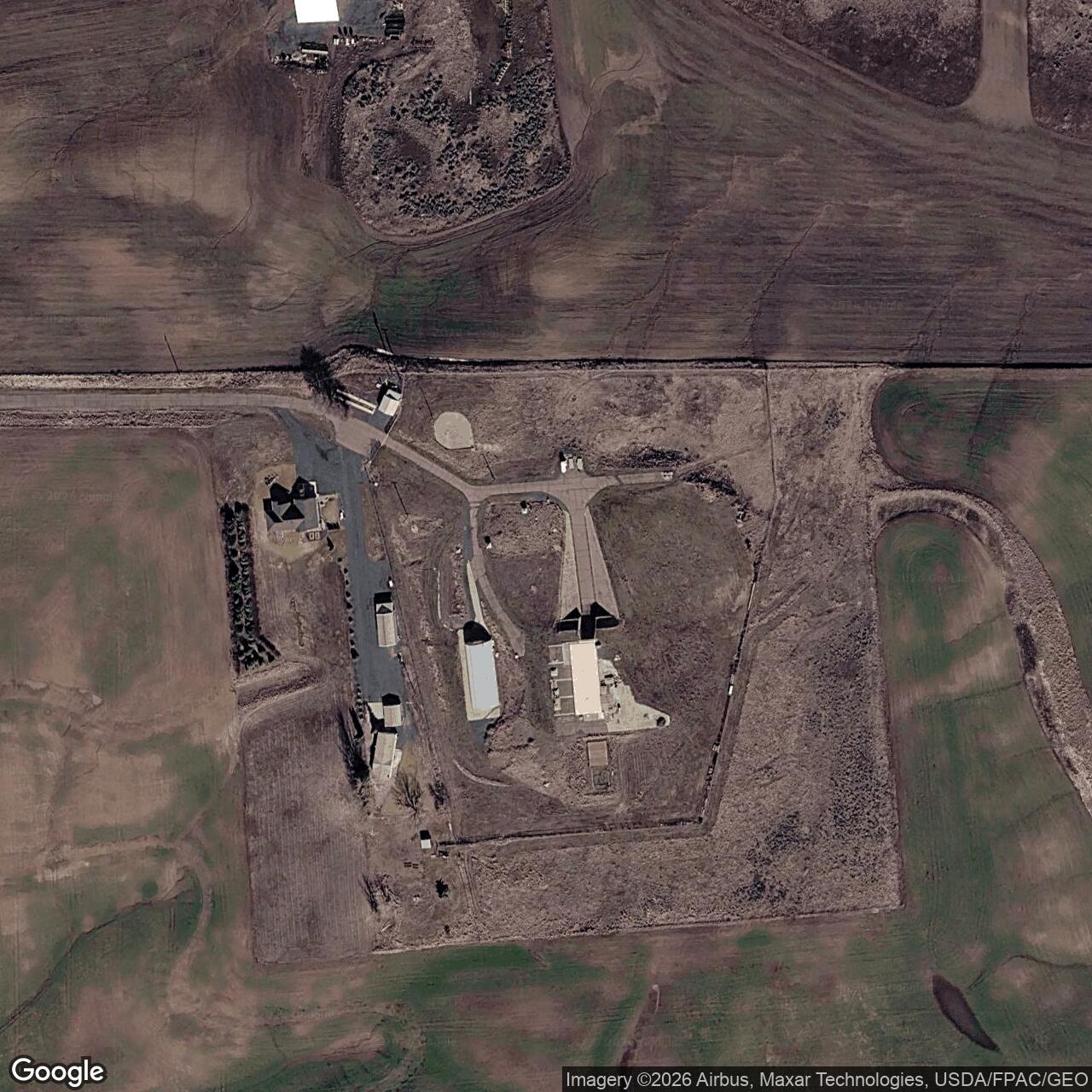
Site 567-7 followed that common Atlas E design. The 567th Strategic Missile Squadron historical Site 7 page includes a present-day photo link for the Wilbur site, and The Military Standard's aerial image shows the former rectangular missile-bay/launcher area, access roads, and surviving surface features within the former launch complex footprint. These visible features support the conclusion that major hardened structural remains were still recognizable after decommissioning, although the missile, nuclear components, operational launch equipment, and Air Force mission systems had long since been removed.
The site was an Atlas E coffin launcher rather than a later Minuteman-style vertical Launch Facility. The missile was not stored vertically in a hardened silo. It rested horizontally in a semi-hardened reinforced-concrete structure. In a launch sequence, the crew would open the launcher roof, raise the missile to vertical position, load liquid oxygen and RP-1 kerosene, complete countdown procedures, and launch from the open launcher. This gave the Atlas E more protection than earlier "soft" pads, but the system remained slower and less survivable than later solid-fueled missiles that stayed sealed in vertical launch facilities.
Strategic and Cold War Context
Atlas E Site 567-7 existed because the United States moved rapidly in the late 1950s and early 1960s to field an operational intercontinental ballistic missile force. The Atlas program was the first operational American ICBM program. It was developed in a period of intense Cold War concern about Soviet long-range missile capability, the perceived "missile gap," and the need to strengthen Strategic Air Command's nuclear deterrent. Fairchild Air Force Base already had a Strategic Air Command bomber and tanker role, and the addition of Atlas E made it part of the early American land-based ICBM force.The Wilbur site's mission was strategic nuclear deterrence, not local air defense. Its crew and missile were part of a national retaliatory force. If properly ordered through authenticated emergency channels, the site crew would prepare and launch the Atlas E missile against a preassigned target. The site's rural placement and separation from Fairchild were inseparable from that mission. Dispersal meant that an enemy would have to locate and attack nine separate Fairchild Atlas E complexes, spread across eastern Washington and north Idaho, rather than destroy one on-base missile installation.
Eastern Washington and nearby north Idaho offered several advantages for the Atlas E deployment. The region had open land, relatively low population density, established road access, and proximity to Fairchild Air Force Base, which supplied squadron headquarters, support personnel, logistics, and command connections. The missile field placed a national nuclear-alert system into a rural landscape of farms, small towns, and county roads. Communities such as Deer Park, Newman Lake, Rockford/Worley, Sprague, Lamona, Davenport, Wilbur, Egypt, and Reardan became geographic reference points in an early ICBM field.
The Atlas E was also a transitional system. It was more capable than the earliest Atlas D deployment because it used all-inertial guidance and was deployed singly in independent semi-hardened launch complexes. The Association of Air Force Missileers describes the Atlas E as a coffin-deployed missile with one control center per missile and a roof at ground level that provided about 25 psi protection. But the missile remained liquid-fueled. It could not sit in the same ready condition as later solid-fueled Minuteman missiles. Crews had to expose, erect, fuel, and launch the missile in a sequence that public missileer sources describe as taking about fifteen minutes. By 1964 and 1965, Minuteman's solid fuel, faster response, and easier alert posture made Atlas E and other first-generation liquid-fueled ICBMs obsolete.
Construction and Activation
Fairchild's Atlas E missile field was built during the emergency first-generation ICBM construction program. Fairchild Air Force Base's official history article states that work on the nine Fairchild Atlas E missile complex sites began on 1959-05-12. The 567th Strategic Missile Squadron was organized at Fairchild on 1960-04-01, marking the first time Strategic Air Command activated an E-series Atlas missile unit. The first Atlas E missile arrived at Fairchild on 1960-12-03. Work on the last of the nine launch sites was completed on 1961-02-10.The broader Fairchild Atlas E construction history indicates that the sites were planned and built simultaneously on a crash schedule. National Register documentation for Atlas E Missile Site 9 states that the U.S. Army Corps of Engineers Seattle District began initial planning and mapping work for the first Atlas E installations around Fairchild in 1958. It also states that the Air Force first considered three sites with three missiles each, then changed the plan to nine individual sites scattered around Fairchild for safety and defensive reasons.
The Fairchild Atlas E field was not a small local construction job. National Register documentation identifies the U.S. Army Corps of Engineers Seattle District Construction Division as the project's general contractor and the Bechtel Corporation of San Francisco and Los Angeles as the design firm. It also identifies Henry George & Sons as the contractor for the Launch Operations Building and MacDonald-Patti-Scott-Leavell as the contractor for the Launch and Service Building. Each site required the main launcher and launch-operations structures plus power, water, sanitary, communications, access-road, fencing, and support systems. National Register documentation describes the sites as including the Launch Operations Building, Launch and Service Building, connecting tunnel, water wells, water storage tanks, distribution systems, sanitary sewer and wastewater disposal, access roads, security fencing, on-site generators, HVAC equipment, mechanical and electrical systems, and gas storage tanks.
Strategic Air Command accepted the first Fairchild Atlas E launch complex on 1961-07-29. Operational readiness training began in August 1961. The Fairchild official history states that this was the first time such training occurred at the operational missile sites rather than at Vandenberg Air Force Base. Headquarters SAC declared the 567th Strategic Missile Squadron operational on 1961-09-28. The first Fairchild Atlas E missile went on alert on 1961-10-01, and most of the missile force was on alert by November 1961. Site 567-7 should therefore be understood as a 1960-built, 1961-accepted Fairchild Atlas E complex that entered the operational missile field during the same 1961 activation period as the other 567th SMS sites.
Missile System and Technical Role
Site 567-7 housed the SM-65E Atlas, also designated CGM-16E after the later missile-designation change. The Atlas was a one-and-one-half-stage liquid-fueled ICBM produced by Convair/General Dynamics. The National Park Service describes Atlas as the United States Air Force's first operational ICBM. The National Museum of the United States Air Force states that the Atlas could deliver a nuclear warhead more than 6,300 miles from its launch site and that the missile was phased out in 1965 but continued to serve as a first-stage booster for Air Force and NASA space projects, including Mercury manned space flights.The Atlas E differed from the Atlas D in basing and guidance. The Atlas E used all-inertial guidance rather than radio-inertial guidance, which removed the need for a separate central radio guidance facility. That allowed one missile to be deployed at each independent launch complex. The Fairchild Atlas E system therefore used nine separated single-missile sites rather than a few clusters of multiple launchers. The individual control function was at the missile site itself.
The Atlas E missile was stored horizontally in the coffin launcher. In a launch sequence, the crew would open the roof, raise the missile, fuel it with RP-1 kerosene and liquid oxygen, and proceed through the countdown. Public missileer sources describe Atlas E launch response time as roughly fifteen minutes. This was fast by the standards of the earliest ICBM fielding, but slow and vulnerable compared with later solid-fueled missiles. The missile had to be maintained under pressure because the Atlas airframe used very thin stainless steel "balloon tank" construction; an unpressurized Atlas could collapse under its own weight. The need to maintain pressurization, handle cryogenic liquid oxygen, maintain ground equipment, and keep trained crews on alert made Atlas E operations labor-intensive.
The warhead and reentry-vehicle description for Site 567-7 must be kept at the public-source level. The 567th Strategic Missile Squadron historical site states that the Atlas E was equipped with a Mark IV reentry vehicle and carried a W-38 nuclear warhead with a yield of approximately 3.8 megatons. The same source gives an approximate range of 6,000 miles. Other public museum and National Park Service sources describe the Atlas as an early operational ICBM with a range of more than 5,000 to 6,300 miles depending on model and source. The point for this site history is that Site 567-7 was built to store, maintain, and if ordered launch one thermonuclear-armed Atlas E ICBM as part of Strategic Air Command's retaliatory force.
Atlas E crews were not organized like later Minuteman missile crews, who sat in a separate underground Launch Control Center controlling multiple unmanned Launch Facilities. Each Atlas E site had its own launch operations building and on-site crew. National Register documentation based on Fairchild oral histories states that each Fairchild missile site was staffed by five squadron members: two officers and three enlisted airmen. The positions included Missile Combat Crew Commander, Missile Combat Crew Deputy Commander, Electric Power Production Technician, Missile Maintenance Technician, and Ballistic Missile Analyst Technician. The crew operated and maintained the site, handled communications, maintained power generation, monitored the missile and launch systems, and guarded the operational readiness of the site until relieved by the next crew.
Operational History
Site 567-7's active operational history was brief but intense. It served during the period when Strategic Air Command was moving from bomber-centered nuclear deterrence to a triad that included land-based ICBMs. The Fairchild Atlas E field was among the earliest operational examples of that transition. The 567th Strategic Missile Squadron was the first Series E Atlas squadron activated by SAC, and Fairchild's official history describes it as the first combat-ready Atlas E squadron.The Wilbur site was part of a nine-site missile field. The other Fairchild Atlas E sites were located near Deer Park, Newman Lake, Rockford/Worley, Sprague, Lamona, Davenport, Egypt, and Reardan. The Fairchild Atlas E sites became operational in September 1961 under the control of the 567th Strategic Missile Squadron and each of the nine sites had one missile. Each site was a twenty-acre facility with a five-acre inner launch and control area and notes that Air Force security police patrolled and maintained security.
A typical operational day at Site 567-7 would have involved an on-site crew, communications checks, missile and facility inspections, power-generation monitoring, maintenance activity, and security procedures. Atlas E crews were responsible for a complex system that had to be ready to move quickly from a protected horizontal storage posture to an exposed launch sequence. The launch equipment, missile support systems, power systems, communications, liquid-oxygen handling capability, RP-1 fuel system, and site security all had to work together under strict Strategic Air Command procedures.
The 567th Strategic Missile Squadron's record was unusually strong for such a short-lived system. Fairchild's official history says that the 567th passed its first Operational Readiness Inspection in April 1963 and became the first SAC missile squadron to pass an ORI. It also notes that the unit was the only missile squadron never to fail one. The same article lists awards and recognition including a General Dynamics Astronautics safety trophy for safety achievements during missile installation and checkout, Headquarters "Outstanding Achievement in Missile Safety for 1961," SAC's Charles D. Trail Material Trophy, the Col. Lee R. Williams Award, the Air Force Association's Outstanding Missile Unit Award, the "Best Maintenance Unit in SAC" trophy, and an Outstanding Unit Award. These honors were squadron-level achievements, not individually documented Site 567-7 events, but Site 567-7 was one of the operating sites that made up the force being inspected and evaluated.
The Cuban Missile Crisis in October 1962 was the most consequential operational episode in the life of the Fairchild Atlas E field. The 567th SMS historical site states that all 567th sites were at a high level of alert during the crisis and ready to launch if necessary. National Register documentation for Site 9 records former Fairchild missileer recollections that standardization crews were posted at different missile sites for the thirteen-day crisis and were not allowed to leave. That documentation is not a Site 567-7-specific account, but it does describe the Fairchild missile field to which Site 567-7 belonged. It illustrates how the site's normal peacetime alert mission became especially urgent during the closest nuclear crisis of the period.
The operational life of Site 567-7 ended quickly because the Atlas E became obsolete almost as soon as it was fielded. Solid-fueled Minuteman missiles were faster to launch, safer to maintain, and easier to keep on alert. Titan II also offered a more survivable and capable liquid-fueled system than the first-generation Atlas and Titan I deployments. The United States did not need to retain the labor-intensive Atlas E force once newer systems entered service. Secretary of Defense Robert McNamara announced the closing of older Atlas E and Titan I sites in February 1964, and the Fairchild Atlas E phaseout followed in 1965.
Deactivation and Disposal
Site 567-7 left active missile service during the 1965 Atlas E phaseout. Fairchild's official history states that the first Atlas E missile at Fairchild came off alert in January 1965, that the last missile came off alert by 1965-03-31, and that it was shipped to storage. The Air Force Order of Battle fact sheet gives related squadron-level dates: first ICBM off alert on 1965-02-17, last ICBM off alert on 1965-04-05, last Series E Atlas ICBMs removed from alert on 1965-03-31, and the last Series E Atlas ICBM to leave a SAC operational base shipped from Fairchild to storage on 1965-04-05. The 567th Strategic Missile Squadron was inactivated on 1965-06-25.The physical decommissioning of an Atlas E site was not one single action. The missile had to be taken off alert, the warhead and reentry vehicle removed under nuclear-weapons controls, propellants and hazardous operating materials dealt with, guidance and launch equipment removed or disabled, and salvageable military equipment taken away. After the Washington Atlas and Titan sites closed, all equipment and salvageable material was removed and the sites were auctioned to the highest bidder. It also states that eleven of the twelve Washington ICBM sites became private property and were not open to public visits; the exception was the Reardan Site 9 property that remained in federal use. For Site 567-7, this supports a general post-closure sequence of missile removal, equipment removal, salvage, federal disposal, and private ownership, but no public source found gives a site-specific GSA sale date or buyer for the Wilbur site.
Site 567-7 was not decommissioned because of an arms-control treaty such as START. It was retired before the major strategic arms-control demolition regimes of the later Cold War and post-Cold War period. Its deactivation reflected the rapid technological replacement of first-generation liquid-fueled ICBMs by newer systems. The aboveground and underground physical remains were not eliminated in the treaty-verification manner later associated with Minuteman or Peacekeeper reductions. Instead, the site passed into the familiar pattern of former Atlas E properties: missile and military equipment removed, hardened structures left in place, property transferred out of active Air Force use, and later private reuse or disuse.
EPA's CERCLA profile is the principal public environmental-status source located for Site 567-7. EPA identifies the property as the Former Fairchild Atlas E Missile S-7 Site, EPA ID WAN001002988, at 450 Logan Street, 4.6 miles east of Wilbur. EPA lists the site as not on the National Priorities List, NFRAP, and not a federal facility. The NFRAP designation means EPA determined, based on available information, that the site did not qualify for the NPL. EPA's public profile for Site 7 does not provide the detailed contaminant and remedial-action narrative that is available for some former Atlas sites in Colorado or for certain other Washington site-specific reports. Because of that, the environmental account for Site 567-7 should be stated carefully: the site has a federal CERCLA record, but the public EPA profile located here does not document a major NPL cleanup or detailed remedy.
Current Status and Site Use
Atlas E Site 567-7 is a decommissioned former missile launch complex on private property near Wilbur, Lincoln County, Washington. The former Washington ICBM sites were sold to private parties are not open to public visits. The current specific ownership and active use of the Wilbur property is not known.Visible remains appear to include major surface evidence of the former launch complex. Aerial images shows a recognizable former launch area with roads and surviving structures.
Chronology
- 1958 The U.S. Army Corps of Engineers Seattle District began initial planning and mapping work for the Atlas E installations around Fairchild Air Force Base.
- 1959-05-12 Work began on the nine Fairchild Atlas E missile complex sites, according to Fairchild Air Force Base's official history article.
- 1960 The 567th Strategic Missile Squadron historical Site 7 page lists construction as beginning in this year.
- 1960-04-01 The 567th Strategic Missile Squadron was organized at Fairchild Air Force Base; Strategic Air Command activated its first E-series Atlas missile squadron.
- 1960-12-03 The first Atlas E missile arrived at Fairchild Air Force Base.
- 1961-02-10 Work on the last of the nine Fairchild Atlas E launch sites was completed.
- 1961 Site 567-7 was turned over to the Air Force.
- 1961-07-29 Strategic Air Command accepted the first Fairchild Atlas E complex.
- 1961-08 Operational readiness training began in the Fairchild Atlas E missile field.
- 1961-09-28 Headquarters Strategic Air Command declared the 567th Strategic Missile Squadron operational.
- 1961-10-01 The first Fairchild Atlas E missile went on alert.
- 1961-11 Most of the Fairchild Atlas E missile force was on alert.
- 1962-02-15 The 92d Bombardment Wing was redesignated the 92d Strategic Aerospace Wing.
- 1962-10 The Fairchild Atlas E missile field was placed in a high-alert posture during the Cuban Missile Crisis.
- 1963-04 The 567th Strategic Missile Squadron passed its first Operational Readiness Inspection and was recognized as the first Strategic Air Command missile squadron to pass an ORI.
- 1964-02 Secretary of Defense Robert McNamara announced the closing of older Atlas E and Titan I missile sites as part of the national phaseout of first-generation liquid-fueled ICBMs.
- 1965-02-17 The Air Force Order of Battle fact sheet lists the first 567th SMS ICBM as off alert on this date.
- 1965-03-31 Public Air Force sources state that the last Series E Atlas ICBMs at Fairchild had been removed from alert by this date.
- 1965-04-05 The Air Force Order of Battle fact sheet states that the last Series E Atlas ICBM left Fairchild for storage on this date.
- 1965-06-25 The 567th Strategic Missile Squadron was inactivated.
- 1965 and after The former missile, nuclear components, and military launch equipment were removed, while the hardened structures remained and the former missile property entered post-military disposal and reuse.
- 2009 National Register documentation for Atlas E Missile Site 9 described the nine Fairchild Atlas E complexes as identical sites and identified Site 7 as Wilbur, Washington.
- 2026 EPA's public CERCLA profile listed the Former Fairchild Atlas E Missile S-7 Site as not on the NPL and NFRAP.
Read about the Atlas at Fairchild AFB
All Atlas Missile Silo Locations