
Atlas E Site 567-8 Missile Silo, Egypt Washington
Longitude: -118.2226429119582
Site Type: Atlas E single-missile coffin launcher complex
Missile Type: SM-65E Atlas
Number of Launchers/Missiles: 1
Parent Base: Fairchild AFB
Missile Wing: 92d Bombardment Wing; 92d Strategic Aerospace Wing after 1962-02-15
Missile Squadron: 567th Strategic Missile Squadron
Current Site Use: Former Atlas E launch complex near Egypt/Davenport; visible launcher-area remains in aerial imagery; no current owner-authorized reuse verified in pass 1.
Site Ownership: Private ownership after post-1965 disposal; EPA lists the CERCLA record as not a federal facility.
Accessible: No public access / private property.
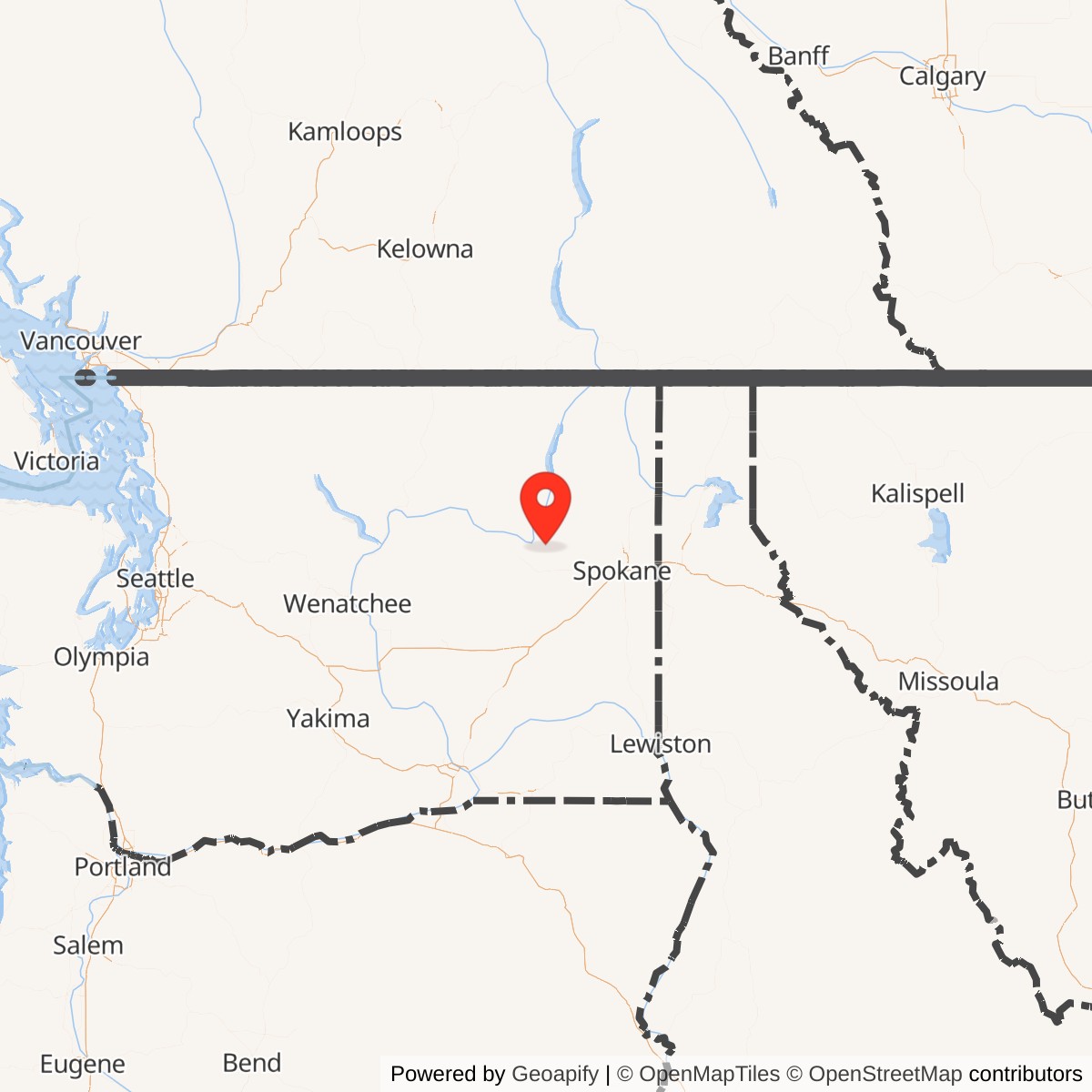
Atlas E Site 567-8 was a single-missile SM-65E Atlas intercontinental ballistic missile launch complex operated by the 567th Strategic Missile Squadron in the Fairchild Air Force Base missile field. It was one of nine Atlas E "coffin launcher" sites dispersed around Fairchild Air Force Base near Spokane, Washington. Its parent base was Fairchild Air Force Base. Its parent wing was the 92d Bombardment Wing during the first deployment period and the 92d Strategic Aerospace Wing after the wing was redesignated on 1962-02-15. The operating squadron was the 567th Strategic Missile Squadron. The site did not have a separate parent Launch Control Center in the later Minuteman sense. Atlas E launch-control functions were located at each individual launch complex.
The site was Air Force Operational Site Number 8 of the 567th Strategic Missile Squadron and is best identified as Atlas E Site 567-8, Egypt, Washington. Public Atlas lists associate the site with Egypt, a small locality in Lincoln County, while EPA identifies the CERCLA record as a Davenport, Washington, property located at Pankey Loop and Sunset Roads off State Route 25, 11.5 miles north of Davenport.
The site is inactive and decommissioned. The 567th Strategic Missile Squadron was organized at Fairchild Air Force Base on 1960-04-01 and was inactivated on 1965-06-25. The Fairchild Atlas E missile field became operational during 1961, with Strategic Air Command declaring the squadron operational on 1961-09-28. The first Fairchild Atlas E missile went on alert on 1961-10-01, and most of the missile field was on alert by November 1961. The former launch complex is now private property. EPA identifies it as the Former Fairchild Atlas E Missile S-8 Site, EPA ID WAN001002358, in Lincoln County, Washington, and lists it as not on the National Priorities List and as NFRAP, meaning it did not qualify for the NPL based on existing information. Public access is not available without owner permission.
Location, Landscape, and Site Description
Site 567-8 occupied a rural plateau-and-coulee landscape in Lincoln County, Washington, north of Davenport and southwest of Deer Meadows. The site is associated in Atlas sources with Egypt, Washington, but the EPA location description uses Davenport because that is the postal and municipal reference for the CERCLA record. The launcher stood in open agricultural country along the State Route 25 corridor, within a landscape of dryland fields, rural roads, and shallow drainage features. It was not a facility on Fairchild Air Force Base itself. It was an off-base hardened launch complex placed far enough from Fairchild and from the other Atlas E launchers to support the squadron's dispersal concept.The site's isolation was part of its military design. An enemy attack that damaged Fairchild Air Force Base would not automatically destroy all nine Fairchild Atlas E missiles, and an attack on one isolated launcher would not necessarily destroy the others. That design logic was especially important for first-generation ICBM sites because the Atlas E was only partly hardened and still had to be raised and fueled before launch.
Public sources describe the general Fairchild Atlas E layout in considerable detail. Each of the nine Fairchild Atlas E sites was a 20-acre facility with a five-acre inner launch and control area. The original inner area contained the major missile structures, security fencing, and supporting facilities. National Register documentation for the best-preserved Fairchild Atlas E site, Site 9 at Reardan, describes the same class of complex as having an Upper Missile Bay, a Launch Operations Building, a Butler Building, an access road, service areas, and a fenced missile area. The launch operations building contained crew and launch-control spaces, power equipment, and support systems, and it was connected to the missile structure by an underground tunnel.
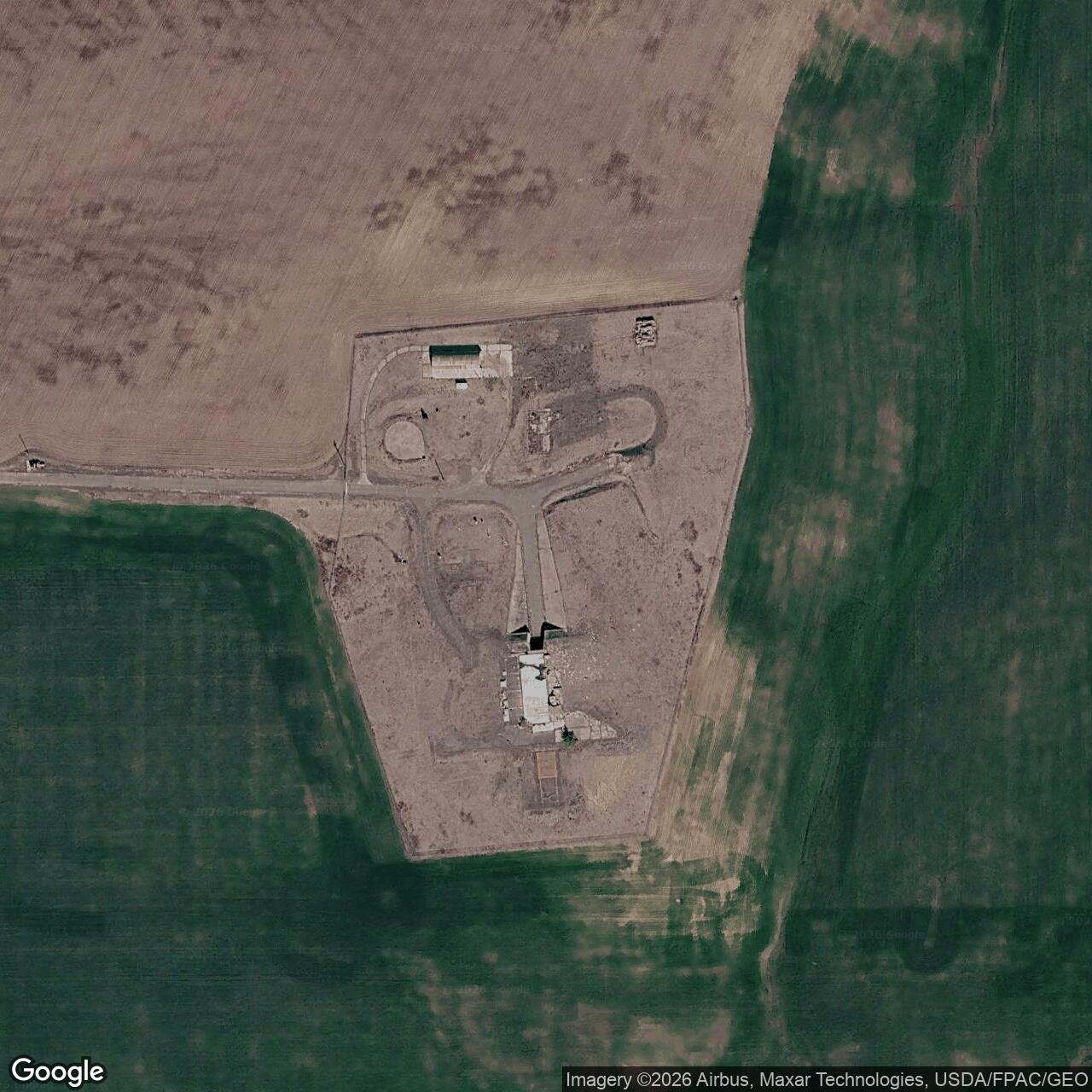
Site 567-8 followed that common Atlas E design. The Atlas E missile was stored horizontally in a semi-hardened reinforced-concrete "coffin" launcher. In a launch sequence, the crew would open the launcher roof, raise the missile to vertical position, load liquid oxygen and RP-1 kerosene, complete countdown procedures, and launch from the exposed launcher. This provided more protection than an open launch pad but less survivability than later vertical silos. Aerial images show the former access roads, launcher structure, launch-operations area, and surviving surface traces within the former launch complex footprint. These images support the conclusion that major structural remains are still legible, although the missile, nuclear components, operational launch equipment, and Air Force mission systems have long since been removed.
Strategic and Cold War Context
Atlas E Site 567-8 existed because the United States moved rapidly in the late 1950s and early 1960s to field an operational intercontinental ballistic missile force. Atlas was the first operational American ICBM program. It was developed in a period of intense Cold War concern about Soviet long-range missile capability, the perceived "missile gap," and the need to strengthen Strategic Air Command's nuclear deterrent. Fairchild Air Force Base already had a Strategic Air Command bomber and tanker mission, and the addition of the 567th Strategic Missile Squadron made the base part of the early American land-based ICBM force.The Egypt site's mission was strategic nuclear deterrence, not local air defense. Its crew and missile were part of a national retaliatory force. If properly ordered through authenticated emergency-war channels, the site crew would prepare and launch the Atlas E missile against a preassigned target. The site's rural placement and separation from Fairchild were inseparable from that mission. Dispersal meant that an enemy would have to locate and attack nine separate Fairchild Atlas E complexes, spread across eastern Washington and north Idaho, rather than destroy one on-base missile installation.
Eastern Washington and nearby north Idaho offered several advantages for the Atlas E deployment. The region had open land, relatively low population density, existing rural road access, and proximity to Fairchild Air Force Base, which supplied squadron headquarters, support personnel, logistics, and command connections. The missile field placed a national nuclear-alert system into a rural landscape of farms, small towns, and county roads. Communities such as Deer Park, Newman Lake, Rockford/Worley, Sprague, Lamona, Davenport, Wilbur, Egypt, and Reardan became geographic reference points in an early ICBM field.
The Atlas E was a transitional system. It was more capable than the earliest Atlas D deployment because it used inertial guidance and was deployed singly in independent semi-hardened launch complexes. The National Park Service describes Atlas E as similar to Atlas D but based in individual launch complexes, using inertial guidance, and deployed in below-ground coffins that somewhat improved blast protection. But the missile remained liquid-fueled. It could not sit in the same ready condition as later solid-fueled Minuteman missiles. Crews had to expose, erect, fuel, and launch the missile in a sequence commonly described as taking about fifteen minutes. By 1964 and 1965, Minuteman's solid fuel, faster response, and easier alert posture made Atlas E and other first-generation liquid-fueled ICBMs obsolete.
Construction and Activation
Fairchild's Atlas E missile field was built during the emergency first-generation ICBM construction program. Fairchild Air Force Base's official history states that in 1961 the 92nd Bombardment Wing became the nation's first "aerospace" wing with the activation of the 567th Strategic Missile Squadron and acquisition and deployment of Atlas E ICBMs at nine complexes throughout the Inland Empire. The 567th Strategic Missile Squadron was activated in December 1959 and organized at Fairchild on 1960-04-01, marking the first E-series Atlas missile squadron in Strategic Air Command service.The 567th Strategic Missile Squadron historical Site 8 page lists construction as beginning in 1960 and site turnover to the Air Force in 1961, but it does not give exact month/day entries for either milestone. The broader Fairchild Atlas E construction history indicates that the sites were planned and built on a compressed schedule. National Register documentation for Atlas E Missile Site 9 states that Site 9 was built in 1960 and that it was one of nine identical Atlas E complexes attached to Fairchild Air Force Base. The same documentation cites a U.S. Army Corps of Engineers history of construction activities at Fairchild for the WS-107A Atlas E missile complexes during January 1959-February 1961.
The Fairchild Atlas E field was not a small local construction job. It required federal land acquisition, heavy excavation, reinforced concrete work, steel launcher construction, power systems, communications systems, secure access, and support buildings across nine rural locations. For the Egypt site, those requirements produced the same basic physical form seen at other Fairchild Atlas E complexes: a semi-hardened missile bay, a launch-operations structure, an underground connection between operational spaces, site fencing, hardstands, access roads, and support areas.
Squadron and field-level activation proceeded in stages. The first Atlas E missile arrived at Fairchild on 1960-12-03. The Air Force Order of Battle fact sheet for the 567th Strategic Missile Squadron lists turnover to Strategic Air Command and operational status on 1961-09-28. Fairchild Air Force Base's history states that the Atlas E missiles were deployed at nine complexes and that the wing was redesignated the 92d Strategic Aerospace Wing on 1962-02-15 after the missile role was added. By late 1961, Site 567-8 was part of a fielded Atlas E missile force.
Missile System and Technical Role
The missile associated with Site 567-8 was the SM-65E Atlas, also known as Atlas E. It was a liquid-fueled intercontinental ballistic missile using RP-1 kerosene and liquid oxygen. Atlas used a very light stainless-steel airframe that required internal pressurization to maintain its shape. The National Park Service describes the Atlas airframe as so thin that it had to remain pressurized while on alert, and it notes that the liquid oxygen fuel provided pressure if the missile was fueled and launched. This "balloon tank" design reduced weight but required careful maintenance and made the missile operationally demanding.The Atlas E was stored in a horizontal coffin launcher. It was not a later Minuteman-style vertical launch facility and not an Atlas F-style vertical silo. The launcher protected the missile until a launch order required the roof to open, the missile to be elevated, and the propellants to be loaded. The U.S. Army Corps of Engineers' public Atlas E description for a Forbes Atlas E site states that Atlas E missiles were housed in a coffin-launcher-style complex, kept horizontally, raised after a heavy overhead roof was moved, and then fueled with RP-1 and liquid oxygen. The same USACE source describes Atlas E as using a Mark IV reentry vehicle with a W-38 warhead of approximately four megatons TNT equivalent and a range of approximately 6,000 miles. The Smithsonian National Air and Space Museum identifies the Mark 4 reentry vehicle as used on Atlas E/F and Titan I ICBMs and states that it carried a W-38 nuclear warhead with a yield of about 3.75 megatons.
The Atlas E's technical role at Site 567-8 was to hold one missile on strategic alert, maintain it in a launch-ready condition short of full fueling, and provide the crew and equipment necessary to execute an authenticated launch order. Because Atlas E had an inertial guidance system, it did not require the same separate ground-radio guidance facility used by earlier Atlas D arrangements. That allowed the Fairchild missiles to be dispersed as individual complexes. Each complex had its own launch-control functions, power support, communications, and crew areas.
The site was crewed, unlike later Minuteman launch facilities that were normally unmanned and controlled remotely from a Launch Control Center. Each Fairchild Atlas E site was staffed by three squadron airmen and two officers and the missile combat crew commander or deputy commander had to be in the launch control facility at all times. The crew's task was to maintain readiness, receive authenticated orders, operate launch-control equipment, and coordinate with Fairchild and Strategic Air Command communications networks. Security police, maintenance teams, missile technicians, propellant specialists, and communications personnel supported the site from the broader Fairchild missile organization.
Operational History
The operational history of Site 567-8 was part of the short but intense service life of the 567th Strategic Missile Squadron. The squadron was organized at Fairchild on 1960-04-01 and operated nine SM-65E Atlas missiles at nine independent launch sites. The Air Force Order of Battle fact sheet lists the squadron's weapon system as SM-65E Atlas from 1960 to 1965 and gives Fairchild Air Force Base as its station beginning 1960-04-01. Fairchild's official history states that the 567th Strategic Missile Squadron's Atlas E deployment made the 92nd Bombardment Wing the nation's first "aerospace" wing and that the wing was redesignated the 92nd Strategic Aerospace Wing on 1962-02-15.Site 567-8 was one of the outer points of that dispersed field. As an Atlas E complex, it had a 24-hour mission. It was not a training relic or a storage depot during its active years. It held a missile and crew in readiness to participate in Strategic Air Command's nuclear deterrent. The site was manned, maintained, guarded, inspected, and tied into SAC's emergency communications and command system. Its crew had to be prepared for a launch order while also managing the hazards of liquid oxygen, kerosene, pressurization, hydraulic systems, electrical systems, and secure command-control procedures.
Normal operations at the Egypt site would have involved repeated readiness checks, maintenance visits, crew changeovers, communications tests, security patrols, inspections, and periodic launch exercises. National Register documentation for Atlas E Missile Site 9 describes how Fairchild crews had to maintain accurate geographic position information for the inertial guidance system. Missile crews used a theodolite, trained on the North Star, to confirm exact site coordinates; the information could then be transmitted to 567th headquarters and used to update targeting boards when needed. The documentation notes that this process was especially important after events such as the 1964 Alaska earthquake, which slightly shifted the location of the Fairchild Atlas E missile sites. This was a missile-field procedure, but it is directly relevant to Site 567-8 because it was one of the nine Fairchild Atlas E launch complexes.
The most serious documented site-specific event at 567-8 was a dangerous liquid oxygen spill during a launch exercise. National Register documentation for Atlas E Missile Site 9 states that the volatility of Atlas liquid propellants made Atlas complexes difficult to maintain and often led to dangerous accidents. It then identifies a valve malfunction that caused a dangerous liquid oxygen spill during a launch exercise at Fairchild's Site 8 in Egypt, Washington.
During the Cuban Missile Crisis in October 1962, the Fairchild Atlas E field entered its most consequential alert episode. Fairchild's official history states that the base's ICBMs played an integral deterrence role in the crisis. National Register documentation state that the Fairchild missiles were targeted on Cuba during the crisis and that targeting teams changed target boards at the missile sites. This was a missile-field event, not a uniquely documented Site 567-8 event, but Site 567-8 was part of the same nine-site alert force. The field's small crews, liquid-fuel procedures, and isolated rural launchers were drawn directly into one of the Cold War's most dangerous confrontations.
The 567th SMS also accumulated a strong squadron-level record. Fairchild's official public-affairs history states that the unit represented a nuclear deterrence mission at Fairchild. The Air Force Order of Battle fact sheet records an Air Force Outstanding Unit Award for 1961-01-01 through 1962-03-31. Public squadron histories state that the 567th SMS was recognized for its performance during the early Atlas E period and was connected with Strategic Air Command's first E-series Atlas operations.
Deactivation and Disposal
Site 567-8 left active missile service during the national phaseout of first-generation Atlas and Titan I systems. The reason was technological rather than local. Solid-fueled Minuteman missiles offered faster response, less dangerous fueling requirements, and a more durable alert posture. The Atlas E was liquid-fueled, had to be raised and fueled before launch, and depended on operational procedures that were already becoming obsolete by the mid-1960s.The Air Force Order of Battle fact sheet lists the first 567th SMS ICBM as off alert on 1965-02-17, states that the last Series E Atlas ICBMs at Fairchild had been removed from alert on 1965-03-31, and states that the last Series E Atlas ICBM to leave a Strategic Air Command operational base departed Fairchild for storage on 1965-04-05. The 567th Strategic Missile Squadron was inactivated on 1965-06-25.
After deactivation, the missile, nuclear components, guidance equipment, propellant-handling systems, communications equipment, launch-control equipment, and salvageable military hardware were removed. When the sites closed, equipment and salvageable material were removed and the sites were auctioned to the highest bidder. The Spokesman-Review similarly reported that original components, including wiring and steel, copper, and iron fixtures, had been hauled off and sold for salvage long before the former sites became objects of curiosity or adaptive reuse. This explains why former Atlas E sites often retain massive concrete-and-steel shells while lacking their original mission systems.
Site 567-8 does not appear to have been demolished in the arms-control sense later applied to some Minuteman and Peacekeeper facilities. Its active service ended before the major late-Cold War and post-Cold War strategic-arms-reduction demolition regimes. The physical result was more typical of the Atlas E program: the missile and sensitive systems were removed, the real property left federal missile use, and the hardened structure remained available for private or nonmilitary reuse.
Current Status and Site Use
Atlas E Site 567-8 is no longer an active missile site. It is a decommissioned former Atlas E launch complex on private property in Lincoln County, Washington. The preferred coordinate identifies the former launcher area, not a public visitor access point. EPA's address description places the property at Pankey Loop and Sunset Roads off State Route 25, 11.5 miles north of Davenport. The Military Standard and 567th SMS historical materials identify it with Egypt.The site retains visible former missile-site features in aerial imagery and in public historical photographs. Images show the long former missile bay/launcher feature, access drives, and associated surface structures or foundations. These visible traces do not mean the site is safe, open, or publicly accessible. Former missile complexes can contain confined spaces, fall hazards, deteriorated structures, water, chemical residues, and other hazards. The site should be treated as private property, and entry should not be attempted without permission.
Chronology
- 1958 The U.S. Army Corps of Engineers Seattle District began initial planning and mapping work for the Atlas E installations around Fairchild Air Force Base.
- 1959-05-12 Work began on the Fairchild Atlas E missile complex program, according to Fairchild Atlas E construction history summarized in public sources.
- 1959-12-16 The 567th Strategic Missile Squadron was activated in the Strategic Air Command lineage.
- 1960-04-01 The 567th Strategic Missile Squadron was organized at Fairchild Air Force Base; Strategic Air Command activated its first E-series Atlas missile squadron.
- 1960-12-03 The first Atlas E missile arrived at Fairchild Air Force Base.
- 1961 Site 567-8 was turned over to the Air Force.
- 1961-02-10 Work on the last of the nine Fairchild Atlas E launch sites was completed.
- 1961-09-28 The Air Force Order of Battle fact sheet lists turnover to Strategic Air Command and operational status for the 567th Strategic Missile Squadron on this date.
- 1961-10-01 The first Fairchild Atlas E missile went on alert.
- 1961-11 Most of the Fairchild Atlas E missile force was on alert.
- 1962-02-15 The 92d Bombardment Wing was redesignated the 92d Strategic Aerospace Wing.
- 1962-10 The Fairchild Atlas E missile field was placed in a high-alert posture during the Cuban Missile Crisis.
- 1961-1965 A valve malfunction caused a dangerous liquid oxygen spill during a launch exercise at Fairchild's Site 8 in Egypt, Washington; the public NRHP documentation does not give a more exact date.
- 1963-04 The 567th Strategic Missile Squadron underwent a major Operational Readiness Inspection period and was recognized in public squadron histories for its Atlas E readiness performance.
- 1964 A major Alaska earthquake slightly shifted the geographic locations of the Fairchild Atlas E missile sites, making site-coordinate verification procedures especially important for targeting.
- 1964-02 Secretary of Defense Robert McNamara announced the closing of older Atlas E and Titan I missile sites as part of the national phaseout of first-generation liquid-fueled ICBMs.
- 1965-02-17 The Air Force Order of Battle fact sheet lists the first 567th SMS ICBM as off alert on this date.
- 1965-03-25 The 567th Strategic Missile Squadron historical Site 8 page lists Site 567-8 as decommissioned on this date.
- 1965-03-31 Public Air Force sources state that the last Series E Atlas ICBMs at Fairchild had been removed from alert by this date.
- 1965-04-05 The Air Force Order of Battle fact sheet states that the last Series E Atlas ICBM left Fairchild for storage on this date.
- 1965-06-25 The 567th Strategic Missile Squadron was inactivated.
- 1965 and after The former missile, nuclear components, and military launch equipment were removed, while the hardened structures remained and the former missile property entered post-military disposal and reuse.
- 2026 EPA's public CERCLA profile listed the Former Fairchild Atlas E Missile S-8 Site as not on the NPL and NFRAP.
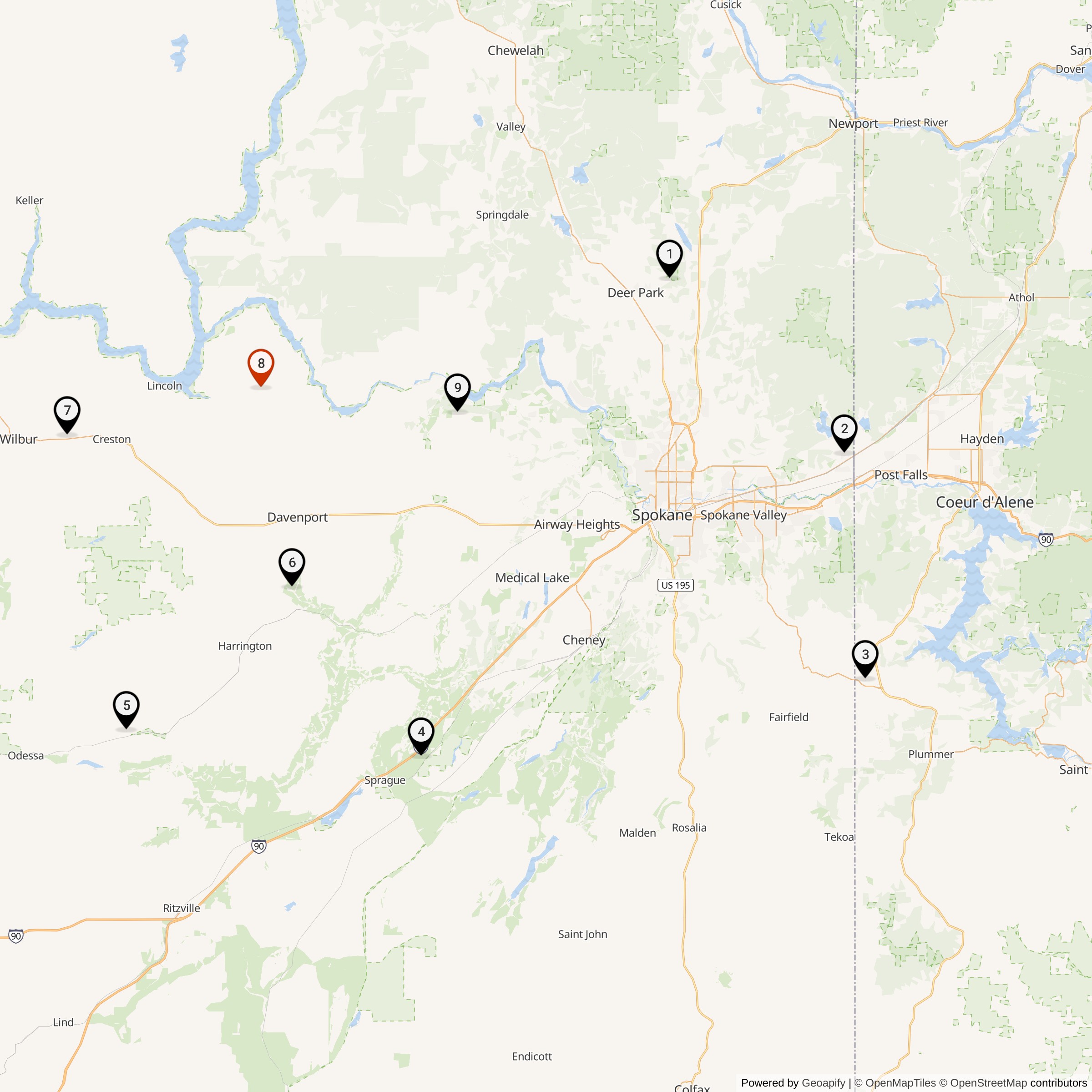
Read about the Atlas at Fairchild AFB
All Atlas Missile Silo Locations