
Atlas F Site 579-5 Missile Silo, Roswell / Highway 380 East New Mexico
Longitude: -104.048345772729
Site Type: Atlas F vertical silo launch facility
Missile Type: SM-65F Atlas
Number of Launchers/Missiles: 1
Parent Base: Walker AFB
Missile Wing: 6th Strategic Aerospace Wing
Missile Squadron: 579th Strategic Missile Squadron
Corps of Engineers Site ID: 12
Approximate Base Size: 8.26 fee-simple facility acres plus 1.65-acre easement; DOD acquired 247.24 acres for development (EPA Ready for Reuse letter)
Current Site Use: Former Atlas F launch complex; accident-damaged and removed from service after 1964 PLX explosion; later disposed, remediated, and EPA/NMED/USACE Ready for Reuse surface property; private rural property.
Site Ownership: Former USAF; GSA conveyed 8.26 fee-simple acres plus 1.65-acre easement to W.L. Pennington and Cliff C. Henderson in 1966; EPA letter identified William L. Wilcox as owner after March 1999; current ownership not independently verified.
Accessible: No public access; private property and former industrial/missile site; do not trespass.
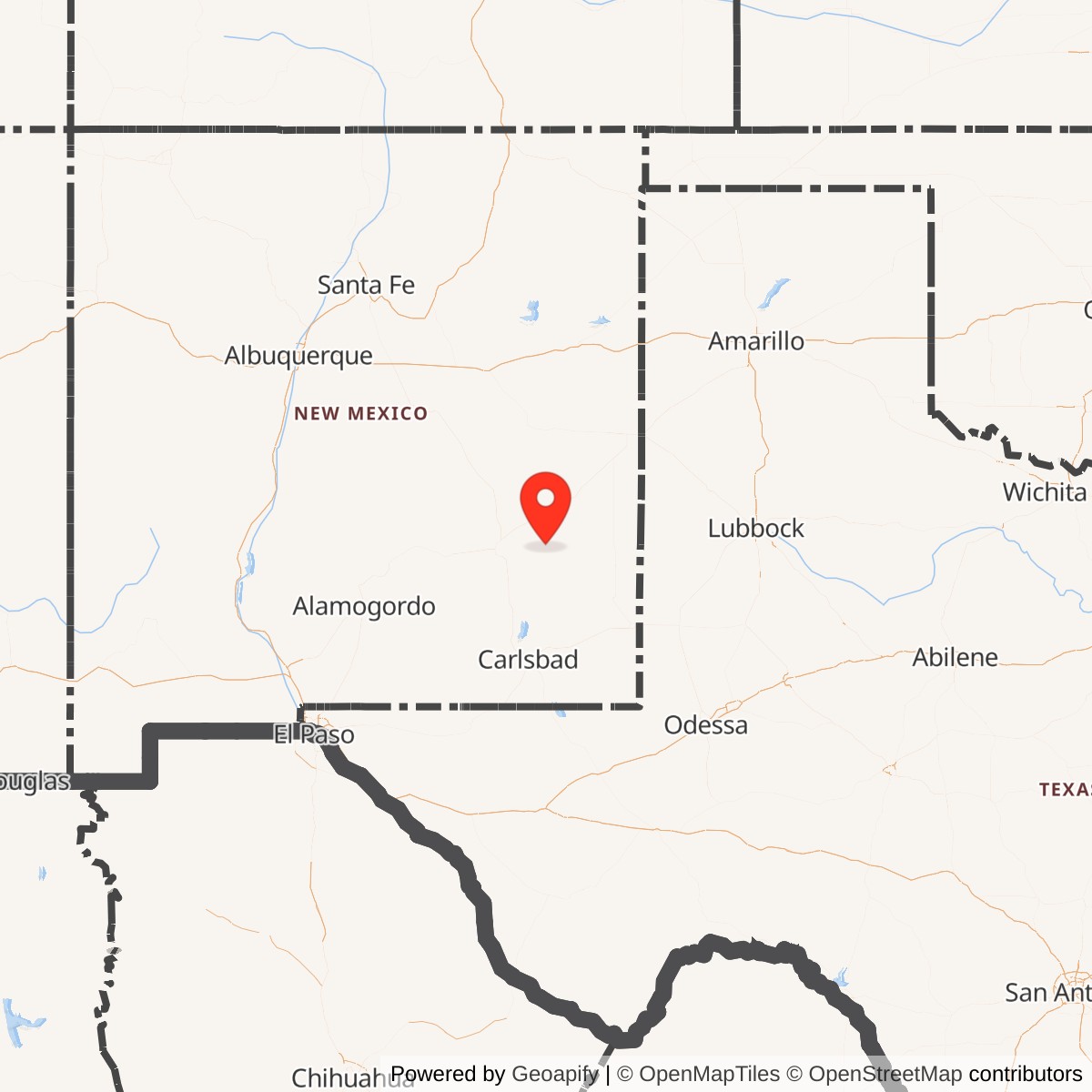
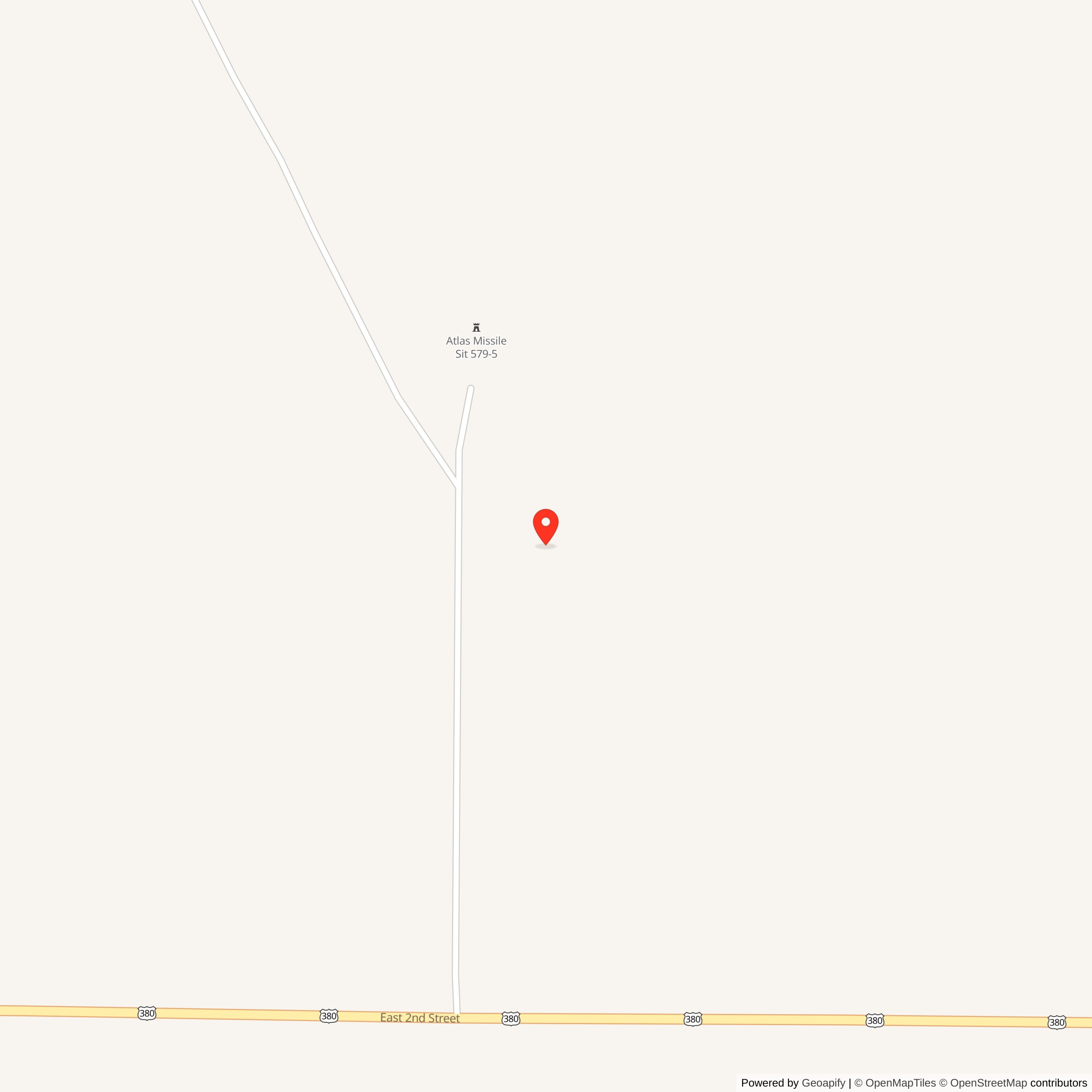
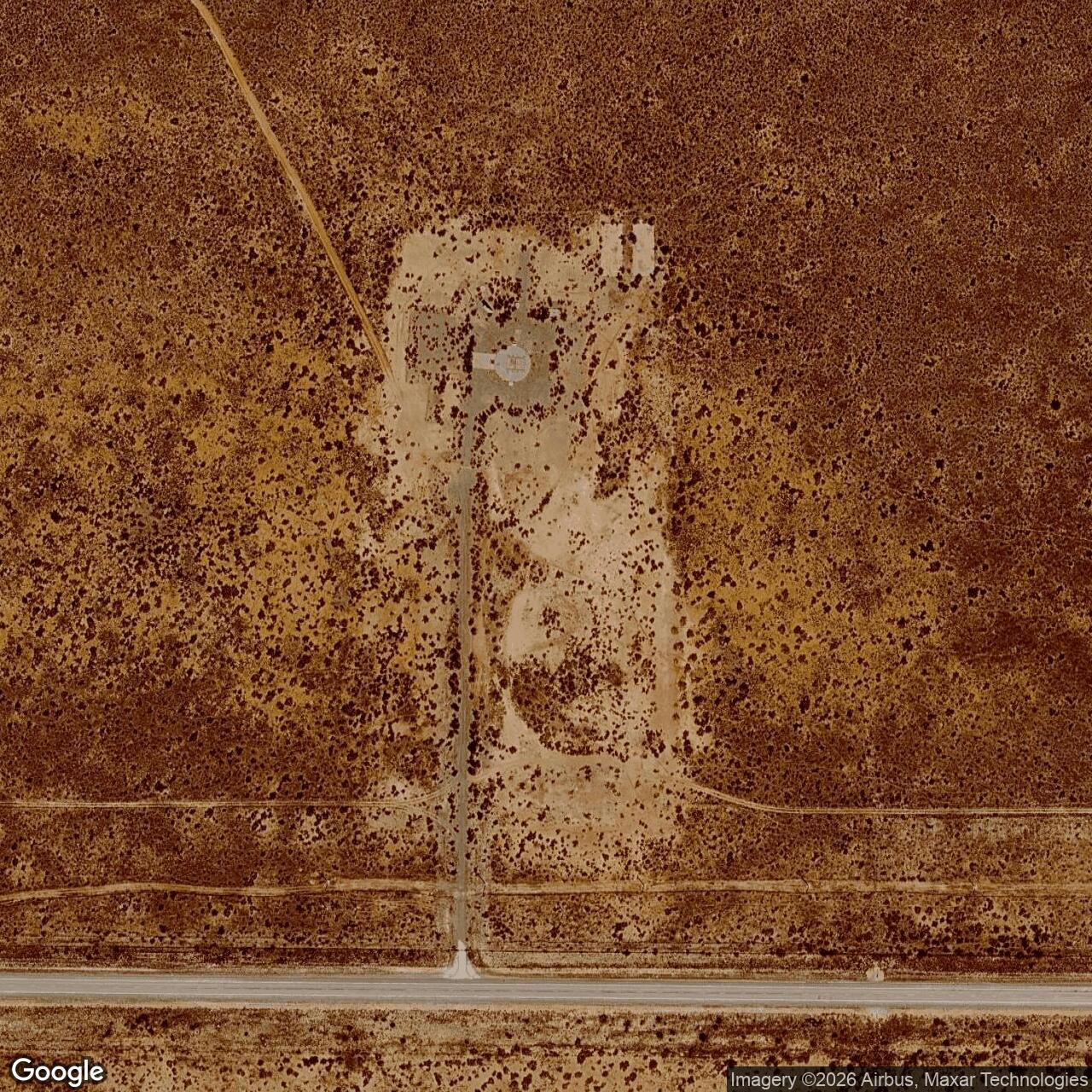
On February 13, 1964, Atlas F Site 579-5 became one of the most dramatic places in the Walker missile field. What had been built as a hardened nuclear-alert complex east of Roswell was destroyed during a propellant-loading exercise, when the dangerous combination of RP-1 fuel, liquid oxygen, electrical systems, confined underground spaces, and first-generation missile procedures turned a training evolution into a catastrophic explosion. The crew survived, but the silo did not. Site 579-5 was never restored to missile service.
That accident is the reason this site stands out. The Walker Atlas F field had only twelve launch complexes, and three of them were destroyed by explosions between June 1963 and March 1964. Site 579-5 was the middle loss in that sequence. Its story shows both sides of the early ICBM era: the extraordinary national effort that built buried launch complexes at high speed across the Roswell landscape, and the technical risk of keeping a liquid-fueled, cryogenic-oxidizer missile ready for nuclear alert in an underground silo.
The site was built as Corps of Engineers Construction Site Number 12 and operated as Air Force Operational Site Number 5. It was part of the Walker Air Force Base Atlas F ring around Roswell, New Mexico. Its active missile history was short: construction was completed in 1961, the 579th Strategic Missile Squadron became operational in 1962, and Site 579-5 was destroyed on February 13, 1964. The former property later passed through federal disposal, environmental investigation, soil remediation, and an EPA / New Mexico Environment Department / USACE Ready for Reuse determination.
Installation / Site Identity
Atlas F Site 579-5 was a one-missile Atlas F vertical-silo launch complex assigned to the 579th Strategic Missile Squadron at Walker Air Force Base, New Mexico. The parent wing was the 6th Bombardment Wing, later redesignated the 6th Strategic Aerospace Wing. The site was part of the dispersed Walker AFB missile field, a ring of twelve Atlas F launch complexes around Roswell.The site is in Chaves County, New Mexico, east of Roswell on the U.S. Highway 380 East corridor. EPA's 2009 Ready for Reuse letter describes the former Site 5 property as being in central Chaves County, approximately 35 miles east of Roswell, on the north side of U.S. Highway 380.
The site identification was Site 5, Roswell, New Mexico, Highway 380 East, Corps of Engineers Construction Site Number 12 and Air Force Operational Site Number 5. The assigned missile was General Dynamics Missile Serial Number 61-2574, General Dynamics Manufacturing Number 88F, and Air Force Missile Tail Number 574. The missile was accepted on July 13, 1962 and delivered on July 16, 1962. It was not later used as a space-launch vehicle because it was destroyed in the February 13, 1964 site accident.
Site 579-5 is inactive and decommissioned. The 579th Strategic Missile Squadron history lists SAC missile operations as turned over to Strategic Air Command and operational on November 30, 1962. The site left practical missile service when the explosion destroyed the silo on February 13, 1964. EPA documentation states that Site 5 was declared excess to the General Services Administration in February 1965, and that the General Services Administration conveyed the 8.26-acre fee-simple property and a 1.65-acre easement in December 1966. The former surface property later received a Ready for Reuse determination dated September 16, 2009.
Location, Landscape, and Site Description
Site 579-5 was built in the high desert and ranching landscape east of Roswell. The terrain is open, dry, and sparsely developed, with long highway approaches, broad sightlines, scrub vegetation, agricultural and grazing use, and scattered oil-and-gas and rural infrastructure typical of the eastern Chaves County plains. The setting fit the Atlas F deployment concept: individual launch complexes were separated from Walker AFB and from one another so that a single attack could not destroy the entire missile field.The former site was located on the north side of U.S. Highway 380, far enough from Roswell to be isolated but close enough for Walker AFB to provide maintenance, security, communications, supply, inspections, emergency response, and crew rotation. The Military Standard and the project KMZ coordinate identify the former launch-complex location rather than a public destination. The site is private property and should be treated as a former industrial and military facility with no assumed public access.
Like other Atlas F complexes, Site 579-5 was not a large aboveground base. Its critical systems were buried. The major components included a deep vertical launch silo, a buried launch-control center, a tunnel connecting the control and launch areas, a silo-lift system, massive overhead silo doors, fuel and oxidizer systems, high-pressure gas systems, electrical power and generator equipment, ventilation, security features, water and wastewater systems, communications, and support buildings or utility structures at the surface.
EPA's Ready for Reuse letter gives important site-specific land and disposal detail. It states that the Department of Defense acquired 247.24 acres in 1960 for the development of Silo Site 5, while the actual missile facility occupied about 8 acres plus a road easement. The later GSA conveyance included 8.26 acres in fee-simple property and a 1.65-acre easement, including improvements. The remaining 237.03 acres in easements expired and reverted to original ownership after nonuse.
The physical history of Site 579-5 must be understood through the accident. The launch complex was not merely decommissioned after normal phaseout; it was damaged catastrophically while still part of the active Atlas F field. After the explosion, the site was not rehabilitated for alert duty. Later disposal, salvage, environmental investigation, and reuse therefore concerned an accident-damaged former missile complex rather than an intact surplus Atlas F site.
Strategic and Cold War Context
Site 579-5 existed because the United States was racing to deploy survivable intercontinental ballistic missiles during the early 1960s. Atlas was the first operational American ICBM. Atlas F was the final and most hardened operational Atlas variant: a one-missile-per-site system in which each missile was stored vertically underground in a hardened silo and raised above ground before launch.The site's strategic purpose was deterrence. A dispersed Atlas F field around Walker AFB made it harder for an enemy to destroy the whole missile force at once. Each launch complex stood apart from the others and from the parent base. Each site had its own crewed control and support functions. The design was intended to preserve retaliatory capability by combining distance, hardening, redundancy, communications, and constant readiness.
Site 579-5 also illustrates the limits of first-generation ICBM technology. Atlas F was a liquid-fueled missile. It used RP-1 kerosene fuel and liquid oxygen oxidizer. RP-1 could remain aboard the missile during alert, but liquid oxygen was cryogenic and had to be handled as part of launch preparation, countdown, training, or propellant-loading operations. The Atlas missile's thin stainless-steel balloon-tank structure depended on internal pressure. The weapon was powerful, but the system was procedurally demanding, mechanically complicated, and hazardous when fuel, oxidizer, pressure, electrical equipment, and confined spaces interacted.
During the Cuban Missile Crisis, the 579th Strategic Missile Squadron history states that operational Walker sites were at a high level of alert and ready to launch if necessary. For Atlas F, that phrase needs explanation. "Placed in an operational launch-ready alert posture" did not mean that the missile sat continuously above ground, continuously raised on its elevator, or continuously loaded with liquid oxygen. It meant that the site, crew, communications, authentication procedures, security force, RP-1 fuel condition, launch equipment, support systems, oxidizer availability, and countdown procedures were ready to execute a valid launch order through the Atlas F launch sequence. The missile normally remained in the silo. RP-1 fuel could remain aboard during alert. Liquid oxygen would be loaded before the missile was lifted, and after the missile was up and locked the crew could top off liquid oxygen during a short hold before the final launch command. That readiness was real, but it was not the same as keeping the Atlas F permanently raised or permanently LOX-loaded.
Construction and Activation
The Walker Atlas F construction program was part of the national-priority ICBM buildup. The work was managed through the U.S. Army Corps of Engineers at a time when the Corps, the Air Force, contractors, designers, and missile-system activation teams were trying to build operational missile fields faster than any previous American strategic-weapons infrastructure.The Walker Atlas F construction-history report describes the project as a complete summary of construction and contract activities associated with building the Walker Air Force Base Atlas F ballistic missile launching facilities. Its scope covered twelve launching complexes and support facilities. It specifically did not include installation of missiles and controls, which were handled separately under the Air Force Site Activation Task Force. That distinction matters: construction created the hardened civil works and facility infrastructure, while later activation installed, tested, and integrated the missile, controls, and operational systems.
The Corps of Engineers Ballistic Missile Construction Office, or CEBMCO, had been established in Los Angeles on August 1, 1960 to streamline, strengthen, and expedite ICBM site construction. CEBMCO coordinated Atlas, Titan, and Minuteman construction through construction directorates and area offices. For remote Atlas F areas such as Walker, CEBMCO representatives made frequent visits to field offices to ensure the accuracy of construction reporting and to maintain control over the broader missile-site construction program.
For Walker, preliminary geologic and soils investigation began in early 1960. Design work followed, and the facilities were advertised for bids in May 1960. Bids were opened in June 1960, and the principal construction contract was awarded to a joint venture made up of Macco Corporation, Raymond International, Inc., The Kaiser Company, and Puget Sound Bridge and Dry Dock Company. Notice to Proceed was issued in June 1960, and work began that month.
The construction task was enormous. Each Atlas F launch complex required deep excavation, concrete placement, structural steel, a vertical silo, a launch-control center, a connecting tunnel, power systems, environmental systems, water and sewage systems, security features, road access, communications pathways, propellant support systems, and later activation work. Even though Site 579-5 later became known for its accident, it began as part of that larger construction race.
EPA's 2009 Ready for Reuse letter gives the most concise site-specific construction milestone currently available for Site 579-5: construction of the missile launching facility was completed in November 1961. The site was then part of the activation process that brought the Walker Atlas F field into operational service. The 579th Strategic Missile Squadron was organized at Walker AFB on September 1, 1961, received its first ICBM on January 24, 1962, and is listed in squadron history as operational on November 30, 1962.
The site's assigned missile, Atlas 88F / serial 61-2574 / tail 574, was accepted on July 13, 1962 and delivered on July 16, 1962. Those dates show how close the construction, activation, missile delivery, and operational deployment phases were. The facility was not an old installation adapted to a new role; it was a purpose-built, first-generation ICBM launch complex brought into service during the peak of the early 1960s missile buildup.
Missile System and Technical Role
Site 579-5 housed the SM-65F Atlas, commonly known as Atlas F. Atlas was the first operational U.S. intercontinental ballistic missile. The F model was the most hardened operational Atlas configuration, using a vertical underground silo and a lift-launcher system. Unlike later solid-fueled missiles that could launch directly from hardened underground launch tubes, Atlas F had to be raised above ground before launch.The 579th Strategic Missile Squadron history describes the Atlas F arrangement clearly. The missile was kept in a vertical position inside a silo launcher. To launch, two 75-ton overhead doors opened and the missile was lifted out of the silo. The missile used RP-1 fuel and liquid oxygen oxidizer. RP-1 fuel was kept aboard during alert. Before the missile was lifted to the launch position, it was filled with liquid oxygen. Internal pressure was maintained by gaseous nitrogen, and if the missile was up and locked during a short hold, the crew could top off liquid oxygen before the "Missile Away" command.
The same history identifies the Atlas F reentry vehicle and warhead in public-source terms: the Atlas F used a General Electric Mark IV reentry vehicle carrying a W-38 warhead with an approximate nuclear yield of four megatons, and had a range of about 6,000 miles.
Operationally, Site 579-5 was a crewed launch complex. The launch-control center was located at the site rather than at a remote Minuteman-style missile alert facility. Crews, maintenance personnel, security personnel, communications specialists, and inspection teams all interacted with the site. The missile was not a passive object in a hole; it was part of a complex operating system requiring alert duty, maintenance, tests, inspections, propellant-handling procedures, power generation, communications, security, and emergency response.
The February 1964 accident shows why the technical role of the Atlas F was so demanding. Propellant-loading exercises were not simply training drills in the modern sense. They brought real fuels, oxidizers, pressure systems, electrical systems, mechanical motion, crew procedures, and missile hardware into a hazardous sequence. The site was designed for nuclear deterrence, but it was also a hazardous industrial plant built around a liquid-fueled rocket.
Operational History
The active operational life of Site 579-5 was brief. The 579th Strategic Missile Squadron was activated as an ICBM unit under the 6th Bombardment Wing at Walker AFB on September 1, 1961. The squadron received its first ICBM on January 24, 1962. The squadron history lists missile operations as turned over to Strategic Air Command and operational on November 30, 1962.Site 579-5 served during one of the most intense periods of the Cold War. The Walker sites were part of the operational force during the Cuban Missile Crisis period. The 579th SMS history states that the sites were manned around the clock and that operational sites were at a high level of alert and ready to launch if necessary. At Site 579-5, as at other Atlas F complexes, alert status meant constant crew readiness and a maintained weapon system, not a missile permanently standing on the surface.
Routine operations at the site would have included alert crew duty, missile monitoring, authentication and communications procedures, maintenance, security checks, inspection activity, power and environmental-system operation, equipment testing, and periodic training. Atlas F sites were both military posts and highly specialized technical facilities. Crews trained to operate the missile under strict procedures, while maintenance and support teams had to sustain the systems that made launch readiness possible.
The Walker field's operational record was overshadowed by accidents. The 579th SMS history states that three of the twelve sites were lost by explosions on June 1, 1963, February 13, 1964, and March 9, 1964. Those dates correspond to Site 579-1, Site 579-5, and Site 579-2. The loss of one quarter of the Walker Atlas F field to propellant-loading explosions made the squadron's experience one of the clearest examples of the hazards of first-generation liquid-fueled silo operations.
After Site 579-5 was destroyed, it was not returned to the alert force. The remaining Walker Atlas F program did not last much longer. Newer solid-fueled missiles such as Minuteman had already changed the strategic and operational picture. The 579th SMS history states that the first ICBM came off alert on January 5, 1965, the last ICBM came off alert on February 4, 1965, and the last ICBM was shipped on February 9, 1965. The squadron was inactivated on March 25, 1965.
February 13th 1964 Explosion
Site 579-5's defining event was the February 13, 1964 accident. It was not a minor mishap. The explosion destroyed the site's operational missile role, eliminated the assigned Atlas missile, and became part of a larger reassessment of Atlas F propellant-loading procedures.The assigned missile was Atlas 88F, General Dynamics serial number 61-2574, Air Force tail number 574. A detailed January 12, 1999 account was told by Allen Kane, who identified himself as the missile facilities technician on Crew R-60. His account is especially valuable because it describes the event from inside the launch-control center, but it must also be treated carefully: Kane repeatedly stated that much of his account was based on recollection, that he had little documentation, and that he was not aware of a formal public official statement of the actual cause.
According to Kane, the crew on duty included Captain Vincent Paul Ford, Jr. as Missile Combat Crew Commander, First Lieutenant Howard Jones as Deputy Missile Combat Crew Commander, Staff Sergeant William Jenkins as BMAT, Airman Second Class Allen L. Kane as missile facilities technician, and Airman Second Class or Airman First Class Wayne Egnew as EPPT. Kane recalled that the site had clearly been selected for a propellant-loading exercise before the crew arrived. The operational warhead had been replaced with a dummy unit, engine ignitors had been replaced with fuse blocks, and other preparatory work had been completed. Extra observers were present at the site, including senior personnel.
The test began in a controlled way. Kane recalled that the crew received and authenticated a message from an airborne command post, then began the countdown. The initial phase of the countdown proceeded normally. During the commit phase, the sequence included final topping of the fuel and liquid oxygen tanks, guidance checks, final setup, and transfer of systems to internal control. The missile and launcher platform then began to move toward the raised position.
Kane was monitoring closed-circuit television views inside the silo. As the launcher platform rose, he saw liquid cascading from the platform and falling into the silo. He reported the abnormal condition to the crew commander. Kane believed the liquid was likely fuel, because it appeared less viscous than hydraulic fluid. The crew understood that this was dangerous. If hydrocarbon fuel or hydraulic fluid contaminated oxidizer plumbing, transferring liquid oxygen through that system could create a shock-sensitive mixture. Kane specifically recalled that the crew knew the mixing of hydrocarbons and liquid oxygen could produce an extremely dangerous gel-like material.
Normally, after a test missile reached the up-and-locked position, the crew commander would initiate an abort sequence to lower the missile, drain oxidizer back to storage tanks, and return the system to a stable condition. At Site 579-5, Kane recalled, the commander chose to keep the missile at the cap and investigate rather than immediately lower it through potentially contaminated plumbing. This was not an ordinary checklist condition; Kane stated that the crew was dealing with a situation not covered by existing emergency procedures and was improvising as events unfolded.
Kane and Wayne Egnew were assigned to investigate conditions in the silo. They donned asbestos suits and Scott air packs and prepared to enter through the tunnel and blast doors toward the lower silo levels. Before they reached the second door, the lights dimmed and a generator problem developed. They returned to the launch-control center to restore power. During this period, Kane recalled hearing what sounded like a muffled boom from the direction of the silo.
The situation deteriorated rapidly. Kane recalled that maintenance personnel were on the launcher platform connecting a missile tank pressurization unit, a normal step if the missile had to remain up and locked for an extended time. While watching through the cap-mounted camera, he saw liquid oxygen begin to gush from the missile's main fill-and-drain line. The maintenance personnel fled the platform. A cloud of oxygen enveloped the camera and cap area, and oxygen likely flowed into the silo as well.
A larger boom followed, and power was lost in the launch-control center. From that point the crew could do little but wait. Kane later learned that a topside observer positioned away from the site reported fire under the missile and smoke coming from the silo. Kane also recalled being told that at the time of missile destruction the dummy warhead rotated and fell through the body of the missile. The crew remained in the launch-control center until conditions allowed escape, probably less than half an hour after the major action subsided. They then exited the complex.
After returning to base, Kane recalled that crew members were placed in separate rooms and questioned individually. Investigators asked about the sequence of events, crew training, and the actions taken during the emergency. Kane's account does not identify fatalities, and the account itself describes the crew escaping the launch-control center.
Kane's later speculation about the accident centered on a fuel-drain sequence failure. In his recollection, residual fuel in launcher-platform lines should have drained before ascent. Instead, fuel drained after the disconnects separated, which was the liquid he saw falling into the enclosure. He speculated that fuel vapors were drawn toward the silo main air-handling exhaust plenum on Level 2. When the Non-Essential Motor Control Center was opened, air-handling equipment stopped, allowing vapors to reach an explosive concentration. An ignition destroyed the plenum, and debris may have cut wiring harnesses that then produced a signal opening the missile's main fill-and-drain valve. Once liquid oxygen dumped from the missile, Kane believed there was no chance to save the site.
Kane also mentioned another possible mechanism discussed informally: fire under the missile may have caused engine-turbine igniters or related components to cook off, sending debris through the tanks and contributing to collapse. He did not claim to know the official cause, and he stated that he was unaware of a formal public official statement. The safest historical conclusion is that the site was destroyed during a propellant-loading exercise after an abnormal fuel/oxidizer emergency sequence, while the precise official accident-board root cause has not been located.
The accident had procedural consequences. Kane recalled that after the losses the Air Force reconsidered the propellant-loading exercise procedure and concluded that use of liquid oxygen during the exercise created more hazard than it was worth. He remembered that a later revision required liquid nitrogen to replace liquid oxygen in silo oxidizer storage tanks for PLX preparation, though he was unsure whether that change followed Site 579-5 specifically or the next Walker loss.
Site 579-5 therefore belongs with the most consequential Atlas F accident sites. Site 579-1 was destroyed on June 1, 1963; Site 579-5 was destroyed on February 13, 1964; Site 579-2 was destroyed on March 9, 1964; and another Atlas F accident later destroyed Altus Site 577-6 in Oklahoma. These accidents exposed the operational hazards of propellant-loading exercises in the Atlas F system and became part of the larger story of why liquid-fueled first-generation ICBMs quickly gave way to solid-fueled systems.
Deactivation and Disposal
For Site 579-5, deactivation was different from a normal Atlas F phaseout. The site left operational usefulness on February 13, 1964, when the explosion destroyed the launch complex and missile. It was not rehabilitated. The site then moved through the broader post-Atlas disposal sequence with the rest of the Walker field, but as an accident-damaged property.EPA's Ready for Reuse letter states that the Department of Defense announced the Atlas F missile program would be phased out in May 1964 and that in February 1965 Silo Site 5 was declared excess to the General Services Administration. The 579th Strategic Missile Squadron history states that the first ICBM came off alert on January 5, 1965, the last ICBM came off alert on February 4, 1965, and the last ICBM was shipped on February 9, 1965. The squadron was inactivated on March 25, 1965.
The General Services Administration conveyed the Site 5 core property in December 1966. EPA states that the conveyance consisted of 8.26 acres in fee simple and a 1.65-acre easement, including improvements, to W. L. Pennington and Cliff C. Henderson. The remaining 237.03 acres in easements expired and reverted to original ownership following a one-year period of nonuse. The same letter states that William L. Wilcox acquired the site property in March 1999.
The site entered the environmental record as a Formerly Used Defense Site. The 2015 USACE New Mexico FUDS inventory lists WAFB FAC SITE #5, property number K06NM0483, in Chaves County, Roswell, with two active listing categories: Site 01 CON/HTRW and Site 02 HTRW. These categories reflect the industrial legacy of the missile facility, including containerized hazardous, toxic, and radioactive waste considerations and hazardous, toxic, and radioactive waste considerations. In this context, "radioactive" is part of the standard FUDS category label and should not be read as evidence of a nuclear-warhead release at the site.
EPA's September 16, 2009 Ready for Reuse letter summarizes the environmental work. A preliminary assessment and site inspection were conducted under the Defense Environmental Restoration Program by USACE to determine whether an immediate or potential threat to human health or the environment existed as a result of DOD activities. In April 2008, USACE completed a site inspection. The soil assessment examined three potential source areas: the former underground storage tank area, the septic leachfield, and the outfall area for silo sump discharge.
The site inspection found arsenic and iron in some soil samples above evaluation criteria, but a geochemical evaluation determined those metals were naturally occurring and not indicative of contamination. The outfall area was more significant. Impacted soil from the silo outfall area contained polychlorinated biphenyls, specifically Aroclor-1260, and polycyclic aromatic hydrocarbons at concentrations exceeding evaluation criteria. USACE undertook voluntary removal actions; the PAH- and PCB-impacted soil was excavated, transported, and disposed of at a licensed disposal facility. Confirmation samples verified removal, with PCB and PAH concentrations either not detected above reporting limits or well below evaluation criteria.
Groundwater and silo water were also characterized. Four metals, including aluminum, arsenic, iron, and manganese, were detected in groundwater samples above evaluation criteria, but EPA states that geochemical evaluation indicated naturally occurring background concentrations. Antimony in silo water exceeded evaluation criteria, and supplemental silo-water sampling was conducted in June 2008. EPA stated that the source of antimony in silo water was not known, but based on the physical characteristics of the site, the absence of a groundwater unit beneath the silo to at least 75 feet, and vadose-zone geochemistry, antimony in silo water was not expected to impact groundwater beneath the site. EPA also noted that water beneath Site 5 could not be used for domestic purposes without treatment due to high total dissolved solids.
In August 2009, the New Mexico Environment Department concurred with a Finding of No Defense Action Indicated. On September 16, 2009, EPA Region 6, in concurrence with NMED and USACE, issued the Ready for Reuse determination. The determination acknowledged that environmental conditions on the property were protective for current and anticipated future use, based on the documents reviewed and the corrective actions completed. It also preserved the usual caveat: if conditions, land use, receptors, or new information changed, suitability for reuse would need to be revisited.
Current Status and Site Use
Site 579-5 is inactive, decommissioned, accident-damaged, and privately owned. It is no longer an active military installation and has no missile, warhead, launch, alert, or command role. The former site should be treated as private property with no assumed public access.The surface property has received an EPA / NMED / USACE Ready for Reuse determination, but that does not make the site public or risk-free. It means that, based on the environmental documentation reviewed as of 2009, conditions were considered protective for the stated current and anticipated future use. Former Atlas F sites can still contain physical hazards such as confined spaces, open or concealed voids, unstable surfaces, deteriorated concrete, sharp metal, wildlife, contaminated water, and remnants of industrial systems. Site 579-5 also has the added history of an explosion that damaged the launch complex.
Chronology
- 1960-01 The Walker Atlas F program moved into early geologic and soils investigation for the future missile field.
- 1960-03 Design work for the Walker Atlas F facilities began after the geologic investigations.
- 1960-05-16 The Walker Atlas F facilities were advertised for bids.
- 1960-06-15 Bids were opened for the Walker Atlas F construction contract.
- 1960-06-16 The construction contract was awarded to the Macco Corporation, Raymond International, Inc., The Kaiser Company, and Puget Sound Bridge and Dry Dock Company joint venture.
- 1960-06-20 Notice to Proceed was issued for the Walker Atlas F construction program.
- 1960-06-23 Work was initiated on the Walker Atlas F construction program.
- 1960 The Department of Defense acquired 247.24 acres for development of Silo Site 5.
- 1961-09-01 The 579th Strategic Missile Squadron was organized at Walker Air Force Base as an ICBM unit under the 6th Bombardment Wing.
- 1961-11 Construction of Site 579-5 was completed, according to EPA's Ready for Reuse letter.
- 1962-01-24 The 579th Strategic Missile Squadron received its first ICBM.
- 1962-07-13 The Site 579-5 assigned missile, Atlas 88F / serial 61-2574 / tail 574, was accepted.
- 1962-07-16 Atlas 88F / serial 61-2574 / tail 574 was delivered.
- 1962-10 During the Cuban Missile Crisis, operational Walker Atlas F sites were placed at a high level of alert; for Atlas F this meant operational launch-ready alert posture, not continuous raised or continuous LOX-loaded status.
- 1962-11-30 The 579th Strategic Missile Squadron history lists SAC missile operations as turned over to Strategic Air Command and operational.
- 1963-06-01 Walker Atlas F Site 579-1 was destroyed by an explosion during a propellant-loading exercise.
- 1964-02-13 Walker Atlas F Site 579-5 was destroyed during a propellant-loading exercise; its assigned missile, Atlas 88F / serial 61-2574 / tail 574, was destroyed and the site was not returned to alert service.
- 1964-03-09 Walker Atlas F Site 579-2 was destroyed by an explosion during a propellant-loading exercise.
- 1964-05 The Department of Defense announced that the Atlas F missile program would be phased out, according to EPA's Ready for Reuse letter.
- 1965-01-05 The first 579th SMS ICBM came off alert.
- 1965-02-04 The last 579th SMS ICBM came off alert.
- 1965-02-09 The last 579th SMS ICBM was shipped.
- 1965-02 Silo Site 5 was declared excess to the General Services Administration.
- 1965-03-25 The 579th Strategic Missile Squadron was inactivated.
- 1966-12 The General Services Administration conveyed 8.26 fee-simple acres and a 1.65-acre easement at Site 5 to W. L. Pennington and Cliff C. Henderson.
- 1999-03 William L. Wilcox acquired the Site 5 property, according to EPA's Ready for Reuse letter.
- 2008-04 USACE completed a Site Inspection for Former Atlas Missile Silo Site 5.
- 2008-06 Supplemental silo-water sampling was conducted after antimony was detected in silo water.
- 2009-08 The New Mexico Environment Department concurred with a Finding of No Defense Action Indicated.
- 2009-09-16 EPA Region 6, in concurrence with NMED and USACE, issued a Ready for Reuse determination for Former Atlas Missile Silo Site 5.
- 2015 The USACE New Mexico FUDS inventory listed WAFB FAC SITE #5 / K06NM0483 in Chaves County with CON/HTRW and HTRW categories.
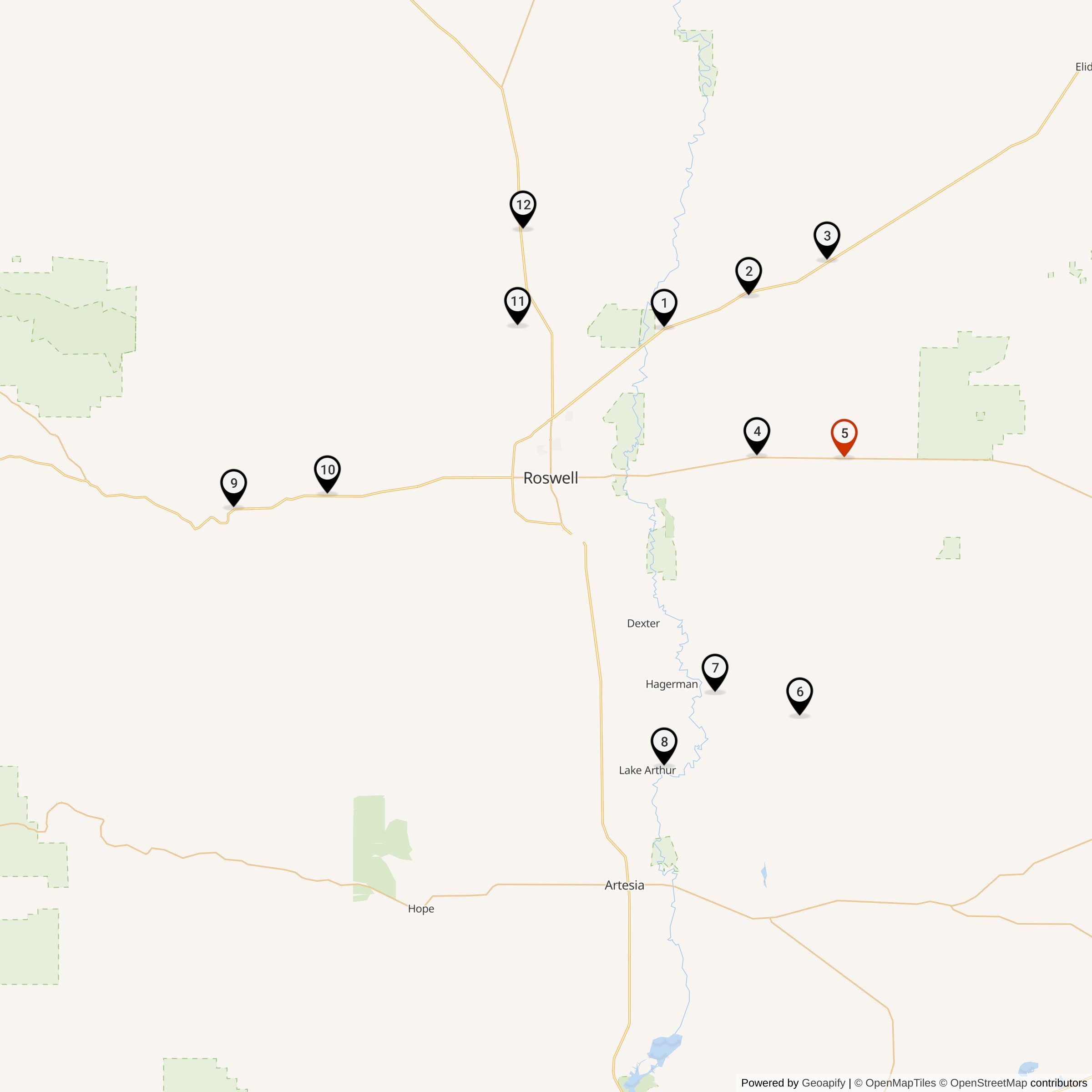
Read about the Atlas at Walker AFB
All Atlas Missile Silo Locations