
Atlas F Site 579-9 Missile Silo, Picacho New Mexico
Longitude: -105.035338401119
Site Type: Atlas F vertical silo launch facility
Missile Type: SM-65F Atlas
Missile Assigned to this Silo: GD mfg 76F; GD serial 61-2562; AF tail 562
Number of Launchers/Missiles: 1
Parent Base: Walker AFB
Missile Wing: 6th Strategic Aerospace Wing
Missile Squadron: 579th Strategic Missile Squadron
Corps of Engineers Site ID: 6
Approximate Base Size: 5.48 actual missile-facility acres; DOD acquired 333.28 acres total (234 withdrawn public-domain acres plus 93.8 easement acres)
Current Site Use: Former Atlas F launch complex near Picacho; EPA/NMED/USACE Ready for Reuse determination covers surface property for current/anticipated industrial operation; current physical use not independently reverified.
Site Ownership: Former USAF/DOD; Bonham Farm Inc. purchased the property from GSA in March 1968; current ownership not reverified.
Accessible: No public access; treat as private property and a hazardous former missile/industrial site; do not trespass.
Atlas F Site 579-9 sat where the Roswell missile field reached west into the harsher country near Picacho. It was built for a moment when the United States wanted nuclear missiles hidden in hardened concrete silos, dispersed far from their parent base, ready to be brought through an exacting liquid-oxygen launch sequence on short notice. But Site 579-9 also tells the afterlife story of the Atlas program unusually well: after the missile years ended, the federal government sold the property, environmental investigators studied the underground tank area, sump outfall, and septic leachfield, and EPA, the New Mexico Environment Department, and the U.S. Army Corps of Engineers later issued a Ready for Reuse determination for the surface property.
Atlas F Site 579-9 was an SM-65F Atlas intercontinental ballistic missile launch complex assigned to Walker Air Force Base near Roswell, New Mexico. It belonged to the 579th Strategic Missile Squadron, under the 6th Bombardment Wing, later the 6th Strategic Aerospace Wing. The site code was 579-9. Its missile system was the SM-65F Atlas, the final operational Atlas ICBM variant and the model deployed in hardened vertical silo-lift launch complexes.
Because Site 579-9 was an Atlas F complex, it did not have a separate Minuteman-style remote parent Launch Control Center. An Atlas F launch complex contained its own launch control center on site, connected to the missile silo by an underground tunnel.
Location, Landscape, and Site Description
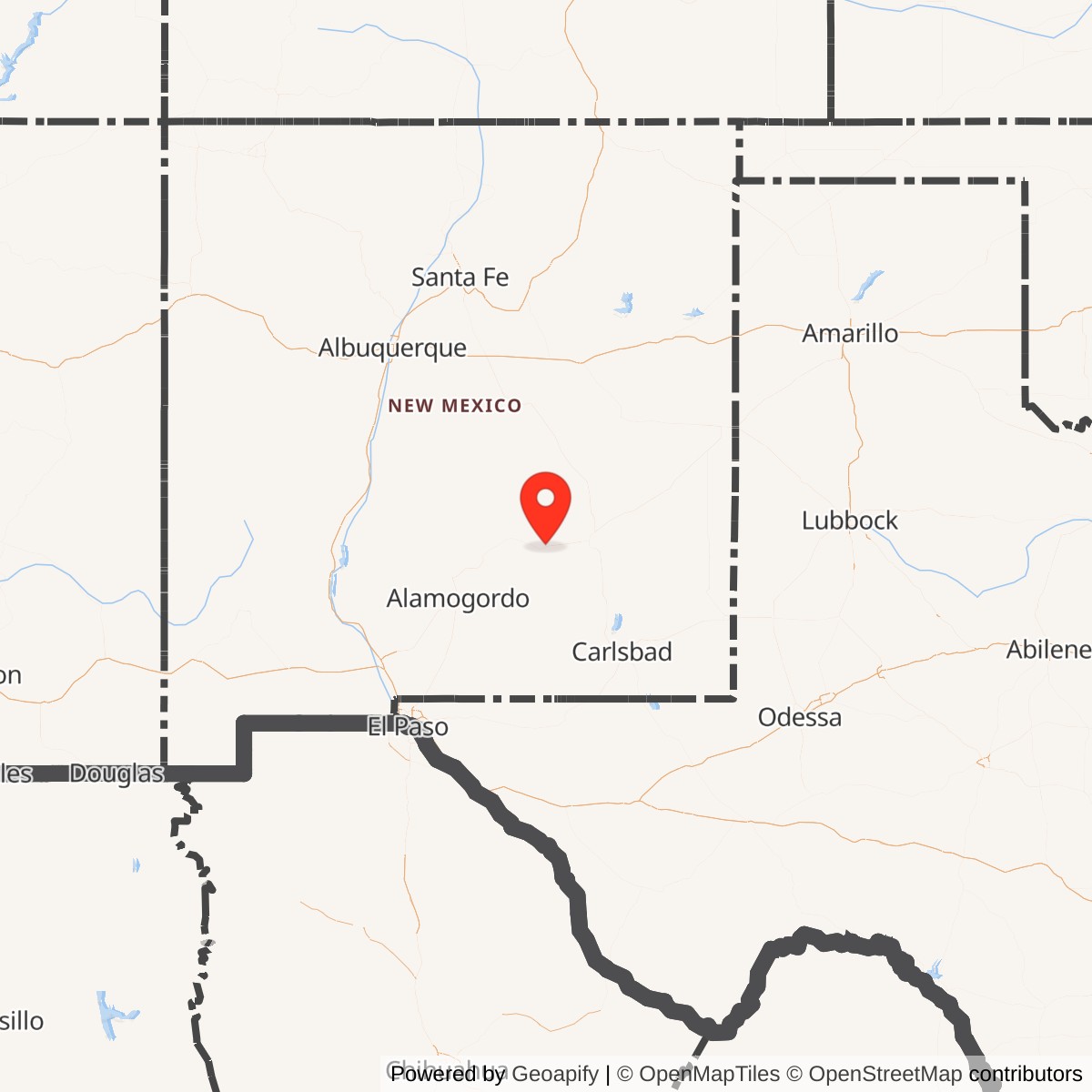
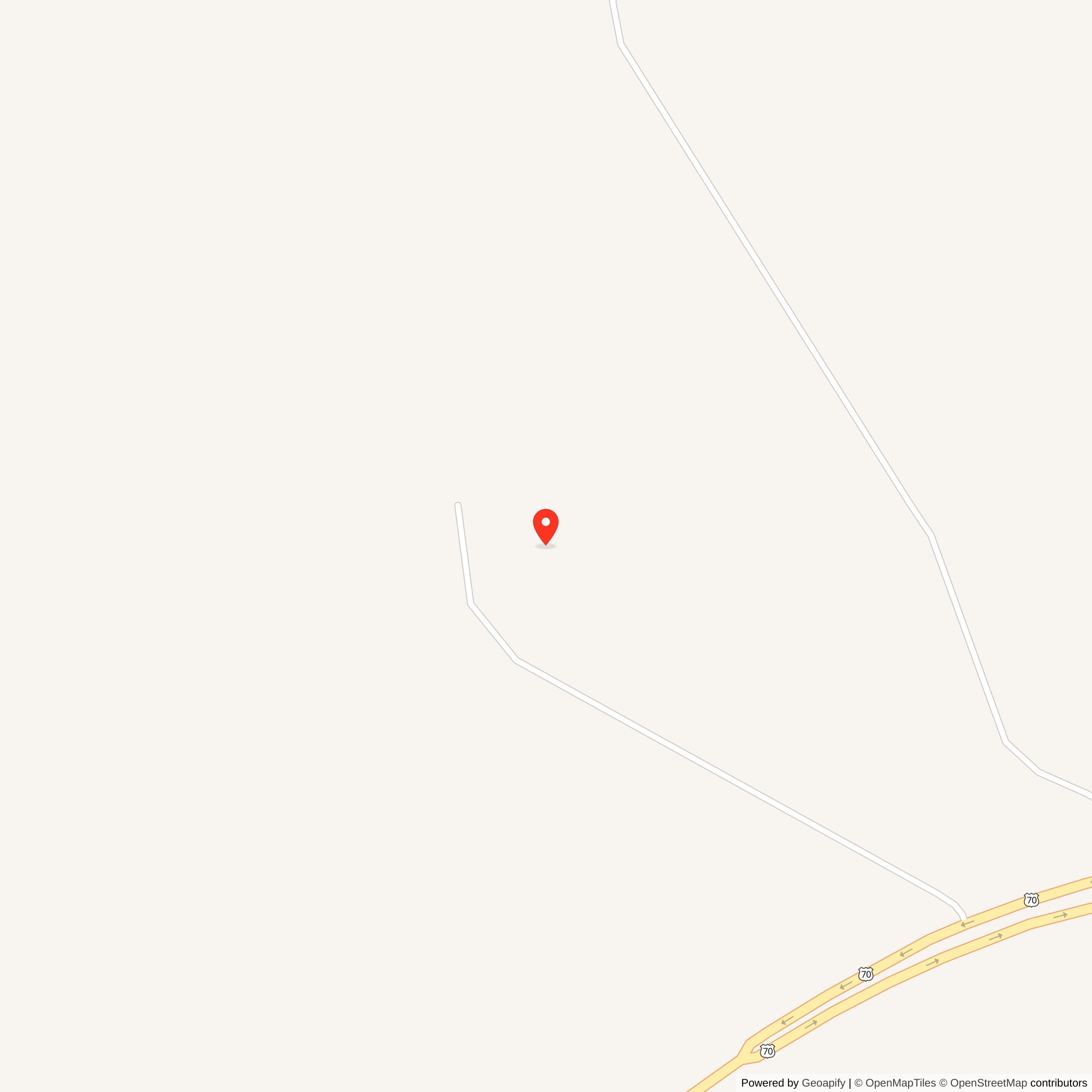
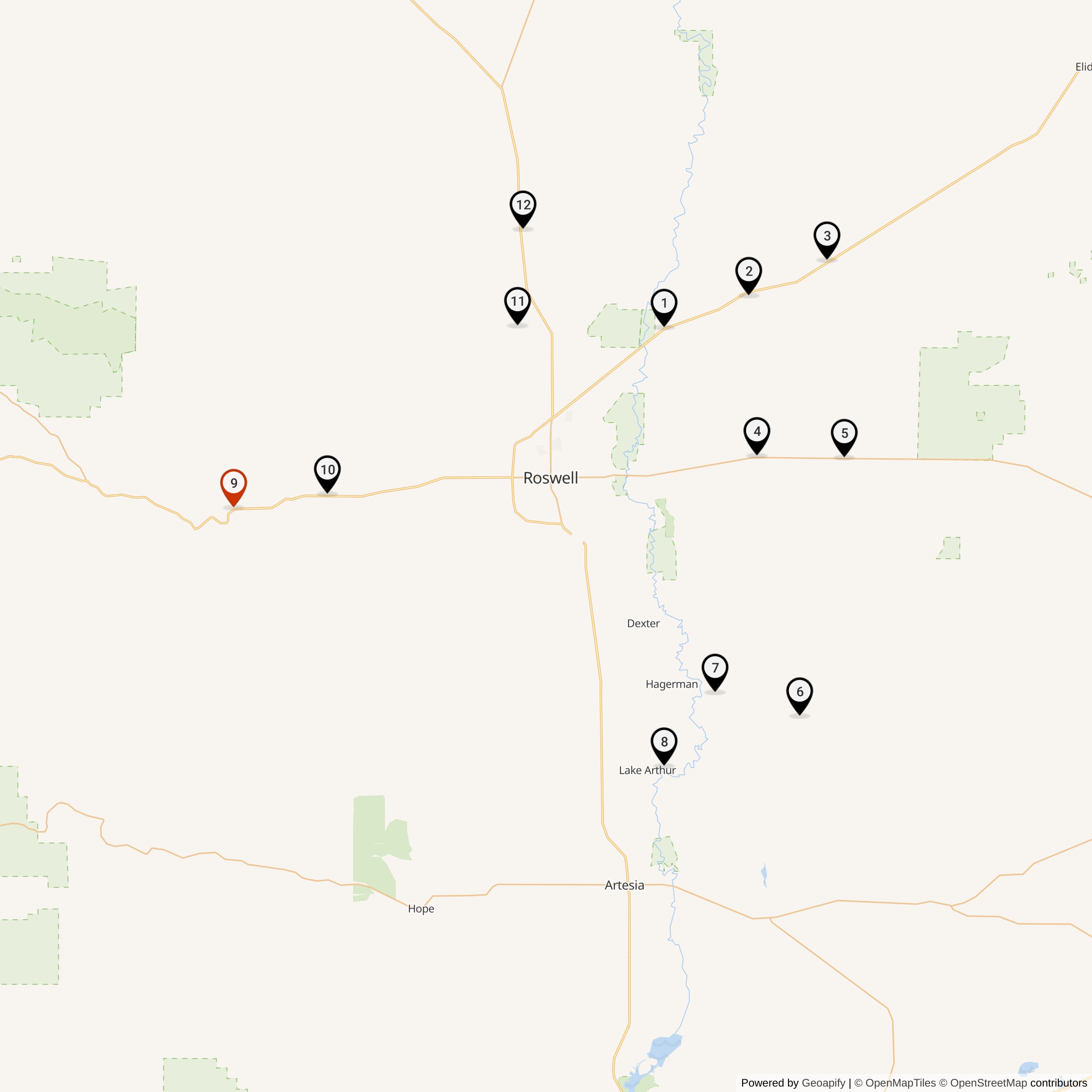
Site 579-9 was located west of Roswell along the U.S. Highway 70/380 corridor, in the rural country associated with Picacho. EPA's 2009 Ready for Reuse determination described the former Atlas Missile Silo Site 9 as approximately 30 miles west of Roswell, New Mexico, along U.S. Highway 70/380. This is a different setting from the eastern and southeastern Walker sites near Hagerman and Lake Arthur. Instead of the lower Pecos Valley agricultural landscape, Site 579-9 lay in drier, more broken country on the western side of the Walker missile field, where desert scrub, ranch land, arroyos, ridges, and scattered rural roads made the complex isolated but still accessible from the highway corridor.That isolation was part of the point. The twelve Walker Atlas F launch complexes were dispersed around Walker Air Force Base so that no single attack could destroy the entire squadron. Site 579-9 helped spread the 579th Strategic Missile Squadron's missile force into a broad ring around Roswell. Walker Air Force Base provided headquarters, maintenance, security, transportation, supply, communications, and weapons-support infrastructure, but the actual missiles were deliberately separated from the base and from each other.
The physical Atlas F complex was much more substantial than a simple underground tube. A 1962 Walker Atlas F tour bulletin described the standard Walker launching facility as consisting of a launching silo, a launch control center, and an underground connecting tunnel. The silo had an inside radius of 26 feet, 1 inch, meaning an inside diameter of roughly 52 feet, 2 inches, and extended about 178 feet deep. The launch control center had a 40-foot inside diameter. The missile and associated equipment were carried in a steel crib suspended from shock mounts inside the silo, and the launch control center also used suspended floors. These design features reflected the Atlas F requirement for blast resistance, shock isolation, and survivable launch control.
Above ground, Site 579-9 would have included the elements typical of an Atlas F launch complex: access road, security fencing, surface entries, ventilation and utility features, antennas or communications-related equipment, parking and hardstand areas, power and support structures, and the large silo-door area over the launcher. Satellite images show the former complex footprint near Picacho. The visible pattern is characteristic of a former Atlas F site: disturbed rectangular surface area, the circular silo-related feature, access traces, and remnants of the support layout.
Strategic and Cold War Context
Site 579-9 existed because the early Cold War demanded a missile force that could reach intercontinental targets and survive long enough to be credible. Atlas was the Air Force's first operational intercontinental ballistic missile family. It was a first-generation system, and its engineering showed both the urgency and the limits of the period. Atlas used a pressure-stabilized stainless-steel airframe that had to remain pressurized to avoid structural collapse. The missile used RP-1 kerosene fuel and liquid oxygen oxidizer, a combination that made the missile powerful but operationally demanding. Compared with later solid-fueled Minuteman missiles, Atlas required far more hands-on maintenance, more careful propellant handling, and a more elaborate countdown.The Atlas F was the most advanced operational Atlas variant. Unlike Atlas D gantry and coffin-launcher arrangements and Atlas E semi-hardened coffin sites, Atlas F was stored vertically underground in a hardened silo-lift complex. The National Park Service summarizes Atlas F as an 82-foot missile held in a blast-proof silo-lift configuration and capable of launch in approximately ten minutes. Seventy-two Atlas F missiles were deployed at six bases, including twelve at Walker Air Force Base in New Mexico.
Site 579-9 was therefore not a local defense site for Picacho or Roswell. It was part of a national nuclear deterrent. Its rural location, hardened silo, buried launch control center, communications systems, security perimeter, and separation from the other eleven Walker sites all served the same strategic goal: dispersal and survivability. The site existed to make the Walker Atlas force harder to destroy and to give Strategic Air Command another launch complex capable of supporting a retaliatory strike if ordered by national command authority.
The phrase "operational launch-ready alert posture" requires careful explanation for Atlas F. It did not mean that the missile was continuously raised above ground. It also did not mean that the missile was continuously loaded with liquid oxygen. In normal alert conditions, the Atlas F sat vertically underground on its elevator launcher. RP-1 fuel was kept aboard. The missile and facility were maintained in readiness, and the missile's pressurization, electrical, propellant, environmental, communications, and safety systems had to be monitored. Launch crews, maintenance teams, and security forces supported the site through the squadron structure. Liquid oxygen would be loaded as part of the launch sequence. The silo doors would open, the launcher would raise the missile, and the crew could top off liquid oxygen during a short hold before the final launch command. During a crisis, readiness meant that crews, communications, propellant systems, facility systems, security, and missile hardware were brought to the highest practical state of serviceability within the limits of the Atlas F design. It did not mean a continuously exposed or continuously LOX-loaded missile waiting above the silo.
Construction and Activation
The Walker Atlas F missile field was built at national-emergency speed. A 1962 Army Corps of Engineers tour bulletin stated that the decision to build Atlas launching facilities in the Roswell area was reached in early January 1960. The Albuquerque District Office was asked to conduct soil investigations to determine whether local geology would support the proposed installations. Spencer J. Buchanan Company and Gordon Herkenhoff & Associates performed those investigations, and the results were favorable.Design began in early March 1960. The project was advertised for bids on 1960-05-16, bids were opened on 1960-06-15, and the construction contract was awarded on 1960-06-16. The $22,125,828 contract went to a joint venture of Macco Corporation, Raymond International, Inc., The Kaiser Company, and Puget Sound Bridge & Dry Dock Company. Notice to proceed followed on 1960-06-20, and work began on 1960-06-23.
Site 579-9 was one of twelve Atlas F launch complexes in that Walker construction program. It was Corps of Engineers Construction Site Number 6. EPA's Ready for Reuse determination states that the U.S. government acquired multiple tracts of land for development of Silo Site 9 from the State of New Mexico between May 1960 and August 1962. Of the 333.28 acres acquired by the Department of Defense for Site 9 development, the actual missile facility occupied 5.48 acres, 234 acres were withdrawn from the public domain, and 93.8 acres were acquired through easements. EPA states that construction of the missile launching facility was completed in October 1961.
The 579th Strategic Missile Squadron was organized at Walker Air Force Base on 1961-09-01. Public sources do not provide a precise day on which Site 579-9 itself was accepted or placed on alert. Squadron-level material gives 1962-11-30 as the date associated with turnover to Strategic Air Command and operational status. In practical terms, Site 579-9 became part of the Walker Atlas F operational system during the 1962 buildup of the 579th Strategic Missile Squadron.
Missile System and Technical Role
Site 579-9 housed an SM-65F Atlas ICBM, a liquid-fueled, pressure-stabilized missile designed to carry a nuclear reentry vehicle to intercontinental range. Public museum and historical sources identify the Atlas E/F reentry vehicle as the Mark 4, built by AVCO, and the Smithsonian National Air and Space Museum describes the Mark 4 as a reentry vehicle used on Titan I and Atlas E/F missiles, carrying a W-38 nuclear warhead with a yield of about 3.75 megatons. The National Park Service describes the Atlas F as taller than earlier Atlas models and as carrying a 4.5-megaton warhead; the difference reflects public-source variation in how the Atlas F warhead/RV combination is summarized.The Atlas F silo-lift system defined Site 579-9's technical role. The missile was stored vertically underground, protected by the hardened silo. In a launch sequence, the silo doors would open and the elevator launcher would raise the missile to the surface before firing. This was not a "hot launch" from inside the silo. It was a lift-to-launch design, an intermediate step between exposed launch pads and later missiles that remained fully underground until launch.
The site itself was not normally a large barracks or continuously crewed base. The launch control center was part of the individual launch complex, and the launch crew worked from the buried control center when the site was on alert. Maintenance personnel, propellant teams, communications specialists, security police, and other support personnel came to the site as needed from the squadron and base support structure. The site depended on Walker Air Force Base for supply, command, heavy maintenance, security organization, training, and overall missile-field support.
The sites assigned missile was General Dynamics missile serial number 61-2562, manufacturing number 76F, Air Force missile tail number 562. The missile was accepted on 1962-05-25 and delivered on 1962-06-08. After its operational ICBM service, the same missile later entered the ABRES test program. Missile 76F launched successfully from Vandenberg Air Force Base's Gantry A-2 on 1971-08-06, carrying an ABRES OV1-20 / OV1-21 payload, it was the last Atlas missile launched from the Vandenberg A-2 gantry complex.
Operational History
Site 579-9's active life was brief, but it belonged to one of the most intense periods of Strategic Air Command missile operations. The 579th Strategic Missile Squadron had twelve dispersed Atlas F sites around Walker Air Force Base. It operated within a mixed bomber-and-missile wing environment at Walker, first under the 6th Bombardment Wing and then under the 6th Strategic Aerospace Wing after the wing redesignation.For Atlas F crews, alert duty involved more than waiting for an order. The site had to keep a complex liquid-fueled missile, a buried launch control center, a deep silo, an elevator launcher, safety systems, environmental systems, and communications systems functioning under tight readiness standards. RP-1 fuel, cryogenic liquid oxygen support systems, missile pressurization, electrical readiness, ground-support equipment, and command-and-control links all mattered. Security personnel had to control access to a remote nuclear launch complex. Maintenance and propellant personnel had to work with hazardous materials in an environment that combined ordinary rural isolation with extraordinary strategic importance.
The Cuban Missile Crisis in October 1962 came as the Walker Atlas F force was moving into operational status. The 579th squadron's Atlas missiles were placed in an operational launch-ready alert posture during the crisis. For an Atlas F site such as 579-9, that meant the missile and facility were held at the highest practical readiness state, launch crews and support personnel were prepared for rapid action, communications and command links were maintained, security was heightened, and propellant and launch-support systems were readied for the launch sequence. It did not mean the missile was continuously raised above the silo, and it did not mean continuous liquid-oxygen loading.
The Walker Atlas F field also had a sobering safety history. Three sister sites in the same squadron were destroyed in propellant-loading explosions: Site 579-1 on 1963-06-01, Site 579-5 on 1964-02-13, and Site 579-2 on 1964-03-09. These were not Site 579-9 accidents. Their relevance is that they show the hazards of the Atlas F operating environment at Walker: large quantities of propellant and oxidizer, complex ground-support systems, deep silo structures, and high-pressure Cold War readiness all existed in close proximity.
Deactivation and Disposal
Atlas F was overtaken quickly by solid-fueled ICBM technology. By 1964, the logic that had made Atlas urgent in 1960 was changing. Minuteman offered quicker reaction, easier alert maintenance, solid propellant, and a more sustainable long-term posture. In November 1964, Secretary of Defense Robert S. McNamara announced that the remaining first-generation Atlas missiles would be phased out by the end of June 1965.For the 579th Strategic Missile Squadron, phaseout came early in 1965. Prior histories and source compilations for the Walker field identify 1965-01-05 as the date the first 579th SMS ICBM was taken off alert, 1965-02-04 as the date the last 579th SMS ICBM was taken off alert, and 1965-02-09 as the date the last 579th SMS ICBM was shipped. The larger Atlas F force then disappeared from operational SAC service as the first-generation Atlas system left the inventory.
The post-service property record for Site 579-9 is unusually specific. EPA states that in May 1964 the Department of Defense announced that the Atlas F missile program was to be phased out. In February 1966, Site 9 was declared excess to the General Services Administration. Bonham Farm Inc. purchased the property from GSA in March 1968. EPA's determination does not document the complete physical disposition of the underground launch equipment, missile removal from the complex, sealing details, or any later private modifications to the silo, launch control center, tunnel, or surface structures.
Site 579-9 was not a Strategic Arms Reduction Treaty demolition site in the later Minuteman or Peacekeeper sense. Its deactivation preceded the START-era ICBM silo elimination procedures. Its post-military history instead belongs to Cold War base closure, federal property disposal, environmental investigation, and surface-property reuse.
Current Status and Site Use
Site 579-9 is a decommissioned former Atlas F launch complex and former federal property near Picacho, New Mexico, at approximately 33.354054, -105.035338. It should be treated as private property with no public access. The site is not an active military installation.EPA's 2009 Ready for Reuse certificate states that the former Atlas Missile Silo Site 9 surface property was determined ready for reuse and that environmental conditions on the surface property were protective for current and anticipated future use as an industrial operation. This determination applies to the surface property and the environmental record reviewed by EPA, NMED, and USACE. It does not mean the underground missile structures are safe for public exploration, and it does not grant public access.
Former Atlas F sites may contain dangerous underground structures, confined spaces, standing water, old utilities, debris, unstable openings, and residual industrial hazards. EPA's Site 9 determination specifically notes that groundwater was not encountered within the study boundary to 250 feet below ground surface and that there was no water in the silo at the time of the site investigation reporting.
Publicly available imagery shows that the former complex remains physically legible. The image shows the former missile-site footprint and the circular silo-related feature within a rural landscape. The current day-to-day use, ownership beyond the documented Bonham Farm Inc. purchase, and condition of underground structures were not independently reverified from county records.
Chronology
- 1960-01 The decision to build Atlas launching facilities in the Walker/Roswell area was reached, and the Albuquerque District was asked to perform soil investigations.
- 1960-03 Design work for the Walker Atlas launching facilities began after favorable soil investigations.
- 1960-05-16 The Walker Atlas F construction project was advertised for bids.
- 1960-05 EPA later reported that the U.S. government began acquiring land tracts for Silo Site 9 development from the State of New Mexico between May 1960 and August 1962.
- 1960-06-15 Bids for the Walker Atlas F construction project were opened.
- 1960-06-16 A $22,125,828 construction contract was awarded to the joint venture of Macco Corporation, Raymond International, Inc., The Kaiser Company, and Puget Sound Bridge & Dry Dock Company.
- 1960-06-20 Notice to proceed was issued for the Walker Atlas F construction project.
- 1960-06-23 Work began on the Walker Atlas F launching facilities.
- 1961-09-01 The 579th Strategic Missile Squadron was organized at Walker Air Force Base, New Mexico.
- 1961-10 EPA's Ready for Reuse determination states that construction of the Site 9 missile launching facility was completed in October 1961.
- 1962-05-25 Missile 76F, serial number 61-2562 and Air Force tail number 562, associated with Site 579-9, was accepted.
- 1962-06-08 Missile 76F / tail number 562 was delivered.
- 1962-08 EPA later reported that the U.S. government completed the main period of land acquisition for Site 9 development in August 1962.
- 1962-10 During the Cuban Missile Crisis, operational 579th Strategic Missile Squadron sites were held at a high level of alert; for Atlas F, this did not mean a continuously raised or continuously liquid-oxygen-loaded missile.
- 1962-11-30 The 579th Strategic Missile Squadron history records turnover to Strategic Air Command and operational status on this date.
- 1963-06-01 Walker Atlas F Site 579-1 was lost in an explosion; this was a sister-site event, not a Site 579-9 event.
- 1964-02-13 Walker Atlas F Site 579-5 was lost in an explosion; this was a sister-site event, not a Site 579-9 event.
- 1964-03-09 Walker Atlas F Site 579-2 was lost in an explosion; this was a sister-site event, not a Site 579-9 event.
- 1964-05 EPA later reported that DOD announced in May 1964 that the Atlas F missile program was to be phased out.
- 1964-11-18 The Defense Department announced accelerated phaseout of liquid-fueled missiles, including the remaining Atlas force, because of the increased reliability of solid-fueled systems.
- 1965-01-05 The first 579th Strategic Missile Squadron ICBM was taken off alert.
- 1965-02-04 The last 579th Strategic Missile Squadron ICBM was taken off alert.
- 1965-02-09 The last 579th Strategic Missile Squadron ICBM was shipped.
- 1965-03-25 The 579th Strategic Missile Squadron was inactivated.
- 1966-02 EPA's Ready for Reuse determination states that Silo Site 9 was declared excess to the General Services Administration in February 1966.
- 1968-03 EPA's Ready for Reuse determination states that Bonham Farm Inc. purchased the Site 9 property from GSA in March 1968.
- 1971-08-06 Missile 76F / tail number 562, formerly associated with Site 579-9, launched successfully from Vandenberg Air Force Base's A-2 gantry on an ABRES OV1-20 / OV1-21 mission.
- 2005 USACE conducted a Site Inspection for Silo Site 9 under the Defense Environmental Restoration Program; the soil assessment examined potential source areas including the former underground storage tank area, sump outfall, and septic leachfield.
- 2006-01-26 The Final Preliminary Assessment Report for Former Walker Air Force Base Atlas F Missile Silo 9, Lincoln County, New Mexico, was listed in EPA's relevant-documents enclosure.
- 2007-09 NMED and USACE issued a Finding of No Defense Action Indicated for Site 9.
- 2009-09-16 EPA Region 6, NMED, and USACE issued a Ready for Reuse determination and certificate for the former Atlas Missile Silo Site 9 surface property.
- 2015-09-30 The USACE FUDS inventory listed WAFB FAC SITE #9 / K06NM0487 in Lincoln County, New Mexico, with Site 01 HTRW.
- 2021 Defense Environmental Restoration Program reporting listed WAFB FAC SITE #9 / NM69799F628200 among properties achieving final response complete before fiscal year 2021.

Read about the Atlas at Walker AFB
All Atlas Missile Silo Locations