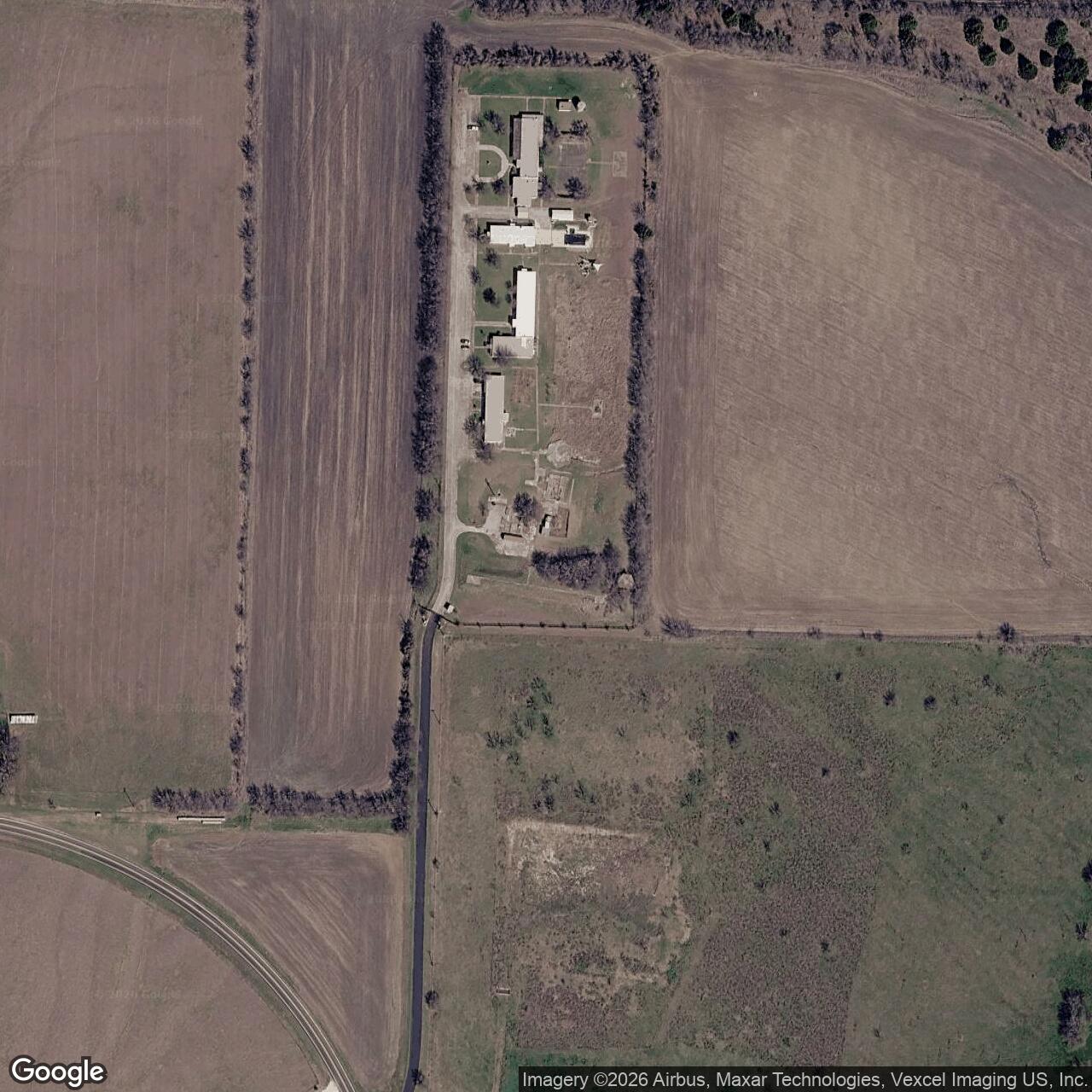
Nike Missile Site DF-50 IFC, Alvarado Texas
Longitude: -97.1669554906607
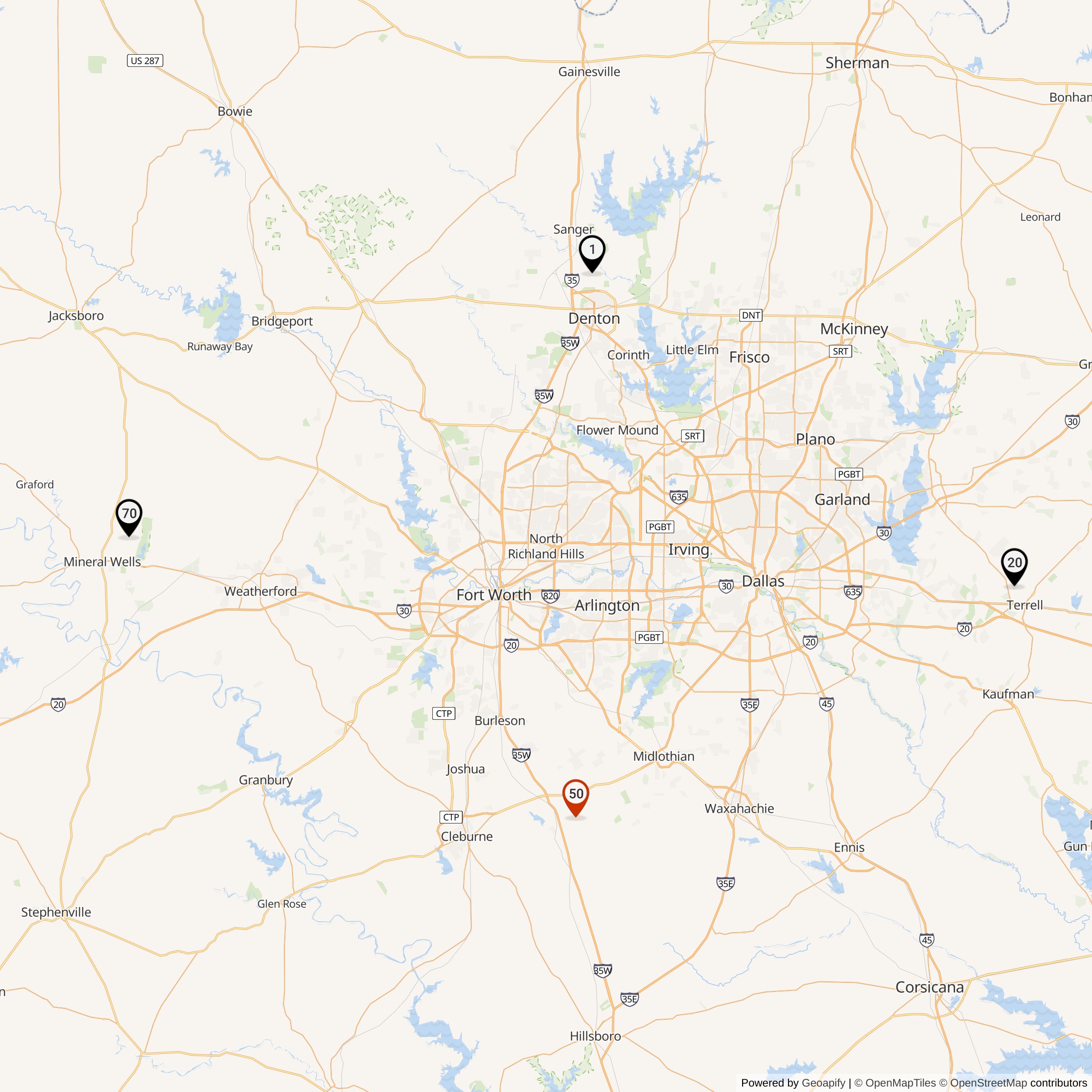
This location was part of the Dallas-Fort Worth Defense Area
Site ID: DF-50
This site controlled the missiles at the Launch Area located here.
Site Role: IFC
A typical Nike air defense site consisted of two separate parcels of land. One area was known as the Integrated Fire Control (IFC) Area. This site contained the Nike system's ground-based radar and computer systems designed to detect and track hostile aircraft, and to guide the missiles to their targets.
The second parcel of land was known as the Launcher Area. At the launcher area, Nike missiles were stored horizontally within heavily constructed underground missile magazines. A large, missile elevator brought the Nikes to the surface of the site where they would be pushed across twin steel rails to one of four satellite launchers.
Elaboration on how Nike worked here.
Missile Type: Ajax/Hercules
The Nike Ajax was the first in the Army's family of guided missiles, and the world's first operational, guided, surface-to-air missile system. Nike Ajax had a burnout speed of Mach 2.3, a range of 25-30 miles, and a ceiling of 65,000 feet.
Designed to carry either nuclear and/or high-explosive warheads, the Nike Hercules missile could attack supersonic aircraft operating at altitudes in excess of 150,000 feet and at a range of more than 87 miles.
Battery Type: single
Current site status: demolished
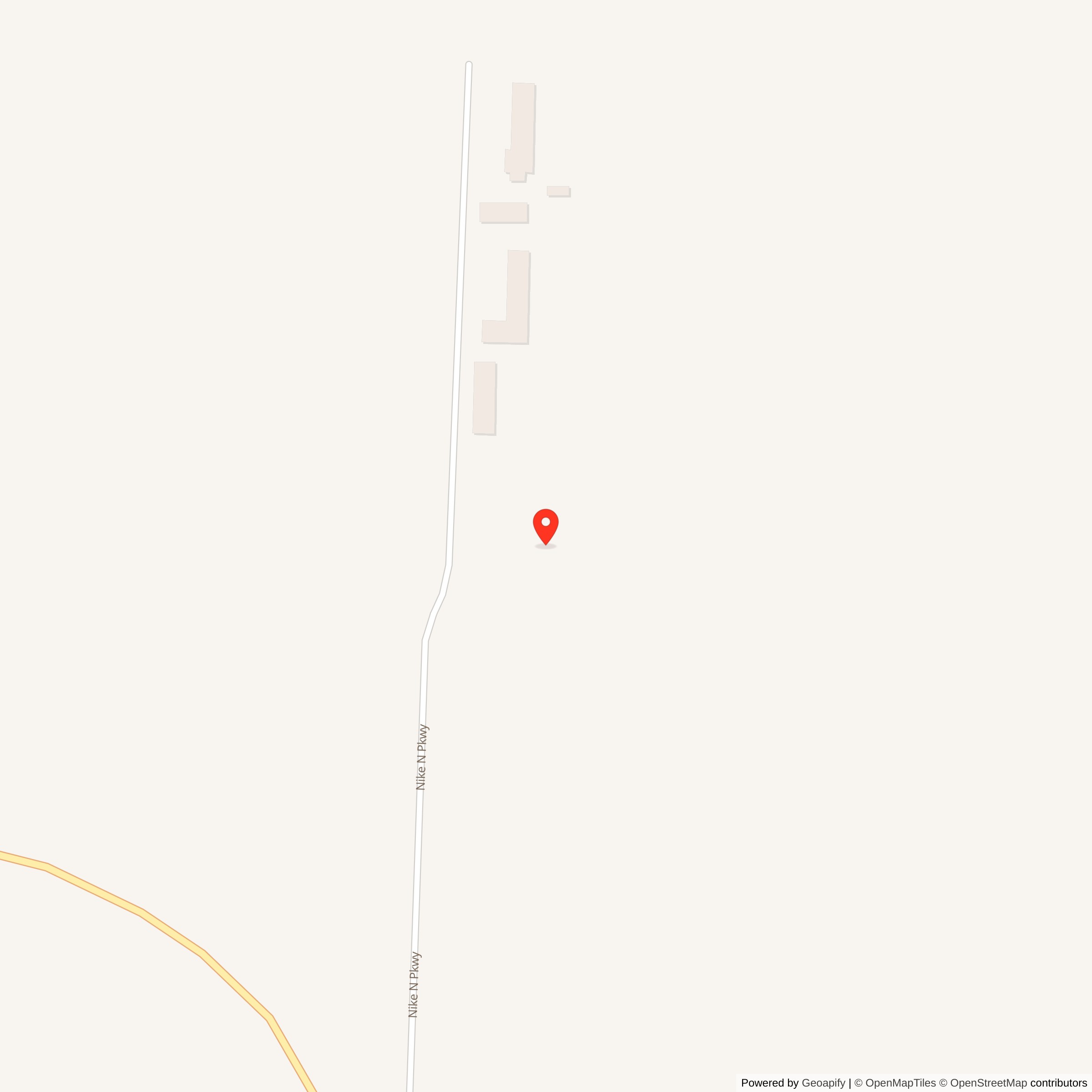
Nike Missile Site DF-50, also written in some later references as D-FW-50, was a former U.S. Army Nike Hercules air-defense battery southeast of Alvarado in Johnson County, Texas. It was part of the Dallas-Fort Worth Defense Area, the inland Nike Hercules network built in the late 1950s to defend the Dallas-Fort Worth metropolitan region, its defense-production plants, transportation infrastructure, and nearby military installations during the Cold War. The best operational listings record DF-50 active from August 1960 to October 1968, with the Dallas-Fort Worth Nike defense deactivated in the 1968-1969 period.
DF-50 was not a conventional base, airfield, depot, or training post. It was a fixed missile battery made up of separated functional components. The Integrated Fire Control area, or IFC, held the acquisition and tracking radars, fire-control vans or buildings, communications equipment, generators, ready facilities, and administrative support needed to detect and engage hostile aircraft. The launch area held the missile magazines, launchers, missile assembly and test facilities, warheading and security areas, support buildings, fencing, and access roads. The separation between the IFC and the launcher was part of the Nike system's design: the IFC needed radar visibility and a clear relationship with the launcher, while the launcher needed a secure site large enough for magazines, explosive safety, and missile handling.
Mission Evolution
DF-50 was built for one principal mission: to defend the Dallas-Fort Worth region from Soviet long-range bomber attack. The Dallas-Fort Worth Nike defense was established during the transition from the first-generation Nike Ajax system to the second-generation Nike Hercules system. Ajax was a conventionally armed surface-to-air missile intended for point defense of major cities and military-industrial targets. Hercules was larger, solid-fueled, longer-ranged, and capable of carrying either a conventional warhead or a nuclear warhead. That made Hercules more suitable for defending a broad metropolitan and industrial region with fewer batteries.The recorded DF-50 configuration was Nike 3D/18H/12L-U. In Nike shorthand, this indicated a Hercules battery with three Type D magazines, eighteen Hercules missiles, and twelve universal launchers. Type D magazines were designed so the site could support either Ajax or Hercules equipment with increased magazine access room; the universal launchers were suited to Hercules-era operation. This configuration makes DF-50 a purpose-built or purpose-fitted Hercules-era battery rather than a small, early Ajax site converted only marginally for later use.
Dallas-Fort Worth was a meaningful Cold War target set because it was more than a population center. Contemporary Nike defense-area descriptions state that the Nike ring protected Dallas and its defense-production facilities. Later historical summaries identify the broader protected complex as including Convair/General Dynamics, Vought, and Bell aircraft plants in Fort Worth and Grand Prairie, government and commercial transportation facilities, rail infrastructure, Carswell Air Force Base with Strategic Air Command forces, Naval Air Station Dallas, and Fort Wolters. DF-50's position southeast of Alvarado gave the regional ring southern coverage, complementing DF-01 near Denton to the north, DF-20 near Terrell to the east, and DF-70 at Fort Wolters to the west.
Operational Role and Command Relationships
DF-50 operated as one battery in a wider Dallas-Fort Worth air-defense system. The four Dallas-Fort Worth Nike Hercules sites were coordinated from Duncanville Air Force Station, where the Army air-defense command-and-control function was collocated with Air Force tracking radars. The command system used BIRDIE, the Battery Integration and Radar Display Equipment system, to coordinate the Nike Hercules batteries with the regional air-defense picture. Duncanville was also tied into the wider Air Force/NORAD air-defense network, including SAGE-supported air-defense coordination.Within that system, DF-50's IFC would have detected, acquired, and tracked hostile aircraft or assigned targets; generated engagement data; tracked the missile after launch; and transmitted firing and guidance commands. The launch area did not independently select or track targets. Its crews maintained and secured the missiles, assembled and checked them, raised them from underground storage when required, and launched them under the fire-control solution directed from the IFC.
A useful oral-history clue identifies the Alvarado site as Battery C, 4th Missile Battalion, 562nd Artillery. One veteran-family account states that a soldier served at the Alvarado site from November 1959 to January 1964 and that the unit was Battery C, 4th Battalion, 562nd Artillery. That same account recalls that, when the site first reached initial operational capability in 1961, it had one Ajax section and two Hercules sections.
Site Layout and Facilities
DF-50's physical arrangement followed the standard Nike pattern, with the IFC/control area separated from the launch area. The IFC sat north of the launch area and contained the radar and fire-control functions. The launch area lay to the south and contained the missile magazines and launcher section. The coordinate separation is roughly one kilometer north-south, which is consistent with a Nike battery layout in which the fire-control radars needed a clear relationship to the launcher while also being placed on suitable terrain for acquisition and tracking.The Dallas-Fort Worth Nike construction program was handled by the U.S. Army Corps of Engineers Fort Worth District. The Corps had to build four Hercules sites for the region: DF-01 north of Denton, DF-20 northeast of Terrell, DF-50 southeast of Alvarado, and DF-70 at Fort Wolters. Contemporary histories state that each Dallas-Fort Worth site required about 30 acres, that construction began in 1958, and that acquisition and construction costs for each site totaled about $1.5 million. Alvarado was specifically singled out in the record because the Fort Worth District had to bring condemnation suits to acquire the land.
The DF-50 launch area's recorded 3D/18H/12L-U configuration means it had three Type D underground magazines supporting eighteen Hercules missiles and twelve universal launchers. In normal operation, missiles were stored horizontally in the magazines. During exercises, alerts, maintenance, or wartime firing preparations, the missile sections could raise missiles to the surface by elevator, move them onto launchers, and elevate them for firing. Hercules missiles launched from ground-level launchers after being raised from storage; the magazines were storage and handling structures, not ICBM-style silos.
The IFC would have included radar towers or pads for acquisition and tracking radars. Later visual accounts noted that the former IFC was still recognizable and that a LOPAR tower was still present at the site during a 2010 visit. LOPAR, the low-power acquisition radar, was one of the radars associated with Nike fire control. Later Hercules sites could also include additional or upgraded acquisition capability depending on the specific defense-area configuration.++
List of all Nike Installations in the Dallas-Fort Worth Defense AreaList of all Nike Installations in Texas