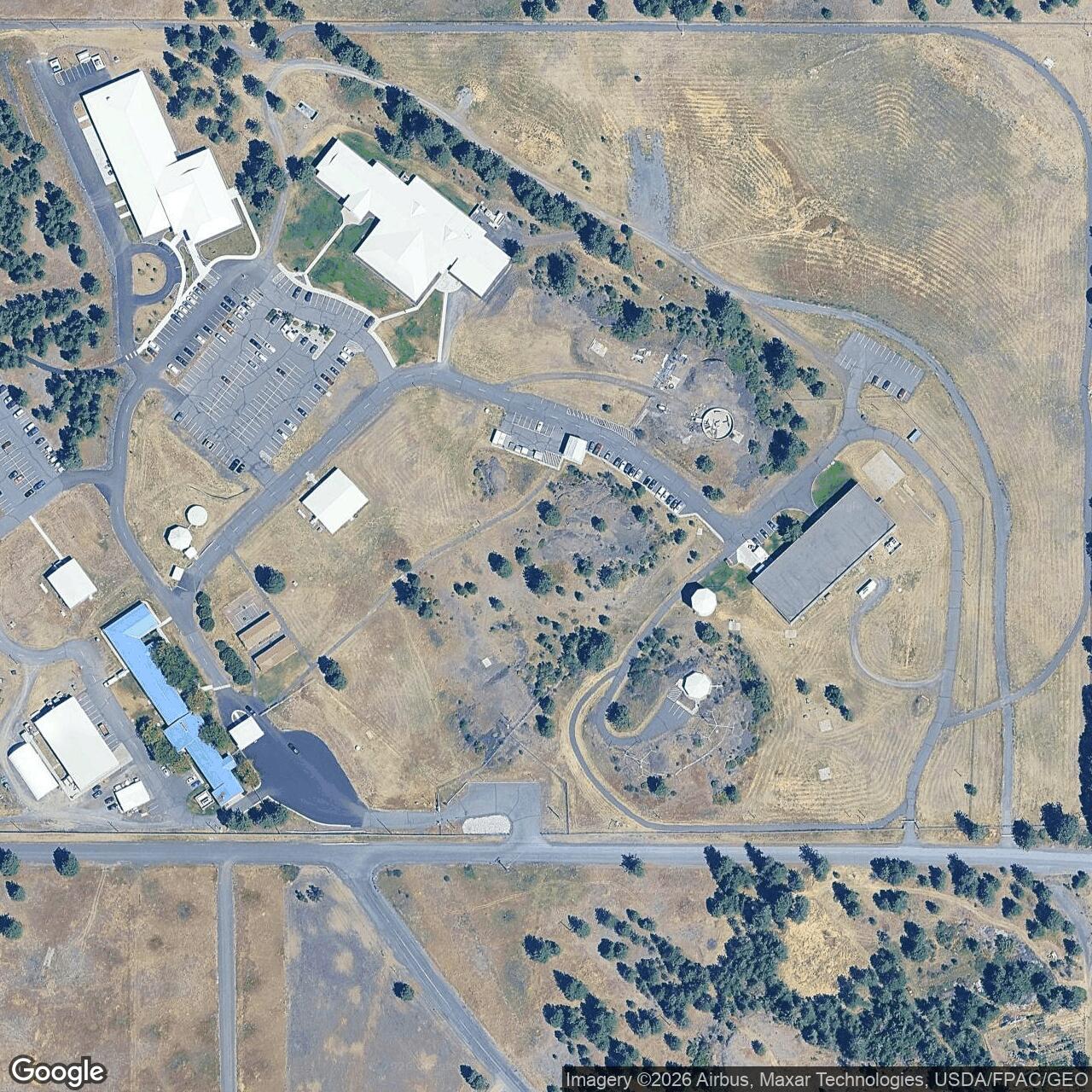
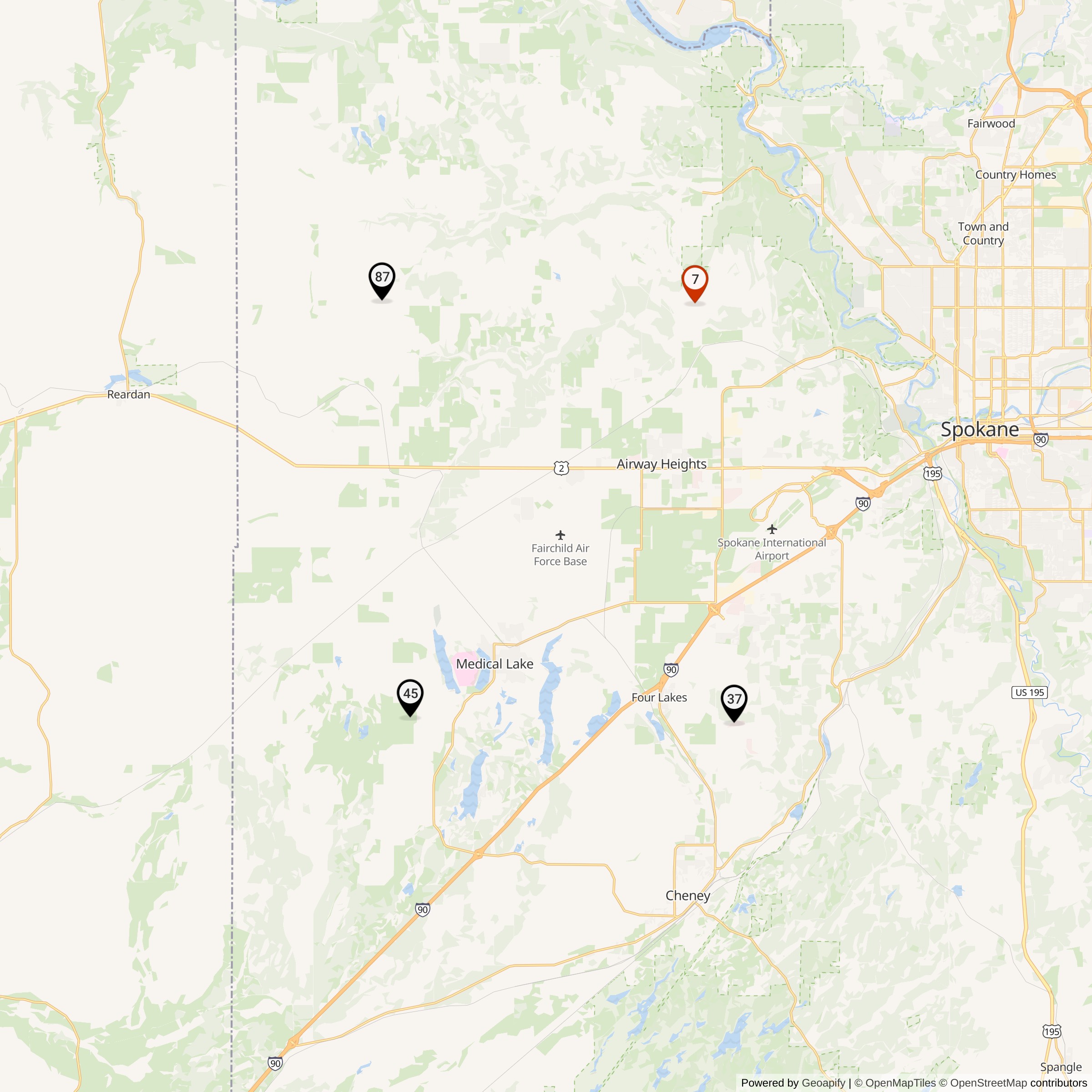
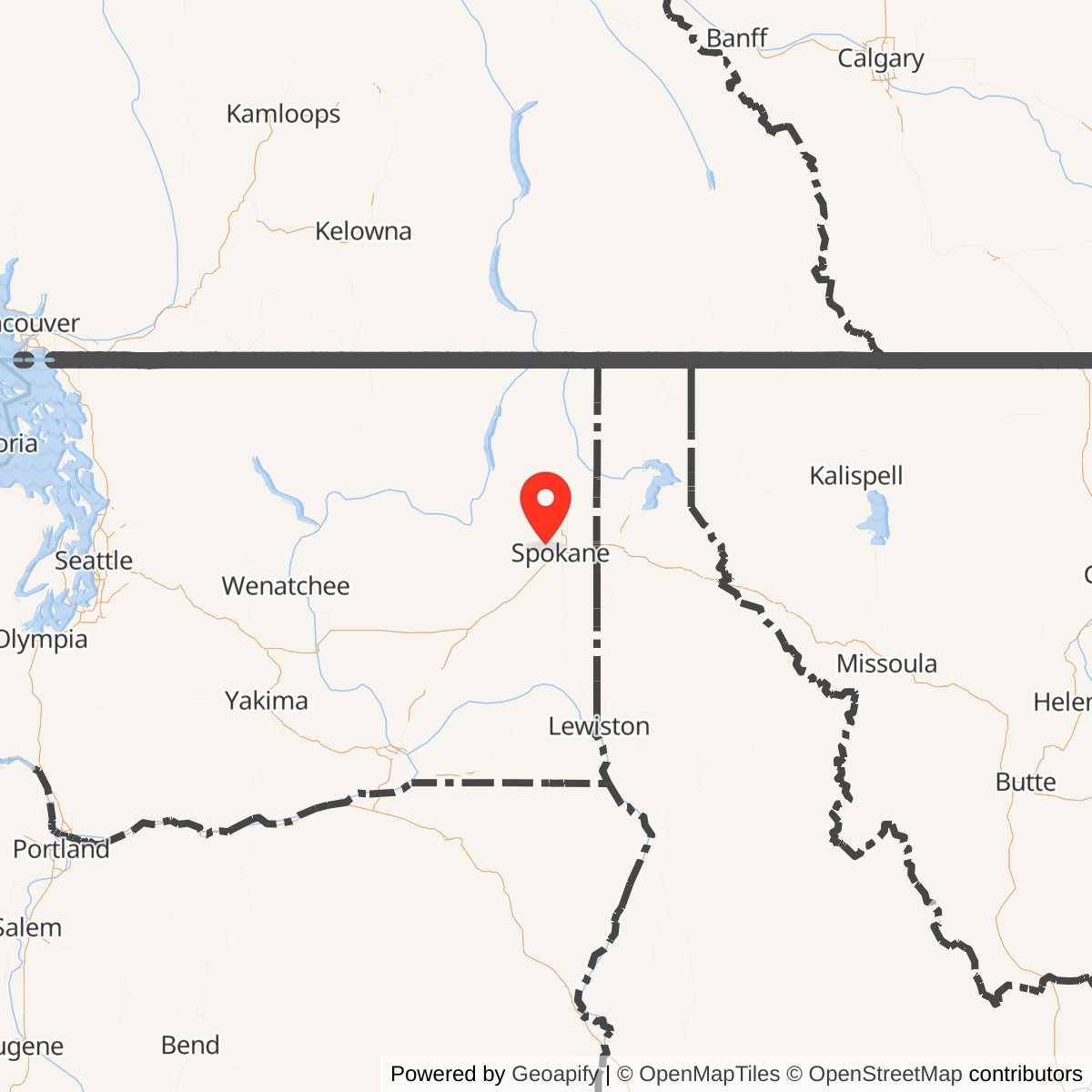
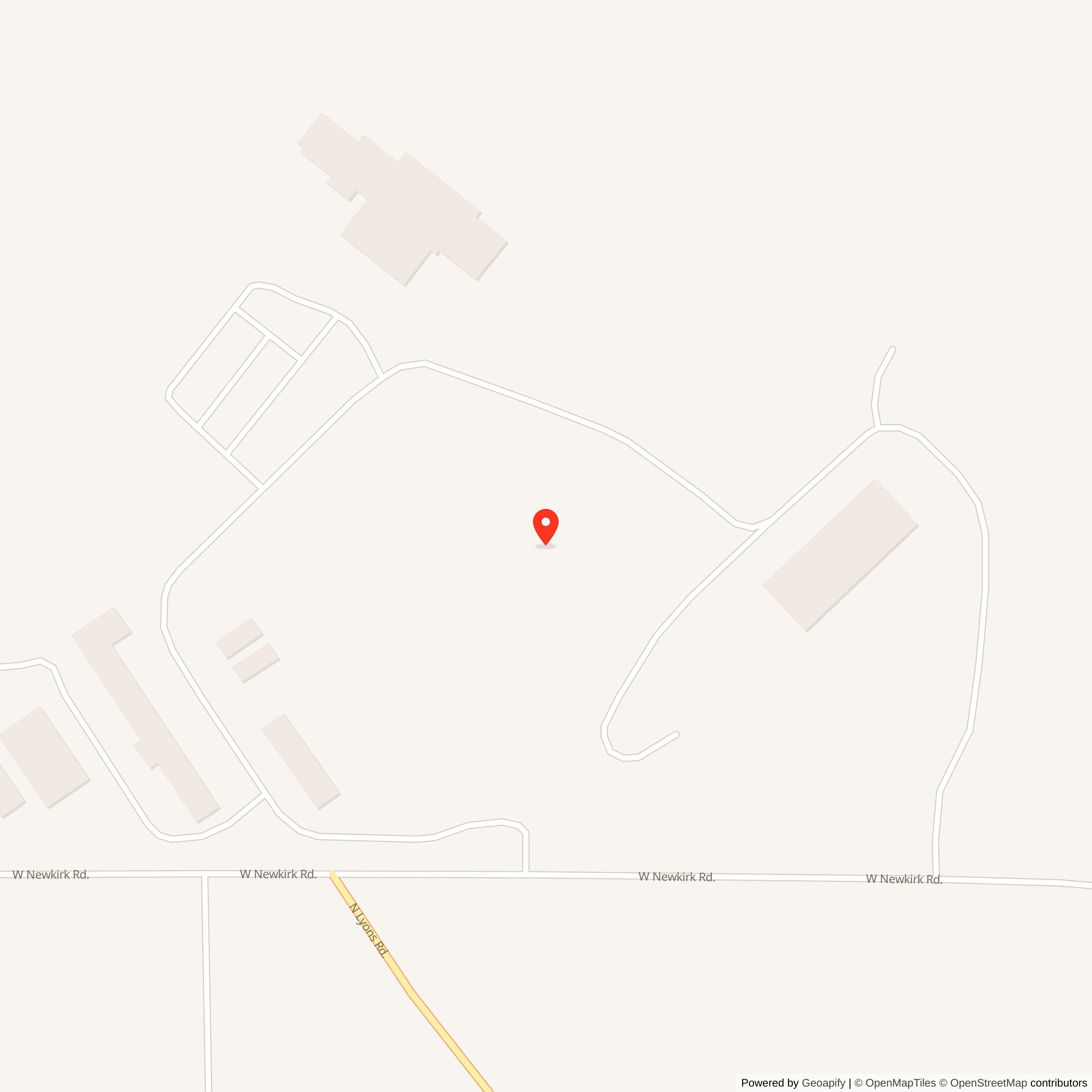
Nike Missile Site F-07 IFC, Spokane Washington
Longitude: -117.57544705600900
This location was part of the Fairchild Defense Area
Site ID: F-07
This site controlled the missiles at the Launch Area located here.
Site Role: IFC
A typical Nike air defense site consisted of two separate parcels of land. One area was known as the Integrated Fire Control (IFC) Area. This site contained the Nike system's ground-based radar and computer systems designed to detect and track hostile aircraft, and to guide the missiles to their targets.
The second parcel of land was known as the Launcher Area. At the launcher area, Nike missiles were stored horizontally within heavily constructed underground missile magazines. A large, missile elevator brought the Nikes to the surface of the site where they would be pushed across twin steel rails to one of four satellite launchers.
Elaboration on how Nike worked here.
Nike Missile Site F-07 was a U.S. Army Nike Ajax surface-to-air missile battery in the Fairchild Air Force Base Defense Area near Spokane, Washington. It was built to help protect Fairchild Air Force Base, then a Strategic Air Command heavy-bomber installation, from Soviet long-range bomber attack. The site is no longer an active Nike missile installation. It served as an operational Nike Ajax battery from 1957 until June 1960 and was not converted to Nike Hercules.
F-07 was the northern/northeastern Fairchild Nike position, commonly described in site histories as the Airway Heights or Spokane site. The battery had two geographically separated tactical components: an Integrated Fire Control (IFC) radar/control area on or near Newkirk Road northwest of Fairchild AFB, and a launcher area southwest of the IFC near Craig Road north of Deno Road. The two areas were separated because Nike missiles depended on a radar-controlled command guidance system: the IFC radars detected, acquired, and tracked hostile aircraft and guided the missile after launch, while the launcher area stored, raised, fueled, and fired the missiles.
F-07 was part of a four-site Nike ring protecting Fairchild Air Force Base and the Spokane military region. The four Fairchild Defense Area batteries were F-07 near Spokane/Airway Heights, F-37 near Cheney, F-45 near Medical Lake, and F-87 at Deep Creek. The sites formed a dispersed surface-to-air missile screen around the SAC base rather than occupying the base itself.
Fairchild's importance explains why the Army built Nike batteries in this part of eastern Washington. The airfield originated during World War II as Spokane Army Air Depot, a repair and supply depot for aircraft returning from the Pacific war. After World War II it became a Strategic Air Command base. By the middle 1950s, Fairchild was transitioning into one of the major SAC bomber and tanker bases in the Northwest. It had hosted B-29 and B-36 forces and then converted to B-52 Stratofortress bombers beginning in 1956; KC-135 aerial refueling aircraft followed in 1958. The same air base later hosted Atlas E intercontinental ballistic missiles under the 567th Strategic Missile Squadron, but F-07 itself was part of the Army air-defense layer, not the Air Force strategic-missile force.
The Fairchild Nike mission was a Cold War point-defense mission. Nike Ajax batteries were not intended to deter attack by threatening retaliation; they were intended to intercept attacking aircraft if deterrence failed. Fairchild's bomber, tanker, nuclear-support, and later missile-related functions made it an obvious target in a strategic war. The Nike sites gave the region a local defensive system capable of engaging high-altitude bomber formations before they could attack the air base or associated Spokane-area military infrastructure.
Nike Ajax Configuration and Physical Layout
F-07 was an Ajax-only site with the federal missile-type code Nike 2B,1C/30A/12L-A. That code indicates a conventional Nike Ajax battery layout with two type-B magazines, one type-C magazine, a 30-Ajax missile storage allowance, and twelve Ajax launchers. It was not modernized for Nike Hercules and did not receive the larger nuclear-capable Hercules missile.The launcher area contained the underground magazines, elevators, launch rails, missile handling areas, fueling-related facilities, generator and support buildings, security fencing, and roads required to support Nike Ajax launch operations. Nike Ajax was a two-stage missile with a solid booster and liquid-fueled sustainer. Because Ajax used volatile liquid propellants and a conventional high-explosive fragmentation warhead, the launch area required careful separation of storage, fueling, handling, and launch functions.
The IFC/control area contained the tactical radars and fire-control equipment. A typical Nike Ajax IFC area included an acquisition radar, target-tracking radar, missile-tracking radar, identification-friend-or-foe equipment, command and plotting vans or buildings, generator support, administrative space, barracks or nearby support facilities, and radar towers or pads where the local terrain required better line of sight. The IFC's job was to acquire the incoming target, track both target and missile, compute an intercept solution, and transmit guidance commands to the missile in flight.
Construction and Activation
The Army Corps of Engineers conducted surveys in 1954 to select tactical locations for the Fairchild ring. The key requirements were line of sight between launcher and IFC, radar coverage over expected approach routes, sufficient separation from civilian development, road access, and enough land for underground magazines, radar positions, support buildings, and security buffers. Construction of the four Fairchild Nike batteries began in April 1956, and the Fairchild Defense Area sites went into service in January 1957.F-07 became operational in 1957.
Operational Role
During its short operational life, F-07 formed part of the first Fairchild Nike Ajax ring. The battery's mission was to defend the SAC base and surrounding military installations from bomber attack. In practice, that meant maintaining radars, missiles, generators, communications, and launcher crews at a high state of readiness; conducting continuous or near-continuous air-defense watch; coordinating with regional air-defense command posts and Air Force radar direction centers; and participating in Army air-defense training and evaluation.Nike Ajax batteries were organized so that the IFC and launcher crews functioned as one tactical unit. If the IFC acquired a hostile aircraft, it would track the target and assign a missile. The launcher crew would raise the missile to firing position, and after launch the IFC would guide the missile by radio command toward an intercept point. The Ajax warhead did not have to physically strike the aircraft; it was designed to detonate near the target and destroy or disable it with fragmentation.
F-07's short life reflected the rapid technological change of the late 1950s. The original Nike Ajax network was built quickly to counter the perceived bomber threat. By the end of the decade, however, Nike Hercules provided longer range, higher altitude capability, and the possibility of nuclear warheads for formation attack. The Army did not convert every Ajax site to Hercules. Instead, it consolidated many defense areas around fewer, more capable sites.
Closure and Non-Conversion to Nike Hercules
F-07 closed in June 1960. The key interpretive point for this site is that it was never a Hercules site. HistoryLink says that when F-45 was converted to Nike Hercules, F-07 and F-37 closed. The federal inventory supports that interpretation by listing F-07 as Ajax-only and giving a service period ending in June 1960. Appendix D of Mary T. Cagle's Nike Hercules history lists Fairchild Hercules conversion work for F-37 and later F-45, but not F-07, further supporting the conclusion that F-07 did not enter the Hercules modernization program.The immediate result was a smaller but more capable Fairchild missile defense. F-45 at Medical Lake and F-87 at Deep Creek survived as Hercules-era positions into the mid-1960s, while the Ajax-only F-07 and F-37 left the operational network in 1960.
Post-Closure Reuse
After the Nike mission ended, the F-07 IFC/control area remained useful because it already had roads, power, cleared areas, communications potential, and a secure hilltop/radar-control layout. Later site inventories report that the control area was acquired by the U.S. Air Force in 1963 for use as a command-readout station for the Defense Meteorological Satellite Program. It was associated with Detachment 1, 4000th Aerospace Applications Group, later with Detachment 1, 1000th Satellite Operations Group, and later with the 5th Satellite Control Squadron under the 50th Space Wing. Some public summaries state that it was converted into the Fairchild Satellite Operations Center to support MILSTAR, GPS, and other Air Force Space Command programs.Because F-07's IFC was reused for satellite and communications purposes, more Cold War layers exist here than at a simple abandoned missile property. The site began as an Army air-defense battery, then continued in federal or defense communications/satellite-related use after its Nike mission ended. The launcher area retained visible missile-magazine traces in later site inventories, while the IFC area's later Air Force communications role obscured much of its Nike-era identity.
Current Status and Integrity
F-07 is inactive as a missile site. The missile system, launch rails, tactical radars, and Ajax support equipment are gone. The launcher area has been described in later inventories as private property with magazines visible, while the control area has been described as a closed federal installation or later defense communications/satellite support property. The most important surviving historical elements, if still present, would likely be launcher-magazine concrete, filled or sealed elevator openings, blast-deflector surfaces, roads, hardstands, utility traces, and possibly adapted control-area buildings or pads.The site has interpretive value because it shows the first-generation Nike Ajax phase of the Fairchild Defense Area. It is especially useful for explaining why some Nike sites had very short active lives. F-07 was not closed because it failed; it closed because the air-defense system evolved quickly and because the Army concentrated later resources in fewer Hercules-capable positions.
Chronology
- 1942 Spokane Army Air Depot was activated as a World War II aircraft repair and supply depot.
- 1947 The Spokane installation entered Strategic Air Command service after the war.
- 1950 Spokane Air Force Base was renamed Fairchild Air Force Base in honor of Gen. Muir S. Fairchild.
- 1954 Army Corps of Engineers surveys began identifying tactical Nike locations around Fairchild AFB.
- April 1956 Construction began on the four Fairchild Defense Area Nike batteries.
- January 1957 The Fairchild Nike ring entered service; F-07 became operational as an Ajax battery in the 1957 activation period.
- 1957 F-07 appears in site inventories as active, Nike 2B,1C/30A/12L-A, Fairchild Defense Area, Spokane.
- 1958 An Army Air-Defense Command Post was established at Mica Peak Air Force Station for Nike command-and-control functions in the Fairchild area.
- 1958 KC-135 tankers arrived at Fairchild, increasing the importance of the SAC base as a bomber/tanker installation.
- 1959 The Fairchild area also entered the Atlas E ICBM construction period, adding another strategic layer to the region.
- June 1960 F-07 was deactivated as an operational Nike Ajax battery.
- 1960-1961 The Fairchild Defense Area consolidated around Hercules-capable batteries rather than retaining the Ajax-only F-07 and F-37 positions.
- 1963 The former F-07 IFC/control site was reportedly acquired by the Air Force for Defense Meteorological Satellite Program command-readout use.
- Later Cold War The former IFC/control site was associated with Air Force satellite operations and communications missions, including support summaries tied to DMSP, MILSTAR, GPS, and Air Force Space Command programs.
- Present F-07 is no longer an active missile site. The launcher and control areas survive only as former Nike properties with later communications, federal, or private reuse depending on parcel.
List of all Nike Installations in Washington