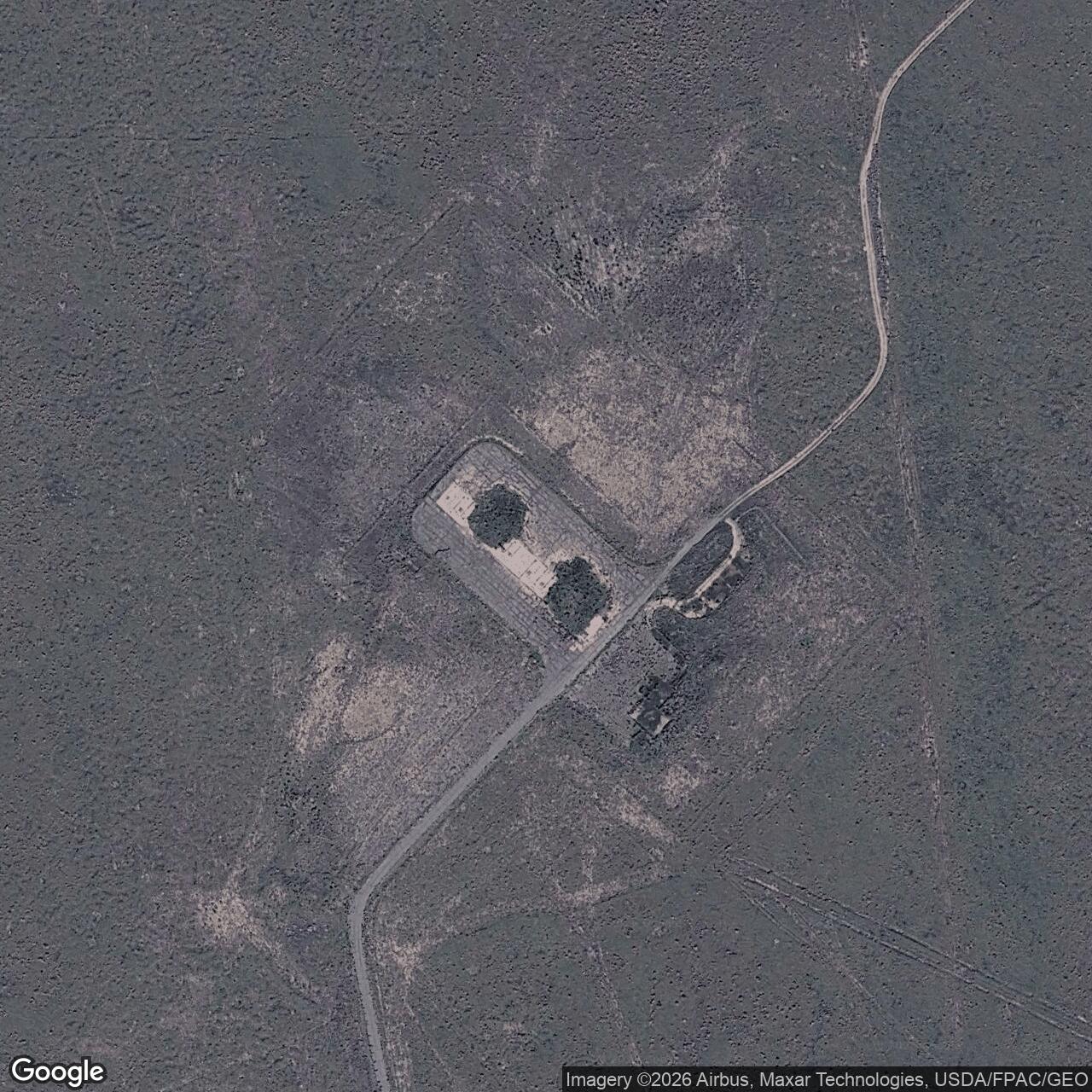
Nike Missile Site H-06 Launcher, Saddle Mountain Washington
Longitude: -119.42957574141200
This location was part of the Hanford Defense Area
Site ID: H-06
Missile configuration: 2B/12H,20A/8L-U
The missiles at this Launch Area were controlled by the Integrated Fire Control site located here.
Site Role: Launcher
A typical Nike air defense site consisted of two separate parcels of land. One area was known as the Integrated Fire Control (IFC) Area. This site contained the Nike system's ground-based radar and computer systems designed to detect and track hostile aircraft, and to guide the missiles to their targets.
The second parcel of land was known as the Launcher Area. At the launcher area, Nike missiles were stored horizontally within heavily constructed underground missile magazines. A large, missile elevator brought the Nikes to the surface of the site where they would be pushed across twin steel rails to one of four satellite launchers.
Elaboration on how Nike worked here.
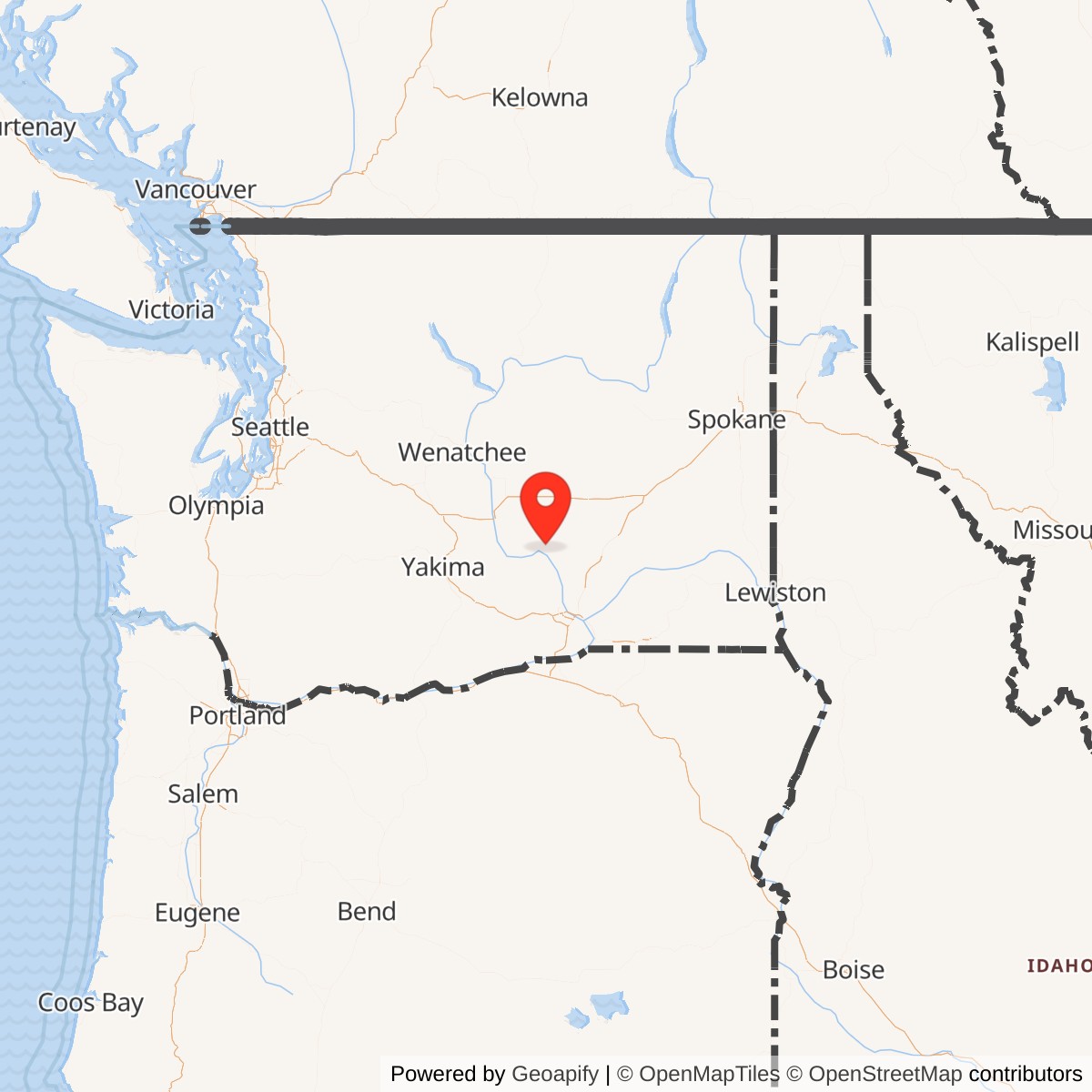
Nike Missile Site H-06 was a former U.S. Army Nike surface-to-air missile battery in the Hanford Defense Area of south-central Washington. The site was located at Saddle Mountain, north of the Columbia River and the Hanford nuclear production reservation. It is no longer active as a military installation. H-06 entered service in 1955 as a Nike Ajax battery, was the only Hanford Defense Area Nike battery converted to Nike Hercules, and was deactivated in December 1960.
The site's military significance came from what it defended. Hanford was not an ordinary industrial facility: it was the federal plutonium-production complex built during the Manhattan Project and expanded during the Cold War. Hanford's wartime mission was industrial-scale plutonium production, and the site produced plutonium for the Trinity test and the Nagasaki weapon. After a brief postwar lull, Hanford's production mission expanded again after 1947 as Cold War weapons requirements increased. By the 1950s, Hanford was one of the most important atomic-weapons production sites in the United States, and its reactors, chemical separation plants, fuel-fabrication areas, power connections, rail lines, water intakes, security zones, and associated workforce communities made it a major strategic target.
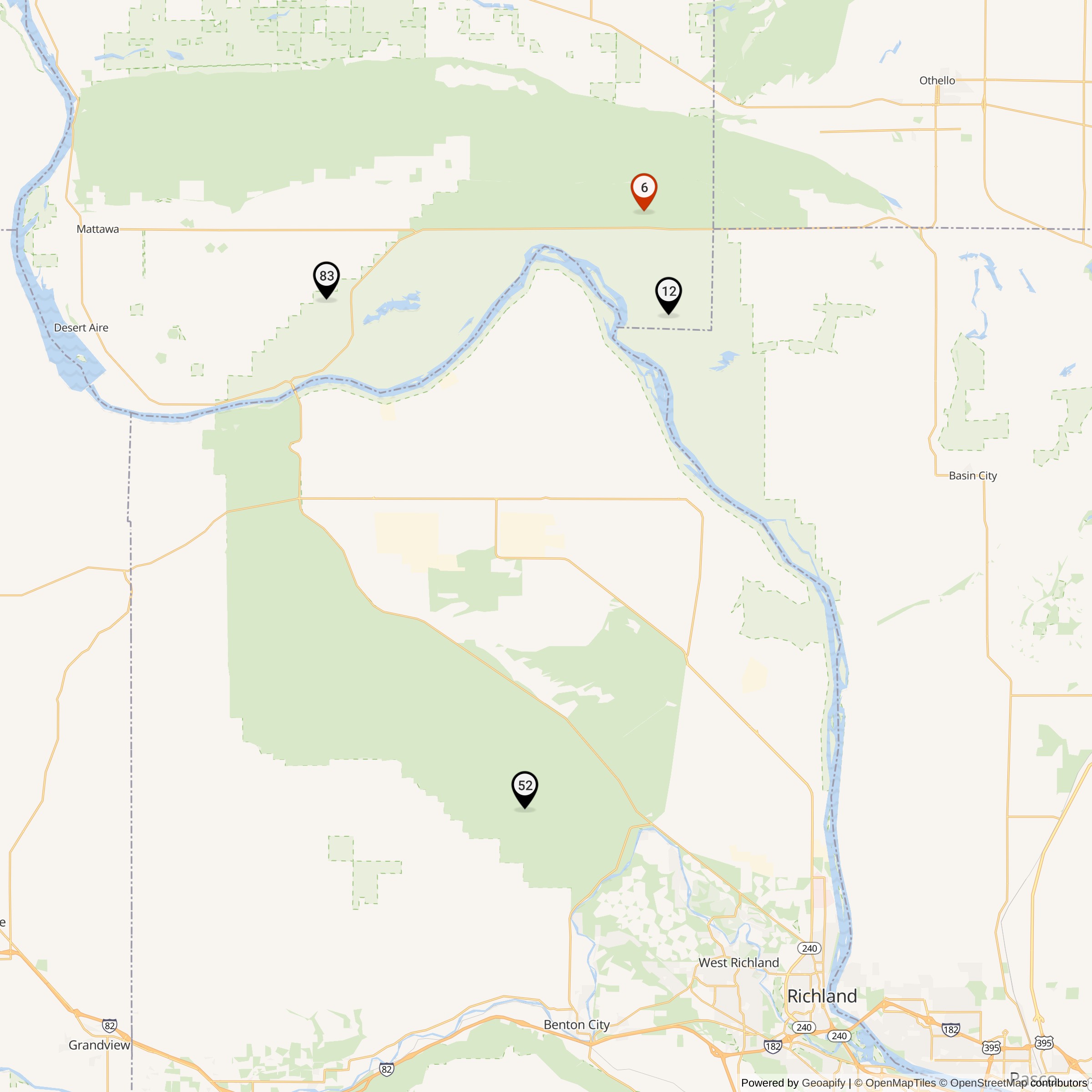
H-06 was one of four Nike batteries built to protect Hanford. The other Hanford Defense Area sites were H-12 at Othello, H-52 at Rattlesnake Mountain, and H-83 at Priest Rapids. These missile batteries replaced and supplemented earlier antiaircraft gun defenses that had protected the nuclear industrial complex. Headquarters facilities for the Hanford Defense Area were at Camp Hanford. When the Hanford Nike defense was reduced in the late 1950s, H-12, H-52, and H-83 were deactivated in December 1958, while H-06 at Saddle Mountain was retained for conversion to Nike Hercules.
The control area was on higher ground associated with Saddle Mountain, giving the battery radar line-of-sight advantages over the Hanford reservation, the Columbia River corridor, and the approaches across the dry plateau. The launch area was lower, on the plain below the mountain, separated from the IFC by several miles. That separation was normal for Nike batteries: the radar/control area needed high, unobstructed radar coverage, while the launch area needed enough land for underground magazines, launchers, missile-handling space, fueling/warheading procedures during the Ajax period, and security perimeters.
Mission and Operational Role
The mission of H-06 was to defend the Hanford nuclear production complex against bomber attack. In the 1950s, before intercontinental ballistic missiles became the dominant strategic threat, U.S. homeland air defense planning focused heavily on Soviet long-range bombers. Hanford's plutonium-production mission made it a strategic industrial target. The Army therefore ringed the reservation with air defenses, first antiaircraft guns and then Nike missiles.As a Nike Ajax battery, H-06 formed part of a radar-guided defensive network. Nike Ajax was a command-guided missile system: radars in the IFC area acquired and tracked the hostile aircraft, tracked the missile after launch, and fed both sets of data to a fire-control computer. The system then generated steering commands for the missile until the computer determined the proper intercept point and ordered warhead detonation. Ajax was designed for aircraft targets and carried conventional high-explosive warheads.
The later Nike Hercules upgrade gave H-06 a more capable missile. Hercules was larger, solid-fueled, longer-ranged, and capable of carrying a nuclear warhead. The upgrade mattered because one Hercules intercept could be used against a formation of aircraft rather than a single bomber, and the solid-fuel missile reduced some of the handling and fueling hazards associated with Ajax. In the Hanford Defense Area, H-06 was the only battery selected for that upgrade, which made it the surviving core of the local Nike defense after the other three Hanford Ajax batteries were shut down.
Site Layout and Facilities
H-06 followed the standard Nike pattern of separated areas. The Integrated Fire Control area contained the radar and command-control equipment needed to detect, track, identify, and engage aircraft. A full Nike fire-control area typically included acquisition radar, target-tracking radar, missile-tracking radar, computer and control vans or buildings, generator support, communications equipment, administrative buildings, security fencing, and crew-support functions. The elevated Saddle Mountain setting was especially important for this role because radar siting was central to Nike effectiveness.The launch area contained the underground missile magazines and launch equipment. The Department of Defense inventory lists H-06 as Nike 2B/12H,20A/8L-U. In Nike inventory shorthand, this records a two-magazine site that had Ajax service and was converted to a Hercules-capable launcher arrangement. The notation reflects H-06's transitional history: it began as an Ajax battery with two underground magazines, twenty Ajax missiles, and eight Ajax launchers, then was modified for Nike Hercules service with twelve Hercules missiles and universal/Hercules-capable launchers.
The two-magazine configuration was typical of smaller Ajax batteries. Missiles were stored horizontally below ground on rails or handling dollies, raised to the surface by elevator, moved into firing position on launchers, and prepared for firing. During the Ajax period, the site also required safe handling of liquid missile fuel and oxidizer. After Hercules conversion, the solid-fuel system simplified some launch-area logistics but required heavier missile-handling equipment and magazine/launcher modifications.
Units and Manning
The best available Nike site-unit summaries identify H-06 as manned first by Battery A, 83rd Antiaircraft Artillery Missile Battalion from 1955 to September 1958, and then by Battery A, 1st Missile Battalion, 52nd Artillery from September 1958 until deactivation in December 1960. This sequence matches the site's technical history: the first unit corresponds to the Nike Ajax period, while the later unit corresponds to the Hercules conversion and final operating period.Soldiers assigned to H-06 worked in a remote and harsh environment. Saddle Mountain and the Hanford reservation are part of the dry shrub-steppe landscape of the Columbia Basin. Heat, wind, dust, winter cold, isolation, and long distances from larger communities shaped daily life. Crews had to keep radars, generators, communications equipment, missile-handling gear, magazines, and launch equipment ready while operating inside a highly restricted federal atomic-energy landscape. The battery's purpose was repetitive but critical: maintain continuous readiness so that, if bombers approached Hanford, the site could pass rapidly from surveillance and tracking to launch.
Hercules Conversion
Appendix D of Mary T. Cagle's History of the Nike Hercules Weapon System lists H-06 in the converted-defense-site table for the Hanford Defense Area. The table gives H-06 a construction/conversion period of June 1958 to December 1958 and an operational date with Nike Hercules missiles of July 9, 1959.The conversion decision also explains the fate of the other Hanford batteries. H-12 Othello, H-52 Rattlesnake Mountain, and H-83 Priest Rapids remained Ajax-only sites and were deactivated in December 1958. H-06 alone stayed in service because it became the Hanford Hercules battery. The H-06 conversion therefore represents the Army's late-1950s shift away from a ring of shorter-ranged Ajax batteries toward fewer, longer-ranged and nuclear-capable Hercules batteries.
Closure and Disposition
H-06 was deactivated in December 1960. The Department of Defense Legacy Program history states that, after deactivation, the Hercules battery's equipment was forwarded to the Norfolk Defense Area at Deep Creek / Portsmouth. Appendix D similarly notes that Hanford Site H-06 and Ellsworth AFB Site E-01 were redeployed to Hartford Site HA-48 and Norfolk Site N-52 in Fiscal Year 1961. The exact redistribution of equipment may reflect multiple component transfers, but both sources agree that H-06 did not remain an active Hanford missile battery after 1960.The closure reflected a broader change in U.S. air defense. Nike batteries had been built for a world in which Soviet bomber attack was treated as the principal strategic threat to the continental United States. By the late 1950s and early 1960s, the strategic threat was shifting toward intercontinental ballistic missiles and submarine-launched ballistic missiles. Bomber defense remained important, but the Army and Air Force no longer needed every early Nike Ajax site, and many isolated or redundant batteries were closed. Hanford's missile defense was especially short-lived: the four-site Ajax defense established in 1955 was reduced to one Hercules battery in 1958-1959 and ended entirely in 1960.
Current Condition and Current Use
H-06 is not active. The DoD missile-site inventory lists both the control site and launch site as obliterated and under Department of Energy ownership. The broader Saddle Mountain area is now associated with the Hanford Reach landscape. The National Park Service notes that Saddle Mountain lies within Hanford Reach National Monument, administered by the U.S. Fish and Wildlife Service, and that foundations of military barracks related to aerial defense of Hanford can still be seen from the mountain area.
Chronology
- 1943 The federal government acquired the Hanford area under wartime authority for the Manhattan Project, displacing local communities and restricting Native peoples' traditional access to the land.
- 1943-1945 The Army Corps of Engineers and DuPont built the Hanford plutonium-production complex, including reactors, chemical processing facilities, roads, rail lines, and worker communities.
- 1945 Hanford plutonium was used in the Trinity test and in the atomic bomb dropped on Nagasaki.
- 1947 Hanford production ramped up again to meet Cold War atomic-weapons requirements.
- Early 1950s Antiaircraft gun defenses and then Nike planning protected Hanford as a strategic nuclear-production target.
- 1955 Four Nike Ajax sites were activated for the Hanford Defense Area: H-06 Saddle Mountain, H-12 Othello, H-52 Rattlesnake Mountain, and H-83 Priest Rapids.
- 1955 H-06 began service as a Nike Ajax battery.
- 1955-September 1958 H-06 was reportedly manned by Battery A, 83rd Antiaircraft Artillery Missile Battalion.
- June 1958-December 1958 H-06 underwent Nike Hercules conversion construction.
- September 1958-December 1960 H-06 was reportedly manned by Battery A, 1st Missile Battalion, 52nd Artillery.
- December 1958 H-12, H-52, and H-83 were deactivated, leaving H-06 as the only Hanford site converted to Nike Hercules.
- July 9, 1959 H-06 became operational with Nike Hercules missiles according to Appendix D of History of the Nike Hercules Weapon System.
- December 1960 H-06 was deactivated.
- Fiscal Year 1961 H-06 equipment was redeployed from Hanford to other air-defense sites according to Nike Hercules deployment records.
- 1960s and after The former H-06 facilities were removed / obliterated rather than preserved as an intact Nike site.
- 1987 Hanford's plutonium-production mission ended when N Reactor ceased operation.
- 1989 The Tri-Party Agreement established the modern legal framework for Hanford cleanup.
- Present H-06 is inactive, closed, and removed; the broader Hanford landscape remains federally managed, with ongoing cleanup and historic-resource interpretation focused primarily on the Manhattan Project / Cold War production complex.
List of all Nike Installations in Washington