
Titan I 725-B Missile Silo Lowry AFB Colorado
Titan I 725-B
Squadron: 725th SMS
Date Activated: August 1st 1960
Date Deactivated: June 25th 1965
Air Force Base: Lowry
State: Colorado
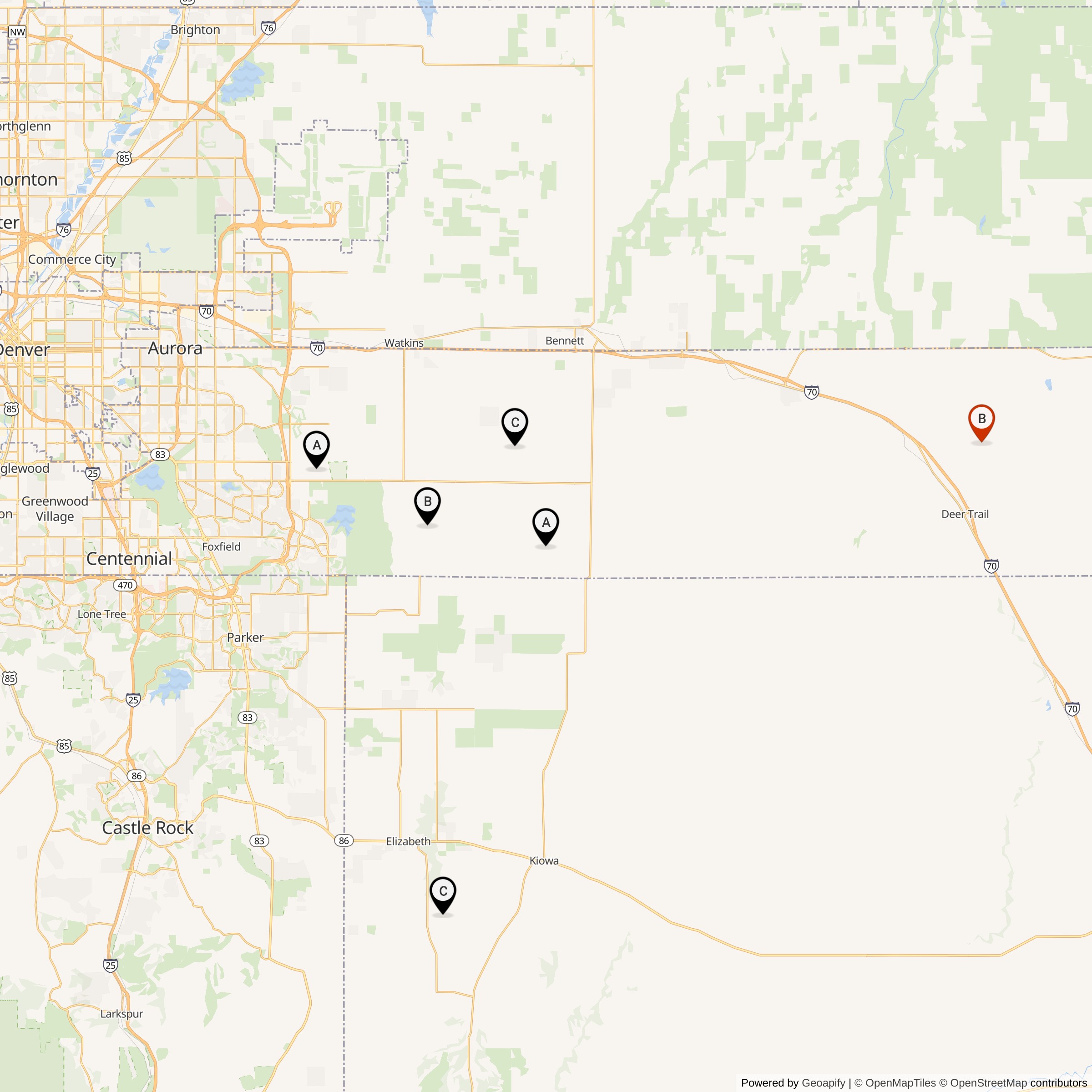
Nearest Town: Bennett
Coordinates:
Latitude: 39°40'4.18"N
Longitude: 104° 1'39.28"W
Decimal:
Longitude: -104.027578
Latitude: 39 40.0696666666667
Longitude: -104 1.65466666666667
3 silos
Former Titan I Missile Complex with the 725th Strategic Missile Squadron
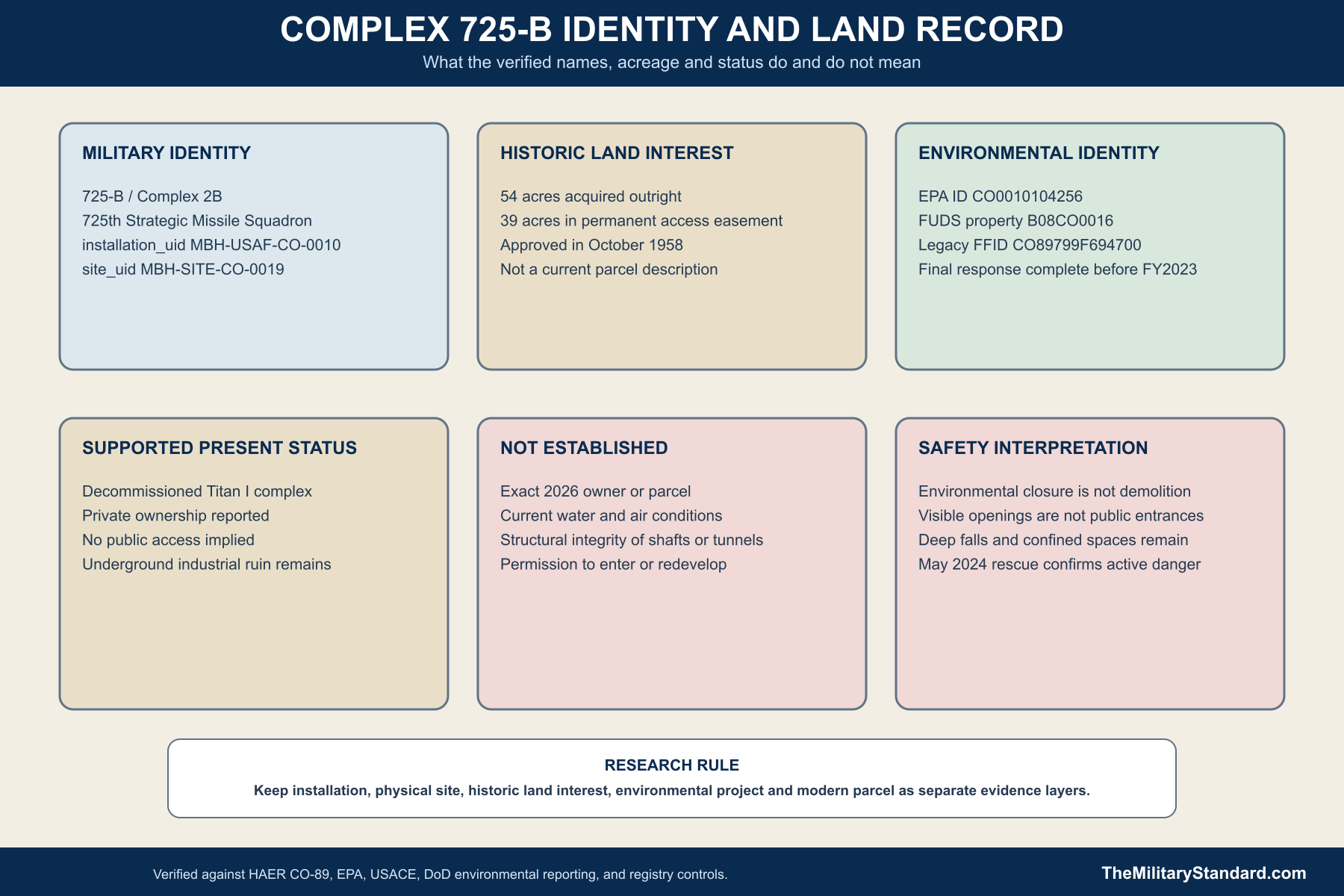
Historic land interests: 54 acres acquired outright plus 39 acres in permanent access easement; not a current parcel description
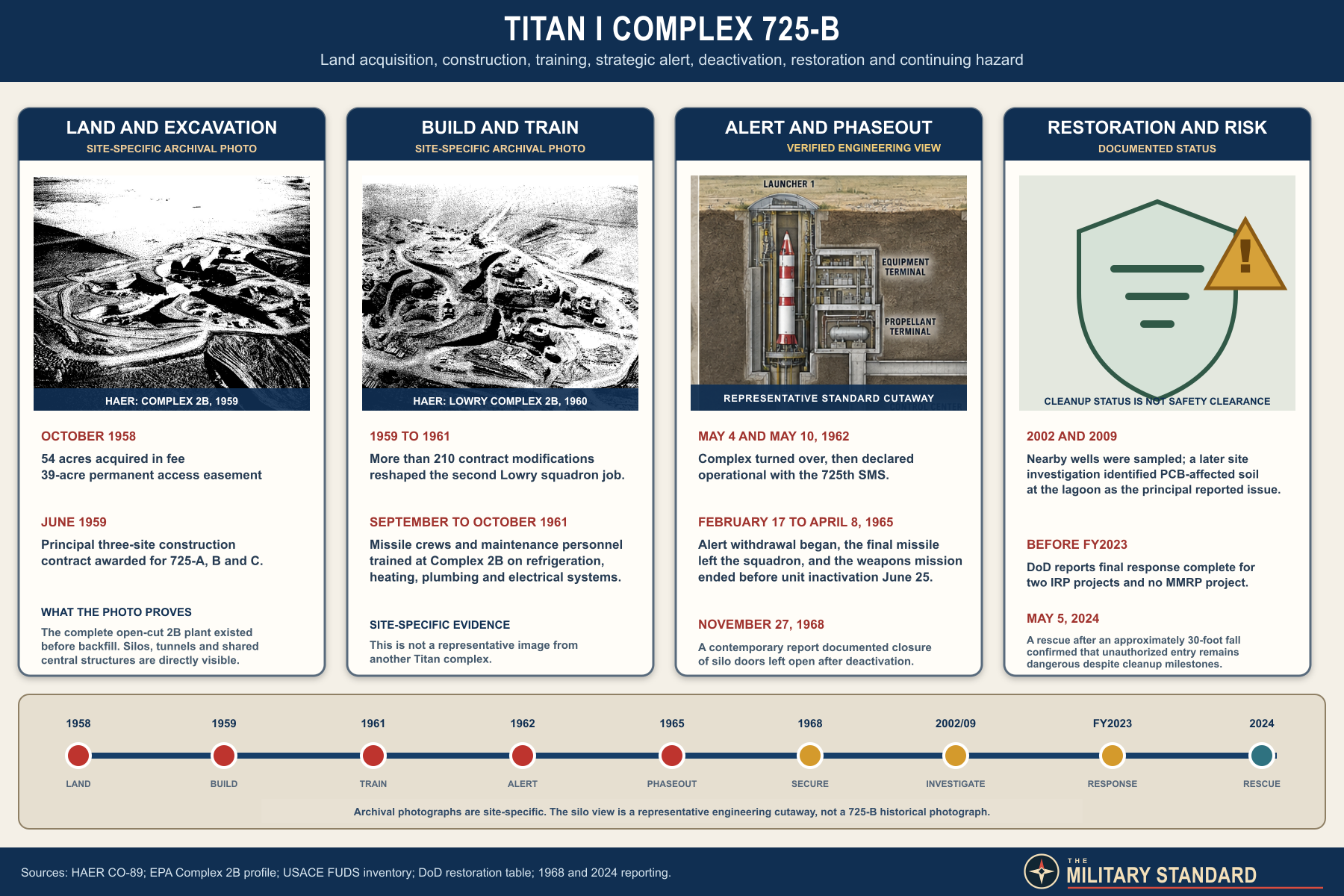
725th SMS site turnover: May 4, 1962
Operational declaration: May 10, 1962
Unit inactivation: June 25, 1965
Present status: Decommissioned, privately owned former Titan I complex and FUDS property; final response complete before fiscal year 2023 does not establish public access or structural safety
Read about the Titan I at Lowry AFB
List of all Titan I site Coordinates
Detailed information about the Titan I Intercontinental Ballistic Missile can be found here.
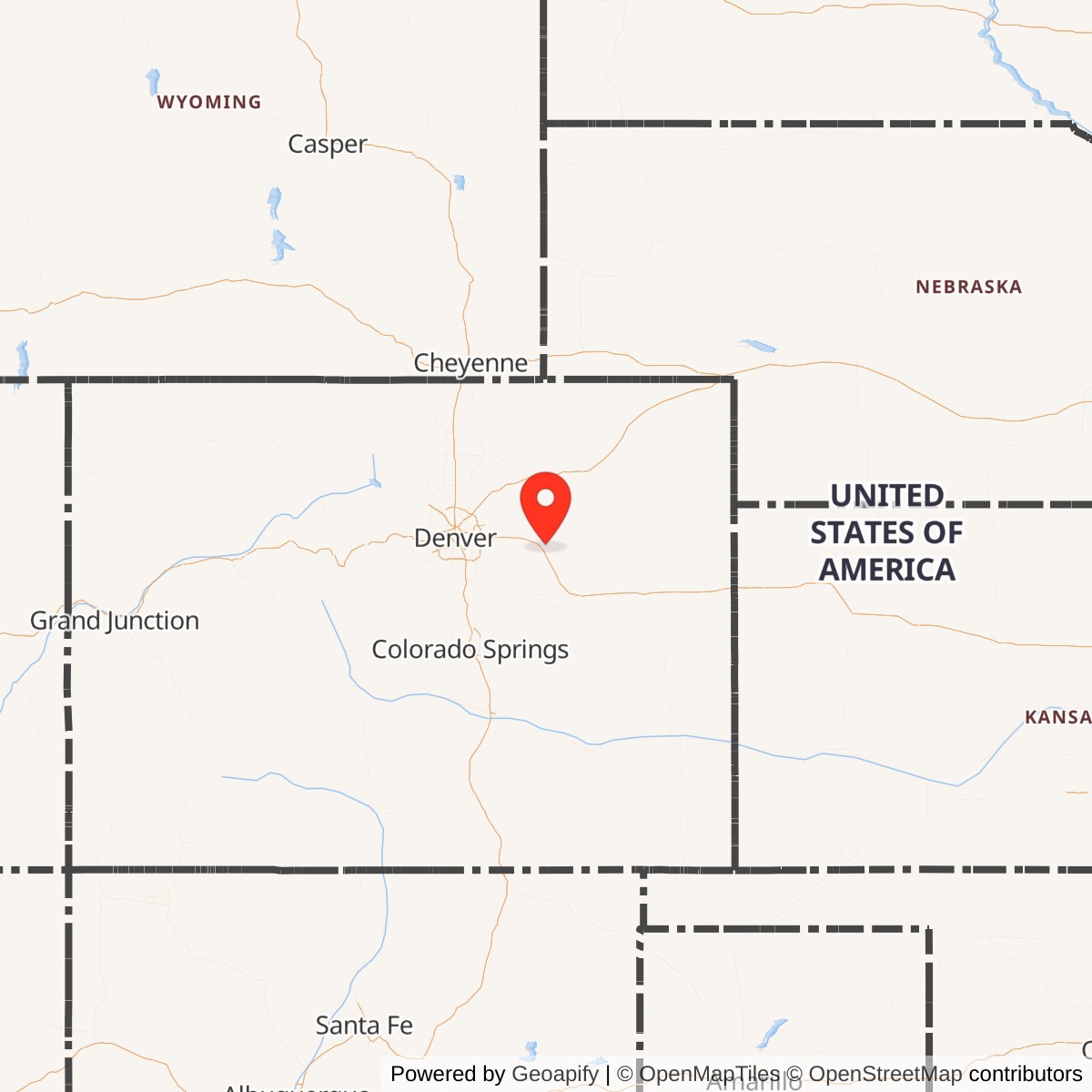
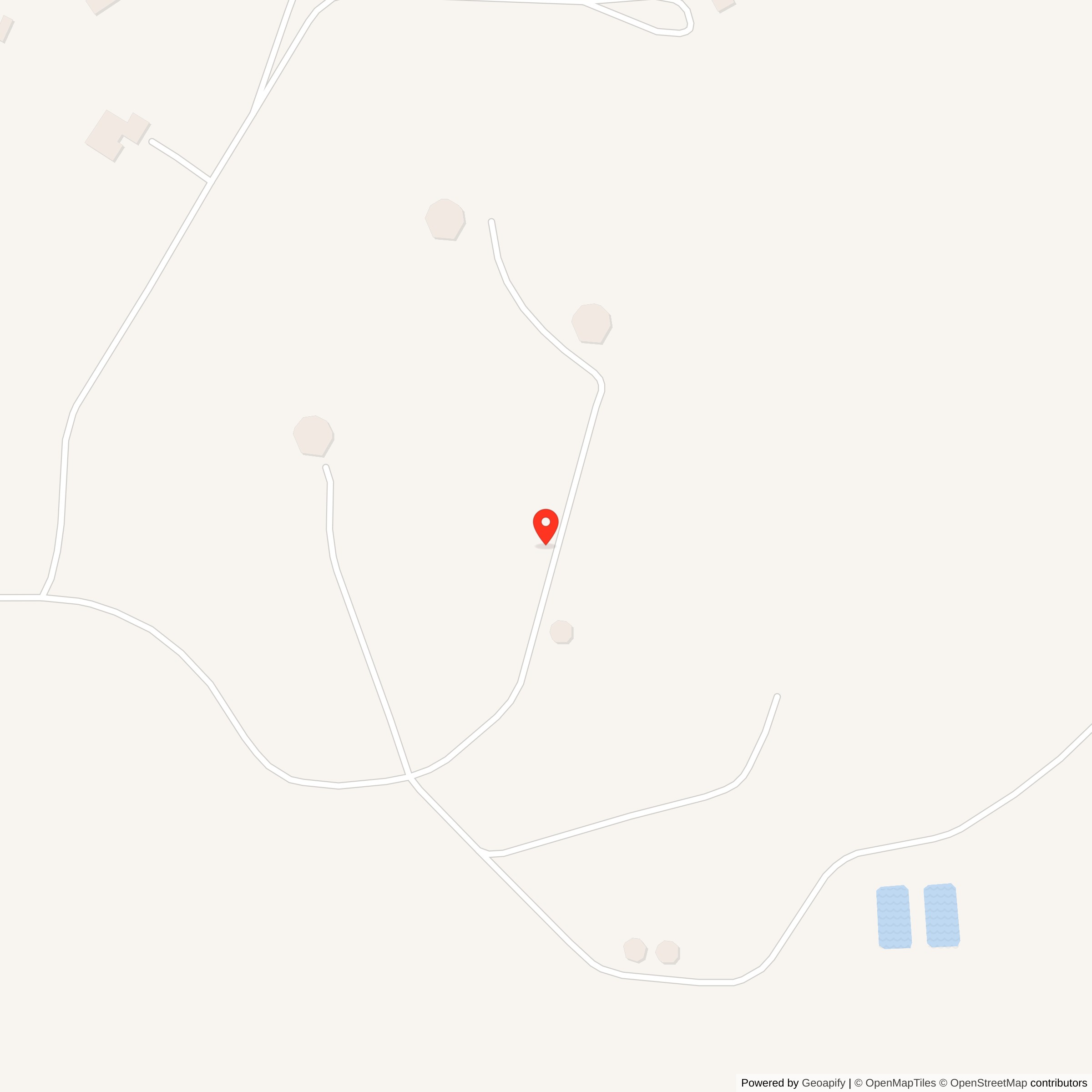
Overview
Titan I Missile Complex 725-B was one of six hardened intercontinental ballistic missile installations built around Lowry Air Force Base and one of three assigned to the 725th Strategic Missile Squadron. The complex lay on privately acquired high-plains land about four miles north-northeast of Deer Trail, Colorado. It was outside the former Lowry Bombing and Gunnery Range, unlike the four western Lowry complexes. Beneath a deliberately sparse surface compound were three missile silos, three equipment terminals, three propellant terminals, a shared launch control center, a powerhouse, an antenna terminal, two guidance-antenna silos, utility rooms, protected entrances, and connecting tunnels. Three HGM-25A Titan I missiles could be maintained on strategic alert, fueled with liquid oxygen when required, elevated from their silos, and launched from the surface.
The historical record for 725-B is stronger than a generic squadron history. The Historic American Engineering Record study of Lowry Complex 2A preserves program records that identify 2B's selection, land acquisition, construction contract, and 1961 training mission. Its data pages reproduce two genuine construction views of Complex 2B: a 1959 aerial image of the open-cut excavation and a 1960 aerial view showing the underground plant before backfilling was complete. Environmental records separately identify the property as Lowry AFB S-3 (Complex 2B), FUDS property B08CO0016 and legacy federal facility identifier CO89799F694700, and EPA site CO0010104256.
The complex served on alert for only about three years, but its physical and regulatory afterlife has lasted more than six decades. The 725th received its three complexes on May 4, 1962 and became operational on May 10. Its first missile came off alert on February 17, 1965, the final alert weapon on April 1, and the final squadron missile was shipped on April 8. The site then passed through equipment removal, salvage, federal disposal, private ownership, environmental investigation, soil removal, and response completion. A rescue in May 2024 after an unauthorized entrant fell inside the complex demonstrated that a closed cleanup project and a decommissioned weapon system do not make the underground ruin safe or open to visitors.
Installation Identity, Location, And Boundaries
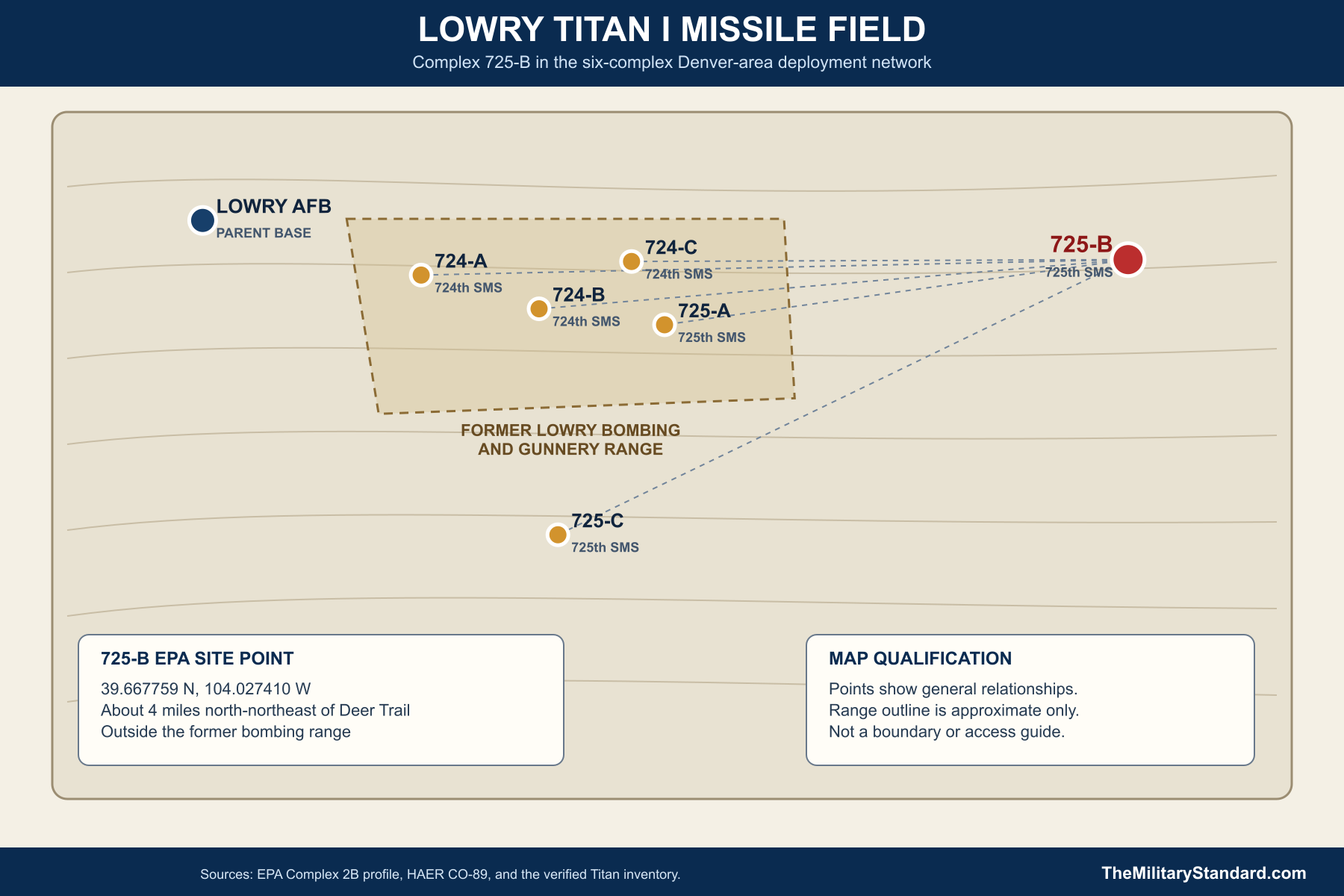
Several names describe the same military property. Strategic Air Command used 725-B, meaning the B complex of the 725th Strategic Missile Squadron. Engineering records used Site 2B, Complex 2B, Lowry Complex 2B, or Titan Site 2B. Environmental programs used Former Lowry AFB Titan Missile Site 3 Complex 2B, Lowry AFB S-3 (Complex 2B), and project shorthand D045. These are administrative and chronological aliases, not additional installations. The site was never Lowry Air Force Base proper, was not part of the former Lowry Bombing and Gunnery Range, and should not be confused with 725-A south of Bennett or 725-C south of Elizabeth.
Land approval in October 1958 covered 54 acres acquired in fee and 39 acres under permanent access easement. The combined 93-acre federal interest should not be presented as a single fenced operational compound. The fee acreage held the core installation, while the easement supported access and associated rights. Later subdivision, conveyance, utility corridors, road changes, or environmental project limits may not follow the Cold War acquisition exactly. Current ownership is therefore stated only as private, the level supported by the available public agency record, without naming an individual owner or implying permission to enter.
The Rural Landscape Before 725-B
Complex 725-B differed from the four Lowry sites constructed on the former bombing range. Its location north of Deer Trail was agricultural and ranching country beyond the large government-controlled range. The Air Force selected the area because it offered open terrain, low population density, suitable dispersal from other launch complexes, road access, and a location within the operating radius of Lowry and the Denver-area Martin plant. Acquiring the land required a separate federal property action instead of simply assigning a new use within an existing reservation.
The distinction matters for both history and environmental interpretation. The site did not inherit the bombing-range munitions footprint documented at the western complexes. Its principal military legacy arose from Titan construction and operation, including fuels, solvents, electrical equipment, wastewater systems, diesel generation, and later salvage. At the same time, the surrounding land remained part of a working rural landscape. Roads, utility lines, grazing, farming, and private property rights shaped the site's post-military setting more directly than they did at complexes retained within the range.
The choice also strengthened strategic dispersal. Planners arranged three complexes for each squadron in a broad triangle, far enough apart that one nuclear detonation was less likely to destroy the entire force. By placing 2B roughly fifty-three miles east of Lowry, the Air Force accepted longer crew, maintenance, and security travel in exchange for survivability. The result was a remote combat installation that depended on Lowry for organization and logistics but had to generate power, sustain crews, receive authenticated orders, and perform a complete launch sequence on its own.
Strategic Origins Of Titan I
Titan I emerged from the American effort to place a dependable intercontinental ballistic missile force on alert before the Soviet Union could gain a decisive strategic advantage. The Air Force developed Titan alongside Atlas so that a major failure in one program would not leave the country without an ICBM. Titan used a rigid, load-bearing airframe and two liquid-propellant stages. Its long range, nuclear payload, and rapid flight time changed strategic planning by allowing distant targets to be threatened within about half an hour, but the first version still required substantial ground machinery and preparation before launch.
Survivability drove the move underground. A surface launch pad, exposed control building, and visible fuel plant were vulnerable to attack, sabotage, and weather. The Titan I complex placed its missiles, crew, communications, power, guidance, and propellant-support equipment in reinforced structures linked by flexible tunnels and isolated with blast doors. Dispersing three complexes across each squadron field further reduced the chance that one enemy weapon could disable all nine launchers. This architecture made 725-B a hardened combat installation rather than a simple storage site.
Titan I nevertheless retained major first-generation limitations. RP-1 kerosene could be stored, but cryogenic liquid oxygen could not remain indefinitely aboard the missile. Before launch, crews had to load oxidizer, complete system checks, open the silo doors, elevate the fueled missile above ground, and raise a guidance antenna. The missile then depended on ground radio guidance during early flight. Titan II and Minuteman eliminated much of this vulnerability through storable propellants or solid fuel, launch-from-silo operation, and improved guidance. Complex 725-B is valuable precisely because it preserves the transition between exposed launch pads and later self-contained silos.
Site Selection And The Lowry Network
The Air Force selected Lowry for the first operational Titan I deployment in January 1958. Proximity to the Glenn L. Martin Company's Denver-area plant was a major advantage because the manufacturer could support installation, modification, testing, and troubleshooting. Lowry Air Force Base already supplied technical training, administration, housing, maintenance, transportation, and logistical infrastructure. The nearby range provided space for dispersed launch sites without requiring the Air Force to create an entirely new support base.
Initial planning expanded quickly. Within about two months of the first squadron decision, the Air Force added a second Lowry Titan squadron. The 724th Strategic Missile Squadron controlled complexes 1A, 1B, and 1C, while the 725th controlled 2A, 2B, and 2C. Each complex supported three missiles. The two squadrons therefore gave the 451st Strategic Missile Wing eighteen operational launchers, plus a spare or maintenance missile within squadron support arrangements. Their broad geographic separation made the field harder to destroy and placed unusual demands on roads, secure communications, maintenance dispatch, weather response, and crew transportation.
Lowry Air Force Base remained the parent organization and logistical hub, but 725-B had to function independently during alert. Wing headquarters coordinated target assignments, readiness, personnel, maintenance priorities, security policy, and higher-command communications. Missile maintenance and technical specialists traveled between Lowry and the remote complexes. Inside 725-B, redundant electrical generation, water, ventilation, communications, food, sanitation, and protected workspaces allowed the crew to remain underground if outside conditions became dangerous. The site was simultaneously a dependent satellite of Lowry and a self-contained nuclear command post.

Design, Contracting, And Construction
Preliminary work began in 1959 with surveys, access roads, drainage, wells, and utility preparation. The Lowry field's ceremonial groundbreaking took place on May 5, 1959, while main construction proceeded at the dispersed sites. The Omaha District of the Army Corps of Engineers administered the work. Morrison-Knudsen and its joint-venture partners received the second-squadron contract for complexes 2A, 2B, and 2C in June 1959. Denver-area subcontractors performed excavation, electrical, guidance, and other specialized work, while the Glenn L. Martin Company later installed and checked missile-support equipment.
The contract for the three second-squadron complexes began at approximately $26.9 million. The HAER study records about 210 modifications adding roughly $17.1 million and raising the total to about $44.0 million, a 63 percent increase. Across the six Lowry complexes, the cited construction contracts grew from about $72.5 million to $115.3 million. The increase reflected a concurrent-development program: missile tests, launch-equipment problems, changing blast criteria, revised liquid-oxygen tanks, shock mounting, safety discoveries, and incomplete drawings repeatedly forced changes in structures and systems already under construction.
The 1959 Complex 2B photograph shows the entire installation as an enormous open excavation. Circular silo and terminal pits, the shared control and powerhouse core, connecting trenches, haul roads, spoil piles, and construction staging occupied a much larger visual footprint than the finished surface plant. A 1960 aerial view shows the reinforced circular and domed structures taking form before earth cover concealed most of the architecture. These images are important because they are genuine 2B evidence, not photographs borrowed from another Titan field.
Construction across Lowry was affected by the 1959 national steel strike, local labor disputes, winter concreting, material shortages, and continuing engineering revisions. At peak, approximately 3,500 workers supported the six-site program. The site activation organization had to integrate concrete, tunnels, missile elevators, blast doors, liquid-oxygen systems, power generation, communications, guidance equipment, safety interlocks, and the missiles themselves. Main construction was substantially complete by fall 1961, but installation, correction, demonstration, and acceptance continued into 1962.
The Lowry Site Activation Task Force coordinated the final transition from construction project to operational weapon. Contractor Technical Acceptance Demonstrations exercised a full countdown and propellant-loading sequence. Strategic Air Command crews then repeated the demonstration under contractor supervision. The site could not be transferred merely because its concrete was finished. It had to prove that structures, equipment, communications, guidance, safety systems, and trained personnel operated as one weapon system.
Underground Design And Surface Layout
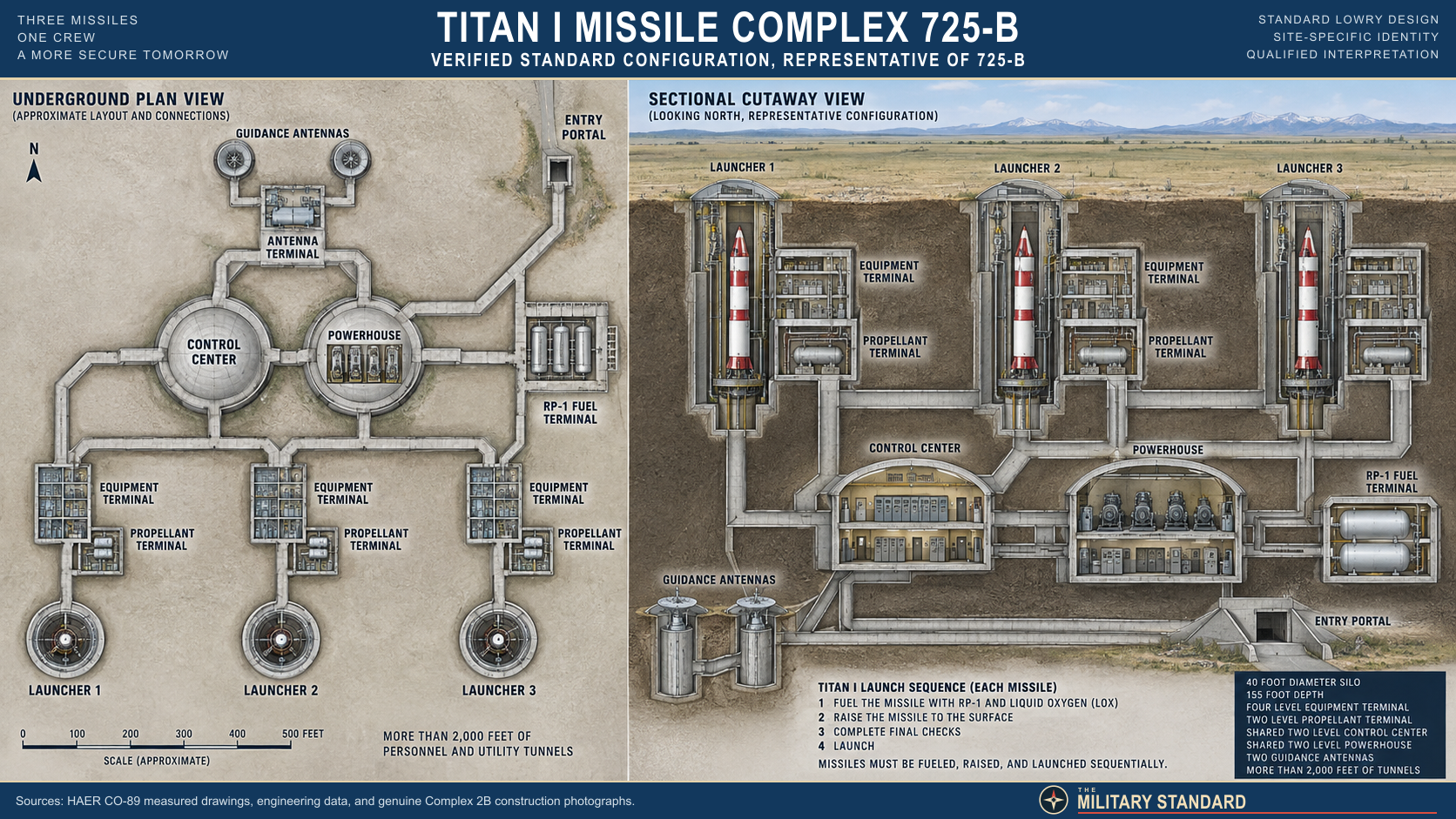
Complex 725-B followed the standardized Lowry Titan I arrangement. No measured drawing made expressly for 2B was found, so plan graphics must be qualified. HAER CO-89 Sheet 2 documents the closely related 725-A complex, while the two historic 2B construction photographs confirm the same three-launcher geometry and central underground core. The standard plan is therefore useful for interpreting 2B, but it is not a cadastral or as-built survey of the Deer Trail property and cannot establish the current position or condition of every buried feature.
A protected entry portal led downward through a blast-resistant access sequence to the central tunnel junction. The shared core contained a two-level launch control center, a two-level powerhouse, water and utility spaces, an antenna terminal, and two retractable guidance-antenna silos. Flexible tunnel sections, shock isolation, and blast doors limited the transfer of ground motion or internal damage. Diesel generators, switchgear, ventilation, cooling, compressed air, communications, food, water, and sanitation allowed the crew to maintain operations if outside services failed.
Three launcher branches radiated from the core. Each branch passed through an equipment terminal and a propellant terminal before reaching a missile silo. The equipment terminal supported launcher elevators, doors, monitoring, and servicing. The propellant terminal contained RP-1 and liquid-oxygen handling equipment, pumps, valves, piping, and controls. The silo was a reinforced vertical shaft with a massive paired surface-door system and an elevator that lifted the missile into launch position.
The antenna terminal supported two redundant retractable radio-guidance antennas. Titan I carried an inertial reference but depended on ground radio corrections during early flight. During a launch sequence, an antenna rose through its own surface doors and transmitted guidance information. Redundancy reduced the chance that one damaged antenna or mechanism would prevent guidance. The antenna silos, orientation targets, cabling, and electronics were therefore part of the primary weapon system rather than ordinary base communications.
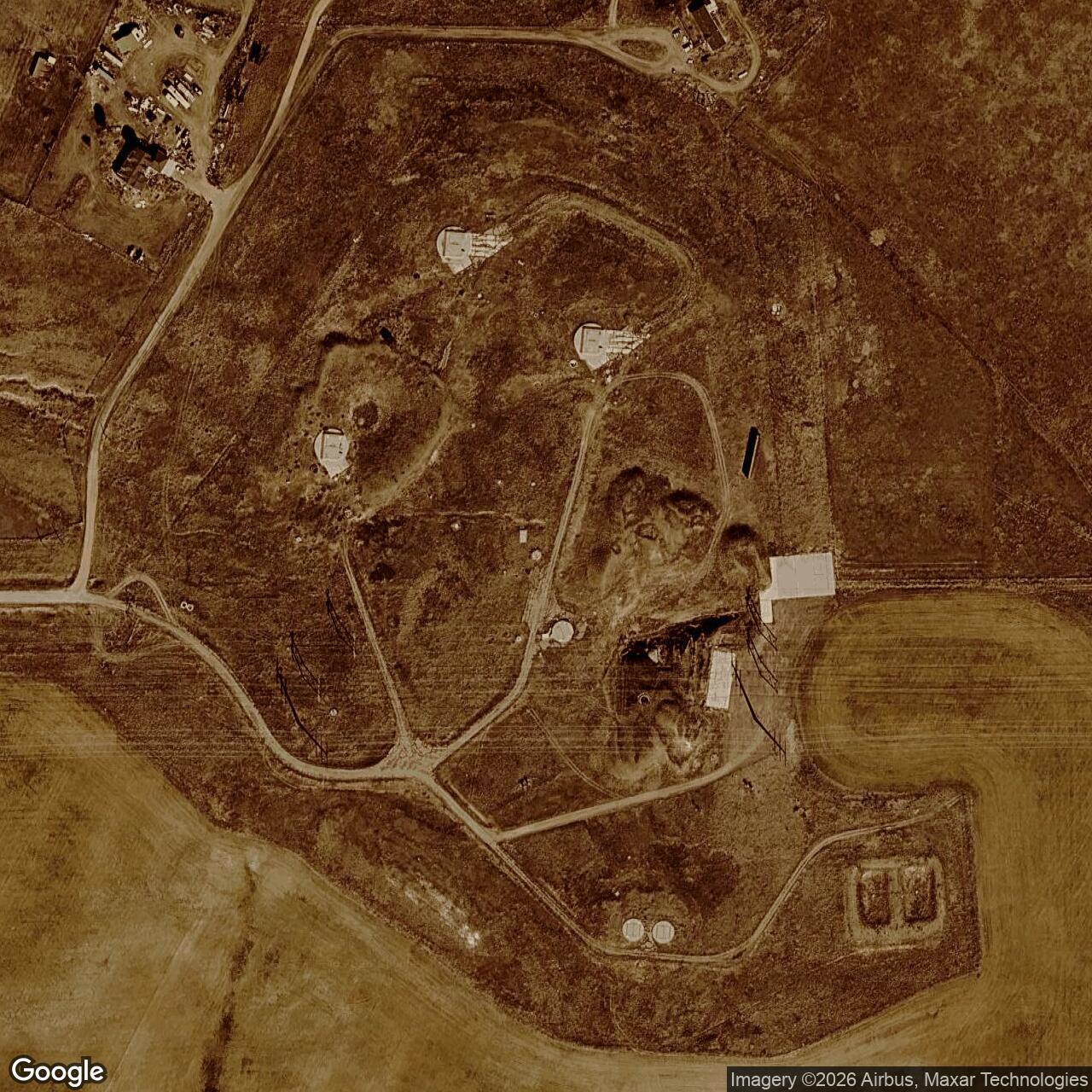
Once backfilled, the surface looked sparse compared with the underground plant. Security fencing, patrol and access roads, small utility features, vents, hatches, launcher doors, antenna doors, and orientation targets punctuated open prairie. That apparent simplicity concealed a multi-level industrial complex reaching roughly 160 feet below grade. The difference between the 1959 excavation photograph and the finished landscape explains why the site can look empty from a distance while retaining extensive underground hazards.
Missile, Propulsion, Guidance, And Launch
The HGM-25A Titan I was a two-stage liquid-propellant missile approximately 98 feet long. Both stages burned RP-1 kerosene and liquid oxygen. A nuclear reentry vehicle gave the missile its strategic effect, while engines, airframe, inertial components, radio guidance, communications, and launch equipment came from a national contractor network. At 725-B, these elements operated as one system. The missile could not fulfill its mission without the site's power, oxidizer plant, elevators, doors, antennas, crew, and authenticated command link.
Liquid oxygen governed readiness. Its extremely low temperature and continual boil-off prevented long-term storage aboard the missile, so the launch sequence included oxidizer loading. Crews treated oxygen equipment as surgically clean because oil, dirt, or incompatible material could cause fire or explosion. HAER interviews describe cleanliness standards below 150 microns, pressurized clean rooms, vapor degreasing, caustic cleaning, black-light inspection, and repeated checks. Liquid nitrogen, high-pressure nitrogen and helium, diesel fuel, hydraulic fluid, lubricants, batteries, and other industrial materials added more hazards.
Propellant Loading Exercises tested every missile on a roughly 90-day cycle, which meant approximately one exercise each month at a three-launcher complex. The procedure forced operations and maintenance personnel to verify tanks, pumps, lines, valves, sensors, timing, and emergency actions under conditions approaching a real countdown. These exercises were essential because Titan I's deterrent value depended on machinery that normally remained idle. They also placed sustained demands on the environmental, safety, and waste-handling systems later examined during cleanup.
A launch order required authenticated messages and controlled cooperation by trained crew members. Once the sequence began, the system loaded liquid oxygen, checked missile and site status, opened the selected silo doors, raised the missile on its elevator, deployed a guidance antenna, and completed ignition preparations. The three missiles could be launched in sequence. Titan I was dramatically faster than an aircraft-delivered weapon, but the fueling and elevation process left it more exposed and slower to respond than the later Titan II and Minuteman systems that launched directly from closed, fueled or solid-propellant silos.
Organization, Personnel, And Training
The 703rd Strategic Missile Wing activated in September 1958 to organize the developing Lowry force and was redesignated the 451st Strategic Missile Wing in 1961. The 725th Strategic Missile Squadron activated on August 1, 1961 and operated complexes 725-A, 725-B, and 725-C. The wing also included the 724th Strategic Missile Squadron, 451st Missile Maintenance Squadron, and headquarters organizations required to support eighteen launchers. On April 30, 1962, the wing reported 170 officers and 1,107 airmen; the 725th accounted for 43 officers and 73 airmen.
Complex 2B had an unusually important pre-operational training role. HAER records that personnel from both missile squadrons and the maintenance squadron trained at 2B during September and October 1961 under the construction contract. Instruction covered refrigeration, heating, plumbing, electrical work, equipment maintenance, and related specialties. The timing placed 2B at the point where contractor knowledge had to become Air Force operating capability. Personnel learned on installed equipment while final corrections and checkout were still underway.
This training is distinct from the later wing training-center mission associated with 725-A and its Launcher 3. Complex 2B helped prepare operations and maintenance personnel before alert activation; 725-A subsequently served as the principal continuing training location while operational. Preserving that distinction prevents the two sites from being collapsed into a generic story. It also shows how the Lowry field used more than one complex to convert a newly built engineering system into a sustainable combat force.
Strategic Air Command maintained enough combat-ready crews to rotate alert duty, evaluation, training, leave, and contingencies. The Lowry wing generally required 26 to 30 crews, with multiple crews available for each complex position. The operational crew was reduced to six members before activation. Two-person control, personnel-reliability requirements, authenticated communications, detailed checklists, recurring evaluations, maintenance controls, and armed security governed the handling of nuclear weapons and classified launch systems.
Daily life combined extreme consequence with long routine. Crew members monitored consoles, tested communications, inspected status indicators, maintained logs, reviewed emergency procedures, ate, rested, and waited for a message they hoped never to receive. Maintenance teams entered the plant for scheduled work and troubleshooting. At a site more than fifty miles from Lowry, weather, road conditions, transportation, and relief schedules were operational considerations. The underground complex was simultaneously a weapon, power plant, communications center, maintenance facility, and temporary living space.
Activation And Strategic Alert
By fall 1961, major construction was largely complete and missiles, ground equipment, and crews moved through the installation and checkout process. All eighteen Lowry Titan I missiles were reported in their silos by May 1, 1962. The 725th Squadron's three complexes were turned over to Strategic Air Command on May 4 and the squadron became operational on May 10. These events are related but not interchangeable: physical construction, equipment acceptance, missile emplacement, site turnover, unit operational status, and the alert condition of an individual missile were separate milestones.
No documented flight test from 725-B was found. The March 15, 1962 launch described in HAER occurred at 725-A, not at Deer Trail. Complex 2B nevertheless underwent contractor and Air Force acceptance demonstrations that exercised the installed launch system. The history therefore credits 725-B with documented training and acceptance work, but it does not transfer 725-A's launch event or Cuban Missile Crisis eyewitness account to this site.
Once operational, 725-B contributed three launchers to Strategic Air Command's continuous nuclear deterrent. Readiness required more than storing missiles underground. Crews verified command channels, target and guidance data, launch circuits, power, environmental controls, elevators, doors, propellant systems, communications, and emergency actions. Maintenance teams responded to discrepancies while wing controllers balanced repair and alert requirements across eighteen launchers.
The three missiles were normally protected below ground but had to be fueled with liquid oxygen and raised before launch. Recurring Propellant Loading Exercises placed each launcher through a near-operational cycle. The sequence involved taking a missile off alert, disconnecting and simulating selected components, loading oxidizer, raising and lowering the launcher, draining the system, performing maintenance, and restoring alert status. Success depended on coordination between the combat crew, maintenance specialists, communications, safety personnel, and Lowry support.
During the October 1962 Cuban Missile Crisis, the entire Lowry Titan force assumed heightened readiness. Site-specific crew testimony survives for 725-A, not 725-B, so the exact duration and actions of a particular Deer Trail crew are not asserted. At the squadron level, however, 725-B was an operational alert complex within the force responding to the national emergency. Its purpose was deterrence: readiness to launch was intended to prevent an attack, and no operational missile was fired.
Role In The Wider Military Network
Complex 725-B connected national command authority to three dispersed nuclear weapons. Strategic Air Command controlled readiness and targeting; the 451st Strategic Missile Wing managed the Lowry field; the 725th Strategic Missile Squadron supplied combat crews; and Lowry Air Force Base provided administration, logistics, training, maintenance, reentry-vehicle support, and secure communications. The 451st Missile Maintenance Squadron moved specialists and equipment between the base and six remote complexes.
The industrial and engineering network was equally important. The Glenn L. Martin Company assembled Titan missiles near Denver and supported installation and modification. The Army Corps of Engineers administered construction. Morrison-Knudsen and its partners built the launch complexes. Air Force ballistic-missile organizations translated test results from Cape Canaveral and Vandenberg into field changes. Contractors trained Air Force personnel at 2B before turnover. The site was therefore not an isolated silo farm but one node in a national system linking research, manufacturing, construction, command, maintenance, and alert operations.
Phaseout, Deactivation, And Salvage
Titan I became obsolete quickly because Titan II and Minuteman offered faster response, reduced surface exposure, simpler alert maintenance, and launch-from-silo capability. Secretary of Defense Robert McNamara announced the phaseout of the remaining first-generation Atlas and Titan I force on November 19, 1964. The decision did not instantly close 725-B. Strategic Air Command had to sequence the removal of weapons from alert, protect nuclear material, drain and make systems safe, remove classified components, and preserve readiness elsewhere.
The 725th's first missile came off alert on February 17, 1965. The last alert weapon was withdrawn on April 1, and the final squadron missile was shipped on April 8. The 725th Strategic Missile Squadron inactivated on June 25.
Deactivation proceeded in phases. Phase I removed reentry vehicles, missiles, classified components, propellants, and gases. Missiles moved through Lowry before shipment to Norton Air Force Base in California. Phase II removed or salvaged equipment, including computers, hydraulic machinery, generators, piping, transformers, propellant hardware, and furnishings. Phase III placed the property in the General Services Administration disposal process. Proposals for records storage, civil defense, laboratories, agriculture, and other reuse generally failed because specialized underground construction was expensive to maintain and difficult to adapt.
Complex 2B acquired a visible post-alert landmark in November 1968. Contemporary newspaper coverage recorded the forceful closure of the Deer Trail silo doors after they had remained open following deactivation. That action did not demolish or fill the underground complex. It reduced a surface hazard while leaving the reinforced chambers, tunnels, silos, and many stripped or deteriorating systems below grade. The site subsequently entered private ownership, while the federal government retained environmental-restoration responsibility for eligible defense-related conditions.
Private Ownership And The Abandoned Complex
Public agency summaries state that Complex 2B is privately owned. The available record does not establish a public reuse comparable to the Bennett National Guard facility at 725-A or the county solid-waste use at 725-C. Surface land around the former compound remains part of the rural Deer Trail setting. The installation's principal post-military identity is therefore an abandoned underground industrial complex within private property rather than a successor military installation.
Salvage and decades of exposure changed the site. Valuable machinery, wiring, metal, fixtures, and equipment were removed through authorized disposal and later disturbance. Openings, stairs, platforms, ladders, rails, and tunnel systems deteriorated. Water collected in deep spaces, and confined areas could contain poor air or hazardous residues. Graffiti and informal exploration do not establish legal access or safety. The absence of an active fence or the visibility of a surface feature from a road does not make the site public.
On May 5, 2024, emergency responders rescued an eighteen-year-old who reportedly fell about thirty feet inside the complex after an unauthorized nighttime entry. Other members of the group also required guidance out of the underground plant. The incident offers unusually recent evidence of the site's condition as a serious physical hazard. It should be interpreted as a warning, not as an exploration narrative. Deep shafts, standing water, darkness, deteriorated metal, incomplete floors, confined spaces, uncertain air quality, and difficult rescue access make entry dangerous even apart from contamination and trespass law.
Environmental Investigation And Response
The former complex entered the Department of Defense Formerly Used Defense Sites program as Lowry AFB S-3 (Complex 2B), property B08CO0016. EPA catalogs the location as Former Lowry AFB Titan Missile Site 3 Complex 2B under EPA ID CO0010104256. The EPA profile places the property outside the National Priorities List and describes the work as other cleanup activity with federal-facility lead. EPA also records an Eligible Response Site exclusion. These are program classifications, not certifications that underground structures are suitable for entry or unrestricted development.
Potential Titan-site contaminants included petroleum products, diesel fuel, RP-1, lubricants, solvents, polychlorinated biphenyls from electrical equipment or coatings, acids, caustics, ethylene glycol, pesticides, batteries, and wastewater residues. Investigations considered surface and subsurface soil, groundwater, nearby domestic wells, sump or silo water, and waste-disposal areas. State summaries reported no evidence of man-made radioactive contamination at the Colorado Titan sites because warhead maintenance was not performed there. That finding should not be broadened into a claim that every industrial or structural hazard is absent.
Nearby domestic wells were sampled in 2002 without evidence of chlorinated-solvent contamination. Site Inspection fieldwork was completed in fall 2009. A Colorado environmental summary reported that PCBs in lagoon waste soil were the principal remaining issue identified by that investigation and that a non-time-critical removal was planned. Federal program reporting later placed Lowry AFB S-3 among FUDS properties achieving final response complete before fiscal year 2023, with two Installation Restoration Program sites and no Military Munitions Response Program sites recorded for the property.
Final response complete is a cleanup-program milestone. It indicates that required response actions for the identified restoration sites were complete under the program's decision framework. It does not guarantee that the abandoned plant is dry, structurally sound, ventilated, secured, or free of all hazardous building materials. EPA's current profile still preserves the site identity and federal-facility-led cleanup classification. Any proposal for excavation, groundwater use, entry, redevelopment, or title-sensitive research requires current agency, owner, and local-government information rather than reliance on a historical summary.
Surviving Features And Documented Condition
The 1959 and 1960 HAER construction views establish the original three-launcher arrangement and the immense scale of the buried complex. Later aerial and ground observations indicate that the surface pattern remains readable through launcher-door areas, antenna doors, orientation targets, vents, hatches, access roads, and disturbed ground. Such observations identify historical features, not their integrity. Concrete can remain recognizable while steel, seals, mechanisms, stairs, and supporting equipment fail.
Below grade, the reinforced shells of the launch silos, equipment and propellant terminals, control center, powerhouse, antenna spaces, and connecting tunnels are expected to remain substantially present, but no current comprehensive engineering survey was located. Unauthorized photographs and video show stripped machinery and extensive deterioration, yet they are not a substitute for an official inspection and are not used here to invite or guide entry. The condition of any particular door, shaft, tunnel, water level, or access opening can change after weather, vandalism, salvage, collapse, or owner action.
The 2024 rescue confirms that at least one route into the underground complex was physically accessible at that time and that a serious fall hazard existed. It does not prove that the whole site was open, legally accessible, or unchanged afterward. For public-history purposes, the most responsible present description is a privately owned, decommissioned, hazardous underground ruin with surviving surface traces and a completed federal environmental response milestone. Exact current security, ownership, and structural condition remain unresolved.
Detailed Chronology
- 1954 The Eisenhower administration authorizes development of Titan as a parallel ICBM program to Atlas.
- 1956 The Glenn L. Martin Company begins developing its Denver-area Titan production and test facilities.
- January 1958 The Air Force selects Lowry for the first operational Titan I deployment.
- Early 1958 A second Lowry Titan squadron is added, requiring three more dispersed complexes.
- October 1958 Land acquisition for Complex 2B is approved: 54 acres in fee and 39 acres under permanent access easement.
- September 25, 1958 The 703rd Strategic Missile Wing activates to organize the Lowry Titan mission.
- Early 1959 Survey, road, drainage, well, and utility work begins across the Lowry field.
- May 5, 1959 Ceremonial groundbreaking marks the Lowry Titan construction program.
- June 1959 Morrison-Knudsen and its partners receive the main contract for complexes 2A, 2B, and 2C.
- 1959 Aerial photography records Complex 2B as a broad open-cut excavation with the three-launcher geometry visible.
- 1959-1961 Complex 2B is built north of Deer Trail while labor disputes, the steel strike, winter work, and design changes affect the program.
- 1960 An Army Corps of Engineers aerial view records the 2B control, power, launcher, terminal, and tunnel structures before backfilling is complete.
- 1960 The Lowry Site Activation Task Force assumes responsibility for integrating construction, equipment, testing, and acceptance.
- 1961 The 703rd Strategic Missile Wing is redesignated the 451st Strategic Missile Wing.
- August 1, 1961 The 725th Strategic Missile Squadron activates.
- September-October 1961 Personnel from both Lowry missile squadrons and the maintenance squadron train at Complex 2B in refrigeration, heating, plumbing, electrical work, and equipment maintenance.
- Fall 1961 Main construction is substantially complete; installation, correction, demonstration, and acceptance continue.
- May 1, 1962 All eighteen Lowry Titan I missiles are reported installed in their silos.
- May 4, 1962 The 725th Squadron's complexes are turned over to Strategic Air Command.
- May 10, 1962 The 725th Strategic Missile Squadron becomes operational.
- October 1962 The Lowry Titan force assumes heightened readiness during the Cuban Missile Crisis.
- 1962-1965 Complex 725-B maintains three Titan I launchers as part of Strategic Air Command's continuous nuclear-alert force.
- November 19, 1964 Secretary of Defense Robert McNamara announces phaseout of the remaining first-generation Atlas and Titan I force.
- February 17, 1965 The first 725th Squadron Titan I is removed from alert.
- April 1, 1965 The final 725th Squadron missile comes off alert.
- April 8, 1965 The final missile is shipped from the 725th Squadron.
- June 25, 1965 The 725th Strategic Missile Squadron inactivates.
- 1965-1966 Reentry vehicles, missiles, classified components, propellants, gases, and selected equipment are removed; salvage and disposal follow.
- November 27, 1968 Contemporary reporting describes the closure of the Deer Trail complex's silo doors after they had remained open following deactivation.
- Late 1960s onward The property passes into private ownership; the underground plant remains largely in place after removal and salvage.
- 1990s-2000s The property enters formal FUDS investigation under Lowry AFB S-3 (Complex 2B).
- 2002 Nearby domestic wells are sampled without evidence of chlorinated-solvent contamination.
- Fall 2009 Site Inspection fieldwork is completed; PCB-affected lagoon waste soil is identified as the principal reported issue.
- 2010s A non-time-critical removal action addresses affected soil as the restoration program advances toward completion.
- Before fiscal year 2023 Department of Defense reporting lists Lowry AFB S-3 among properties achieving final response complete for its two Installation Restoration Program sites.
- May 5, 2024 Emergency responders rescue an unauthorized entrant injured by a roughly thirty-foot fall inside the complex, demonstrating continuing structural and access hazards.

Sources & References
- PDF Historic American Engineering Record, Titan One Missile Complex 2A, HAER CO-89 data pages Used for: Primary evidence for Complex 2B selection, 54-acre fee acquisition, 39-acre access easement, construction contracts, 1959 and 1960 site-specific photographs, September and October 1961 training, Lowry wing organization, operations, deactivation, salvage, and chronology.
- WEB Library of Congress, Titan One Missile Complex 2A collection record Used for: Official HAER CO-89 catalog identity, collection scope, rights information, measured drawings, photographs, and national statement of significance. The formal survey property is 2A, while its data pages contain the cited 2B evidence.
- WEB U.S. Environmental Protection Agency, Former Lowry AFB Titan Missile Site 3 Complex 2B CERCLA Site Profile Used for: EPA ID CO0010104256, official site name, Arapahoe County, representative coordinate, non-NPL status, federal-facility flag, federal-facility-led cleanup classification, and Eligible Response Site exclusion.
- PDF U.S. Army Corps of Engineers, Formerly Used Defense Sites Inventory for Colorado Used for: FUDS property B08CO0016, Lowry AFB S-3 (Complex 2B) identity, Arapahoe County and Deer Trail location, two environmental project categories, and Omaha District responsibility.
- PDF Department of Defense, Defense Environmental Programs Annual Report to Congress, Table 9, properties achieving final response complete before fiscal year 2023 Used for: Final response complete status for Lowry AFB S-3 (Complex 2B), legacy identifier CO89799F694700, two Installation Restoration Program sites, no Military Munitions Response Program sites, and reported program expenditure.
- WEB Colorado Department of Public Health and Environment historical Titan I complex summary, preserved by Mile High Base Performance Project Group Used for: Private ownership, 2002 domestic-well sampling, 2009 Site Inspection, PCB-affected lagoon waste soil, proposed removal action, general Colorado Titan environmental issues, and the state's bounded radiation finding. This is an archived reproduction of an older state page and is not treated as current status by itself.
- PDF Department of Defense Legacy Resource Management Program, Programmatic Approaches to the Management of Cold War Historic Properties Used for: Independent federal cultural-resources identification of Titan I Missile Complex 2B at Deer Trail and its treatment within the national Cold War property inventory.
- PDF U.S. Air Force History and Museums Program, Ballistic Missiles in the United States Air Force, 1945-1960 Used for: Official Air Force history of Titan development, acquisition, contractor relationships, deployment decisions, testing, and strategic purpose.
- WEB National Park Service, Titan Intercontinental Ballistic Missile Used for: Federal interpretive context for Titan I configuration, hardened deployment, missile characteristics, cryogenic propellants, radio guidance, launch procedure, and transition to Titan II.
- PDF National Park Service, Defend and Deter: The Legacy of the United States Cold War Missile Program Used for: National Cold War missile context, Titan I deployment pattern, launch-complex design, organizational relationships, and comparative development.
- PDF Air Force Global Strike Command, Strategic Air Command Alert Operations Used for: Strategic Air Command alert doctrine, crew readiness, command relationships, security, and nuclear-deterrence context.
- WEB The Denver Gazette, Death around every corner: inside Arapahoe County's missile silo rescue mission, May 6, 2024 Used for: Contemporary account of the May 5, 2024 rescue, private-property and trespass context, reported fall distance, access and confined-space dangers, and modern condition observations. Claims are attributed and not used as an engineering inspection.
- WEB Chrome Hooves Titan I document library, Denver Post 725-B silo-door closure record Used for: Bibliographic identification of the November 27, 1968 Denver Post report documenting closure of the Deer Trail silo doors. The history uses the event conservatively and does not reproduce the article.
- WEB Library of Congress, HABS, HAER, and HALS rights and restrictions information Used for: Publication guidance for federal HAER images incorporated into the graphics.