
Titan I 851-B Missile Silo Beale AFB California
Titan I 851-B
Squadron: 851st SMS
Date Activated: February 1st 1961
Date Deactivated: March 25th 1965
Air Force Base: Beale
State: California
Nearest Town: Live Oak
Coordinates:
Latitude: 39°16'33.97"N
Longitude: 121°49'46.34"W
Decimal:
Longitude: -121.829539
Latitude: 39 16.5661666666667
Longitude: -121 49.7723333333333
3 silos
Former Titan I Missile Complex with the 851st Strategic Missile Squadron
Read about the Titan I at Beale AFB
List of all Titan I site Coordinates
Detailed information about the Titan I Intercontinental Ballistic Missile can be found here.
Overview
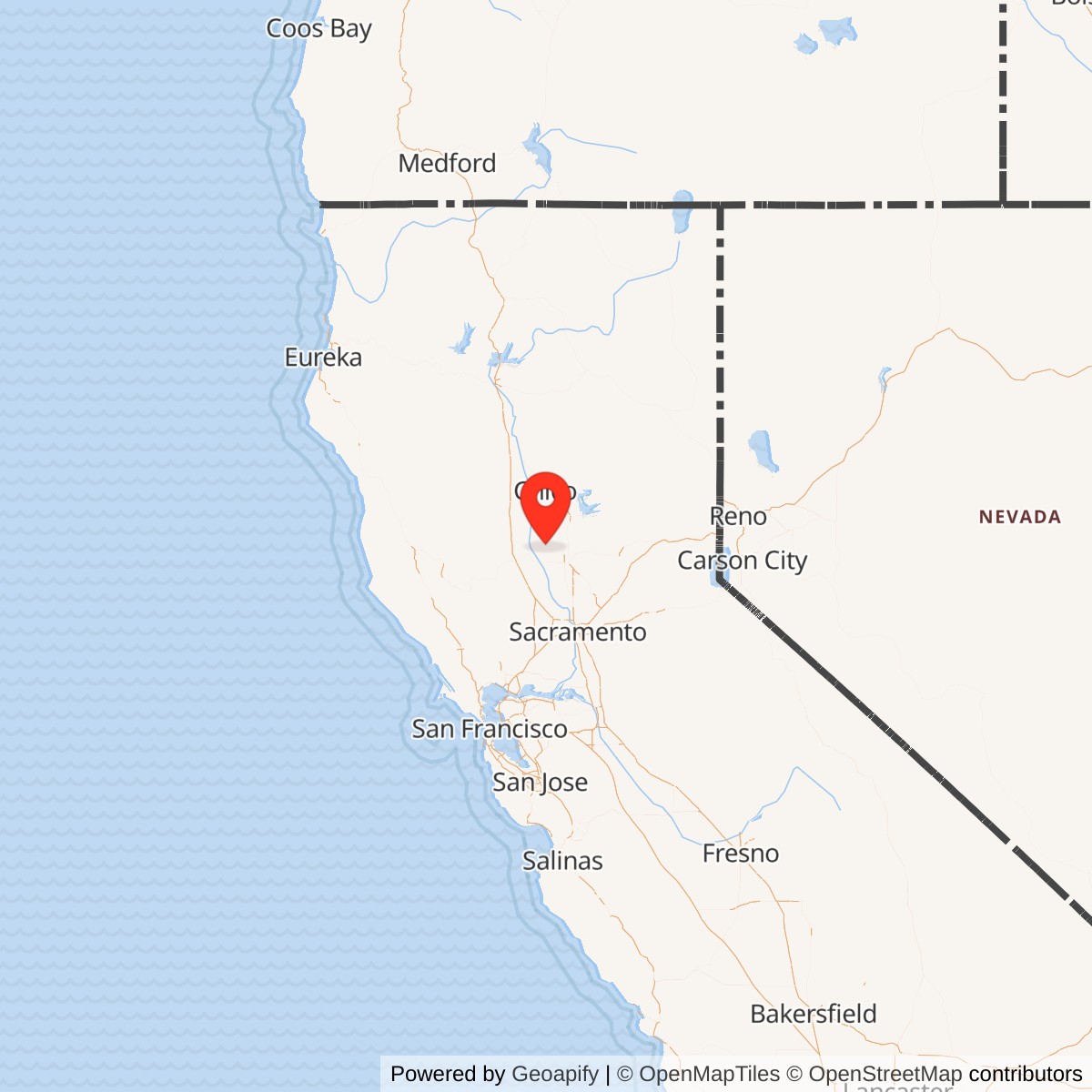
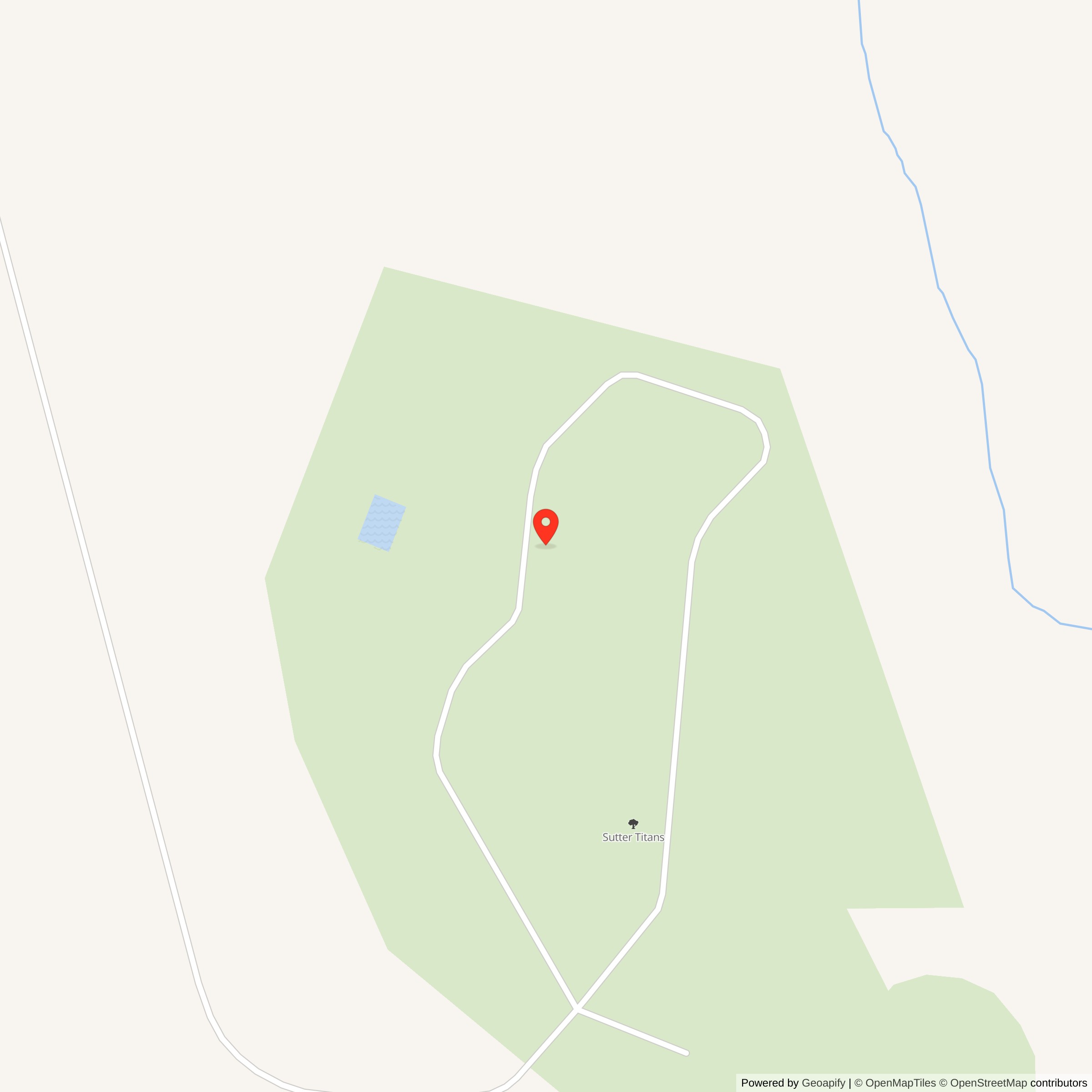
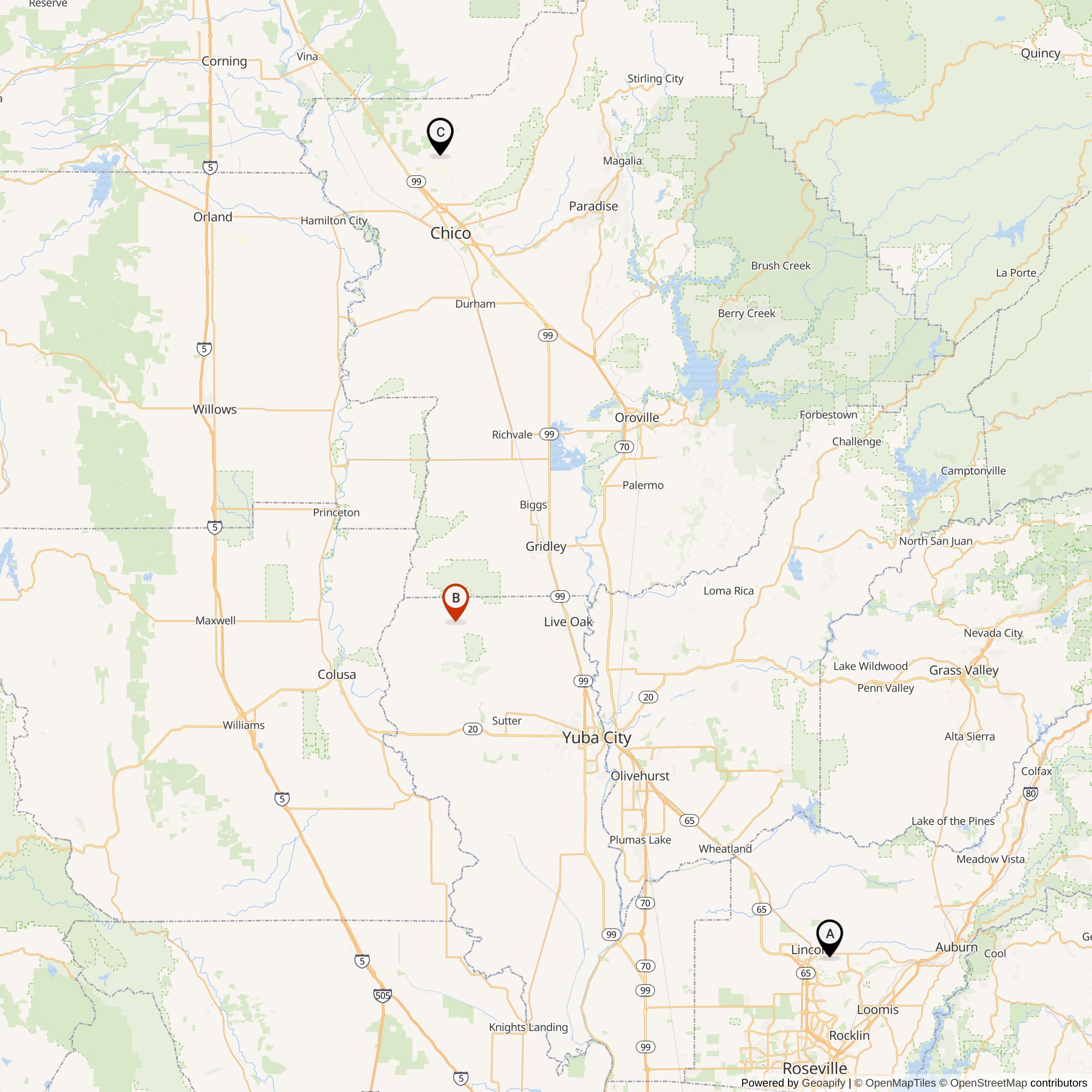
The installation occupied a rural setting north-northeast of the Sutter Buttes. The current U.S. Army Corps of Engineers FUDS geographic record places the property at 39.27555556 north latitude and 121.82944444 west longitude, identifies Sutter County, and says the installation is not within a city. Historical descriptions connect it with Live Oak, while the modern federal record describes it as about 20 miles northwest of Marysville. These place names identify regional relationships, not separate installations.
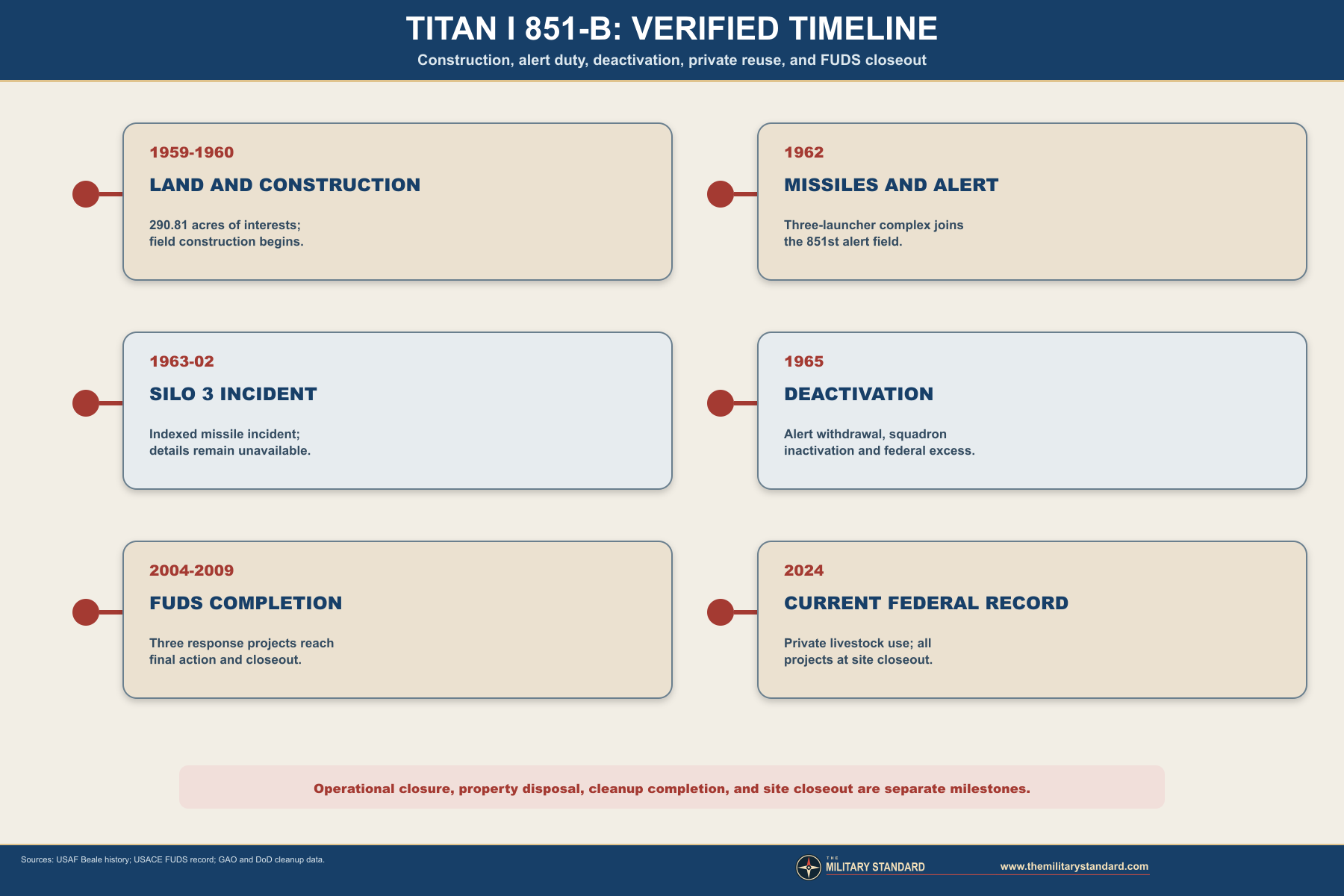
USACE reports 290.81 total acres of military property interests, divided into 46.7 fee acres and 244.11 easement acres. The underground missile plant and support structures occupied roughly 47 acres, while the surrounding easements created an isolation, security, access, and utility envelope. This distinction is important because popular summaries often call the site a 291-acre complex even though the government did not hold all of that land in the same form and the hardened structures did not fill the full envelope.
The operational life was short. Construction of the Beale field began in 1960, missiles arrived across the three complexes during 1962, and the squadron achieved alert status in September. Air Force historical-research material specifically indexes a February 1963 missile incident at Sutter Buttes Silo 3, but the reviewed public index does not give enough detail to describe its cause or consequences. Titan I phaseout followed in 1964 and 1965. USACE records March 31, 1965 as the beginning of deactivation at 851-B and June 22 as the date the Department of Defense reported the property excess.
After military use, the core returned to private ownership and agricultural use. The current federal record says the property is privately owned and used for livestock grazing. Three FUDS projects addressed soil or groundwater contamination, underground storage tanks, and building demolition or debris removal. All are shown as response complete or site closeout, but those environmental and program terms do not certify the underground complex for entry, guarantee that no hazard remains, or create public access.
Installation Identity and Permanent Record
The permanent project identity is Titan I Missile Complex 851-B. The parent installation is Camp Beale / Beale Air Force Base. Although command, administration, training, maintenance, security, logistics, nuclear support, and higher headquarters led back to Beale, the Sutter Buttes property was a geographically separate launch installation with its own land, construction, operational, disposal, and environmental record.Several names describe the same installation. Air Force history uses 851-B, Complex 4B, and Sutter Buttes. The current USACE geographic record uses Beale AFB Titan 1-B, FUDS installation CA99799F569800, and property number J09CA0755. Defense-derived cleanup data also use Beale AFB Facility S-2. Live Oak appears because it was the nearest community commonly associated with the site.
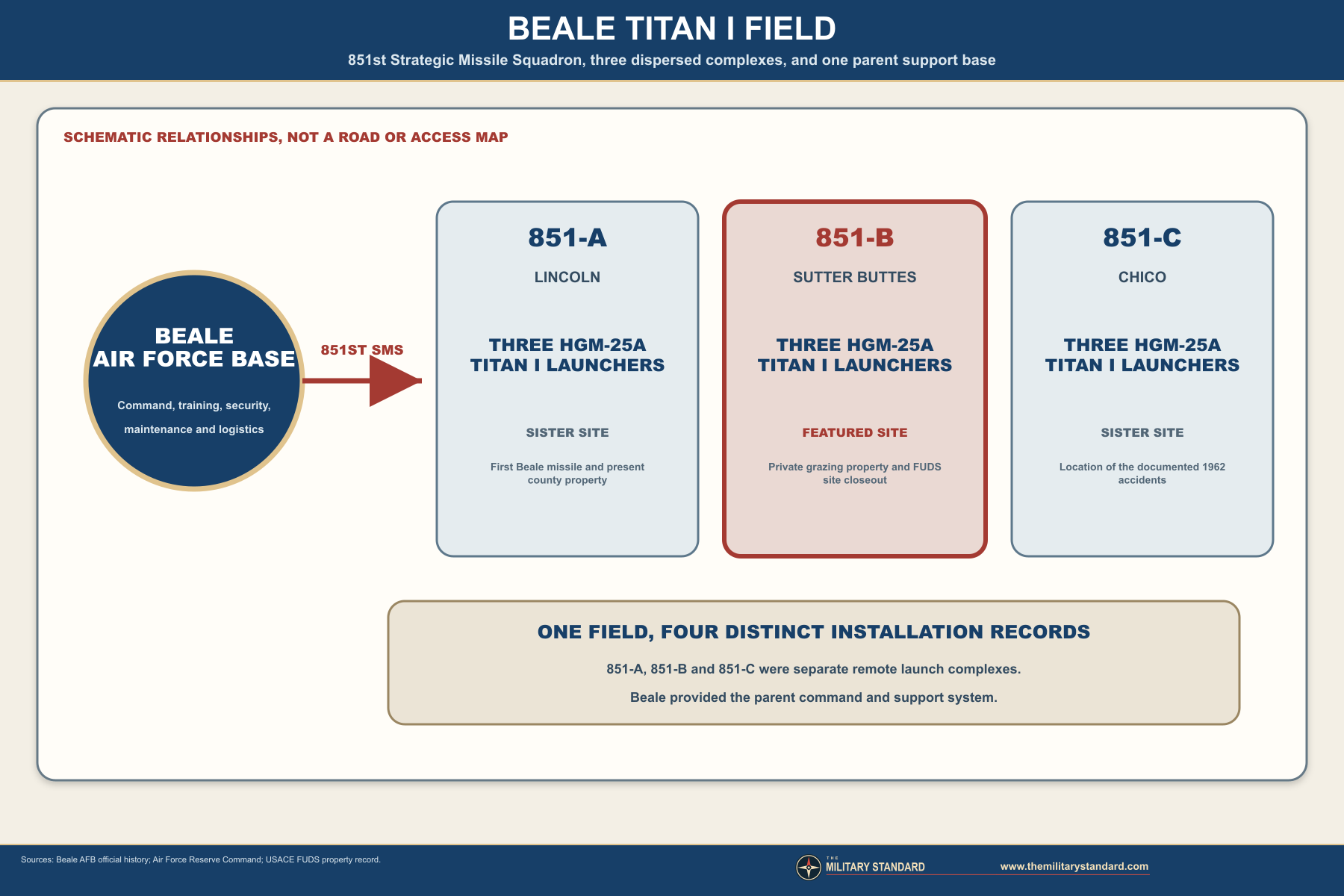
The label Titan 1-B can be mistaken for a missile variant. In this context the numeral identifies the Titan I weapon system and the letter identifies the B complex of the Beale field. The missiles were HGM-25A Titan I weapons. The squadron number was 851st, and the field designations A, B, and C distinguished the Lincoln, Sutter Buttes, and Chico complexes.
Site Selection and Land Control
The Sutter Buttes complex occupied agricultural land separated from the population centers of the early 1960s. Titan I siting required distance from the parent base and from the other complexes, suitable transportation for heavy construction and missile delivery, communications links, electrical support, security space, and geology that could accept a large underground plant. The location also had to permit a safety and isolation envelope without buying every surrounding acre in fee.The fee-and-easement pattern answered those demands. Direct federal ownership covered the main complex, while easements extended military control or restrictions beyond it. Easements could protect approaches, utilities, security, blast separation, or incompatible development while leaving underlying title with private owners. That approach reduced the amount of land purchased outright but made the later disposal record more complicated.
The current USACE total of 290.81 acres is internally consistent with 46.7 fee acres plus 244.11 easement acres. A separate DoD-derived public data page describes roughly 47 acres occupied by the missile silos and support structures and repeats a 244-acre easement envelope. It also reports a June 1961 final judgment involving 64.63 acres at and adjacent to the main complex. Because the public summary does not reproduce the underlying judgment and its wording is difficult to reconcile with the later FUDS acreage table, this history preserves the fact as a title-record clue rather than treating it as a complete modern chain of title.
The safest property conclusion is limited. The United States held a fee core and a much larger collection of easement interests for the missile mission. The property disposal process returned the core and surrounding interests to private control in stages. The modern federal record says the missile property is privately owned and used for livestock grazing.
Why Beale Received Titan I
Titan I entered deployment while Strategic Air Command was moving from a bomber-centered retaliatory force toward a mixed force of bombers and intercontinental missiles. The missile offered long range and a powerful nuclear payload, but its cryogenic liquid-oxygen system, radio-inertial guidance, above-ground launch requirement, and large underground support plant made each operational site complex and labor intensive. The Air Force placed early Titan squadrons at widely separated western and central bases to complicate enemy targeting and to build a survivable first-generation missile force as quickly as technology allowed.Beale offered strategic and geographic advantages. Its inland California location supported dispersed sites away from the coast, while the Sacramento Valley provided access to transportation, construction labor, utilities, and a major Air Force support base. The three complexes were separated from Beale and from one another, reducing the chance that one attack or one accident would disable the entire field. Beale supplied the institutional center for personnel, training, logistics, nuclear support, administration, maintenance, and communications while the remote complexes performed the alert mission.
The missile assignment also fit Beale's transformation. The former wartime Army installation was becoming a Strategic Air Command base with expanding bombardment, tanker, missile, and later reconnaissance responsibilities. Official Beale history places the Titan support era between 1959 and 1965. The 851st was assigned first under the 4126th Strategic Wing, which SAC had activated at Beale, and then under the 456th Strategic Aerospace Wing after the 4126th was redesignated on February 1, 1963.
Construction of the Beale Field
Official Beale history says construction on the three complexes began January 22, 1960. Peter Kiewit Sons Company served as the principal contractor for the Beale Titan work, and the U.S. Army Corps of Engineers managed the ballistic-missile construction program. The field was a coordinated project rather than three unrelated excavations. Designs, forms, lessons, specialized crews, and acceptance processes moved across the Lincoln, Sutter Buttes, and Chico sites.The Lincoln record documents the sequence especially well. Forms fabricated for 851-A were reused at the B and C complexes. That fact gives 851-B a direct construction relationship with the earlier Lincoln work, even though the publicly reviewed sources do not preserve the same day-by-day excavation diary for Sutter Buttes. It also warns against copying Lincoln-specific geology, groundwater depth, excavation quantities, or concrete totals into the Sutter Buttes record without site-level support.
An official Air Force public history states that more than 600,000 cubic yards of earth were excavated and that each Beale complex required about 32,000 cubic yards of concrete, 300 tons of piping, 90 miles of cable, and 1,800 separate supply items. The wording and surviving project histories suggest that some quantities are rounded or use different accounting scopes.
Construction had to integrate civil engineering with a weapon system. Reinforced underground rooms and cylinders needed exact interfaces for elevators, doors, propellant equipment, electrical systems, ventilation, communications, guidance antennas, and missile-support hardware. Completion of concrete did not equal operational acceptance. Equipment installation, contractor checkout, Air Force turnover, crew training, shakedown exercises, and Strategic Air Command certification followed.
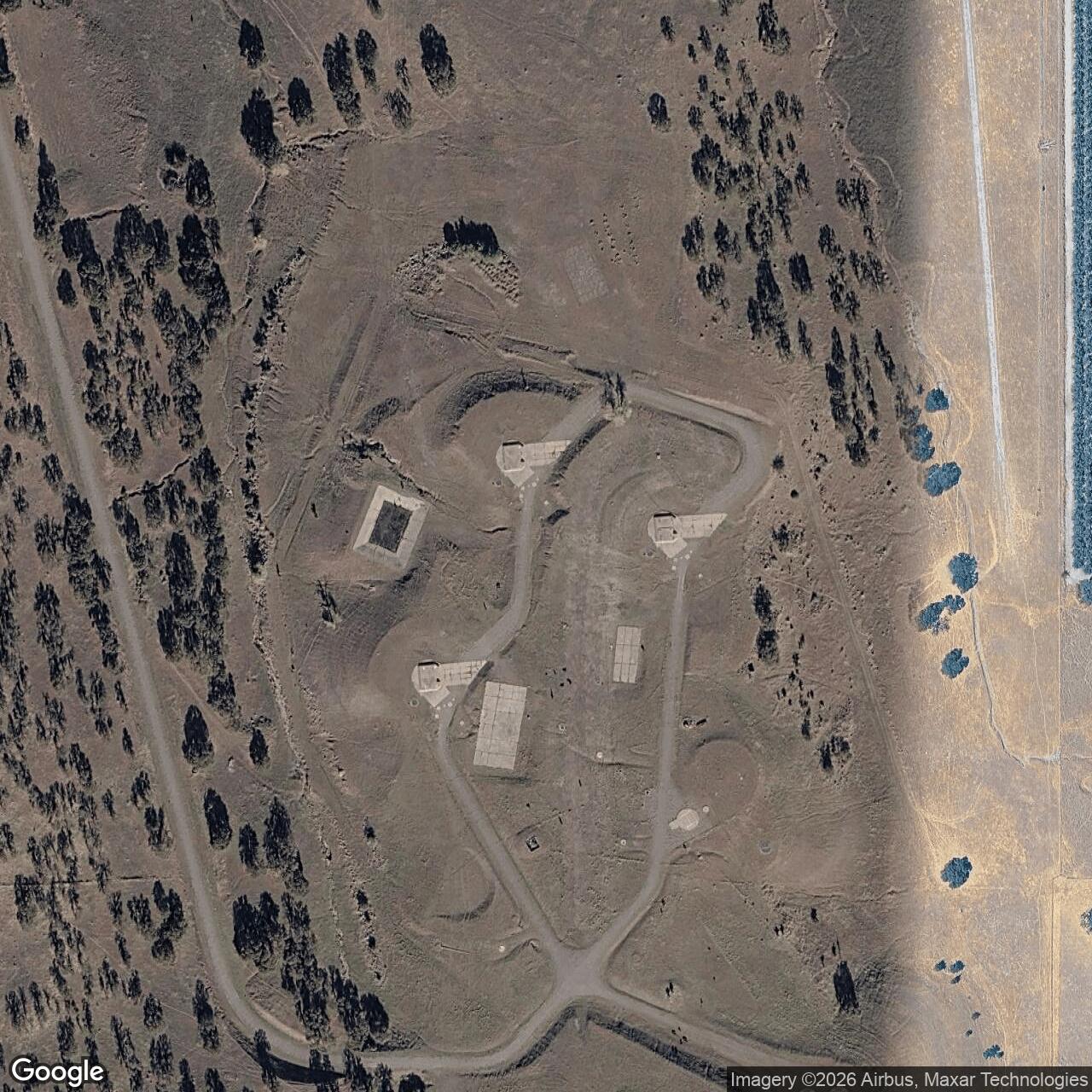
USACE describes the completed Sutter Buttes installation as hardened, with essential facilities underground to withstand nuclear attack. The federal feature record lists three missile silos with adjacent propellant and equipment silos, a control center, a generator house, two antenna silos, an entry portal, and connecting tunnels. It also lists underground electrical, water, wastewater, communications, and storage-tank systems. That inventory is the best site-specific public description located for 851-B.
Standard Titan I Physical Plant
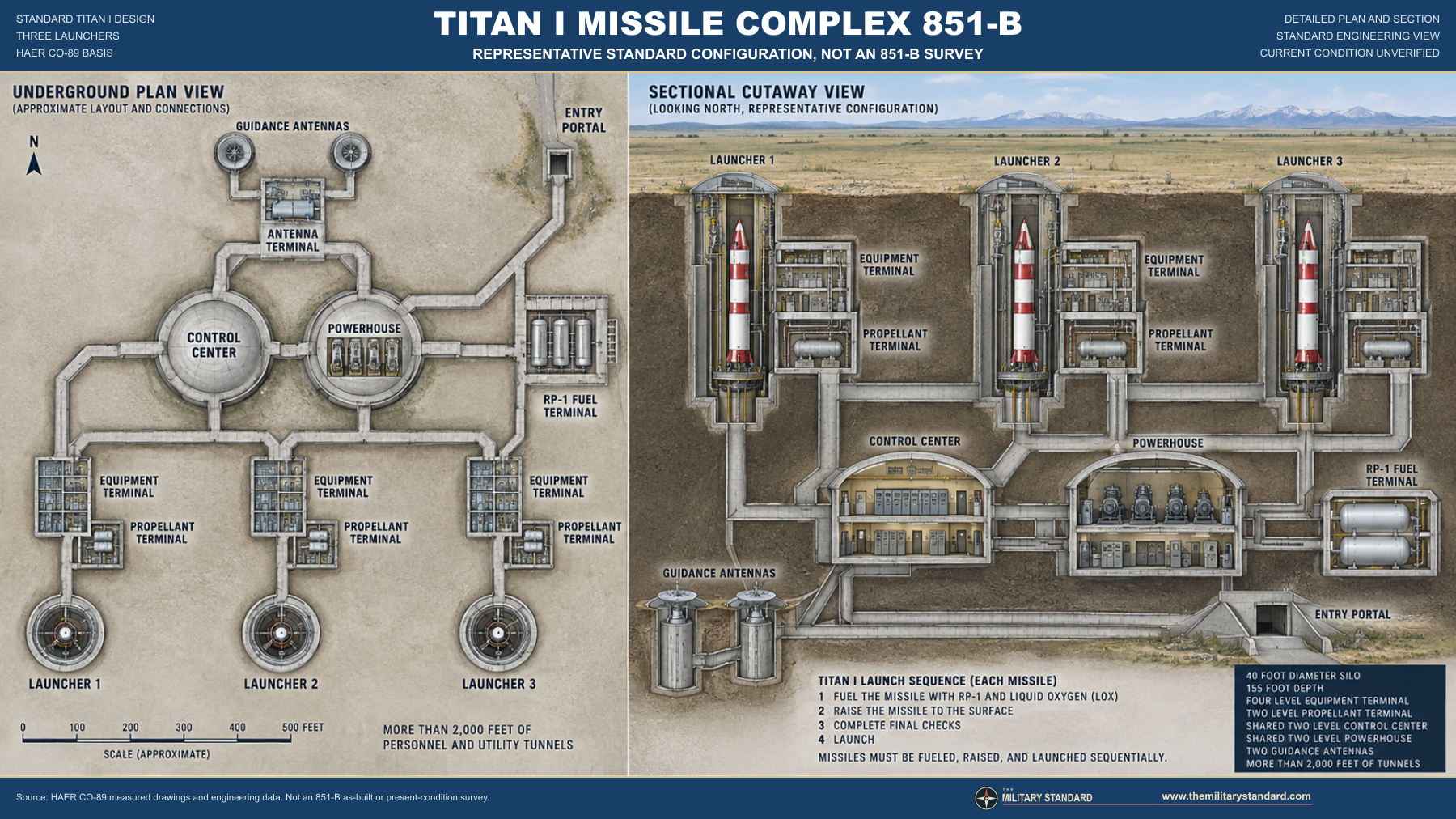
Each launcher branch functioned as part of one integrated plant rather than as an independent hole in the ground. Electrical power, communications, environmental control, propellant service, guidance data, and command authority had to reach the launcher through protected spaces. The control center supported combat-crew operations and authentication. The power house maintained electrical continuity. Antenna equipment connected the site to the external guidance and command network, while the terminals managed the hazardous fluids required to ready a missile for launch.
The surface plan was intentionally understated. Roads, vents, portals, covers, support buildings, fencing, security zones, and utility features marked the site, but most operational volume lay below ground. The silos protected missiles during alert storage; they were not launch tubes in the later Minuteman sense. Before launch, Titan I had to be fueled, raised to the surface by elevator, and launched from the exposed position. That sequence imposed time, machinery, and vulnerability penalties that later solid-fueled missiles avoided.
Site-Specific Surface and Utility Features
The current FUDS record adds aboveground detail not always included in general Titan I summaries. It lists access roads, a metal building, a helipad, hardstands for missile launches, watch towers, an oxidation pond, and fencing. These features supported movement, security, operations, utilities, and emergency response around the underground plant. Their inclusion does not establish that every feature survives today.The storage-tank inventory reflects the complex's operating burden. USACE identifies tanks or systems associated with kerosene, diesel fuel, liquid oxygen, and possible liquid nitrogen. Kerosene-type RP-1 fueled the missile, liquid oxygen supplied the oxidizer, and diesel supported site power. The qualifying word possible for liquid nitrogen must remain because the current property description does not confirm that system with the same certainty as the other tanks.
Wastewater facilities and an oxidation pond served a site that functioned continuously as a guarded industrial installation. Water, sanitation, drainage, ventilation, and environmental control were not secondary conveniences. They sustained combat crews and machinery in a buried facility and became part of the later environmental and closure record. A launch-complex diagram that shows only three circles for silos therefore understates the actual infrastructure.
Missile System and Launch Method
The HGM-25A Titan I was the United States' first operational multistage intercontinental ballistic missile. It used kerosene-type fuel and liquid oxygen, with liquid oxygen loaded during launch preparation because it could not be stored indefinitely in the missile. Radio-inertial guidance relied on a ground-based system that tracked and updated the missile during the early flight. These characteristics made the weapon a major advance over earlier single-stage designs while also creating a large support burden at each complex.An alert sequence required verified command messages, crew coordination, system checkout, propellant operations, guidance readiness, opening the silo cover, raising the fueled missile, and completing launch from the surface. The crew did not simply press a button beside a permanently fueled missile. Multiple mechanical, electrical, communications, and procedural systems had to work in order. The elaborate complex was a physical expression of that chain, and the short service life reflected how rapidly the Air Force improved beyond it.
The Titan I carried a nuclear reentry vehicle and served a deterrent mission rather than a routine firing program. No missile was launched from the Lincoln facility. Operational success was measured by secure alert time, readiness inspections, crew proficiency, maintenance, and the ability to execute a valid order if national command authority required it.
The 851st Strategic Missile Squadron
Official lineage and public-history sources describe the squadron's beginning with slightly different administrative dates. Air Force lineage records activate the 851st Strategic Missile Squadron on August 25, 1960, and organize it on February 1, 1961, while Beale public history says the squadron was activated April 1, 1961. These dates can represent separate establishment, activation, organization, and effective-operating milestones.The squadron's mission required much more than launch crews. Missile maintenance specialists, facilities personnel, communications technicians, security forces, supply functions, trainers, evaluators, and headquarters staff linked the remote sites to Beale. Each complex had to sustain crews underground, maintain the missile and its support equipment, control access, and communicate through protected channels. Beale handled many functions that did not need to be duplicated at every launcher location, while the sites maintained the equipment and personnel that had to remain close to the weapons.
The squadron belonged to Strategic Air Command's larger missile structure. It was assigned to the 4126th Strategic Wing from organization in 1961 until February 1, 1963, when the 456th Strategic Aerospace Wing replaced the 4126th and assumed its mission, personnel, and equipment. That relationship placed the dispersed field inside a base organization already responsible for strategic missions. The installation history therefore cannot be understood by looking only at the 46-acre Lincoln parcel; it was one node in a wider chain of command, logistics, nuclear custody, training, and communications.
Turnover, Shakedown, and Alert Duty
Air Force Historical Research Agency material indexed in the Lincoln remedial investigation shows that 851st crews assumed positions and prepared for shakedown in August 1962. The shakedown was a simulated launch exercise used to test the integrated crew, equipment, procedures, communications, and safety program without firing a missile. A September 20 shakedown plan and a September 25 simulated Broken Arrow exercise appear in the same research index.The indexed records mention radiation badges for the Broken Arrow exercise, pre-liquid-oxygen checks for fuel or hydraulic-fluid spills at the bottom of silos, RP-1 trailers in a fuels and propellants parking area, and DCM-20 missile pyrotechnics. These details illuminate field practices and hazards, but the index does not assign every procedure to a particular 851-B launcher. They are used here as squadron-level operating evidence, not as a claim that a named action occurred at one exact Sutter Buttes point.
The Beale field achieved alert status in September 1962 and was the last Titan I squadron to do so. The exact day often repeated in secondary sources is not supported by the reviewed official public histories. Two months after full operational status, the 851st became the first Titan I unit to pass a Strategic Air Command Operational Readiness Inspection. That result indicates successful integration of all three remote complexes with Beale support.
Alert duty required continuous readiness rather than frequent visible activity. Crews staffed protected spaces, maintained secure communications, verified equipment status, trained for launch and emergency procedures, and coordinated with maintenance and security forces. The missile remained underground until a launch sequence required fueling and elevation.
February 1963 Silo 3 Missile Incident
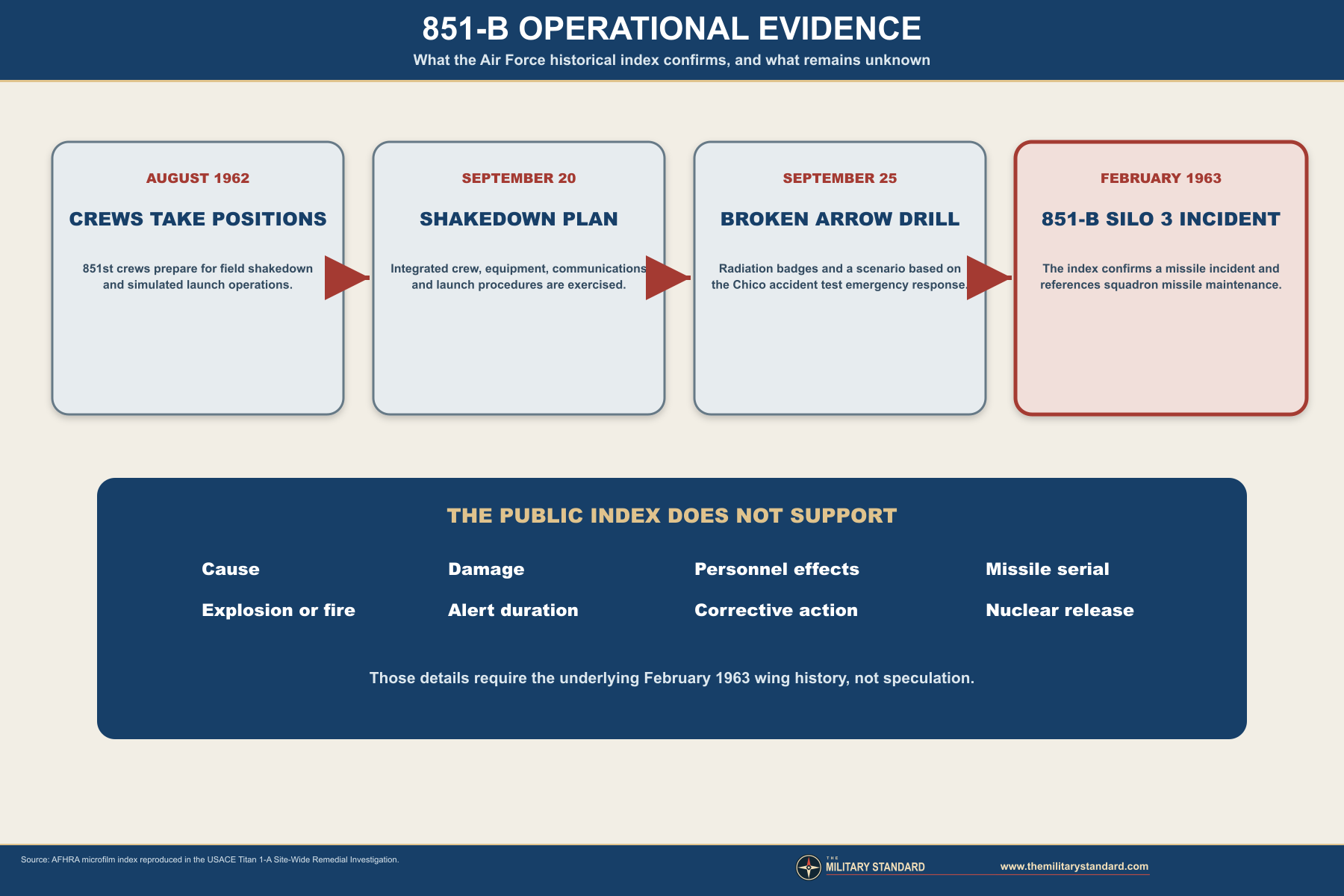
The reviewed index does not describe the incident's cause, damage, personnel effects, alert duration, corrective action, or missile serial number. No defensible public source located supports describing it as an explosion, fire, spill, dropped missile, or nuclear event.
The incident also should not be confused with the documented May 24, 1962 explosion and June 6 flash fire at 851-C near Chico. Those events have separate dates, locations, causes, and consequences. The field's shared command and technical system meant that lessons could affect every complex, but the accidents remain site-specific.
Relationship to 851-A and 851-C
Complex 851-B formed the geographic center of the Beale missile field. Lincoln 851-A lay southwest of Beale and became the first complex to receive a missile. Chico 851-C lay northwest of Beale and received the last missile in April 1962. Sutter Buttes and Live Oak provided the intermediate site reference. Dispersal kept one accident or attack from physically disabling all nine missiles at once.The three complexes shared standardized engineering and the 851st's personnel and procedures. Construction forms moved from Lincoln to the B and C sites. Shakedown, safety, maintenance, communications, and operational-readiness findings applied across the field even when an event occurred at only one location. This combination of standardization and separation was central to early ICBM deployment.
The May 1962 Chico explosion damaged 851-C and destroyed a missile, delaying that complex's operational participation until March 9, 1963. Sutter Buttes and Lincoln were not physically damaged by that accident, but the event shaped the squadron's training, investigation, and safety context. September 1962 Broken Arrow exercises reportedly simulated the Chico disaster, showing how one site's experience became field-wide preparation.
Role in the Wider Military Network
The complex also depended on civilian infrastructure and regional geography. Roads carried oversized construction loads and later missile and support equipment. Commercial suppliers furnished aggregate, concrete inputs, cable, piping, and thousands of components. Local property interests carried easements and restrictions. After closure, the same site entered county road, fire, recreation, and land-planning systems, showing how a secretive strategic facility could become deeply entangled with ordinary regional government.
Phaseout and Site Deactivation
On May 16, 1964, Secretary of Defense Robert McNamara directed accelerated phaseout of Titan I. Solid-fueled Minuteman and storable-liquid Titan II reduced reaction time and eliminated the need to load liquid oxygen immediately before launch. Titan I was retired because the strategic force had moved beyond its first operational generation, not because the Sutter Buttes complex alone had failed.The first Beale Titan I left alert on January 4, 1965. The reviewed public record does not identify its complex or silo, so that date remains a field milestone. Other sources say the last squadron missile was shipped out in February, while USACE records March 31 as the beginning of deactivation work at Sutter Buttes. These dates describe different steps: alert withdrawal, missile removal, unit inactivation, and physical stripping.
The 851st Strategic Missile Squadron was inactivated March 25, 1965. USACE says deactivation at Sutter Buttes began March 31 and that usable equipment and materials were removed from both underground and aboveground facilities. The six-day difference is not contradictory. A unit could inactivate before contractor, engineering, property, and salvage work at a remote complex was complete.
By June 22, 1965, the Department of Defense had reported the acquired property excess and transferred accountability to the General Services Administration. Missile retirement, removal of government equipment, real-property disposal, and later environmental restoration were therefore distinct phases. A single word such as abandoned obscures the formal processes that followed alert duty.
Federal Excess, Revesting, and Private Ownership
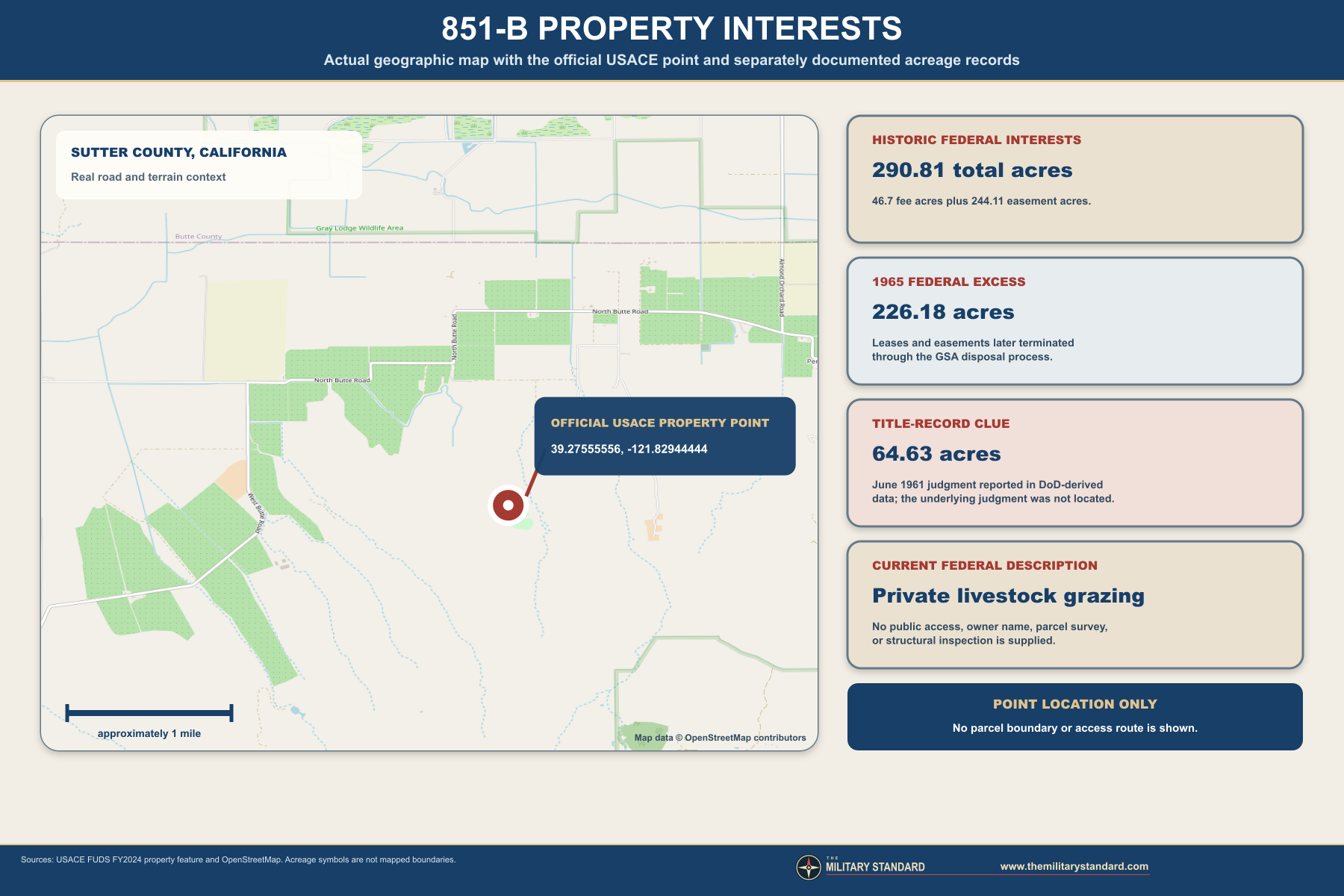
A DoD-derived cleanup summary adds that private residents with leasehold interests exercised rights and that a June 1961 Final Judgment Revesting Title affected 64.63 acres at and adjacent to the main complex. The summary's sequence and legal terminology require the underlying judgment for a definitive interpretation. It may reflect condemnation, leasehold, or title adjustments during acquisition rather than post-1965 disposal.
The federal feature identifies the current owner category only as private and says the land is used for livestock grazing.
Postmilitary Agricultural Use
The Sutter Buttes site's postmilitary history differs sharply from Lincoln's. The current federal record does not describe a county corporation yard, residential development, public park planning, or active federal remedy selection. It describes private ownership and livestock grazing. The rural agricultural setting appears to have limited the intensity of redevelopment across the main former complex.Livestock use does not prove that the underground plant is intact, safe, or accessible. Surface grazing can coexist with capped structures, filled openings, demolished support buildings, buried utilities, monitoring points, and restricted areas. Environmental site closure likewise does not provide a structural survey.
USACE's fiscal year 2024 status is the best current federal snapshot located. It says all projects are at site closeout, the property is not on the National Priorities List, and current use is livestock grazing. Older reports show how the cleanup program reached that status. Newer county, state, or owner actions could occur after the federal data year and should be checked in future updates.
FUDS Property and Project Structure
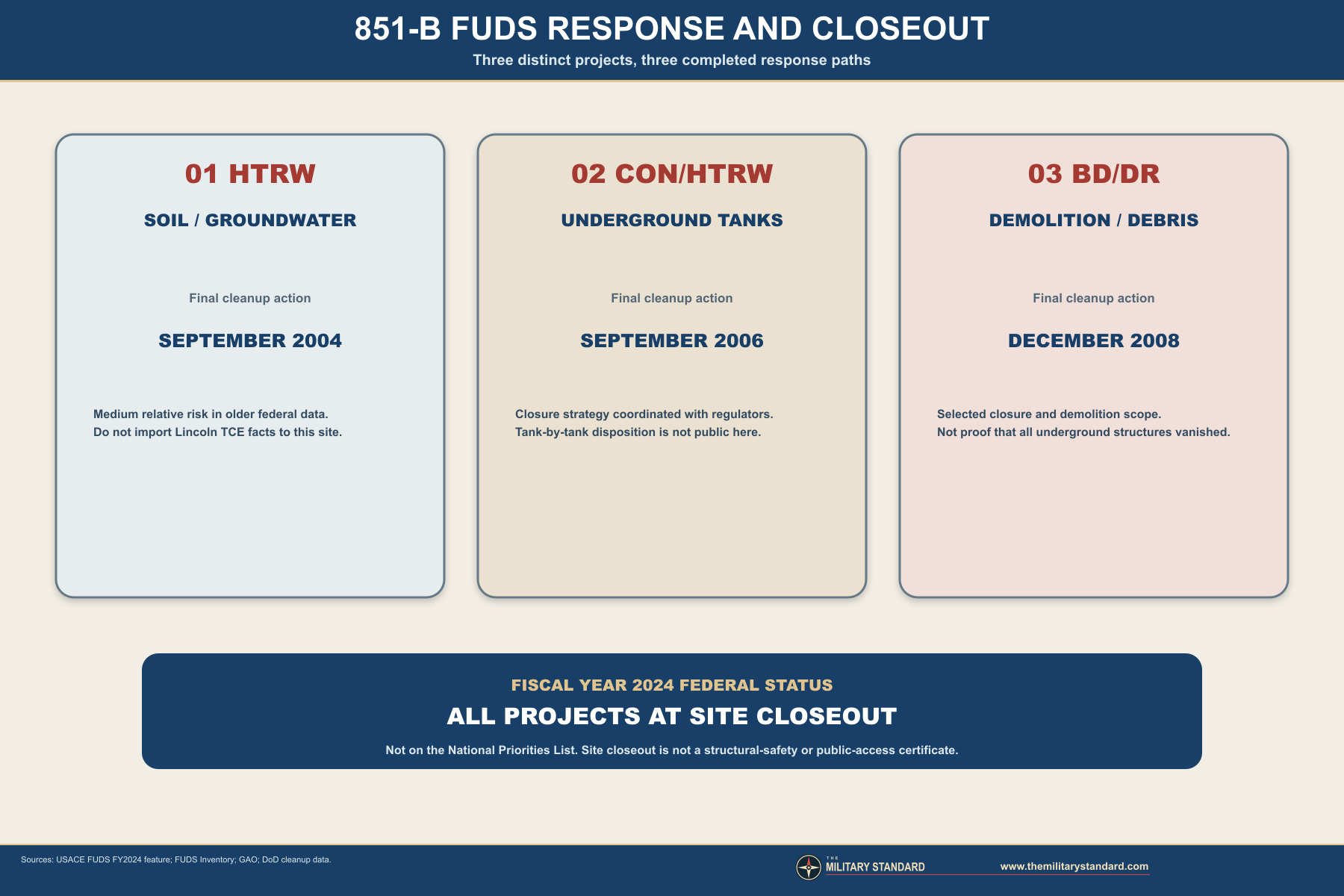
The FUDS inventory identifies three projects: 01 HTRW for soil or groundwater contamination, 02 CON/HTRW for underground storage-tank removal, and 03 BD/DR for site closure and building demolition or debris removal. HTRW means hazardous, toxic, and radioactive waste. CON/HTRW combines container or tank work with hazardous-material response. BD/DR addresses building demolition and debris removal rather than groundwater treatment.
Separating the projects clarifies the afterlife of the site. A groundwater investigation, tank abandonment or removal, and demolition or closure action answer different problems and can finish on different schedules. A property can reach all-project site closeout only after the program has resolved each project under its applicable process. That status still does not mean every subsurface structure was removed or every possible non-FUDS issue eliminated.
Soil and Groundwater Project 01HTRW
The oldest project addressed soil or groundwater contamination. A 2001 federal compilation listed the HTRW project as medium relative risk and showed the remedial investigation and feasibility study complete. The current Defense-derived cleanup page reports a final cleanup action in September 2004. Later federal data place the overall property at site closeout.The reviewed public records do not identify a contaminant plume comparable to the TCE project at Lincoln. It would therefore be incorrect to copy Lincoln's chemicals, concentrations, monitoring network, or active 2026 schedule into 851-B. The Sutter Buttes history records only what the site-specific public program data support: a soil or groundwater project existed and reached response-complete status.
An older reference list mentions a 1986 Air Force report concerning alleged nerve gas buried at Titan 1-B. The reviewed source is an index entry, not the report or a confirmation that chemical warfare agent was present. No current USACE property description identifies nerve agent as a remaining site condition. The allegation is therefore documented as a records-research lead and not repeated as fact.
Response complete is a regulatory-program milestone. It indicates that the selected FUDS response has been carried out and the project requires no further funded remedial action under that decision, subject to any controls or monitoring that may apply. It does not mean the land has been restored to its pre-1959 condition, that old structures are safe, or that private access rules no longer apply.
Underground Storage-Tank Project 02CON/HTRW
The site used underground storage systems for kerosene, diesel, liquid oxygen, and possibly liquid nitrogen, and it also had water and wastewater infrastructure. These systems created potential closure and removal needs after military use. The CON/HTRW project specifically addressed underground storage tanks rather than the entire missile plant.Early 2000s defense-program reports said USACE was working with state regulators on the correct closure strategy and planned to abandon wells and underground storage tanks. Later data report final cleanup action in September 2006. The progression from investigation through design and physical closure explains why work continued decades after the missile mission ended.
Tank abandonment can involve removal, cleaning, filling, closure in place, sampling, or combinations chosen for site conditions. The public summary does not give a tank-by-tank disposition list. This history therefore does not claim that every historic tank was excavated or that all associated piping was removed. It records the completed FUDS project and the historic tank functions supported by USACE.
Building Demolition and Site-Closure Project 03BD/DR
The BD/DR project addressed building demolition, debris removal, and site closure. A 2001 federal compilation still showed it in remedial design, and the DoD-derived project page reports final cleanup action in December 2008. The overall cleanup completion date is reported as 2009, consistent with administrative closeout after the last physical project milestone.USACE's current property description lists the original metal building, watch towers, fencing, helipad, hardstands, roads, oxidation pond, and extensive underground structures. A demolition project could remove selected unsafe or unnecessary features without eliminating the entire hardened complex. The current public feature does not publish a component-by-component demolition inventory.
The term site closure in the project title is program language, not a claim that the property was sealed forever or opened safely to the public. It marks completion of an authorized demolition or debris-removal scope. Private livestock use continued after the cleanup program, and the former missile identity remains visible in federal records.
Meaning of All Projects at Site Closeout
USACE's fiscal year 2024 geographic record gives the property status as properties with all projects at site closeout. That is stronger and more current than older schedules showing work under way.Site closeout does not certify unrestricted future use, structural integrity, potable groundwater, or absence of every hazard. FUDS eligibility and project decisions are tied to former DoD responsibility and defined project scopes. Private owners and other regulators may still manage ordinary property, agricultural, building, well, waste, or safety obligations outside those scopes.
The property is also listed as not on the National Priorities List. This means it is not a federal Superfund NPL site. It does not mean that no environmental work occurred. The three FUDS projects and their reported completion dates show substantial federal investigation and response despite the non-NPL status.
Surviving Features, Safety, and Access
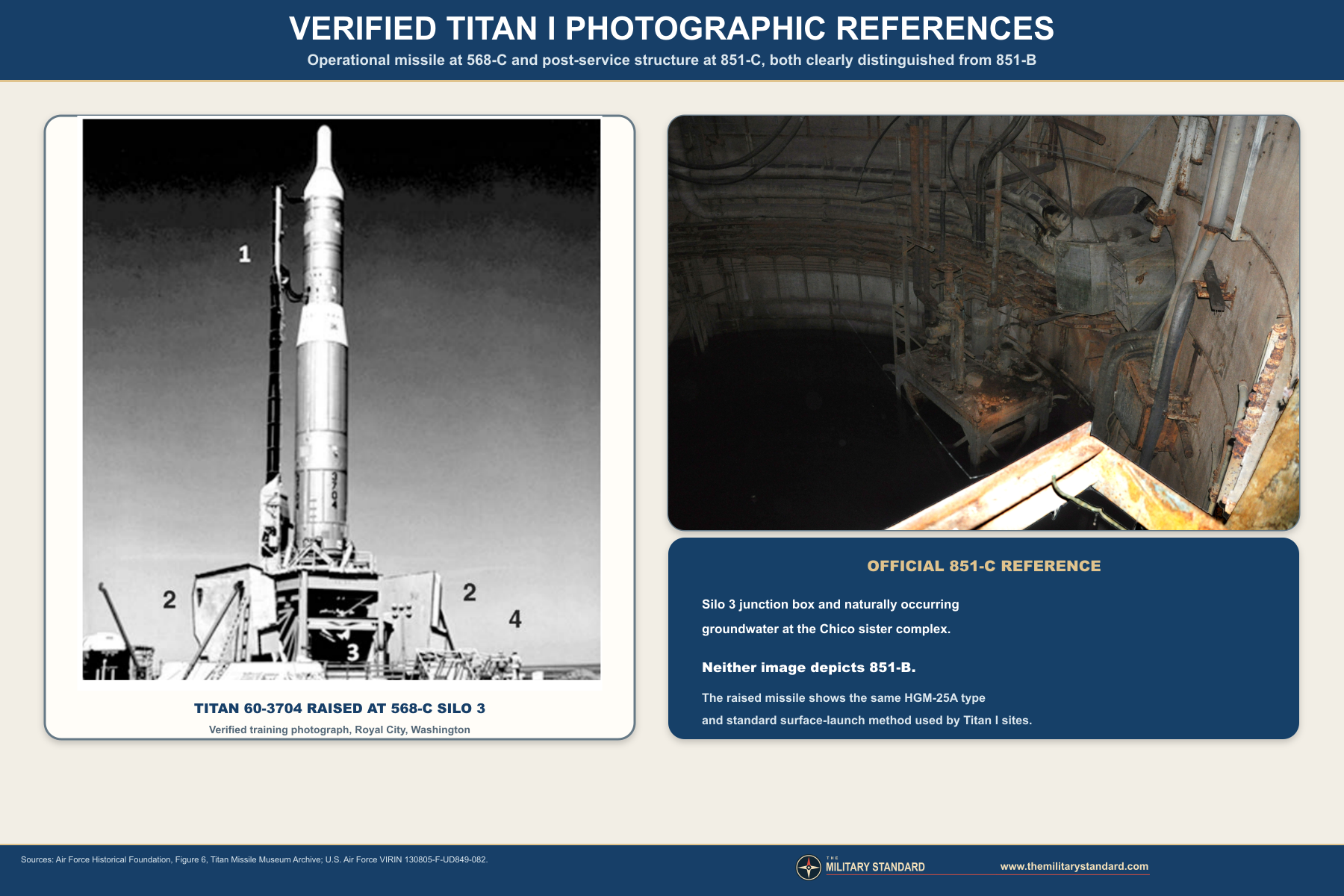
Titan I sites can contain deep shafts, flooded or oxygen-deficient spaces, deteriorated stairs and platforms, unstable debris, residual utilities, contaminated materials, and concealed openings.
Private ownership controls access. No reviewed source establishes a museum, tour program, public trail, or permission to enter the former complex. The coordinate, site-context map, and standard-layout graphics are for identification and education. They are not instructions for entering the property, locating openings, crossing fences, or bypassing livestock and owner controls.
The safest description of survival is feature-specific and qualified. The federal record confirms what was built. The cleanup record confirms that tanks, contamination, demolition, and debris were addressed through three projects. The current record confirms private grazing use and site closeout. It does not confirm a fully intact underground plant, complete demolition, or public-safe access.
Chronology
- 1957 Congressional and Air Force decisions accelerate deployment of intercontinental ballistic missiles, including the two-stage Titan I.
- 1959 The Air Force announces the Beale Titan I field and begins acquiring fee and easement interests for three dispersed complexes.
- 1959-1965 USACE reports acquisition of 290.81 acres of interests for Sutter Buttes: 46.7 fee acres and 244.11 easement acres.
- 1960-01-22 Construction begins on the Beale field under the U.S. Army Corps of Engineers and Peter Kiewit Sons Company.
- 1960 Standardized forms, specialized crews, and construction methods move through the Lincoln, Sutter Buttes, and Chico projects.
- 1960-08-01 The Corps of Engineers Ballistic Missile Construction Office is established to manage the expanding national missile-construction program.
- 1960-11-01 Specialized ballistic-missile construction management assumes greater responsibility for the Beale work.
- 1961-02-01 The 851st Strategic Missile Squadron is organized under the 4126th Strategic Wing at Beale.
- 1961-06 A DoD-derived property summary reports a Final Judgment Revesting Title involving 64.63 acres at and adjacent to the main complex.
- 1962-02-28 The first missile in the Beale field is moved to Complex 4A at Lincoln.
- 1962-04-20 The last missile in the three-complex field is placed at Chico, bracketing missile emplacement at Sutter Buttes within the February-to-April period.
- 1962-05-24 An explosion at sister complex 851-C destroys a missile and damages a Chico silo. The event is separate from the later 851-B incident.
- 1962-06-06 A flash fire at Chico kills a worker during repair-era activity. Field safety and emergency planning absorb the lessons.
- 1962-08 851st crews assume positions and prepare for shakedown exercises across the missile field.
- 1962-09-20 An indexed 851st Titan I shakedown plan documents simulated launch preparation.
- 1962-09-25 The squadron conducts a simulated Broken Arrow exercise using radiation badges and a scenario based on the Chico accident.
- 1962-09 The 851st enters alert, becoming the last Titan I squadron to reach that status.
- Late 1962 The 851st becomes the first Titan I unit to pass a Strategic Air Command Operational Readiness Inspection.
- 1963-02-01 The 4126th Strategic Wing is redesignated as the 456th Strategic Aerospace Wing. The 851st remains the missile squadron.
- 1963-02 Air Force historical-research indexing records a missile incident at Sutter Buttes 851-B Silo 3. Publicly reviewed material does not provide the cause or outcome.
- 1963-03-09 The repaired Chico complex returns to operational status.
- 1964-05-16 Secretary of Defense Robert McNamara directs accelerated phaseout of Titan I.
- 1964-11 The Department of Defense publicly announces phaseout of the remaining first-generation Titan I force.
- 1965-01-04 The first Beale Titan I is removed from alert. The public record does not identify the specific complex.
- 1965-02 The last missile is reported shipped from the 851st field for disposition.
- 1965-03-25 The 851st Strategic Missile Squadron is inactivated.
- 1965-03-31 USACE records the beginning of deactivation at Sutter Buttes and removal of usable underground and aboveground equipment.
- 1965-06-22 DoD reports the acquired property excess and transfers accountability to GSA.
- After 1965 GSA terminates leases and easements covering 226.18 acres as property interests return to private control.
- 1986 An Air Force records index notes a report concerning an allegation of buried nerve gas at Titan 1-B. No reviewed current record confirms the allegation.
- 1995 Federal records show the tank and hazardous-material project in the remedial-design process.
- 1997 Federal records show the soil and groundwater remedial investigation and feasibility study complete.
- 2001 GAO reports three cleanup projects at the Sutter Buttes property, with the tank and demolition projects still under way.
- 2002-2004 Defense program reports describe coordination with state regulators and planned well and underground-storage-tank closure work.
- 2004-09 Defense-derived data report final cleanup action for project 01HTRW.
- 2006-09 Defense-derived data report final cleanup action for project 02CON/HTRW.
- 2008-12 Defense-derived data report final cleanup action for project 03BD/DR.
- 2009 DoD data report overall cleanup completion, followed by administrative site closeout.
- 2015 The national FUDS inventory lists all three Sutter Buttes projects under J09CA0755.
- 2024 The USACE FUDS geographic record shows private ownership, livestock grazing, all projects at site closeout, and not on the National Priorities List.

Sources & References
- WEB Cold War Relics: Deactivated Titan 1 Missile Silos Surround Beale SOURCE FOR: Official Air Force field identity, construction start, summarized quantities, missile emplacement, Chico accident, alert duty, readiness inspection, phaseout, and private ownership of Complex 4B.
- WEB Titan 1 Missile Facility Provides Glimpse into Beale's Past SOURCE FOR: Official Air Force Reserve history of the 851st and the Lincoln, Live Oak, and Chico complex network.
- WEB Beale's History: Past to Present SOURCE FOR: Official Beale history and the base's 1959 to 1965 support of Titan I sites near Lincoln, Chico, and the Sutter Buttes.
- PDF Ballistic Missiles in the United States Air Force, 1945-1960 SOURCE FOR: Official Air Force historical context for missile development, Titan I deployment, Strategic Air Command organization, and early ICBM policy.
- PDF To Defend and Deter: The Legacy of the United States Cold War Missile Program SOURCE FOR: National Titan I program, construction organization, standard engineering, field deployment, and phaseout context.
- WEB Titan I Intercontinental Ballistic Missile SOURCE FOR: National Park Service explanation of Titan I development, liquid propellants, underground storage, surface launch, guidance, and replacement.
- WEB National Museum of the United States Air Force Titan I Fact Sheet SOURCE FOR: Official Air Force missile characteristics, two-stage design, liquid-oxygen requirements, development, and operational role.
- WEB Beale AFB Titan 1-B, USACE FUDS Fiscal Year 2024 Property Feature SOURCE FOR: Official coordinate, county, property and FUDS identifiers, acreage, acquisition and deactivation history, facility inventory, disposal, private ownership, livestock use, and site-closeout status.
- WEB USACE FUDS Data Map Service Description SOURCE FOR: Official description and fiscal year 2024 scope of the property and project geographic layers used for the current federal status.
- PDF FUDS Inventory, California SOURCE FOR: Official national inventory confirmation of J09CA0755 projects 01 HTRW, 02 CON/HTRW, and 03 BD/DR.
- WEB Defense Environmental Programs Annual Report to Congress, Fiscal Year 2008, References and Index SOURCE FOR: Official FUDS installation identity and FFID CA99799F569800.
- PDF Defense Environmental Restoration Program Annual Report, Appendix B SOURCE FOR: Historical federal progress notes on the Sutter Buttes closure strategy, wells, underground storage tanks, and planned remedial work.
- PDF Status of Active Installations, BRAC Installations, and FUDS Properties SOURCE FOR: Defense program record of three Sutter Buttes projects and reported federal cleanup expenditure.
- WEB Environmental Contamination: Cleanup Actions at Formerly Used Defense Sites SOURCE FOR: GAO's 2001 project status, hazard categories, relative-risk information, schedule, and cost context for J09CA0755.
- WEB Properties Identified for Potential Inclusion in the FUDS Cleanup Program SOURCE FOR: GAO property-level confirmation of Sutter County, eligibility, three projects, and early program-cost estimates.
- WEB Bombs in Your Backyard: Beale AFB Titan 1-B SOURCE FOR: DoD and USACE-derived project names, response-complete dates, 2009 completion date, 64.63-acre title clue, private ownership, and livestock use. Used as a secondary presentation of federal data.
- PDF Site-Wide Remedial Investigation Report, Former Beale AFB Titan 1-A Missile Facility SOURCE FOR: Air Force Historical Research Agency index entries covering 851st shakedown, Broken Arrow exercise, operating procedures, the February 1963 851-B Silo 3 incident, and the 1986 Titan 1-B allegation record.
- WEB Historic American Engineering Record, Titan One Missile Complex 2A, HAER CO-89 SOURCE FOR: Standard Titan I complex engineering, three-launcher arrangement, underground component relationships, measured drawings, and interpretation limits for a standard-design comparison.
- PDF HAER CO-89 Data Pages SOURCE FOR: Detailed standard Titan I construction, systems, operations, component functions, and Cold War significance.
- WEB Titan 1 Intercontinental Ballistic Missile Complex 4C Photograph SOURCE FOR: Official public-domain Air Force photograph of groundwater in a standard-design sister complex, used only as a clearly labeled comparison and not as an 851-B photograph.