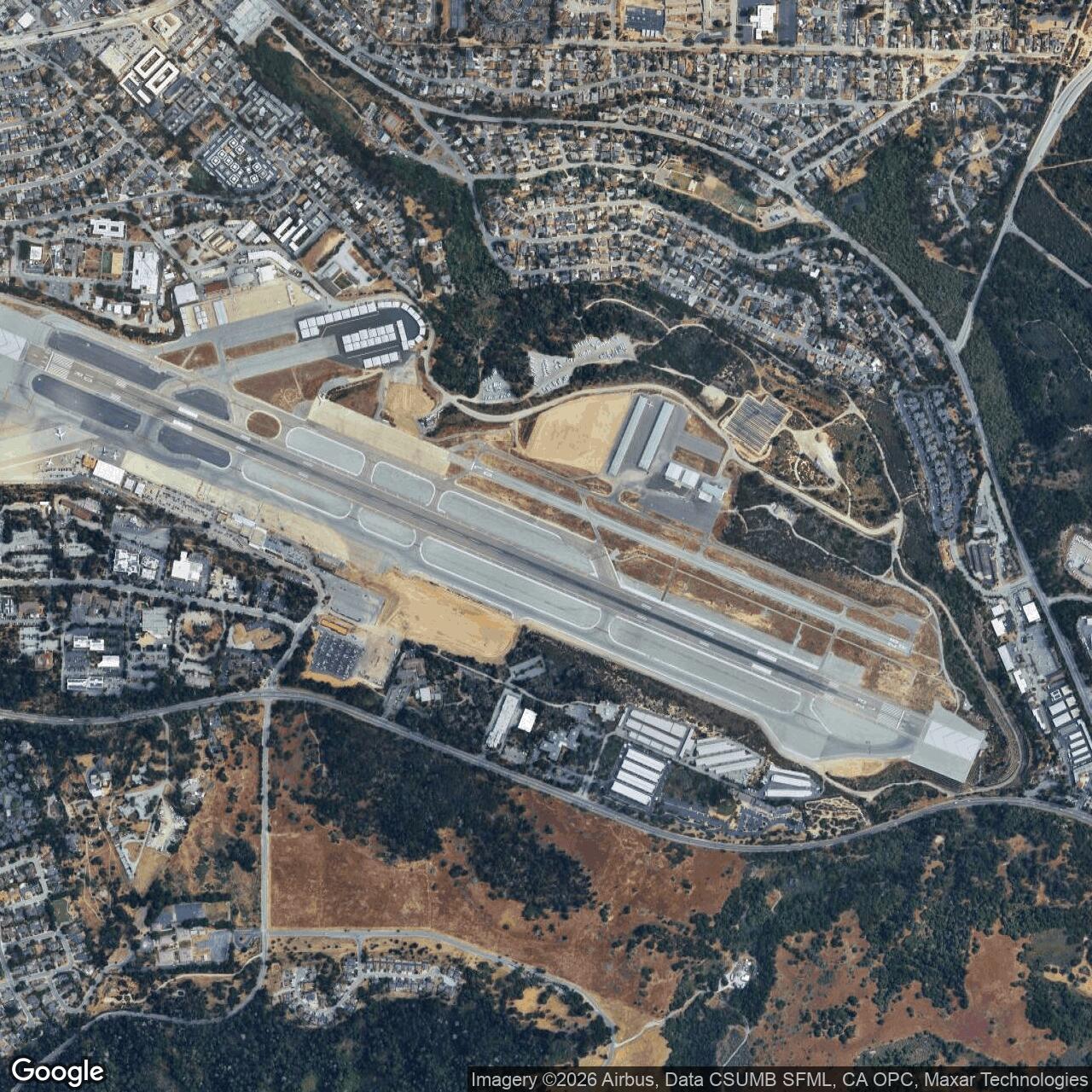
Naval Auxiliary Air Station Monterey, California
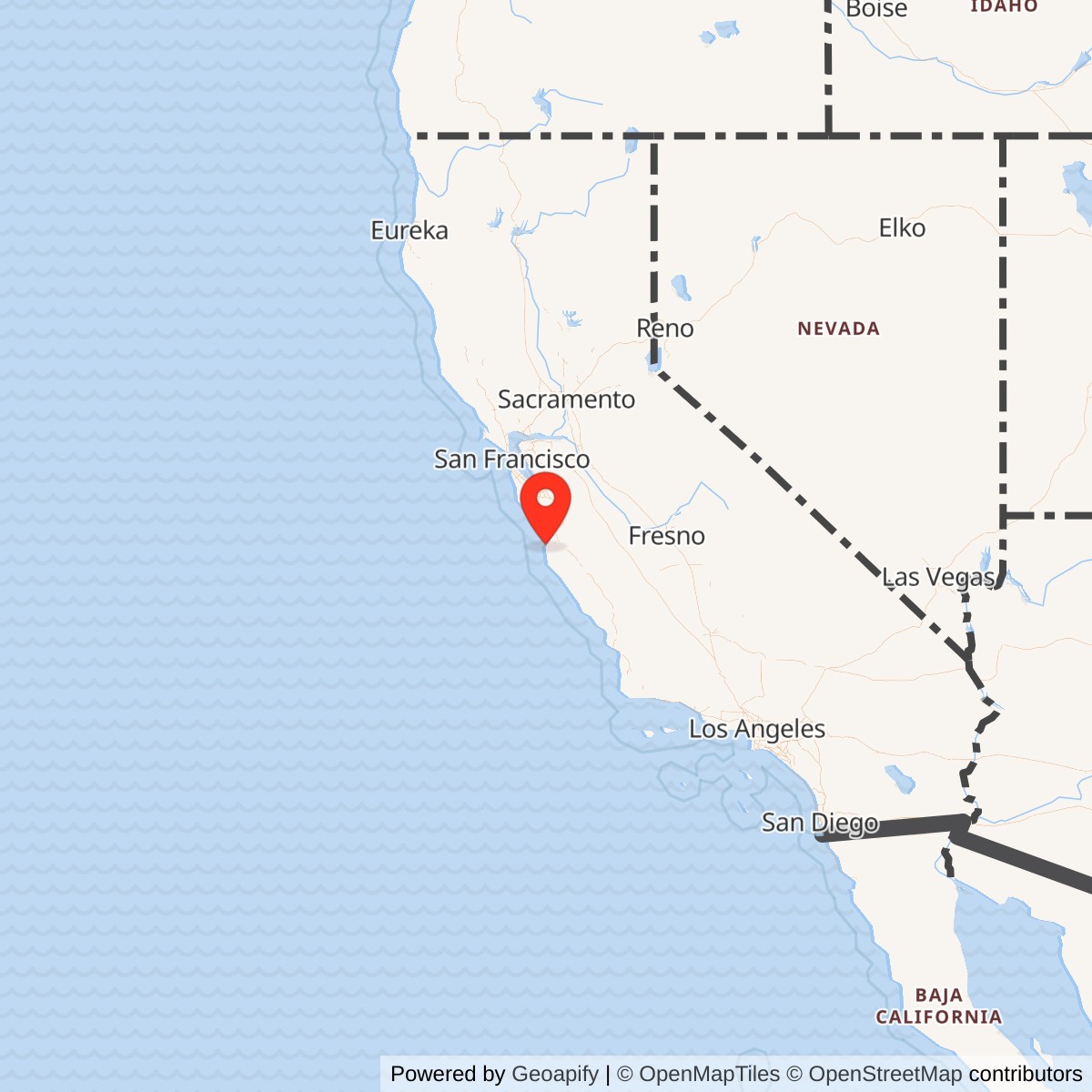
Longitude: -121.8427831
Current Role: Former NAS Alameda auxiliary torpedo/composite-squadron training station and postwar Naval Postgraduate School flight-proficiency field; now Monterey Regional Airport under Monterey Peninsula Airport District operation, with USACE FUDS groundwater cleanup completed in 2014.
Naval Auxiliary Air Station Monterey was the kind of small wartime field that made carrier aviation possible at scale. Its runways were not on a carrier deck, and its hangars were not the center of a great fleet base, but the work done there was directly tied to the Pacific war. At Monterey, Navy torpedo crews practiced the dangerous rhythm of launch, drop, recovery, and rearming; carrier squadrons completed operational training before moving toward combat; and one of the Navy's early assault-drone units prepared for deployment. The field's position on the Monterey Peninsula gave the Navy something rare: a usable landplane station beside Monterey Bay, close enough to Naval Air Station Alameda for aircraft, crews, torpedoes, and maintenance support to move between the mother station and the training range.
The installation occupied the wartime Monterey Peninsula Airport site, developed on land acquired by the Monterey Peninsula Airport District shortly before the United States entered World War II. Local aviation had older roots around the Hotel Del Monte and Tarpey Flats, but the Navy transformed the new airport into a military auxiliary air station after leasing the field for a nominal annual rent. Construction began in August 1942, with the Civil Aeronautics Administration funding hard-surface runway work and the Navy acquiring additional land for barracks and administrative facilities. The station was commissioned on May 23, 1943, as an auxiliary of Naval Air Station Alameda.
The site's identity later changed several times without losing its Navy connection. After World War II, Monterey was placed on caretaker status, then reactivated in December 1947 to support the Naval Postgraduate School after the Navy purchased the former Hotel Del Monte and began relocating its graduate education mission to Monterey. In that postwar period the airfield functioned primarily as a flight-proficiency and support field for Navy and Marine aviators connected with the school. The Naval Auxiliary Landing Field closed on March 3, 1972, but Navy lease and fuel-storage responsibilities remained part of the site story into the 1980s. Today the former military field is Monterey Regional Airport, a public commercial and general-aviation airport owned and operated by the Monterey Peninsula Airport District, with the former Navy contamination record addressed through a completed U.S. Army Corps of Engineers Formerly Used Defense Sites cleanup.
Site Development and Physical Layout
The Navy inherited a young civilian airport rather than an old military reservation. In March 1941, the Monterey Peninsula Airport District had been formed and acquired about 455 acres from Del Monte Properties for a modern airport. After the Navy leased the airport in 1942, wartime construction converted that civilian aviation project into a functional auxiliary station. The CAA allocated roughly $1.7 million for hard-surfaced runways, and the Navy purchased an additional 17 acres for barracks and administrative buildings. The wartime plan therefore combined shared airport land with Navy-owned support parcels, producing a compact military-civil aviation landscape rather than a large isolated base.The wartime field had two principal macadam runways: one 5,000 feet long and another 4,500 by 150 feet. Those runways were long enough to support the carrier-type aircraft used by the squadrons assigned to the station, while the nearby bay provided the torpedo drop range that made Monterey unusually valuable. The station was not simply a runway complex. It included barracks, administrative buildings, support structures, aircraft service areas, fuel systems, a control function, medical support, and the field torpedo operation tied to Monterey Bay.
By March 1944 the station complement stood at 117 officers and 785 enlisted personnel, with accommodations for 120 officers and 928 enlisted men. Carrier Aircraft Service Unit 37 maintained a detachment at Monterey to support the squadrons moving through the field. The base also normally operated two GH Howard ambulance aircraft and one GB Beech light transport, evidence that even a subordinate auxiliary station needed organic utility, medical, and liaison aircraft to keep training operations moving.
Monterey's physical layout was inseparable from its relationship to the bay. The airfield handled the aircraft, crews, maintenance, and scheduling; Monterey Bay served as the torpedo training range; and Alameda remained the major base 80 miles to the north where torpedoes were loaded and later overhauled. Practice torpedoes dropped at Monterey were recovered by the local Field Torpedo Unit and trucked back to Alameda. The runway, range, road, and mother-station connection together made the installation useful.
Mission Evolution
The original wartime mission was operational training for torpedo squadrons and the torpedo components of composite squadrons. This was a specialized mission rather than generic flight training. Navy pilots and aircrew had already moved beyond elementary flying. At Monterey they practiced the difficult combat tasks required of carrier aviation: torpedo approaches, coordinated attack profiles, field carrier landing practice, squadron operations, and preparation for deployment.The torpedo range made Monterey especially important. The Navy established the Monterey Bay torpedo range in cooperation with the local Naval Section Base. Along with Pyramid Lake, Nevada, Monterey was one of the only torpedo-range facilities in the Twelfth Naval District. That meant squadrons from other air stations could also use the Monterey range. The field's role therefore extended beyond housing its own assigned squadrons; it supported a district-wide training requirement for carrier and composite aviation.
During 1943 and 1944 the station operated at a high training tempo. In the remainder of 1943, twelve squadrons dropped 693 torpedoes. In 1944, twenty-one squadrons launched 1,511 torpedoes, with 71 lost in the bay. Those numbers capture the station's practical importance better than any abstract mission statement. Monterey existed to turn training sorties into measurable combat preparation. The 160-man Field Torpedo Unit recovered practice torpedoes and kept the system functioning by returning them to the maintenance and overhaul pipeline.
Monterey also became a final training site for units headed to the Pacific. The squadrons associated with the station included composite squadrons VC-33, VC-37, VC-7, VC-63, and VC-11, as well as torpedo squadrons VT-18, VT-27, VT-17, and VT-5. In spring 1944, Special Task Air Group One and its drone units, VK-11 and VK-12, completed final training at Monterey with TDR assault drones before deploying to the combat theater. Monterey also hosted electronic advance-base elements ARGUS 19, ARGUS 13, and ARGUS 54, and in July 1944 a mobile radar-intercept unit was established nearby for fighter-pilot training. In the closing months of the war, the station supported a detachment of Moffett Field's Antisubmarine Warfare Training Unit operating a mixed group that included one F6F, ten OS2U Kingfishers, two SNJs, and one GH Howard.
The station's wartime mission wound down quickly after victory. On November 1, 1945, the Navy placed Monterey on caretaker status. That did not mean the field had failed or become useless; it meant the emergency requirement that had created so many auxiliary aviation installations had ended. The base had done its wartime job as part of Alameda's auxiliary field system.
Postwar Naval Use and Naval Postgraduate School Connection
Monterey's second Navy life came through education and proficiency flying rather than wartime squadron work. The Navy had used the Hotel Del Monte during World War II as a pre-flight school for aviators. After the war, the Navy purchased the hotel and surrounding land as the future home of the Naval Postgraduate School, whose Annapolis facilities had become inadequate for the Navy's postwar graduate-education needs. Congress authorized the purchase in 1947, and the school moved from Annapolis to Monterey in December 1951.That decision gave the airfield a renewed purpose. Naval Auxiliary Air Station Monterey reactivated on December 20, 1947, to provide aircraft for flight proficiency by Navy and Marine aviators at the postgraduate school. Initial aircraft included SNJs, TBMs, F6Fs, SNBs, and JRBs. The postwar station was not a combat-deployment pipeline in the World War II sense. It was a proficiency, support, and training field tied to the Navy's professional education system.
The postwar operating arrangement was also unusual. The Navy and the Monterey Peninsula Airport District shared the field. The Navy controlled the tower for both military and commercial aircraft, occupied Navy-owned and leased acreage, and used portions of the broader airport under joint-use arrangements. The field therefore remained a hybrid space where civil aviation and naval aviation overlapped for decades. That joint-use arrangement helps explain why the old Navy station did not simply vanish in 1946 and why the installation's closure and lease history are more complicated than the wartime commissioning and caretaker dates alone.
The flight-proficiency mission continued until Congress terminated the proficiency-flying program in 1971. Naval Auxiliary Landing Field Monterey closed without ceremony on March 3, 1972. The last of roughly sixty aircraft, an S-2 antisubmarine aircraft, left the field on February 29, 1972. At closure, 27 officers, 279 enlisted personnel, and 47 civilians were transferred to other naval installations. The dispensary was transferred to the Naval Postgraduate School, where medical support continued in a different institutional setting.
Even after the flying mission ended, Navy lease and restoration obligations remained. From 1972 to 1982, the Naval Postgraduate School continued to renew lease arrangements involving airport parcels and fuel-storage infrastructure, including large underground tanks and associated pipelines. The Department of the Navy agreed to restoration work and lease termination terms in the early 1980s, and the Monterey Peninsula Airport District released the Department of the Navy from the 455-acre lease in 1989. This is why environmental sources sometimes describe Navy use from 1942 to 1989 even though the air station itself closed in 1972.
Units, Organizations, and Systems
The station's most important organizational relationship was with Naval Air Station Alameda. NAAS Monterey was commissioned as an Alameda auxiliary, and its torpedo training mission depended on Alameda's aircraft, ordnance, maintenance, and command network. Alameda provided the major operating-base infrastructure; Monterey provided the runway and bay-range environment that Alameda could not duplicate inside San Francisco Bay.The Field Torpedo Unit was central to Monterey's function. Its 160 personnel recovered torpedoes dropped in Monterey Bay and made the range usable for repeated training. Without that unit, the torpedo range would have been a one-way expenditure of practice weapons. The recovery and return cycle linked Monterey directly to Alameda's ordnance and overhaul system.
Carrier Aircraft Service Unit 37 maintained a detachment at Monterey to support carrier squadrons present at the field. CASU detachments were essential to the Navy's wartime carrier-aviation training network because they kept operational squadrons flying while those squadrons moved through multiple fields and training stages. At Monterey, CASU 37 supported a mix of torpedo, composite, fighter, and special-purpose aviation.
The squadrons associated with Monterey reflected several wartime aviation communities. Composite squadrons trained with mixed aircraft for escort-carrier and special carrier assignments. Torpedo squadrons trained for attack profiles using torpedo aircraft such as the TBM Avenger. Special Task Air Group One, with VK-11 and VK-12, connected Monterey to one of the Navy's most unusual wartime projects: the TDR assault drone program. ARGUS advance-base elements and the mobile radar-intercept training unit added an electronic-warfare and radar-training layer. The later Moffett antisubmarine training detachment connected the field to patrol and ASW instruction as the war approached its end.
In the postwar era the key institutional relationship shifted to the Naval Postgraduate School. Monterey's airfield supported the flying proficiency of Navy and Marine aviators who were students or instructors at the school. The installation's role therefore moved from deploying squadrons to sustaining officer education, technical training, and professional military aviation currency.
Role in the Wider Military Network
NAAS Monterey was part of the Navy's wartime solution to a simple but enormous problem: carriers were becoming central to naval war, but carrier air groups could not all train on carriers. The Navy needed shore fields that could simulate portions of carrier work, support aircraft maintenance, and absorb the tempo of squadron formation and operational training. Major air stations such as Alameda could not carry the load alone. They needed auxiliary stations with enough runway, airspace, support personnel, and nearby ranges to push squadrons through final preparation.Monterey's special value was the Monterey Bay torpedo range. In the Twelfth Naval District, few locations could combine a landplane airfield with a practical torpedo drop-and-recovery range. Monterey and Pyramid Lake filled that gap. Monterey therefore served not only Alameda but the wider West Coast training system by giving torpedo and composite squadrons a place to practice a mission that required water, target ships, recovery personnel, and ordnance logistics.
The station also sat in a broader Monterey naval landscape. The wartime Del Monte Pre-Flight School, the Naval Section Base, the torpedo range, the auxiliary air station, and later the Naval Postgraduate School together made Monterey more than a single airfield. It became a place where the Navy trained bodies, crews, technical specialists, and graduate-level officers across different eras. The airfield was one component in that wider Navy presence on the peninsula.
After World War II, the military-network role shifted from operational preparation to professional education and proficiency support. The Naval Postgraduate School's move to Monterey gave the Navy a permanent education campus, and the airfield helped maintain flight currency for aviators connected with that campus. The closure of the flight-proficiency program in the early 1970s ended that specific airfield mission, but the Navy's broader Monterey presence continued through the Naval Postgraduate School and Naval Support Activity Monterey.
Environmental History and Cleanup
The former NAAS Monterey left an environmental record tied primarily to fuel storage and groundwater contamination rather than unexploded-ordnance hazards. The Navy had used the airfield and associated facilities from the wartime period through the postwar lease era. Underground fuel tanks and pipelines remained part of the site's later restoration story, and the U.S. Army Corps of Engineers began investigating groundwater contamination at and around the airport in the early 1990s under the Formerly Used Defense Sites program.The Corps completed an $18 million groundwater cleanup and environmental restoration project in 2014. According to the Sacramento District, the project was completed about fifteen years and $4.5 million ahead of schedule. The final public meeting was held on March 19, 2014, marking the end of active cleanup work for the Corps. The cleanup used an approach that pumped contaminated groundwater, treated it, and returned it to the ground to accelerate biodegradation. In all, roughly 243 million gallons of groundwater were pumped, treated, and returned.
That cleanup is an important part of the installation's history because it shows the long tail of a relatively small wartime auxiliary field. Monterey's active air-station mission lasted less than three years during World War II and roughly twenty-four years in postwar proficiency use, but the land and groundwater record carried Navy responsibilities well beyond closure. The site's current public-airport status rests partly on that long environmental closeout.
Current Status
The former Naval Auxiliary Air Station Monterey is now Monterey Regional Airport. AirNav lists the airport as publicly owned by the Monterey Peninsula Airport District, open to the public, and located three miles southeast of Monterey. The airport retains two paved runways: Runway 10R/28L at 7,175 by 150 feet and Runway 10L/28R at 3,503 by 60 feet. It supports commercial service, general aviation, air taxi, and other aviation activity in a constrained coastal setting surrounded by Monterey neighborhoods, hills, and regional transportation corridors.
Chronology
- 1910 Early flights on the Monterey Peninsula took place from the Hotel Del Monte polo field.
- 1941-03 Local communities formed the Monterey Peninsula Airport District and acquired about 455 acres from Del Monte Properties for airport development.
- 1942 The Navy leased the Monterey airport site for wartime use and the Civil Aeronautics Administration funded hard-surfaced runway construction.
- 1942-08 Construction began on the wartime airfield improvements and Navy support facilities.
- 1943-02 The Navy established the Del Monte Pre-Flight School at the former Hotel Del Monte.
- 1943-05-23 Naval Auxiliary Air Station Monterey was commissioned as an auxiliary of Naval Air Station Alameda.
- 1943 Twelve squadrons used the Monterey torpedo range and dropped 693 torpedoes during the remainder of the year.
- 1944-03 The station complement was 117 officers and 785 enlisted personnel, with accommodations for 120 officers and 928 enlisted personnel.
- 1944 Twenty-one squadrons launched 1,511 torpedoes at the Monterey Bay range; 71 were lost in the bay.
- 1944 spring Special Task Air Group One, including VK-11 and VK-12, completed final TDR assault-drone training at Monterey.
- 1944-07 A mobile radar-intercept unit was established nearby for fighter-pilot training.
- 1944-09-01 Monterey acquired an outlying landing field at San Luis Obispo.
- 1945 late war period The station supported a detachment of Moffett Field's Antisubmarine Warfare Training Unit.
- 1945-11-01 The Navy placed NAAS Monterey on caretaker status.
- 1947 Congress authorized purchase of the Hotel Del Monte and surrounding land for the Naval Postgraduate School.
- 1947-12-20 The Navy reactivated the Monterey air station to support flight proficiency for Naval Postgraduate School aviators.
- 1951-12 The Naval Postgraduate School moved from Annapolis to Monterey.
- 1971 Congress terminated the proficiency-flying program that had supported postwar NALF Monterey operations.
- 1972-02-29 The last of roughly sixty aircraft, an S-2 antisubmarine aircraft, departed the field.
- 1972-03-03 Naval Auxiliary Landing Field Monterey closed without ceremony.
- 1972-1982 Naval Postgraduate School lease renewals and fuel-storage responsibilities continued as part of the post-closure property record.
- 1989-11-22 The Monterey Peninsula Airport District released the Department of the Navy from the 455-acre lease.
- Early 1990s The U.S. Army Corps of Engineers began investigating groundwater contamination at and around the former NAAS Monterey under the FUDS program.
- 2014-03-19 The Corps held the final public meeting marking the end of active cleanup work for the former NAAS Monterey groundwater cleanup project.
- 2014 The Corps completed an $18 million groundwater cleanup and environmental restoration project about fifteen years and $4.5 million ahead of schedule.
- Present The former Navy air station is Monterey Regional Airport, a public airport owned and operated by the Monterey Peninsula Airport District; the broader Navy presence in Monterey continues through Naval Support Activity Monterey and the Naval Postgraduate School.