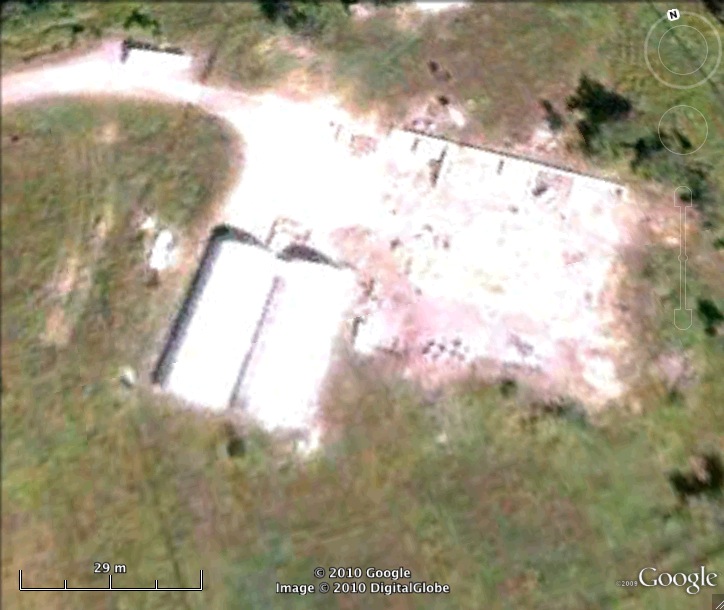
Atlas F Site 556-11 Missile Silo, Ellenburg Depot New York

Do you have a correction, comment, or story you would like to share about this location? Please tell us about it in the comments below.

Latitude: 44.91231923609202
Longitude: -73.81793716262878

View on Google Maps

Site Type: Atlas F vertical silo launch facility

Missile Type: SM-65F Atlas

Missile Assigned to this Silo: GD mfg 89F; GD serial 62-12125; AF tail 125; accepted 1962-06-12; delivered 1962-06-21; later launched 1968-06-01 from Vandenberg AFB Gantry A-2 with ABRES PDV payload; successful re-entry vehicle test.

Number of Launchers/Missiles: 1

Parent Base: Plattsburgh AFB

Missile Wing: 380th Strategic Aerospace Wing

Missile Squadron: 556th Strategic Missile Squadron

Corps of Engineers Site ID: 8

Site Excavation Began: August 2, 1960

Construction Completed: January 15, 1962

Site Turnover to GD for Missile Installation: January 20, 1962

Site Turnover to Site Activation Task Force SATAF: January 20, 1962

Approximate Base Size: 245.97 silo/easement tract acres; 9.18 actual acres sold at disposal (Plattsburgh history-office packet); USACE FS describes approx. 15 acres of open land.

Missiles Activated: December 20, 1962


Missiles Deactivated March 25, 1965


Current Site Use: Former Atlas S-11 silo complex on Bull Run Road near Ellenburg Depot; private business storage for architectural stone per 2012 USACE decision document; former silo, Quonset huts, smaller storage buildings, fencing, and flooded access stairwell documented.

Site Ownership: Former USAF; conveyed to Town of Ellenburg by GSA in 1967; later private ownership noted in USACE/NYSDEC decision document.

Accessible: No public access / private property; former missile silo and environmental-restoration site; do not enter without owner permission.

How the Atlas F Missile Worked

Map showing location of Atlas F Site 556-11, New York

Map showing location of Atlas F Site 556-11, New York

On Bull Run Road outside Ellenburg Depot, New York the Cold War left behind a hardened underground machine disguised by fields, woods, and a few stubborn surface structures. Atlas F Site 556-11 was not a base in the familiar sense; it was one missile, one silo, one launch crew complex, and one assigned thermonuclear weapon held ready in the northern New York countryside. Its story is especially strong because the site's afterlife is unusually well documented: after only a brief operational career, the former launch site became a municipal property, then private property, and later a detailed Formerly Used Defense Site environmental case centered on groundwater near Ellenburg Depot.

Atlas F Site 556-11 was an SM-65F Atlas intercontinental ballistic missile launch facility associated with Plattsburgh Air Force Base, New York. It was part of the 556th Strategic Missile Squadron, the Atlas F squadron assigned to the Plattsburgh missile field and tied to the 380th Bombardment Wing / 380th Strategic Aerospace Wing era at Plattsburgh. The site's Air Force operational site number was 11. The Plattsburgh history-office information packet identifies it as Site #11, Ellenburg, New York, Clinton County, accepted on 1962-12-04.

The site is in the hamlet area of Ellenburg Depot, Town of Ellenburg, Clinton County, New York. It was one of twelve Atlas F sites in the Plattsburgh missile field, ten in New York and two in Vermont. Unlike later Minuteman Launch Facilities, an Atlas F launch complex did not report to a remote Minuteman-style Launch Control Center. It had its own hardened on-site launch-control and support facilities.

Site 556-11 is no longer active. It was decommissioned during the 1965 Atlas phaseout. On 1965-06-25, the 556th Strategic Missile Squadron was inactivated. Today the site is a decommissioned former Atlas F silo complex, later recorded as Formerly Used Defense Site PLATTSBURGH ATLAS S-11 / C02NY0216. The 2012 U.S. Army Corps of Engineers decision document described the property as privately owned and used by a private business for storing architectural stone.

Location, Landscape, and Site Description

Atlas F Site 556-11 is located on Bull Run Road, about one-quarter mile north of U.S. Route 11, in the Ellenburg Depot area of the Town of Ellenburg, Clinton County, New York. The U.S. Army Corps of Engineers described the former Atlas S-11 property as part of a site that included the former missile property and an area southeast of it where groundwater had been investigated for contaminants originating from the property. The hamlet of Ellenburg Depot lies along U.S. Route 11 and the Great Chazy River, southeast of the former missile site. The surrounding area is wooded, agricultural, and rural, with Brandy Brook north of the site and the Great Chazy River system to the south and southeast.

The Plattsburgh missile-field map in the history-office packet placed Site 11 northwest of Ellenburg Depot and west of Moores Forks, in the northern part of the Plattsburgh Atlas ring. That same map estimated Site 11 as 27 miles from Plattsburgh Air Force Base and 25 miles from a railhead. In practical terms, Site 556-11 was far enough from the main base to be dispersed, but close enough for security, maintenance, propellant, and logistics support from the Plattsburgh missile organization.

The U.S. Army Corps of Engineers' 2010 feasibility study provides one of the best public descriptions of the former Site 11 physical remains. It described the site as approximately 15 acres of open land surrounded by woods and some agricultural fields. It identified a single former missile silo approximately 70 feet in diameter and 175 feet deep, covered by reinforced-concrete doors flush with the ground surface. Other visible structures included two Quonset buildings, each approximately 40 by 100 feet, two smaller storage buildings, and a concrete entrance stairwell that once provided access to the underground missile-control facilities. The stairwell was flooded to about 20 feet below ground surface. The central area was enclosed by an inner 8-foot-high chain-link fence and an outer 3-foot-high barbed-wire fence.

Those site-specific dimensions sit alongside the broader Plattsburgh Atlas history-office packet's general Atlas F silo data, which described the field's silos as one-silo-per-site facilities with a listed silo diameter of 52 feet and depth of 174 feet, using about 3,200 cubic yards of concrete and 600 tons of steel per silo. The difference between the packet's general silo diameter and the Corps' site-specific 70-foot diameter likely reflects differing measurement conventions or structural descriptions.

Strategic and Cold War Context

Site 556-11 existed because the United States was trying to make its first generation of ICBMs survivable enough to deter a nuclear attack. The Atlas missile began as an exposed and operationally demanding liquid-fueled weapon system. Atlas F was the hardened vertical-silo version: the missile was stored upright underground, protected by reinforced concrete and steel, and raised to the surface by elevator for launch. That arrangement made it more survivable and faster to launch than earlier horizontal Atlas D and E basing modes, while still depending on liquid oxygen and complex countdown procedures.

The Plattsburgh field was geographically unusual. Most U.S. ICBM fields were in the Plains, the mountain West, or the Southwest. Plattsburgh placed a twelve-site Atlas F field in northeastern New York and northwestern Vermont. Official 380th wing history notes that twelve Atlas F missile sites were constructed within a fifty-mile radius of Plattsburgh Air Force Base and that the 556th Strategic Missile Squadron was the last Atlas squadron to be accepted and the only ICBM base east of the Mississippi River. Site 556-11 was one of the northernmost points in that ring.

The strategy depended on dispersal, hardening, and readiness. Each Atlas F site was separated from the others so a single attack could not destroy the whole squadron. Each site was hardened underground and built with its own control/support functions. Crews, security police, maintenance personnel, communications systems, power systems, propellant equipment, and the missile itself formed a local strategic installation. The goal was not that any one silo was invulnerable; it was that an attacker could not confidently eliminate the entire retaliatory force before it could launch.

Construction and Activation

The Plattsburgh Atlas F field was built during the crash effort to deploy operational ICBMs. A Plattsburgh Air Force Base history-office information packet stated that soil testing for the missile sites was conducted in January 1960 and excavation started in June 1960, with Raymond International identified as the prime contractor. The work involved deep excavation, heavy concrete and steel construction, utility installation, launch-control and support facilities, propellant systems, access features, security fencing, and crew-support spaces.

The same packet listed Site #11 as Ellenburg, New York, Clinton County, and gave its acceptance date as 1962-12-04. It also listed its installation number as 7477, permanent installation code THZN, silo/easement tract acreage as 245.97 acres, and total land acquisition cost as $6,928. The later disposal table in the packet listed Site 11's total construction cost as $4,965,419.25, actual acreage as 9.18 acres, sale price as $7,600, buyer as the Town of Ellenburg, and quitclaim date as 1967-11-17.

Site 556-11 was therefore accepted after the October 1962 Cuban Missile Crisis had already peaked and after the November 1962 easing of emergency alert conditions. This is important because some squadron-level sources state that operational 556th sites were on heightened alert during the crisis.

Strategic Air Command declared the 556th Strategic Missile Squadron operational later in December 1962, completing the Atlas ICBM deployment. Site 556-11's acceptance just sixteen days before that declaration places it among the late-stage final pieces of the Plattsburgh Atlas F field.

Missile System and Technical Role

Site 556-11 housed the SM-65F Atlas, the final operational version of the Atlas ICBM. Atlas F used a vertical hardened silo, unlike the earlier Atlas D and E systems that used different launch arrangements. The missile itself was a liquid-fueled, stage-and-a-half ICBM using RP-1 kerosene fuel and liquid oxygen oxidizer. The Atlas F was kept vertical in a "silo launcher" complex, lifted out of the silo after two heavy overhead doors opened, and powered by RP-1 and liquid oxygen. The RP-1 fuel could be kept aboard the missile during alert; liquid oxygen was loaded during the launch sequence because it was cryogenic and boiled off.

The Plattsburgh history-office packet described the Atlas F missile as designed to reach 6,325 statute miles, carry a nuclear warhead, measure about 80 feet in length, generate approximately 360,000 pounds of takeoff thrust, weigh about 130 tons at takeoff, and reach a top speed of about 15,000 miles per hour. The Atlas F weapon carried a Mark IV reentry vehicle and a W-38 nuclear warhead with a yield of approximately 3.8 megatons.

An Atlas F "operational launch-ready alert posture" meant that the missile, launch complex, crew, security force, communications, and propellant systems were ready to execute the launch sequence if a valid order was received. It did not mean the missile was continuously raised above the silo, and it did not mean the missile was continuously filled with liquid oxygen. In a launch sequence, the site would open the silo doors, load liquid oxygen, raise the missile, complete checks, and launch if the order proceeded through the required command-and-control process.

Site 556-11's assigned missile was General Dynamics manufacturing number 89F, General Dynamics serial number 62-12125, Air Force tail number 125. The missile was accepted on 1962-06-12 and delivered on 1962-06-21, months before the site's recorded acceptance date. The same missile later had a second career after operational ICBM service, missile 89F was launched successfully from Vandenberg Air Force Base Gantry A-2 on 1968-06-01 with an ABRES PDV reentry-vehicle test payload.

Operational History

Atlas F Site 556-11 served as one of the twelve launch sites of the 556th Strategic Missile Squadron around Plattsburgh Air Force Base. The site's operational life was short, but intense. The 556th had to keep a liquid-fueled first-generation ICBM force ready during a period when the United States was rapidly transitioning from Atlas and Titan I to Minuteman and Titan II. For Site 556-11, that meant daily readiness, local security, maintenance routines, propellant-system upkeep, communications checks, and crew operations inside a rural hardened launch complex.

Unlike later Minuteman launch facilities, an Atlas F site was a more self-contained launch complex. The Plattsburgh Atlas sites were manned continuously during the squadron's active period. The Plattsburgh history-office packet referenced living quarters for launch crew and maintenance personnel, and two Quonset huts at each site for maintenance and limited spare-parts storage. The missile could not be treated as a passive buried object; it required trained crews, regular maintenance, missile handling expertise, security presence, and readiness discipline.

The 556th's location gave the Plattsburgh missile field a distinct identity. It was the last Atlas squadron accepted into the operational force and the only operational ICBM base east of the Mississippi River. The individual missile sites, including Site 556-11, were spread through small communities, farm roads, wooded parcels, and hamlets rather than concentrated on the main air base. The result was a missile field that left visible Cold War infrastructure across northern New York and Vermont.

Deactivation and Disposal

Atlas F Site 556-11 left service as part of the rapid retirement of first-generation liquid-fueled ICBMs. By late 1964, the Department of Defense had announced the phaseout of Atlas and Titan I systems. HAER documentation for Plattsburgh Air Force Base states that the Atlas F missiles assigned to Plattsburgh were removed from their silos, equipment was salvaged for use by the U.S. Air Force space program as space-launch vehicles, and the sites were divested from Air Force ownership. The 556th Strategic Missile Squadron was officially inactivated on 1965-06-25.

The Plattsburgh history-office packet gives a clear disposal trail. It listed Site 11's total construction cost as $4,965,419.25, actual acreage as 9.18 acres, sale price as $7,600, buyer as the Town of Ellenburg, and quitclaim date as 1967-11-17. The same packet's land-acquisition table listed a larger silo/easement tract of 245.97 acres. The distinction matters: the original federal footprint for construction, security, easements, and operations was much larger than the small disposal parcel later sold.

The environmental afterlife of the site became formal under the Formerly Used Defense Sites program. The U.S. Army Corps of Engineers' 2015 New York FUDS inventory lists PLATTSBURGH ATLAS S-11 / C02NY0216 in Clinton County, Ellenburg Depot, with three site categories: BD/DR, CON/HTRW, and HTRW. GAO's FUDS cleanup table likewise listed PLATTSBURGH ATLAS S-11 / C02NY0216 in Clinton County with multiple cleanup/project lines, including HTRW. ProPublica's "Bombs in Your Backyard" data lists PLATTSBURGH ATLAS S-11 at Ellenburg Depot, Clinton County, with a risk category of "Risk Not Evaluated or Not Required."

USACE's final 2012 decision document selected "No Action" as the remedy for the site. It stated that the former Atlas S-11 site is a FUDS property but is not listed on the National Priorities List, that the State of New York concurred with the selected remedy, and that no remedial action was necessary to ensure protection of human health and the environment. The decision did not erase the site's environmental history; it marked the formal conclusion that the investigated concentrations and risks did not warrant a further active remedy.

Current Status and Site Use

Atlas F Site 556-11 is a decommissioned former missile silo complex on private property near Ellenburg Depot. USACE's 2010 feasibility study and 2012 decision document described the property as containing the former missile silo, two Quonset huts, smaller storage buildings, a former access stairwell, fencing, and open land surrounded by woods and agricultural fields. The 2012 decision document described the property as privately owned and used by a private business for storing architectural stone.

Public access is not established. The site should be treated as private property and as a former military installation with possible hazards, including flooded underground spaces, confined-space dangers, deteriorated structures, former utility systems, and environmental-history concerns. The appropriate current-status description is: decommissioned former Atlas F silo; privately reused; FUDS PLATTSBURGH ATLAS S-11 / C02NY0216; not an active military installation; no public access confirmed.

Chronology

  • 1960-01 Soil testing was conducted for the Plattsburgh Atlas F missile sites.
  • 1960-06 Excavation for the Plattsburgh Atlas F sites began, with Raymond International identified as the prime contractor in a Plattsburgh Air Force Base history-office packet.
  • 1961-05-12 SAC Special Orders No. G-52 designated the Plattsburgh missile sites as reflected in real-property records; Site 11 was listed as Plattsburgh Air Force Missile Site No. 11, Ellenburg Depot, New York, PIN 7477.
  • 1961-10-01 The 556th Strategic Missile Squadron was organized at Plattsburgh Air Force Base for Atlas F operations.
  • 1962-06-12 Site 556-11's assigned missile, General Dynamics manufacturing number 89F / serial number 62-12125 / Air Force tail number 125, was accepted.
  • 1962-06-21 Missile 89F was delivered to Plattsburgh.
  • 1962-12-04 Site #11, Ellenburg, New York, Clinton County, was accepted.
  • 1962-12-20 Strategic Air Command declared the 556th Strategic Missile Squadron at Plattsburgh operational, completing Atlas ICBM deployment.
  • 1965-04-30 Broader 380th wing history accounts identify the 556th Strategic Missile Squadron's last operational day around the end of April 1965.
  • 1965-06-25 The 556th Strategic Missile Squadron was inactivated as Atlas missiles were withdrawn from service.
  • 1967-11-17 The former Site 11 property was quitclaimed/sold to the Town of Ellenburg; the Plattsburgh history-office packet lists 9.18 actual acres, a sale price of $7,600, and a total construction cost of $4,965,419.25.
  • 1968-06-01 Missile 89F, formerly assigned to Site 556-11, was successfully launched from Vandenberg Air Force Base Gantry A-2 with an ABRES PDV reentry-vehicle test payload.
  • 1988 USACE contracted for a preliminary investigation that detected TCE in one groundwater monitoring well at 6, slightly above the drinking-water MCL, with lower detections in another monitoring well and in missile-silo water.
  • 1990 NYSDEC-related investigation in Ellenburg Depot detected VOCs in water supplies and led to additional evaluation of possible sources, including the former Atlas S-11 site.
  • 1998 USACE conducted public meetings for the former Atlas S-11 site and remedial-investigation process.
  • 1998-2003 Weston conducted a remedial investigation of the former Atlas S-11 site.
  • 2005 The final remedial investigation report was issued.
  • 2006-2008 Long-term groundwater monitoring was conducted at the site and in nearby Ellenburg Depot wells.
  • 2010-11 USACE issued a proposed plan recommending No Action for the former Atlas S-11 site and held a public meeting in November 2010.
  • 2012-01 USACE issued the final decision document selecting No Action for Former Atlas S-11 Site / FUDS C02NY0216.
  • 2015 The USACE New York FUDS inventory listed PLATTSBURGH ATLAS S-11 / C02NY0216 at Ellenburg Depot, Clinton County, with BD/DR, CON/HTRW, and HTRW categories.

Plattsburgh history-office packet on Atlas Missile Deployment

Current Google Satellite Image of Atlas F Site 556-11, New York
Aerial View 1: Current Google Satellite Image of Atlas F Site 556-11, New York Source: Google Maps - Click to View
Map Showing 556th Strategic Missile Squadron Atlas F Missile Silo Locations
Map 3: Map Showing 556th Strategic Missile Squadron Atlas F Missile Silo Locations Red Marker Shows 556-11 Location, Black shows the other Silos in the Squadron

Read about the Atlas at Plattsburgh AFB

All Atlas Missile Silo Locations


Do you have a correction, comment, or story you would like to share about this site? Please tell us about it in the comments below.